
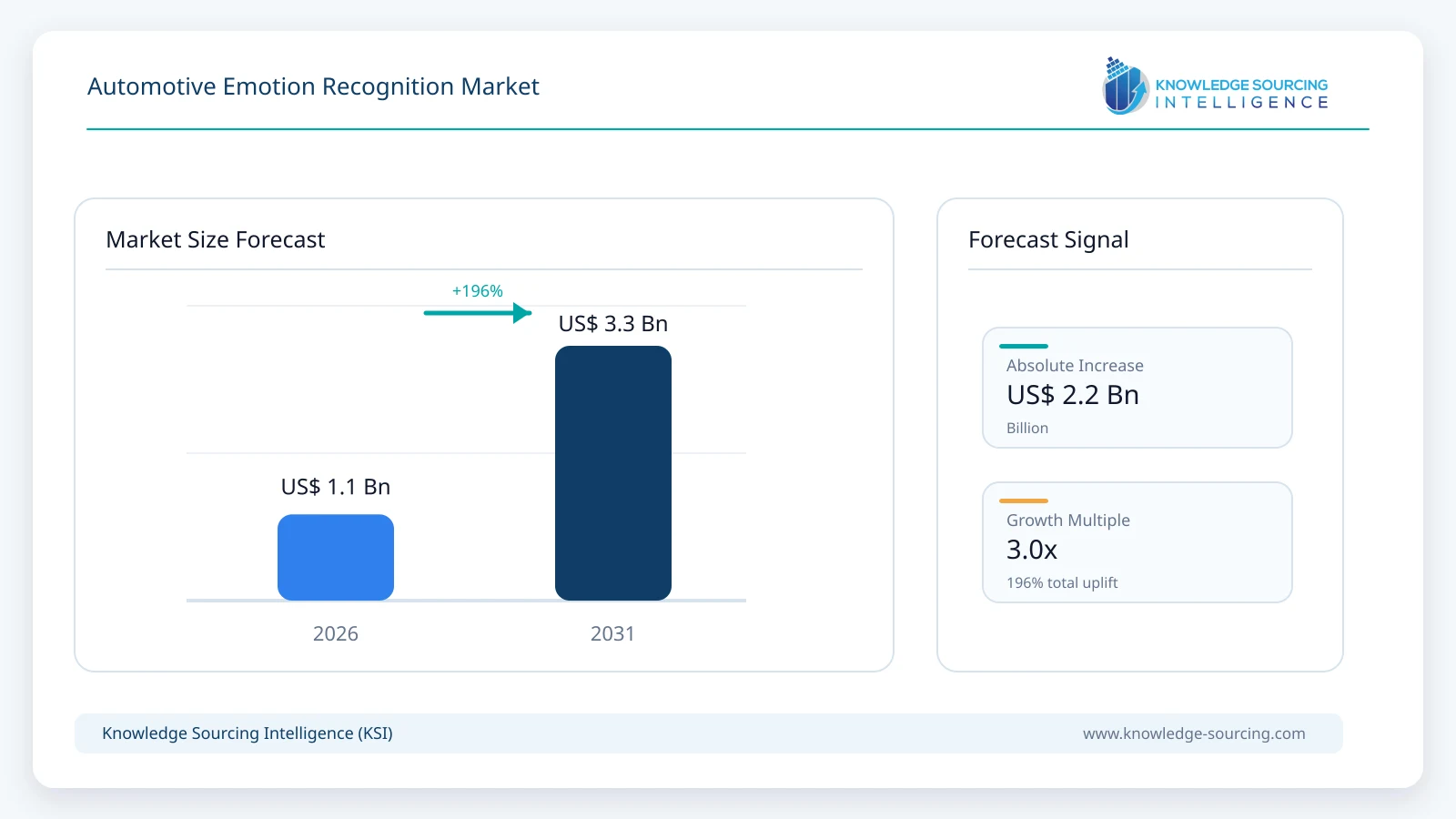
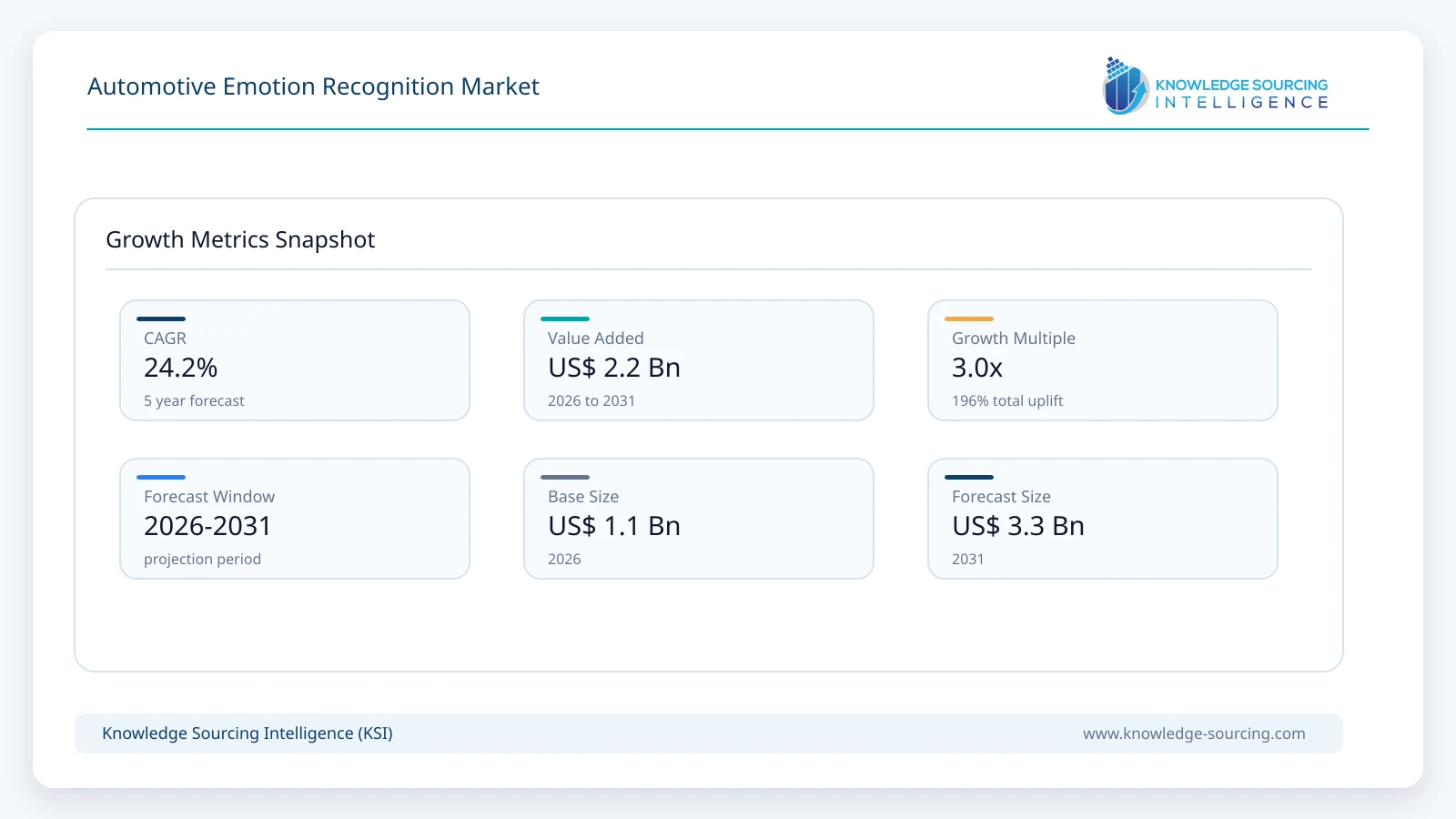
The automotive emotion recognition market is estimated at approximately USD 1.100 billion in 2026 and is projected to reach about USD 3.251 billion by 2031, representing a CAGR of 24.2% across the forecast period.
Highlights:
- 1Facial-expression and vision-based emotion recognition accounts for approximately 51% of global market value in 2026 because cameras already deployed for driver and occupant monitoring can support affective-state analysis through additional AI software.
- 2Stress, cognitive-load and negative-state detection represents approximately 43% of market value in 2026, reflecting the strongest current safety and wellbeing use cases around frustration, anxiety, fatigue and mental overload.
- 3Multimodal emotion-recognition architectures account for approximately 58% of 2026 market value as OEMs increasingly combine face, gaze, voice, physiology and vehicle context rather than relying on one signal alone.
- 4Driver-focused emotion recognition represents approximately 69% of global market value in 2026 because the immediate safety value of stress, cognitive-load and affective-state detection is strongest for the person controlling the vehicle.
- 5Premium and luxury vehicles represent approximately 45% of global market value in 2026 because advanced sensing, high-performance cockpit compute and adaptive comfort functions remain most concentrated in high-content vehicle platforms.
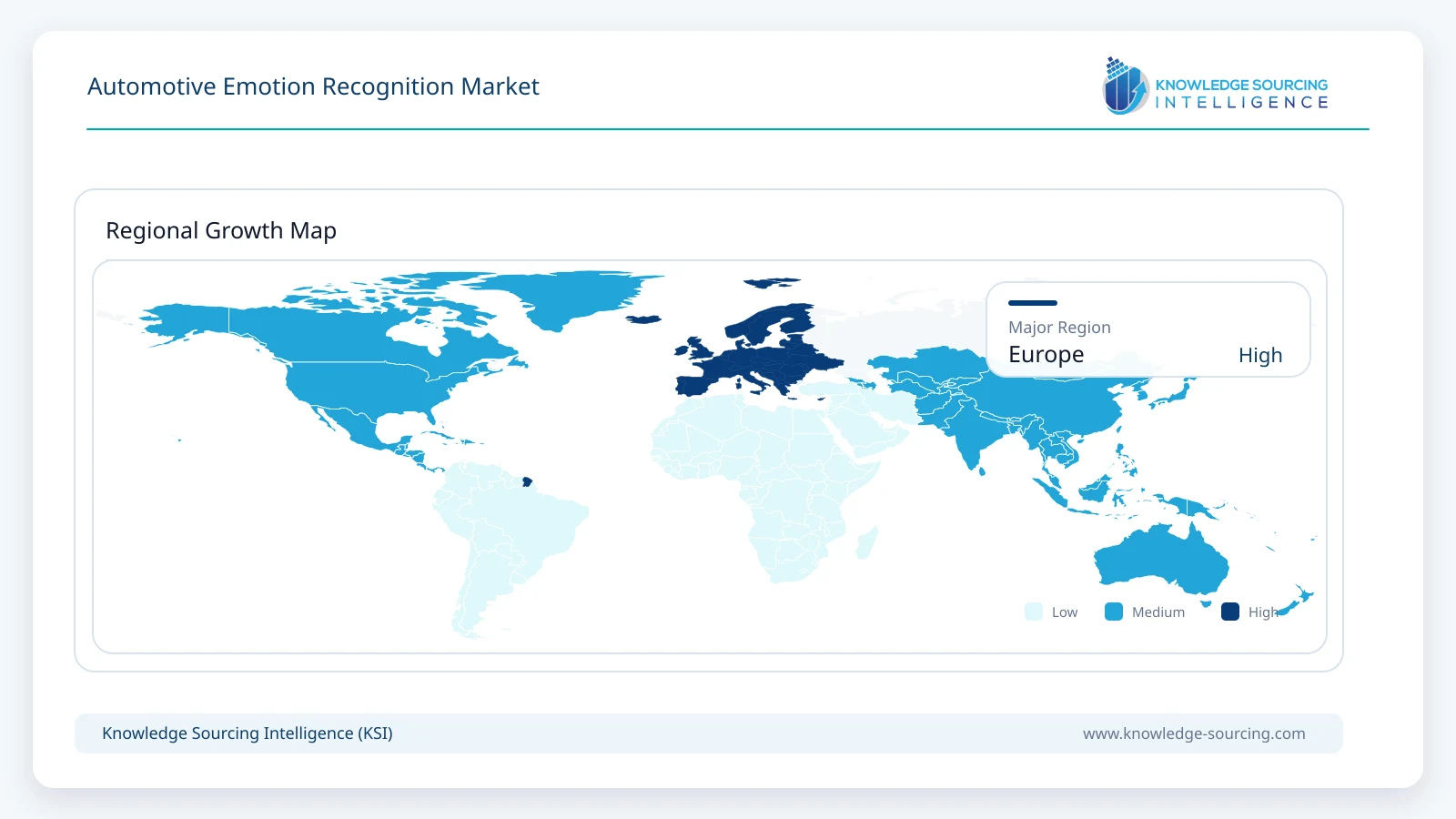
- 6Europe represents approximately 35% of global market value in 2026, supported by strong DMS adoption, premium OEM activity and a large supplier base in human-machine interaction, cockpit electronics and driver-state monitoring.
Emotion recognition adds an affective layer to conventional driver and occupant monitoring. Instead of only determining whether the driver is looking at the road or whether a seat is occupied, the system attempts to interpret stress, engagement, frustration, cognitive load and related states and determine whether a warning, assistance function or personalized cabin response is appropriate.
Facial-expression analysis remains the most mature sensing route because existing in-cabin cameras can capture facial behavior together with gaze, eyelid and head-pose signals. Smart Eye's Affectiva platform uses deep-learning facial analysis and a large global data set to classify expressions and cognitive states in real time, with automotive implementations designed for changing head angles, illumination and camera positions.
Voice, physiological signals and behavioral context increasingly complement facial analysis. Acoustic tone, tempo and pause patterns can indicate stress or frustration, while HARMAN Ready Care combines visual information with heart-rate and breathing indicators and LG links facial-expression recognition with health and driver-state analysis. Multimodal fusion therefore reduces dependence on any single cue and supports broader emotional-state interpretation.
Adaptive cabin response is the longer-term value layer for emotion AI. Once emotional or cognitive state is inferred with sufficient confidence, the vehicle can adjust lighting, music, climate, seat massage, navigation guidance, content recommendations or conversational style, making emotion recognition more valuable when it is connected with other software-defined cabin domains rather than operating as an isolated analytics function.
Market Trends
Emotion AI Is Moving from Standalone Classification toward Multimodal Human Insight
Automotive systems are increasingly combining facial expression with gaze, attention, voice, physiological indicators and environmental context. Smart Eye's September 2026 multimodal automotive AI agent explicitly combines emotion, driver state, gaze, identity, occupancy and vehicle information as inputs to a broader contextual intelligence layer.
Multimodal context reduces the risk of over-interpreting a single facial cue and makes emotional-state estimation more useful in production vehicles where lighting, movement and individual behavior vary continuously. The strongest architectures use agreement across several signals to raise confidence before the cabin or safety system responds.
Stress and Cognitive Load Are Becoming the Strongest Safety-Oriented Use Cases
OEMs are prioritizing emotional states that can influence driving performance rather than attempting to classify every possible feeling. Stress, anxiety, cognitive load and frustration can affect attention, reaction time and decision-making, making them more commercially relevant than purely entertainment-oriented emotion labels.
HARMAN Ready Care illustrates the commercial direction by combining driver monitoring with stress and emotional-state interpretation and then using personalized interventions to restore a safer or more comfortable state. Safety-oriented emotion AI is therefore concentrating on states that can change driver behavior rather than on broad entertainment-focused emotion labels.
Emotion Recognition Is Becoming an Input to Adaptive Cabin Experience
Emotion AI is increasingly connected with lighting, music, climate, seat functions and HMI behavior. FORVIA's Cockpit UX Engine can personalize cockpit lighting, music and voice-assistant behavior according to driver stress and emotion, while Yanfeng XiM27 uses AI-based emotion recognition to adjust multiple cabin parameters.
Closed-loop cabin control extends emotion recognition from sensing into experience orchestration because the vehicle can identify a state and then alter the environment intended to influence it. The commercial value rises when the same inference can coordinate several cabin systems rather than triggering a single isolated response.
On-Device Processing Is Strengthening Privacy and Real-Time Performance
Emotion recognition often relies on highly sensitive facial, vocal and physiological data. OEMs are therefore moving toward local processing that avoids transmitting raw occupant data to the cloud and reduces response latency.
Local processing strengthens both privacy and real-time performance by keeping sensitive facial, vocal and physiological data inside the vehicle while avoiding dependence on cloud connectivity. Smart Eye has long positioned automotive emotion analysis for local processing, and LG's broader AI Cabin Platform similarly emphasizes on-device AI.
Emotion-Aware AI Agents Are Emerging as a New Human-Machine Interface Layer
The rise of conversational and agentic AI creates a new role for emotion recognition. An assistant that understands stress, frustration or engagement can change tone, simplify information, delay nonessential prompts or select a more appropriate intervention.
Emotion-aware AI agents increasingly treat affective state as one contextual input among gaze, attention, identity, occupancy and vehicle conditions rather than as a separate dashboard metric. Smart Eye's multimodal AI-agent demonstration illustrates how that combined context can guide what the automotive assistant says, delays or changes next.
Automotive Emotion Recognition Market Segment Analysis
By Recognition Technology
Facial-Expression and Vision-Based Emotion Recognition
Facial-expression and vision-based emotion recognition is projected to generate approximately USD 1.55 billion of market value by 2031. Growth will be supported by the expanding installed base of DMS and OMS cameras and the ability to add affective-state analysis largely through software.
Vision-based emotion recognition should remain the largest technology segment because facial behavior provides a rich, continuous signal and can be combined with gaze, eyelid, head-pose and posture analysis on common in-cabin camera hardware. Reuse of DMS and OMS cameras also limits incremental hardware cost, although multimodal confirmation becomes increasingly important where facial expression alone is ambiguous.
By Emotion State
Stress, Cognitive Load and Negative-State Detection
Stress, cognitive-load and negative-state detection is projected to generate approximately USD 1.45 billion of market value by 2031. These states have the clearest link with driver safety, fatigue management and human-machine interaction, giving them stronger commercialization potential than generalized emotion labeling.
Stress and cognitive-state models are expected to broaden toward anxiety, frustration and overload indicators as multimodal systems combine face, voice and physiological context with traffic and vehicle conditions. Their commercial relevance is strongest where the detected state can justify a clear safety, HMI or wellbeing response rather than merely produce an emotion label.
By Sensing Architecture
Multimodal Emotion Recognition
Multimodal emotion-recognition architectures are projected to generate approximately USD 2.05 billion of market value by 2031. These systems combine facial expression, gaze, speech, posture and physiological signals to improve confidence and reduce ambiguity.
Multimodal architectures are expected to gain share because production vehicles already contain several cabin sensors and centralized compute that can support fusion without requiring a dedicated emotion-specific hardware stack. Shared sensing also improves the economics of combining face, voice and physiological context while reducing the risk that one noisy signal drives an inappropriate response.
By Monitoring Target
Driver-Focused Emotion Recognition
Driver-focused emotion recognition is projected to generate approximately USD 2.15 billion of market value by 2031. Safety-driven use cases such as stress, cognitive load and fatigue remain concentrated on the driver and can support real-time warnings, route changes or cabin interventions.
Driver-focused systems should remain dominant through the forecast period because the driver's emotional and cognitive state has the clearest connection with vehicle control and safety intervention. Passenger-focused recognition can grow faster in premium, highly automated and entertainment-oriented cabins where affective context is used more heavily for personalization and experience orchestration.
By Vehicle Class
Premium and Luxury Vehicles
Premium and luxury vehicles are projected to generate approximately USD 1.35 billion of market value by 2031. These platforms offer the strongest early-adoption environment for advanced interior sensing, multimodal AI and cabin systems capable of responding to detected emotional state.
Mid-range adoption should increase as DMS cameras and centralized compute become standard outside premium vehicles, allowing selected emotion-recognition functions to migrate through software rather than major new hardware. Premium vehicles will nevertheless retain the deepest multimodal feature sets because they can more readily justify physiological sensing, richer cabin responses and higher validation cost.
Market Drivers
Rapid Expansion of Driver and Occupant Monitoring Cameras
DMS and OMS deployment provides the core imaging hardware required for facial-expression and cognitive-state analysis. Once a camera and automotive-grade compute platform are already present, emotion recognition can be added incrementally through software and model updates.
Reuse of existing DMS and OMS hardware lowers the marginal cost of emotion sensing and creates a broad installed base for future affective functions. The economics improve further when software can be deployed across several vehicle lines using the same camera and compute architecture.
Growing Focus on Stress, Cognitive Load and Driver Wellbeing
Driver stress and mental overload can influence attention and decision-making even when conventional distraction metrics remain within acceptable limits. Emotion and cognitive-state recognition therefore provides an additional layer of human-state understanding.
Stress and cognitive-load signals give OEMs an opportunity to intervene before conventional distraction or drowsiness thresholds are crossed. Route suggestions, simplified information, reduced notification load or cabin adjustments can provide a less intrusive response while preserving the driver's sense of control.
Advances in Multimodal AI and Human-State Modelling
Modern AI models can combine face, gaze, voice, posture and physiological data rather than interpreting each signal independently. This improves context and reduces the risk that a temporary expression is incorrectly classified as a meaningful emotional state.
Higher-performance edge compute allows multimodal models to run continuously inside the vehicle with lower latency while keeping sensitive raw data local. That capability is important because affective inference depends on temporal patterns and cross-signal context rather than a single facial frame or voice sample.
Software-Defined Cabins Enable Closed-Loop Emotional Response
Emotion recognition becomes more valuable when the vehicle can respond through lighting, audio, climate, seat massage, navigation or conversational HMI. Centralized software architectures make these cross-domain interventions increasingly practical.
Closed-loop emotional response creates monetization potential beyond safety because automakers can use affective intelligence to differentiate comfort, wellness and entertainment experiences. The value is highest when a single inference layer can coordinate lighting, audio, climate, seat functions and conversational HMI rather than requiring separate rules for each domain.
Demand for More Natural and Empathetic Human-Machine Interaction
More capable conversational AI is increasing expectations that vehicle assistants respond to context rather than treating every command identically. Emotion-aware assistants can adapt tone, timing and complexity according to the user's state.
Emotion-aware context can therefore become an input to next-generation digital companions and agentic vehicle interfaces. Assistants that adapt tone, timing and information density to the user's state may create a more natural interaction than systems that respond identically regardless of stress or engagement.
Market Restraints
Emotion Is Difficult to Infer Reliably from Observable Signals
Facial expressions and vocal characteristics do not map perfectly to internal emotional state. People differ significantly in how they express stress, frustration or excitement, and cultural and individual variation can affect model performance.
Automotive deployment therefore requires conservative confidence thresholds, temporal context and clearly bounded claims rather than treating emotion classification as a precise psychological diagnosis. The system must distinguish between an uncertain affective cue and a state strong enough to justify a safety or cabin intervention.
Bias, Fairness and Demographic Performance Variation
Emotion-recognition models must perform across different ages, skin tones, facial structures, languages and cultural expression patterns. Uneven training data can create systematic differences in classification accuracy.
Demographic robustness requires broad and diverse data sets, transparent validation and continuous performance monitoring across target markets. Any material performance gap across ages, skin tones, facial structures or languages can undermine both user trust and OEM confidence in global deployment.
Privacy and Acceptance of Continuous Emotional Monitoring
Emotion data can feel more intrusive than ordinary vehicle telemetry because it relates directly to a person's behavior and internal state. Users may object to continuous facial or vocal analysis, particularly if data are retained or shared.
Privacy-preserving deployment will depend on local processing, clear consent, minimal data retention and visible user control. These safeguards become more important when the system infers internal state rather than simply detecting a mechanical vehicle condition.
False Positives Can Lead to Irritating or Inappropriate Interventions
Incorrectly interpreting concentration as anger or ordinary fatigue as emotional distress can cause unnecessary cabin changes or alerts. Repeated false interventions can quickly reduce trust in the system.
False-positive control requires multimodal confirmation and graded response strategies before the vehicle makes intrusive adjustments. Low-confidence detections are better suited to subtle changes or deferred action, while repeated or corroborated signals can justify stronger interventions.
Regulatory Ambiguity around Emotional and Biometric Inference
Emotion recognition sits at the intersection of biometric processing, AI governance and driver-monitoring regulation. Requirements can differ depending on whether the system is positioned as a safety feature, wellness function or personalization tool.
Regulatory uncertainty makes privacy-by-design architectures, conservative product claims and clear separation between safety, wellness and personalization functions increasingly important. Automakers and suppliers need deployment strategies that can accommodate different AI-governance and biometric-processing rules across markets without changing the core cabin architecture.
Regional Outlook
Europe
Europe is the largest regional market and is expected to remain a major commercialization centre through 2031. The region combines strong DMS deployment, premium-vehicle development and a large supplier base in automotive HMI, driver-state monitoring and cockpit electronics.
Smart Eye is headquartered in Sweden and continues to expand Affectiva emotion sensing within its Human Insight AI portfolio. FORVIA has developed emotion-responsive cockpit software, while HARMAN and Cerence AI maintain major European OEM relationships across driver monitoring and conversational HMI.
European adoption will depend on strong privacy controls, transparent user consent and careful distinction between safety-oriented stress detection and broader emotional profiling. Premium OEMs are expected to remain the earliest adopters of multimodal and closed-loop emotion-aware features.
Asia Pacific
Asia Pacific is expected to be the fastest-growing regional market through 2031, supported by rapid smart-cabin development in China and advanced electronics and AI capabilities in South Korea and Japan.
Yanfeng XiM27 demonstrates the region's move toward emotion-aware adaptive cabins, while LG is integrating facial-expression recognition, health analysis and AI-powered in-cabin sensing into its automotive platform portfolio. Chinese EV manufacturers are also using software-defined interiors to differentiate user experience.
Regional growth will be strongest where emotion recognition is embedded into broader AI-cabin and personalization architectures rather than sold as a standalone feature.
Competitive Landscape
The automotive emotion recognition market includes human-insight AI specialists, cockpit software suppliers, in-cabin sensing providers and interior-system integrators. Smart Eye, HARMAN, LG Electronics Vehicle Solution Company, FORVIA, Yanfeng and Cerence AI are directly relevant through facial-expression analysis, stress and cognitive-state monitoring, vocal emotion sensing and emotion-responsive cabin software.
Smart Eye is differentiated by Affectiva Emotion Sensing AI and a large global facial-behavior data set, while HARMAN integrates stress and emotional-state assessment with personalized in-cabin interventions. LG combines facial-expression recognition with driver health and in-cabin sensing, creating a broader context-aware platform.
FORVIA and Yanfeng connect emotion recognition directly with interior responses such as lighting, music, climate and HMI adaptation. Cerence AI contributes emotion-aware conversational technology and auditory emotion analysis. Competitive advantage increasingly depends on multimodal accuracy, demographic robustness, privacy-preserving processing and the ability to convert emotional insight into appropriate vehicle action.
Recent Developments
September 2026: Smart Eye unveiled a multimodal automotive AI agent that combines driver identity, gaze, attention, emotion, driver state, occupancy and vehicle/environment context to support more efficient and context-aware in-cabin AI decisions.
June 2026: Yanfeng unveiled XiM27 as a production-ready smart-cabin platform integrating generative AI, adaptive seating, individualized climate and emotion-aware cabin intelligence.
January 2026: HARMAN announced new Ready Care capabilities that interpret driver stress and emotional state and connect those insights with proactive in-cabin interventions.
January 2026: Smart Eye demonstrated Affectiva Emotion Sensing AI at CES 2026, including automotive facial classifiers for emotions and cognitive states as part of its broader Human Insight AI portfolio.
December 2025: LG announced CES 2026 AI-powered in-vehicle solutions combining advanced in-cabin sensing with context-aware and empathetic interactions across driver and passenger zones.
June 2025: FORVIA announced that its Cockpit UX Engine had received two innovation awards. The platform uses DMS camera input to adapt cockpit lighting, music and voice-assistant behavior according to driver stress levels and emotions.
Market Outlook
The automotive emotion recognition market is expected to expand rapidly through 2031 as emotion AI becomes a software extension of increasingly standard driver and occupant sensing hardware. Facial-expression analysis will remain the largest technology pool, while multimodal fusion of face, voice, physiology and context is expected to grow faster.
Actionable human-state estimation will increasingly replace broad emotion labeling as the commercial focus of the market. Systems will concentrate on stress, cognitive load, frustration, engagement and fatigue and then determine whether a safety, comfort or HMI response is appropriate.
Europe is expected to remain the largest high-value market, while Asia Pacific delivers the strongest volume growth. Competitive advantage will depend on robust cross-demographic performance, low false-positive rates, privacy-preserving edge processing, multimodal fusion and careful integration of emotion insight with vehicle responses.
Automotive Emotion Recognition Market Scope:
| Report Metric | Details |
|---|---|
| Total Market Size in 2026 | USD 1.100 billion |
| Total Market Size in 2031 | USD 3.251 billion |
| Forecast Unit | USD Billion |
| Growth Rate | 24.2% |
| Study Period | 2021 to 2031 |
| Historical Data | 2021 to 2024 |
| Base Year | 2025 |
| Forecast Period | 2026 – 2031 |
| Segmentation | Recognition Technology, Emotion State, Sensing Architecture, Monitoring Target, Vehicle Class, Geography |
| Companies |
|
Market Segmentation
By Recognition Technology
Facial-Expression and Vision-Based Emotion Recognition
Voice and Acoustic Emotion Recognition
Physiological and Biometric Emotion Recognition
Behavioral and Contextual Emotion Recognition
By Emotion State
Stress, Cognitive Load and Negative-State Detection
Fatigue, Drowsiness and Low-Arousal States
Positive Engagement and Comfort States
Frustration, Anxiety and Agitation
By Sensing Architecture
Multimodal Emotion Recognition
Camera-Only Emotion Recognition
Voice- and Audio-Led Emotion Recognition
Physiological and Sensor-Fusion Architectures
By Monitoring Target
Driver-Focused Emotion Recognition
Driver and Front-Passenger Recognition
Full-Cabin Occupant Emotion Recognition
By Vehicle Class
Premium and Luxury Vehicles
Mid-Range Vehicles
Mass-Market and Economy Vehicles
By Geography
North America
United States
Canada
Mexico
South America
Brazil
Argentina
Others
Europe
Germany
United Kingdom
France
Italy
Spain
Others
Middle East and Africa
Saudi Arabia
UAE
South Africa
Others
Asia Pacific
China
Japan
South Korea
India
Singapore
Others
Table of Contents
1. INTRODUCTION
1.1. Market Overview
1.2. Market Definition
1.3. Scope of the Study
1.4. Market Segmentation
1.5. Currency
1.6. Assumptions
1.7. Base and Forecast Years
1.8. Key Benefits to Stakeholders
2. RESEARCH METHODOLOGY
2.1. Research Design
2.2. Secondary Research
2.3. Primary Research
2.4. Market Estimation
2.5. Segment Modelling
2.6. Data Triangulation and Validation
3. EXECUTIVE SUMMARY
3.1. Key Findings
3.2. Automotive Emotion Recognition Market Size, 2026-2031
3.3. Recognition Technology Outlook
3.4. Emotion State Outlook
3.5. Sensing Architecture Outlook
3.6. Monitoring Target Outlook
3.7. Vehicle Class Outlook
3.8. Regional Opportunity Summary
4. MARKET DYNAMICS
4.1. Market Drivers
4.1.1. Rapid Expansion of Driver and Occupant Monitoring Cameras
4.1.2. Growing Focus on Stress, Cognitive Load and Driver Wellbeing
4.1.3. Advances in Multimodal AI and Human-State Modelling
4.1.4. Software-Defined Cabins Enable Closed-Loop Emotional Response
4.1.5. Demand for More Natural and Empathetic Human-Machine Interaction
4.2. Market Restraints
4.2.1. Emotion Is Difficult to Infer Reliably from Observable Signals
4.2.2. Bias, Fairness and Demographic Performance Variation
4.2.3. Privacy and Acceptance of Continuous Emotional Monitoring
4.2.4. False Positives Can Lead to Irritating or Inappropriate Interventions
4.2.5. Regulatory Ambiguity around Emotional and Biometric Inference
4.3. Market Opportunities
4.4. Porter's Five Forces Analysis
4.5. Industry Value Chain Analysis
4.6. Emotion AI Software and Sensing Economics
4.7. Privacy, AI Governance and Human-Factors Environment
5. TECHNOLOGY OUTLOOK
5.1. Facial-Expression Analysis and Facial Action Coding
5.2. Eye, Gaze and Eyelid Behavior as Affective Signals
5.3. Vocal Emotion and Acoustic-Prosodic Analysis
5.4. Physiological Stress and Arousal Indicators
5.5. Posture, Gesture and Behavioral-State Interpretation
5.6. Multimodal Emotion and Cognitive-State Fusion
5.7. Stress, Anxiety and Cognitive-Load Estimation
5.8. Emotion-Aware Conversational AI and Digital Assistants
5.9. Closed-Loop Lighting, Climate, Audio and Seat Interventions
5.10. Edge AI, Privacy-Preserving Processing and Model Optimization
5.11. Confidence Scoring, Bias Testing and Real-World Validation
6. AUTOMOTIVE EMOTION RECOGNITION MARKET BY RECOGNITION TECHNOLOGY
6.1. Introduction
6.2. Facial-Expression and Vision-Based Emotion Recognition
6.3. Voice and Acoustic Emotion Recognition
6.4. Physiological and Biometric Emotion Recognition
6.5. Behavioral and Contextual Emotion Recognition
7. AUTOMOTIVE EMOTION RECOGNITION MARKET BY EMOTION STATE
7.1. Introduction
7.2. Stress, Cognitive Load and Negative-State Detection
7.3. Fatigue, Drowsiness and Low-Arousal States
7.4. Positive Engagement and Comfort States
7.5. Frustration, Anxiety and Agitation
8. AUTOMOTIVE EMOTION RECOGNITION MARKET BY SENSING ARCHITECTURE
8.1. Introduction
8.2. Multimodal Emotion Recognition
8.3. Camera-Only Emotion Recognition
8.4. Voice- and Audio-Led Emotion Recognition
8.5. Physiological and Sensor-Fusion Architectures
9. AUTOMOTIVE EMOTION RECOGNITION MARKET BY MONITORING TARGET
9.1. Introduction
9.2. Driver-Focused Emotion Recognition
9.3. Driver and Front-Passenger Recognition
9.4. Full-Cabin Occupant Emotion Recognition
10. AUTOMOTIVE EMOTION RECOGNITION MARKET BY VEHICLE CLASS
10.1. Introduction
10.2. Premium and Luxury Vehicles
10.3. Mid-Range Vehicles
10.4. Mass-Market and Economy Vehicles
11. AUTOMOTIVE EMOTION RECOGNITION MARKET BY GEOGRAPHY
11.1. North America
11.1.1. United States
11.1.2. Canada
11.1.3. Mexico
11.2. South America
11.2.1. Brazil
11.2.2. Argentina
11.2.3. Others
11.3. Europe
11.3.1. Germany
11.3.2. United Kingdom
11.3.3. France
11.3.4. Italy
11.3.5. Spain
11.3.6. Others
11.4. Middle East and Africa
11.4.1. Saudi Arabia
11.4.2. UAE
11.4.3. South Africa
11.4.4. Others
11.5. Asia Pacific
11.5.1. China
11.5.2. Japan
11.5.3. South Korea
11.5.4. India
11.5.5. Singapore
11.5.6. Others
12. COMPETITIVE ENVIRONMENT AND ANALYSIS
12.1. Major Players and Strategy Analysis
12.2. Market Share Analysis
12.3. Emotion Recognition Technology Benchmarking
12.4. Facial versus Voice versus Multimodal Architecture Comparison
12.5. Stress and Cognitive-State Performance Benchmarking
12.6. OEM Integration and Production Readiness
12.7. Competitive Dashboard
13. COMPANY PROFILES
13.1. Smart Eye AB / Affectiva
13.2. HARMAN International
13.3. LG Electronics Vehicle Solution Company
13.4. FORVIA
13.5. Yanfeng
13.6. Cerence AI
14. APPENDIX
14.1. Currency
14.2. Assumptions
14.3. Base and Forecast Years Timeline
14.4. Key Benefits for Stakeholders
14.5. Research Methodology
14.6. Abbreviations
14.7. Data Sources
Navigate
Trusted by the world's leading organizations











