
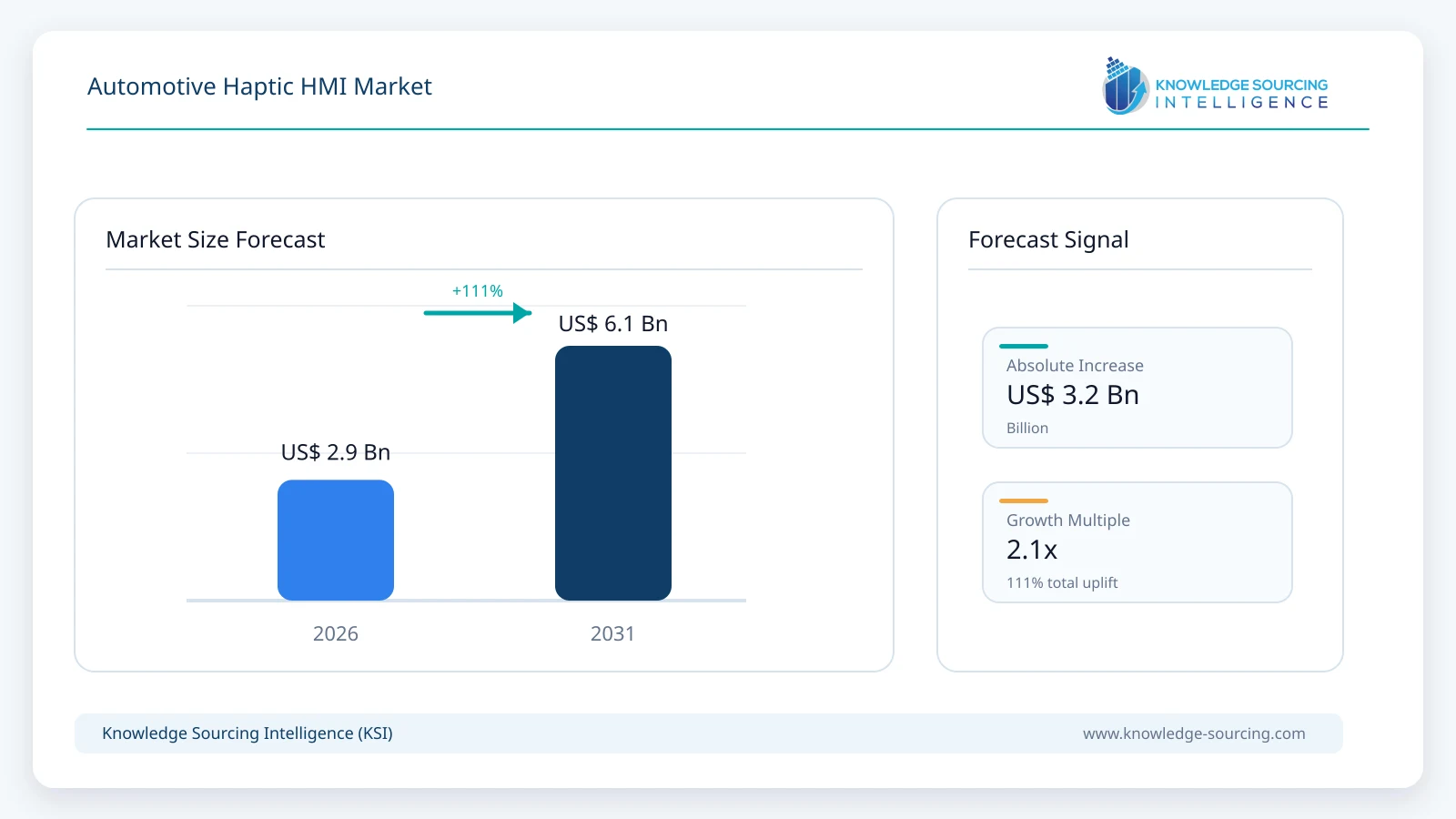
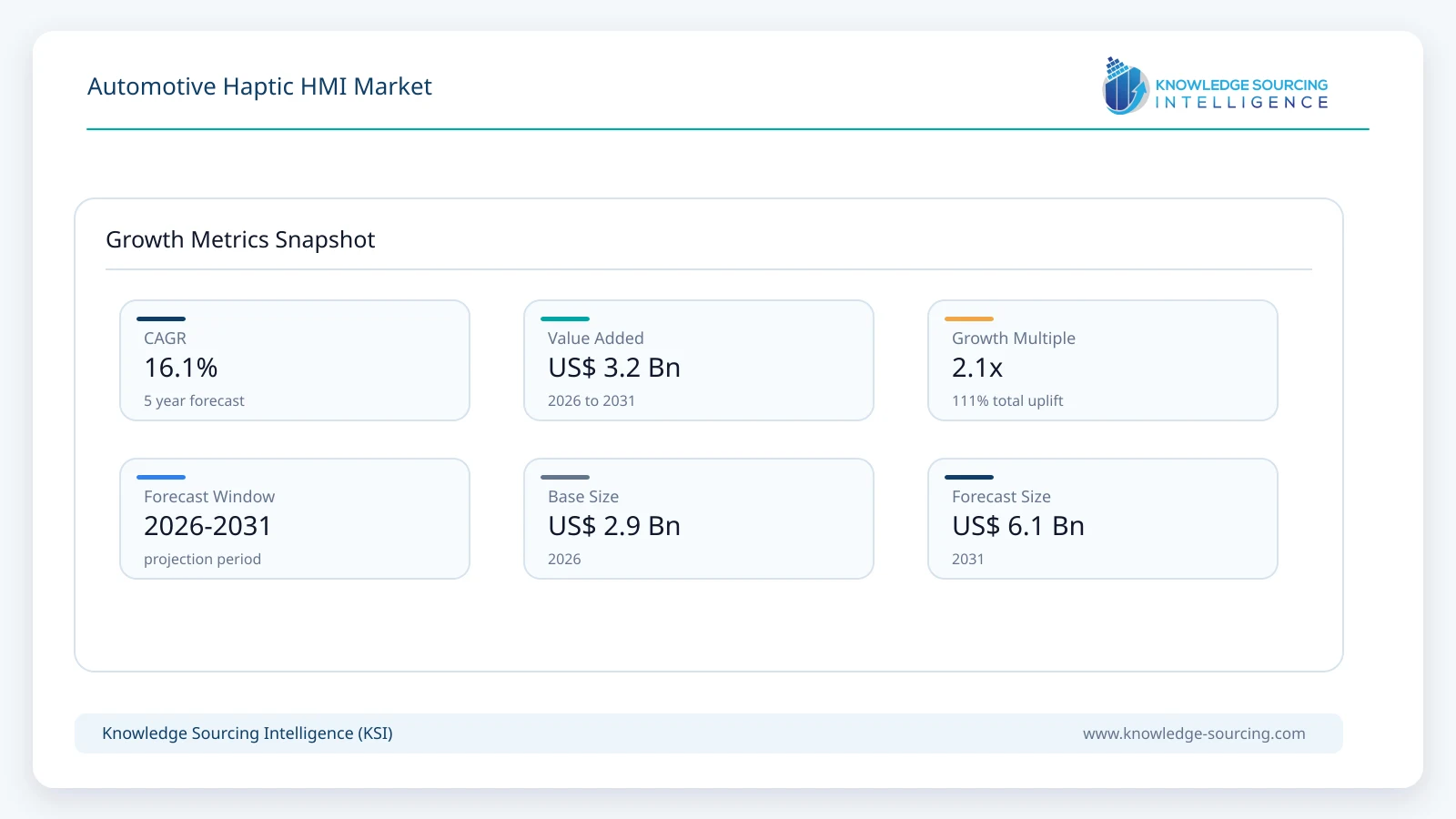
The Automotive Haptic HMI Market is forecast to grow at a CAGR of 16.1%, reaching USD 6.12 billion in 2031 from USD 2.90 billion in 2026.
Highlights:
- 1Active haptic touchscreens, touchpads and smart surfaces account for approximately 47% of global market value in 2026 because OEMs are reducing conventional switches while retaining tactile confirmation for frequently used cockpit functions.
- 2Electromechanical actuator-based haptics represent approximately 68% of 2026 market value because solenoids, eccentric or linear actuators and related mechatronic solutions remain the most production-proven route for generating programmable tactile feedback in automotive controls.
- 3Center-stack, center-console and display interfaces account for approximately 44% of 2026 market value as touchscreens, capacitive panels and integrated control surfaces absorb functions previously assigned to dedicated knobs and buttons.
- 4Configurable and software-defined haptic feedback represents approximately 59% of market value in 2026 because OEMs increasingly use one control surface to deliver different tactile signatures, force thresholds and detent profiles across functions and drive modes.
- 5Passenger vehicles account for approximately 94% of global market value in 2026 due to high digital-cockpit penetration, premium HMI content and large production volumes across passenger cars, SUVs and MPVs.
- 6Europe represents approximately 39% of global market value in 2026, supported by strong premium OEM adoption, established HMI suppliers and continued deployment of haptic steering-wheel, touchscreen and center-console controls.
The market is moving from fixed mechanical tactility toward programmable feedback that can be embedded in flat touchscreens, capacitive switch panels, steering-wheel controls and other digital interfaces, allowing OEMs to preserve tactile confirmation while reducing visible switch count and increasing software configurability. The commercial value increasingly depends on the quality, localization and programmability of the tactile response rather than on simple vibration alone.
Production activity spans display suppliers, HMI specialists, actuator providers and technology licensors. HARMAN's Ready Display uses customizable solenoid haptics for key touchscreen functions, Valeo offers configurable active haptics across capacitive controls and steering-wheel switches, Preh combines touchscreens and smart surfaces with scalable actuator technology, and Immersion licenses automotive haptic technology for displays, touchpads, consoles and steering wheels. BMW's Panoramic iDrive further demonstrates how active haptic feedback is being retained on steering-wheel controls even as the cockpit becomes increasingly display-led, reinforcing the role of haptics as a bridge between software-defined interfaces and physical driver confirmation.
Market Overview
Haptic HMI restores a physical sense of confirmation to increasingly digital vehicle interfaces by translating a touch or control input into a localized vibration, click, detent, pulse or resistance change. This feedback is commercially important because touchscreens and seamless capacitive surfaces remove the mechanical cues that drivers previously used to confirm a selection without looking, making tactile response a key part of reducing uncertainty and unnecessary visual checking.
Active haptic displays and touch surfaces form the largest technology layer because actuators can be mounted behind a display, panel, or control surface and triggered only when a defined interaction occurs. HARMAN uses solenoid haptics in Ready Display, Valeo combines capacitive controls with configurable mechatronic feedback, and Preh applies scalable active haptics to touchscreens, touchpads and smart surfaces, allowing one flat interface to simulate clicks, sliders or stepped rotary behavior.
Steering-wheel and physical control haptics remain strategically important because the steering wheel is one of the few interaction zones that drivers can operate while maintaining hand position and road focus. BMW's Panoramic iDrive uses active haptic feedback on multifunction steering-wheel buttons, while Valeo offers capacitive steering-wheel controls with active haptics and hands-on detection. These designs show that haptics is not simply replacing mechanical controls but is increasingly being combined with capacitive sensing to preserve tactile certainty on reconfigurable surfaces.
Software-defined feedback is the longer-term architecture because tactile response can be tuned by function, vehicle mode, user preference, or interaction state rather than fixed permanently in hardware. Actuator control software can create different clicks, detents, resistance levels, or textures from the same surface, allowing OEMs to update the feel of digital controls over time and differentiate brand character without redesigning the physical interface. This increases the value of haptic algorithms, calibration and actuator-control electronics alongside the mechanical actuator itself.
Market Trends
Programmable Haptics Is Restoring Tactile Confirmation to Touch-Dominant Cockpits
As more climate, media and vehicle functions migrate into touchscreens and capacitive panels, OEMs are adding active tactile feedback to reduce the uncertainty associated with flat digital controls. HARMAN Ready Display, Valeo smart control panels and Preh haptic touch systems all reflect the same design logic: the visible surface remains digitally configurable, while the user receives a physical confirmation that resembles a button, detent or click.
Programmable feedback gives automakers greater design freedom than a conventional switch because one surface can support different control layouts across trims and software versions. The value of the haptic layer therefore rises as cockpit functions become more dynamic, provided the tactile response remains localized and distinctive enough for the driver to associate each sensation with a specific command.
Steering-Wheel Haptics Is Expanding as OEMs Reduce Conventional Button Count
Steering wheels are increasingly adopting capacitive, multifunction and shy-tech controls to support ADAS, infotainment and display interaction without adding more physical switches. BMW's Panoramic iDrive retains active haptic feedback on illuminated multifunction steering-wheel buttons, while Valeo combines capacitive switching and active haptics with hands-on detection within the same steering-wheel architecture.
The steering-wheel use case is particularly important because poor tactile differentiation can force drivers to look down at controls that are intended to support eyes-on-road operation. Haptic feedback therefore becomes part of the safety and usability architecture rather than a purely premium feel feature, especially as button functions change with software context.
Force and Pressure Sensing Are Becoming More Important for Intent Confirmation
Modern haptic interfaces increasingly pair tactile output with force or pressure sensing so the system can distinguish an intentional press from a light touch or accidental contact. Continental's active haptic display architecture demonstrated the value of combining force recognition with tactile output, while smart-surface suppliers continue to use pressure thresholds to control when a haptic event should be generated.
Force sensing reduces false activation and allows one flat surface to support multiple interaction stages, such as hover, touch and firm press, without adding mechanical travel. The trade-off is more complex calibration because surface stiffness, mounting, actuator behavior and user force vary across vehicle interiors and must remain consistent over temperature and long service life.
Haptic Smart Surfaces Are Expanding beyond Center Displays into Interior Trim
Seamless interior design is pushing controls into door panels, center consoles, steering wheels, and decorative smart surfaces where mechanical buttons would interrupt the visual design. Valeo and Preh both support haptic capacitive controls on different surface materials, allowing wood, glass, polymer, or black-panel designs to become interactive only when needed.
Distributed haptic surfaces can reduce switch count and improve styling, but they increase integration complexity because actuator energy, local stiffness and acoustic behavior change with material and mounting location. Suppliers that can tune one haptic platform across several interior zones have an advantage over solutions optimized only for a rigid center display.
Haptic Feedback Is Becoming a Software-Defined Brand Attribute
OEMs are increasingly treating tactile feel as part of the digital brand experience because the same actuator system can be programmed to feel soft, sharp, progressive, or mechanical depending on vehicle positioning and interaction type. Immersion's automotive licensing model and Preh's configurable actuator technologies illustrate how software and control algorithms can shape perceived quality without requiring a different physical switch for every function.
Software-defined tactility enables future OTA tuning and model-specific differentiation, but it also creates a new calibration burden because excessive vibration, inconsistent response or mismatched audio cues can make the interface feel artificial. High-value systems therefore require coordinated tuning of actuator waveform, surface response, sound design and visual confirmation rather than isolated vibration effects.
Segment Analysis
By Interface Type: Active Haptic Touchscreens, Touchpads and Smart Surfaces
Active haptic touchscreens, touchpads and smart surfaces are projected to generate approximately USD 3.05 billion of market value by 2031 because these interfaces allow OEMs to reduce physical switch count while maintaining tactile confirmation across climate, media, navigation and vehicle settings. Large displays and seamless capacitive surfaces create the strongest need for active feedback because visual confirmation alone can increase driver glance time.
Active haptic touchscreens, touchpads and smart surfaces should retain the largest interface share as actuator systems become more tightly integrated into display modules and center-stack assemblies. Future growth will depend on localized response quality, force-sensing accuracy and the ability to maintain consistent tactile feel across larger, thinner or curved surfaces without adding excessive actuator count or weight.
By Haptic Technology: Electromechanical Actuator-Based Haptics
Electromechanical actuator-based haptics are projected to generate approximately USD 4.00 billion of market value by 2031 because solenoids, linear actuators and related mechatronic devices remain the most mature way to create distinct clicks, pulses and force sensations across automotive surfaces. These systems can be tuned through software and are compatible with touchscreens, capacitive panels, steering-wheel controls and touchpads.
Piezoelectric, electrostatic and ultrasonic approaches can offer thinner packaging or more localized surface effects, but mainstream vehicle adoption remains more limited by cost, control complexity and integration requirements. Electromechanical platforms therefore retain the largest value pool even as alternative surface-haptics technologies gain relevance in premium and space-constrained applications.
By Haptic Function: Confirmation, Detents and Programmable Tactile Cues
Confirmation clicks, virtual detents and programmable tactile cues are projected to generate approximately USD 2.70 billion by 2031 because they address the most common need for tactile certainty on flat digital interfaces. A driver can feel whether a virtual button has been activated, whether a slider moved one step or whether a steering-wheel control registered input without relying exclusively on visual feedback.
More advanced texture simulation and continuous force effects will expand in premium applications, but discrete confirmation events remain easier to validate and understand across a wide user base. Commercial value will favor systems that make tactile cues clearly distinguishable without creating excessive noise, vibration transfer or inconsistent feel across control locations.
By Integration Location: Center Stack, Center Console and Display Surfaces
Center-stack, center-console and display surfaces are projected to generate approximately USD 2.65 billion of market value by 2031 because these areas concentrate the largest number of functions migrating from physical controls into digital interfaces. Climate, media, drive-mode and navigation controls increasingly share one display or capacitive panel, making tactile confirmation commercially important for reducing user uncertainty.
Steering-wheel, door and roof controls will grow faster from a smaller base as capacitive surfaces spread across the cabin, but center interfaces retain the largest absolute value because of display area, actuator count and integration complexity. Premium vehicles with curved or multi-panel cockpit surfaces are expected to carry particularly high haptic content per vehicle.
By Vehicle Class: Premium and Upper-Mid-Range Vehicles
Premium and upper-mid-range vehicles are projected to generate approximately USD 3.20 billion of market value by 2031 because these platforms combine large touch displays, seamless surfaces, configurable steering-wheel controls and higher perceived-quality requirements. OEMs in these segments are more willing to pay for localized active haptics, force sensing and brand-specific tactile tuning.
Mid-range penetration should expand as integrated actuator modules and shared display platforms lower cost, but premium vehicles will retain disproportionate market value because they use more haptic zones and more sophisticated feedback profiles. The segment also serves as the primary proving ground for advanced surface haptics before technology migrates into higher-volume models.
By Vehicle Type: Passenger Vehicles
Passenger vehicles are projected to generate approximately USD 5.75 billion of market value by 2031 because large digital cockpits, premium HMI systems and smart-surface design are concentrated in passenger cars, SUVs and MPVs. Passenger-vehicle OEMs also have the strongest incentive to use haptic quality as a visible differentiation point in the user experience.
Commercial vehicles will adopt haptic displays, steering-wheel controls and programmable levers where tactile confirmation improves operation, particularly in trucks and off-highway equipment, but lower volumes keep the overall value pool smaller. Passenger vehicles therefore remain dominant even as advanced force-feedback controls create specialized opportunities outside the passenger-car market.
Market Drivers
Larger Touchscreens and Reduced Physical Switch Count Are Increasing the Need for Tactile Feedback
Digital cockpits are absorbing climate, media, navigation and vehicle settings into large touch displays and seamless capacitive panels, reducing the mechanical cues that previously confirmed user input. Haptic feedback restores a physical response without forcing OEMs to reintroduce a full array of dedicated switches.
The market opportunity grows as more functions move onto configurable surfaces because one actuator system can support changing layouts across trims and software updates. Haptics therefore becomes an enabling technology for digital interior simplification rather than an optional vibration feature.
Driver-Distraction Concerns Are Supporting Eyes-on-Road HMI Design
Drivers can identify and confirm physical controls partly through touch, while flat displays often require visual checking before and after a selection. Active haptics can reduce this dependence by providing confirmation that a virtual control has been located or activated, especially when paired with clear surface geometry and consistent control placement.
The benefit is strongest for high-frequency tasks such as volume, climate, and steering-wheel controls where repeated glance behavior can accumulate during driving. OEMs are therefore retaining or reintroducing tactile feedback even as interface design becomes more digital and visually minimal.
Smart-Surface Design Is Expanding the Number of Potential Haptic Zones
Interior designers increasingly integrate controls into glass, plastic, decorative trim and black-panel surfaces that remain visually clean when functions are inactive. Haptic actuation allows these surfaces to feel more like physical switches once activated, improving usability without compromising seamless styling.
Distributed smart surfaces broaden the addressable market from center displays into steering wheels, door panels, center consoles and roof controls. Suppliers that can tune actuators across different materials and stiffness profiles can therefore capture more content per vehicle than vendors limited to a single display format.
Software-Defined HMI Is Increasing the Value of Configurable Haptic Profiles
Software-defined vehicles allow one physical interface to change function according to drive mode, user profile, feature activation or software update, creating demand for tactile feedback that changes with the same logic. Programmable actuators can simulate different button clicks, detents, resistance levels, or confirmation pulses without changing the underlying surface.
Configurable feedback improves platform reuse because OEMs can differentiate models and trims through software while retaining common hardware. The same architecture also opens a path to OTA refinement of tactile feel, although calibration and validation must remain tightly controlled.
Premium UX and Perceived Quality Continue to Support Haptic Content per Vehicle
The feel of switches, knobs and touch surfaces remains an important indicator of interior quality even as mechanical controls become less visible. Premium OEMs therefore use haptic response, sound and surface behavior together to create a deliberate brand character rather than allowing digital controls to feel generic.
Perceived tactile quality supports higher haptic content in premium programs because OEMs use actuator response, sound and surface behavior to reinforce brand character over the vehicle lifetime. High-fidelity control, low noise, and repeatable response therefore increase the commercial importance of licensing, waveform design, and calibration expertise relative to basic vibration hardware.
Market Restraints
Poorly Tuned Haptic Feedback Can Feel Artificial or Distracting
Haptic feedback only improves usability when the tactile event is clear, localized, and appropriately matched to the interaction, while excessive vibration or delayed response can make a digital interface feel less precise than a conventional button. Surface resonance can also transfer feedback to nearby controls or create audible buzz, reducing perceived quality.
OEM validation therefore requires detailed tuning of actuator waveform, mounting stiffness, sound, and control timing for each surface. This engineering burden makes haptic quality highly dependent on vehicle-specific integration rather than a plug-and-play actuator specification.
Actuator Cost, Packaging and Power Can Limit Broad Deployment
Active haptics adds actuators, control electronics, mounting structures, and calibration effort to interfaces that could otherwise rely on passive capacitive sensing. Large displays or distributed smart surfaces may require several actuators to achieve localized feedback, increasing bill of materials, weight, and packaging complexity.
Cost pressure is strongest in mass-market vehicles where tactile feedback must compete with conventional buttons that are inexpensive and well understood. Haptic systems gain a stronger business case when they replace several mechanical controls or are integrated into display modules already carrying substantial electronic content.
Surface Material and Structural Variation Complicate Consistent Tactile Performance
Glass, plastic, wood-like trim, curved displays and flexible surfaces respond differently to the same actuator input because stiffness, mass and mounting conditions determine how vibration propagates. A haptic profile tuned for one panel can therefore feel substantially different when transferred to another interior location or vehicle platform.
Cross-platform reuse requires mechanical modeling, calibration and sometimes different actuator placement even when the control software is common. Suppliers that cannot compensate for structural variation may struggle to deliver a consistent brand-level tactile signature across multiple vehicle programs.
Driver Acceptance Depends on Preserving Clear Interaction Logic
Replacing familiar knobs or buttons with flat haptic surfaces can frustrate users if functions are difficult to locate or if the control mapping changes too frequently with software context. Tactile feedback confirms an action, but it does not by itself solve discoverability or memorability problems created by overly dynamic interfaces.
OEMs therefore need stable interaction zones, visual hierarchy, and selected physical controls alongside haptic surfaces rather than assuming tactility can compensate for poor HMI design. This limits the extent to which haptics can justify complete removal of conventional controls from safety-relevant or frequently used functions.
Durability and Long-Term Calibration Must Match Vehicle Lifecycles
Automotive haptic actuators and force-sensing interfaces must maintain consistent response through millions of interactions, temperature cycles, vibration exposure, and years of material aging. Changes in panel stiffness, mounting condition or actuator performance can alter perceived feel even when electronic control remains unchanged.
Long-term durability requirements increase qualification cost and can make new actuator technologies slower to enter production than conventional switches. OEMs are therefore likely to favor technologies with demonstrated automotive lifetime performance before deploying advanced surface haptics across high-volume platforms.
Regional Outlook
Europe
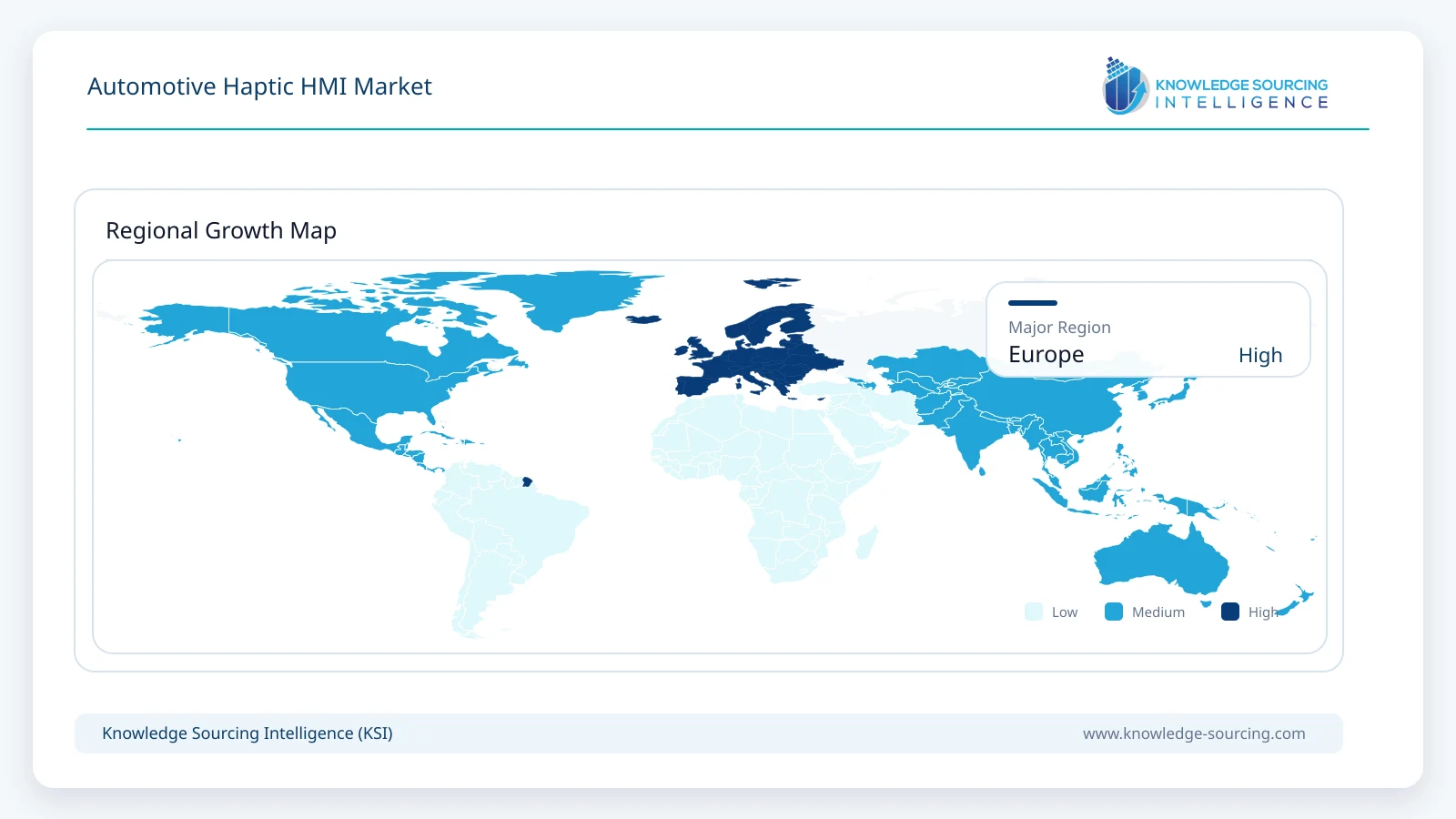
Europe is estimated to be the largest regional automotive haptic HMI market in 2026 because premium OEMs and established HMI suppliers continue to combine large digital surfaces with tactile controls that preserve eyes-on-road usability. BMW's Panoramic iDrive uses active haptic steering-wheel buttons across the Neue Klasse generation, while Valeo, Preh and Continental maintain deep expertise in active haptic touch, capacitive controls and smart surfaces.
The regional supplier ecosystem supports both premium tactility and scalable production. Preh supplies haptic control systems across center stacks and steering-wheel applications, Valeo offers configurable haptic faceplates and active steering-wheel switches, and Continental has long developed force-sensing active haptic displays and shy-tech control concepts. These capabilities position Europe strongly as digital interiors move toward fewer visible controls.
European market expansion through 2031 will depend on balancing cockpit simplification with usability and regulatory scrutiny around driver distraction, which favors localized feedback and stable control layouts over visually ambiguous touch-only interfaces. Steering-wheel and display architectures that let drivers confirm actions without prolonged visual attention should therefore remain central to regional HMI design.
Asia Pacific
Asia Pacific is expected to be the fastest-growing regional market through 2031 because China, Japan, South Korea and India are rapidly expanding digital cockpit content, large touch displays and software-defined interior architectures. Regional vehicle volumes create a substantial opportunity for haptic technology to migrate from premium systems into cost-optimized display, steering-wheel and center-console platforms.
HARMAN's Ready Display combines Samsung Neo QLED with customizable solenoid haptics, LG has demonstrated an adaptive touch controller with haptic feedback, and Valeo is expanding digital cockpit and display manufacturing capability in India. The region also benefits from strong electronics and display supply chains that can integrate actuator hardware directly into high-volume cockpit modules.
Asia Pacific growth should be strongest where haptics is embedded into common display and smart-surface platforms rather than added as a separate premium module. Chinese and Korean OEM competition around digital experience can accelerate adoption of programmable tactile feedback, while cost optimization and localization will determine how quickly the technology reaches mid-range vehicles.
Competitive Landscape
The automotive haptic HMI market combines cockpit-system suppliers, display integrators, mechatronic-control specialists and haptic technology licensors. Valeo, Preh, HARMAN International, Continental, Immersion Corporation, LG Electronics Vehicle Solution Company and Bosch are directly relevant through active haptic displays, capacitive control surfaces, steering-wheel feedback, actuator systems, touch interfaces and haptic-control software.
Valeo competes through configurable control panels and steering-wheel switches that combine capacitive sensing with active haptic response, while Preh provides scalable actuator technology across touchscreens, touchpads, smart surfaces and multimodal central controls. HARMAN integrates solenoid haptics into production-ready displays, giving OEMs a more complete display-and-feedback module rather than a separate actuator purchase.
Continental contributes long-standing expertise in force-sensing active haptic displays and smart control surfaces, while Immersion operates primarily through automotive haptic technology licensing, reference designs and tuning know-how for touchscreens, touchpads, consoles and steering wheels. LG extends the competitive field through adaptive touch controllers and software-defined cockpit integration, showing how haptics is becoming part of the broader display and digital-interface architecture.
Competitive advantage increasingly depends on tactile fidelity, response localization, durability, surface-material adaptability and software programmability rather than actuator force alone. Suppliers that can coordinate haptic waveform, sound, visual feedback and force sensing across multiple interior zones are better positioned than vendors offering an isolated vibration component with limited HMI integration.
Recent Developments
13 January 2026: HARMAN introduced its latest Ready Display portfolio with customizable solenoid haptics designed to provide tactile feedback for key display functions while driving.
September 2025: BMW launched the first series-production Neue Klasse model, the BMW iX3, bringing Panoramic iDrive and its multifunction steering wheel with active haptic feedback into production.
11 June 2025: HARMAN launched its first Samsung Neo QLED automotive display in the Tata Harrier.ev, expanding the production base for the display platform that underpins its broader Ready Display family and advanced haptic integration.
26 March 2025: Continental introduced its Ac2ated Sound display using actuators mounted behind the display surface, demonstrating how surface-mounted actuation can be integrated into display modules for multimodal audible and tactile-capable cockpit architectures.
7 January 2025: BMW unveiled Panoramic iDrive at CES 2025 with multifunction steering-wheel buttons using active haptic feedback and relief-like surfaces designed for eyes-on-road operation.
7 January 2025: LG presented an Intelligent HMI solution featuring a touch-sensitive curved OLED adaptive controller integrated into the steering wheel with haptic feedback for navigation, multimedia and climate functions.
Market Outlook
The automotive haptic HMI market is expanding as digital cockpits replace conventional switches with programmable touchscreens, capacitive controls and smart surfaces that still require tactile confirmation. Active haptic touchscreens and smart surfaces remain the largest interface category, while steering-wheel and distributed interior haptics are gaining importance as more vehicle controls become reconfigurable. Increasing integration of haptic feedback into infotainment systems, instrument clusters and center consoles is supporting adoption, while automakers are focusing on intuitive interfaces that improve driver interaction and reduce visual distraction. Advances in actuator technologies, sensor integration, and software-defined vehicle architectures are further broadening applications across passenger and premium vehicles.
The largest structural change will be the shift from fixed tactile mechanisms toward software-defined haptic profiles that can vary by function, drive mode, user preference and vehicle brand. Actuator-control software, force sensing and calibration will therefore capture more value relative to simple vibration hardware, particularly in premium systems where perceived quality depends on precise coordination of touch, sound and visual feedback.
Europe is expected to remain the largest high-value regional market, while Asia Pacific delivers the strongest incremental growth. Competitive performance will depend on localized feedback, low latency, long-term durability, scalable actuator cost, consistent feel across different surface materials and the ability to integrate haptics with digital displays and smart surfaces without compromising packaging or user clarity.
Automotive Haptic HMI Market Scope:
| Report Metric | Details |
|---|---|
| Total Market Size in 2026 | USD 2.90 billion |
| Total Market Size in 2031 | USD 6.12 billion |
| Forecast Unit | USD Billion |
| Growth Rate | 16.1% |
| Study Period | 2021 to 2031 |
| Historical Data | 2021 to 2024 |
| Base Year | 2025 |
| Forecast Period | 2026 – 2031 |
| Segmentation | Interface Type, Haptic Technology, Haptic Function, Integration Location |
| Companies |
|
Market Segmentation
By Interface Type
Active Haptic Touchscreens, Touchpads and Smart Surfaces
Haptic Steering-Wheel Controls
Haptic Buttons, Switches and Rotary Controls
Force-Feedback Pedals, Levers and Other Interfaces
By Haptic Technology
Electromechanical Actuator-Based Haptics
Piezoelectric Haptics
Electrostatic and Ultrasonic Surface Haptics
Hybrid and Multi-Actuator Haptics
By Haptic Function
Confirmation, Detents and Programmable Tactile Cues
Texture and Surface Simulation
Continuous Force and Resistance Feedback
Warning and Attention Feedback
By Integration Location
Center Stack, Center Console and Display Surfaces
Steering Wheel
Door and Armrest Controls
Roof, Seat and Other Cabin Controls
Pedals and Driving Controls
By Vehicle Class
Premium and Upper-Mid-Range Vehicles
Mid-Range Vehicles
Mass-Market and Economy Vehicles
By Vehicle Type
Passenger Vehicles
Light Commercial Vehicles
Medium and Heavy Commercial Vehicles
Off-Highway and Specialized Vehicles
By Geography
North America
United States
Canada
Mexico
South America
Brazil
Argentina
Others
Europe
Germany
United Kingdom
France
Italy
Spain
Others
Middle East and Africa
Saudi Arabia
UAE
South Africa
Others
Asia Pacific
China
Japan
South Korea
India
Singapore
Others
Table of Contents
1. INTRODUCTION
1.1. Market Overview
1.2. Market Definition
1.3. Scope of the Study
1.4. Market Segmentation
1.5. Currency
1.6. Assumptions
1.7. Base and Forecast Years
1.8. Key Benefits to Stakeholders
2. RESEARCH METHODOLOGY
2.1. Research Design
2.2. Secondary Research
2.3. Primary Research
2.4. Market Estimation
2.5. Segment Modelling
2.6. Data Triangulation and Validation
3. EXECUTIVE SUMMARY
3.1. Key Findings
3.2. Automotive Haptic HMI Market Size, 2026-2031
3.3. Interface Type Outlook
3.4. Haptic Technology Outlook
3.5. Haptic Function Outlook
3.6. Integration Location Outlook
3.7. Vehicle Class Outlook
3.8. Vehicle Type Outlook
3.9. Regional Opportunity Summary
4. MARKET DYNAMICS
4.1. Market Drivers
4.1.1. Larger Touchscreens and Reduced Physical Switch Count Are Increasing the Need for Tactile Feedback
4.1.2. Driver-Distraction Concerns Are Supporting Eyes-on-Road HMI Design
4.1.3. Smart-Surface Design Is Expanding the Number of Potential Haptic Zones
4.1.4. Software-Defined HMI Is Increasing the Value of Configurable Haptic Profiles
4.1.5. Premium UX and Perceived Quality Continue to Support Haptic Content per Vehicle
4.2. Market Restraints
4.2.1. Poorly Tuned Haptic Feedback Can Feel Artificial or Distracting
4.2.2. Actuator Cost, Packaging and Power Can Limit Broad Deployment
4.2.3. Surface Material and Structural Variation Complicate Consistent Tactile Performance
4.2.4. Driver Acceptance Depends on Preserving Clear Interaction Logic
4.2.5. Durability and Long-Term Calibration Must Match Vehicle Lifecycles
4.3. Market Opportunities
4.4. Porter's Five Forces Analysis
4.5. Industry Value Chain Analysis
4.6. Haptic Actuator, Control Electronics and Software Economics
4.7. Driver-Distraction, Functional Safety and HMI Usability Environment
5. TECHNOLOGY OUTLOOK
5.1. Electromagnetic and Solenoid Haptic Actuators
5.2. Linear Resonant and Eccentric Actuation
5.3. Piezoelectric Haptic Actuation
5.4. Electrostatic and Ultrasonic Surface Haptics
5.5. Force and Pressure Sensing
5.6. Localized Haptic Feedback and Surface Isolation
5.7. Programmable Clicks, Detents, Pulses and Textures
5.8. Haptic Touchscreens and Touchpads
5.9. Haptic Smart Surfaces and Capacitive Controls
5.10. Steering-Wheel and Switch Haptics
5.11. Force-Feedback Pedals, Levers and Rotary Controls
5.12. Haptic-Audio-Visual Multimodal Feedback
5.13. Haptic Calibration, Waveform Control and OTA Tuning
6. AUTOMOTIVE HAPTIC HMI MARKET BY INTERFACE TYPE
6.1. Introduction
6.2. Active Haptic Touchscreens, Touchpads and Smart Surfaces
6.3. Haptic Steering-Wheel Controls
6.4. Haptic Buttons, Switches and Rotary Controls
6.5. Force-Feedback Pedals, Levers and Other Interfaces
7. AUTOMOTIVE HAPTIC HMI MARKET BY HAPTIC TECHNOLOGY
7.1. Introduction
7.2. Electromechanical Actuator-Based Haptics
7.3. Piezoelectric Haptics
7.4. Electrostatic and Ultrasonic Surface Haptics
7.5. Hybrid and Multi-Actuator Haptics
8. AUTOMOTIVE HAPTIC HMI MARKET BY HAPTIC FUNCTION
8.1. Introduction
8.2. Confirmation, Detents and Programmable Tactile Cues
8.3. Texture and Surface Simulation
8.4. Continuous Force and Resistance Feedback
8.5. Warning and Attention Feedback
9. AUTOMOTIVE HAPTIC HMI MARKET BY INTEGRATION LOCATION
9.1. Introduction
9.2. Center Stack, Center Console and Display Surfaces
9.3. Steering Wheel
9.4. Door and Armrest Controls
9.5. Roof, Seat and Other Cabin Controls
9.6. Pedals and Driving Controls
10. AUTOMOTIVE HAPTIC HMI MARKET BY VEHICLE CLASS
10.1. Introduction
10.2. Premium and Upper-Mid-Range Vehicles
10.3. Mid-Range Vehicles
10.4. Mass-Market and Economy Vehicles
11. AUTOMOTIVE HAPTIC HMI MARKET BY VEHICLE TYPE
11.1. Introduction
11.2. Passenger Vehicles
11.3. Light Commercial Vehicles
11.4. Medium and Heavy Commercial Vehicles
11.5. Off-Highway and Specialized Vehicles
12. AUTOMOTIVE HAPTIC HMI MARKET BY GEOGRAPHY
12.1. North America
12.1.1. United States
12.1.2. Canada
12.1.3. Mexico
12.2. South America
12.2.1. Brazil
12.2.2. Argentina
12.2.3. Others
12.3. Europe
12.3.1. Germany
12.3.2. United Kingdom
12.3.3. France
12.3.4. Italy
12.3.5. Spain
12.3.6. Others
12.4. Middle East and Africa
12.4.1. Saudi Arabia
12.4.2. UAE
12.4.3. South Africa
12.4.4. Others
12.5. Asia Pacific
12.5.1. China
12.5.2. Japan
12.5.3. South Korea
12.5.4. India
12.5.5. Singapore
12.5.6. Others
13. COMPETITIVE ENVIRONMENT AND ANALYSIS
13.1. Major Players and Strategy Analysis
13.2. Market Share Analysis
13.3. Haptic Technology and Actuator Benchmarking
13.4. Electromechanical versus Piezoelectric versus Surface-Haptics Comparison
13.5. Localized Feedback, Force-Sensing and False-Activation Benchmarking
13.6. Touchscreen, Smart-Surface and Steering-Wheel Haptics Comparison
13.7. Durability, Acoustic and Tactile Quality Benchmarking
13.8. OEM Programs and Production Readiness
13.9. Competitive Dashboard
14. COMPANY PROFILES
14.1. Valeo
14.2. Preh GmbH
14.3. HARMAN International
14.4. Continental
14.5. Immersion Corporation
14.6. LG Electronics Vehicle Solution Company
14.7. Robert Bosch GmbH
15. APPENDIX
15.1. Currency
15.2. Assumptions
15.3. Base and Forecast Years Timeline
15.4. Key Benefits for Stakeholders
15.5. Research Methodology
15.6. Abbreviations
15.7. Data Sources
Navigate
Trusted by the world's leading organizations











