
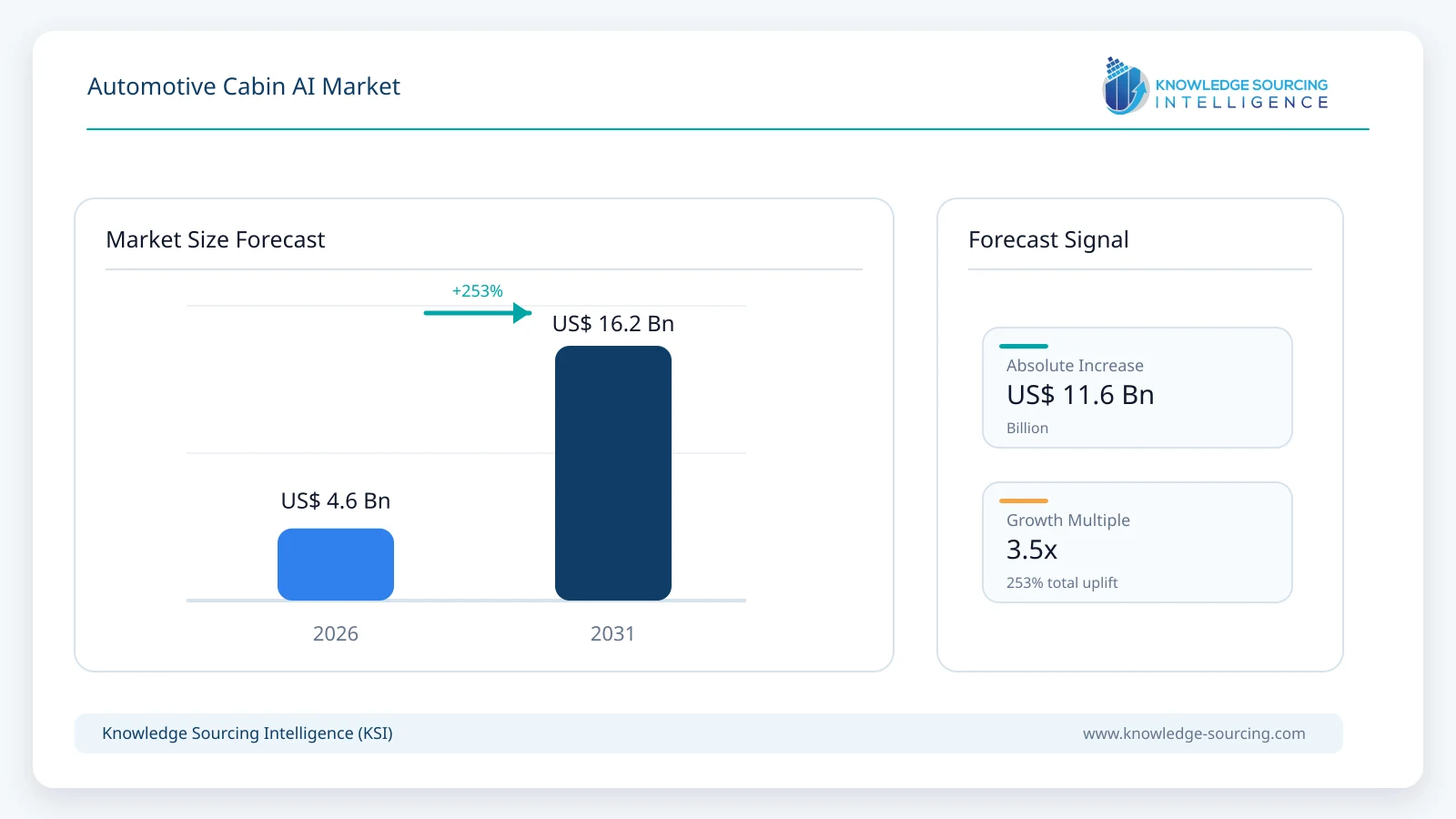
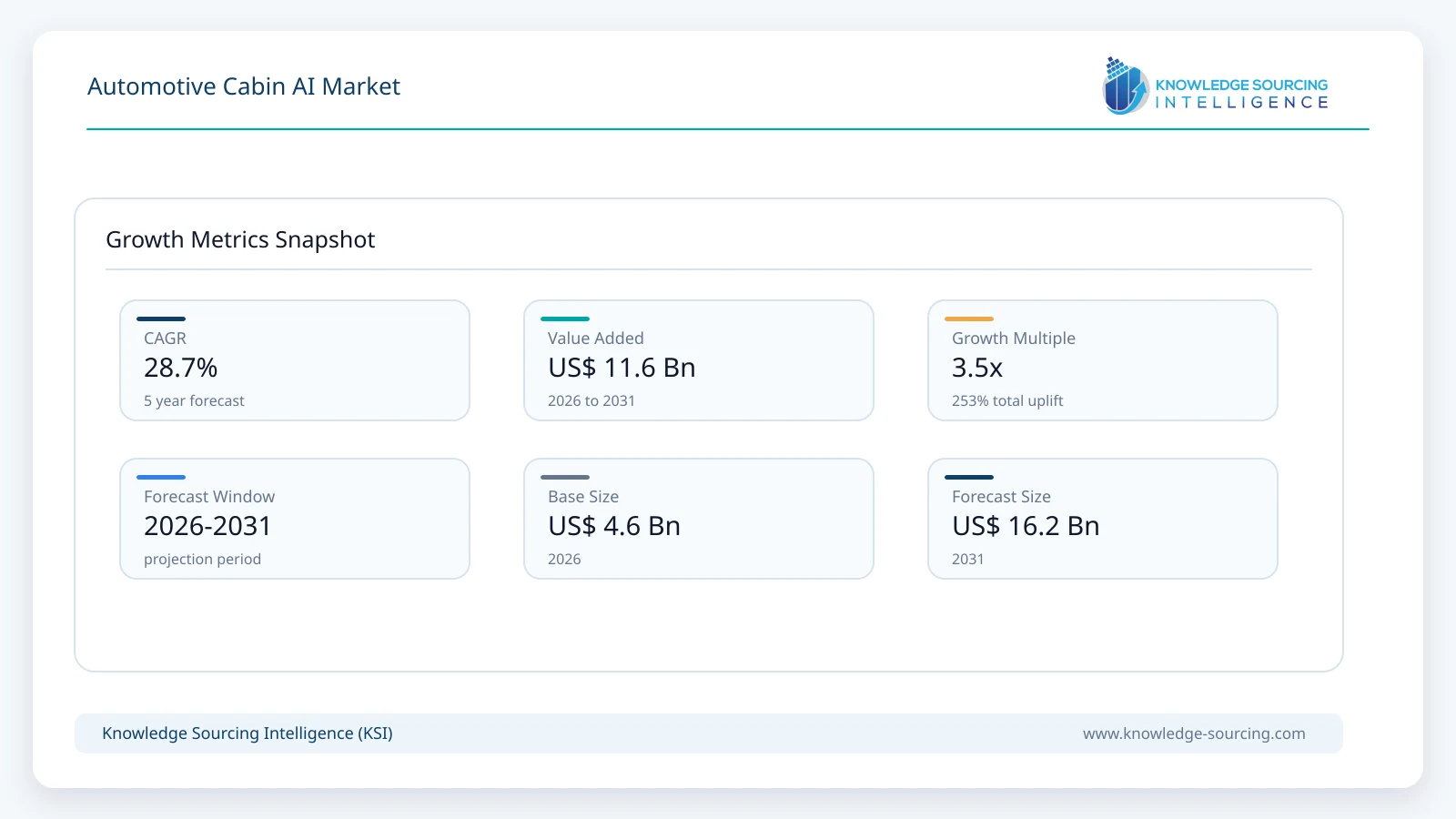
The automotive cabin AI market is estimated at approximately USD 4.60 billion in 2026 and is projected to reach about USD 16.24 billion by 2031, representing a CAGR of 28.7% during the forecast period.
Highlights:
- 1Conversational, multimodal and generative AI capabilities account for approximately 34% of global market value in 2026 because natural-language assistants are becoming the primary consumer-facing AI interface inside software-defined vehicles.
- 2Edge and on-device AI processing represents approximately 46% of market value in 2026 as OEMs prioritize low latency, privacy, offline availability and deterministic response for high-frequency cabin interactions.
- 3Infotainment and digital-assistant applications account for approximately 38% of 2026 market value, supported by voice control, contextual recommendations, navigation support, content discovery, vehicle knowledge and personalized assistance.
- 4Premium and luxury vehicles represent approximately 44% of global market value in 2026 because high-performance cockpit compute, advanced displays, richer sensing and differentiated AI experiences remain concentrated in high-content vehicle platforms.
- 5Passenger vehicles account for approximately 89% of global market value in 2026, driven by large production volumes and rapid adoption of digital-cockpit and smart-cabin technologies across sedans, SUVs and electric vehicles.
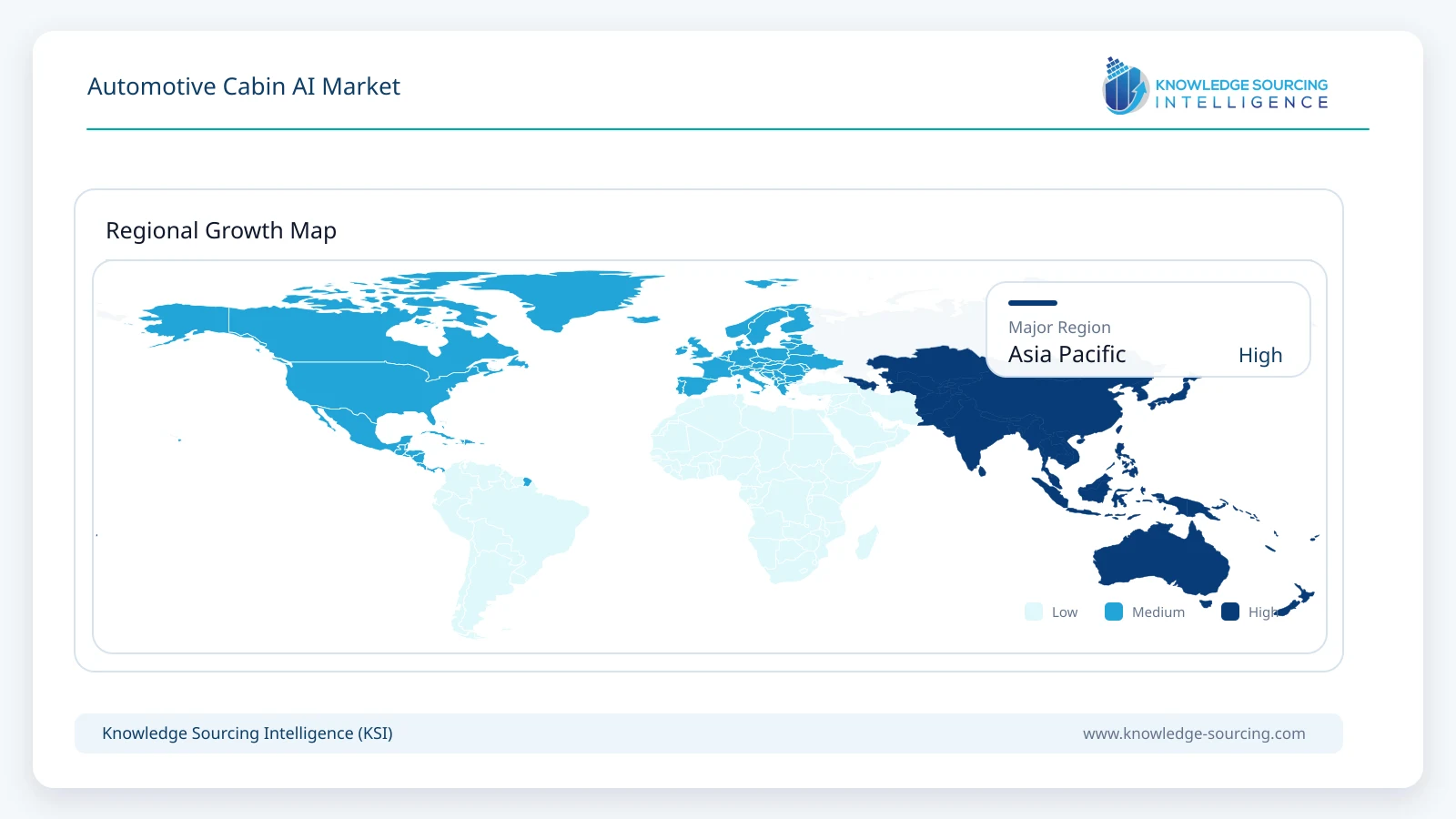
- 6Asia Pacific represents approximately 41% of global market value in 2026, supported by rapid smart-cockpit development in China and strong electronics, display and cabin-system capabilities in Japan and South Korea.
- 7Cabin AI is becoming a central intelligence layer for the software-defined interior by connecting voice, vision, displays, occupant sensing, infotainment, climate and seating through context-aware software that can interpret natural language, combine vehicle and sensor data, anticipate user needs and coordinate responses across multiple cabin domains.
Commercial deployment is accelerating as Qualcomm embeds agentic and multimodal AI into Snapdragon Cockpit and Digital Chassis platforms, LG runs vision-language, large-language and image-generation models on-device through its AI Cabin Platform, HARMAN combines Ready Engage and Ready Care with conversational orchestration and occupant-state intelligence, and Yanfeng integrates generative AI, emotion recognition and adaptive cabin functions in XiM27. The resulting value pool extends beyond AI models to automotive-grade compute, edge inference, sensor fusion, orchestration software, HMI integration and lifecycle updates required to deploy cabin intelligence safely and consistently across production vehicles.
Market Overview
Artificial intelligence is shifting the vehicle cabin from a collection of separate interfaces toward a continuously interpreted environment in which speech, gaze, gesture, vehicle status, location and personal preference can be combined to infer occupant intent. Conversational and multimodal models form the most visible user-facing layer because large-language-model-based assistants can handle follow-up questions, ambiguous requests and open-ended knowledge queries while automotive-specific guardrails preserve brand behavior and control boundaries.
Vision AI and occupant intelligence deepen this contextual layer by allowing cabin cameras and perception software to estimate attention, posture, emotion, occupancy and activity and then relate those signals to vehicle state. LG's AI Cabin Platform uses interior and exterior camera data for personalized assistance, while Yanfeng XiM27 applies AI-based emotion recognition to lighting, temperature and music, illustrating how cabin AI can convert sensed occupant context into specific environmental responses.
Edge and on-device processing are becoming central to production cabin AI because high-frequency voice, vision and personalization workloads require low latency, privacy and continued availability when cloud connectivity is weak. Qualcomm Snapdragon Cockpit Elite, LG's AI Cabin Platform and other next-generation cockpit systems are designed to run increasingly capable models locally, increasing the importance of automotive NPUs, model optimization and hybrid edge-cloud orchestration.
Cross-domain orchestration represents the long-term commercial opportunity because cabin AI can connect conversational intent with seat position, climate, audio, lighting, navigation, entertainment and safety systems through a common decision layer. Coordinating these domains allows the vehicle to move beyond isolated smart features toward proactive experiences that adapt continuously to each occupant while preserving deterministic control over safety-adjacent functions.
Market Trends
Multimodal Generative AI Is Moving from Cloud Demonstrations to On-Device Cockpits
Automotive AI is rapidly shifting from cloud-dependent assistants toward models that can process voice, images, vehicle data and contextual information at the edge. LG's AI Cabin Platform runs vision-language, large-language and image-generation models on Snapdragon Cockpit Elite, while Qualcomm is positioning multimodal and agentic AI as a core cockpit capability.
On-device multimodal processing improves latency and privacy while preserving richer interaction when network conditions are weak, which raises the strategic importance of high-performance automotive NPUs and AI-optimized cockpit compute. Model efficiency, memory bandwidth and thermal management therefore become direct constraints on how much generative and vision capability can be delivered inside the vehicle.
In-Vehicle Assistants Are Becoming Proactive and Agentic
The next generation of cabin assistants is designed to anticipate needs rather than wait for a fixed wake word and command. Qualcomm and Google are developing agentic AI experiences that can interpret context and provide proactive assistance, while HARMAN Ready Engage coordinates intent, vehicle context and cabin-domain actions.
Agentic cabin AI increases strategic value when it can translate a high-level request into coordinated multi-step actions across navigation, comfort, media and vehicle settings without requiring the user to understand individual subsystem logic. The commercial advantage therefore shifts toward assistants that can plan and execute bounded actions reliably rather than simply answer questions or trigger one function at a time.
Occupant Intelligence Is Converging with Comfort, Safety and Personalization
Occupant intelligence is converging with comfort, safety and personalization because the same AI layer can interpret distraction, drowsiness, stress, posture and vital signs and then translate that context into cabin responses. HARMAN Ready Care connects occupant-state analysis with interventions, Yanfeng uses emotion recognition to adapt interior parameters, and LG applies vision AI to understand driver and passenger state.
Combining occupant intelligence with comfort, safety and personalization allows the same cameras, sensors and centralized compute to support several value pools at once, improving the economics of higher-content cabin hardware. OEMs can justify richer sensing architectures when one perception stack supports regulated safety functions and differentiated wellness, comfort and HMI features through software.
Centralized Cockpit Compute Is Becoming the Foundation for Cross-Domain AI
Centralized cockpit compute is replacing fragmented ECU architectures because advanced AI, graphics, voice and sensing workloads increasingly need shared processing resources and common access to vehicle data. Bosch has delivered more than 10 million cockpit computers using Snapdragon platforms, while Qualcomm's next-generation Cockpit Elite architecture is designed to support multiple cabin workloads through a consolidated compute layer.
Centralized cockpit compute makes sensor data, AI models and orchestration services available across infotainment, displays, voice, occupant monitoring and comfort domains, reducing duplicated processing and simplifying lifecycle updates. The architecture also concentrates integration risk, making workload isolation, middleware stability and deterministic control important design requirements as more cabin functions depend on common compute.
AI Avatars and Adaptive HMI Are Creating Branded Digital Companions
AI-driven avatars and adaptive interfaces are creating a new branding layer because automakers can differentiate not only visual HMI design but also the tone, personality and contextual behavior of the digital cockpit. HARMAN Ready Engage includes expressive digital avatars and persona tools, while generative visual systems can adapt display content and interface presentation according to occupant context and brand intent.
Brand-controlled AI behavior can therefore become a recurring differentiator as OEMs tune tone, recommendations, visual expression and digital-companion personality across vehicle lines without redesigning the physical cockpit. The challenge is to preserve recognizably branded behavior while constraining generative variability and maintaining consistent user expectations.
Segment Analysis
By AI Capability: Conversational, Multimodal and Generative AI
Conversational, multimodal and generative AI is projected to generate approximately USD 6.40 billion of market value by 2031. Growth will be driven by natural-language assistants, multimodal query handling, generative search, vehicle knowledge, contextual recommendations and branded digital companions.
Conversational, multimodal and generative AI should remain the largest AI capability because it is both the most visible interface for navigation, media, connected services and vehicle functions and a potential orchestration layer for other cabin domains. Its share will increasingly depend on how effectively OEMs convert open-ended model capability into reliable automotive actions rather than on model scale alone.
By Processing Architecture: Edge and On-Device AI
Edge and on-device AI is projected to generate approximately USD 7.10 billion of market value by 2031. Automotive-grade CPUs, GPUs and NPUs increasingly support local execution of language, vision and personalization models without sending every interaction to the cloud.
Edge and on-device AI growth will be reinforced by privacy requirements, lower latency, reduced connectivity dependence and the need for predictable operation across safety-adjacent cabin functions. Local execution also gives OEMs greater control over model versions, data handling and response timing, although it raises silicon, memory and thermal requirements inside the cockpit platform.
By Cabin Application: Infotainment and Digital Assistant
Infotainment and digital-assistant applications are projected to generate approximately USD 6.20 billion of market value by 2031. The category includes conversational control, content discovery, navigation assistance, vehicle knowledge, communication, recommendations and intelligent interaction across displays and voice interfaces.
Infotainment and digital assistants should remain the largest cabin-AI application because they provide the broadest direct consumer interaction and can absorb new capabilities through software throughout the vehicle lifecycle. Continuous updates create room for navigation intelligence, content discovery, vehicle knowledge and personalized assistance to evolve without replacing the underlying cockpit hardware.
By Vehicle Class: Premium and Luxury Vehicles
Premium and luxury vehicles are projected to generate approximately USD 6.50 billion of cabin-AI market value by 2031. These platforms provide the strongest early adoption environment for high-performance compute, multiple displays, richer sensing, advanced assistants and differentiated personalized experiences.
AI capability should migrate from premium vehicles into mid-range platforms as common cockpit architectures, smaller on-device models and lower-cost acceleration reduce the incremental compute burden per vehicle. The pace of migration will depend on whether OEMs can reuse one software stack across trims while reserving the highest model complexity and feature depth for premium variants.
By Vehicle Type: Passenger Vehicles
Passenger vehicles are projected to generate approximately USD 14.10 billion of market value by 2031. High annual production volumes and strong digital-cockpit penetration make passenger cars the primary commercialization channel for multimodal assistants, AI personalization and occupant intelligence.
Commercial vehicles and shared mobility add meaningful use cases in productivity, fleet assistance and passenger services, but passenger vehicles remain the dominant value pool because their annual production volumes and digital-cockpit penetration are materially larger. Consumer-facing cabin AI also benefits from frequent feature exposure, which supports faster software iteration and broader monetization opportunities in passenger platforms.
Market Drivers
Rapid Expansion of Software-Defined Vehicle and Centralized Cockpit Architectures
Software-defined vehicles provide the compute, networking and update infrastructure required to deploy AI at scale. Centralized cockpit platforms can run multiple AI workloads, access shared sensor data and receive model updates throughout the vehicle lifecycle.
Centralized software-defined architectures create a scalable foundation for new cabin AI functions because shared compute, networking and OTA infrastructure allow language, vision and personalization workloads to be added without redesigning the complete hardware stack for each model. Reusing a common cockpit platform across nameplates can therefore lower integration cost while preserving software differentiation.
Consumer Demand for Natural, Smartphone-Like and Conversational Interaction
Drivers increasingly expect vehicle interfaces to understand natural language and behave more like modern digital assistants. Generative AI lowers the need for memorized commands and enables more flexible, conversational access to navigation, entertainment and vehicle settings.
Natural-language interaction can reduce menu complexity and improve accessibility by allowing users to reach functions through intent rather than navigating dense touchscreen hierarchies. The commercial value increases when conversational AI understands ambiguous phrasing and can safely translate a request into the correct vehicle action with minimal driver distraction.
Advances in Automotive-Grade Generative AI and Edge Compute
High-performance automotive NPUs and optimized language and vision models are making it practical to run increasingly capable AI locally in the vehicle. This reduces latency, improves privacy and creates more consistent performance when connectivity is limited.
Automotive-specific model orchestration, guardrails and AI development tools are shortening the path from prototype to production by giving OEMs clearer control over data sources, action permissions and fallback behavior. These layers are becoming as important as the underlying model because production deployment requires predictable behavior across languages, vehicle domains and long software lifecycles.
Growth of In-Cabin Cameras and Occupant Sensing
Driver monitoring, occupant monitoring and interior cameras provide AI with richer context about who is inside the vehicle, where they are looking and what they are doing. These inputs allow the system to personalize information and adjust comfort or safety responses.
Wider deployment of driver monitoring, occupant monitoring and interior cameras reduces the incremental cost of AI-based occupant intelligence because the sensing hardware and data pipeline are already present for safety functions. Cabin AI can then add personalization, context-aware assistance and comfort responses primarily through perception and orchestration software rather than new dedicated sensors.
OTA Updates and Lifecycle Monetization of Digital Cabin Features
OTA-capable cabin AI creates lifecycle value because new models, features and content can improve the in-vehicle experience after sale without requiring hardware replacement. Automakers can add assistants, personalization capabilities or premium digital services through software updates while reusing the installed cockpit compute and sensing base.
OTA-delivered AI features shift part of the cabin value proposition from one-time hardware content toward recurring software differentiation because assistants, personalization models and premium digital services can evolve after vehicle sale. The resulting lifecycle model increases the importance of update governance, compute headroom and sustained model support over many years of vehicle use.
Market Restraints
Hallucinations, Incorrect Responses and Safety-Critical Interaction Risk
Generative AI can produce inaccurate or inappropriate responses if it is not constrained by reliable data and automotive-specific guardrails. The risk becomes more significant when AI is allowed to influence navigation, vehicle controls or safety-adjacent information.
Safety-critical interaction risk requires deterministic control layers, restricted action domains and explicit fallback logic before generative models can orchestrate high-impact cabin functions such as navigation changes, vehicle settings or safety-adjacent information. Production systems therefore need a clear boundary between probabilistic language generation and the verified control software that actually executes vehicle actions.
High Compute Cost, Power Consumption and Thermal Load
Running large language and vision models inside the vehicle creates a direct trade-off between AI capability and the power, thermal and silicon limits of automotive hardware. OEMs must balance model performance with cooling requirements, processor cost and long vehicle product cycles, particularly when several cabin workloads share the same compute platform.
Compute, power and thermal constraints will keep smaller optimized models and hybrid edge-cloud architectures important where full local execution would require disproportionate silicon, memory or cooling cost. OEMs will need to allocate workloads dynamically so latency-sensitive and privacy-sensitive tasks remain on-device while less critical processing can use cloud resources when available.
Privacy and Governance of Sensitive Occupant Data
Cabin AI can process voice recordings, camera images, behavioral signals, user preferences and location history. These data can be highly sensitive and may create significant privacy concerns if stored or transmitted without clear consent.
Privacy-sensitive cabin AI will depend on local processing, data minimization, transparent permission controls and secure model architectures because voice, images, behavioral signals, location history and user preferences can expose highly personal information. Separating mandatory vehicle functions from optional personalization and cloud services will be important to both consumer trust and regulatory compliance.
Integration Complexity across Vehicle Domains and Legacy Software
An intelligent assistant must connect reliably with climate, seating, navigation, media, vehicle settings and other systems that may use different software stacks and suppliers. Inconsistent interfaces can limit what AI is allowed to control.
Centralized architectures can reduce cross-domain integration complexity over time, but automakers still need stable APIs, clear domain ownership and long-term validation because climate, seating, navigation, media and vehicle controls often originate from different software stacks and suppliers. Cabin AI cannot safely orchestrate these systems unless interfaces remain consistent across updates and vehicle generations.
AI Model Lifecycle, Cybersecurity and Validation Requirements
AI models can change faster than traditional automotive software, while vehicles remain in service for many years. OEMs must manage model versions, security vulnerabilities, changing cloud dependencies and performance drift across different markets and languages.
Long vehicle lifecycles make continuous validation and secure update processes essential because model versions, cloud dependencies, cybersecurity exposure and multilingual performance can all change faster than the underlying hardware platform. OEMs need observability and rollback mechanisms that preserve reliable cabin behavior even as AI components evolve throughout years of ownership.
Regional Outlook
Asia Pacific
Asia Pacific is the largest regional market and is expected to remain the strongest growth centre through 2031. China is moving rapidly toward AI-defined smart cabins, with local EV manufacturers adopting high-performance cockpit compute, multimodal assistants and deeply personalized software experiences. Japan and South Korea add strong electronics, display, infotainment and interior-system capabilities.
Yanfeng's XiM27 demonstrates the region's shift toward generative AI and emotion-aware cabin adaptation, while LG's AI Cabin Platform combines on-device multimodal generative AI with vehicle and occupant sensing. Qualcomm also reports strong adoption of Snapdragon Cockpit and agentic-AI platforms across major Chinese automakers.
Asia Pacific growth will be reinforced by aggressive software release cycles, premium EV competition and a willingness to integrate AI across entertainment, comfort and HMI domains rather than confine it to voice control. Suppliers that can localize models, support Chinese-language ecosystems and scale edge inference efficiently across high-volume vehicle programs are positioned most strongly.
Europe
Europe is a major high-value market because premium automakers, cockpit suppliers and AI software companies are integrating generative assistants, centralized cockpit compute and occupant intelligence into new vehicle programs. HARMAN, Cerence AI and Bosch all maintain significant European OEM relationships and production activity.
Bosch has delivered more than 10 million Snapdragon-based cockpit computers, while Cerence AI provides conversational and generative AI to major European automakers. HARMAN combines AI interaction, driver-state intelligence and cockpit platforms through its Ready portfolio.
European commercialization will place particular emphasis on privacy, safety validation, multilingual performance and OEM brand control as cabin AI moves from infotainment into cross-domain orchestration. Premium automakers and established Tier 1 relationships give the region a strong engineering base, but suppliers will need tighter governance over model behavior and data handling than in less regulated consumer software environments.
Competitive Landscape
The automotive cabin AI market includes conversational-AI specialists, digital-cockpit suppliers, semiconductor companies, in-cabin sensing providers and interior-system integrators. HARMAN, Cerence AI, Qualcomm Technologies, LG Electronics Vehicle Solution Company, Yanfeng, Robert Bosch GmbH and Panasonic Automotive Systems are directly relevant through AI assistants, multimodal compute, vision intelligence, smart-cabin platforms and centralized cockpit architectures.
HARMAN combines Ready Engage, Ready Care and cockpit compute to connect conversational AI, digital avatars, occupant intelligence and cabin-domain responses. Cerence AI brings automotive-grade conversational and generative AI with broad OEM integration, while Qualcomm supplies the high-performance compute and AI acceleration layer used across multiple next-generation cockpit platforms.
LG and Yanfeng are pushing deeper system integration through AI-native cabin platforms that combine vision, generative models, personalization and physical interior functions, while Bosch and Panasonic provide scalable cockpit computers and HMI platforms that enable AI deployment across large vehicle volumes. Competitive advantage increasingly depends on model quality, edge performance, integration depth, safety guardrails and the ability to customize one AI stack around OEM-specific brand behavior and vehicle-domain interfaces.
Recent Developments
29 July 2026: Qualcomm and BMW Group announced a long-term agreement making Qualcomm a lead compute silicon provider for BMW's next-generation digital cockpit and automated-driving platforms, including Snapdragon Cockpit and dedicated AI acceleration.
29 June 2026: Yanfeng unveiled XiM27 as a production-ready smart-cabin platform integrating generative AI, centralized electronics, adaptive seating, personalized climate and scenario-based cabin intelligence.
10 April 2026: Bosch and Qualcomm expanded their collaboration after Bosch surpassed 10 million delivered cockpit computers powered by Snapdragon Cockpit platforms, reinforcing the scale of centralized intelligent cockpit architectures.
13 January 2026: HARMAN introduced major updates across its Ready portfolio, emphasizing integrated, production-ready AI experiences across personalization, safety, visual systems and software-defined vehicle functions.
5 January 2026: Qualcomm announced expanded collaboration with Google and multiple global automakers to bring agentic AI, multimodal interaction and proactive personalization to Snapdragon Digital Chassis platforms.
11 December 2025: LG Electronics announced its AI Cabin Platform for CES 2026, combining vision-language models, large language models and image-generation models with on-device processing on Snapdragon Cockpit Elite.
Market Outlook
The automotive cabin AI market is expected to expand rapidly through 2031 as multimodal generative AI, occupant intelligence and proactive digital assistants move into production vehicles. Conversational and generative AI will remain the largest visible capability, while on-device inference and cross-domain orchestration are expected to grow particularly quickly.
Persistent cabin intelligence will become the defining architecture as vehicles combine language, vision, user profiles and sensor data to understand context, anticipate needs and coordinate information, entertainment, comfort and safety responses through a common AI layer. This raises the value of orchestration software and model lifecycle management because multiple cabin domains will depend on the same contextual intelligence rather than isolated AI features.
Asia Pacific is expected to retain the largest regional share, while Europe remains a major premium engineering and commercialization market. Competitive advantage will depend on automotive-grade model reliability, edge-compute efficiency, strong privacy controls, multilingual performance, safe action orchestration and the ability to update AI continuously over long vehicle lifecycles.
Automotive Cabin AI Market Scope
| Report Metric | Details |
|---|---|
| Total Market Size in 2026 | USD 4.60 billion |
| Total Market Size in 2031 | USD 16.24 billion |
| Forecast Unit | Billion |
| Growth Rate | 28.7% |
| Study Period | 2021 to 2031 |
| Historical Data | 2021 to 2024 |
| Base Year | 2025 |
| Forecast Period | 2026 – 2031 |
| Segmentation | AI Capability, Processing Architecture, Cabin Application, Vehicle Class, Vehicle Type, Geography |
| Companies |
|
Market Segmentation
By AI Capability
Conversational, Multimodal and Generative AI
Computer Vision and Occupant Intelligence
Predictive and Contextual AI
Personalization and Recommendation AI
Generative Visual and Content AI
By Processing Architecture
Edge and On-Device AI
Hybrid Edge-Cloud AI
Cloud-Centric AI
By Cabin Application
Infotainment and Digital Assistant
Driver and Occupant Intelligence
Comfort, Wellness and Cabin Orchestration
Navigation and Contextual Guidance
Entertainment and Personalized Content
By Vehicle Class
Premium and Luxury Vehicles
Mid-Range Vehicles
Mass-Market and Economy Vehicles
By Vehicle Type
Passenger Vehicles
Commercial Vehicles
Shared and Autonomous Mobility Vehicles
By Geography
North America
United States
Canada
Mexico
South America
Brazil
Argentina
Others
Europe
Germany
United Kingdom
France
Italy
Spain
Others
Middle East and Africa
Saudi Arabia
UAE
South Africa
Others
Asia Pacific
China
Japan
South Korea
India
Singapore
Others
Table of Contents
1. INTRODUCTION
1.1. Market Overview
1.2. Market Definition
1.3. Scope of the Study
1.4. Market Segmentation
1.5. Currency
1.6. Assumptions
1.7. Base and Forecast Years
1.8. Key Benefits to Stakeholders
2. RESEARCH METHODOLOGY
2.1. Research Design
2.2. Secondary Research
2.3. Primary Research
2.4. Market Estimation
2.5. Segment Modelling
2.6. Data Triangulation and Validation
3. EXECUTIVE SUMMARY
3.1. Key Findings
3.2. Automotive Cabin AI Market Size, 2026-2031
3.3. AI Capability Outlook
3.4. Processing Architecture Outlook
3.5. Cabin Application Outlook
3.6. Vehicle Class Outlook
3.7. Vehicle Type Outlook
3.8. Regional Opportunity Summary
4. MARKET DYNAMICS
4.1. Market Drivers
4.1.1. Rapid Expansion of Software-Defined Vehicle and Centralized Cockpit Architectures
4.1.2. Consumer Demand for Natural, Smartphone-Like and Conversational Interaction
4.1.3. Advances in Automotive-Grade Generative AI and Edge Compute
4.1.4. Growth of In-Cabin Cameras and Occupant Sensing
4.1.5. OTA Updates and Lifecycle Monetization of Digital Cabin Features
4.2. Market Restraints
4.2.1. Hallucinations, Incorrect Responses and Safety-Critical Interaction Risk
4.2.2. High Compute Cost, Power Consumption and Thermal Load
4.2.3. Privacy and Governance of Sensitive Occupant Data
4.2.4. Integration Complexity across Vehicle Domains and Legacy Software
4.2.5. AI Model Lifecycle, Cybersecurity and Validation Requirements
4.3. Market Opportunities
4.4. Porter's Five Forces Analysis
4.5. Industry Value Chain Analysis
4.6. Cabin AI Software and Compute Economics
4.7. AI Safety, Privacy, Cybersecurity and Regulatory Environment
5. TECHNOLOGY OUTLOOK
5.1. Automotive Large Language Models and Small Language Models
5.2. Multimodal Voice, Vision and Context Understanding
5.3. Generative AI Assistants and Agentic Cabin Intelligence
5.4. AI-Based Driver and Occupant Monitoring
5.5. Emotion, Intent and Activity Recognition
5.6. Personalized Recommendation and Preference Learning
5.7. Generative HMI, Visual Content and Digital Avatars
5.8. Edge AI, NPUs and Automotive High-Performance Compute
5.9. Hybrid Edge-Cloud AI Orchestration
5.10. AI Guardrails, Deterministic Control and Functional Separation
5.11. OTA Model Updates, AI Lifecycle Management and Observability
6. AUTOMOTIVE CABIN AI MARKET BY AI CAPABILITY
6.1. Introduction
6.2. Conversational, Multimodal and Generative AI
6.3. Computer Vision and Occupant Intelligence
6.4. Predictive and Contextual AI
6.5. Personalization and Recommendation AI
6.6. Generative Visual and Content AI
7. AUTOMOTIVE CABIN AI MARKET BY PROCESSING ARCHITECTURE
7.1. Introduction
7.2. Edge and On-Device AI
7.3. Hybrid Edge-Cloud AI
7.4. Cloud-Centric AI
8. AUTOMOTIVE CABIN AI MARKET BY CABIN APPLICATION
8.1. Introduction
8.2. Infotainment and Digital Assistant
8.3. Driver and Occupant Intelligence
8.4. Comfort, Wellness and Cabin Orchestration
8.5. Navigation and Contextual Guidance
8.6. Entertainment and Personalized Content
9. AUTOMOTIVE CABIN AI MARKET BY VEHICLE CLASS
9.1. Introduction
9.2. Premium and Luxury Vehicles
9.3. Mid-Range Vehicles
9.4. Mass-Market and Economy Vehicles
10. AUTOMOTIVE CABIN AI MARKET BY VEHICLE TYPE
10.1. Introduction
10.2. Passenger Vehicles
10.3. Commercial Vehicles
10.4. Shared and Autonomous Mobility Vehicles
11. AUTOMOTIVE CABIN AI MARKET BY GEOGRAPHY
11.1. North America
11.1.1. United States
11.1.2. Canada
11.1.3. Mexico
11.2. South America
11.2.1. Brazil
11.2.2. Argentina
11.2.3. Others
11.3. Europe
11.3.1. Germany
11.3.2. United Kingdom
11.3.3. France
11.3.4. Italy
11.3.5. Spain
11.3.6. Others
11.4. Middle East and Africa
11.4.1. Saudi Arabia
11.4.2. UAE
11.4.3. South Africa
11.4.4. Others
11.5. Asia Pacific
11.5.1. China
11.5.2. Japan
11.5.3. South Korea
11.5.4. India
11.5.5. Singapore
11.5.6. Others
12. COMPETITIVE ENVIRONMENT AND ANALYSIS
12.1. Major Players and Strategy Analysis
12.2. Market Share Analysis
12.3. Cabin AI Capability Benchmarking
12.4. Edge versus Cloud Architecture Comparison
12.5. OEM Programs and Production Readiness
12.6. AI Safety, Privacy and Integration Benchmarking
12.7. Competitive Dashboard
13. COMPANY PROFILES
13.1. HARMAN International
13.2. Cerence AI
13.3. Qualcomm Technologies, Inc.
13.4. LG Electronics Vehicle Solution Company
13.5. Yanfeng
13.6. Robert Bosch GmbH
13.7. Panasonic Automotive Systems Co., Ltd.
14. APPENDIX
14.1. Currency
14.2. Assumptions
14.3. Base and Forecast Years Timeline
14.4. Key Benefits for Stakeholders
14.5. Research Methodology
14.6. Abbreviations
14.7. Data Sources
Navigate
Trusted by the world's leading organizations











