
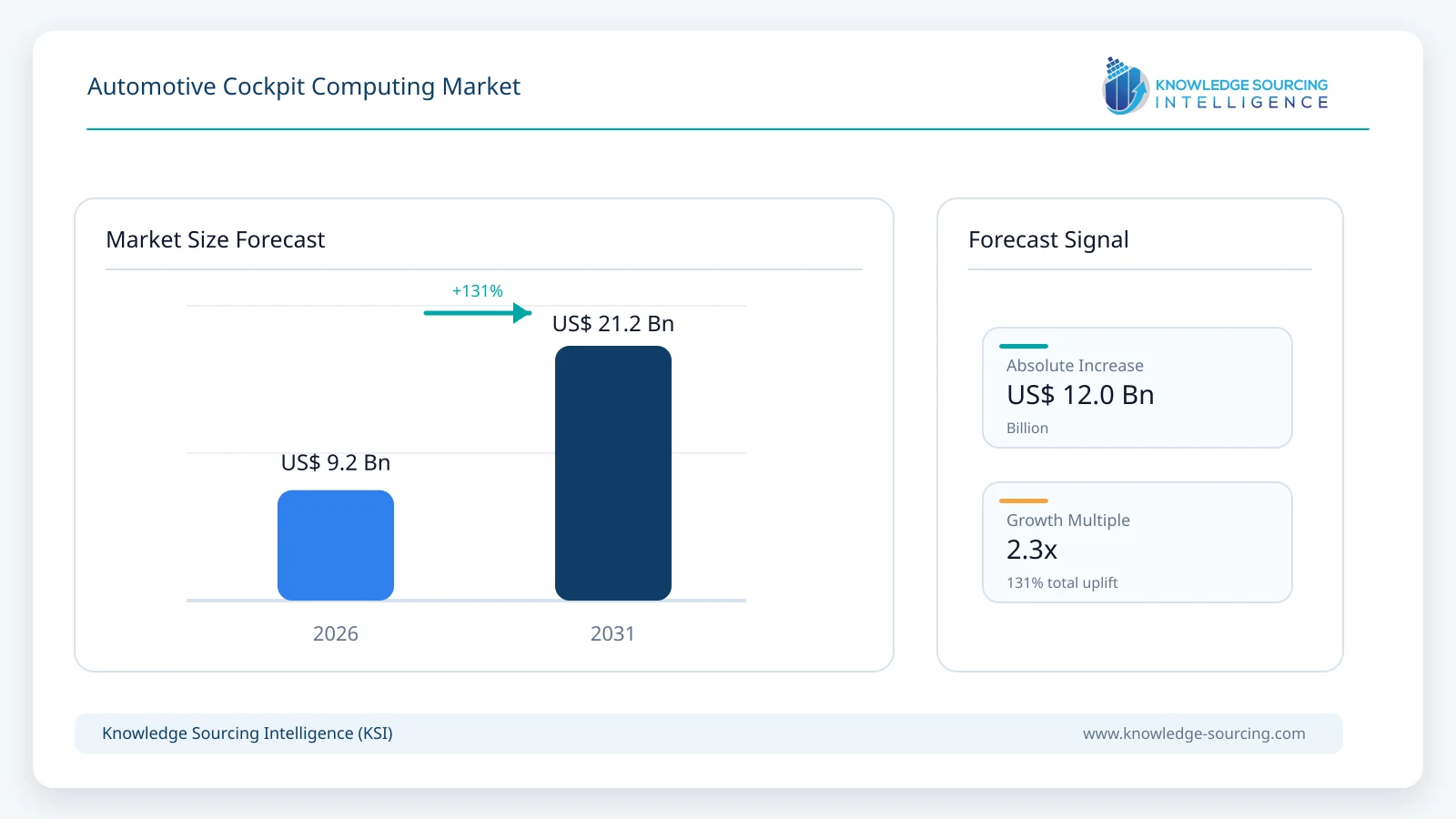
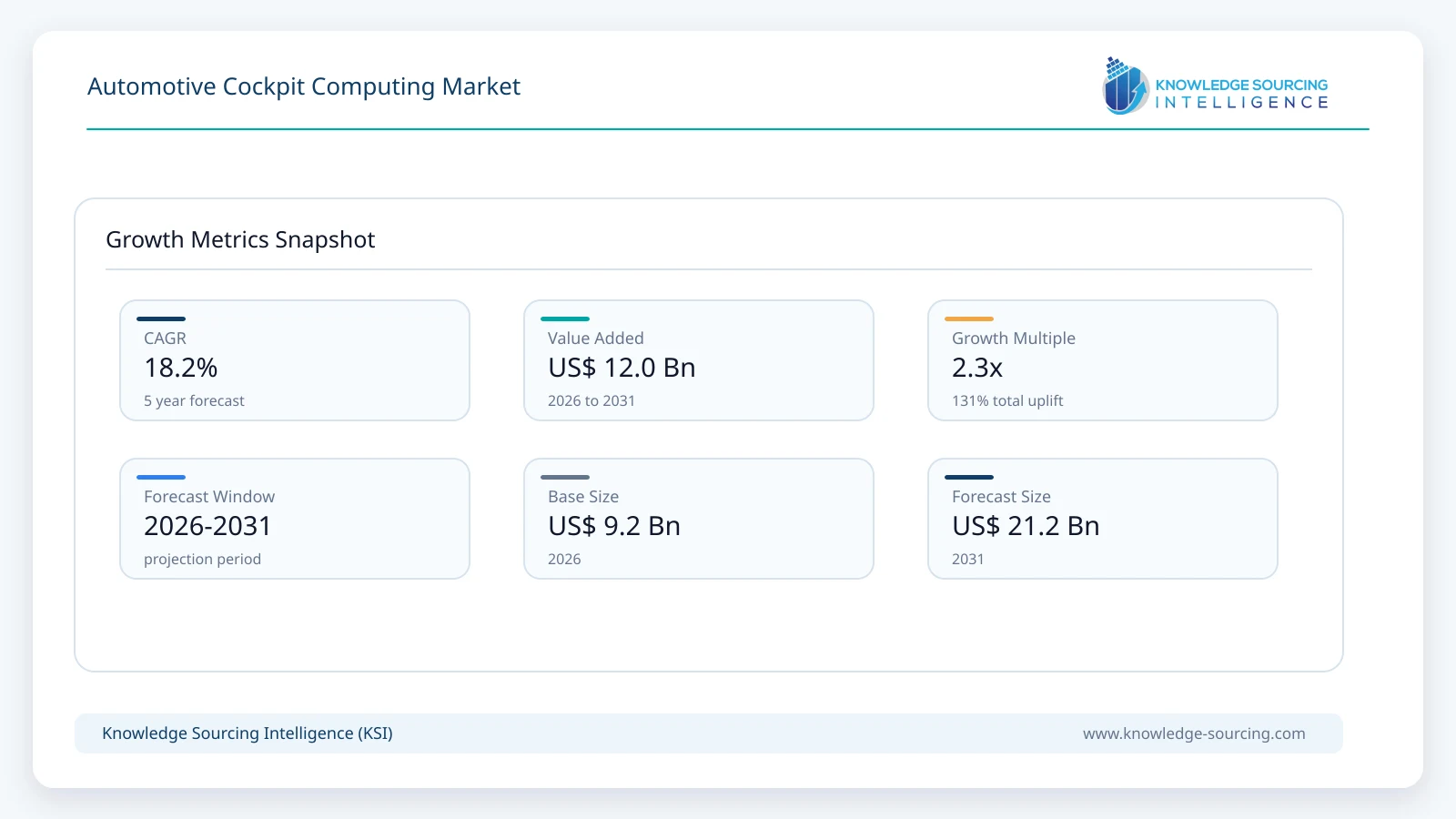
The Automotive Cockpit Computing Market is projected to expand at a CAGR of 18.2%, increasing from USD 9.20 billion in 2026 to USD 21.23 billion by 2031.
Highlights:
- 1Cockpit domain controllers and dedicated cockpit HPC architectures account for approximately 64% of global market value in 2026 because cluster, IVI, display, audio and selected camera workloads are increasingly consolidated onto one high-performance compute platform.
- 2Compute hardware and controller modules represent approximately 72% of 2026 market value, while virtualization, base software and integration content are gaining share as OEMs decouple software from hardware and extend cockpit platforms across several vehicle generations.
- 3Infotainment, digital cluster and multi-display workloads account for approximately 48% of 2026 market value because high-resolution graphics, multiple display outputs and premium multimedia remain the largest recurring compute requirement inside the cockpit.
- 4Single-SoC integrated cockpit platforms account for approximately 61% of market value in 2026, although multi-SoC, system-on-module and cross-domain architectures are expanding as AI, camera and ADAS workloads demand more compute headroom.
- 5Passenger vehicles represent approximately 93% of global market value in 2026 because digital cockpit deployment, high production volumes and software-defined vehicle programs are concentrated in passenger cars, SUVs and MPVs.
- 6Asia Pacific represents approximately 45% of global market value in 2026, supported by rapid smart-cockpit adoption in China, high vehicle production and strong semiconductor, display and cockpit-electronics ecosystems across China, Japan and South Korea.
Cockpit computing is moving from separate infotainment, cluster and display controllers toward consolidated domain and high-performance computers that host multiple operating systems, graphics workloads, AI functions, camera inputs and connected services on a shared hardware platform. The architectural value is increasingly determined by compute scalability, GPU and NPU capability, virtualization, memory bandwidth, thermal design and software portability rather than by the head-unit function alone.
Commercial scale is already substantial and is moving further toward centralized architectures. Bosch has delivered more than ten million cockpit computers powered by Snapdragon Cockpit platforms, Panasonic Automotive is deploying a cockpit domain controller in the all-new Mazda CX-5, Visteon is expanding SmartCore high-performance cockpit programs, and AUMOVIO offers scalable cockpit HPC architectures spanning entry through high-end vehicles. Qualcomm, LG and HARMAN are simultaneously extending the compute layer toward AI acceleration, cross-domain integration and upgradeable software-defined vehicle platforms, which shifts supplier competition from standalone infotainment electronics toward reusable computing architectures with long software lifecycles.
Market Overview
Cockpit computing sits between vehicle electronics and the digital user experience, providing the hardware and base-software environment that executes cluster, infotainment, graphics, audio, connectivity, HMI and selected cabin-sensing workloads. Earlier vehicles often used separate ECUs for the instrument cluster, infotainment head unit and display functions, whereas newer platforms increasingly consolidate these workloads through a cockpit domain controller or high-performance computer that shares processing, memory, networking and thermal resources.
High-performance automotive SoCs are increasing the amount of cockpit functionality that can be hosted on one controller because modern CPU, GPU and NPU blocks can execute Android infotainment, safety-relevant cluster software, 3D graphics, camera processing and AI concurrently. Qualcomm Snapdragon Cockpit Elite exemplifies this direction with automotive Oryon CPU, Adreno GPU and Hexagon NPU resources, while Tier 1 suppliers such as Bosch, Panasonic, Visteon, LG and AUMOVIO package these processor platforms into production-grade cockpit computers.
Virtualization and multi-OS execution are becoming commercially important because a consolidated cockpit computer must isolate safety-related cluster functions from rapidly changing infotainment and application software. Hypervisors, VirtIO-based device virtualization, containers and hardware abstraction allow QNX, Linux, Android Automotive and OEM software stacks to share the same compute platform while retaining independent update paths, which improves reuse across vehicle lines and reduces the need to redesign hardware whenever the software stack changes.
Cross-domain computing is the next architectural step because cockpit processors are beginning to share hardware with ADAS visualization, surround view, cabin sensing, body control, or gateway functions. Leapmotor's dual Snapdragon Elite central controller and AUMOVIO's AD-Cockpit HPC illustrate how cockpit workloads can move into broader central-compute systems, although dedicated cockpit HPCs remain commercially important where OEMs want clear domain ownership, predictable validation and cost-optimized scaling across entry, mid-range and premium vehicles.
Market Trends
Cockpit Domain Consolidation Is Replacing Separate Infotainment and Cluster ECUs
OEMs are consolidating instrument cluster, infotainment, display and camera workloads because duplicated processors, memory, power supplies and networking increase system cost and software complexity. Panasonic's cockpit domain controller for the Mazda CX-5, Visteon's SmartCore platforms and AUMOVIO's cockpit HPC portfolio demonstrate how one controller can replace several previously independent cockpit ECUs while supporting richer graphics and multi-display environments.
Domain consolidation improves bill-of-material efficiency and software reuse, but the commercial value extends beyond hardware reduction because one compute platform can receive common OTA updates, share vehicle data and support several trims through software configuration. Suppliers that provide scalable controller families rather than one fixed hardware design are therefore better positioned to support OEM platform strategies across multiple vehicle classes.
Cockpit HPC Is Moving toward Cross-Domain and Central Vehicle Compute
Dedicated cockpit domain controllers are increasingly being designed as building blocks within centralized E/E architectures rather than as isolated endpoints. Leapmotor's dual Snapdragon Elite controller unifies cockpit, driver-assistance, body and gateway workloads, while AUMOVIO and HARMAN have demonstrated architectures that combine cockpit with ADAS or other vehicle domains on common high-performance compute.
Cross-domain integration can reduce controller count and simplify data sharing, but it raises the requirements for functional isolation, safety monitoring, deterministic scheduling and fault containment. Cockpit computing suppliers therefore need architectures that can scale from a standalone domain controller to broader central compute without forcing OEMs to rebuild their software stack.
Virtualization Is Becoming a Core Enabler of Hardware-Software Decoupling
Cockpit computing increasingly depends on virtualization because safety-relevant cluster software, Android infotainment and third-party applications often evolve at different rates and cannot share one processor without controlled isolation. Panasonic's VirtIO work, HARMAN Ready CQuence Run and LG's multi-VM cockpit domain controller illustrate how device virtualization and hypervisors are becoming standard elements of software-defined cockpit design.
Hardware-software decoupling shortens development cycles because software teams can work against virtualized interfaces before final hardware is available and can reuse application layers across different processor generations. The same abstraction also supports feature-on-demand and hardware refresh strategies, although it increases the importance of performance overhead, boot time, cybersecurity and safety certification.
AI Acceleration Is Increasing the Compute Content of the Digital Cockpit
Generative assistants, camera-based occupant intelligence, voice processing and adaptive visual interfaces are pushing cockpit platforms beyond traditional CPU and GPU workloads toward dedicated NPU acceleration. Snapdragon Cockpit Elite, Visteon's SmartCore HPC and next-generation Tier 1 controllers increasingly reserve substantial AI compute so language, vision and personalization models can run locally with lower latency and stronger privacy.
AI workload growth raises memory bandwidth, cooling and power requirements and therefore increases the value of platform-level optimization rather than simply installing a faster processor. OEMs need enough compute headroom for future software while avoiding overprovisioning that makes mass-market cockpit controllers economically unattractive.
Modular Compute and System-on-Module Designs Are Improving Platform Longevity
Cockpit computers are increasingly separating the base board, vehicle networking and safety functions from replaceable or scalable compute modules so OEMs can change processor performance without redesigning the complete controller. AUMOVIO's AD-Cockpit HPC uses exchangeable system-on-module concepts, while HARMAN Ready Upgrade is designed around multiple domain-controller variants and upgradeable compute modules.
Modularity addresses the mismatch between long vehicle programs and short semiconductor cycles because automakers can preserve connector, network, and software interfaces while introducing newer SoCs for later model years. The trade-off is additional mechanical, thermal, and interface complexity, which requires disciplined platform design if modularity is to lower lifecycle cost rather than add unnecessary hardware overhead.
Segment Analysis
By Component: Compute Hardware and Controller Modules
Compute hardware and controller modules are projected to generate approximately USD 14.30 billion of market value by 2031 because the physical cockpit computer remains the largest value pool across processor, memory, storage, networking, power-management and thermal hardware. Higher display counts, AI acceleration and camera inputs increase controller content even as domain consolidation reduces the number of separate ECUs.
Hardware share should decline gradually as virtualization, middleware and lifecycle software grow faster, but controller ASPs will remain supported by premium SoCs, high-speed memory and increasingly complex cooling. Suppliers that can scale one mechanical and electrical platform across several processor tiers should retain an advantage in cost and sourcing flexibility.
By Compute Architecture: Cockpit Domain Controller and Dedicated Cockpit HPC
Cockpit domain controllers and dedicated cockpit HPCs are expected to generate approximately USD 12.80 billion by 2031, remaining the largest architecture because most OEMs still prefer a clearly bounded cockpit domain for cluster, IVI, displays, audio and HMI. This architecture combines substantial ECU consolidation with a validation boundary that is easier to manage than full vehicle central compute.
Dedicated cockpit HPCs will lose some share to cross-domain controllers as premium and EV platforms centralize more aggressively, but absolute value should continue to rise because mid-range vehicles are still migrating from distributed head units toward integrated cockpit controllers. Cost-optimized Smart Cockpit HPC products are particularly important to expanding this architecture beyond premium vehicles.
By Processing Configuration: Single-SoC Integrated Platforms
Single-SoC integrated cockpit platforms are projected to generate approximately USD 11.90 billion of market value by 2031 because one automotive SoC can increasingly host cluster, infotainment, graphics, audio and selected camera workloads through virtualization. The architecture reduces board complexity and power compared with multi-chip designs while supporting high-volume platform reuse.
Multi-SoC and modular systems will grow faster where OEMs need additional AI, graphics or cross-domain capacity, but single-SoC platforms remain attractive for mainstream vehicles where cost and thermal efficiency are more important than maximum compute headroom. Processor roadmaps that offer several performance tiers with common software interfaces therefore have strong commercial leverage.
By Application: Infotainment, Digital Cluster and Multi-Display Computing
Infotainment, digital cluster and multi-display computing is projected to generate approximately USD 9.70 billion by 2031 because these workloads represent the core reason cockpit domain controllers exist across virtually every digital-cockpit architecture. High-resolution central displays, passenger screens, instrument clusters, HUDs and rear entertainment increasingly share graphics pipelines, storage and software services on one compute platform.
Application value is also rising as OEMs add 3D rendering, gaming, multi-zone audio and advanced camera visualization, which increases GPU, memory and display-controller requirements even when the number of physical ECUs falls. Platform suppliers that can drive more displays and cameras without linear increases in hardware cost should capture disproportionate value.
By Vehicle Class: Premium and Upper-Mid-Range Vehicles
Premium and upper-mid-range vehicles are projected to generate approximately USD 10.10 billion of cockpit-computing market value by 2031 because these platforms carry the highest display count, AI workload, graphics requirement and cross-domain integration. Premium programs are also the earliest adopters of Cockpit Elite-class SoCs, liquid cooling, multi-SoC controllers and centralized architectures.
Mass-market adoption will broaden as cost-optimized cockpit HPCs replace separate cluster and infotainment ECUs, but average compute content per vehicle will remain highest in premium and upper-mid-range models. The segment therefore retains a disproportionate share of market value even as lower-cost architectures expand unit penetration.
By Vehicle Type: Passenger Vehicles
Passenger vehicles are projected to generate approximately USD 19.75 billion of market value by 2031 because digital clusters, large central displays, AI assistants and software-defined cockpit platforms are overwhelmingly concentrated in passenger cars, SUVs and MPVs. OEM platform strategies also allow one cockpit computer to scale across several passenger-vehicle nameplates, increasing lifetime volumes for successful controller programs.
Commercial vehicles will create relevant demand for digital clusters, infotainment, fleet applications and multi-display HMI, but lower annual production and slower premium-content adoption keep the value pool smaller. Shared and autonomous mobility can carry higher compute per vehicle, yet unit volumes remain limited relative to mainstream passenger production.
Market Drivers
Software-Defined Vehicle Architectures Are Accelerating Cockpit Domain Consolidation
Software-defined vehicles require computing platforms that can host new applications, expose standardized services, and receive OTA updates without redesigning the electronics for every feature. Cockpit domain controllers provide one of the earliest commercially mature examples of this model because cluster, infotainment, display, and HMI workloads can be consolidated while still preserving a manageable domain boundary.
Software-defined cockpit programs increase demand for scalable hardware families, hypervisors and service-oriented software because OEMs want one architecture to support multiple trims, model years and regional software configurations. Controller value therefore extends beyond ECU consolidation into lifecycle software support, platform reuse and the ability to preserve application compatibility as vehicle programs evolve.
Rising Display, Graphics and Camera Workloads Are Increasing Compute Requirements
Digital cockpits increasingly drive several high-resolution displays, HUDs, passenger screens and camera feeds while rendering complex 3D graphics and ADAS visualization in real time. Qualcomm's Cockpit Elite platform is designed to support numerous high-resolution displays and camera inputs, while Tier 1 HPCs are scaling graphics and memory resources accordingly.
More demanding visual workloads prevent cockpit computing from becoming a commodity head-unit market because GPU performance, display bandwidth, boot time and thermal design directly affect user experience. OEMs therefore continue to allocate higher compute budgets even as hardware is consolidated.
On-Device AI Is Expanding the Role of the Cockpit Computer
Generative assistants, voice processing, occupant intelligence, and predictive HMI increasingly execute on the cockpit platform, adding NPU and memory requirements that were not central to earlier infotainment controllers. Edge inference improves latency and privacy and allows core interactions to remain available when cloud connectivity is limited.
AI workload growth strengthens demand for higher-performance SoCs and long-term compute headroom, but it also favors suppliers that can optimize models, middleware and power management rather than simply increase peak TOPS. Efficient AI execution is therefore becoming a meaningful differentiator in cockpit controller design.
Virtualization and Multi-OS Platforms Are Reducing Software Rework across Vehicle Programs
Cockpit computers increasingly need to run Android, Linux, QNX and other software environments on shared hardware while isolating safety-relevant cluster functions from rapidly changing infotainment software. VirtIO, hypervisors and containerized services allow OEMs to reuse software across processor generations and begin development before final hardware is available.
Reusable software platforms lower engineering cost and shorten time to market because OEM teams do not need to rebuild application layers for every controller variant. The value of cockpit computing therefore extends beyond the ECU to the base software, hardware abstraction and development tooling that preserve portability.
Cross-Domain Architectures Are Increasing the Strategic Value of Cockpit Compute
Centralized vehicle architectures increasingly use cockpit processors for ADAS visualization, surround view, cabin sensing, gateway services and selected body functions, creating a pathway from cockpit domain controllers toward multi-domain and central compute. Leapmotor's dual Snapdragon Elite controller demonstrates how cockpit and driver-assistance workloads can be integrated on a common architecture.
Cross-domain reuse can reduce controller count and wiring while improving data sharing between HMI, sensing and automated-driving functions. This raises the strategic importance of cockpit computing because the platform becomes part of the wider vehicle-compute roadmap rather than a standalone infotainment purchase.
Market Restraints
High Compute Cost and Thermal Management Can Limit Mainstream Deployment
Premium cockpit HPCs combine high-end SoCs, substantial memory, storage, high-speed networking and active or advanced passive cooling, creating a materially higher bill of materials than conventional infotainment head units. Large display counts and sustained GPU or AI workloads also make thermal performance a vehicle-packaging issue rather than a semiconductor specification alone.
Cost pressure is strongest in entry and mid-range vehicles, where OEMs may prefer lower-tier cockpit controllers or retain some distributed ECUs instead of maximizing consolidation. Suppliers therefore need scalable controller families that preserve software compatibility while allowing lower hardware content where premium compute is not economically justified.
Functional Isolation and Mixed-Criticality Software Increase Validation Complexity
A consolidated cockpit computer can host safety-relevant cluster functions alongside infotainment, third-party applications and AI workloads, which requires strong isolation so a fault or software update in one domain does not compromise another. Hypervisors and hardware security features reduce risk, but each additional workload increases the validation matrix across operating systems, processors and software versions.
Mixed-criticality validation becomes even more demanding when cockpit functions share hardware with ADAS or body domains. OEMs need deterministic scheduling, fault containment and traceable update processes, which can slow the migration from conventional cockpit HPCs to more aggressive central-compute architectures.
Rapid Semiconductor Cycles Conflict with Long Vehicle Development and Support Lifecycles
Automotive programs can remain in production for many years while leading-edge cockpit processors evolve on much shorter cycles, creating obsolescence and performance-planning challenges. A SoC selected early in development may be several generations behind consumer expectations by the time a vehicle reaches the later years of its lifecycle.
Modular SoM designs, hardware abstraction, and software portability can reduce the mismatch, but they require additional engineering discipline and sourcing commitments. OEMs must balance future compute headroom against the cost of over-specifying hardware at launch.
Software Fragmentation Can Reduce the Benefits of Hardware Consolidation
Cockpit platforms often combine Android Automotive, QNX, Linux, OEM middleware, third-party applications and several supplier frameworks, so consolidating ECUs does not automatically consolidate software ownership. Inconsistent APIs and duplicated middleware can preserve complexity even when the physical controller count falls.
Cockpit HPC economics depend on common service layers, standardized interfaces and clear domain ownership because hardware consolidation alone does not remove duplicated middleware or fragmented software responsibility. Without software harmonization, OEMs can carry the cost of a high-performance controller while still maintaining several parallel software stacks.
Cross-Domain Integration Can Create Supplier and Organizational Boundary Conflicts
Cockpit, ADAS, body and connectivity domains have historically been procured and engineered by different OEM teams and Tier 1 suppliers, making central-compute migration as much an organizational challenge as a technical one. Combining domains changes responsibility for safety, software integration, hardware sourcing and lifecycle support.
Organizational boundaries between cockpit, ADAS, body and connectivity teams can slow sourcing decisions and encourage OEMs to retain dedicated cockpit computers even when broader consolidation is technically possible. Suppliers that provide modular architectures and clear software-ownership models can reduce this friction more effectively than monolithic central-compute proposals.
Regional Outlook
Asia Pacific
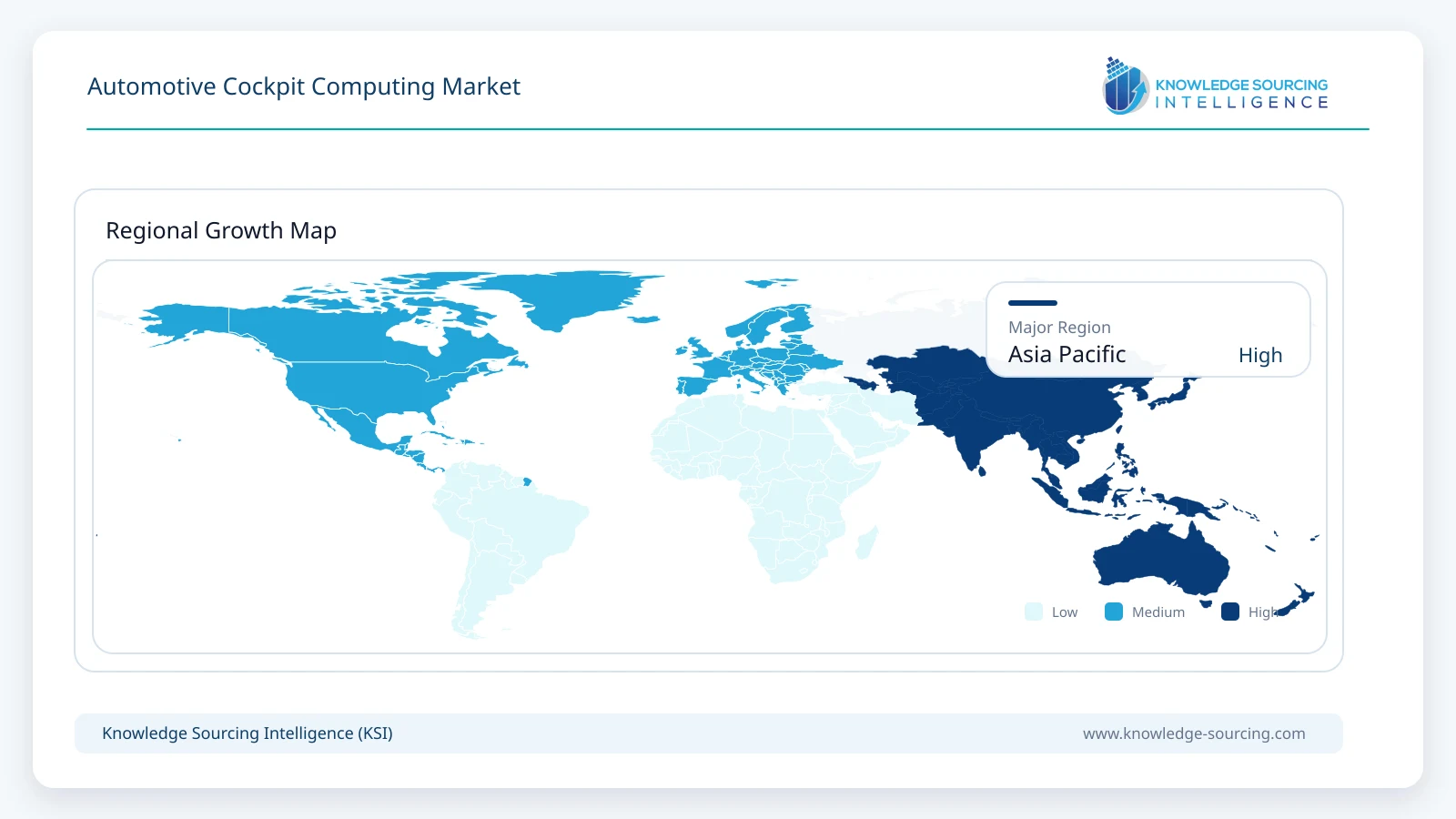
Asia Pacific is estimated to be the largest regional cockpit-computing market in 2026 because China combines high vehicle production with rapid adoption of large displays, AI-enabled smart cockpits and centralized electrical/electronic architectures across both premium and mass-market EV brands. Japan and South Korea add major automotive electronics suppliers, semiconductor ecosystems and high-value OEM programs, while India is becoming a larger deployment market for integrated cockpit domain controllers.
Qualcomm reports broad Snapdragon Cockpit adoption among Chinese OEMs, Leapmotor is moving a dual Snapdragon Elite central controller into production, and Visteon has won SmartCore HPC programs in China and India. Panasonic, LG and other Asian suppliers are also scaling CDC and HPC platforms, giving the region both demand-side volume and a deep local supply base for cockpit computing.
Asia Pacific cockpit-compute demand through 2031 should expand fastest where OEMs reuse common hardware and software platforms across several vehicle lines instead of developing one controller per model. High annual volumes make cost-optimized single-SoC HPCs particularly important, while premium Chinese programs are expected to push faster adoption of cross-domain and AI-intensive architectures.
Europe
Europe represents the second major high-value cockpit-computing market because premium vehicle programs, software-defined vehicle roadmaps and strong Tier 1 engineering capabilities support early adoption of high-performance domain controllers and cross-domain architectures. Bosch, AUMOVIO and HARMAN have significant cockpit-compute portfolios, while European OEMs increasingly require long-term OTA support, virtualized software environments and hardware platforms that can scale across several brands.
Bosch's delivery of more than ten million Snapdragon-based cockpit computers demonstrates substantial production scale, while BMW's 2026 agreement naming Qualcomm as a lead compute-silicon provider for future digital cockpit programs signals continued investment in high-performance centralized platforms. AUMOVIO's cockpit HPC portfolio and cross-domain development further strengthen Europe's role in architectures that combine cockpit, ADAS visualization and wider vehicle functions.
European growth will be shaped by platform longevity, cybersecurity, functional isolation and the ability to reuse software across long vehicle lifecycles. Premium programs should continue to lead adoption of high-end compute, while scalable controller families and virtualization allow the same architectural principles to move into higher-volume mid-range vehicles.
Competitive Landscape
The automotive cockpit computing market combines Tier 1 cockpit-system suppliers, high-performance controller specialists and semiconductor-platform companies. Robert Bosch GmbH, Panasonic Automotive Systems, LG Electronics Vehicle Solution Company, AUMOVIO, HARMAN International, Visteon Corporation and Qualcomm Technologies are directly relevant through cockpit domain controllers, cockpit HPCs, virtualization, compute silicon and cross-domain software-defined vehicle platforms.
Bosch competes through large-scale cockpit-computer production across entry through premium vehicles, while Panasonic combines cockpit domain controllers with virtualization and multi-OS software designed for long SDV lifecycles. LG provides hardware-agnostic multi-VM cockpit controllers and broader high-performance computing platforms, and AUMOVIO offers a scalable portfolio from cost-optimized Smart Cockpit HPC to higher-end cockpit and AD-cockpit systems.
HARMAN differentiates through Ready Upgrade domain controllers, modular compute and virtualization software, while Visteon uses SmartCore and SmartCore HPC to combine cluster, infotainment, displays, cameras and AI-enabled functions. Qualcomm supplies the processor architecture underpinning a large share of these platforms and is increasingly extending Snapdragon Cockpit into cross-domain and central-compute designs with OEMs such as BMW and Leapmotor.
Competitive advantage increasingly depends on more than peak compute performance because OEMs need stable software abstraction, low boot time, mixed-criticality isolation, efficient thermal design, long semiconductor support and a clear migration path from dedicated cockpit controllers toward broader central compute. Suppliers able to preserve application software across processor generations and vehicle classes can create more durable platform economics than vendors competing primarily on one hardware specification.
Recent Developments
29 July 2026: Qualcomm and BMW Group announced a long-term agreement naming Qualcomm a lead compute-silicon provider for BMW's next-generation digital cockpit and automated-driving platforms, extending Snapdragon Digital Chassis adoption through the next decade.
7 July 2026: Panasonic Automotive Systems announced that its cockpit domain controller was adopted for Mazda's all-new CX-5, integrating infotainment, head-up display and instrument-cluster functions on an updatable SDV-oriented platform.
10 April 2026: Bosch and Qualcomm expanded their strategic collaboration after Bosch surpassed ten million delivered cockpit computers powered by Snapdragon Cockpit platforms across vehicle segments from entry to premium.
24 February 2026: Panasonic Automotive Systems announced completion of a VirtIO-compliant in-vehicle software platform for cockpit domain controllers, supporting hardware-software decoupling and reusable virtualized development across SDV platforms.
8 January 2026: Visteon presented production specifications and OEM implementations of its SmartCore high-performance compute solution built on Snapdragon Cockpit Elite, targeting centralized AI-enabled cockpit architectures.
5 January 2026: Leapmotor and Qualcomm introduced a mass-production dual-Snapdragon Elite central controller for the Leapmotor D19 that unifies cockpit, driver-assistance, body-control, and gateway workloads on one cross-domain computing system.
Market Outlook
The automotive cockpit computing market is expanding as OEMs replace separate cluster, infotainment, and display controllers with consolidated domain and high-performance computers. Dedicated cockpit HPCs should remain the largest architecture because they provide a practical balance between ECU consolidation, software reuse, cost and validation complexity. Increasing integration of digital instrument clusters, infotainment, advanced displays, and connected cockpit functions is strengthening demand for centralized computing platforms. Automakers are also prioritizing scalable architectures that support software-defined vehicle strategies, over-the-air updates and enhanced user experiences. This transition is encouraging greater adoption of high-performance computing solutions capable of managing multiple cockpit functions through fewer, more powerful electronic control units.
Cross-domain and central-compute architectures will nevertheless capture the fastest growth as premium and EV platforms integrate cockpit workloads with ADAS visualization, cabin sensing, body or gateway functions. Virtualization, multi-OS execution and modular compute will become more valuable because OEMs need software portability across rapidly changing processor generations and long vehicle lifecycles.
Asia Pacific is expected to retain the largest regional value pool, while Europe remains a major high-value engineering and commercialization market. Competitive performance will depend on scalable compute tiers, efficient AI acceleration, thermal management, mixed-criticality isolation, OTA lifecycle support and the ability to migrate from cockpit-domain to central-compute architectures without forcing OEMs to rebuild their application software.
Automotive Cockpit Computing Market Scope:
| Report Metric | Details |
|---|---|
| Total Market Size in 2026 | USD 9.20 billion |
| Total Market Size in 2031 | USD 21.23 billion |
| Forecast Unit | USD Billion |
| Growth Rate | 18.2% |
| Study Period | 2021 to 2031 |
| Historical Data | 2021 to 2024 |
| Base Year | 2025 |
| Forecast Period | 2026 – 2031 |
| Segmentation | Component, Compute Architecture, Processing Configuration, Application |
| Companies |
|
Market Segmentation
By Component
Compute Hardware and Controller Modules
Base Software, Virtualization and Middleware
Integration and Engineering Software
By Compute Architecture
Cockpit Domain Controller and Dedicated Cockpit HPC
Cross-Domain Cockpit and ADAS/Central Compute
Distributed and Modular Cockpit Compute
By Processing Configuration
Single-SoC Integrated Platforms
Multi-SoC and Multi-Processor Platforms
System-on-Module and Upgradeable Compute Platforms
By Application
Infotainment, Digital Cluster and Multi-Display Computing
AI HMI and Cabin Intelligence
ADAS Visualization, Surround View and Camera Processing
Audio, Connectivity and Communication Services
Other Cockpit and Vehicle Services
By Vehicle Class
Premium and Upper-Mid-Range Vehicles
Mid-Range Vehicles
Mass-Market and Economy Vehicles
By Vehicle Type
Passenger Vehicles
Light Commercial Vehicles
Medium and Heavy Commercial Vehicles
Shared and Autonomous Mobility Vehicles
By Geography
North America
United States
Canada
Mexico
South America
Brazil
Argentina
Others
Europe
Germany
United Kingdom
France
Italy
Spain
Others
Middle East and Africa
Saudi Arabia
UAE
South Africa
Others
Asia Pacific
China
Japan
South Korea
India
Singapore
Others
Table of Contents
1. INTRODUCTION
1.1. Market Overview
1.2. Market Definition
1.3. Scope of the Study
1.4. Market Segmentation
1.5. Currency
1.6. Assumptions
1.7. Base and Forecast Years
1.8. Key Benefits to Stakeholders
2. RESEARCH METHODOLOGY
2.1. Research Design
2.2. Secondary Research
2.3. Primary Research
2.4. Market Estimation
2.5. Segment Modelling
2.6. Data Triangulation and Validation
3. EXECUTIVE SUMMARY
3.1. Key Findings
3.2. Automotive Cockpit Computing Market Size, 2026-2031
3.3. Component Outlook
3.4. Compute Architecture Outlook
3.5. Processing Configuration Outlook
3.6. Application Outlook
3.7. Vehicle Class Outlook
3.8. Vehicle Type Outlook
3.9. Regional Opportunity Summary
4. MARKET DYNAMICS
4.1. Market Drivers
4.1.1. Software-Defined Vehicle Architectures Are Accelerating Cockpit Domain Consolidation
4.1.2. Rising Display, Graphics and Camera Workloads Are Increasing Compute Requirements
4.1.3. On-Device AI Is Expanding the Role of the Cockpit Computer
4.1.4. Virtualization and Multi-OS Platforms Are Reducing Software Rework across Vehicle Programs
4.1.5. Cross-Domain Architectures Are Increasing the Strategic Value of Cockpit Compute
4.2. Market Restraints
4.2.1. High Compute Cost and Thermal Management Can Limit Mainstream Deployment
4.2.2. Functional Isolation and Mixed-Criticality Software Increase Validation Complexity
4.2.3. Rapid Semiconductor Cycles Conflict with Long Vehicle Development and Support Lifecycles
4.2.4. Software Fragmentation Can Reduce the Benefits of Hardware Consolidation
4.2.5. Cross-Domain Integration Can Create Supplier and Organizational Boundary Conflicts
4.3. Market Opportunities
4.4. Porter's Five Forces Analysis
4.5. Industry Value Chain Analysis
4.6. Cockpit Compute Hardware, Software and Integration Economics
4.7. Functional Safety, Cybersecurity and SDV Software Environment
5. TECHNOLOGY OUTLOOK
5.1. Cockpit Domain Controllers and Cockpit High-Performance Computers
5.2. Automotive CPU, GPU and NPU SoC Architectures
5.3. Multi-OS Virtualization, Hypervisors and VirtIO
5.4. Cluster and Infotainment Domain Consolidation
5.5. Multi-Display Graphics, HUD and 3D Rendering
5.6. AI Acceleration and Edge Inference
5.7. Camera, Cabin-Sensing and Surround-View Inputs
5.8. Cockpit-ADAS Cross-Domain Compute
5.9. Central and Zonal E/E Architecture Integration
5.10. System-on-Module and Modular Compute Architectures
5.11. Memory, Storage, Networking and High-Speed I/O
5.12. Thermal Management and Liquid-Cooled Cockpit HPC
5.13. OTA Updates, Hardware Abstraction and Lifecycle Management
6. AUTOMOTIVE COCKPIT COMPUTING MARKET BY COMPONENT
6.1. Introduction
6.2. Compute Hardware and Controller Modules
6.3. Base Software, Virtualization and Middleware
6.4. Integration and Engineering Software
7. AUTOMOTIVE COCKPIT COMPUTING MARKET BY COMPUTE ARCHITECTURE
7.1. Introduction
7.2. Cockpit Domain Controller and Dedicated Cockpit HPC
7.3. Cross-Domain Cockpit and ADAS/Central Compute
7.4. Distributed and Modular Cockpit Compute
8. AUTOMOTIVE COCKPIT COMPUTING MARKET BY PROCESSING CONFIGURATION
8.1. Introduction
8.2. Single-SoC Integrated Platforms
8.3. Multi-SoC and Multi-Processor Platforms
8.4. System-on-Module and Upgradeable Compute Platforms
9. AUTOMOTIVE COCKPIT COMPUTING MARKET BY APPLICATION
9.1. Introduction
9.2. Infotainment, Digital Cluster and Multi-Display Computing
9.3. AI HMI and Cabin Intelligence
9.4. ADAS Visualization, Surround View and Camera Processing
9.5. Audio, Connectivity and Communication Services
9.6. Other Cockpit and Vehicle Services
10. AUTOMOTIVE COCKPIT COMPUTING MARKET BY VEHICLE CLASS
10.1. Introduction
10.2. Premium and Upper-Mid-Range Vehicles
10.3. Mid-Range Vehicles
10.4. Mass-Market and Economy Vehicles
11. AUTOMOTIVE COCKPIT COMPUTING MARKET BY VEHICLE TYPE
11.1. Introduction
11.2. Passenger Vehicles
11.3. Light Commercial Vehicles
11.4. Medium and Heavy Commercial Vehicles
11.5. Shared and Autonomous Mobility Vehicles
12. AUTOMOTIVE COCKPIT COMPUTING MARKET BY GEOGRAPHY
12.1. North America
12.1.1. United States
12.1.2. Canada
12.1.3. Mexico
12.2. South America
12.2.1. Brazil
12.2.2. Argentina
12.2.3. Others
12.3. Europe
12.3.1. Germany
12.3.2. United Kingdom
12.3.3. France
12.3.4. Italy
12.3.5. Spain
12.3.6. Others
12.4. Middle East and Africa
12.4.1. Saudi Arabia
12.4.2. UAE
12.4.3. South Africa
12.4.4. Others
12.5. Asia Pacific
12.5.1. China
12.5.2. Japan
12.5.3. South Korea
12.5.4. India
12.5.5. Singapore
12.5.6. Others
13. COMPETITIVE ENVIRONMENT AND ANALYSIS
13.1. Major Players and Strategy Analysis
13.2. Market Share Analysis
13.3. Cockpit Compute Architecture Benchmarking
13.4. Dedicated Cockpit HPC versus Cross-Domain Compute Comparison
13.5. SoC, GPU, NPU and Memory Performance Benchmarking
13.6. Virtualization, Multi-OS and Hardware-Abstraction Benchmarking
13.7. Multi-Display, Camera and AI Workload Benchmarking
13.8. OEM Programs and Production Readiness
13.9. Competitive Dashboard
14. COMPANY PROFILES
14.1. Robert Bosch GmbH
14.2. Panasonic Automotive Systems Co., Ltd.
14.3. LG Electronics Vehicle Solution Company
14.4. AUMOVIO
14.5. HARMAN International
14.6. Visteon Corporation
14.7. Qualcomm Technologies, Inc.
15. APPENDIX
15.1. Currency
15.2. Assumptions
15.3. Base and Forecast Years Timeline
15.4. Key Benefits for Stakeholders
15.5. Research Methodology
15.6. Abbreviations
15.7. Data Sources
Navigate
Trusted by the world's leading organizations











