
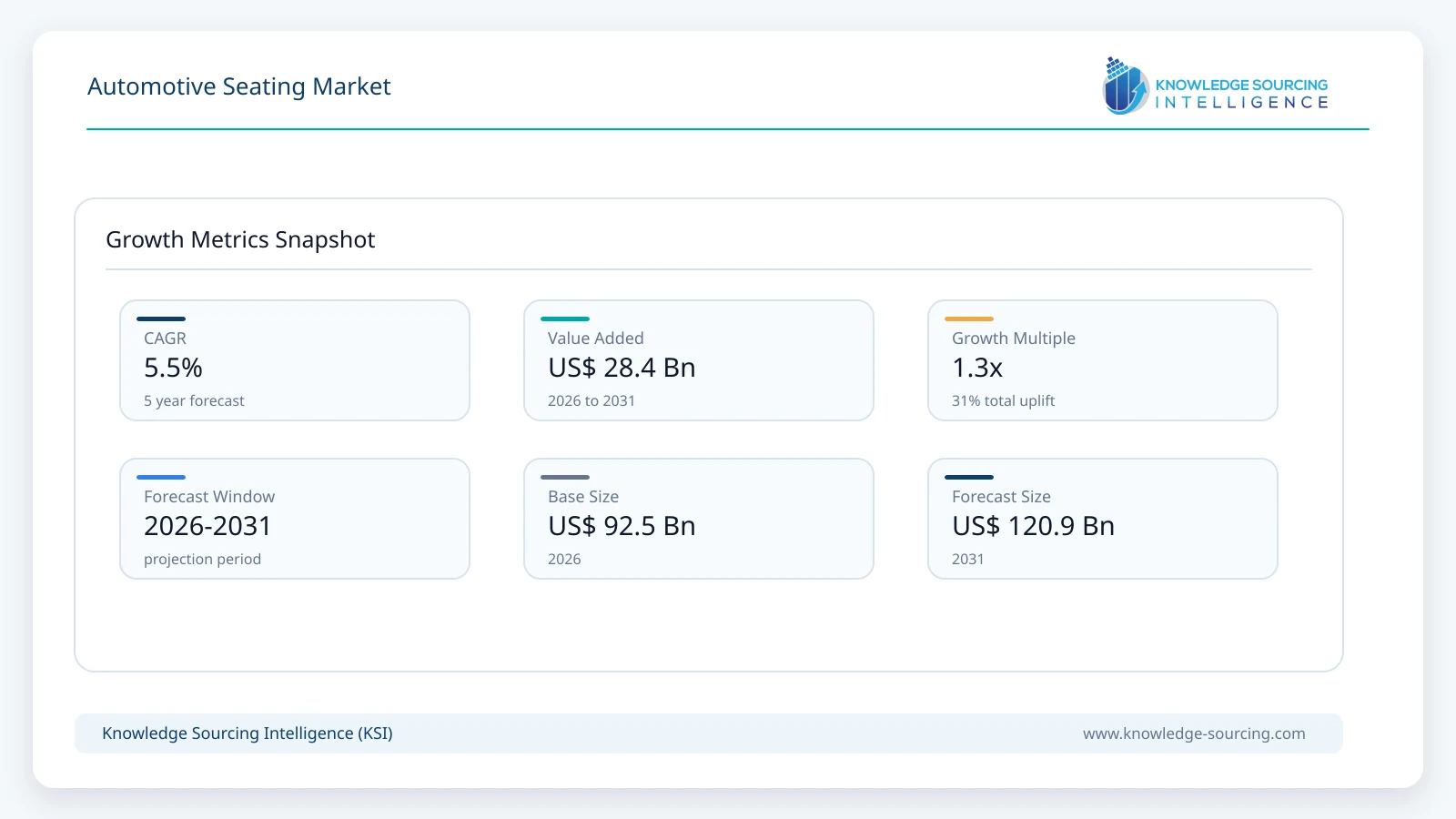
The automotive seating market is estimated at approximately USD 92.5 billion in 2026 and is projected to reach about USD 120.9 billion by 2031, representing a CAGR of 5.5% during the forecast period.
Highlights:
- 1Individual and bucket-type seat systems account for approximately 58% of global market value in 2026 because front seats and premium second-row captain seats carry the highest concentration of mechanisms, power adjustment and comfort features.
- 2Manual and mechanically adjusted seating represents approximately 54% of 2026 market value, while powered and electronically controlled systems are gaining share rapidly as multi-axis adjustment and memory migrate into mainstream vehicle segments.
- 3Conventional comfort seating without advanced thermal or massage packages accounts for approximately 52% of 2026 market value, while thermal, pneumatic and adaptive comfort systems represent the fastest-growing content layer.
- 4Front-row seating systems account for approximately 61% of global market value in 2026 because driver and front-passenger seats carry more structural, adjustment, safety and comfort content than rear seating positions.
- 5Passenger vehicles represent approximately 92% of global market value in 2026, supported by high production volumes and substantially higher comfort and electronics content than most commercial-vehicle applications.
- 6Asia Pacific represents approximately 46% of global market value in 2026, supported by vehicle-production scale and rapid adoption of zero-gravity, executive, ventilated and intelligent seating among Chinese, Japanese and South Korean OEMs.
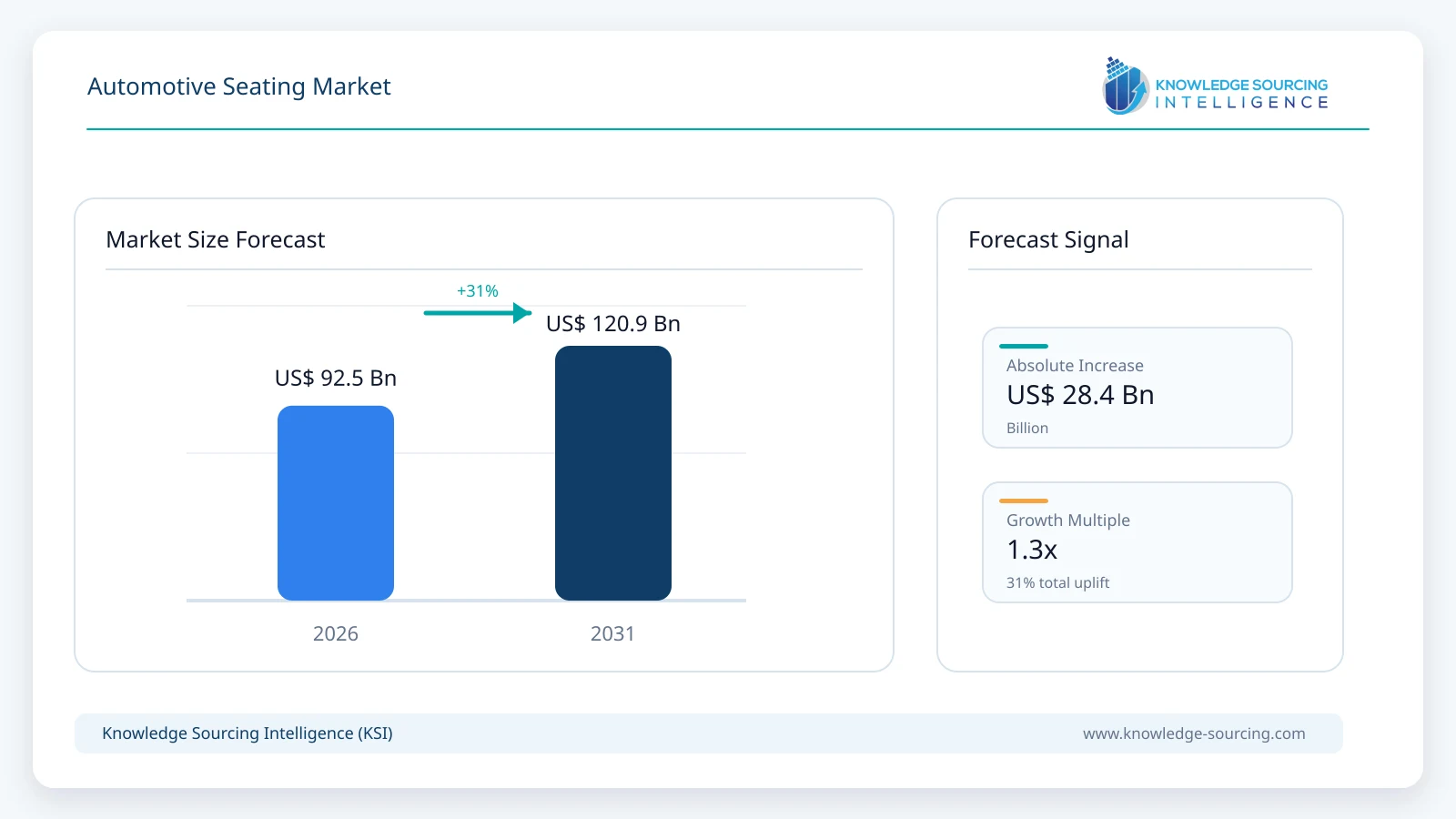
Complete seat systems are moving beyond conventional mechanically adjusted structures toward higher-content architectures that combine multi-axis power actuation, memory, heating, ventilation, massage, occupant sensing, lightweight structures and software-controlled personalization. Value growth is therefore increasingly tied to the amount of comfort, electronics and reconfigurability integrated into each seating position rather than vehicle production alone.
Adient, Lear, FORVIA, Magna, Toyota Boshoku and other major suppliers are pairing modular seat platforms, thinner and lighter structures, reconfigurable rails and adaptive comfort with highly localized manufacturing networks. Complete-seat supply remains operationally demanding because assemblies are bulky, highly variant-rich and delivered in exact build sequence to vehicle plants, requiring tight control of structures, foam, trim, final assembly and launch execution. Competitive advantage therefore depends on balancing higher-value seating innovation with program-management discipline, regional production scale and reliable just-in-time delivery.
Market Overview
A production-ready automotive seat combines a crash-critical structural frame with tracks and adjustment mechanisms, cushioning, trim, head restraints, restraint interfaces and a growing set of electronic comfort functions. Front seats carry the highest content through multi-way power adjustment, memory, heating, ventilation, lumbar, massage, side airbags and occupancy sensing, while rear systems range from split benches to powered executive captain seats with leg rests, tables and climate functions. Electric and software-defined vehicle platforms are expanding the design envelope further through long rails, swivels, fold-flat mechanisms and zero-gravity positions that allow the cabin to shift between driving, resting, working and cargo modes; Magna and FORVIA are among the suppliers developing these reconfigurable and adaptive architectures.
Comfort, wellness and sustainability are increasingly being engineered as part of one complete-seat system rather than as isolated component upgrades. Lear integrates thermal and comfort functions through platforms such as ComfortFlex and ComfortMax, while Adient is expanding mechanical massage and foot-massage functions into production programs. At the same time, lightweight structures, lower-density foam, recyclable trim foundations, renewable-content polyurethane and simplified material combinations are reducing mass and lifecycle impact, giving vertically integrated suppliers greater scope to optimize cost, comfort, recyclability and manufacturability across the full seat rather than improve individual components in isolation.
Market Trends
Zero-Gravity and Executive Seating Is Moving into Higher-Volume EV Programs
Zero-gravity seating is moving beyond flagship luxury vehicles into premium electric SUVs and MPVs, with FORVIA's 2026 Luxeed award demonstrating production-oriented seats that recline toward a near-horizontal position and automatically adjust based on occupant morphology and vehicle driving conditions. Chinese EV brands are using these features to differentiate rear-seat comfort and create lounge-like interior experiences.
Delivering zero-gravity and executive-seat functionality requires stronger recliners, longer travel, leg-rest mechanisms, power actuation and careful restraint integration, increasing the engineering burden as these configurations move into higher-volume programs. Suppliers therefore need to simplify the architecture so premium comfort can be delivered without excessive mass, cost or package height.
Adaptive Seating Is Linking Physical Comfort with Software and Occupant Data
Adaptive seating is increasingly being designed to respond to occupant identity, posture and vehicle operating conditions, turning the seat from a fixed comfort component into a system that can adjust position and support dynamically. Magna describes this approach through adaptive seating concepts, while FORVIA is applying algorithms to real-time seat adjustment in production-oriented programs.
The integration of sensors, position data and software logic is creating a new value layer by allowing seat movement to be coordinated with driver profiles, cabin monitoring, entry and exit, climate systems and automated-driving modes. This increasingly turns the complete seat into an electromechanical node within the wider vehicle architecture rather than a stand-alone comfort component.
Modular Seat Architecture Is Reducing Manufacturing Complexity
Seat manufacturers are using modular architectures to increase variant flexibility without multiplying assembly complexity, as illustrated by Adient's ModuTec platform, which separates major seat modules for offline build and rapid sequencing into the main just-in-time line. Magna similarly emphasizes flexible seating systems that reuse a common architecture across different use cases and vehicle programs.
Lower assembly labor, faster changeover and greater automation form the main commercial benefit of modular seat design, while the same architecture allows premium comfort or trim variants to be added without rebuilding the complete production process. This flexibility is becoming increasingly important as OEM option complexity grows across vehicle programs.
Thermal, Massage and Wellness Functions Are Moving Down-Market
Heating is already widely established, while ventilation, pneumatic lumbar and massage are spreading into higher-volume vehicle segments, with Adient's 2026 StepJoy foot massage launch on NIO's ES9 and ProForce Massage Flow programs for two Chinese OEM models showing that wellness functions are moving from concept demonstrations into production. The shift broadens the addressable market for advanced comfort beyond traditional flagship vehicles.
Lear and Gentherm are expanding integrated thermal and pneumatic comfort systems as demand shifts toward solutions that combine heating, cooling and massage with fewer components and lower power consumption. The opportunity is particularly relevant in EVs, where localized seat comfort can reduce the energy required for whole-cabin HVAC operation.
Sustainable Seat Materials Are Moving from Components to Full-System Strategies
Complete-seat sustainability strategies are moving beyond isolated material substitutions, as shown by Adient and Dow's renewable-content polyurethane foam, Lear's recyclable FlexAir cushioning and Magna's EcoSphere combination of sustainable foam, trim foundations, face materials and structures. This approach gives suppliers greater scope to reduce lifecycle impact across the full seating system rather than optimize individual materials independently.
Designing seats so individual layers can be separated, reused or recycled without compromising crash performance or craftsmanship is becoming the next stage of complete-seat sustainability. Suppliers with control over the full bill of materials are better positioned to coordinate these changes across foam, trim, structures and assembly while limiting added manufacturing cost.
Segment Analysis
By Seat Configuration: Individual and Bucket-Type Seat Systems
Individual and bucket-type seats form the largest configuration segment because almost every passenger vehicle uses two front individual seats and an increasing number of premium SUVs and MPVs use second-row captain seats. These systems carry the highest content in power adjustment, side bolsters, heating, ventilation, massage, memory and occupant sensing.
Individual and bucket-type seat systems represent approximately USD 53.65 billion in 2026 and could approach USD 72 billion by 2031 as higher comfort content per seat and executive second-row configurations expand across China, North America and premium European vehicle programs. Their value growth therefore reflects both broad front-seat penetration and rising feature intensity in premium rear seating.
By Adjustment and Actuation: Manual and Mechanical Seating Systems
Manual and mechanically adjusted seats remain the largest category globally because entry and mid-range vehicles continue to rely on lever-operated slide, recline and height adjustment. These systems provide lower cost, lower mass and simpler electronics and remain especially important in emerging markets and rear seating positions.
Manual and mechanically adjusted systems account for approximately USD 49.95 billion of market value in 2026, but their share is expected to decline through 2031 as power seats spread into mainstream vehicles. Absolute demand will nevertheless remain substantial because low-cost passenger cars, rear seating positions and commercial vehicles continue to prioritize simplicity, durability and lower system cost.
By Comfort Integration: Conventional Comfort Seating
Conventional comfort seating includes complete seats with standard cushioning, ergonomic contouring and limited electrical content but without advanced ventilation, massage or adaptive wellness packages. It remains the largest category because it spans the majority of global compact, mid-size and commercial vehicle production.
Conventional comfort seating represents approximately USD 48.10 billion in 2026, although its share will decline as thermal, pneumatic and adaptive systems expand across higher-volume vehicle segments. Suppliers will continue to improve the category through thinner frames, optimized foam, suspension design and better pressure distribution rather than relying on high-cost electronics.
By Seating Row: Front-Row Seating Systems
Front-row seats are the largest value pool because they must satisfy the widest range of adjustment, crash, ergonomic and comfort requirements. Driver seats typically include the greatest mechanism and electronics content, while front-passenger seats increasingly adopt memory, ventilation, massage and zero-gravity functions on premium vehicles.
Front-row seating systems account for approximately USD 56.43 billion in 2026 and could approach USD 75 billion by 2031 as powered adjustment, wellness functions and adaptive support increase content per seat. Lightweighting will remain equally important because suppliers must offset the added mass of motors, mechanisms and electronics without compromising crash performance or packaging efficiency.
By Vehicle Type: Passenger Vehicles
Passenger cars, SUVs, crossovers and MPVs dominate the market because they combine high global production with the richest seating content. SUVs and premium MPVs are particularly important because they support multiple seating rows, captain chairs, fold-flat mechanisms and high-value comfort packages.
Passenger vehicles represent approximately USD 85.10 billion in 2026 and could exceed USD 110 billion by 2031, with most incremental value expected to come from power actuation, thermal comfort and premium rear-seat configurations. Commercial vehicles remain important for durable driver seats and ergonomic systems, but their lower feature intensity keeps passenger platforms as the principal source of market expansion.
Market Drivers
Higher Comfort and Wellness Content per Vehicle
Consumer expectations are pushing automotive seating beyond basic support toward integrated comfort and wellness, with heating, ventilation, massage, lumbar adjustment, memory, leg rests and footrests becoming key differentiators in premium and technology-oriented vehicles. As component costs decline, several of these functions are also migrating into broader price segments.
The migration of comfort and wellness functions directly raises complete-seat revenue per vehicle because each added feature requires additional mechanisms, electronics, controls and validation. Suppliers that integrate several functions into common hardware can capture higher content while helping OEMs control mass, packaging and system complexity.
EV and Software-Defined Vehicle Interior Redesign
Electric platforms are creating more freedom for long rails, rotating seats, fold-flat configurations and lounge positions because flatter floors and different cabin proportions reduce several packaging constraints found in conventional powertrains. Software-defined architectures reinforce this shift by allowing seat position to be coordinated with user profiles, climate settings and other cabin systems.
The redesign of EV and software-defined vehicle interiors is increasing demand for flexible and electronically controlled seating architectures that can coordinate position with user profiles, climate settings and other cabin systems. OEMs can also use seating to differentiate the interior as propulsion systems become less visually distinct, making the seat a more strategic element of EV brand identity.
Growth of Premium SUVs, MPVs and Executive Rear Seating
Large SUVs and MPVs support higher seat content because they have more seating positions and greater package space for powered mechanisms, captain chairs and reclining second-row systems. Premium Chinese EVs have accelerated this trend by treating the rear cabin as a lounge or mobile office.
Executive rear seats carry significantly higher value than conventional bench systems because power leg rests, massage, ventilation, integrated tables and long-slide mechanisms materially increase component and integration content per seating position. As premium SUVs and MPVs adopt these configurations more widely, the vehicle-mix shift can raise seating market value even when overall vehicle production grows slowly.
Lightweighting and Packaging Requirements
Reducing frame mass and package height has a meaningful effect on vehicle efficiency and cabin space because seats are among the heaviest interior systems and are simultaneously absorbing more motors, electronics and comfort hardware. Toyota Boshoku's next-generation seat roadmap targets thinner and lighter front and rear structures, while FORVIA and Magna continue to develop compact high-strength mechanisms and frames.
Adding power, thermal and wellness functions without increasing total seat mass has become a central engineering challenge as OEMs pursue both richer cabin content and better vehicle efficiency. Suppliers that combine high-strength materials, optimized mechanisms and fewer components can create more usable cabin space while limiting the energy and weight penalty of added functionality.
OEM Outsourcing of Complete Seat Integration and JIT Assembly
Complete seats combine many components and option variants that must match each vehicle build, making final integration and sequencing a significant source of line-side complexity for automakers. Outsourcing this responsibility to a specialist seating supplier shifts variant management, trim sequencing and functional testing to the Tier 1 while simplifying OEM assembly operations.
The need for localized sequencing and reliable launch execution favors global suppliers with plants close to vehicle assembly sites and strong just-in-time capabilities. This operational barrier supports market concentration because smaller component specialists cannot easily replicate complete-seat engineering, sequencing, manufacturing scale and launch management.
Market Restraints
High Program-Specific Tooling and Capital Requirements
Complete seating programs require dedicated frames, mechanisms, foam tools, trim patterns, assembly fixtures and just-in-time production lines, creating substantial upfront capital requirements before production revenue begins. The exposure is particularly high when a supplier must build or expand a plant near the OEM to support a major platform award.
Program-specific tooling and dedicated production capacity create material financial risk when vehicle launches are delayed or volumes fall below plan. Because this floor space and equipment cannot be redeployed easily across unrelated seat programs, supplier returns remain closely linked to the performance of individual customer platforms.
Growing Mechanical and Electronic Integration Complexity
A premium complete seat may combine dozens of motors, switches, sensors, heaters, blowers, valves, pneumatic cells and control electronics within a crash-critical structure, making integration complexity a direct engineering and warranty challenge rather than simply a feature-count issue. Each added function increases wiring, software diagnostics, thermal-management requirements and potential failure modes.
The growing combination of motors, sensors, heaters, blowers, valves, pneumatic cells and control electronics can offset the value benefit of higher seat content by increasing validation, warranty and launch complexity. Suppliers must validate mechanical, electrical and comfort systems together while coordinating a large sub-supplier network, which raises engineering and program-management cost.
Persistent OEM Cost-Down Pressure
Aggressive annual OEM productivity targets place persistent pressure on seating economics even though complete seats carry high visible value and substantial material content. Inflation in steel, foam chemicals, textiles, leather, electronics and labor can therefore compress margins when long-term contracts limit immediate price recovery.
Protecting margins under sustained OEM cost-down pressure increasingly depends on automation, common architectures and vertical integration across major seat subsystems. Premium features can lift revenue, but they do not automatically improve profitability when added mechanical or electronic complexity increases warranty exposure and assembly cost.
Safety Validation Limits Rapid Architectural Change
Because seats form a core part of the occupant-restraint system, any new architecture must continue to manage crash loads, whiplash performance, side-airbag deployment and occupant positioning across the permitted range of seat movement. Swivel, long-slide and zero-gravity concepts therefore require extensive validation across multiple seating positions before they can move into broader production.
Extensive crash and restraint validation slows the adoption of radical reconfigurable seating concepts because new swivel, long-slide and zero-gravity positions cannot be treated as conventional fixed seating states. OEMs and suppliers must often restrict when certain positions can be used or automatically return the seat to a safe crash posture, adding sensors, controls and system-level coordination.
Bulky JIT Logistics and Labor Intensity
The bulky, highly customized nature of complete seats makes long-distance transport inefficient and reinforces the need for assembly close to vehicle plants. Exact-sequence delivery also leaves limited buffer inventory and little tolerance for production disruption, making logistics execution a direct part of program performance.
Trim and final seat assembly remain labor intensive despite increasing automation, leaving program economics exposed to wage inflation, workforce availability and line stoppages. These operating constraints can also affect OEM production continuity because sequenced seating supply typically carries little inventory buffer.
Regional Outlook
Asia Pacific
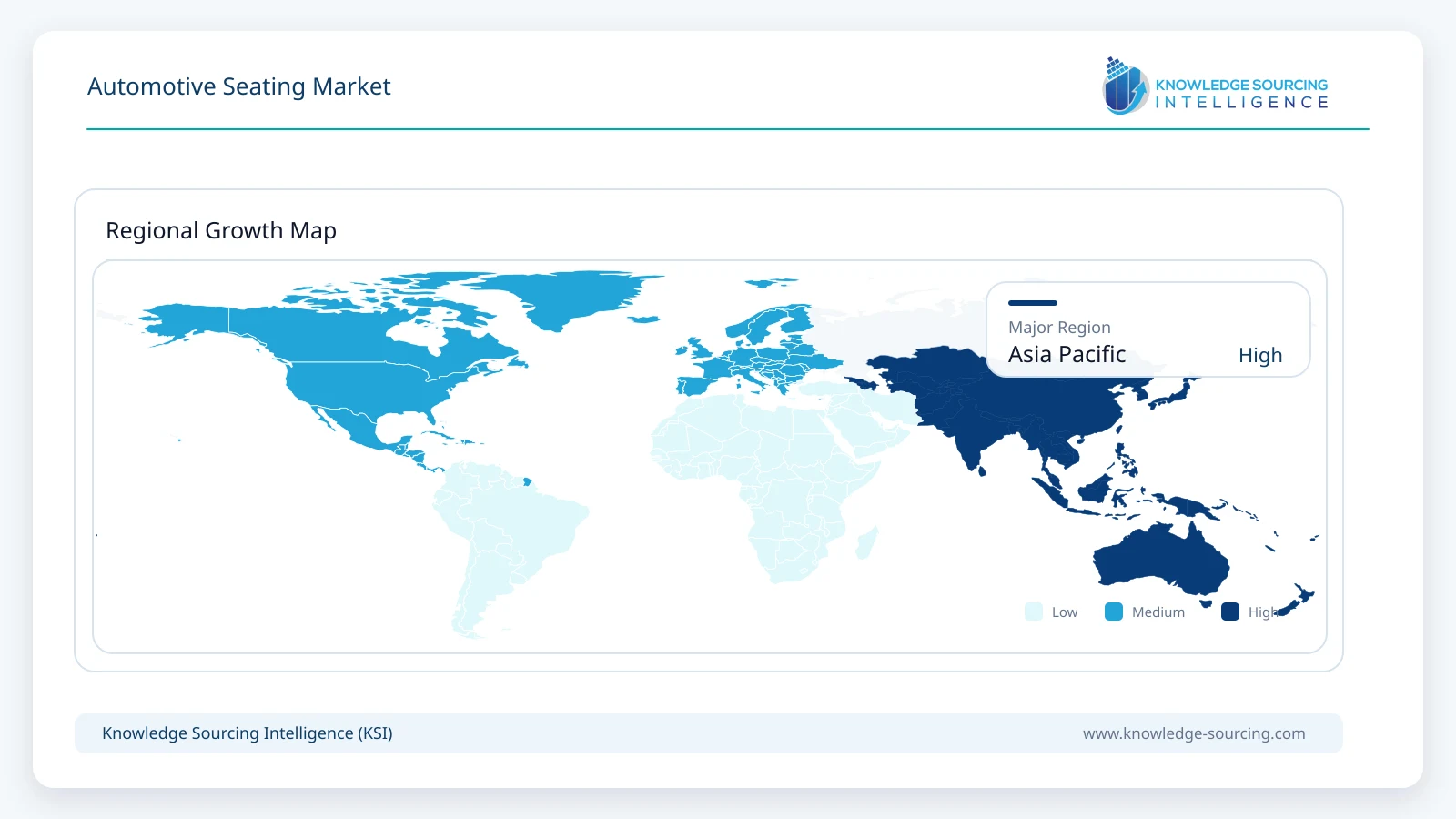
Asia Pacific is the largest automotive seating market because vehicle-production scale in China, Japan, South Korea and India is being reinforced by rapid growth in high-content seating, particularly within Chinese EV and premium vehicle programs. Zero-gravity seats, powered second-row captain chairs, ventilation, massage, footrests and smart adaptive comfort are increasingly being used as core cabin differentiators, making China the region's strongest value-growth market.
Asia Pacific combines deep regional seating capability with substantial manufacturing scale, as Toyota Boshoku, TS TECH, TACHI-S, Yanfeng Seating and global suppliers including Adient, Lear, FORVIA and Magna maintain major engineering and production operations across the region. FORVIA's 2026 Luxeed award and Adient's production launches with Chinese OEMs show how new comfort features are being industrialized first at scale in the market.
Growth through 2031 will be supported by both vehicle volume and rising seating content, with China remaining the principal technology driver while India and Southeast Asia add production growth for cost-optimized complete seats. These markets are also expected to adopt progressively higher levels of power adjustment and comfort functionality as vehicle segments mature.
North America
North America is a major high-value seating market because SUVs, pickups and large crossovers carry substantial seat content and premium trims frequently include power adjustment, heating, ventilation and memory. Large vehicles also create more opportunity for third-row mechanisms, fold-flat systems and premium captain chairs.
North America's complete-seat manufacturing base is anchored by extensive operations from Adient, Lear and Magna, with Toyota Boshoku and other Japanese suppliers supporting major transplant programs across the region. Magna reported USD 5.9 billion of Seating Systems sales in 2025, while Adient and Lear maintain broad complete-seat manufacturing networks across the United States, Canada and Mexico.
North American seating growth is expected to depend more on content per vehicle than on unit production, reflecting the region's concentration of SUVs, pickups and premium trim packages. Comfort systems, large-vehicle seating architectures, sustainable materials and manufacturing automation are therefore expected to raise average system value through 2031.
Competitive Landscape
The automotive seating market is concentrated among global Tier 1 suppliers with the scale to engineer, manufacture and sequence complete seat systems across multiple regions. Adient, Lear, FORVIA and Magna are among the largest global suppliers and compete through complete-seat integration, structures, foam, trim and advanced comfort technologies. Toyota Boshoku, Yanfeng Seating, TS TECH, TACHI-S and Hyundai Transys add strong regional and global positions.
System architecture is becoming a more important basis of competitive differentiation as suppliers seek to integrate manufacturing flexibility, comfort technology and reconfigurability into common complete-seat platforms. Adient is emphasizing modular manufacturing and advanced massage; Lear combines complete seating with thermal and modular comfort systems; FORVIA is commercializing algorithm-based adaptive zero-gravity seating; and Magna is developing flexible, reconfigurable and adaptive seating concepts.
Vertical integration across structures, mechanisms, foam, trim and final assembly gives seating suppliers greater control over weight, cost, craftsmanship and response time when OEMs request new comfort content or material changes. Specialist technology companies remain important partners for thermal, pneumatic and electronic subsystems where dedicated expertise is required.
A localized manufacturing footprint remains a major barrier to entry because complete seats must be assembled close to customer plants and delivered in sequence, often requiring multiple facilities, dedicated equipment and synchronized supplier networks for global platform awards. Quality, launch performance and operational reliability therefore remain decisive competitive factors alongside product innovation.
Recent Developments
4 August 2026: Adient and Dow commercially launched a next-generation polyurethane seating foam using ISCC PLUS certified renewable-content attribution, extending lower-fossil-content material options into production automotive seating systems.
31 July 2026: Lear reported significant new seating awards including complete-seat business with Audi in Europe and North America and a complete-seat award with Leapmotor in South America, alongside additional ComfortFlex and FlexAir awards.
24 April 2026: Adient introduced ProForce Massage Flow, a modular mechanical massage solution scheduled for production on two Chinese OEM models, expanding mass-production wellness content within complete seats.
14 April 2026: Toyota Boshoku presented its T-CORE seating concept at Milan Design Week 2026, demonstrating Comfort, Relax and Sport seats using a common material and silhouette but different internal structures, density and elasticity.
10 April 2026: Adient launched StepJoy, an automotive-grade foot-massage system entering mass production on NIO's ES9 and designed to stow into the seatback when not in use.
18 February 2026: FORVIA won a multi-year complete-seat program with Luxeed covering several hundred thousand seat sets and including lightweight frames, zero-gravity seating and algorithm-driven real-time adjustment based on occupant morphology and driving conditions.
22 January 2026: Adient announced ModuTec, a modular seat design and manufacturing concept that shifts major subassembly offline and enables rapid sequencing into the main just-in-time production line.
Market Outlook
The automotive seating market is expected to expand from approximately USD 92.500 billion in 2026 to about USD 120.894 billion by 2031, with higher content per seat contributing more to value growth than unit production alone. Global vehicle output will remain the baseline demand driver, but power actuation, thermal comfort, massage, executive configurations and adaptive functions will increasingly determine revenue expansion through the forecast period.
Powered adjustment, climate-controlled seating, massage, executive rear-seat configurations and adaptive comfort will increase average revenue per seat, while modular structures and automation are expected to offset some of the added manufacturing complexity. Reconfigurable and zero-gravity designs will remain concentrated in premium and EV programs but should move gradually into broader segments as mechanisms become more standardized.
Asia Pacific will remain the largest regional market and the main center for rapid comfort-feature adoption, while North America continues to generate high average seat value through large vehicles and premium option penetration. Supplier success will depend on combining comfort innovation with lower mass, scalable manufacturing, sustainable materials and reliable JIT execution.
Automotive Seating Market Scope
| Report Metric | Details |
|---|---|
| Total Market Size in 2026 | USD 92.5 billion |
| Total Market Size in 2031 | USD 120.9 billion |
| Forecast Unit | Billion |
| Growth Rate | 5.5% |
| Study Period | 2021 to 2031 |
| Historical Data | 2021 to 2024 |
| Base Year | 2025 |
| Forecast Period | 2026 – 2031 |
| Segmentation | Seat Configuration, Adjustment and Actuation, Comfort Integration, Seating Row, Vehicle Type, Geography |
| Companies |
|
Market Segmentation
By Seat Configuration
Individual and Bucket-Type Seat Systems
Bench and Split-Bench Seat Systems
Captain and Executive Seat Systems
Foldable, Swivel and Reconfigurable Seating Systems
By Adjustment and Actuation
Manual and Mechanical Seating Systems
Powered and Electromechanical Seating Systems
Intelligent and Automatically Adjustable Seating Systems
By Comfort Integration
Conventional Comfort Seating
Heated Seating Systems
Ventilated and Climate-Controlled Seating
Massage, Pneumatic and Wellness Seating
Adaptive and Zero-Gravity Comfort Systems
By Seating Row
Front-Row Seating Systems
Second-Row Seating Systems
Third-Row and Specialty Seating Systems
By Vehicle Type
Passenger Vehicles
Light Commercial Vehicles
Medium and Heavy Commercial Vehicles
Buses and Coaches
By Geography
North America
United States
Canada
Mexico
South America
Brazil
Argentina
Others
Europe
Germany
United Kingdom
France
Italy
Spain
Others
Middle East and Africa
Saudi Arabia
UAE
South Africa
Others
Asia Pacific
China
Japan
South Korea
India
Indonesia
Thailand
Others
Table of Contents
1. INTRODUCTION
1.1. Market Overview
1.2. Market Definition
1.3. Scope of the Study
1.4. Market Segmentation
1.5. Currency
1.6. Assumptions
1.7. Base and Forecast Years
1.8. Key Benefits to Stakeholders
2. RESEARCH METHODOLOGY
2.1. Research Design
2.2. Secondary Research
2.3. Primary Research
2.4. Market Estimation
2.5. Segment Modelling
2.6. Data Triangulation and Validation
3. EXECUTIVE SUMMARY
3.1. Key Findings
3.2. Automotive Seating Market Size, 2026-2031
3.3. Seat Configuration Outlook
3.4. Adjustment and Actuation Outlook
3.5. Comfort Integration Outlook
3.6. Seating Row Outlook
3.7. Vehicle Type Outlook
3.8. Regional Opportunity Summary
4. MARKET DYNAMICS
4.1. Market Drivers
4.1.1. Higher Comfort and Wellness Content per Vehicle
4.1.2. EV and Software-Defined Vehicle Interior Redesign
4.1.3. Growth of Premium SUVs, MPVs and Executive Rear Seating
4.1.4. Lightweighting and Packaging Requirements
4.1.5. OEM Outsourcing of Complete Seat Integration and JIT Assembly
4.2. Market Restraints
4.2.1. High Program-Specific Tooling and Capital Requirements
4.2.2. Growing Mechanical and Electronic Integration Complexity
4.2.3. Persistent OEM Cost-Down Pressure
4.2.4. Safety Validation Limits Rapid Architectural Change
4.2.5. Bulky JIT Logistics and Labor Intensity
4.3. Market Opportunities
4.4. Porter's Five Forces Analysis
4.5. Industry Value Chain Analysis
4.6. Complete Seat Content, JIT and Vertical Integration Economics
4.7. Safety, Material, Electronics and Sustainability Requirements
5. TECHNOLOGY OUTLOOK
5.1. Lightweight Seat Frames and Structural Architectures
5.2. Long Rails, Swivels and Reconfigurable Seat Mechanisms
5.3. Power Adjustment, Memory and Multi-Axis Actuation
5.4. Zero-Gravity and Executive Seating
5.5. Heating, Ventilation and Climate-Controlled Seats
5.6. Pneumatic Lumbar, Massage and Wellness Systems
5.7. Occupant-Adaptive and Software-Controlled Seating
5.8. Thin Seat and Cabin-Space Optimization
5.9. Sustainable Foam, Trim and Recyclable Seat Materials
5.10. Modular Seat Platforms and Automated Assembly
5.11. Seat Sensors, Local Electronics and Network Integration
5.12. Integrated Safety and Occupant-Position Management
6. AUTOMOTIVE SEATING MARKET BY SEAT CONFIGURATION
6.1. Introduction
6.2. Individual and Bucket-Type Seat Systems
6.3. Bench and Split-Bench Seat Systems
6.4. Captain and Executive Seat Systems
6.5. Foldable, Swivel and Reconfigurable Seating Systems
7. AUTOMOTIVE SEATING MARKET BY ADJUSTMENT AND ACTUATION
7.1. Introduction
7.2. Manual and Mechanical Seating Systems
7.3. Powered and Electromechanical Seating Systems
7.4. Intelligent and Automatically Adjustable Seating Systems
8. AUTOMOTIVE SEATING MARKET BY COMFORT INTEGRATION
8.1. Introduction
8.2. Conventional Comfort Seating
8.3. Heated Seating Systems
8.4. Ventilated and Climate-Controlled Seating
8.5. Massage, Pneumatic and Wellness Seating
8.6. Adaptive and Zero-Gravity Comfort Systems
9. AUTOMOTIVE SEATING MARKET BY SEATING ROW
9.1. Introduction
9.2. Front-Row Seating Systems
9.3. Second-Row Seating Systems
9.4. Third-Row and Specialty Seating Systems
10. AUTOMOTIVE SEATING MARKET BY VEHICLE TYPE
10.1. Introduction
10.2. Passenger Vehicles
10.3. Light Commercial Vehicles
10.4. Medium and Heavy Commercial Vehicles
10.5. Buses and Coaches
11. AUTOMOTIVE SEATING MARKET BY GEOGRAPHY
11.1. North America
11.1.1. United States
11.1.2. Canada
11.1.3. Mexico
11.2. South America
11.2.1. Brazil
11.2.2. Argentina
11.2.3. Others
11.3. Europe
11.3.1. Germany
11.3.2. United Kingdom
11.3.3. France
11.3.4. Italy
11.3.5. Spain
11.3.6. Others
11.4. Middle East and Africa
11.4.1. Saudi Arabia
11.4.2. UAE
11.4.3. South Africa
11.4.4. Others
11.5. Asia Pacific
11.5.1. China
11.5.2. Japan
11.5.3. South Korea
11.5.4. India
11.5.5. Indonesia
11.5.6. Thailand
11.5.7. Others
12. COMPETITIVE ENVIRONMENT AND ANALYSIS
12.1. Major Players and Strategy Analysis
12.2. Market Share Analysis
12.3. Complete Seat Architecture Benchmarking
12.4. Power, Thermal and Wellness Feature Benchmarking
12.5. Reconfigurable and Zero-Gravity Seating Benchmarking
12.6. Sustainable Material and Lightweighting Benchmarking
12.7. Manufacturing Footprint, Vertical Integration and JIT Capability
12.8. Competitive Dashboard
13. COMPANY PROFILES
13.1. Adient plc
13.2. Lear Corporation
13.3. FORVIA
13.4. Magna Seating
13.5. Toyota Boshoku Corporation
13.6. Yanfeng International Seating Systems Co., Ltd.
13.7. TS TECH Co., Ltd.
13.8. TACHI-S Co., Ltd.
13.9. Hyundai Transys
13.10. NHK Spring Co., Ltd.
13.11. Brose Fahrzeugteile SE & Co. KG
13.12. Gentherm Incorporated
14. APPENDIX
14.1. Currency
14.2. Assumptions
14.3. Base and Forecast Years Timeline
14.4. Key Benefits for Stakeholders
14.5. Research Methodology
14.6. Abbreviations
14.7. Data Sources
Navigate
Trusted by the world's leading organizations











