
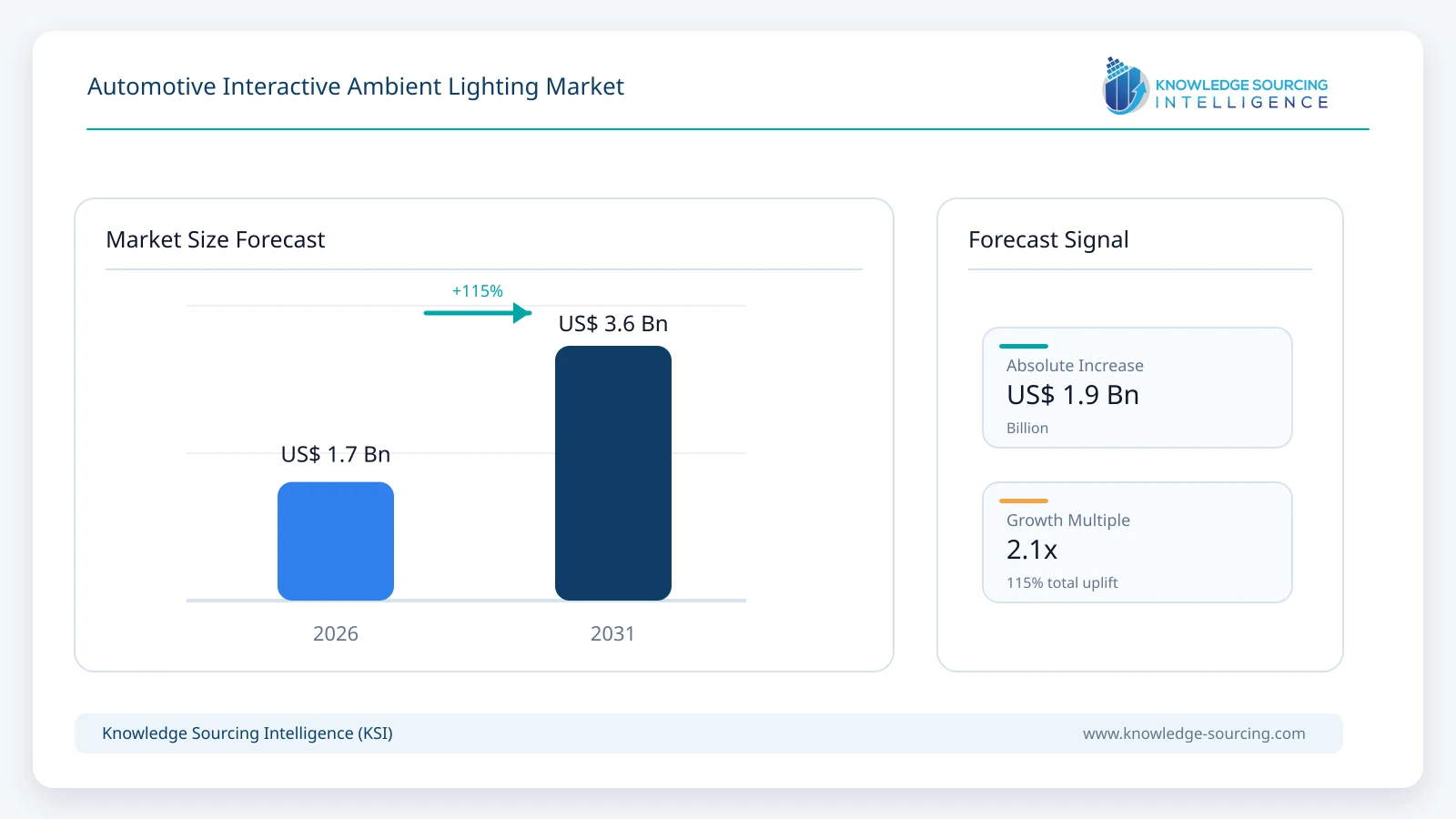
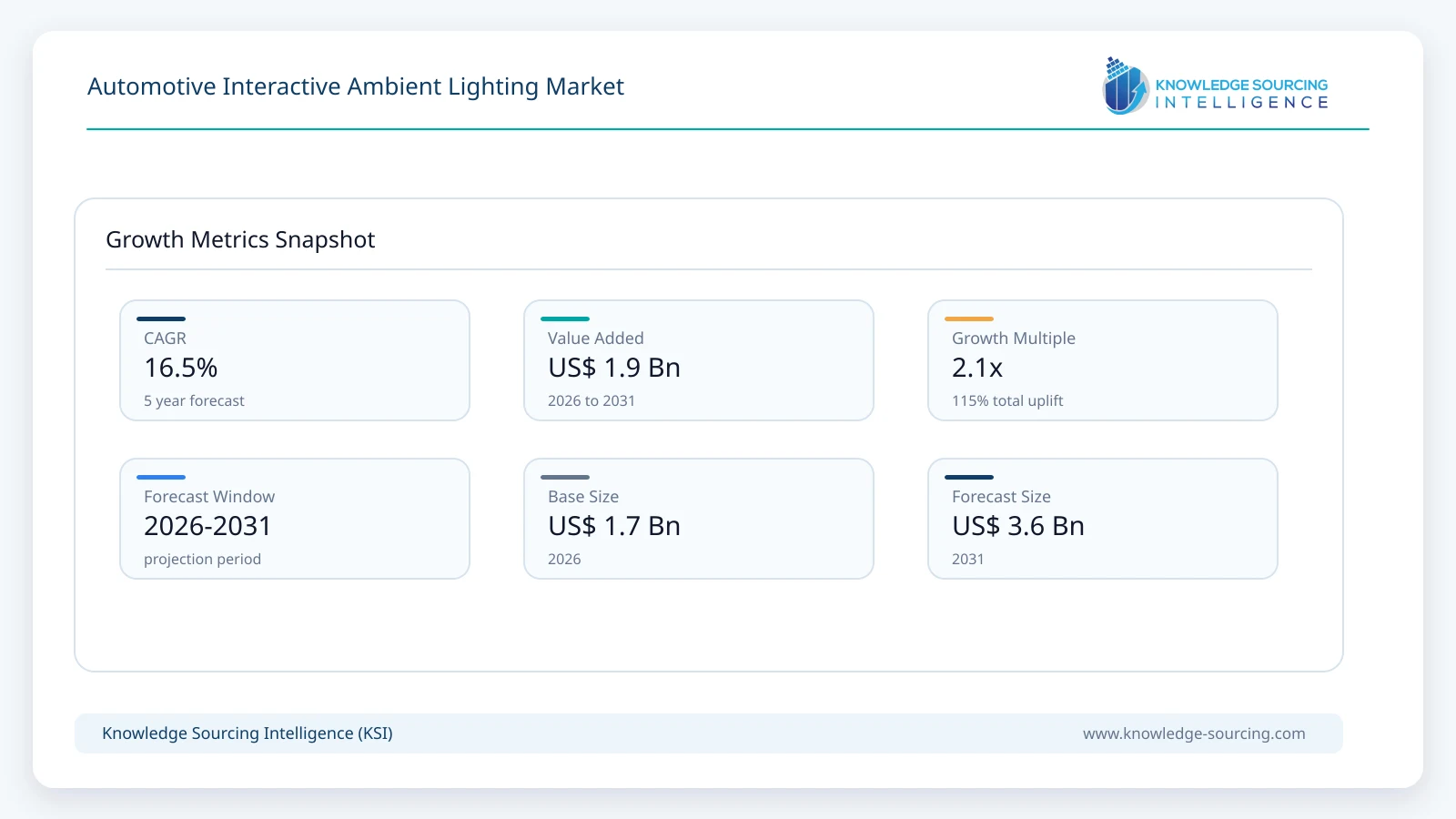
The automotive interactive ambient lighting market is growing at a CAGR of 16.5%, from USD 1.70 billion in 2026 to USD 3.65 billion by 2031.
Highlights:
- 1Individually addressable RGB ambient lighting accounts for approximately 44% of global market value in 2026 because it provides the core hardware platform for localized reactions, animated themes and software-defined cabin behavior.
- 2Occupant-triggered and profile-based interaction represents approximately 34% of 2026 market value, while vehicle-state, ADAS and safety-linked interaction is the fastest-growing trigger class.
- 3Comfort and personalization functions account for approximately 43% of 2026 market value, although safety/HMI communication and immersive entertainment functions are gaining share faster.
- 4Door panels and instrument-panel/console zones together account for approximately 61% of 2026 demand because they combine high visibility with long light paths, controls, speakers and smart-surface interfaces.
- 5Passenger vehicles represent approximately 96% of global market value in 2026, with premium EVs and technology-focused upper-midrange models driving early adoption.
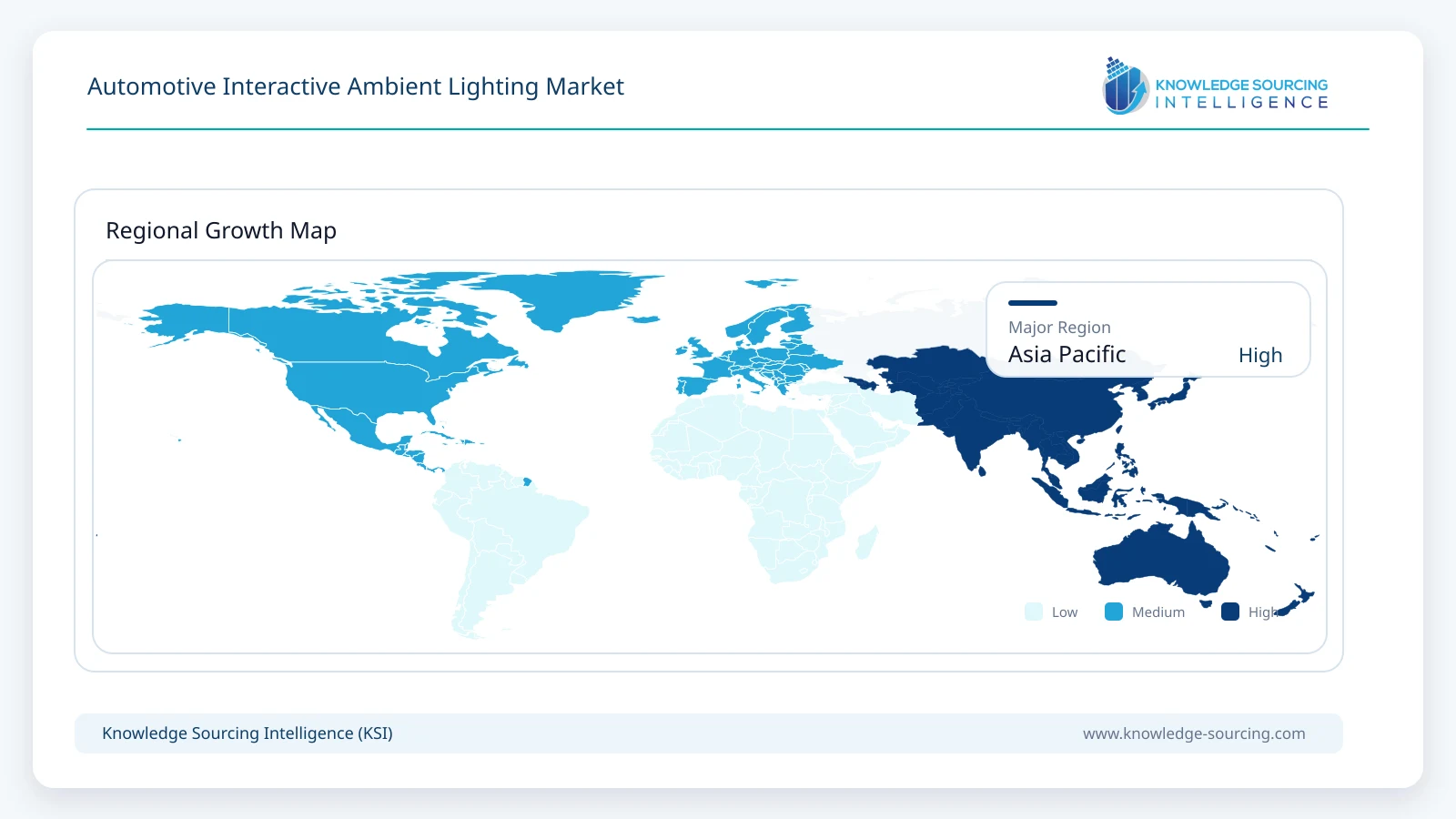
- 6Asia Pacific represents approximately 48% of global market value in 2026, supported by rapid smart-cabin innovation and high ambient-lighting content among Chinese new-energy vehicle manufacturers.
Automotive interactive ambient lighting is emerging as the responsive layer within the broader intelligent interior-lighting architecture. The market captures ambient illumination that changes according to a trigger or context rather than merely offering fixed color selection, including interactions linked to touch, voice, user profiles, vehicle state, music, navigation, ADAS and occupant sensing.
Individually addressable RGB systems form the largest technology base because they can create localized gradients, moving effects and context-specific cues across doors, instrument panels, consoles, footwells and roof areas from a common network architecture. Embedded LED drivers, calibration memory, serial communication and distributed control are increasing the number of independent light points that can be coordinated without proportional growth in wiring and centralized electronics.
Commercial value is limited to the incremental lighting hardware, network electronics and software required to make ambient illumination interactive. Static decorative light strips, conventional fixed-color mood lighting, dome and map lamps, display backlighting and broader circadian or task-lighting functions are excluded unless they participate directly in a responsive ambient-lighting experience.
Market Overview
Software-defined interaction is converting ambient lighting from a decorative option into a responsive cabin interface that can react continuously to user and vehicle data. A door light can brighten when the occupant reaches for a handle, a contour strip can pulse with navigation or charging status, and multiple zones can synchronize with a selected profile, music track or drive mode without requiring a separate display.
Distributed RGB architectures are central to this transition because individually addressable light points can be calibrated, diagnosed and animated independently while sharing a common communication bus. Open or supplier-specific serial protocols, intelligent LED packages and zonal controllers allow larger numbers of light points to be deployed across the cabin with less wiring than conventional point-to-point lamp architectures.
Integration with smart surfaces is broadening the addressable area for interaction as lighting moves behind translucent skins, decorative films, textiles, molded trim and in-mold electronic structures. The strongest systems combine illumination with touch, haptics, microphones, cameras or other sensing so that the same surface can receive an input and provide a visual response, creating a two-way interaction rather than a one-direction decorative effect.
Market Trends
Individually Addressable RGB Networks Are Increasing Interaction Resolution
Higher-density networks of individually addressable RGB LEDs are allowing ambient systems to respond at the level of a specific door, seat, contour segment or warning zone instead of changing the entire cabin uniformly. Localized color and motion can therefore reinforce user actions, vehicle states or ADAS events without sacrificing the broader ambient theme.
Embedded calibration and communication functions are also improving color consistency across large cabins, which is essential when a software-defined animation moves seamlessly from one physical lighting module to another.
Ambient Lighting Is Becoming a Peripheral HMI Channel
Context-aware light cues are increasingly being used to reinforce blind-spot warnings, incoming calls, charging state, navigation events, assistance-system activity and attention direction while keeping the primary display uncluttered. Peripheral illumination can direct the occupant toward the relevant side or zone of the cabin more intuitively than a generic icon located in the center stack.
Human-factors discipline is becoming more important as decorative and functional uses converge, because safety-related colors and motion patterns must remain distinguishable from entertainment or personalization effects.
Music, Media and Drive-Mode Synchronization Is Expanding Immersive Use Cases
Audio-reactive lighting and synchronized cabin themes are creating a more immersive link between infotainment and the physical interior, particularly in EVs where software-defined experience is a visible differentiator. Dynamic color, pulse rate and zone activation can be mapped to music, gaming, media playback or drive modes without additional physical interfaces.
The commercial value rises when the same RGB hardware can support entertainment, personalization and functional communication through software, improving utilization of the installed lighting network.
Smart Surfaces Are Combining Input and Visual Feedback
In-mold electronics, hidden-until-lit graphics and translucent trim are enabling ambient lighting to respond directly where the user touches, presses or approaches a surface. Visual feedback can confirm an input without adding a mechanical switch or separate indicator lamp, helping OEMs create cleaner cabin layouts while preserving interaction confidence.
Suppliers that can integrate lighting, touch sensing, haptics and trim materials within one validated surface are therefore moving closer to the center of cockpit HMI development rather than remaining conventional lamp vendors.
Adaptive Emotional and Human-Centric Behavior Is Entering Premium Programs
Research and early production concepts are extending interactive ambient lighting toward emotional-state, attention and wellness adaptation, using color, intensity and dynamic patterns to change according to journey context or sensed occupant condition. Antolin's LUXIA initiative reflects this shift from manually selected mood lighting toward user-centered adaptive behavior.
Full circadian or spectrum-controlled systems remain a separate narrower category, but interactive ambient platforms increasingly provide the control architecture through which future wellness functions can be delivered.
Segment Analysis
By Lighting Architecture: Individually Addressable RGB Networks
Individually addressable RGB networks hold the largest segment share because they provide the spatial resolution needed for local reactions, animated effects and synchronized multi-zone behavior. Integrated drivers and calibration data at the LED level also reduce the complexity of matching color across different interior modules.
Representing approximately USD 0.75 billion in 2026, the segment could approach USD 1.55 billion by 2031 as OEMs increase light-point density and migrate addressable architectures from flagship vehicles into higher-volume models.
By Interaction Trigger: Occupant Input and User Profiles
Occupant-triggered interaction remains the largest trigger class because touch, voice, seat position, stored profiles and direct color-theme selection provide an immediate and easily understood consumer benefit. Lighting can welcome a recognized driver, follow seat or door use, confirm a touch input or recall a preferred cabin theme automatically.
The trigger class accounts for approximately USD 0.58 billion in 2026, while vehicle-state, ADAS and safety-linked triggers are expected to grow faster through 2031 as ambient lighting becomes more tightly connected to the broader cockpit data architecture.
By Function: Comfort and Personalization
Comfort and personalization is the largest functional category because interactive color themes, welcome sequences, drive-mode responses and zone-specific settings are among the most visible ways for occupants to experience software-defined cabin differentiation. Premium EVs have accelerated this behavior by making the interior experience a larger part of perceived brand identity.
Approximately USD 0.73 billion of 2026 market value is attributable to comfort and personalization, with absolute demand continuing to expand even as HMI, safety and entertainment functions gain share.
By Application Location: Door Panels
Door panels form the largest application location because long contour lines, speaker zones, handles, window controls and broad decorative surfaces allow multiple interactive behaviors to be combined within one visible area. Door lighting can respond to approach, access, blind-spot warnings, audio content, drive modes and occupant preferences while remaining integrated into the trim.
Door-panel interactive ambient lighting is estimated at approximately USD 0.56 billion in 2026 and is expected to remain the largest application through 2031 as smart surfaces and flexible light guides increase the amount of usable illuminated area.
By Vehicle Type: Passenger Vehicles
Passenger vehicles dominate demand because interactive ambient lighting is primarily purchased as a comfort, technology and brand-differentiation feature in cars, SUVs and MPVs. Chinese EV manufacturers and premium European brands are expanding these systems into more vehicle zones and using software updates to vary themes and behavior.
Passenger vehicles account for approximately USD 1.63 billion in 2026, leaving commercial vehicles as a smaller niche concentrated in premium buses, executive vans and advanced driver-cab applications.
Market Drivers
Software-Defined Cockpit Architectures
Centralized and zonal cockpit architectures are allowing ambient lighting to consume the same vehicle-state, user-profile, navigation, infotainment and ADAS data streams used by displays and audio, making responsive behavior easier to orchestrate across the cabin. Lighting logic can therefore be changed in software while retaining a common physical network.
Shared software layers also allow OEMs to differentiate trim levels or brands with themes and interaction rules after installing similar hardware, improving platform reuse and reducing the need for unique lamp architectures.
Demand for Personalized and Immersive Cabin Experiences
Consumer expectations for configurable digital environments are carrying into vehicle interiors, where color, animation and localized reactions provide an immediate sense of personalization without adding another screen. EV programs are especially active because cabin experience has become a major route for differentiating vehicles with increasingly similar propulsion characteristics.
Higher personalization demand supports more addressable light points, tighter color calibration and greater software content per vehicle, raising system value faster than basic vehicle production.
Expansion of Lighting-Based HMI and Safety Communication
Ambient lighting can reinforce blind-spot warnings, navigation prompts, assistance-system states and other events by placing visual information near the relevant side or component of the cabin. This spatial quality gives interactive lighting a functional role that fixed decorative strips cannot provide.
As ADAS complexity increases, peripheral light cues can reduce dependence on central-screen alerts and help create multimodal warning strategies alongside sound and haptic feedback.
Advances in Smart LEDs, Serial Protocols and Flexible Optics
Intelligent RGB LEDs with embedded drivers, calibration memory and communication interfaces are reducing the electronics burden of large lighting networks, while flexible light guides and thin optical structures allow interactive effects to follow complex interior geometries. These technologies make higher-resolution behavior possible without requiring a separate conventional lamp module at every illuminated zone.
Lower wiring and packaging complexity improves the business case for interactive lighting in upper-midrange vehicles, where cost and assembly constraints previously limited dense ambient-lighting architectures.
Integration of Lighting with Smart Surfaces and Interior Electronics
Smart-surface architectures combine lighting with touch, haptic and decorative functions so that one physical area can act as both an input and feedback interface. Replacing separate buttons, indicator lamps and trim pieces can offset some of the additional electronics cost associated with interactive lighting.
The integration trend also encourages closer collaboration among lighting suppliers, interior-system companies, semiconductor vendors and HMI software teams, expanding the strategic value of the market beyond standalone illumination.
Market Restraints
Human-Factors and Driver-Distraction Constraints
Rapid animation, excessive brightness or poorly prioritized color changes can distract drivers at night and weaken the meaning of safety-related cues when entertainment effects use similar patterns. Interactive lighting therefore requires strict hierarchy rules that determine when decorative behavior must be suppressed or overridden.
Regional HMI expectations, driver age and cabin geometry further complicate validation because the same visual effect can produce different distraction or comprehension outcomes across vehicle programs.
Color Consistency across Distributed Lighting Networks
Small differences in LED output, junction temperature, optical guides and aging become visible when animated effects move across dozens or hundreds of light points, making color matching a system-level challenge. Interactive behavior exposes these differences more readily than static illumination because the occupant directly compares adjacent zones during motion.
Calibration memory and thermal compensation improve consistency, but they increase semiconductor and software requirements and must remain effective over the full vehicle lifecycle.
Higher Electronics, Software and Integration Cost
Interactive ambient systems require addressable LEDs, drivers, network communication, diagnostics, software logic and often additional sensing beyond the hardware used for static decorative lighting. The cost penalty can be difficult to justify in entry-level vehicles when the functionality is positioned only as a styling feature.
Platform-standard modules and common software stacks reduce the incremental cost, but OEMs still need sufficient perceived value or component replacement to support broad mainstream adoption.
Durability Challenges in Smart and Hidden-Until-Lit Surfaces
Lighting embedded behind soft trim, films, textiles or molded decorative structures must maintain brightness, color and tactile quality after heat, UV exposure, abrasion, cleaning chemicals and repeated user contact. Interactive surfaces face additional mechanical and optical stress because the same area may also contain touch or haptic functions.
Validation therefore has to cover the complete material-electronics stack rather than the light source alone, increasing development time and supplier coordination.
Software Complexity and Cross-Supplier Interoperability
Interactive lighting sits across body electronics, cockpit software, ADAS, infotainment and interior trim, creating more interfaces than conventional ambient lighting. Differences in communication protocols, controller ownership and diagnostic strategy can complicate integration when multiple suppliers contribute to one cabin network.
Open protocols and standardized smart-LED architectures can reduce fragmentation, but OEM-specific software behavior and cybersecurity requirements continue to limit plug-and-play deployment.
Regional Outlook
Asia Pacific
Asia Pacific leads the global interactive ambient-lighting market because Chinese new-energy vehicle manufacturers are using dense RGB networks, synchronized animations and software-defined cabin themes as visible differentiators across premium and increasingly mid-range models. Fast model cycles also encourage rapid adoption of new light-guide, smart-LED and surface-integration technologies.
A broad regional semiconductor, LED, electronics and interior-systems supply base supports localized development and cost reduction, while Japan and South Korea add established capabilities in automotive lighting and interior modules. Growth through 2031 will be driven more by rising lighting content per vehicle than by vehicle production alone.
Europe
Europe remains a high-value market because premium vehicle programs increasingly combine ambient lighting with safety communication, hidden-until-lit controls and software-defined personalization. Suppliers such as FORVIA HELLA and Valeo are developing modular RGB, smart-surface and integrated interior-lighting architectures that can serve multiple vehicle zones from common technology platforms.
European adoption will continue to favor functional interaction and human-factors discipline rather than purely decorative complexity, supporting high system value even in a slower vehicle-production environment. The region is also likely to remain influential in defining how safety-related color and animation behavior should coexist with entertainment and personalization.
Competitive Landscape
Competition is centered on the ability to combine addressable RGB hardware, optical integration, networking, software control and interior-system engineering rather than on emitter supply alone. FORVIA HELLA, Valeo, Toyoda Gosei and Marelli compete through complete lighting and smart-surface solutions, while ams OSRAM provides intelligent RGB LEDs and communication technology that enable high-density interactive networks.
Interior specialists such as Antolin and Yanfeng are increasing their role as lighting becomes embedded within door panels, instrument panels, consoles and decorative surfaces, creating competition for system value between traditional lighting suppliers and interior integrators. TactoTek and other embedded-electronics specialists strengthen this convergence by allowing lighting and controls to be molded directly into structural trim.
Competitive advantage increasingly depends on color calibration, network scalability, packaging depth, interaction software, smart-surface integration and the ability to reuse common hardware across multiple trims and vehicle platforms. Suppliers that can demonstrate production-ready integration with ADAS, infotainment and occupant inputs are better positioned than companies offering decorative lighting without system-level intelligence.
Recent Developments
3 September 2026: FORVIA HELLA presented an adaptive RGB interior-lighting concept for commercial vehicles that combines ambience, visual communication and safety-related functions in a seamlessly integrated surface using intelligent RGB LED arrays.
29 May 2026: Toyoda Gosei announced that its LIN-supported interior full-color illumination unit was adopted on the new Mazda CX-5, using refined software control to deliver smoother and more sophisticated lighting behavior through a simple vehicle network architecture.
12 May 2026: ams OSRAM announced deployment of its OSIRE E3731i intelligent RGB LED with Open System Protocol in the NIO ES9, supporting immersive and personalized dynamic lighting inside the smart electric flagship SUV.
26 January 2026: Antolin advanced its LUXIA R&D project focused on adaptive emotional lighting, studying how color, intensity and dynamic patterns can respond to user state and influence well-being, attention and cognitive performance.
20 January 2026: Valeo announced a major premium-automaker interior-lighting program using TactoTek IMSE technology to integrate lighting and electronics into a single production-ready smart structure for high-volume manufacturing.
8 January 2026: Toyoda Gosei introduced Dynamic Shadowy Illumination on the Lexus RZ, using three LED lamp units and patterned optical plates to create moving light effects across interior door surfaces.
Market Outlook
The automotive interactive ambient lighting market is expected to expand from approximately USD 1.700 billion in 2026 to about USD 3.650 billion by 2031, with individually addressable RGB networks remaining the primary hardware architecture while smart-surface and sensor-linked applications gain share. Value growth will increasingly come from software, network electronics and higher light-point density rather than from conventional lamp count.
Interaction will become more contextual as ambient lighting consumes occupant, ADAS, navigation, infotainment and environmental data through centralized or zonal vehicle architectures. The same installed lighting network will support personalization, safety communication, entertainment and selected wellness functions, making software-defined reuse central to the economics of future systems.
Asia Pacific will remain the largest regional market, while Europe continues to generate high value per vehicle through premium smart-cabin integration and functional HMI use cases. Supplier success will depend on delivering scalable network architecture, disciplined human-factors behavior, consistent color performance and seamless integration with trim, sensing and cockpit software.
Automotive Interactive Ambient Lighting Market Scope
| Report Metric | Details |
|---|---|
| Total Market Size in 2026 | USD 1.70 billion |
| Total Market Size in 2031 | USD 3.65 billion |
| Forecast Unit | Billion |
| Growth Rate | 16.5% |
| Study Period | 2021 to 2031 |
| Historical Data | 2021 to 2024 |
| Base Year | 2025 |
| Forecast Period | 2026 – 2031 |
| Segmentation | Lighting Architecture, Interaction Trigger, Function, Application Location, Vehicle Type, Geography |
| Companies |
|
Market Segmentation
By Lighting Architecture
Individually Addressable RGB Networks
Zone-Based Dynamic Ambient Lighting
Interactive Smart-Surface Lighting
Projection and Pattern-Based Ambient Lighting
Adaptive White and Multi-Spectral Ambient Lighting
By Interaction Trigger
Occupant Input and User Profiles
Vehicle State and ADAS Events
Infotainment, Audio and Media
Environmental and Cabin Sensors
Multi-Input Contextual Interaction
By Function
Comfort and Personalization
Safety, Warning and HMI Communication
Entertainment and Immersive Experience
Navigation and Vehicle-State Guidance
Wellness and Adaptive Emotional Lighting
By Application Location
Door Panels
Instrument Panel and Dashboard
Center Console and Storage Areas
Roof, Headliner and Overhead Zones
Footwell, Seats and Rear-Passenger Areas
By Vehicle Type
Passenger Vehicles
Light Commercial Vehicles
Medium and Heavy Commercial Vehicles and Buses
Shared and Autonomous Mobility Vehicles
By Geography
North America
United States
Canada
Mexico
South America
Brazil
Argentina
Others
Europe
Germany
United Kingdom
France
Italy
Spain
Others
Middle East and Africa
Saudi Arabia
UAE
South Africa
Others
Asia Pacific
China
Japan
South Korea
India
Indonesia
Thailand
Others
Table of Contents
1. INTRODUCTION
1.1. Market Overview
1.2. Market Definition
1.3. Scope of the Study
1.4. Market Segmentation
1.5. Currency
1.6. Assumptions
1.7. Base and Forecast Years
1.8. Key Benefits to Stakeholders
2. RESEARCH METHODOLOGY
2.1. Research Design
2.2. Secondary Research
2.3. Primary Research
2.4. Market Estimation
2.5. Segment Modelling
2.6. Data Triangulation and Validation
3. EXECUTIVE SUMMARY
3.1. Key Findings
3.2. Automotive Interactive Ambient Lighting Market Size, 2026-2031
3.3. Lighting Architecture Outlook
3.4. Interaction Trigger Outlook
3.5. Function Outlook
3.6. Application Location Outlook
3.7. Vehicle Type Outlook
3.8. Regional Opportunity Summary
4. MARKET DYNAMICS
4.1. Market Drivers
4.1.1. Software-Defined Cockpit Architectures
4.1.2. Demand for Personalized and Immersive Cabin Experiences
4.1.3. Expansion of Lighting-Based HMI and Safety Communication
4.1.4. Advances in Smart LEDs, Serial Protocols and Flexible Optics
4.1.5. Integration of Lighting with Smart Surfaces and Interior Electronics
4.2. Market Restraints
4.2.1. Human-Factors and Driver-Distraction Constraints
4.2.2. Color Consistency across Distributed Lighting Networks
4.2.3. Higher Electronics, Software and Integration Cost
4.2.4. Durability Challenges in Smart and Hidden-Until-Lit Surfaces
4.2.5. Software Complexity and Cross-Supplier Interoperability
4.3. Market Opportunities
4.4. Porter's Five Forces Analysis
4.5. Industry Value Chain Analysis
4.6. Interactive Lighting Hardware, Software and Integration Economics
4.7. HMI, Functional Safety and Driver-Distraction Requirements
5. TECHNOLOGY OUTLOOK
5.1. Individually Addressable RGB LEDs
5.2. Intelligent LED Networks and Serial Protocols
5.3. Centralized, Zonal and Distributed Lighting Control
5.4. Flexible and Omni-Bendable Light Guides
5.5. LED-on-Foil and Thin Flexible Lighting
5.6. In-Mold Electronics and Interactive Smart Surfaces
5.7. Hidden-Until-Lit and Translucent Material Illumination
5.8. Interior Projection and Pattern Lighting
5.9. Audio and Infotainment Synchronization
5.10. Occupant, Gesture and Proximity Sensor Integration
5.11. ADAS and Vehicle-State Interaction
5.12. Color Calibration, Thermal Compensation and Lifecycle Validation
6. AUTOMOTIVE INTERACTIVE AMBIENT LIGHTING MARKET BY LIGHTING ARCHITECTURE
6.1. Introduction
6.2. Individually Addressable RGB Networks
6.3. Zone-Based Dynamic Ambient Lighting
6.4. Interactive Smart-Surface Lighting
6.5. Projection and Pattern-Based Ambient Lighting
6.6. Adaptive White and Multi-Spectral Ambient Lighting
7. AUTOMOTIVE INTERACTIVE AMBIENT LIGHTING MARKET BY INTERACTION TRIGGER
7.1. Introduction
7.2. Occupant Input and User Profiles
7.3. Vehicle State and ADAS Events
7.4. Infotainment, Audio and Media
7.5. Environmental and Cabin Sensors
7.6. Multi-Input Contextual Interaction
8. AUTOMOTIVE INTERACTIVE AMBIENT LIGHTING MARKET BY FUNCTION
8.1. Introduction
8.2. Comfort and Personalization
8.3. Safety, Warning and HMI Communication
8.4. Entertainment and Immersive Experience
8.5. Navigation and Vehicle-State Guidance
8.6. Wellness and Adaptive Emotional Lighting
9. AUTOMOTIVE INTERACTIVE AMBIENT LIGHTING MARKET BY APPLICATION LOCATION
9.1. Introduction
9.2. Door Panels
9.3. Instrument Panel and Dashboard
9.4. Center Console and Storage Areas
9.5. Roof, Headliner and Overhead Zones
9.6. Footwell, Seats and Rear-Passenger Areas
10. AUTOMOTIVE INTERACTIVE AMBIENT LIGHTING MARKET BY VEHICLE TYPE
10.1. Introduction
10.2. Passenger Vehicles
10.3. Light Commercial Vehicles
10.4. Medium and Heavy Commercial Vehicles and Buses
10.5. Shared and Autonomous Mobility Vehicles
11. AUTOMOTIVE INTERACTIVE AMBIENT LIGHTING MARKET BY GEOGRAPHY
11.1. North America
11.1.1. United States
11.1.2. Canada
11.1.3. Mexico
11.2. South America
11.2.1. Brazil
11.2.2. Argentina
11.2.3. Others
11.3. Europe
11.3.1. Germany
11.3.2. United Kingdom
11.3.3. France
11.3.4. Italy
11.3.5. Spain
11.3.6. Others
11.4. Middle East and Africa
11.4.1. Saudi Arabia
11.4.2. UAE
11.4.3. South Africa
11.4.4. Others
11.5. Asia Pacific
11.5.1. China
11.5.2. Japan
11.5.3. South Korea
11.5.4. India
11.5.5. Indonesia
11.5.6. Thailand
11.5.7. Others
12. COMPETITIVE ENVIRONMENT AND ANALYSIS
12.1. Major Players and Strategy Analysis
12.2. Market Share Analysis
12.3. RGB and Addressable LED Technology Benchmarking
12.4. Interactive Network and Control Architecture Benchmarking
12.5. Smart-Surface and Sensor Integration Benchmarking
12.6. HMI, Safety and Immersive Function Benchmarking
12.7. OEM Programs and Series-Production Readiness
12.8. Competitive Dashboard
13. COMPANY PROFILES
13.1. FORVIA HELLA
13.2. Valeo
13.3. ams OSRAM
13.4. Toyoda Gosei Co., Ltd.
13.5. Antolin
13.6. Yanfeng Automotive Interiors
13.7. Marelli
13.8. TactoTek Oy
13.9. Hyundai Mobis
13.10. Stanley Electric Co., Ltd.
14. APPENDIX
14.1. Currency
14.2. Assumptions
14.3. Base and Forecast Years Timeline
14.4. Key Benefits for Stakeholders
14.5. Research Methodology
14.6. Abbreviations
14.7. Data Sources
Navigate
Trusted by the world's leading organizations











