
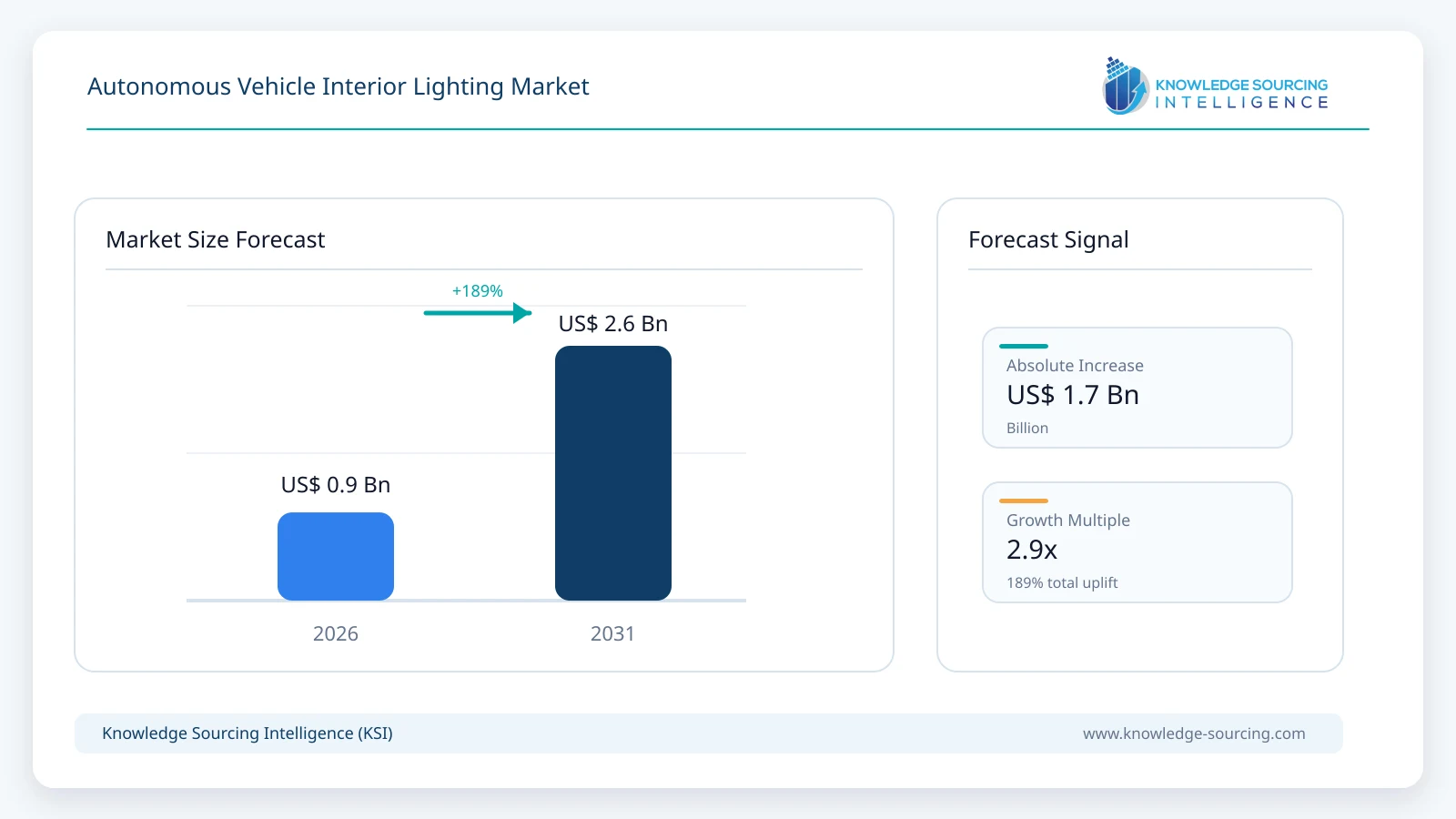
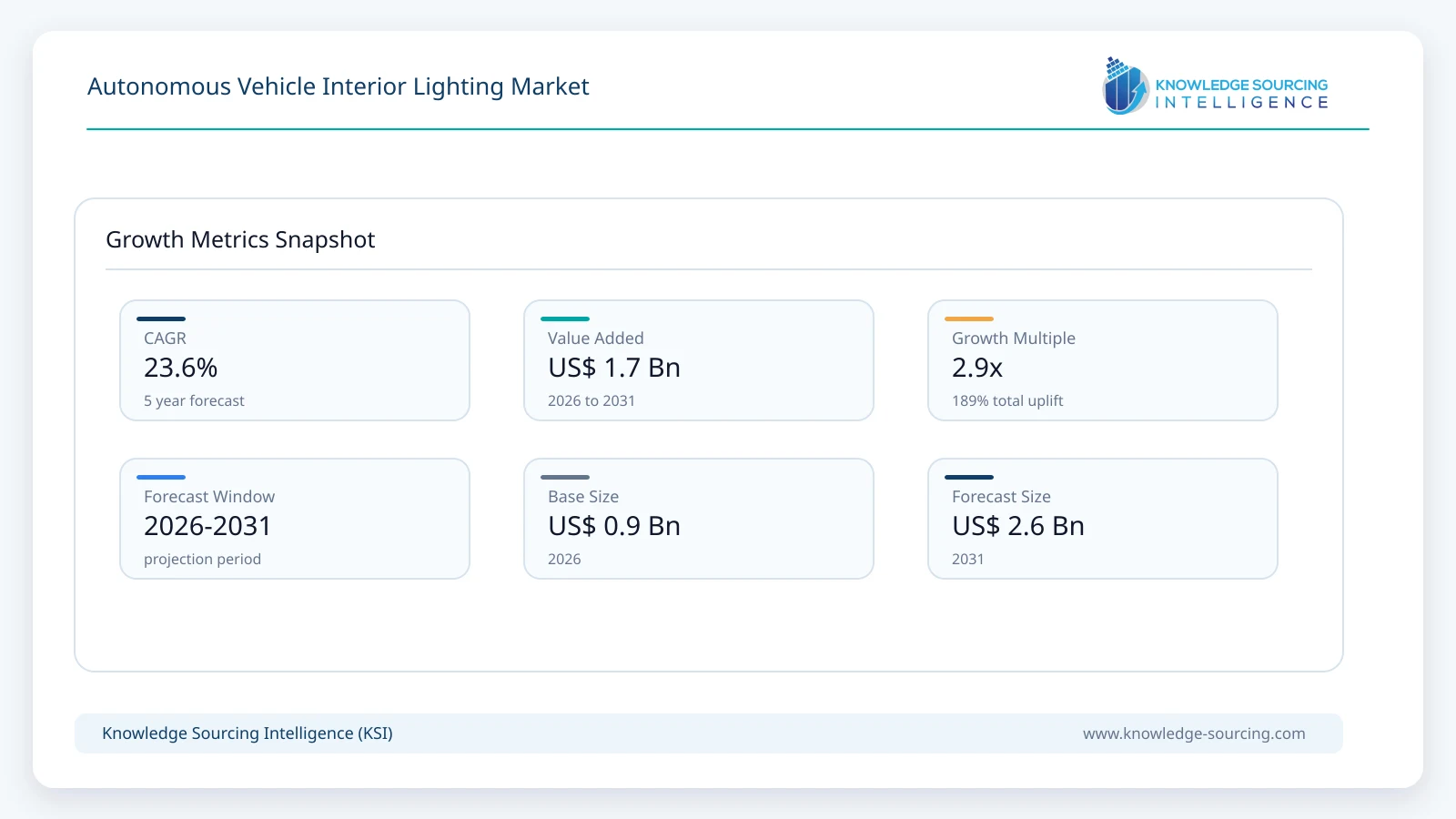
The autonomous vehicle interior lighting market is forecast to grow at a CAGR of 23.6%, reaching approximately USD 2.60 billion in 2031 from USD 0.90 billion in 2026.
Highlights:
- 1Dynamic ambient lighting accounts for approximately 41% of global market value in 2026, supported by wider use of individually controlled RGB LEDs, animated light sequences and personalized cabin themes.
- 2Functional and safety communication lighting represents approximately 29% of market value in 2026 as light is increasingly used for automation-state indication, ADAS warnings, navigation feedback and occupant guidance.
- 3SAE Level 3 applications account for approximately 60% of global market value in 2026, supported by the first production-scale automated vehicles requiring clearer mode and transition communication inside the cabin.
- 4Personally owned autonomous passenger vehicles represent approximately 62% of market value in 2026, while robotaxi and shared autonomous mobility applications are increasing demand for passenger-oriented lighting and interaction.
- 5Battery electric vehicles account for approximately 75% of global market value in 2026 because smart interior lighting is strongly aligned with software-defined electric platforms and premium digital-cabin differentiation.
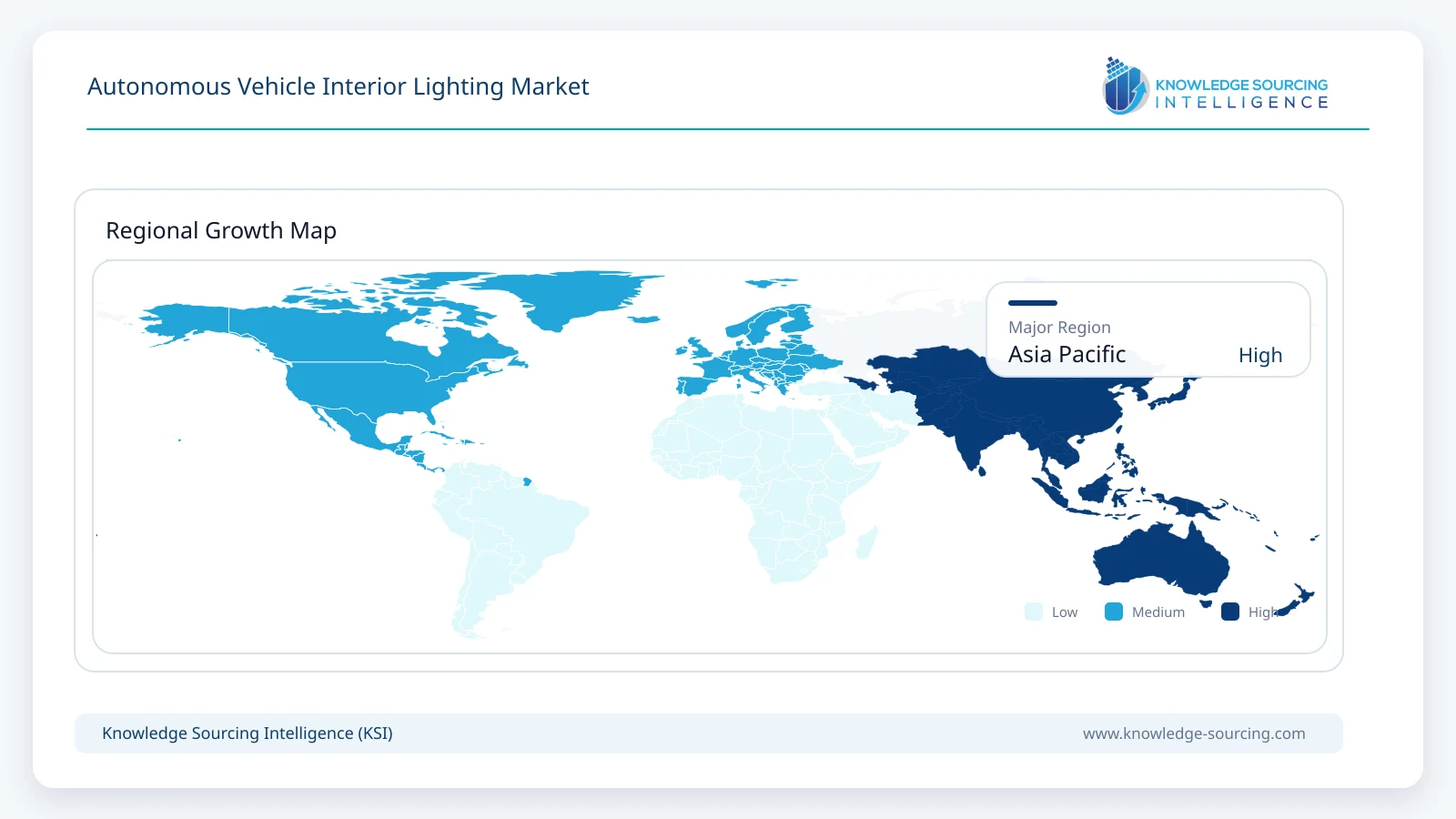
- 6Asia Pacific represents approximately 41% of global market value in 2026, supported by rapid smart-cabin commercialization and strong premium EV development in China, Japan and South Korea.
Demand is being driven by increasingly automated vehicles that use light not only for visibility and ambience, but also to communicate vehicle status, guide attention, support relaxation and coordinate the cabin with software-defined user modes.
Dynamic RGB systems, backlit surfaces, light-transmitting trim and projected content are expanding the functional role of interior lighting. Valeo uses dynamic interior lighting as a visual communication channel for ADAS and system feedback, while FORVIA integrates smart ambient and surface lighting that can display warnings, calls and other vehicle information.
Production-ready smart cabins are accelerating this shift. Yanfeng's XiM27 uses wrap-around light strips, dynamic light-transmitting surfaces and touch-interactive materials within a centralized cabin architecture, while Antolin, Marelli and FORVIA HELLA are developing adaptive, functional and software-linked interior lighting technologies for increasingly automated and connected vehicles.
Market Overview
Interior lighting in automated vehicles performs a wider set of functions than conventional dome, reading or accent illumination. Dynamic light can identify active automation modes, reinforce warning messages, visualize voice-assistant activity, guide passenger attention and create scenario-specific environments for work, rest or entertainment.
Valeo's dynamic interior lighting uses smart LEDs whose color, luminance and animation can be controlled individually. The company positions the technology as a communication channel for notifications, navigation and ADAS feedback and as a way to build occupant trust as vehicles become more automated.
FORVIA combines interior lighting with smart surfaces and vehicle software. Its ambient and surface lighting solutions can display warnings and information, while embedded lighting technologies are designed to create personalized and immersive cabin environments. FORVIA HELLA also provides the lighting electronics and manufacturing capabilities needed for system-level deployment.
Yanfeng's XiM27 demonstrates how lighting can operate as part of a centrally managed smart cabin. The platform integrates ultra-thin wrap-around light strips, 3D dynamic light-transmitting surfaces and touch-interactive materials, and can alter lighting according to passenger state and scenario together with climate, seating and audio.
Market Trends
Lighting Is Becoming an HMI Channel
Interior lighting is increasingly used to communicate information rather than only create atmosphere. Dynamic light sequences can confirm system input, visualize voice-assistant activity, highlight ADAS warnings or indicate a change in automation status without requiring occupants to look at a central screen.
This role becomes more important in autonomous cabins where occupants may be reclined, turned away from the dashboard or engaged in other activities.
Adaptive and Emotional Lighting Is Expanding
Suppliers are developing lighting systems that react to occupant state, activity and preferences. Antolin's LUXIA project focuses on adaptive emotional lighting and the effects of color, intensity and dynamic patterns on well-being, attention and cognitive performance.
Yanfeng also uses adaptive lighting within XiM27, linking passenger behavior and emotion recognition to lighting, temperature and audio adjustments.
Smart Surfaces Are Increasing Illuminated Area
Light is moving beyond conventional strips and point sources into illuminated trim, door panels, headliners and integrated decorative surfaces. Valeo's in-mold structural electronics program combines lighting and electronics in a flush smart structure, while FORVIA integrates lighting into surface materials and Antolin uses lighted headliners and smart-surface technologies.
Larger illuminated surfaces allow lighting to function as both interior design and information architecture.
Software-Defined Lighting Is Enabling Personalization
Modern lighting systems are increasingly connected to vehicle networks and controlled through software. FORVIA's LightOpen enables software-based lighting configuration, while open LED communication architectures support individually addressable light sources and dynamic effects.
Software-defined control makes it possible to update themes, animations and functional behavior over the vehicle life cycle without changing the physical lighting hardware.
Autonomous Cabins Are Increasing Lighting-Based Safety Communication
As driver attention shifts away from the road, lighting can provide peripheral and spatial cues for automation status, warnings or required action. Valeo specifically positions dynamic ambient lighting as a visual feedback channel that can support confidence in autonomous-driving experiences.
Functional lighting can also complement acoustic and haptic warnings, creating multimodal alerts that remain visible across a wider range of occupant postures.
Segment Analysis
By Lighting Type: Dynamic Ambient Lighting
Dynamic ambient lighting systems are projected to reach approximately USD 1.05 billion by 2031. Growth is being supported by intelligent RGB LEDs, animated light sequences, cabin-wide light networks and software-controlled personalization that allow the same hardware to support ambience, notifications and interactive functions.
By Function: Functional and Safety Communication
Functional and safety communication lighting is projected to reach approximately USD 0.91 billion by 2031. Automated vehicles require clear and redundant communication of system status, warnings, navigation cues and occupant guidance, increasing the value of dynamic lighting as a visible interaction layer.
By Automation Level: SAE Level 4 and Above
SAE Level 4 and above interior lighting is projected to reach approximately USD 1.43 billion by 2031. Highly automated mobility shifts lighting design toward passenger guidance, immersive ambience, accessibility and rider-specific communication rather than continuous driver-focused illumination.
By Vehicle Application: Personally Owned Autonomous Passenger Vehicles
Personally owned autonomous passenger vehicles are projected to generate approximately USD 1.17 billion of interior-lighting market value by 2031. Premium and upper-mid EVs provide an important commercialization path for adaptive ambient lighting, smart surfaces and personalized lighting themes used repeatedly by the same occupant.
By Cabin Use Mode: Comfort, Wellness and Immersive Experience
Comfort, wellness and immersive lighting applications are projected to reach approximately USD 0.91 billion by 2031. Dynamic color, brightness, illuminated surfaces and synchronized sensory effects are becoming more important as occupants spend less time actively driving and more time resting, interacting or consuming media.
By Propulsion: Battery Electric Vehicles
Battery electric vehicles are projected to generate approximately USD 2.16 billion of autonomous interior-lighting market value by 2031. Electric platforms have a strong overlap with smart-cabin and automated-driving development and provide centralized electronics that support complex lighting control and personalization.
By Geography: Asia Pacific
Asia Pacific is projected to reach approximately USD 1.07 billion by 2031. China is the principal growth engine through rapid EV and smart-cabin development, while Japan and South Korea contribute established electronics, interior and lighting engineering capabilities.
Market Drivers
Expansion of SAE Level 3 and Level 4 Vehicles
Higher vehicle automation increases the need for intuitive in-cabin communication and creates more non-driving time in which ambience and passenger experience become important. Lighting can support both safety messaging and new comfort-oriented use cases.
Growth of Software-Defined Cabins
Centralized vehicle electronics allow interior lighting to coordinate with seating, climate, audio, HMI and occupant sensing. This supports scenario-based cabin modes and more responsive personalization.
Demand for Premium and Immersive Interior Experience
Automakers increasingly use dynamic lighting as a visible differentiator in EV and premium interiors. Animated effects, illuminated surfaces and customizable themes can create a stronger brand identity without major changes to structural cabin components.
Increasing Use of Light for Functional Communication
Dynamic lighting can provide warnings, navigation feedback and system-status information across a broad visual field. This makes light an important complementary interface when occupants are not looking directly at displays.
Advances in Intelligent RGB LEDs and Smart Surfaces
Individually addressable LEDs, thin light guides, backlit decorative materials and in-mold electronics are increasing design freedom while reducing the need for separate lighting housings. These technologies support larger illuminated areas and more complex animations.
Market Restraints
Higher Electronics and Integration Cost
Dynamic lighting requires intelligent LEDs, controllers, wiring or network connections, optical components and software. Large illuminated surfaces and smart materials can add further cost compared with conventional static lighting.
Visual Distraction and Human-Factors Requirements
Excessive brightness, animation or color changes can distract occupants or interfere with displays. Autonomous cabin lighting must adapt appropriately to driving mode, time of day and occupant activity.
Color and Brightness Consistency
Large RGB networks require tight calibration so that color and luminance remain consistent across LEDs, materials and production batches. Visible variation can reduce perceived interior quality.
Complex Validation and Software Coordination
Lighting used for warnings or automation-state communication must operate reliably across vehicle modes and software updates. Functional lighting therefore requires stronger validation than purely decorative illumination.
Energy and Thermal Management
Cabin-wide dynamic lighting increases electrical load and generates heat across distributed light sources and electronics. Efficient LEDs and intelligent control are necessary, particularly in battery electric vehicles where auxiliary energy use is closely managed.
Regional Outlook
Asia Pacific
Asia Pacific is the largest regional market and is expected to remain the strongest growth centre through 2031. China is driving commercialization through premium EVs, smart cabins and rapid adoption of software-defined interior features. Dynamic ambient lighting is increasingly used as a core interaction and brand-differentiation element rather than a decorative add-on.
Yanfeng's XiM27 demonstrates the region's direction through adaptive lighting, 3D light-transmitting surfaces and touch-interactive illuminated materials linked to a centralized cabin controller. NIO's 2026 flagship ES9 also adopted an intelligent RGB lighting architecture that synchronizes dynamic ambient and speaker lighting.
Europe
Europe is the second major regional market, supported by a deep supplier base in automotive lighting, interiors and smart surfaces. Valeo, FORVIA HELLA, Antolin and Marelli are all developing interior lighting that combines ambience with communication, interaction and software-defined cabin functions.
European development is increasingly focused on adaptive emotional lighting, backlit smart structures, interior projections and light-integrated HMI. The region's premium-vehicle production and early Level 3 commercialization support higher-value lighting systems that combine design with functional communication.
Competitive Landscape
The autonomous vehicle interior lighting market is led by suppliers with direct capabilities in complete interior lighting systems, smart surfaces, dynamic ambient lighting and software-linked cabin illumination. Valeo, FORVIA HELLA, Yanfeng, Antolin and Marelli are directly active in intelligent automotive interior-lighting technologies.
Valeo provides static and dynamic ambient lighting, backlit decorative systems and surface projection, with lighting increasingly used for ADAS and autonomous-driving communication. FORVIA HELLA combines lighting electronics and manufacturing with FORVIA Interiors' smart surface and embedded illumination capabilities.
Yanfeng integrates lighting into complete smart-cabin systems, Antolin combines lighting with headliners, smart surfaces and emotional-lighting research, and Marelli uses illuminated decorative and informative smart surfaces as part of future-cabin and software-defined vehicle solutions.
Recent Developments
September 2026: Antolin and UltraSense Systems announced advancement of a next-generation Smart Surface HMI initiative combining thin configurable controls with visual and haptic feedback for future automotive interiors.
July 2026: Yanfeng's XiM27 received the 2026 Red Dot Design Concept Award; the platform features adaptive lighting, spatial audio and individualized climate control linked to passenger preferences.
June 2026: Yanfeng unveiled XiM27, a production-ready smart-cabin platform using wrap-around light strips, 3D dynamic light-transmitting surfaces and touch-interactive illuminated materials as a core interaction layer.
May 2026: ams OSRAM announced that its intelligent RGB LED and Open System Protocol had been integrated into the NIO ES9, enabling dynamic cabin lighting and coordinated speaker illumination.
April 2026: Marelli announced next-generation in-cabin innovations for Auto China 2026, including ambient-lighting technologies integrated with displays, audio and software-defined vehicle electronics.
January 2026: Antolin advanced the LUXIA project to develop adaptive emotional lighting that responds to well-being, emotional state, attention and cognitive performance.
January 2026: Valeo announced a major interior-lighting program award from a premium global automaker using in-mold structural electronics to integrate lighting and electronics into a unified smart interior structure.
Market Outlook
The autonomous vehicle interior lighting market is expected to expand rapidly through 2031 as lighting becomes a combined design, communication and wellness layer within increasingly automated cabins. Dynamic ambient lighting will remain the largest value pool, while functional communication and illuminated smart surfaces gain importance.
Development will focus on software-defined lighting behavior, occupant-aware adaptation, larger illuminated surfaces and lower-power light networks coordinated with displays, audio and haptics. Asia Pacific is expected to lead commercialization, while Europe remains a major centre for premium lighting systems, smart surfaces and functional illumination.
Autonomous Vehicle Interior Lighting Market Scope
| Report Metric | Details |
|---|---|
| Total Market Size in 2026 | USD 0.90 billion |
| Total Market Size in 2031 | USD 2.60 billion |
| Forecast Unit | Billion |
| Growth Rate | 23.6% |
| Study Period | 2021 to 2031 |
| Historical Data | 2021 to 2024 |
| Base Year | 2025 |
| Forecast Period | 2026 – 2031 |
| Segmentation | Lighting Type, Function, Automation Level, Vehicle Application, Cabin Use Mode, Propulsion, Geography |
| Companies |
|
Market Segmentation
By Lighting Type
Dynamic Ambient Lighting
Functional and Safety Lighting
Illuminated Smart Surfaces and Projection
Task and Localized Lighting
By Function
Comfort and Personalization
Functional and Safety Communication
HMI and Interaction Feedback
Brand and Immersive Experience
By Automation Level
SAE Level 3
SAE Level 4 and Above
By Vehicle Application
Personally Owned Autonomous Passenger Vehicles
Robotaxi and Shared Autonomous Mobility
Autonomous Shuttle and Commercial Mobility
By Cabin Use Mode
Comfort, Wellness and Immersive Experience
Work and Productivity
Rest and Sleep
Safety and Driving-Mode Transition
By Propulsion
Battery Electric Vehicles
Hybrid Electric Vehicles
Internal Combustion Engine Vehicles
By Geography
North America
United States
Canada
Mexico
South America
Brazil
Argentina
Others
Europe
Germany
France
United Kingdom
Spain
Italy
Others
Middle East and Africa
Saudi Arabia
UAE
South Africa
Others
Asia Pacific
China
Japan
South Korea
India
Singapore
Others
Table of Contents
1. INTRODUCTION
1.1. Market Overview
1.2. Market Definition
1.3. Scope of the Study
1.4. Market Segmentation
1.5. Currency
1.6. Assumptions
1.7. Base and Forecast Years
1.8. Key Benefits to Stakeholders
2. RESEARCH METHODOLOGY
2.1. Research Design
2.2. Secondary Research
2.3. Primary Research
2.4. Market Estimation
2.5. Segment Modelling
2.6. Data Triangulation and Validation
3. EXECUTIVE SUMMARY
3.1. Key Findings
3.2. Autonomous Vehicle Interior Lighting Market Size, 2026-2031
3.3. Lighting Type Outlook
3.4. Function Outlook
3.5. Automation Level Outlook
3.6. Vehicle Application Outlook
3.7. Cabin Use Mode Outlook
3.8. Propulsion Outlook
3.9. Regional Opportunity Summary
4. MARKET DYNAMICS
4.1. Market Drivers
4.1.1. Expansion of SAE Level 3 and Level 4 Vehicles
4.1.2. Growth of Software-Defined Cabins
4.1.3. Demand for Premium and Immersive Interior Experience
4.1.4. Increasing Use of Light for Functional Communication
4.1.5. Advances in Intelligent RGB LEDs and Smart Surfaces
4.2. Market Restraints
4.2.1. Higher Electronics and Integration Cost
4.2.2. Visual Distraction and Human-Factors Requirements
4.2.3. Color and Brightness Consistency
4.2.4. Complex Validation and Software Coordination
4.2.5. Energy and Thermal Management
4.3. Market Opportunities
4.4. Porter's Five Forces Analysis
4.5. Industry Value Chain Analysis
4.6. Interior Lighting System Economics
4.7. Safety and Human-Factors Environment
5. TECHNOLOGY OUTLOOK
5.1. Static and Dynamic RGB Ambient Lighting
5.2. Intelligent Addressable LED Networks
5.3. Functional and Safety Communication Lighting
5.4. Backlit Decorative and Smart Surfaces
5.5. Dynamic Light-Transmitting Surfaces
5.6. Interior Projection
5.7. Lighted Headliners and Large-Area Illumination
5.8. Ambient-Light Sensing and Automatic Adaptation
5.9. Centralized and Software-Defined Lighting Control
5.10. Human-Centric and Emotional Lighting
6. AUTONOMOUS VEHICLE INTERIOR LIGHTING MARKET BY LIGHTING TYPE
6.1. Introduction
6.2. Dynamic Ambient Lighting
6.3. Functional and Safety Lighting
6.4. Illuminated Smart Surfaces and Projection
6.5. Task and Localized Lighting
7. AUTONOMOUS VEHICLE INTERIOR LIGHTING MARKET BY FUNCTION
7.1. Introduction
7.2. Comfort and Personalization
7.3. Functional and Safety Communication
7.4. HMI and Interaction Feedback
7.5. Brand and Immersive Experience
8. AUTONOMOUS VEHICLE INTERIOR LIGHTING MARKET BY AUTOMATION LEVEL
8.1. Introduction
8.2. SAE Level 3
8.3. SAE Level 4 and Above
9. AUTONOMOUS VEHICLE INTERIOR LIGHTING MARKET BY VEHICLE APPLICATION
9.1. Introduction
9.2. Personally Owned Autonomous Passenger Vehicles
9.3. Robotaxi and Shared Autonomous Mobility
9.4. Autonomous Shuttle and Commercial Mobility
10. AUTONOMOUS VEHICLE INTERIOR LIGHTING MARKET BY CABIN USE MODE
10.1. Introduction
10.2. Comfort, Wellness and Immersive Experience
10.3. Work and Productivity
10.4. Rest and Sleep
10.5. Safety and Driving-Mode Transition
11. AUTONOMOUS VEHICLE INTERIOR LIGHTING MARKET BY PROPULSION
11.1. Introduction
11.2. Battery Electric Vehicles
11.3. Hybrid Electric Vehicles
11.4. Internal Combustion Engine Vehicles
12. AUTONOMOUS VEHICLE INTERIOR LIGHTING MARKET BY GEOGRAPHY
12.1. North America
12.1.1. United States
12.1.2. Canada
12.1.3. Mexico
12.2. South America
12.2.1. Brazil
12.2.2. Argentina
12.2.3. Others
12.3. Europe
12.3.1. Germany
12.3.2. France
12.3.3. United Kingdom
12.3.4. Spain
12.3.5. Italy
12.3.6. Others
12.4. Middle East and Africa
12.4.1. Saudi Arabia
12.4.2. UAE
12.4.3. South Africa
12.4.4. Others
12.5. Asia Pacific
12.5.1. China
12.5.2. Japan
12.5.3. South Korea
12.5.4. India
12.5.5. Singapore
12.5.6. Others
13. COMPETITIVE ENVIRONMENT AND ANALYSIS
13.1. Major Players and Strategy Analysis
13.2. Market Share Analysis
13.3. Product and Technology Benchmarking
13.4. Program Awards and Development Activity
13.5. Competitive Dashboard
14. COMPANY PROFILES
14.1. Valeo
14.2. FORVIA HELLA
14.3. Yanfeng
14.4. Antolin
14.5. Marelli
15. APPENDIX
15.1. Currency
15.2. Assumptions
15.3. Base and Forecast Years Timeline
15.4. Key Benefits for Stakeholders
15.5. Research Methodology
15.6. Abbreviations
15.7. Data Sources
Navigate
Trusted by the world's leading organizations











