
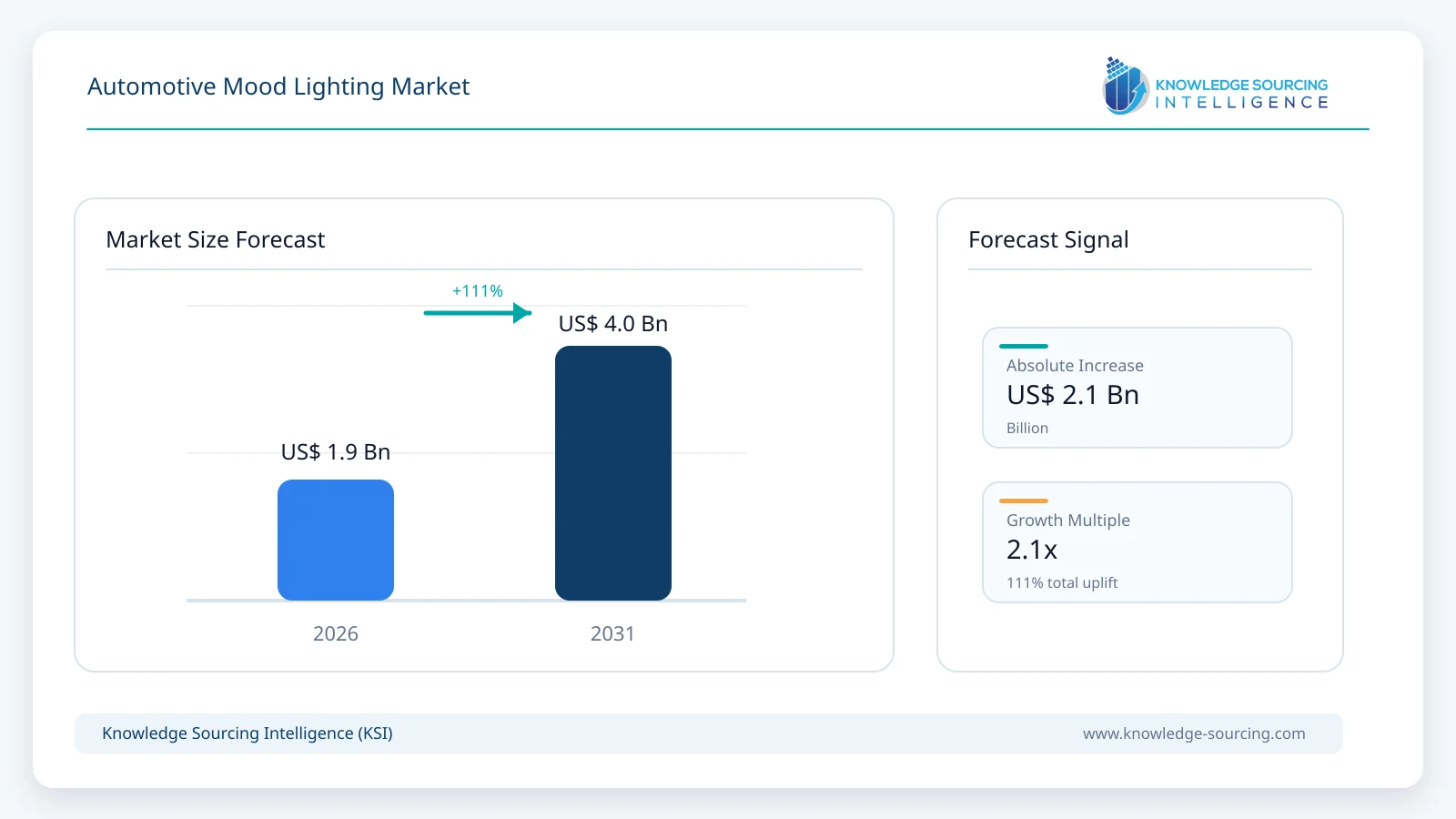
The automotive mood lighting market is projected to expand at a CAGR of 16.1%, reaching USD 4.00 billion in 2031 from USD 1.90 billion in 2026.
Highlights:
- 1User-selectable color themes and preset mood scenes account for approximately 43% of global market value in 2026 because they form the most widely adopted personalization layer across doors, dashboards, consoles and footwells.
- 2Addressable RGB LED systems represent approximately 50% of 2026 technology value, supported by improved color calibration, serial communication and the ability to control individual light points across the cabin.
- 3User-selected control accounts for approximately 49% of 2026 market value, while context-adaptive and content-reactive mood lighting are gaining share as lighting becomes more closely linked with vehicle software and infotainment.
- 4Door and side-trim lighting represents approximately 30% of 2026 demand because long illuminated contours provide the most visible canvas for color themes and animated lighting effects.
- 5Passenger vehicles account for approximately 97% of global market value in 2026, with premium vehicles and technology-focused EVs leading adoption.
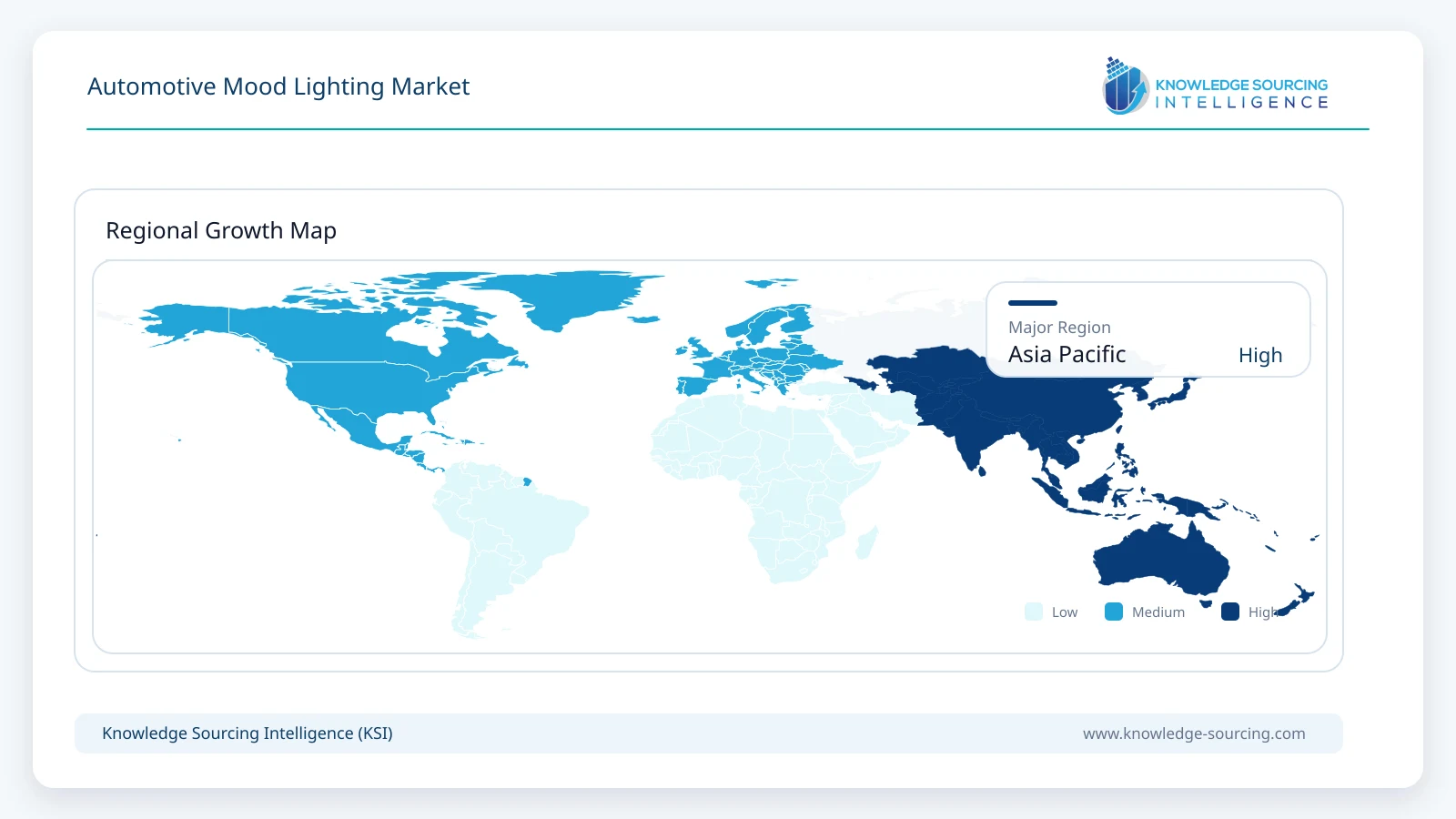
- 6Asia Pacific represents approximately 47% of global market value in 2026, supported by rapid smart-cabin development in China and strong regional production of RGB LEDs, lighting electronics and interior systems.
Selectable color worlds, animated light scenes and coordinated display themes are turning interior lighting into a visible part of vehicle personalization rather than a fixed decorative feature.
User-selectable RGB themes remain the largest value pool because they allow occupants to change the perceived character of the cabin with minimal hardware changes. Higher-value systems add gradients, flowing animations, music visualization, drive-mode-linked scenes and synchronized display graphics, increasing the importance of addressable LEDs, distributed control and software-defined lighting profiles.
The market includes lighting hardware, local control electronics and attributable software used primarily to create a desired cabin atmosphere. Safety-warning lighting, functional HMI cues and circadian or wellness functions are excluded when their main purpose is not mood creation, while conventional fixed-color decorative illumination and ordinary cabin lamps remain outside the core scope.
Market Overview
Color, intensity and movement can change the perceived atmosphere of the cabin without altering its physical design, giving mood lighting a strong role in personalization and brand identity. A single lighting network can create a calm evening scene, a brighter sport-oriented theme, a warm welcome sequence or an entertainment-focused environment by changing how light is distributed across doors, dashboards, consoles, roof areas and footwells.
Higher-content systems increasingly coordinate lighting with the digital cockpit rather than operating as a separate body-electronics feature. Display backgrounds, instrument colors, ambient-light scenes and audio effects can be matched within the same user profile, allowing the interior to present one consistent visual theme rather than several independent interfaces.
The commercial value is shifting toward software and control as the number of addressable light points rises. Factory-calibrated RGB devices, serial LED networks and centralized cabin software reduce the effort required to maintain color consistency while allowing OEMs to create more complex mood scenes without adding a dedicated controller to every illuminated zone.
Market Trends
Coordinated Display and Lighting Themes Are Creating Complete Cabin Moods
Premium vehicles are increasingly coordinating instrument graphics, infotainment backgrounds and ambient-light colors so a selected theme changes the complete visual character of the cabin. Mercedes-Benz has expanded this approach through ambient styles that synchronize display motifs, controls and lighting rather than treating mood lighting as a separate color-selection menu.
The stronger integration gives OEMs more freedom to build recognizable brand moods and allows software updates to refresh the cabin experience after the vehicle has entered service.
Individually Addressable RGB Networks Are Increasing Scene Complexity
Intelligent RGB LEDs with embedded drivers and calibration data allow each light point to be controlled independently, enabling gradients, flowing animations and zone-specific effects that are difficult to achieve with centrally driven color channels. The NIO ES9 implementation of ams OSRAM's OSIRE E3731i demonstrates how nearly one hundred calibrated LEDs can be coordinated across the instrument panel and door panels.
More addressable points improve visual quality but also raise software and thermal-management requirements, making scalable network architecture an important part of the system value.
Music and Media Visualization Is Becoming a Distinct Mood-Lighting Use Case
Linking cabin light to music tempo, sound intensity or entertainment content creates a more immersive experience than a fixed ambient theme. Fast beats can trigger rapid light changes while slower music can produce gradual transitions, turning the lighting system into a visual extension of the audio system.
The feature is particularly attractive in EVs and premium rear-seat environments where quieter cabins and high-end audio systems make entertainment quality more visible to occupants.
Emotional Lighting Research Is Moving Mood Design beyond Styling Preference
OEMs and suppliers are beginning to study how color, intensity and dynamic patterns influence emotional state, attention and perceived comfort rather than choosing lighting scenes only through styling reviews. Antolin's LUXIA project is evaluating user-centered emotional lighting and its non-visual effects inside the vehicle.
Better human-factors evidence can help manufacturers create mood themes that remain pleasant over longer journeys and avoid combinations that are visually tiring or distracting.
Lighting Is Expanding into Roofs and Larger Interior Surfaces
Panoramic roofs, headliners and broad decorative surfaces are becoming part of the mood-lighting architecture as thin light guides, patterned optics and integrated RGB modules reduce packaging depth. The new Mercedes-AMG GT 4-Door Coupé uses coordinated roof lighting and ambient-light colors to extend the visual theme beyond the dashboard and doors.
Larger illuminated areas strengthen the sense of immersion, but they also make optical uniformity and brightness control more important because small color differences become easier to notice across the cabin.
{{infographic:41689}
Segment Analysis
By Lighting Experience: User-Selectable Color Themes and Presets
Preset color worlds remain the largest mood-lighting format because they give occupants immediate control without requiring continuous sensor input or complex automation. OEMs can offer several themes using the same installed hardware, allowing the feature to scale from simple color selection to coordinated gradients and animated sequences.
User-selectable themes account for approximately USD 0.82 billion in 2026 and are projected to reach about USD 1.61 billion by 2031. Their share will gradually decline as context-adaptive and content-reactive scenes expand, but preset personalization will remain the core entry point for mood lighting.
By Technology: Addressable RGB LED Systems
Addressable RGB systems lead the technology mix because they combine wide color range, fast response and precise zone control with mature automotive packaging. Factory calibration and embedded driver electronics improve color consistency across large networks and reduce end-of-line adjustment effort.
The technology represents approximately USD 0.95 billion in 2026 and could reach about USD 1.96 billion by 2031. RGBW, tunable-white and smart-surface lighting will grow faster in selected premium applications, but RGB will remain the dominant platform for atmosphere-oriented cabin lighting.
By Control Type: User-Selected Mood Control
Direct user selection remains the largest control mode because occupants expect mood lighting to reflect personal preference rather than operate entirely in the background. Color palettes, favorite scenes, brightness zones and stored profiles can be selected through the infotainment system, mobile app or voice interface.
User-selected control accounts for approximately USD 0.93 billion in 2026. Context-adaptive and content-reactive control will gain share through 2031 as vehicle software begins to coordinate lighting automatically with media, drive modes and user profiles.
By Application Location: Door and Side-Trim Lighting
Long illuminated contours and broad visible surfaces make doors the most effective location for creating a continuous cabin mood. Lighting around door inserts, handles, speakers and trim edges can extend from the front to the rear of the cabin, giving the selected color theme a strong visual presence.
Door and side-trim applications are estimated at approximately USD 0.57 billion in 2026 and could approach USD 1.18 billion by 2031 as denser RGB networks spread into higher-volume vehicles.
By Vehicle Type: Passenger Vehicles
Passenger cars, SUVs and MPVs dominate demand because interior personalization has become an important differentiator in premium, electric and smart-cockpit vehicle programs. Chinese EV manufacturers in particular are expanding the number of lighting zones and color effects offered at lower price points than traditional luxury vehicles.
Passenger vehicles represent approximately USD 1.84 billion in 2026 and are projected to reach about USD 3.86 billion by 2031. Commercial-vehicle adoption remains small but is increasing in premium vans, buses and driver cabins where adjustable ambience supports comfort during long operating periods.
Market Drivers
Personalization Is Becoming a Core Smart-Cabin Purchase Feature
Users increasingly expect the digital cabin to reflect individual preferences in the same way as a smartphone or personal device. Mood lighting provides an immediate and highly visible form of personalization because color, brightness and animation can be changed without altering the physical interior.
Stored profiles also allow the vehicle to restore preferred lighting scenes automatically, strengthening the connection between account-based software and the physical cabin environment.
Electric Vehicles Are Increasing the Importance of Interior Experience
EVs reduce many traditional mechanical cues associated with vehicle character, placing greater emphasis on the cabin, software and sensory experience. Lighting gives manufacturers a relatively low-mass way to create a distinctive atmosphere and reinforce brand identity across different drive modes or customer profiles.
Fast innovation cycles among Chinese EV makers are also increasing competitive pressure on established OEMs to add richer interior-lighting experiences across more segments.
Software-Defined Cockpits Are Making Mood Scenes Easier to Scale
Centralized cockpit software can coordinate lighting with displays, audio, navigation and drive-mode settings, reducing the need for independent feature logic in each lamp or controller. The same hardware platform can therefore support a wider range of visual experiences through software.
OTA capability creates additional value because new themes, animations or coordinated display-lighting packages can be introduced during the vehicle lifecycle.
Audio and Entertainment Integration Is Expanding Immersive Use Cases
Music visualization, speaker illumination and media-linked color changes make mood lighting part of the entertainment system rather than a static decorative feature. The feature is particularly effective in vehicles with high-end surround sound, quiet EV cabins and rear-seat entertainment environments.
The stronger link between audio and light also raises demand for faster LED control, low-latency communication and software capable of translating sound content into stable visual patterns.
Smart LED Networks Are Reducing the Cost of High-Point-Count Systems
Integrated RGB devices with embedded drivers, calibration data and serial communication reduce the number of discrete components needed to control complex lighting networks. Open or standardized protocols also give OEMs more flexibility in sourcing compatible LEDs and controllers.
Lower wiring and calibration burden improves the economics of moving high-point-count mood lighting from flagship vehicles into upper-midrange and eventually mainstream platforms.
Market Restraints
Excessive Animation Can Reduce Comfort and Increase Driver Distraction
Rapid light movement, high brightness and frequent color changes can become distracting at night, particularly when they occur in the driver's peripheral vision. Mood effects therefore need speed, brightness and location limits that change according to driving state.
Entertainment-oriented scenes may also require automatic suppression when safety-related alerts or demanding driving conditions take priority.
Color Consistency Is Difficult across Large Multi-Zone Cabins
Small differences in LED output, temperature, optical materials and aging become visible when several lighting zones display the same color at once. Premium interiors require calibration, thermal compensation and careful optical design to maintain a uniform appearance from the dashboard to rear-door surfaces.
The validation burden increases as vehicles use more light points, translucent materials and curved light guides across different suppliers and manufacturing locations.
Mood Preferences Vary Widely between Occupants and Markets
Color associations and preferred brightness levels are highly personal, limiting the usefulness of one fixed set of mood scenes across all customers. Themes that feel premium or calming to one user may appear distracting, overly bright or culturally inappropriate to another.
Broad personalization and simple controls are therefore more important than a large number of pre-programmed themes that users may rarely select.
Higher Content Can Be Difficult to Justify in Cost-Sensitive Vehicles
Individually addressable RGB LEDs, light guides, controllers and software add cost to a feature whose primary benefit is experiential rather than essential. The business case becomes weaker when the hardware is used only for decoration and does not also support HMI, status indication or other cabin functions.
Platform reuse and common electronics are important for reducing the incremental cost as mood lighting expands beyond premium vehicles.
Feature Proliferation Can Make the User Experience More Complex
Large menus of colors, animations, zones and synchronization settings can create unnecessary setup effort if the controls are not intuitive. A mood-lighting system should enhance the cabin quickly rather than require repeated manual configuration.
Voice control, saved profiles and a smaller number of well-designed themes can provide more value than technically complex options that are difficult to discover or understand.
Regional Outlook
Asia Pacific
China's rapid smart-cabin development cycle and strong consumer interest in highly personalized EV interiors make Asia Pacific the largest automotive mood-lighting market in 2026. NIO, Zeekr and other regional manufacturers are pushing dense RGB networks, animated scenes and audio-linked illumination into vehicles that compete below traditional European luxury price points.
Regional component capability also supports fast adoption, with ams OSRAM and other lighting suppliers expanding intelligent RGB solutions for Chinese NEV programs. Japan and South Korea contribute established optical and interior-system expertise, while India and Southeast Asia provide longer-term volume growth as premium cabin features spread into locally produced vehicles.
Europe
European premium OEMs continue to set a high benchmark for coordinated mood-lighting experiences by linking ambient illumination with display themes, roof lighting and audio. Mercedes-Benz's 2026 vehicle launches show how selectable ambient styles and mood-enhancing background motifs are being integrated across the complete cockpit rather than offered as a simple color strip.
European suppliers including FORVIA HELLA and Antolin are also developing adaptive RGB and emotional-lighting technologies that support both personalization and broader smart-cabin functions. The region should retain high value per vehicle even if overall production growth remains slower than Asia.
Competitive Landscape
Competition spans lighting Tier 1 suppliers, LED and semiconductor companies, interior-system integrators and OEM software teams because mood lighting depends on both optical hardware and the user experience built around it. FORVIA HELLA, Valeo, Toyoda Gosei and Marelli compete through lighting modules and vehicle integration, while ams OSRAM supplies intelligent RGB devices and network technology that enable high-density color control.
Antolin and Yanfeng add value by integrating lighting into doors, dashboards and smart surfaces, while OEMs increasingly differentiate through proprietary theme design, display coordination and sound-linked software. The competitive boundary is therefore moving beyond lamp performance toward the quality of the complete visual atmosphere.
Supplier advantage will depend on color consistency, network scalability, thin packaging, intuitive software control and the ability to support both simple entry-level themes and high-resolution dynamic scenes from a common architecture. Platforms that give OEMs design freedom without forcing a large increase in wiring or controller count are likely to gain the broadest adoption.
Recent Developments
3 September 2026: FORVIA HELLA presented adaptive RGB interior lighting for commercial vehicles, combining customizable full-color ambience, dynamic animations and integrated cabin-surface lighting.
29 July 2026: Mercedes-Benz premiered the all-new GLA with 64 ambient-light colors, ten color schemes, multiple brightness zones and coordinated mood-enhancing display backgrounds designed to create a personalized cabin atmosphere.
29 May 2026: Toyoda Gosei announced adoption of its LIN-supported interior full-color illumination unit on the new Mazda CX-5, enabling smoother color effects and future emotionally appealing flowing-light behavior.
12 May 2026: ams OSRAM announced integration of its OSIRE E3731i intelligent RGB LED in the NIO ES9, supporting personalized dynamic cabin lighting with factory-calibrated color consistency across nearly one hundred light points.
6 March 2026: Mercedes-AMG unveiled the interior of the new GT 4-Door Coupé with continuous ambient lighting, coordinated atmospheric display styles and mood-enhancing visual themes across the cockpit.
26 January 2026: Antolin advanced the LUXIA project to study adaptive emotional lighting, focusing on how color, intensity and dynamic patterns influence user experience, emotional state and attention.
Market Outlook
Greater personalization, higher RGB light-point density and closer coordination with displays and audio are expected to expand the automotive mood lighting market from approximately USD 1.900 billion in 2026 to about USD 4.000 billion by 2031. User-selectable themes will remain the largest experience type, while content-reactive and context-adaptive scenes gain share as lighting becomes more deeply integrated with vehicle software.
The strongest commercial opportunity will come from architectures that provide richer mood experiences without adding excessive hardware complexity. Individually addressable LEDs, serial networks and centralized software allow OEMs to create visible differentiation through new themes and animations while reusing the same physical lighting platform across several trim levels.
Asia Pacific is expected to retain the largest regional position, while Europe continues to generate high value through premium coordinated lighting and strong interior-design capability. Long-term market success will depend on visual quality, intuitive controls, disciplined animation, software flexibility and a clear balance between emotional appeal and driver comfort.
Automotive Mood Lighting Market Scope
| Report Metric | Details |
|---|---|
| Total Market Size in 2026 | USD 1.90 billion |
| Total Market Size in 2031 | USD 4.00 billion |
| Forecast Unit | Billion |
| Growth Rate | 16.1% |
| Study Period | 2021 to 2031 |
| Historical Data | 2021 to 2024 |
| Base Year | 2025 |
| Forecast Period | 2026 – 2031 |
| Segmentation | Lighting Experience, Technology, Control Type, Application Location, Vehicle Type, Geography |
| Companies |
|
Market Segmentation
By Lighting Experience
User-Selectable Color Themes and Presets
Dynamic Mood Scenes and Animations
Music and Media-Reactive Lighting
Drive-Mode and Context-Linked Mood Themes
By Technology
Addressable RGB LED Systems
RGBW and Tunable-White Systems
Smart-Surface and Light-Guide Systems
Projection, Pattern and Other Mood-Lighting Technologies
By Control Type
User-Selected Mood Control
Context-Adaptive Mood Control
Content-Reactive Mood Control
By Application Location
Door and Side Trim
Instrument Panel and Dashboard
Center Console and Storage Areas
Roof and Headliner
Footwell, Seats and Rear-Passenger Areas
By Vehicle Type
Passenger Vehicles
Light Commercial Vehicles
Medium and Heavy Commercial Vehicles and Buses
By Geography
North America
United States
Canada
Mexico
South America
Brazil
Argentina
Others
Europe
Germany
United Kingdom
France
Italy
Spain
Others
Middle East and Africa
Saudi Arabia
UAE
South Africa
Others
Asia Pacific
China
Japan
South Korea
India
Indonesia
Thailand
Others
Table of Contents
1. INTRODUCTION
1.1. Market Overview
1.2. Market Definition
1.3. Scope of the Study
1.4. Market Segmentation
1.5. Currency
1.6. Assumptions
1.7. Base and Forecast Years
1.8. Key Benefits to Stakeholders
2. RESEARCH METHODOLOGY
2.1. Research Design
2.2. Secondary Research
2.3. Primary Research
2.4. Market Estimation
2.5. Segment Modelling
2.6. Data Triangulation and Validation
3. EXECUTIVE SUMMARY
3.1. Key Findings
3.2. Automotive Mood Lighting Market Size, 2026-2031
3.3. Lighting Experience Outlook
3.4. Technology Outlook
3.5. Control Type Outlook
3.6. Application Location Outlook
3.7. Vehicle Type Outlook
3.8. Regional Opportunity Summary
4. MARKET DYNAMICS
4.1. Market Drivers
4.1.1. Personalization Is Becoming a Core Smart-Cabin Purchase Feature
4.1.2. Electric Vehicles Are Increasing the Importance of Interior Experience
4.1.3. Software-Defined Cockpits Are Making Mood Scenes Easier to Scale
4.1.4. Audio and Entertainment Integration Is Expanding Immersive Use Cases
4.1.5. Smart LED Networks Are Reducing the Cost of High-Point-Count Systems
4.2. Market Restraints
4.2.1. Excessive Animation Can Reduce Comfort and Increase Driver Distraction
4.2.2. Color Consistency Is Difficult across Large Multi-Zone Cabins
4.2.3. Mood Preferences Vary Widely between Occupants and Markets
4.2.4. Higher Content Can Be Difficult to Justify in Cost-Sensitive Vehicles
4.2.5. Feature Proliferation Can Make the User Experience More Complex
4.3. Market Opportunities
4.4. Porter's Five Forces Analysis
4.5. Industry Value Chain Analysis
4.6. Mood-Lighting Hardware, Software and Integration Economics
4.7. Driver-Distraction, Interior Lighting and Human-Factors Requirements
5. TECHNOLOGY OUTLOOK
5.1. Intelligent RGB LEDs
5.2. RGBW and Tunable-White Mood Lighting
5.3. Flexible and Conformal Light Guides
5.4. Smart-Surface and Hidden-Until-Lit Lighting
5.5. Interior Projection and Pattern Lighting
5.6. Music and Media-Reactive Lighting
5.7. Serial Lighting Networks and Open Protocols
5.8. Centralized and Zonal Mood-Lighting Control
5.9. Color Calibration and Thermal Compensation
5.10. Display and Ambient-Light Synchronization
5.11. User Profiles, Voice Control and Personalization Software
5.12. OTA Theme and Lighting-Scene Management
6. AUTOMOTIVE MOOD LIGHTING MARKET BY LIGHTING EXPERIENCE
6.1. Introduction
6.2. User-Selectable Color Themes and Presets
6.3. Dynamic Mood Scenes and Animations
6.4. Music and Media-Reactive Lighting
6.5. Drive-Mode and Context-Linked Mood Themes
7. AUTOMOTIVE MOOD LIGHTING MARKET BY TECHNOLOGY
7.1. Introduction
7.2. Addressable RGB LED Systems
7.3. RGBW and Tunable-White Systems
7.4. Smart-Surface and Light-Guide Systems
7.5. Projection, Pattern and Other Mood-Lighting Technologies
8. AUTOMOTIVE MOOD LIGHTING MARKET BY CONTROL TYPE
8.1. Introduction
8.2. User-Selected Mood Control
8.3. Context-Adaptive Mood Control
8.4. Content-Reactive Mood Control
9. AUTOMOTIVE MOOD LIGHTING MARKET BY APPLICATION LOCATION
9.1. Introduction
9.2. Door and Side Trim
9.3. Instrument Panel and Dashboard
9.4. Center Console and Storage Areas
9.5. Roof and Headliner
9.6. Footwell, Seats and Rear-Passenger Areas
10. AUTOMOTIVE MOOD LIGHTING MARKET BY VEHICLE TYPE
10.1. Introduction
10.2. Passenger Vehicles
10.3. Light Commercial Vehicles
10.4. Medium and Heavy Commercial Vehicles and Buses
11. AUTOMOTIVE MOOD LIGHTING MARKET BY GEOGRAPHY
11.1. North America
11.1.1. United States
11.1.2. Canada
11.1.3. Mexico
11.2. South America
11.2.1. Brazil
11.2.2. Argentina
11.2.3. Others
11.3. Europe
11.3.1. Germany
11.3.2. United Kingdom
11.3.3. France
11.3.4. Italy
11.3.5. Spain
11.3.6. Others
11.4. Middle East and Africa
11.4.1. Saudi Arabia
11.4.2. UAE
11.4.3. South Africa
11.4.4. Others
11.5. Asia Pacific
11.5.1. China
11.5.2. Japan
11.5.3. South Korea
11.5.4. India
11.5.5. Indonesia
11.5.6. Thailand
11.5.7. Others
12. COMPETITIVE ENVIRONMENT AND ANALYSIS
12.1. Major Players and Strategy Analysis
12.2. Market Share Analysis
12.3. RGB and Addressable LED Technology Benchmarking
12.4. Dynamic Mood-Scene and Personalization Benchmarking
12.5. Music and Media-Reactive Lighting Benchmarking
12.6. Color Consistency and Network Architecture Benchmarking
12.7. OEM Programs and Series-Production Readiness
12.8. Competitive Dashboard
13. COMPANY PROFILES
13.1. FORVIA HELLA
13.2. ams OSRAM
13.3. Toyoda Gosei Co., Ltd.
13.4. Antolin
13.5. Valeo
13.6. Yanfeng Automotive Interiors
13.7. Marelli
13.8. Hyundai Mobis
13.9. Stanley Electric Co., Ltd.
13.10. Mercedes-Benz Group AG
14. APPENDIX
14.1. Currency
14.2. Assumptions
14.3. Base and Forecast Years Timeline
14.4. Key Benefits for Stakeholders
14.5. Research Methodology
14.6. Abbreviations
14.7. Data Sources
Navigate
Trusted by the world's leading organizations











