
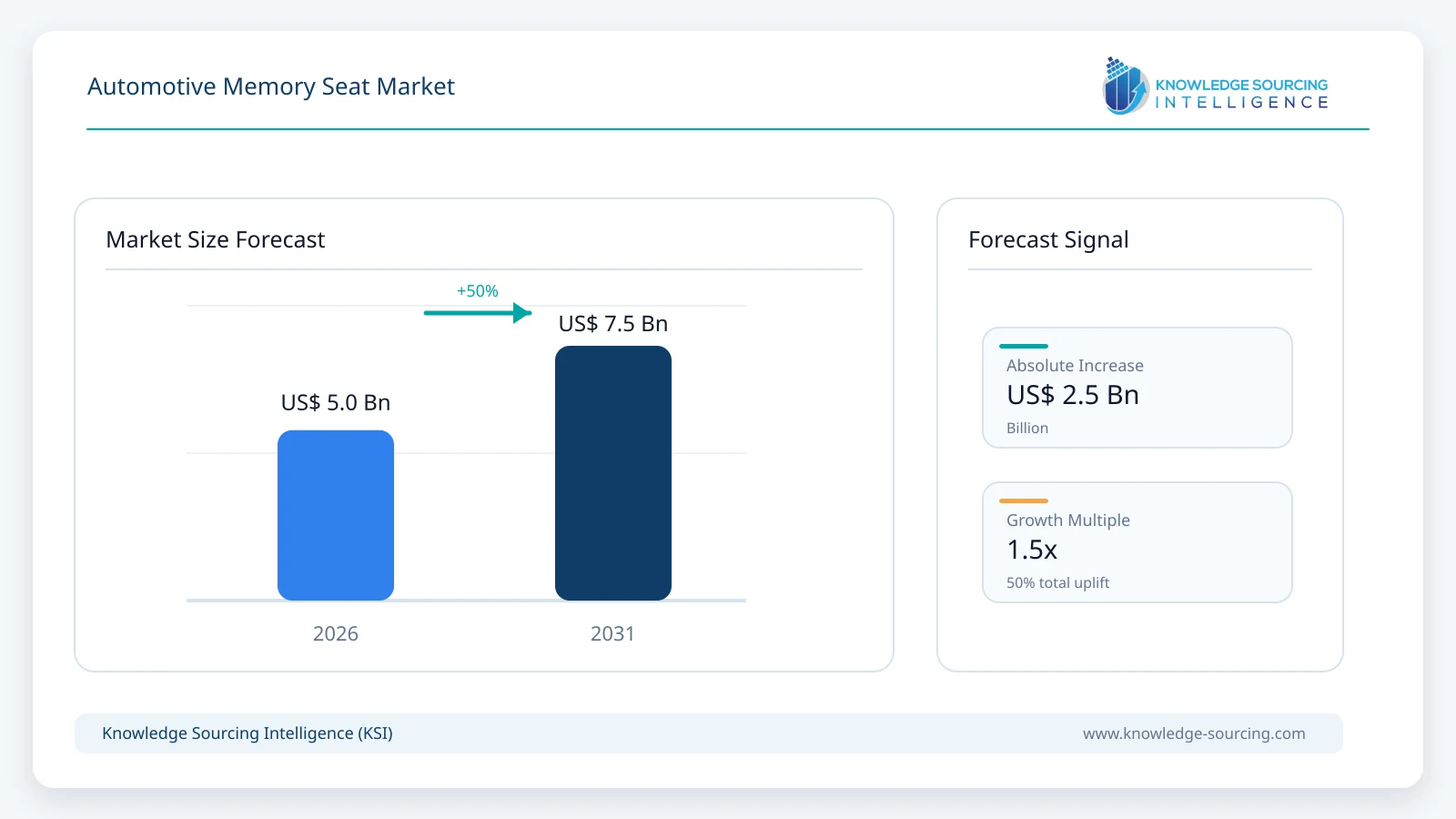
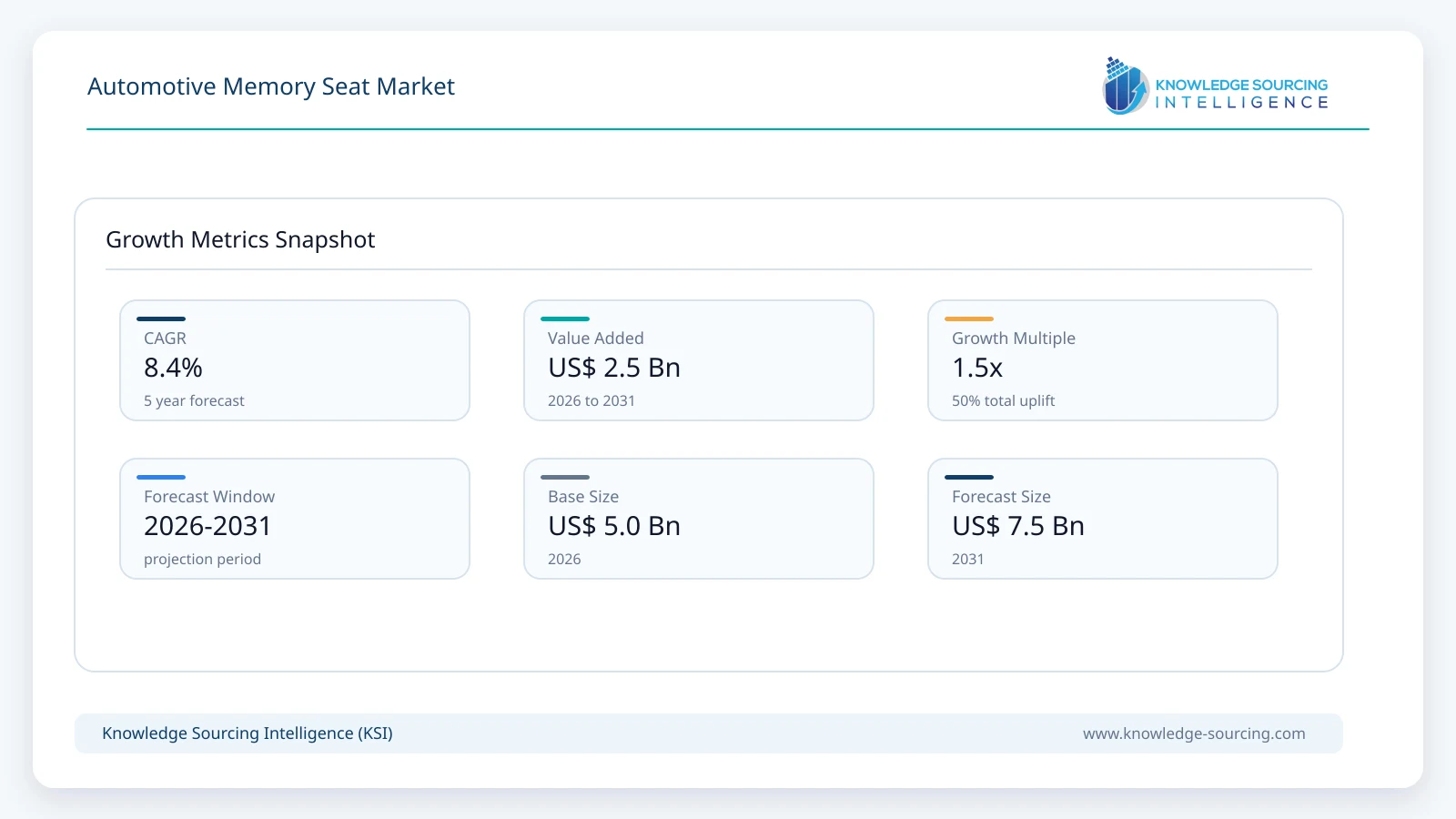
The automotive memory seat market is forecast to grow at a CAGR of 8.4%, reaching approximately USD 7.55 billion in 2031 from USD 5.05 billion in 2026.
Highlights:
- 1Core position-memory functions account for approximately 52% of global market value in 2026, reflecting broad use of stored fore-aft, recline, height and cushion settings.
- 2Front-row applications represent approximately 93% of market value in 2026 because memory functionality remains concentrated in driver and front-passenger powered seats.
- 3Passenger cars account for approximately 96% of global market value in 2026, led by premium sedans, SUVs, crossovers and increasingly upper-mid vehicle trims.
- 4Premium and luxury vehicles represent approximately 54% of market value in 2026, although adoption is expanding into mid-range vehicles as power-seat electronics become more scalable.
- 5Internal-combustion vehicles represent approximately 57% of market value in 2026, while battery electric vehicles are gaining share as digital profiles and personalized cabin functions expand.
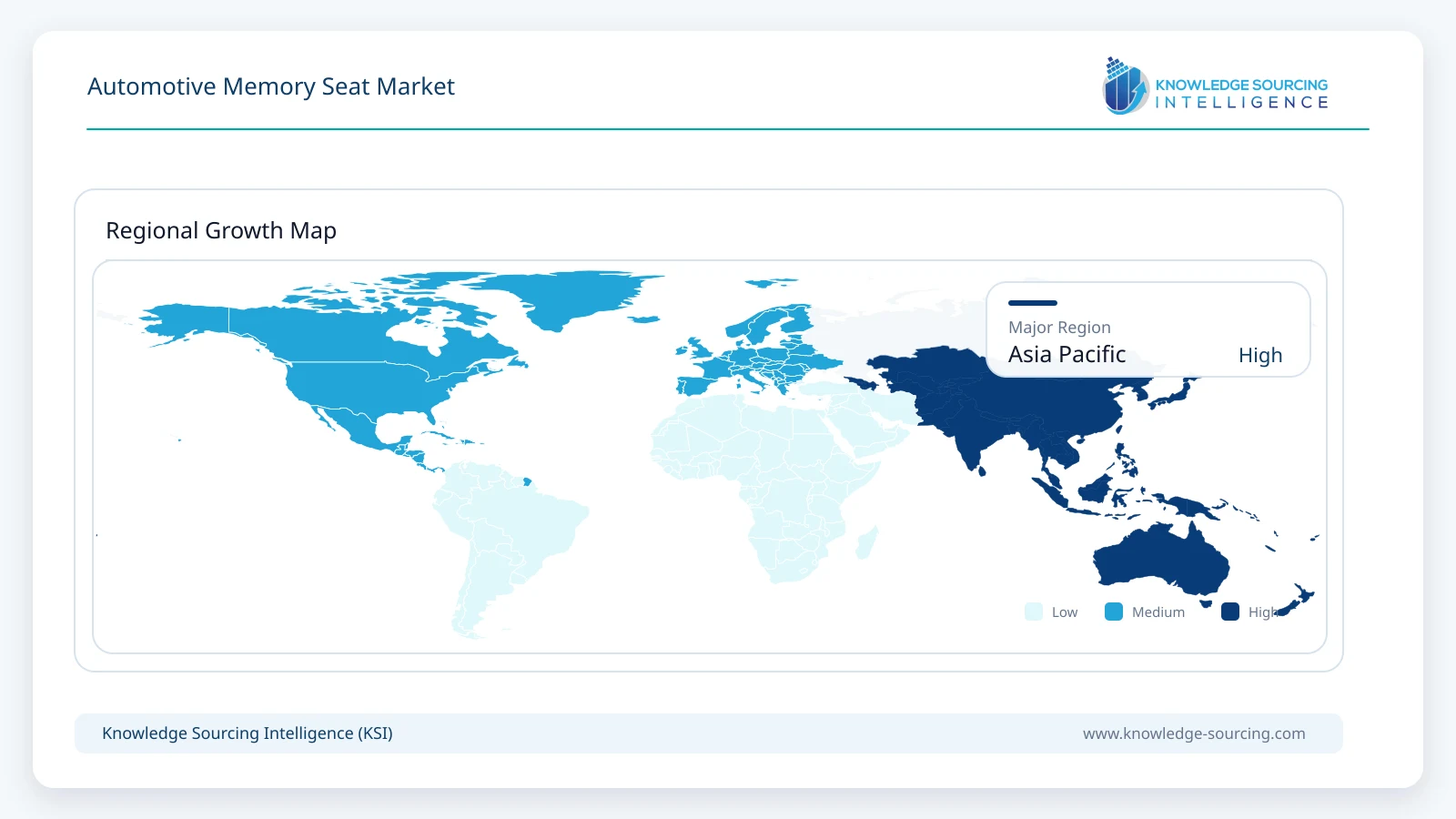
- 6Asia Pacific represents approximately 43% of global market value in 2026, supported by large passenger-vehicle production volumes and rising premium-feature penetration in China, Japan and South Korea.
Demand is being supported by wider adoption of multi-way power seats, lower-cost electronic control, greater use of user profiles and increasing consumer expectations for personalized comfort across premium and upper-mid vehicle segments.
Memory seat systems use position sensors, motors, seat-control electronics and stored user settings to return the seat to a preferred configuration. Core functions typically include fore-aft position, recline, seat height and cushion tilt, while higher-content systems can retain lumbar, bolster, massage or thermal preferences and coordinate with steering-column or mirror positions.
The feature is becoming more closely linked with wider personalization systems. Yanfeng has demonstrated precise memory settings for seat configurations and massage functions, while its newer AI-adaptive seating automatically adjusts position, firmness and temperature from learned user preferences. FORVIA, Magna, Lear, Adient, Toyota Boshoku and Hyundai Transys are similarly advancing electronically controlled and personalized seating platforms.
Market Overview
Automotive memory seats combine powered seat-adjustment mechanisms with electronic position feedback and stored configuration data. When a user selects a saved profile, the seat-control system commands multiple motors or actuators until the required positions are restored. Depending on the vehicle, the function can be activated by a door-mounted switch, seat-side control, digital key, infotainment profile or connected user account.
Seat-position memory has historically been concentrated in premium driver seats, but the function is broadening through lower-cost power-seat architectures. Toyota Boshoku has developed compact one-motor power-seat technology to reduce motor count, wiring and mass, while also offering an Easy Return function that stores a preferred seating position. These developments support wider availability of powered adjustment in smaller and lower-priced vehicles.
Memory functionality is also becoming more feature-rich. Yanfeng has demonstrated seating with precise saved settings for seat configuration and massage, while intelligent platforms are beginning to learn occupant preferences automatically. This progression increases the role of software and seat-control electronics relative to conventional switch-based adjustment.
The move toward connected and software-defined vehicles further supports memory seating. User profiles can increasingly coordinate seat position with mirrors, steering, climate and infotainment settings, allowing the vehicle to restore a broader personalized environment when the driver or passenger is recognized.
Market Trends
Memory Is Expanding Beyond Basic Seat Position Recall
Higher-content systems increasingly store more than slide and recline positions. Lumbar support, cushion angle, bolsters, headrest position, massage programs and selected thermal settings can be linked to a user profile, increasing the value of the memory function within the complete seat system.
Yanfeng has demonstrated memory settings that save both seat configuration and massage functions, illustrating the shift from simple positional recall toward broader comfort personalization.
Digital Profiles Are Replacing Stand-Alone Memory Buttons
Traditional memory seats use dedicated buttons to store two or three positions. Newer vehicle architectures increasingly associate seat settings with digital keys, infotainment accounts or recognized users, allowing the preferred position to load automatically when an occupant enters the vehicle.
This approach creates closer integration between seating, vehicle electronics and user identity, particularly in connected and software-defined vehicles.
Power-Seat Cost Reduction Is Supporting Mid-Range Adoption
Lower-cost motor, actuator and control architectures are making powered adjustment available in a wider range of vehicles. Toyota Boshoku has reduced motor count and wiring through its one-motor power-seat platform, demonstrating how system simplification can improve the economics of electronically controlled seating.
As multi-way power seats move into more upper-mid and compact premium vehicles, memory functionality can be added with less incremental mechanical complexity.
Preference Learning Is Extending Conventional Memory
The next stage of memory seating is moving from explicit stored positions toward learned preferences. Yanfeng's XiM27 automatically adjusts position, firmness and temperature using AI-learned user preferences, while FORVIA and Magna are advancing seats that automatically adapt to occupant morphology, posture and driving conditions.
These systems are likely to coexist with conventional memory functions, providing both user-controlled recall and automatic adaptation within the same seat architecture.
Rear-Seat Memory Functions Are Emerging in Premium Vehicles
Memory functions are gradually expanding beyond the driver seat as second-row powered recline, leg rests, massage and executive lounge functions become more complex. Premium rear seats benefit from stored configurations because occupants can quickly restore preferred relaxation or working positions after the seat has been moved for access or cargo use.
The opportunity is strongest in executive sedans, premium SUVs and MPVs where second-row seating carries a high level of powered adjustment and comfort content.
Segment Analysis
By Memory Function: Core Position Memory
Core position-memory systems are projected to reach approximately USD 3.480 billion by 2031. These systems store fore-aft, recline, height and cushion-angle positions and remain the principal configuration across premium and upper-mid vehicles. Their large installed base is supported by broad compatibility with conventional multi-motor power seats and relatively mature control architectures.
By Seat Position: Front Row
Front-row memory seating is projected to reach approximately USD 6.720 billion by 2031. Driver seats remain the dominant application because stored positioning improves convenience when vehicles are shared between multiple users. Front-passenger memory is expanding in luxury vehicles and high-content EVs with advanced power adjustment.
By Vehicle Type: Passenger Cars
Passenger cars are projected to generate approximately USD 7.180 billion of memory-seat market value by 2031. Premium sedans, SUVs, crossovers and MPVs provide the largest installation base, while upper-mid vehicles are increasingly adding memory as part of technology or comfort packages.
By Vehicle Class: Premium and Luxury Vehicles
Premium and luxury vehicles are projected to generate approximately USD 3.620 billion of market value by 2031. Memory seats remain a common expectation in this segment and are increasingly integrated with multi-contour support, massage, thermal comfort and driver-profile systems.
By Propulsion: Battery Electric Vehicles
Battery electric vehicles are projected to generate approximately USD 2.870 billion of memory-seat market value by 2031. EV manufacturers are using software-defined personalization and digitally managed cabins as differentiators, creating a strong fit for profile-linked seat memory and multi-function comfort recall.
By Sales Channel: OEM
OEM installations are projected to generate approximately USD 7.400 billion by 2031. Factory integration remains dominant because memory functions require direct coordination between seat motors, sensors, control modules, vehicle networks and user-profile systems.
By Geography: Asia Pacific
Asia Pacific is projected to reach approximately USD 3.470 billion by 2031. China is the main growth engine through rising premium-feature adoption and rapid development of personalized smart cabins, while Japan and South Korea contribute established automotive seating and electronics capabilities.
Market Drivers
Higher Penetration of Power Seats
Memory functionality depends on powered seat movement, making expansion of multi-way power seats a primary market driver. Power adjustment is increasingly moving from premium vehicles into upper-mid and compact premium segments.
Demand for Personalized Driver Comfort
Vehicles are frequently shared between household members, fleet users or multiple drivers. Stored positions reduce repeated manual adjustment and improve convenience, particularly where seats offer numerous powered degrees of freedom.
Growth of Digital User Profiles
Connected vehicles increasingly recognize users through keys, smartphones or accounts. Linking seat memory to these profiles allows automatic restoration of preferred settings and strengthens the value of the memory function.
Premiumization of Mid-Range Vehicles
Features that were once concentrated in luxury vehicles are spreading into higher trims of mainstream models. Memory seats are increasingly included within comfort, technology and convenience packages as electronic content per vehicle rises.
Expansion of Multi-Function Comfort Seats
Modern seats combine power adjustment with lumbar support, massage, heating, ventilation and adaptive bolsters. Memory capability allows these settings to be stored together, increasing the usefulness of the complete comfort system.
Market Restraints
Higher Cost Than Manual or Basic Power Seats
Memory seating requires position feedback, electronic control and software in addition to powered adjustment. This increases cost relative to manual seats and basic power seats without memory functionality.
Electronic and Software Complexity
Multiple motors and sensors must reach stored positions accurately and repeatedly. As memory expands into lumbar, massage and linked cabin functions, calibration and software validation become more complex.
Reliability Across Repeated Adjustment Cycles
Seat motors, gears, tracks and position sensors must maintain repeatability over many years. Mechanical wear or sensor drift can reduce positional accuracy and affect the perceived quality of the memory function.
Limited Value in Low-Adjustment Seat Architectures
Vehicles with manual seats or only limited power adjustment have less need for stored positioning. Memory functionality therefore remains concentrated in higher-content seat architectures.
Integration and Data-Management Requirements
Profile-linked memory requires coordination with body controllers, digital keys, infotainment and sometimes cloud-connected user accounts. This increases software integration and data-security requirements relative to stand-alone seat controls.
Regional Outlook
Asia Pacific
Asia Pacific is the largest regional market and is expected to remain the strongest growth centre through 2031. China is driving adoption through rapid premiumization, EV growth and strong competition around personalized smart-cabin features. Yanfeng has demonstrated both precise saved memory settings and AI-learned seat preferences, while Toyota Boshoku, Hyundai Transys and other regional suppliers continue to expand electronically controlled seating.
Japan and South Korea provide a mature engineering base for power-seat mechanisms, seat electronics and premium vehicle applications. Continued migration of comfort features into upper-mid vehicle segments is expected to broaden the addressable regional market.
North America
North America is a major memory-seat market because premium SUVs, pickups, crossovers and high-trim passenger vehicles commonly offer multi-way power adjustment and driver-profile memory. The feature is also widely used in family vehicles where multiple drivers share the same vehicle.
The region benefits from strong complete-seat supply positions held by Lear, Adient and Magna, together with high consumer familiarity with power convenience features. Expansion of electric SUVs and software-defined vehicle platforms is expected to support broader profile-linked seat personalization.
Competitive Landscape
Competition combines complete-seat manufacturers with seat-mechanism specialists that supply powered adjustment, electronic control and memory-capable structures. Lear, Adient, FORVIA, Magna, Yanfeng, Toyota Boshoku, Hyundai Transys and Brose are directly involved in advanced power seating, memory-related functionality or electronically controlled seat systems.
Yanfeng differentiates through memory settings that extend into massage and through AI-based preference learning. Toyota Boshoku combines power-seat engineering with simplified mechanisms and stored-position functions. Brose has a long-standing position in electric seat adjusters and electronic seat-position memory, while Lear, Adient, FORVIA and Magna integrate memory-capable powered adjustment within broader complete-seat platforms.
The competitive focus is shifting toward lower-cost power architectures, more precise position sensing, faster recall, profile integration and extension of memory into lumbar, thermal and wellness functions. Suppliers with strong seat-electronics and software capabilities are increasingly able to differentiate beyond basic multi-motor adjustment.
Recent Developments
July 2026: Lear reported significant new and conquest seating awards with Audi for complete seats and advanced comfort systems in Europe and North America, expanding the installed base for electronically controlled premium seating.
June 2026: Yanfeng unveiled XiM27, a production-ready smart-cabin platform with AI-adaptive seating that automatically adjusts seat position, firmness and temperature based on learned user preferences.
May 2026: Magna detailed its adaptive-seat technology direction, highlighting occupant recognition and automatic seat-position and support adjustments based on individual posture and driving conditions.
February 2026: FORVIA presented an intelligent-seat platform capable of automatically adjusting up to ten parameters using occupant morphology, driving conditions, sensors, software and AI.
August 2025: Adient announced ModuGo, a customizable modular seat platform with adaptive support and smart comfort features for personalized interiors.
Market Outlook
The automotive memory seat market is expected to maintain steady expansion through 2031 as power-seat penetration rises and memory moves into a broader range of vehicle classes. Core position recall will remain the largest value pool, but growth will increasingly come from multi-function comfort memory and profile-linked personalization.
Future systems will increasingly recognize users and automatically load preferences. Seat position, lumbar support, bolsters, massage and selected thermal functions are expected to be managed through common digital profiles.
Asia Pacific is expected to lead market expansion, while North America remains a major demand centre for high-content power seating. Competitive advantage will depend on lower-cost actuation, accurate position sensing, software integration, reliable long-life adjustment and the ability to extend memory functionality across broader comfort systems.
Automotive Memory Seat Market Scope
| Report Metric | Details |
|---|---|
| Total Market Size in 2026 | USD 5.05 billion |
| Total Market Size in 2031 | USD 7.55 billion |
| Forecast Unit | Billion |
| Growth Rate | 8.4% |
| Study Period | 2021 to 2031 |
| Historical Data | 2021 to 2024 |
| Base Year | 2025 |
| Forecast Period | 2026 – 2031 |
| Segmentation | Memory Function, Seat Position, Vehicle Type, Vehicle Class, Propulsion, Sales Channel, Geography |
| Companies |
|
Market Segmentation
By Memory Function
Core Position Memory
Multi-Function Comfort Memory
Integrated User-Profile Memory
By Seat Position
Front Row
Rear and Second Row
By Vehicle Type
Passenger Cars
Light Commercial Vehicles
Medium and Heavy Commercial Vehicles
By Vehicle Class
Premium and Luxury Vehicles
Mid-Range Vehicles
Entry-Level Vehicles
By Propulsion
Internal Combustion Engine Vehicles
Hybrid Electric Vehicles
Battery Electric Vehicles
By Sales Channel
OEM
Aftermarket
By Geography
North America
United States
Canada
Mexico
South America
Brazil
Argentina
Others
Europe
Germany
United Kingdom
France
Italy
Spain
Others
Middle East and Africa
Saudi Arabia
UAE
South Africa
Others
Asia Pacific
China
Japan
South Korea
India
Indonesia
Thailand
Others
Table of Contents
1. INTRODUCTION
1.1. Market Overview
1.2. Market Definition
1.3. Scope of the Study
1.4. Market Segmentation
1.5. Currency
1.6. Assumptions
1.7. Base and Forecast Years
1.8. Key Benefits to Stakeholders
2. RESEARCH METHODOLOGY
2.1. Research Design
2.2. Secondary Research
2.3. Primary Research
2.4. Market Estimation
2.5. Segment Modelling
2.6. Data Triangulation and Validation
3. EXECUTIVE SUMMARY
3.1. Key Findings
3.2. Automotive Memory Seat Market Size, 2026-2031
3.3. Memory Function Outlook
3.4. Seat Position Outlook
3.5. Vehicle Type Outlook
3.6. Vehicle Class Outlook
3.7. Propulsion Outlook
3.8. Sales Channel Outlook
3.9. Regional Opportunity Summary
4. MARKET DYNAMICS
4.1. Market Drivers
4.1.1. Higher Penetration of Power Seats
4.1.2. Demand for Personalized Driver Comfort
4.1.3. Growth of Digital User Profiles
4.1.4. Premiumization of Mid-Range Vehicles
4.1.5. Expansion of Multi-Function Comfort Seats
4.2. Market Restraints
4.2.1. Higher Cost Than Manual or Basic Power Seats
4.2.2. Electronic and Software Complexity
4.2.3. Reliability Across Repeated Adjustment Cycles
4.2.4. Limited Value in Low-Adjustment Seat Architectures
4.2.5. Integration and Data-Management Requirements
4.3. Market Opportunities
4.4. Porter's Five Forces Analysis
4.5. Industry Value Chain Analysis
4.6. Memory Seat System Economics
4.7. Safety and Electronic Integration Environment
5. TECHNOLOGY OUTLOOK
5.1. Seat Control Modules
5.2. Position Sensors and Feedback Systems
5.3. Electric Motors and Actuators
5.4. Non-Volatile Memory and Profile Storage
5.5. LIN and CAN Seat-Network Integration
5.6. Digital Key and User Recognition
5.7. Steering and Mirror Profile Coordination
5.8. Lumbar, Bolster and Massage Memory
5.9. AI-Based Preference Learning
5.10. Software-Defined Seat Personalization
6. AUTOMOTIVE MEMORY SEAT MARKET BY MEMORY FUNCTION
6.1. Introduction
6.2. Core Position Memory
6.3. Multi-Function Comfort Memory
6.4. Integrated User-Profile Memory
7. AUTOMOTIVE MEMORY SEAT MARKET BY SEAT POSITION
7.1. Introduction
7.2. Front Row
7.3. Rear and Second Row
8. AUTOMOTIVE MEMORY SEAT MARKET BY VEHICLE TYPE
8.1. Introduction
8.2. Passenger Cars
8.3. Light Commercial Vehicles
8.4. Medium and Heavy Commercial Vehicles
9. AUTOMOTIVE MEMORY SEAT MARKET BY VEHICLE CLASS
9.1. Introduction
9.2. Premium and Luxury Vehicles
9.3. Mid-Range Vehicles
9.4. Entry-Level Vehicles
10. AUTOMOTIVE MEMORY SEAT MARKET BY PROPULSION
10.1. Introduction
10.2. Internal Combustion Engine Vehicles
10.3. Hybrid Electric Vehicles
10.4. Battery Electric Vehicles
11. AUTOMOTIVE MEMORY SEAT MARKET BY SALES CHANNEL
11.1. Introduction
11.2. OEM
11.3. Aftermarket
12. AUTOMOTIVE MEMORY SEAT MARKET BY GEOGRAPHY
12.1. North America
12.1.1. United States
12.1.2. Canada
12.1.3. Mexico
12.2. South America
12.2.1. Brazil
12.2.2. Argentina
12.2.3. Others
12.3. Europe
12.3.1. Germany
12.3.2. United Kingdom
12.3.3. France
12.3.4. Italy
12.3.5. Spain
12.3.6. Others
12.4. Middle East and Africa
12.4.1. Saudi Arabia
12.4.2. UAE
12.4.3. South Africa
12.4.4. Others
12.5. Asia Pacific
12.5.1. China
12.5.2. Japan
12.5.3. South Korea
12.5.4. India
12.5.5. Indonesia
12.5.6. Thailand
12.5.7. Others
13. COMPETITIVE ENVIRONMENT AND ANALYSIS
13.1. Major Players and Strategy Analysis
13.2. Market Share Analysis
13.3. Product and Technology Benchmarking
13.4. Product Launches and Development Activity
13.5. Competitive Dashboard
14. COMPANY PROFILES
14.1. Lear Corporation
14.2. Adient plc
14.3. FORVIA
14.4. Magna International Inc.
14.5. Yanfeng
14.6. Toyota Boshoku Corporation
14.7. Hyundai Transys Inc.
14.8. Brose Fahrzeugteile SE & Co. KG
15. APPENDIX
15.1. Currency
15.2. Assumptions
15.3. Base and Forecast Years Timeline
15.4. Key Benefits for Stakeholders
15.5. Research Methodology
15.6. Abbreviations
15.7. Data Sources
Navigate
Trusted by the world's leading organizations











