
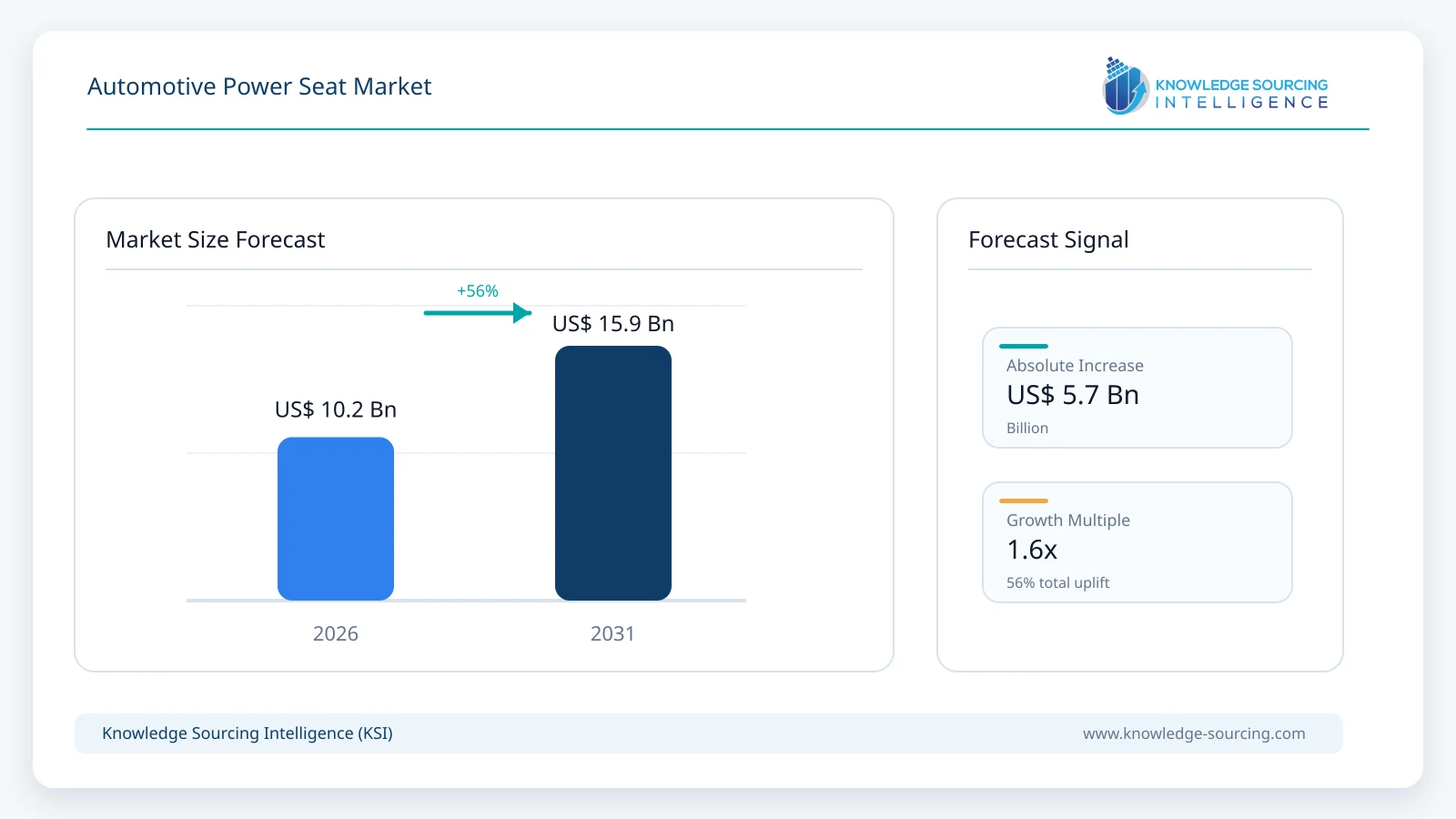
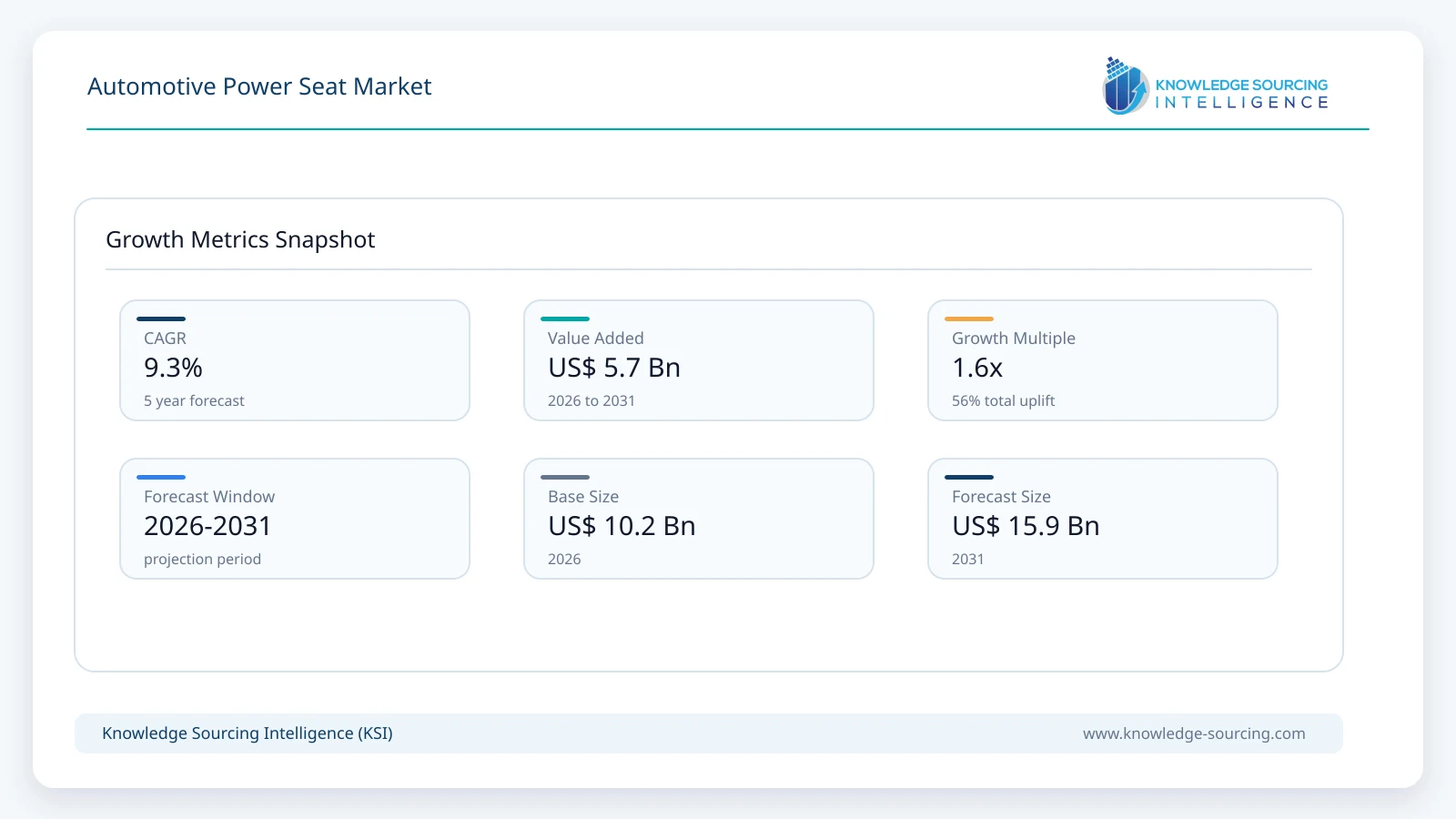
The automotive power seat market is forecast to grow at a CAGR of 9.3%, reaching approximately USD 15.9 billion in 2031 from USD 10.2 billion in 2026.
Highlights:
- 1Six-way power-seat systems account for approximately 38% of global market value in 2026, supported by broad use of powered fore/aft, height and recline adjustment across upper-mid and premium passenger vehicles.
- 2Front-row applications represent approximately 88% of market value in 2026 because powered adjustment remains concentrated in driver and front-passenger seats.
- 3Passenger cars account for approximately 95% of global market value in 2026, led by SUVs, crossovers, sedans, MPVs and higher-content electric vehicles.
- 4Mid-range vehicles represent approximately 47% of market value in 2026 as powered adjustment moves down from luxury trims into larger-volume vehicle programs.
- 5Internal-combustion vehicles account for approximately 56% of market value in 2026, while battery electric vehicles are gaining share as cabin comfort and software-controlled positioning become stronger differentiators.
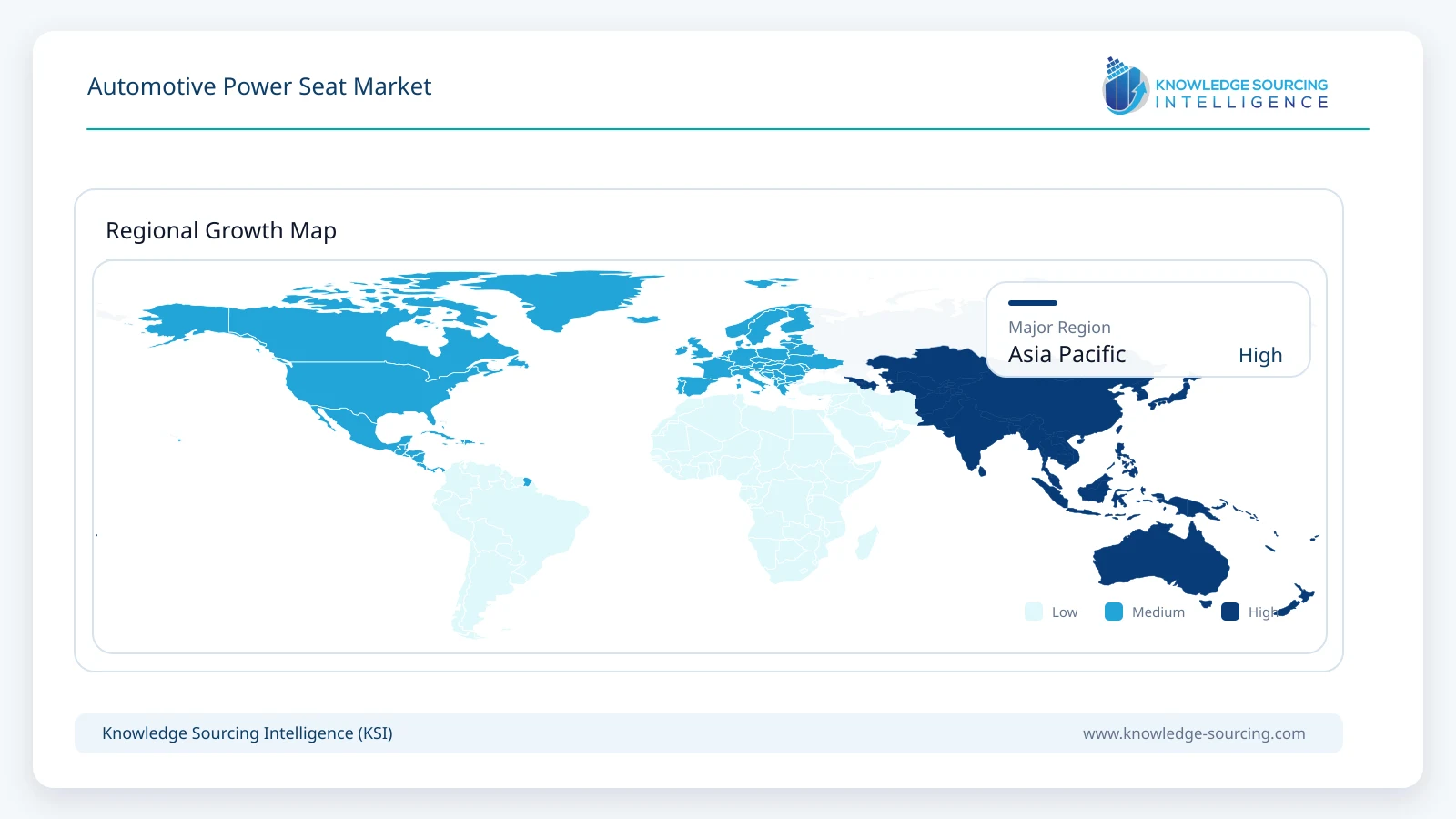
- 6Asia Pacific represents approximately 45% of global market value in 2026, supported by the world's largest passenger-vehicle production base and rapid adoption of powered seating in China, Japan and South Korea.
Demand is being driven by wider fitment of electrically powered fore/aft, height, tilt and recline functions, increasing rear-seat actuation and greater integration of powered positioning with memory and comfort features.
Power-seat systems range from basic two- and four-way adjustment to six-, eight-, ten- and twelve-way architectures with independent control of seat slide, lift, recline, cushion tilt and cushion extension. The core system typically combines one or more electric motors, gearboxes, tracks, recliners, height adjusters, switches or electronic controllers and structural interfaces.
Suppliers are reducing the cost and complexity of powered seating through more compact mechatronics and platform-based mechanisms. Toyota Boshoku's one-motor six-way power seat consolidates fore/aft, recline and vertical adjustment into a single motor and clutch architecture. FORVIA offers powered tracks, recliners, height adjusters and e-tilt actuators, while Magna supplies power adjusters and recliners across complete-seat and structural programs.
Market Overview
Power seats replace manual adjustment levers with motorized mechanisms that move the seat along one or more axes. Common functions include longitudinal slide, seat height, backrest recline, cushion tilt, cushion length and seat-base angle. Premium systems can add independent thigh support, powered headrests, leg rests and multi-axis rear-seat positioning.
Brose has been active in electric seat adjustment for decades and develops adjustment systems, motors and controllers for automotive seating. Its portfolio combines mechatronic components with software and sensors, while electronically commutated motors can deliver faster and quieter adjustment for increasingly flexible interiors.
FORVIA offers a broad powered-mechanism portfolio covering seat tracks, recliners, powered height adjusters and compact mechatronic e-tilt actuators. The company also uses smart actuators with integrated control units to support seat-position customization and monitoring.
Toyota Boshoku is reducing system complexity through its one-motor power-seat architecture. The system provides six-way adjustment using a single motor and a clutch box that changes power transmission according to switch input, reducing motor count, wiring, mass and cost compared with conventional multi-motor arrangements.
Market Trends
Power Seats Are Moving Further into Mid-Range Vehicles
Powered seat adjustment is becoming less concentrated in luxury vehicles as OEMs use common seat architectures across several trim grades. Basic powered slide, height and recline functions are increasingly offered in mainstream SUVs, crossovers and upper-mid sedans, particularly on driver seats.
This broadening of fitment is increasing unit volumes while encouraging suppliers to simplify mechanisms, reduce motor count and standardize structures across vehicle programs.
Multi-Function Actuators Are Reducing Cost and Mass
Seat suppliers are developing architectures that consolidate several powered movements into fewer actuators. Toyota Boshoku's one-motor six-way power seat demonstrates this direction by using a clutch box to route one motor across slide, recline and vertical functions.
Lower motor count can reduce wiring, packaging volume, seat mass and electrical content, improving the business case for powered seating in compact and mid-range vehicles.
Powered Rear-Seat Functions Are Expanding
Electric actuation is increasingly moving beyond the front row into second- and third-row seating. Power recline, one-touch easy entry, long rails, leg rests and powered folding are becoming more common in large SUVs, MPVs and premium electric vehicles.
Magna's reconfigurable seating portfolio uses powered long rails and full-powered easy-entry functions, while FORVIA offers rear structures designed for both manual and powered actuation.
Seat Actuation Is Becoming More Software-Integrated
Power seats are increasingly controlled through electronic modules, digital interfaces and central vehicle networks rather than only through local seat switches. Software coordination enables stored positions, easy-entry movement, automated pre-crash repositioning and integration with user profiles.
FORVIA's smart actuators integrate control functions within the mechatronic unit, and Brose combines seat adjustment with electronics and software to support more responsive, connected seat motion.
Electric Vehicles Are Increasing Powered Cabin Reconfiguration
Battery electric platforms are encouraging more flexible seating because flatter floors and centralized electronics support long rails, powered swivels and larger adjustment ranges. EV manufacturers also place greater emphasis on cabin experience as a competitive differentiator.
Global electric-car sales exceeded 20 million units in 2025 and represented one-quarter of new-car sales, increasing the vehicle base for electronically controlled seat-positioning systems.
Segment Analysis
By Adjustment Configuration: Six-Way Power Seats
Six-way power-seat systems are projected to reach approximately USD 5.25 billion by 2031. This configuration offers a strong balance between comfort, packaging and cost by combining powered fore/aft, vertical and backrest-recline adjustment. It is increasingly suitable for upper-mid and mainstream vehicles as actuator cost declines and common seat platforms are used across multiple trim grades.
By Seat Position: Front Row
Front-row power seats are projected to reach approximately USD 13.50 billion by 2031. Driver seats remain the highest-penetration application because precise positioning affects ergonomics, visibility and control access, while powered front-passenger adjustment continues to expand in premium and upper-mid models.
By Vehicle Type: Passenger Cars
Passenger cars are projected to generate approximately USD 15.00 billion of power-seat market value by 2031. SUVs, crossovers, sedans and MPVs provide the largest installation base, with feature penetration rising as powered adjustment spreads into larger-volume trims.
By Vehicle Class: Mid-Range Vehicles
Mid-range vehicles are projected to generate approximately USD 7.00 billion of power-seat market value by 2031. This segment is becoming increasingly important as OEMs use modular seat structures and lower-cost actuator architectures to provide powered adjustment without the cost structure of full luxury seating.
By Propulsion: Battery Electric Vehicles
Battery electric vehicles are projected to generate approximately USD 5.60 billion of power-seat market value by 2031. EV makers are increasing electronic seat content and using power rails, powered recline and software-linked positioning to create more flexible and differentiated interiors.
By Geography: Asia Pacific
Asia Pacific is projected to reach approximately USD 7.55 billion by 2031. China is the principal growth engine because of its large passenger-vehicle production base and rapid EV expansion, while Japan and South Korea provide strong seat-mechanism engineering and manufacturing capabilities.
Market Drivers
Broader Adoption in Mid-Range Vehicles
Powered adjustment is becoming more accessible as standardized mechanisms, lower-cost motors and common seat platforms reduce incremental system cost. This is expanding power-seat fitment beyond premium and luxury vehicles.
Increasing Consumer Demand for Comfort and Convenience
Electric adjustment allows occupants to achieve a more precise seating position with less physical effort than manual systems. Convenience is particularly important for multi-driver households, older users and vehicles with wider adjustment ranges.
Growth of SUVs and Premium Crossovers
SUVs and crossovers typically offer higher comfort content than entry-level cars and often package driver-seat power adjustment in mid- and upper-grade trims. Continued growth of these body styles supports higher power-seat penetration.
Expansion of Electric and Software-Defined Vehicles
EVs and software-defined vehicles use more centralized electronics and digital user profiles, creating a natural platform for powered seat positioning, memory recall, automated entry/exit functions and adaptive comfort.
Development of Compact Mechatronic Actuators
Smaller motors, integrated controllers and multi-function mechanisms are reducing seat packaging requirements and simplifying wiring. These improvements support wider deployment in compact vehicles and additional seat rows.
Market Restraints
Higher Cost Than Manual Seats
Power seats require motors, gearboxes, electronic controls, wiring and more complex validation than manual seats. The additional cost remains a barrier in entry-level vehicles and highly price-sensitive markets.
Higher Seat Weight
Multiple motors, tracks and powered mechanisms increase seat mass, which can conflict with vehicle lightweighting and EV range targets. Suppliers are therefore under pressure to reduce actuator and structural weight.
Electrical and Reliability Requirements
Seat motors and controllers must operate reliably over thousands of adjustment cycles and under varying temperature, vibration and occupant loads. Failure can affect usability and, in some configurations, safety-related seat positioning.
Packaging Constraints
Power mechanisms must fit beneath or within the seat while preserving foot space, battery packaging, low seat height and structural crash performance. Compact vehicle platforms provide less room for complex multi-axis adjustment.
Limited Value in Entry-Level and Fleet Vehicles
Manual seats remain cost-effective where adjustment frequency is low and buyers prioritize acquisition cost over convenience. This limits power-seat penetration in basic commercial and entry passenger vehicles.
Regional Outlook
Asia Pacific
Asia Pacific is the largest regional market and is expected to remain the strongest growth centre through 2031. China combines very high passenger-vehicle production with rapid electric-vehicle growth and rising comfort-feature penetration, while Japan and South Korea maintain strong capabilities in seat structures, motors and mechanisms.
Toyota Boshoku's one-motor power seat demonstrates regional efforts to lower cost and extend power adjustment into compact vehicles. The company's increased control of seat-recliner and seat-slide manufacturing in Indonesia also strengthens its mechanism supply base across Asia.
North America
North America is a major power-seat market because SUVs, pickups and premium crossovers account for a large share of light-vehicle demand. Driver-seat power adjustment is widely available across mid- and upper-range trims, while higher-end vehicles increasingly add powered passenger and rear-seat functions.
Magna, Lear, Adient, FORVIA and Brose maintain significant regional seating or mechanism operations. Continued demand for large vehicles and feature-rich interiors supports high content per vehicle even as overall power-seat penetration matures.
Competitive Landscape
The automotive power-seat market includes complete-seat suppliers and specialist mechanism manufacturers with capabilities in electric adjusters, tracks, recliners, lifters, motors and electronic controls. Brose, Magna, FORVIA, Toyota Boshoku, Adient, Lear and Hyundai Transys are directly involved in power-seat systems or powered seat-mechanism manufacturing.
Brose is one of the industry's long-standing specialists in electric seat adjustment and combines motors, adjustment mechanisms, electronics and software. Magna supplies manual and power adjusters and recliners as part of its structural portfolio, while FORVIA offers powered tracks, recliners, height adjusters and compact mechatronic e-tilt actuators.
Toyota Boshoku differentiates through low-cost integration such as its one-motor six-way seat and maintains in-house capability in recliners, slides and geared motors. Adient and Lear integrate powered mechanisms into complete-seat architectures, while Hyundai Transys manufactures seat frames and electronic adjustment systems across global OEM programs.
Recent Developments
July 2026: Lear reported significant new and conquest seating awards with Audi in Europe and North America, expanding complete-seat and modular comfort business across premium vehicle programs.
May 2026: Magna outlined its adaptive-seat technology direction, highlighting automatic seat-position adjustment and continuous support changes based on occupant posture and driving conditions.
April 2026: Toyota Boshoku completed full ownership of PT. Toyota Boshoku Device Indonesia, strengthening control of a production base manufacturing seat recliners and seat slides.
February 2026: FORVIA presented its intelligent-seat technology at Capital Markets Day, including smart mechatronic actuation and automatic adjustment of multiple seat parameters through software and AI.
January 2026: FORVIA announced more than USD 1 billion in new and extended business with a major European automaker, including front-seat structures and complete-seat assembly for North American production.
October 2025: FORVIA extended its cooperation with Hyundai-Kia for seat frames and mechanisms alongside a new seating-comfort award for models planned for Europe and the United States.
August 2025: Brose presented its SlimSeat development, integrating seat adjusters within a thin belt-integrated structure and adding powered leg-rest functionality to support flexible premium interiors.
Market Outlook
The automotive power-seat market is expected to maintain steady growth through 2031 as powered adjustment continues moving from premium vehicles into mid-range programs. Six-way systems will remain an important volume category, while higher-way systems, rear-seat actuation and long-rail architectures are expected to increase content per vehicle.
Technology development will increasingly focus on compact motors, integrated electronics, quieter movement, lower mass and software coordination. Multi-function actuator architectures and common seat platforms will be important for reducing the cost of powered seating without sacrificing adjustment range.
Asia Pacific is expected to lead market expansion, while North America remains a major high-content market. Competitive advantage will depend on actuator efficiency, packaging, noise performance, durability, modularity and the ability to integrate powered movement with memory, safety and intelligent-seat functions.
Automotive Power Seat Market Scope
| Report Metric | Details |
|---|---|
| Total Market Size in 2026 | USD 10.2 billion |
| Total Market Size in 2031 | USD 15.9 billion |
| Forecast Unit | Billion |
| Growth Rate | 9.3% |
| Study Period | 2021 to 2031 |
| Historical Data | 2021 to 2024 |
| Base Year | 2025 |
| Forecast Period | 2026 – 2031 |
| Segmentation | Adjustment Configuration, Seat Position, Vehicle Type, Vehicle Class, Propulsion, Geography |
| Companies |
|
Market Segmentation
By Adjustment Configuration
Two- and Four-Way
Six-Way
Eight-Way
Ten-Way and Above
By Seat Position
Driver
Front Passenger
Rear and Second Row
By Vehicle Type
Passenger Cars
Light Commercial Vehicles
Medium and Heavy Commercial Vehicles
By Vehicle Class
Entry-Level Vehicles
Mid-Range Vehicles
Premium and Luxury Vehicles
By Propulsion
Internal Combustion Engine Vehicles
Hybrid Electric Vehicles
Battery Electric Vehicles
By Geography
North America
United States
Canada
Mexico
South America
Brazil
Argentina
Others
Europe
Germany
United Kingdom
France
Italy
Spain
Others
Middle East and Africa
Saudi Arabia
UAE
South Africa
Others
Asia Pacific
China
Japan
South Korea
India
Indonesia
Thailand
Others
Table of Contents
1. INTRODUCTION
1.1. Market Overview
1.2. Market Definition
1.3. Scope of the Study
1.4. Market Segmentation
1.5. Currency
1.6. Report Parameters
1.7. Base and Forecast Years
1.8. Key Benefits to Stakeholders
2. RESEARCH METHODOLOGY
2.1. Research Design
2.2. Secondary Research
2.3. Primary Research
2.4. Market Sizing Approach
2.5. Segmentation Framework
2.6. Data Triangulation and Validation
3. EXECUTIVE SUMMARY
3.1. Key Findings
3.2. Automotive Power Seat Market Size, 2026-2031
3.3. Adjustment Configuration Outlook
3.4. Seat Position Outlook
3.5. Vehicle Type Outlook
3.6. Vehicle Class Outlook
3.7. Propulsion Outlook
3.8. Regional Opportunity Summary
4. MARKET DYNAMICS
4.1. Market Drivers
4.1.1. Broader Adoption in Mid-Range Vehicles
4.1.2. Increasing Consumer Demand for Comfort and Convenience
4.1.3. Growth of SUVs and Premium Crossovers
4.1.4. Expansion of Electric and Software-Defined Vehicles
4.1.5. Development of Compact Mechatronic Actuators
4.2. Market Restraints
4.2.1. Higher Cost Than Manual Seats
4.2.2. Higher Seat Weight
4.2.3. Electrical and Reliability Requirements
4.2.4. Packaging Constraints
4.2.5. Limited Value in Entry-Level and Fleet Vehicles
4.3. Market Opportunities
4.4. Porter's Five Forces Analysis
4.5. Industry Value Chain Analysis
4.6. Power Seat System Economics
4.7. Safety and Electrical Requirements
5. TECHNOLOGY OUTLOOK
5.1. Power Seat Motors
5.2. Seat Tracks and Fore/Aft Adjusters
5.3. Powered Recliners
5.4. Height and Lift Adjusters
5.5. Cushion Tilt and Length Adjustment
5.6. Multi-Function and One-Motor Architectures
5.7. Smart Mechatronic Actuators
5.8. Seat Control Modules and Switches
5.9. CAN and Vehicle-Network Integration
5.10. Powered Long-Rail and Rear-Seat Reconfiguration
6. AUTOMOTIVE POWER SEAT MARKET BY ADJUSTMENT CONFIGURATION
6.1. Introduction
6.2. Two- and Four-Way
6.3. Six-Way
6.4. Eight-Way
6.5. Ten-Way and Above
7. AUTOMOTIVE POWER SEAT MARKET BY SEAT POSITION
7.1. Introduction
7.2. Driver
7.3. Front Passenger
7.4. Rear and Second Row
8. AUTOMOTIVE POWER SEAT MARKET BY VEHICLE TYPE
8.1. Introduction
8.2. Passenger Cars
8.3. Light Commercial Vehicles
8.4. Medium and Heavy Commercial Vehicles
9. AUTOMOTIVE POWER SEAT MARKET BY VEHICLE CLASS
9.1. Introduction
9.2. Entry-Level Vehicles
9.3. Mid-Range Vehicles
9.4. Premium and Luxury Vehicles
10. AUTOMOTIVE POWER SEAT MARKET BY PROPULSION
10.1. Introduction
10.2. Internal Combustion Engine Vehicles
10.3. Hybrid Electric Vehicles
10.4. Battery Electric Vehicles
11. AUTOMOTIVE POWER SEAT MARKET BY GEOGRAPHY
11.1. North America
11.1.1. United States
11.1.2. Canada
11.1.3. Mexico
11.2. South America
11.2.1. Brazil
11.2.2. Argentina
11.2.3. Others
11.3. Europe
11.3.1. Germany
11.3.2. United Kingdom
11.3.3. France
11.3.4. Italy
11.3.5. Spain
11.3.6. Others
11.4. Middle East and Africa
11.4.1. Saudi Arabia
11.4.2. UAE
11.4.3. South Africa
11.4.4. Others
11.5. Asia Pacific
11.5.1. China
11.5.2. Japan
11.5.3. South Korea
11.5.4. India
11.5.5. Indonesia
11.5.6. Thailand
11.5.7. Others
12. COMPETITIVE ENVIRONMENT AND ANALYSIS
12.1. Major Players and Strategy Analysis
12.2. Market Share Analysis
12.3. Product and Technology Benchmarking
12.4. New Business Awards and Product Development
12.5. Competitive Dashboard
13. COMPANY PROFILES
13.1. Brose Fahrzeugteile SE & Co. KG
13.2. Magna International Inc.
13.3. FORVIA
13.4. Toyota Boshoku Corporation
13.5. Adient plc
13.6. Lear Corporation
13.7. Hyundai Transys Inc.
14. APPENDIX
14.1. Currency
14.2. Report Parameters
14.3. Base and Forecast Years Timeline
14.4. Key Benefits for Stakeholders
14.5. Research Methodology
14.6. Abbreviations
14.7. Data Sources
Navigate
Trusted by the world's leading organizations











