
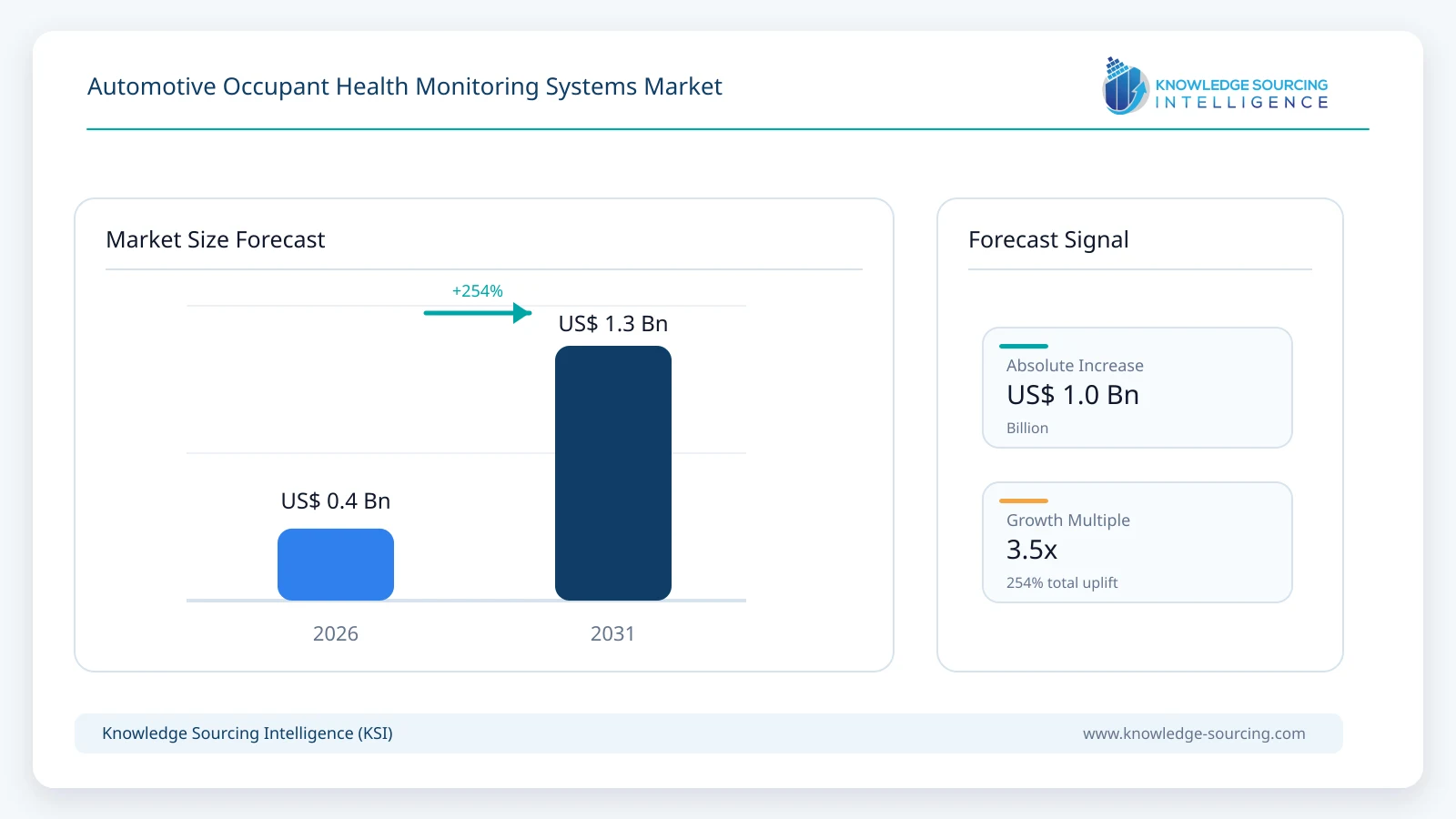
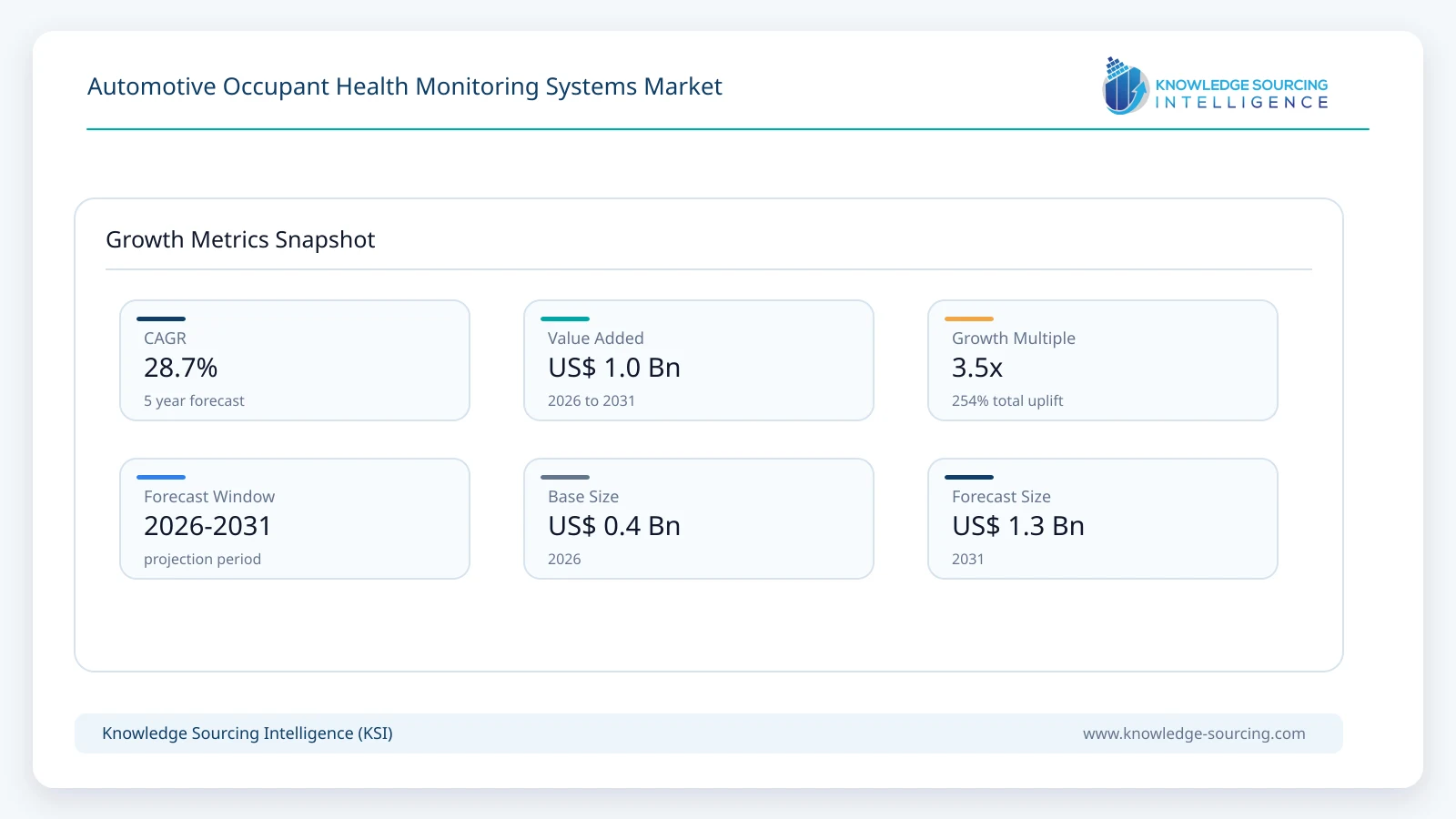
The automotive occupant health monitoring systems market is forecast to grow at a CAGR of 28.7%, reaching approximately USD 1.337 billion by 2031 from USD 0.378 billion in 2026.
Highlights:
- 1Camera-based remote physiological monitoring is estimated to account for approximately 38% of revenue in 2026, reflecting the potential to reuse existing in-cabin cameras and processing.
- 2Cardiovascular and respiratory assessment represents an estimated 39% of the 2026 market and remains an important foundation for multi-occupant health interpretation.
- 3Integrated driver and occupant monitoring architectures account for approximately 61% of 2026 revenue as OEMs favor sensor and processor reuse.
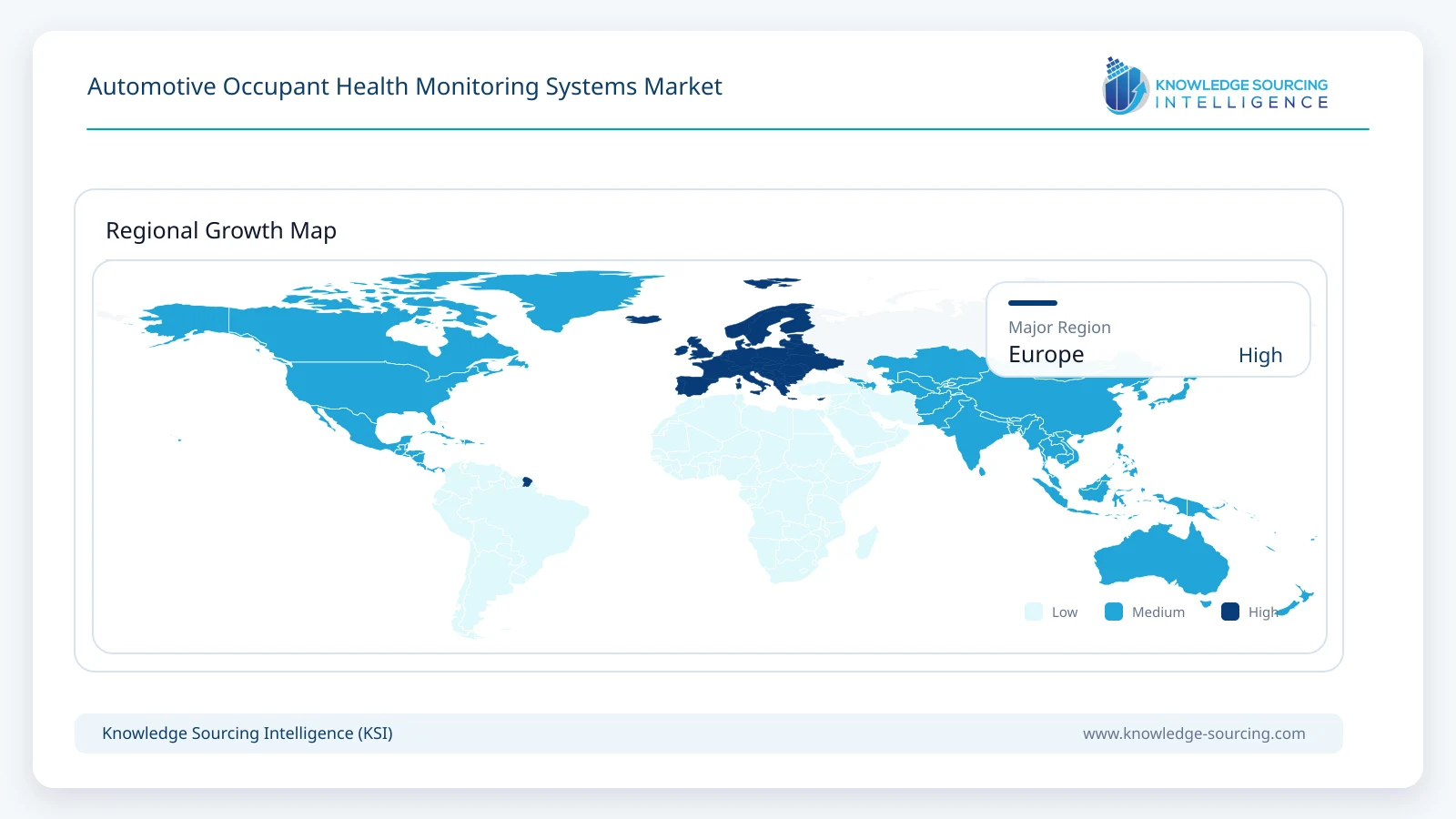
- 4Europe is estimated to represent approximately 35% of market revenue in 2026, while Asia Pacific is expected to gain share through 2031.
- 5Multi-row and passenger-inclusive coverage expands as manufacturers develop shared cabin perception software rather than isolated driver-only sensing.
- 6Production evidence for passenger-specific physiological systems remains less mature than evidence for driver monitoring; reported supplier concepts are not treated as full-volume launches.
The market encompasses systems that extend physiological observation beyond a driver-only installation to a front passenger, rear-seat occupant or multiple people in the cabin. Revenue includes health-specific sensors, processing software and vehicle integration.
Automotive cameras can estimate periodic physiological changes from exposed skin, while millimetre-wave radar can detect the small movements associated with breathing and selected heartbeat signals. Seat-integrated contact sensors and available wearable interfaces can provide complementary readings when supported by the vehicle architecture. For multiple occupants, software must assign each signal correctly and assess its reliability.
Market Overview
Automotive occupant health monitoring uses information gathered within the passenger compartment to assess selected physical and cognitive indicators without requiring a medical examination. For a multi-seat system, the central challenge is not simply sensing a heartbeat or breathing movement but establishing which occupant generated the signal, whether the observation is reliable during motion, and how the result should influence the vehicle. Cameras can derive remote pulse-related information from skin variations, while radar provides an alternative source of micro-motion information when visibility is limited. An occupant model must then combine the measurement with position, movement and signal quality before generating a warning or wellbeing response.
Automotive suppliers are extending established interior-monitoring technology toward these functions, although the maturity of each application differs. Bosch describes cabin radar capable of recognizing vital signs and locating occupants, and Infineon offers 60 GHz radar and depth-imaging building blocks for broader in-cabin monitoring. Hyundai Mobis has developed whole-cabin monitoring that assesses passenger posture, actions and selected bio-signals, while Gentex has displayed mirror-integrated platforms with future vital-sign capabilities. Smart Eye introduced remote heart-rate and breathing estimation on existing driver-monitoring cameras in June 2026, demonstrating a relevant sensing pathway rather than a disclosed rollout of multi-passenger health assessment.
System value depends on the engineering needed to make physiological measurements usable in real vehicles. OEMs must consider movement and skin visibility, seat geometry, sensor placement, interference, and differences among occupants before deciding whether a signal is sufficiently reliable. Reusing In-cabin cameras and radar fitted for driver or child monitoring limits hardware cost, but health algorithms, validation, integration and appropriate notification logic remain distinct expenses. Passenger health functions will therefore emerge first where suppliers can demonstrate an incremental benefit without presenting the system as a clinical diagnostic device.
Market Trends
Remote physiology is expanding beyond the driver-facing camera
Camera-based physiological analysis can estimate pulse-related signals without contact, creating a path to extend health interpretation onto cameras already positioned for occupant and driver monitoring. Moving beyond a driver-only field of view requires wider cabin coverage, reliable face or skin visibility and careful separation of signals from people seated near one another. Reclining and occlusion complicate multi-row measurements.
Smart Eye announced remote heart-rate and estimated breathing-rate capability for its DMS in June 2026, while Hyundai Mobis has described whole-cabin sensing of passenger behavior and selected bio-signals. These developments do not yet prove widespread passenger-health deployment. Reliable multi-person measurement will differentiate products.
Radar is becoming a useful complement for non-contact health signals
Millimetre-wave cabin radar can identify periodic chest movement associated with respiration and may derive selected heartbeat-related signals under suitable conditions. Its practical advantage is that physiological motion can sometimes be observed without the face being visible, which helps with passengers seated in rear rows or under difficult lighting conditions. Radar still needs occupant localization and motion filtering because seat vibrations and overlapping reflections can degrade the result.
Bosch positions interior radar as a source of vital signs and occupant location, while Infineon describes 60 GHz sensing within a multifunctional cabin platform. These components may also serve child-presence and seat-occupancy functions, reducing the incremental hardware burden where a qualified radar installation already exists. Health-specific value remains in interpretation and validation.
Shared cabin perception is replacing isolated health sensors
OEMs increasingly favor a common interior-sensing architecture that combines occupant location, posture, driver state and selected physiological indicators. This improves the commercial case for health monitoring because the same camera, radar, illumination and edge processor can serve several vehicle functions. An effective implementation must keep occupant identities and confidence levels consistent as people enter, move between seats or leave the cabin.
Valeo and Seeing Machines demonstrated integrated driver and occupant perception at CES 2026, and Murata and Smart Eye subsequently presented camera-radar fusion for broader cabin sensing. Neither confirms series-production passenger health monitoring. They show the integration foundations that can support such functions if the health algorithms and software interfaces are independently validated.
Health information is becoming an input to cabin response
Occupant sensing becomes more commercially useful when the vehicle can respond to a recognized condition through an appropriate warning or cabin adjustment. A sustained indication of stress, irregular breathing or discomfort might lead to a prompt or a change in climate, lighting or seating support when the occupant consents. Such responses must remain proportionate because normal variation in pulse or breathing cannot be treated as evidence of disease.
HARMAN Ready Care connects contactless vital-sign sensing with selected cabin interventions, while Yanfeng showed blood-oxygen monitoring in its XiM27 smart-cabin concept in June 2026. The examples show the interaction between sensing and wellbeing functions, but their evidence does not establish a standardized production market for passenger diagnosis. The strongest opportunity is reliable, proportionate response.
Privacy-conscious edge processing is becoming central to acceptance
Physiological measurements can reveal more sensitive information than conventional seat occupancy or infotainment selections. Vehicle owners and passengers may object to continuous collection when consent, retention and sharing rules are unclear, particularly in shared cars and commercial passenger services. Suppliers are responding by emphasizing in-vehicle inference and by limiting the data needed to determine whether a response is required.
Automakers will need separate consent and operating rules for non-driver occupants rather than assuming that a driver has authorized health monitoring for everyone in the cabin. Visible controls may support acceptance. Privacy controls will therefore influence software architecture, cloud participation and OEM procurement requirements.
Segment Analysis
By Sensing Technology: Camera-Based Remote Physiological Monitoring
Camera-based systems are estimated to represent approximately 38% of the 2026 market because remote pulse estimation can be introduced through compatible image sensors and processing already used for cabin observation. Additional value comes from correcting for motion, skin visibility and lighting while distinguishing measurements from different seated occupants. A single camera’s broad view does not automatically provide reliable physiological measurements for every passenger position.
By 2031, camera-based revenue is expected to remain a substantial pool, although radar and multimodal sensing gain importance when non-line-of-sight monitoring and redundancy are needed. The strongest commercial designs will use software to identify low-confidence conditions rather than treating every video-derived result as actionable.
By Health Parameter: Cardiovascular and Respiratory Assessment
Heart rate, respiratory rate and related temporal indicators provide the most direct measurable foundation for occupant health-state functions. The segment contributes approximately 39% of modeled 2026 revenue because camera and radar techniques can both support aspects of these measurements. Longer-term value lies in contextual interpretation.
Passenger programs must accommodate age-related variation, changes in posture and ordinary movement while avoiding medical claims unsupported by validation. Extensions into stress estimation, acute-illness indicators and other physiological parameters will require more stringent testing and careful threshold design.
By Monitoring Coverage: Multi-Seat and Full-Cabin Health Monitoring
Cabin-wide monitoring is becoming important in premium family vehicles, passenger shuttles and emerging autonomous mobility configurations, where a single driver-focused sensor does not represent all occupants. Front- and rear-seat coverage requires the system to assign each signal correctly and to preserve performance as occupants move, recline or obscure the sensors. Radar and optical sensor fusion can improve context, but multi-person interpretation also adds calibration and processing requirements.
The market is expected to move toward broader multi-row capability over the forecast period as sensing platforms become shared across driver, passenger and child-presence use cases. Commercial uptake will depend on genuine health-specific functionality rather than counting ordinary passenger detection as physiological monitoring.
By Architecture: Integrated DMS/OMS Health Monitoring
Integrated driver and occupant monitoring represents approximately 61% of estimated 2026 revenue because an existing sensing and compute platform can host additional physiological algorithms at lower incremental cost than a wholly separate installation. Camera, radar and occupant position inputs can be shared while software controls determine which functions are enabled for each vehicle trim or regional specification.
When OEMs run health interpretation on a shared cabin-perception platform, they still require separate validation of physiological measurement accuracy, controlled software updates and passenger-specific privacy safeguards. Dedicated modules may remain relevant for premium applications or difficult sensor placements, while connected and wearable-linked functions can increase their share where OEMs support explicit user participation.
Market Drivers
Expansion of shared driver and occupant sensing hardware
Automotive platforms are increasingly deploying cameras, radar and edge processors for distraction, child presence, seat-belt use and occupant classification, creating a practical base for additional physiological interpretation. Reusing qualified sensing positions may lower the marginal cost of expanding selected health functions to passengers without a dedicated camera or radar for every seat.
Bosch and Infineon describe multifunction interior sensing, while Hyundai Mobis has developed whole-cabin perception for passenger risk scenarios. The opportunity grows when OEMs can attribute the health-specific software and integration investment separately from existing mandatory safety equipment.
Rising interest in passenger wellbeing and longer in-vehicle dwell time
Premium vehicles, mobility shuttles and extended-journey applications are creating demand for cabin functions that respond to more than temperature or seat position. Selected physiological signals could support personalized comfort recommendations and non-intrusive wellbeing feedback for consenting passengers, particularly where cabin layouts encourage rest or work during travel.
Yanfeng’s XiM27 concept demonstrates how a future passenger cabin can combine adaptive seating and oxygen-related monitoring with other interior systems. Broad adoption will depend on verified usefulness, but the integration opportunity is distinct from conventional comfort hardware.
Progress in remote pulse and radar-based respiratory sensing
Contactless sensing offers a route to physiological measurements without steering-wheel electrodes or wearable devices that must remain correctly positioned. Advances in camera algorithms, motion correction and radar signal processing are making selected readings more feasible under automotive vibration and varying light, although accuracy remains dependent on real-world conditions.
Smart Eye’s 2026 DMS software development and Infineon’s cabin radar portfolio illustrate complementary approaches. OEMs may select either pathway or combine them according to cabin geometry, costs and the level of confidence required.
Greater demand for integrated multi-occupant safety information
As cabin monitoring expands beyond the driver, OEMs are building common occupant models that link seating position, posture and occupant type to appropriate warnings and safety responses. Physiological observations can add useful context to that model when a risk signal is supported by adequate confidence and clear action rules.
Hyundai Mobis, Valeo and Gentex are developing broader cabin-perception systems that provide some of the building blocks. Health functionality will scale where it can be integrated into the same production platform without compromising established restraint and occupant-detection performance.
Software-defined cabins and lifecycle-enabled feature improvement
Centralized cabin computing allows automakers to deploy and refine software features across vehicle programs while sharing sensing hardware among multiple functions. Health-monitoring algorithms benefit from this architecture because accuracy, threshold calibration and privacy controls can be improved without replacing a complete sensor assembly.
The commercial effect is a larger contribution from validated software and integration compared with basic sensing components. Suppliers able to support controlled updates, traceable performance evidence and clearly bounded data handling are likely to be better positioned in OEM tenders.
Market Restraints
Weak physiological signals in moving and crowded cabins
Vehicle vibration, sudden passenger movement, changing illumination and partial occlusion can degrade camera-derived pulse estimates and radar micro-motion analysis. When several occupants sit close together, reflected signals and overlapping fields of view make it difficult to associate a measured rhythm with the correct person. Rear seating and reclining positions introduce further variability across vehicle platforms.
False or low-confidence measurements can create inappropriate warnings or unreliable comfort adjustments, making extensive motion and multi-occupant validation essential before broad series-production use.
Uncertain clinical meaning and regulatory boundaries
Automotive vital-sign estimates are not automatically equivalent to clinical measurements, and the significance of a pulse or breathing change varies across age, activity and individual health condition. OEMs must decide whether the feature offers a general wellbeing indicator, a safety alert or a claim resembling medical diagnosis. Each choice changes validation, regulatory and potential liability exposure.
Suppliers are likely to favor conservative indications and proportionate prompts rather than assert that a vehicle can detect specific diseases. This constraint may limit near-term consumer willingness to pay for advanced health packages.
Privacy and consent challenges for multiple occupants
Passenger physiology is sensitive personal information, and a vehicle may be used by family members, colleagues or customers who did not configure its monitoring preferences. Systems that store or transmit health-related readings can face restrictions on purpose, retention, access and onward disclosure. A driver’s agreement cannot necessarily substitute for another occupant’s consent.
Privacy-preserving local processing, clear user controls and separation between wellness and mandatory safety functions add software and compliance work. Uncertainty around data governance can slow adoption in shared mobility fleets.
Incremental cost and integration burden for broad cabin coverage
Reliable monitoring of several occupants may require wider camera fields, additional radar channels, carefully placed microphones or seat-integrated sensors alongside a processor capable of separating multiple signals. Higher sensor counts raise component, packaging and power costs, while reusing an existing module can create competition for processing resources and thermal headroom.
Automakers must demonstrate that the passenger-health feature delivers enough additional benefit to justify both the attributable hardware and the repeated vehicle-specific engineering effort. Cost sensitivity will remain a barrier outside premium vehicles.
Limited evidence of large-scale passenger-specific commercialization
Supplier disclosures establish meaningful physiological sensing capability, but many cited vehicle demonstrations emphasize the driver, general occupant perception or prototype wellbeing features. A program announcement may concern camera or radar hardware without confirming passenger-health algorithms in production. The distinction matters because vehicle nomination, launch timing and optional-feature take rates determine realized revenue.
Procurement teams will seek proven field performance and clear integration accountability before expanding these functions across full platforms. The present evidence therefore supports a gradual rather than immediate mass-market transition.
Regional Outlook
Europe
European OEMs and suppliers benefit from a substantial in-cabin sensing ecosystem, mature premium-vehicle programs and growing adoption of driver and occupant monitoring. The region represents an estimated 35% of passenger-capable occupant health monitoring revenue in 2026, reflecting the availability of relevant cameras, processors and sensor integration. These foundations can reduce the engineering required to add validated physiological functions across additional seating positions.
Bosch, Smart Eye, Infineon and several Tier 1 system developers contribute important technology, although driver-sensing program volumes cannot be treated as passenger-health shipments. European growth will depend on reliable multi-person measurements, clear health-claim boundaries and stringent treatment of sensitive physiological information.
Asia Pacific
Asia Pacific is projected to gain share through 2031 as Chinese, Japanese and South Korean automotive suppliers compete to differentiate smart cabins and develop integrated occupant-monitoring systems. The region combines large passenger-vehicle production with expertise in cameras, radar, seating electronics and software-driven interior functions. Premium electric vehicles and new mobility formats are natural early environments for passenger-oriented wellbeing features.
Hyundai Mobis has disclosed whole-cabin passenger perception and bio-signal development, while Yanfeng’s XiM27 illustrates integrated passenger wellbeing in a drivable concept. The forecast assumes gradual movement from technology demonstrations to narrower production programs; wider adoption remains conditional on independently verified performance and affordable incremental content.
Competitive Landscape
Competition involves interior-sensing software developers, camera and radar semiconductor vendors, cockpit electronics suppliers and Tier 1 system integrators. HARMAN, Smart Eye, Bosch, Gentex, Hyundai Mobis, Infineon and Valeo provide relevant physiological or broad cabin-monitoring capabilities, while Yanfeng and Murata contribute wellbeing concepts and sensing foundations. Their commercial positions differ: an enabling sensor device, a tested health algorithm and a complete OEM-integrated system generate different revenue and should not be treated as equivalent finished products.
Tier 1 suppliers have an advantage when they can combine passenger localization, multi-signal quality controls, privacy handling and a dependable vehicle response under one validated architecture. Camera-only approaches can minimize incremental hardware cost, whereas radar and fused configurations offer additional flexibility in darkness and partially obstructed seating positions. The strongest differentiation will be measured robustness rather than an expanding list of unverified health claims.
Recent Developments
15 September 2026: Murata and Smart Eye presented camera-radar fusion for advanced in-cabin monitoring. The demonstration provides a relevant multi-sensor foundation but is not evidence of production passenger-health measurement.
29 June 2026: Yanfeng introduced its XiM27 drivable smart-cabin concept with an active oxygen generator and blood-oxygen monitoring, illustrating integrated passenger wellbeing without confirming volume vehicle installations.
9 June 2026: Smart Eye announced remote vital-sign metrics for camera-based driver monitoring, including heart rate and estimated breathing rate. The company described a DMS capability, not a passenger-wide series-production award.
27 April 2026: Infineon highlighted REAL3 Time-of-Flight and XENSIV radar technologies for integrated in-cabin sensing, which can provide supporting components for future broader physiological assessment.
13 January 2026: HARMAN reported enhancements to Ready Care, including single-heartbeat detection and occupant-position monitoring, linking more precise sensing with automotive safety and wellbeing software.
6 January 2026: Gentex displayed its next-generation mirror-integrated driver and cabin monitoring technologies at CES, including proposed functions for cognitive state, impairment and vital signs.
Market Outlook
Passenger-capable occupant health monitoring is expected to advance alongside shared cabin perception rather than through a rapid rollout of dedicated medical sensors. Camera-based solutions can expand where existing hardware has suitable optical coverage, while radar and sensor fusion should gain importance for non-contact monitoring in more challenging seating positions. Early commercialization will remain strongest in premium vehicles and differentiated mobility applications.
The supplier opportunity through 2031 is concentrated in robust physiological algorithms, multi-person signal attribution, compliant data handling and system integration. Europe should remain commercially important because of its established sensing ecosystem, while Asia Pacific gains share through smart-cabin development. Wider market expansion will require evidence that health-related indicators are useful and reliable in everyday vehicles without overstating their diagnostic capability.
Automotive Occupant Health Monitoring Systems Market Scope:
| Report Metric | Details |
|---|---|
| Total Market Size in 2026 | USD 0.378 billion |
| Total Market Size in 2031 | USD 1.337 billion |
| Forecast Unit | USD Billion |
| Growth Rate | 28.7% |
| Study Period | 2021 to 2031 |
| Historical Data | 2021 to 2024 |
| Base Year | 2025 |
| Forecast Period | 2026 – 2031 |
| Segmentation | Sensing Technology, Health Parameter, Monitoring Coverage, System Architecture, Revenue Component, Vehicle Type, Geography |
| Companies |
|
Market Segmentation
By Sensing Technology
Camera-Based Remote Physiological
Radar-Based Vital-Sign Monitoring
Seat-Integrated and Contact Sensors
Multimodal Sensor Fusion
By Health Parameter
Cardiovascular and Respiratory
Stress and Cognitive-Load
Fatigue-Related Physiological
Sudden-Illness and Acute Risk Indicators
Other Physiological Indicators
By Monitoring Coverage
Driver and Front Passenger
Whole-Cabin Multi-Occupant
Rear and Multi-Row Passenger
By System Architecture
Integrated DMS/OMS Health Monitoring
Dedicated Occupant Health Modules
Connected and Wearable-Linked Health
By Revenue Component
Attributable Hardware and Embedded Software
Separately Attributable Integration and Validation
By Vehicle Type
Passenger Vehicles
Commercial Passenger Vehicles
Shared and Autonomous Mobility
By Geography
North America
United States
Canada
Mexico
South America
Brazil
Argentina
Others
Europe
Germany
United Kingdom
France
Italy
Spain
Others
Middle East and Africa
Saudi Arabia
UAE
South Africa
Others
Asia Pacific
China
Japan
South Korea
India
Indonesia
Thailand
Taiwan
Others
Table of Contents
1. EXECUTIVE SUMMARY
1.1. Market Opportunity and Key Findings
1.2. Five-Year Outlook
2. MARKET SNAPSHOT
2.1. Market Overview
2.2. Definition and Coverage
2.3. Market Segmentation
2.4. Market Value and Forecast
3. BUSINESS LANDSCAPE
3.1. Market Drivers
3.1.1. Expansion of shared driver and occupant sensing hardware
3.1.2. Rising interest in passenger wellbeing and longer in-vehicle dwell time
3.1.3. Progress in remote pulse and radar-based respiratory sensing
3.1.4. Greater demand for integrated multi-occupant safety information
3.1.5. Software-defined cabins and lifecycle-enabled feature improvement
3.2. Market Restraints
3.2.1. Weak physiological signals in moving and crowded cabins
3.2.2. Uncertain clinical meaning and regulatory boundaries
3.2.3. Privacy and consent challenges for multiple occupants
3.2.4. Incremental cost and integration burden for broad cabin coverage
3.2.5. Limited evidence of large-scale passenger-specific commercialization
3.3. Market Opportunities
3.4. Porter’s Five Forces Analysis
3.5. Value Chain Analysis
3.6. Policies and Regulations
3.7. Strategic Recommendations
4. TECHNOLOGICAL OUTLOOK
4.1. Camera-Based Remote Pulse Analysis
4.2. Radar-Based Respiration and Micro-Motion
4.3. Contact and Seat-Integrated Sensors
4.4. Multi-Person Signal Attribution
4.5. Edge Processing and Privacy
5. AUTOMOTIVE OCCUPANT HEALTH MONITORING SYSTEMS MARKET BY SENSING TECHNOLOGY
5.1. Introduction
5.2. Camera-Based Remote Physiological
5.3. Radar-Based Vital-Sign Monitoring
5.4. Seat-Integrated and Contact Sensors
5.5. Multimodal Sensor Fusion
6. AUTOMOTIVE OCCUPANT HEALTH MONITORING SYSTEMS MARKET BY HEALTH PARAMETER
6.1. Introduction
6.2. Cardiovascular and Respiratory
6.3. Stress and Cognitive-Load
6.4. Fatigue-Related Physiological
6.5. Sudden-Illness and Acute Risk Indicators
6.6. Other Physiological Indicators
7. AUTOMOTIVE OCCUPANT HEALTH MONITORING SYSTEMS MARKET BY MONITORING COVERAGE
7.1. Introduction
7.2. Driver and Front Passenger
7.3. Whole-Cabin Multi-Occupant
7.4. Rear and Multi-Row Passenger
8. AUTOMOTIVE OCCUPANT HEALTH MONITORING SYSTEMS MARKET BY SYSTEM ARCHITECTURE
8.1. Introduction
8.2. Integrated DMS/OMS Health Monitoring
8.3. Dedicated Occupant Health Modules
8.4. Connected and Wearable-Linked Health
9. AUTOMOTIVE OCCUPANT HEALTH MONITORING SYSTEMS MARKET BY REVENUE COMPONENT
9.1. Introduction
9.2. Attributable Hardware and Embedded Software
9.3. Separately Attributable Integration and Validation
10. AUTOMOTIVE OCCUPANT HEALTH MONITORING SYSTEMS MARKET BY VEHICLE TYPE
10.1. Introduction
10.2. Passenger Vehicles
10.3. Commercial Passenger Vehicles
10.4. Shared and Autonomous Mobility
11. AUTOMOTIVE OCCUPANT HEALTH MONITORING SYSTEMS MARKET BY GEOGRAPHY
11.1. Introduction
11.2. North America
11.2.1. United States
11.2.2. Canada
11.2.3. Mexico
11.3. South America
11.3.1. Brazil
11.3.2. Argentina
11.3.3. Others
11.4. Europe
11.4.1. Germany
11.4.2. United Kingdom
11.4.3. France
11.4.4. Italy
11.4.5. Spain
11.4.6. Others
11.5. Middle East and Africa
11.5.1. Saudi Arabia
11.5.2. UAE
11.5.3. South Africa
11.5.4. Others
11.6. Asia Pacific
11.6.1. China
11.6.2. Japan
11.6.3. South Korea
11.6.4. India
11.6.5. Indonesia
11.6.6. Thailand
11.6.7. Taiwan
11.6.8. Others
12. COMPETITIVE ENVIRONMENT AND ANALYSIS
12.1. Major Market Participants
12.2. Market Share Analysis
12.3. Competitive Benchmarking
12.4. Partnerships and Recent Developments
13. COMPANY PROFILES
13.1. HARMAN International
13.2. Smart Eye AB
13.3. Robert Bosch GmbH
13.4. Gentex Corporation
13.5. Hyundai Mobis Co., Ltd.
13.6. Infineon Technologies AG
13.7. Valeo SE
13.8. Seeing Machines Limited
13.9. Yanfeng International
13.10. Murata Manufacturing Co., Ltd.
13.11. Texas Instruments Incorporated
14. APPENDIX
14.1. Currency and Unit Conventions
14.2. Study Assumptions
14.3. Base and Forecast Years
14.4. Stakeholder Benefits
14.5. Research Methodology
14.6. Abbreviations
Navigate
Trusted by the world's leading organizations











