
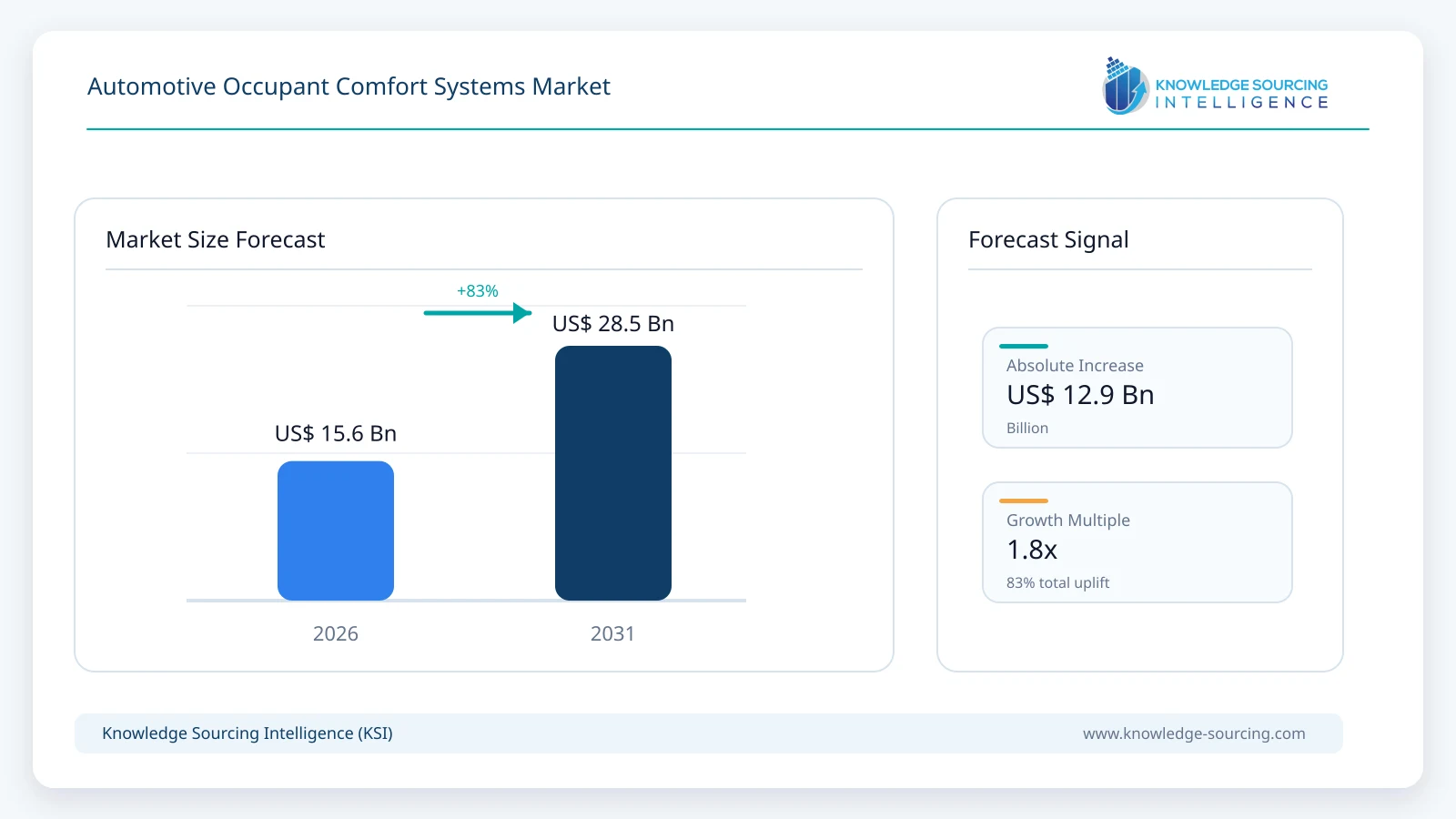
The automotive occupant comfort systems market is forecast to grow at a CAGR of 12.8%, reaching approximately USD 28.5 billion by 2031 from USD 15.6 billion in 2026.
Key Highlights
• Seating and postural comfort systems account for approximately 39% of global market value in 2026 because power adjustment, lumbar support, massage, seat ventilation, adaptive bolsters and ergonomic support represent the largest concentration of dedicated occupant-comfort hardware.
• Thermal and physical comfort functions represent approximately 43% of market value in 2026, supported by localized heating and cooling, seat ventilation, targeted airflow, massage, pressure management and dynamic posture adjustment.
• Front-row occupants account for approximately 55% of 2026 market value because driver and front-passenger seats carry the highest concentration of actuation, thermal comfort, sensing, massage and personalization content.
• Integrated adaptive comfort architectures represent approximately 58% of market value in 2026 as automakers increasingly coordinate seating, climate, lighting, audio and sensing through shared electronics and software.
• Premium and luxury vehicles represent approximately 40% of global market value in 2026 because advanced massage, multi-zone thermal comfort, active posture support and personalized sensory functions remain concentrated in high-content interiors.
• Asia Pacific represents approximately 43% of global market value in 2026, supported by high vehicle production, rapid premium EV development in China and established seating and interior-system capabilities in Japan and South Korea.
Comfort content per occupant is increasing as seat structures, thermal effectors, pneumatic systems, audio, lighting and sensing become more adaptive and more deeply connected through vehicle software.
Commercial development is accelerating across both hardware and software. Gentherm continues to expand climate-control seating, lumbar and massage comfort and climate-control interiors; Lear is scaling ComfortFlex, ComfortMax and FlexAir across multiple global programs; FORVIA is advancing intelligent seating with posture monitoring, pneumatics, massage and lumbar adjustment; Yanfeng's XiM27 combines AI-adaptive seating, individualized climate, spatial audio and responsive lighting; Toyota Boshoku's LOUNZE+ coordinates seats and interior elements around comfort; and HARMAN Ready Care links occupant sensing with personalized cabin interventions.
The market is moving from user-selected settings toward adaptive comfort. Sensors can identify occupant position, body morphology, stress, fatigue and activity, while software coordinates seat support, local heating and cooling, airflow, lighting and audio around the individual rather than treating the cabin as one uniform environment. This increases the value of sensing, software calibration and cross-domain integration alongside traditional mechanical and thermal hardware.
Market Overview
Occupant comfort is becoming a personalized vehicle-system layer rather than a collection of independent seat and climate options. The strongest systems adapt directly to the person, changing support, temperature, airflow, vibration, sound or light according to who is seated, how they are positioned and what they are doing.
Seating remains the central physical interface. Modern seats increasingly integrate power actuation, active lumbar support, massage, heating, ventilation, haptics and pressure-management functions, while sensorized designs can identify occupant morphology and posture. FORVIA's intelligent seat direction illustrates the shift toward automatic adjustment of multiple parameters using sensors, software and AI.
Localized thermal comfort is expanding alongside seat intelligence. Climate-controlled seats, neck conditioning, targeted airflow and other local effectors can change thermal sensation faster than whole-cabin HVAC. Gentherm and Lear are both scaling modular occupant-focused thermal technologies that can be integrated across vehicle classes.
Personal acoustic and sensory comfort is also becoming more occupant-specific. Headrest audio, spatial sound, adaptive lighting and scenario-based cabin software can create separate personal zones, allowing one occupant to relax or consume content without imposing the same environment on everyone else.
The long-term direction is toward predictive comfort. Occupant monitoring, user profiles and centralized cabin controllers allow the vehicle to anticipate discomfort and automatically coordinate seat posture, local temperature, massage, lighting and audio. This shifts comfort from manual adjustment toward a continuously optimized service.
Market Trends
Intelligent Seating Is Becoming the Core Occupant Comfort Platform
Advanced seats increasingly combine sensors, pneumatic support, massage, thermal functions and software-controlled actuation. Instead of asking the user to adjust individual settings, the seat can respond to body shape, posture, road conditions and learned preferences.
FORVIA's intelligent-seat strategy and Lear's complete thermal-comfort portfolio show how value is moving from traditional seat structures toward integrated mechatronics, sensing and software. The seat is becoming the main delivery platform for personalized physical comfort.
Localized Microclimate Is Shifting Comfort from Cabin-Level to Occupant-Level Control
Seat heating and ventilation, neck warmers, surface heating and directed airflow can change thermal sensation directly at the occupant. This reduces dependence on conditioning the entire cabin and can improve both comfort response and energy efficiency.
Gentherm's climate-control seats and broader climate-control interiors, together with Lear's modular thermal systems, demonstrate the move toward occupant-level thermal architectures that can operate alongside central HVAC.
Occupant Sensing Is Enabling Predictive and Automatic Comfort Adjustment
Cameras, seat sensors and other interior sensing technologies can identify position, posture, body size, stress and activity. Comfort software can then use those inputs to determine how strongly to support the lumbar region, whether to activate massage, how to distribute heating or cooling, or when to change the sensory environment.
The key transition is from stored memory positions toward real-time adaptation. Systems become more valuable when they recognize changes during the journey and respond before discomfort becomes severe.
Personal Audio and Sensory Zones Are Expanding Multi-Occupant Comfort
Headrest speakers, spatial audio, adaptive lighting and localized controls allow different occupants to experience different environments within the same cabin. Toyota Boshoku's LOUNZE+ and Yanfeng's XiM27 both demonstrate interiors in which seats, audio, lighting and other elements operate in coordination around distinct user scenarios.
These technologies are especially relevant in large vehicles, premium EVs and autonomous or highly automated cabins where occupants may work, rest or consume media at the same time.
Software-Defined Comfort Is Increasing Lifecycle and Personalization Value
Centralized vehicle software allows comfort algorithms and user profiles to evolve after production. OEMs can refine seat behavior, add new relaxation modes or recalibrate thermal and sensory responses through software rather than redesigning the complete hardware system.
The longer-term opportunity is a persistent occupant-comfort profile that follows the user across vehicles and automatically restores preferred support, temperature and sensory settings while adapting to real-time conditions.
Segment Analysis
By Comfort System: Seating and Postural Comfort Systems
Seating and postural comfort systems are projected to generate approximately USD 10.90 billion of market value by 2031. Growth will be driven by wider adoption of climate-controlled seats, active lumbar support, massage, dynamic bolsters, multi-axis power adjustment and sensor-based posture optimization.
The segment will remain the largest because the seat is the primary physical contact point between occupant and vehicle. Increasing electronics and software content will also raise value per seat as comfort moves from manual adjustment toward adaptive control.
By Comfort Function: Thermal and Physical Comfort
Thermal and physical comfort functions are projected to generate approximately USD 12.00 billion by 2031. Localized heating and cooling, ventilation, massage, pressure management and dynamic support will increasingly be combined to maintain comfort during longer journeys.
The function is expected to expand beyond premium front seats as modular thermal and pneumatic systems become easier to integrate into second-row seating and upper-mid vehicle classes.
By Occupant Zone: Front-Row Occupants
Front-row occupants are projected to generate approximately USD 14.80 billion of market value by 2031. Driver and front-passenger positions carry the highest concentration of power actuation, seat sensing, climate-control seating, massage, lumbar support and personalized controls.
Second-row growth is expected to accelerate in premium SUVs, executive sedans and MPVs, but front-row content will remain the largest value pool because of higher feature density and stronger integration with driver-state and user-profile systems.
By Integration Architecture: Integrated Adaptive Comfort Systems
Integrated adaptive comfort systems are projected to approach USD 17.40 billion by 2031. These architectures combine seats, localized climate, lighting, audio and occupant sensing through shared electronics and software rather than operating each comfort feature independently.
Integration improves user experience because a single relaxation or recovery mode can change posture, temperature, massage intensity and sensory settings together. It also gives OEMs greater flexibility to differentiate comfort through software.
By Vehicle Class: Premium and Luxury Vehicles
Premium and luxury vehicles are projected to generate approximately USD 11.60 billion of occupant-comfort market value by 2031. These vehicles will remain the primary commercialization channel for active seating, massage, dense sensor networks, multi-zone thermal comfort and personalized sensory functions.
Scalable mechatronics, modular thermal systems and lower-cost sensing are expected to move selected features into upper-mid and mass-market vehicles over the forecast period, particularly ventilation, lumbar adjustment and software-based personalization.
Market Drivers
Vehicle Premiumization and Competition around Personalized Interior Experience
Automakers increasingly use interior comfort to differentiate vehicles that share similar powertrains, digital platforms and performance. Intelligent seats, personalized microclimate and scenario-based sensory functions create visible and repeatable user benefits that can support higher trim levels and brand positioning.
Competition is particularly strong in premium EVs, where cabin experience is becoming as important as acceleration, range and display technology in shaping perceived vehicle quality.
Advances in Intelligent Seating, Pneumatics and Thermal Comfort Technology
Seat electronics, pneumatic systems, compact blowers and localized thermal effectors are becoming more capable and easier to integrate. This allows more comfort functions to be packaged within the seat without excessive mass, complexity or space requirements.
The resulting systems can provide active lumbar support, massage, ventilation and heating through shared hardware, creating a stronger business case for broader adoption.
Growth of Occupant Sensing and Personalized Cabin Control
Interior cameras, seat sensors and user profiles provide a richer understanding of occupant identity, position and state. These inputs allow comfort systems to move beyond fixed memory settings and respond automatically to posture, stress, fatigue or activity.
As sensing becomes more accurate, comfort can be delivered more selectively, reducing unnecessary actuation and making personalization feel more natural.
Software-Defined Vehicle and Centralized Cabin Architectures
Centralized compute enables seats, climate, lighting and audio to share information and operate through coordinated software. This supports scenario-based comfort modes, persistent profiles and over-the-air calibration across multiple vehicle domains.
Software-defined architecture also lets OEMs differentiate comfort across trims and regions without redesigning the complete hardware platform.
Longer In-Cabin Dwell Time and Broader Use of Vehicles for Rest and Productivity
Long commutes, EV charging stops, premium rear-seat travel and higher levels of driving automation are increasing the time occupants spend using the cabin for activities beyond basic transportation. Work, entertainment and relaxation create new comfort requirements around posture, temperature, support and sensory isolation.
This expands demand for adaptive systems that can shift between upright driving, relaxation, work and rest settings rather than providing one static seating and climate configuration.
Market Restraints
High Cost and Concentration in Premium Vehicle Programs
Advanced occupant comfort can require multiple actuators, pumps, blowers, sensors, controllers and software calibration. The resulting bill of materials remains difficult to justify in lower-cost vehicles where comfort options compete with safety and infotainment content.
Broader adoption depends on modular systems that share components across several functions and can scale across multiple trims without major hardware changes.
Subjective Comfort Preferences and Complex Human-Factors Validation
Comfort varies by body size, age, posture, clothing, climate and personal preference. A setting that feels supportive or thermally comfortable to one occupant may be uncomfortable to another.
OEMs therefore need extensive user testing and adaptive algorithms rather than one fixed target, increasing validation time and calibration complexity across global markets.
Packaging, Weight and Energy Trade-Offs
Power seat motors, massage pumps, blowers, heating elements and additional electronics consume space, add mass and draw electrical power. The challenge is particularly important in EVs where packaging and energy efficiency directly affect range and cabin space.
Suppliers must continue integrating multiple functions into fewer components while improving efficiency and reducing wiring, control modules and mechanical complexity.
Cross-Domain Integration and Software Reliability
Adaptive comfort requires reliable communication between seats, climate, lighting, audio, sensing and vehicle-network domains. Conflicting control logic, latency or software faults can create inconsistent behavior and reduce trust in automatic adjustment.
OEMs need clear domain ownership, stable interfaces and fail-safe fallback modes so that personalization does not compromise basic comfort or safety functions.
Privacy and User Acceptance of Continuous Occupant Sensing
Predictive comfort may rely on cameras, posture information, behavioral signals and personal profiles. Some users may resist systems that appear to monitor them continuously or make unexplained changes to their environment.
Local processing, transparent consent and simple manual override will be important for maintaining user trust as occupant sensing becomes more closely tied to comfort personalization.
Regional Outlook
Asia Pacific
Asia Pacific is the largest regional market and is expected to remain the strongest growth centre through 2031. China is accelerating adoption of high-content smart cabins across premium and upper-mid EVs, while Japan and South Korea contribute established expertise in seating, interior systems, electronics and user-experience engineering.
Yanfeng's XiM27 demonstrates the region's move toward AI-adaptive seating, individualized climate, spatial audio and responsive lighting, while Toyota Boshoku's LOUNZE+ coordinates seats, door trims and consoles around occupant relaxation and comfort. Strong local EV competition is also accelerating feature migration below traditional luxury price points.
Growth will be supported by high vehicle production, rapid electrification and strong demand for differentiated interiors. Suppliers that can combine adaptive comfort with competitive cost and software scalability are positioned to capture the largest regional opportunity.
Europe
Europe is a major high-value market because premium automakers and established Tier 1 suppliers continue to lead in intelligent seating, thermal comfort, ergonomics and occupant-aware cabin technologies. FORVIA, Gentherm, Lear and HARMAN all maintain strong development activity and OEM relationships in the region.
FORVIA is using intelligent seating to raise content per vehicle through postural sensing, pneumatics, massage and lumbar adjustment, while Lear is expanding modular thermal comfort through ComfortFlex, ComfortMax and FlexAir. European premium brands also provide a strong commercialization pathway for adaptive seat and sensory technologies.
Growth through 2031 will depend on scaling premium comfort without excessive mass, cost or energy consumption. Software integration, modular hardware and validated human-factors performance will remain central to broader adoption.
Competitive Landscape
The automotive occupant comfort systems market includes seating, thermal-management, interior-system and cabin-software suppliers that directly shape personalized occupant comfort. Gentherm, Lear, FORVIA, Yanfeng, Toyota Boshoku and HARMAN are directly active across climate-controlled seating, massage, pneumatic support, intelligent seats, smart-cabin integration and occupant-aware comfort software.
Gentherm is differentiated by climate-control seats, lumbar and massage comfort, climate-control interiors and related electronics. Lear combines complete-seat capability with modular thermal comfort through ComfortFlex, ComfortMax and FlexAir, while FORVIA is integrating sensors, software, pneumatics, massage and lumbar functions into intelligent seating.
Yanfeng and Toyota Boshoku compete through broader scenario-based interior integration, while HARMAN links occupant sensing with personalized responses across temperature, lighting, audio and seat massage. Competition is shifting toward suppliers that can coordinate multiple comfort domains around the individual occupant rather than selling isolated components.
Recent Developments
• 31 July 2026: Lear reported significant new awards with Audi for complete seats, ComfortFlex and FlexAir in Europe and North America, reinforcing commercial adoption of modular occupant thermal and seating comfort technologies.
• 23 July 2026: Gentherm reported USD 690 million of automotive new-business awards in the second quarter and 14.1% year-over-year growth in Automotive Climate and Comfort Solutions revenue.
• 10 July 2026: Yanfeng announced that XiM27 received the 2026 Red Dot Design Concept Award. The platform combines adaptive seating, individually adjustable climate, spatial audio and AI-based emotion recognition to optimize occupant comfort and wellbeing.
• 29 June 2026: Yanfeng unveiled XiM27, a production-ready smart-cabin platform with AI-adaptive seating that adjusts position, firmness and temperature according to learned user preferences.
• 23 April 2026: Toyota Boshoku presented LOUNZE+ at Auto China 2026, coordinating seats, door trims and console functions to create a mobility space focused on relaxation, reassurance and individualized comfort.
• 24 February 2026: FORVIA's Capital Markets Day highlighted intelligent seating that automatically adjusts multiple parameters using postural and road-condition monitoring, pneumatics, massage, lumbar functions and software/AI.
• 19 February 2026: Gentherm reported record 2025 revenue and continued growth in climate-control seats, lumbar and massage comfort solutions, climate-control interiors and climate-and-comfort electronics.
• 13 January 2026: HARMAN introduced new Ready Care capabilities that combine occupant monitoring and vital-sign sensing with personalized in-cabin interventions including temperature, lighting, audio and seat-massage adjustments.
Market Outlook
The automotive occupant comfort systems market is expected to expand steadily through 2031 as comfort functions become more adaptive, more personalized and more deeply connected through software. Seating and localized thermal comfort will remain the largest value pools, while faster growth is expected in sensing-led posture control, massage, personal sensory zones and cross-domain comfort orchestration.
The market will increasingly shift from memory settings toward predictive comfort. Vehicles will identify who is seated, interpret position and activity, learn preferences and coordinate support, temperature, airflow, massage, lighting and audio automatically. The most successful systems will deliver noticeable comfort improvement with minimal interaction and limited energy or packaging penalties.
Asia Pacific is expected to retain the largest regional share, while Europe remains a major premium engineering and commercialization market. Competitive advantage will depend on scalable mechatronics, energy-efficient thermal performance, robust occupant sensing, strong human-factors validation and software architectures that can coordinate multiple comfort domains in real time.
Automotive Occupant Comfort Systems Market Scope:
| Report Metric | Details |
|---|---|
| Total Market Size in 2026 | USD 15.6 billion |
| Total Market Size in 2031 | USD 28.5 billion |
| Forecast Unit | USD Billion |
| Growth Rate | 12.8% |
| Study Period | 2021 to 2031 |
| Historical Data | 2021 to 2024 |
| Base Year | 2025 |
| Forecast Period | 2026 – 2031 |
| Segmentation | Comfort System, Comfort Function, Occupant Zone, Integration Architecture, Vehicle Class, Geography |
| Companies |
|
Market Segmentation
By Comfort System
Seating and Postural Comfort Systems
Thermal and Microclimate Comfort Systems
Massage, Pneumatic and Pressure-Management Systems
Personal Acoustic and Sensory Comfort Systems
Comfort Electronics, Sensing and Software
By Comfort Function
Thermal and Physical Comfort
Ergonomic and Postural Support
Relaxation and Fatigue Reduction
Acoustic and Sensory Comfort
Personalized and Adaptive Comfort
By Occupant Zone
Front-Row Occupants
Second-Row Occupants
Third-Row and Rear Occupants
By Integration Architecture
Integrated Adaptive Comfort Systems
Domain-Integrated Comfort Subsystems
Standalone and Single-Function Comfort Systems
By Vehicle Class
Premium and Luxury Vehicles
Mid-Range Vehicles
Mass-Market and Economy Vehicles
By Geography
North America
United States
Canada
Mexico
South America
Brazil
Argentina
Others
Europe
Germany
United Kingdom
France
Italy
Spain
Others
Middle East and Africa
Saudi Arabia
UAE
South Africa
Others
Asia Pacific
China
Japan
South Korea
India
Singapore
Others
Table of Contents
1. INTRODUCTION
1.1. Market Overview
1.2. Market Definition
1.3. Scope of the Study
1.4. Market Segmentation
1.5. Currency
1.6. Assumptions
1.7. Base and Forecast Years
1.8. Key Benefits to Stakeholders
2. RESEARCH METHODOLOGY
2.1. Research Design
2.2. Secondary Research
2.3. Primary Research
2.4. Market Estimation
2.5. Segment Modelling
2.6. Data Triangulation and Validation
3. EXECUTIVE SUMMARY
3.1. Key Findings
3.2. Automotive Occupant Comfort Systems Market Size, 2026-2031
3.3. Comfort System Outlook
3.4. Comfort Function Outlook
3.5. Occupant Zone Outlook
3.6. Integration Architecture Outlook
3.7. Vehicle Class Outlook
3.8. Regional Opportunity Summary
4. MARKET DYNAMICS
4.1. Market Drivers
4.1.1. Vehicle Premiumization and Competition around Personalized Interior Experience
4.1.2. Advances in Intelligent Seating, Pneumatics and Thermal Comfort Technology
4.1.3. Growth of Occupant Sensing and Personalized Cabin Control
4.1.4. Software-Defined Vehicle and Centralized Cabin Architectures
4.1.5. Longer In-Cabin Dwell Time and Broader Use of Vehicles for Rest and Productivity
4.2. Market Restraints
4.2.1. High Cost and Concentration in Premium Vehicle Programs
4.2.2. Subjective Comfort Preferences and Complex Human-Factors Validation
4.2.3. Packaging, Weight and Energy Trade-Offs
4.2.4. Cross-Domain Integration and Software Reliability
4.2.5. Privacy and User Acceptance of Continuous Occupant Sensing
4.3. Market Opportunities
4.4. Porter's Five Forces Analysis
4.5. Industry Value Chain Analysis
4.6. Occupant Comfort System Economics
4.7. Human-Factors, Data-Privacy and Functional-Safety Environment
5. TECHNOLOGY OUTLOOK
5.1. Intelligent Seats and Adaptive Postural Support
5.2. Power Adjustment, Active Bolsters and Dynamic Lumbar Systems
5.3. Massage, Pneumatic Support and Pressure Management
5.4. Climate-Controlled Seating and Surface Thermal Management
5.5. Localized Airflow, Neck Conditioning and Microclimate Control
5.6. Occupant Position, Morphology and Posture Sensing
5.7. Personal Audio, Headrest Sound and Acoustic Zoning
5.8. Adaptive Lighting and Occupant-Specific Sensory Control
5.9. AI-Based Comfort Personalization and Scenario Management
5.10. Comfort Electronics, Seat Controllers and Zonal Compute
5.11. OTA Comfort Software, Profiles and Cross-Domain Integration
6. AUTOMOTIVE OCCUPANT COMFORT SYSTEMS MARKET BY COMFORT SYSTEM
6.1. Introduction
6.2. Seating and Postural Comfort Systems
6.3. Thermal and Microclimate Comfort Systems
6.4. Massage, Pneumatic and Pressure-Management Systems
6.5. Personal Acoustic and Sensory Comfort Systems
6.6. Comfort Electronics, Sensing and Software
7. AUTOMOTIVE OCCUPANT COMFORT SYSTEMS MARKET BY COMFORT FUNCTION
7.1. Introduction
7.2. Thermal and Physical Comfort
7.3. Ergonomic and Postural Support
7.4. Relaxation and Fatigue Reduction
7.5. Acoustic and Sensory Comfort
7.6. Personalized and Adaptive Comfort
8. AUTOMOTIVE OCCUPANT COMFORT SYSTEMS MARKET BY OCCUPANT ZONE
8.1. Introduction
8.2. Front-Row Occupants
8.3. Second-Row Occupants
8.4. Third-Row and Rear Occupants
9. AUTOMOTIVE OCCUPANT COMFORT SYSTEMS MARKET BY INTEGRATION ARCHITECTURE
9.1. Introduction
9.2. Integrated Adaptive Comfort Systems
9.3. Domain-Integrated Comfort Subsystems
9.4. Standalone and Single-Function Comfort Systems
10. AUTOMOTIVE OCCUPANT COMFORT SYSTEMS MARKET BY VEHICLE CLASS
10.1. Introduction
10.2. Premium and Luxury Vehicles
10.3. Mid-Range Vehicles
10.4. Mass-Market and Economy Vehicles
11. AUTOMOTIVE OCCUPANT COMFORT SYSTEMS MARKET BY GEOGRAPHY
11.1. North America
11.1.1. United States
11.1.2. Canada
11.1.3. Mexico
11.2. South America
11.2.1. Brazil
11.2.2. Argentina
11.2.3. Others
11.3. Europe
11.3.1. Germany
11.3.2. United Kingdom
11.3.3. France
11.3.4. Italy
11.3.5. Spain
11.3.6. Others
11.4. Middle East and Africa
11.4.1. Saudi Arabia
11.4.2. UAE
11.4.3. South Africa
11.4.4. Others
11.5. Asia Pacific
11.5.1. China
11.5.2. Japan
11.5.3. South Korea
11.5.4. India
11.5.5. Singapore
11.5.6. Others
12. COMPETITIVE ENVIRONMENT AND ANALYSIS
12.1. Major Players and Strategy Analysis
12.2. Market Share Analysis
12.3. Occupant Comfort Technology Benchmarking
12.4. Product Launches and Development Activity
12.5. Competitive Dashboard
13. COMPANY PROFILES
13.1. Gentherm Incorporated
13.2. Lear Corporation
13.3. FORVIA
13.4. Yanfeng
13.5. Toyota Boshoku Corporation
13.6. HARMAN International
14. APPENDIX
14.1. Currency
14.2. Assumptions
14.3. Base and Forecast Years Timeline
14.4. Key Benefits for Stakeholders
14.5. Research Methodology
14.6. Abbreviations
14.7. Data Sources
Navigate
Trusted by the world's leading organizations











