
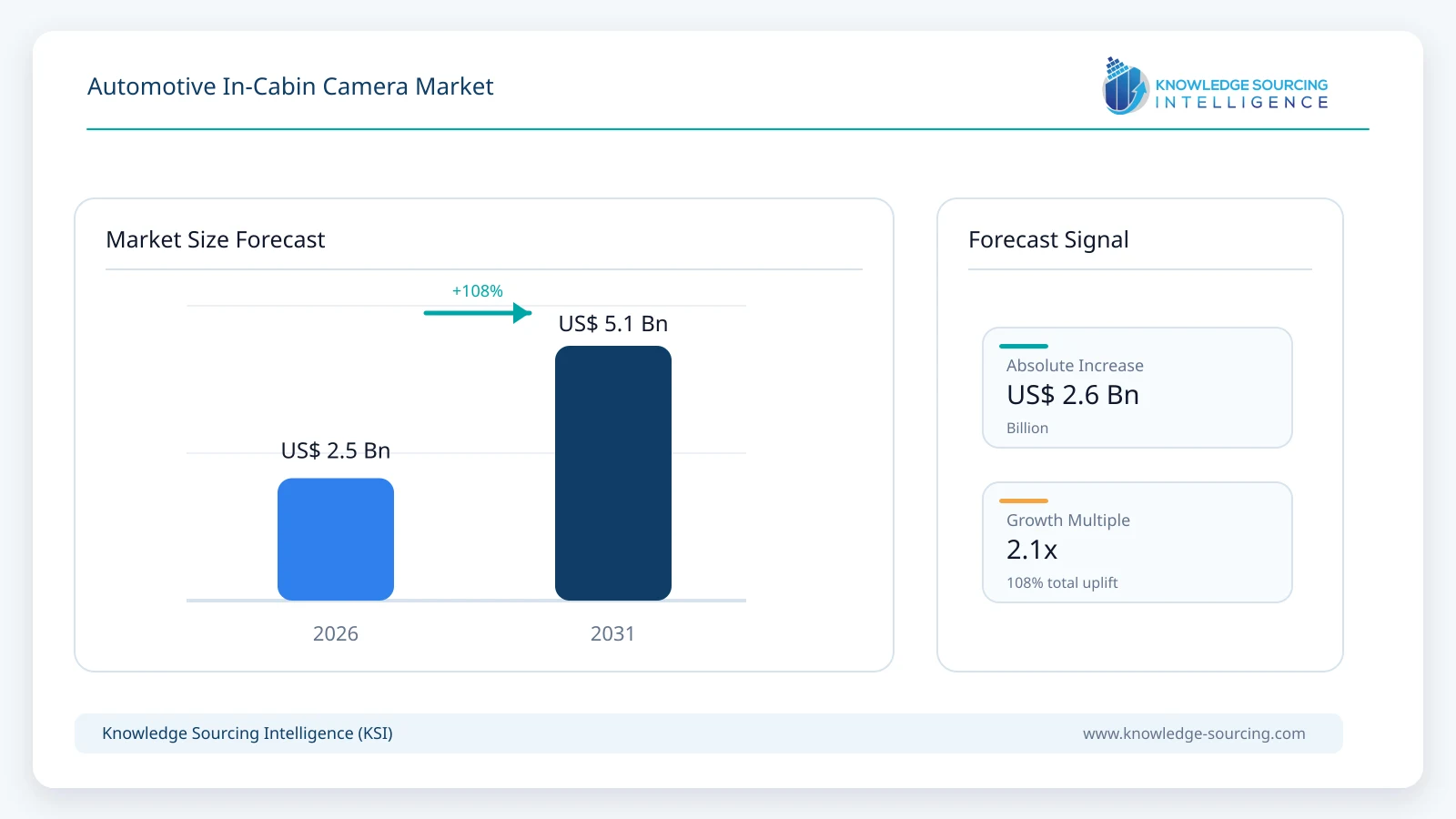
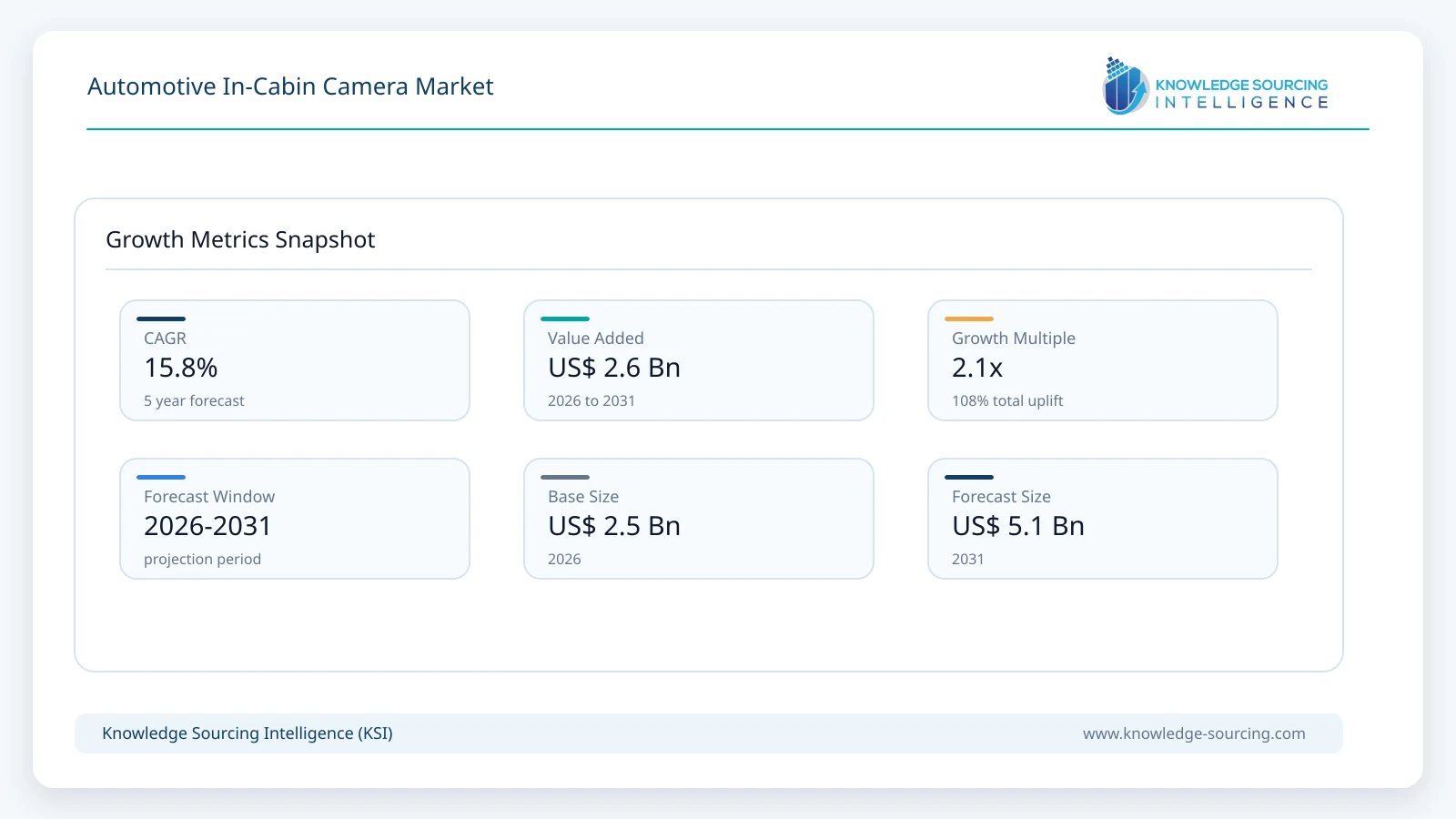
The automotive in-cabin camera market is forecast to grow at a CAGR of 15.8%, reaching approximately USD 5.10 billion by 2031 from USD 2.45 billion in 2026.
Key Highlights
• Near-infrared monochrome and NIR-led global-shutter camera architectures account for approximately 46% of global market value in 2026 because they remain the most cost-efficient route for reliable gaze, eyelid and head-pose monitoring under day and night conditions.
• RGB-IR cameras represent approximately 31% of 2026 market value and are gaining share as OEMs seek one wide-angle camera that can combine safety-grade infrared perception with color imaging for occupant monitoring, personalization and video-oriented functions.
• Driver monitoring is the largest primary application, representing approximately 48% of 2026 market value, while integrated driver and occupant monitoring cameras are the fastest-growing application architecture as safety functions converge on shared hardware.
• Steering-column and instrument-cluster-area installations account for approximately 39% of 2026 market value, although mirror-integrated, overhead and behind-display placements are expanding as OEMs prioritize cleaner cockpit packaging and broader cabin coverage.
• Passenger vehicles represent approximately 92% of global market value in 2026 because regulatory adoption, NCAP scoring and smart-cockpit integration are concentrated in passenger cars, SUVs and MPVs.
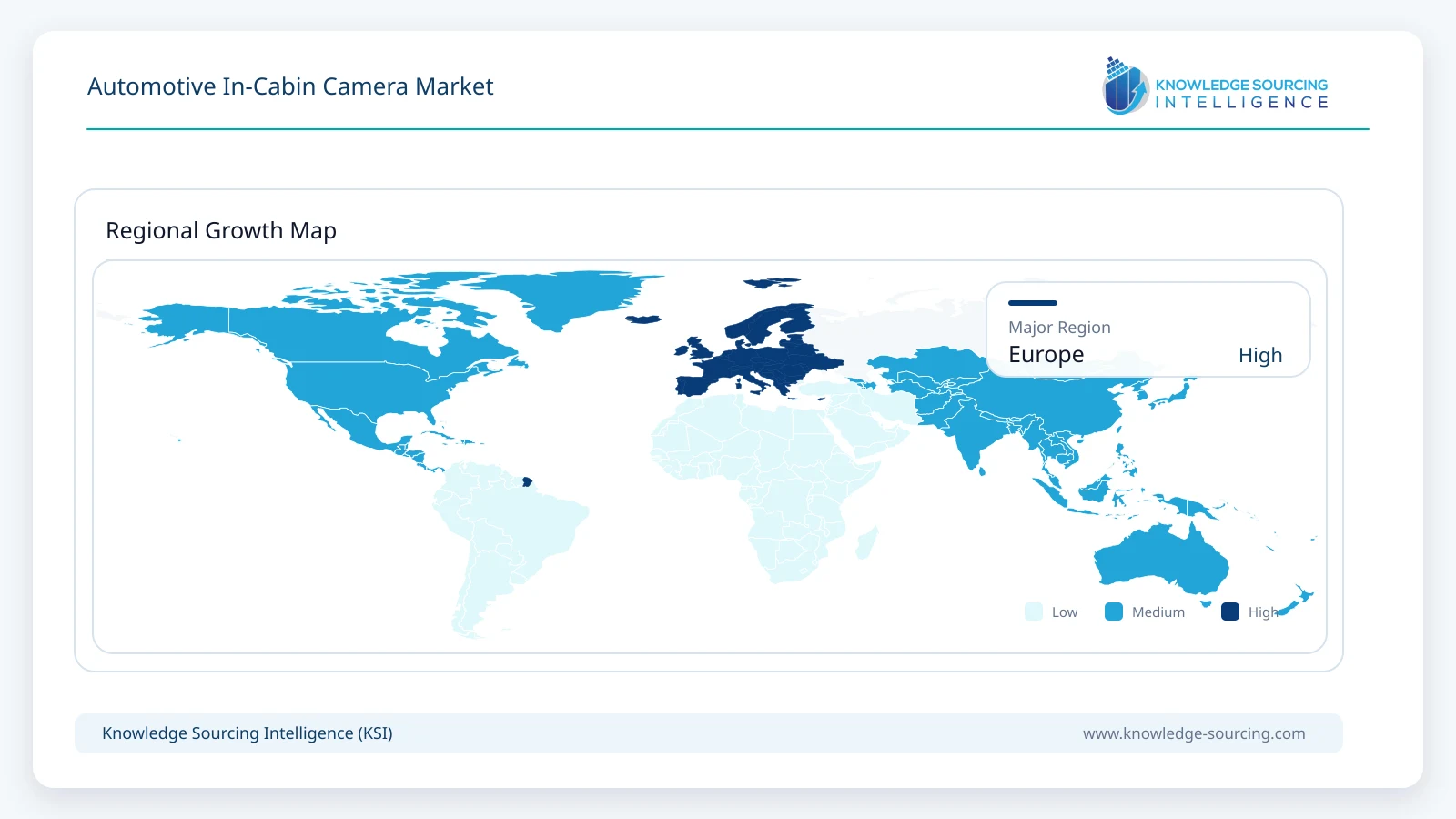
• Europe represents approximately 39% of global market value in 2026, supported by the July 2026 advanced driver distraction warning implementation milestone, Euro NCAP protocols and broad camera standardization across new passenger-vehicle programs.
The market is progressing from dedicated driver-facing cameras toward higher-capability imaging platforms that can monitor both the driver and other occupants, with near-infrared sensitivity, wide-angle optics, RGB-IR capture and global-shutter HDR allowing one module to support functions that previously required separate camera or seat-sensor architectures. Regulatory demand provides the strongest volume base as the European Union General Safety Regulation and Euro NCAP increase requirements around driver attention, distraction and broader occupant monitoring, favoring reliable direct visual sensing for gaze, eyelid, head-pose, occupant-position and restraint-related interpretation.
Commercial value is increasingly determined by optical performance, illumination efficiency, packaging and multi-function reuse rather than pixel count alone. Magna and Gentex are scaling mirror-integrated camera architectures, Valeo is integrating driver and interior monitoring into cockpit systems, and Aptiv is using the existing cabin camera for software-based occupant classification, while STMicroelectronics, Sony Semiconductor Solutions and OMNIVISION are improving 940 nm sensitivity, compact global-shutter designs and higher-resolution RGB-IR imaging. These developments shift the camera from a dedicated monitoring device toward a reusable interior-sensing endpoint that can support safety and user-experience functions across the vehicle lifecycle.
Market Overview
An automotive in-cabin camera converts visible and infrared light from the vehicle interior into image data for driver-monitoring, occupant-monitoring and cockpit software, with module performance determined by the complete optical and electronic chain rather than the image sensor alone. A typical safety-focused module combines an automotive CMOS sensor, lens, near-infrared illumination, LED or VCSEL driver, power management, image-signal processing or local control, and a high-speed data link to cockpit or central compute. Near-infrared imaging is central because monitoring must operate in darkness and across changing ambient light, while global-shutter sensors and high 940 nm quantum efficiency improve motion capture, synchronization with pulsed illumination and usable eye or face detail at lower illumination power.
RGB-IR and three-dimensional imaging are expanding the functional envelope of the cabin camera beyond conventional monochrome driver monitoring. A single RGB-IR sensor can provide infrared frames for gaze and occupant perception while also capturing color imagery for video, personalization and broader cabin-experience functions, with higher resolution and dynamic range making wider driver-and-passenger coverage more practical from mirror or overhead locations. Time-of-Flight and structured-light systems remain smaller but strategically important because they add depth for body-pose, hand-position and adaptive-restraint use cases where accurate spatial measurement is required, despite higher cost and integration complexity.
Market Trends
RGB-IR Cameras Are Consolidating Driver and Occupant Monitoring
The most important camera-architecture shift is the move from a dedicated monochrome DMS camera toward RGB-IR devices that can serve both safety perception and broader cabin functions. High-resolution RGB-IR sensors provide enough field of view and pixel density to observe the driver and passengers from a central position while retaining near-infrared capability for low-light eye, face and posture analysis.
RGB-IR consolidation strengthens the business case for a higher-specification in-cabin camera because one module can support driver monitoring, occupant detection, seat-belt recognition, cabin communication and selected personalization features while reducing duplicated optics and housings. Sony planned spring 2026 mass production of its approximately 5 MP IMX775 RGB-IR sensor, while OMNIVISION has positioned 5 MP RGB-IR global-shutter devices for simultaneous DMS and OMS, reinforcing the move toward one-camera multi-function interior sensing.
Higher 940 nm Sensitivity Is Reducing Illumination Power and Camera Cost
Image-sensor suppliers are focusing heavily on near-infrared quantum efficiency and optical sharpness because better sensor sensitivity lowers the burden on the rest of the camera module. Fewer or lower-power NIR LEDs reduce power consumption, heat, driver complexity and packaging around the camera. Strong modulation transfer performance can also allow lower-cost optics without giving up the facial and eye detail required by perception software.
STMicroelectronics introduced the 1.1 MP VD56GA in September 2026 with materially higher image sharpness and infrared sensitivity than its prior generation, specifically positioning the device for lower-cost high-volume in-cabin sensing. This type of system-level optimization is increasingly important because regulatory penetration is pushing interior cameras into price-sensitive vehicle segments where a premium camera bill of materials is difficult to sustain.
Mirror and Hidden Camera Packaging Is Expanding
The interior rear-view mirror is becoming an important camera location because it provides a high, central view with line of sight to both the driver and much of the cabin. Magna and Gentex both support mirror-integrated monitoring architectures, allowing cameras, illumination and in some cases processing to be packaged behind or around the mirror glass. The approach reduces visible sensor clutter and can be reused across multiple vehicle lines.
Behind-display and under-display camera positions are also developing as OEMs seek cleaner cockpit surfaces, even though these placements introduce optical transmission, thermal and near-infrared challenges. Improved sensor sensitivity and processing can make these locations viable, and their commercial value extends beyond aesthetics because standardized hidden positions can reduce redesign work when the same camera architecture is scaled across several models and interior themes.
Camera-Only Occupant Classification Is Challenging Traditional Seat Sensors
Interior cameras are moving into passive-safety functions that historically depended on pressure, bladder or capacitive sensors inside seats. Aptiv introduced a camera-only Advanced Occupancy Classification system in June 2026 that uses the vehicle interior camera to estimate occupant size, posture and seating position for airbag-related decisions. This demonstrates how an already-installed camera can replace separate sensing hardware rather than merely add a new feature.
Camera reuse creates a commercially significant opportunity to simplify seats, wiring and calibration while producing richer occupant information than dedicated seat sensors alone. Passive-safety use cases also raise the performance requirement for in-cabin imaging because visibility must remain stable across clothing, posture, child seats and unusual seating positions, allowing camera suppliers with reliable low-cost full-cabin imaging to participate in a broader share of the restraint and occupant-classification value chain.
Centralized Compute Is Separating Camera Hardware from Perception Software
Software-defined vehicle architectures are shifting image processing from dedicated camera ECUs toward cockpit domain controllers and central computers. In this architecture, the in-cabin camera becomes a standardized sensing endpoint connected through automotive Ethernet or high-speed serial links, while multiple monitoring functions run on shared compute. This reduces dedicated electronics inside the camera and can lower module cost over time.
Centralized image processing increases the importance of synchronization, image-quality consistency, cybersecurity and hardware abstraction because one camera may need to support several software stacks over the life of the vehicle. DMS, OMS, identity and future safety functions can then be delivered through common hardware and software updates, pushing suppliers to compete on stable optical performance, safety compliance, interface flexibility and long-term availability as much as on initial image specifications.
Segment Analysis
By Imaging Technology: Near-Infrared Monochrome and NIR Global-Shutter Cameras
Near-infrared monochrome cameras are the largest imaging segment because they provide the most direct balance of cost, low-light performance and algorithm reliability for driver monitoring. Safety functions such as eye gaze, eyelid opening, blink rate and head pose do not require full color, while 940 nm illumination allows the driver to be monitored at night without visible cabin lighting. Global-shutter operation further improves image consistency during head movement and pulsed-illumination sequences.
Near-infrared monochrome and NIR global-shutter cameras account for approximately USD 1.13 billion in 2026 and are expected to approach USD 2.10 billion by 2031. Their share will gradually decline as RGB-IR devices gain adoption, but absolute demand will continue to grow because cost-sensitive passenger vehicles and commercial fleets will retain dedicated DMS cameras, keeping competition focused on NIR quantum efficiency, compact optical format, low power and reliable eye-region detail with a single low-power illumination source.
By Primary Monitoring Use: Driver Monitoring
Driver monitoring remains the largest primary use for in-cabin cameras because direct visual observation is becoming the preferred route for distraction, drowsiness and readiness assessment. A driver-facing camera can determine gaze direction, eye closure and head orientation with much greater specificity than steering-behavior analysis alone, making it suitable for advanced distraction warning and supervised-driving engagement checks.
Driver-monitoring camera content represents approximately USD 1.18 billion of market value in 2026 and is expected to exceed USD 2.1 billion by 2031. Growth will increasingly come from mainstream vehicle platforms rather than premium applications, while higher-value programs will add RGB-IR, wider field of view and integration with occupant monitoring. The segment will remain large even as shared DMS/OMS cameras gain share because many entry and mid-range vehicles will continue to use a dedicated, lower-cost driver-facing module.
By Integration Location: Steering Column and Instrument-Cluster Area
Steering-column and instrument-cluster-area cameras hold the largest installation share because they provide a short, direct line of sight to the driver. The geometry is favorable for eye and eyelid measurement and can minimize the amount of cabin background that must be processed. This location also supports compact monochrome NIR modules and is well established across production DMS programs.
Steering-column and instrument-cluster-area camera installations account for approximately USD 0.96 billion in 2026 and will continue to grow in absolute value even as mirror-integrated and overhead cameras gain share in combined DMS/OMS architectures. Steering-wheel adjustment, display size and cockpit styling can complicate the optical path, so suppliers are improving lens design, illumination placement and calibration to maintain eye visibility across driver height and seating-position ranges.
By Camera Architecture: Integrated DMS/OMS Full-Cabin Camera
Integrated DMS/OMS cameras use a wider field of view and higher image resolution to observe the driver and additional occupants from one centrally positioned module. RGB-IR imaging is particularly attractive because the same camera can generate infrared perception frames and color imagery for cabin-facing functions. Mirror and overhead positions are well suited to this architecture because they provide a more complete interior view than a low steering-column camera.
Integrated full-cabin cameras are the fastest-growing architecture through 2031 as OEMs seek to spread hardware cost across driver attention, occupant presence, seat-belt recognition, child awareness, communication and personalization. Growth is being reinforced by Aptiv camera-only occupant classification, Magna mirror-integrated DMS/OMS programs and the wider availability of approximately 5 MP RGB-IR sensors. The principal constraint is that one camera must satisfy several optical requirements simultaneously, increasing calibration and performance-validation complexity.
By Vehicle Type: Passenger Vehicles
Passenger cars, SUVs and MPVs dominate the market because the strongest regulatory, NCAP and smart-cockpit adoption drivers are concentrated in light vehicles. European safety requirements create broad baseline demand for driver monitoring, while premium and high-volume EV platforms are adding occupant monitoring, video, personalization and adaptive-restraint functions that increase camera content per vehicle.
Passenger vehicles represent approximately USD 2.25 billion of global market value in 2026 and are expected to exceed USD 4.6 billion by 2031. Commercial vehicles will remain strategically important for fatigue and fleet-safety monitoring, but passenger platforms generate the larger camera opportunity because of production scale, faster integration of RGB-IR and full-cabin architectures, and the ability to reuse the same module across multiple safety and user-experience functions.
Market Drivers
EU General Safety Regulation and Euro NCAP Monitoring Requirements
European regulation provides the clearest near-term volume catalyst for in-cabin cameras. The EU General Safety Regulation requires driver drowsiness and attention warning and advanced driver distraction warning, with the advanced distraction requirement reaching the all-new-vehicle registration milestone in July 2026 under the applicable implementation schedule. Although regulations remain technology-neutral, direct camera monitoring provides a practical route to measuring gaze and driver attention with high specificity.
Euro NCAP creates additional demand beyond minimum type approval through dedicated Driver Monitoring and Occupant Monitoring protocols, requiring OEMs seeking strong safety ratings to maintain consistent information about driver attention, occupant presence, seating position and restraint context. This favors higher-performing cameras, broader fields of view and better low-light operation, particularly on global platforms where one interior-sensing architecture is expected to satisfy several regional programs.
Expansion of Occupant Monitoring and Passive-Safety Intelligence
The camera opportunity is widening from driver attention toward complete cabin awareness. Occupant monitoring can support passenger detection, child and rear-seat awareness, seat-belt recognition, body-pose estimation and crash-occupancy information. These functions increase the value of wide-angle and higher-resolution cameras because the system must observe multiple seating positions rather than one face.
Passive-safety integration further strengthens the economic case for higher-capability cabin cameras because camera-based occupant classification can provide more information about body size and posture than binary seat-occupancy sensing. If one camera can replace or supplement several seat-based sensors, OEMs can justify a more capable imaging module while reducing distributed hardware elsewhere in the vehicle.
Growth of Supervised Driving and Driver-Readiness Verification
Advanced driver assistance increasingly depends on a reliable understanding of whether the driver is attentive and available to supervise the vehicle. Hands-on-wheel sensing alone cannot establish where the driver is looking or whether the driver is drowsy. A direct camera provides continuous gaze, eyelid and head-pose information that can be linked to ADAS availability, escalation logic and takeover requests.
Expansion of supervised hands-off and conditionally automated functions turns the in-cabin camera into a functional input to ADAS availability and takeover logic rather than a stand-alone warning device. This raises the value of low-latency global-shutter imaging, robust NIR operation and consistent performance under sunglasses and changing light while encouraging OEMs to standardize camera hardware on platforms that may later receive more advanced automation through software.
Falling System Cost from Higher Sensor Efficiency and Hardware Reuse
The cost of an in-cabin camera is being reduced through smaller image sensors, improved NIR sensitivity, fewer illumination components and centralized processing. A sensor that can operate effectively with one lower-power LED reduces driver electronics, heat and module size. Compact chip-scale packages and embedded image-processing functions further simplify camera design and assembly.
Hardware reuse provides a second cost lever because the same interior camera can support regulatory DMS, occupant monitoring, identity, video and passive safety, spreading the incremental cost of additional software features across hardware already required for compliance. This economics is especially important in mass-market vehicles, where a stand-alone camera for each cabin function would be difficult to justify.
Smart-Cockpit Differentiation and Multi-Function Cabin Imaging
Automakers are using the interior camera for functions beyond mandated safety, including face-based personalization, gesture interaction, video calling, cabin recording and remote communication. These applications favor RGB or RGB-IR imaging and increase demand for higher resolution, wider dynamic range and more natural color reproduction than a basic monochrome DMS camera provides.
Multi-function camera value is highest when one module can support both safety and convenience without compromising privacy or safety performance, allowing OEMs to differentiate the cabin experience through software while retaining common sensing hardware across multiple trims. This creates demand for cameras with broader performance envelopes and longer software lifecycles rather than devices optimized for one fixed monitoring algorithm.
Market Restraints
Performance under Sunglasses, Glare, Darkness and NIR Interference
Interior cameras must maintain usable eye, face and body information across direct sunlight, darkness, reflections, sunglasses, prescription lenses, facial occlusion and rapid transitions between lighting conditions. Multiple infrared sources inside the cabin can also interfere with one another if illumination and exposure are not synchronized. These conditions can reduce algorithm confidence even when the camera performs well in laboratory scenes.
Suppliers are responding with higher NIR sensitivity, global-shutter HDR, better optical filtering and synchronized illumination, but each improvement adds design trade-offs around cost, power and packaging. OEMs must validate cameras across global populations, cabin materials and seating positions, making optical robustness one of the largest engineering burdens in production programs.
Line-of-Sight Limitations and Rear-Row Occlusion
A camera can only interpret what is visible. Rear-facing child seats, blankets, seatbacks, passengers leaning out of the field of view and objects placed between the camera and occupant can create blind zones that are difficult to solve through image processing alone. The challenge becomes greater in three-row vehicles, flexible interiors and highly reclined seating configurations.
Wide-angle lenses and multi-camera layouts can improve cabin coverage but increase distortion, calibration effort, bandwidth and system cost, while radar and other non-visual sensors can complement cameras when direct visibility is weak. Camera-only architectures will therefore remain highly effective for many DMS and OMS functions but may require sensor fusion for the most demanding child-presence or hidden-occupant scenarios.
Privacy, Biometric Concerns and Cabin Data Governance
A visible interior camera can create consumer concern because it appears capable of recording faces, conversations or private activity. Safety functions may operate entirely on-device, but users may not distinguish between local perception and stored video. Optional identity, personalization and video features create additional consent and data-handling requirements beyond basic driver-attention monitoring.
European vehicle-safety rules encourage closed-loop processing and limit unnecessary retention for driver-monitoring functions, requiring OEMs to separate mandatory safety processing from optional recording or cloud services. Privacy-by-design can increase user acceptance, but it also constrains some data-collection approaches that might otherwise simplify algorithm improvement and remote diagnostics.
Packaging, Thermal and Illumination Integration Complexity
Camera placement is tightly constrained by cockpit styling, driver line of sight and the need to hide illumination components. Mirror, steering-column, A-pillar, overhead and display-integrated positions each create different optical paths and thermal environments. Small apertures may restrict lens size, while direct sunlight can raise sensor temperature and degrade image quality if thermal design is insufficient.
Infrared illumination adds another integration layer because LED or VCSEL placement must avoid eye-safety concerns, reflections from glasses and trim, and non-uniform illumination across the face or cabin. Higher sensor sensitivity reduces these burdens, but each vehicle still requires optical calibration and packaging work, limiting the extent to which one camera design can be transferred unchanged across every model.
Functional-Safety, Cybersecurity and Long Automotive Validation Cycles
In-cabin camera outputs increasingly influence safety-critical functions such as ADAS availability, driver takeover, occupant classification and restraint decisions. The camera and its interfaces must therefore support automotive reliability, diagnostics, cybersecurity and functional-safety requirements over long vehicle lifecycles. Higher-resolution devices and centralized data links also increase the attack surface and bandwidth that must be managed.
Long automotive qualification and validation cycles can slow adoption of new image sensors even when laboratory performance improves, because OEMs and Tier 1 suppliers also require stable supply, long-term product support and predictable behavior across temperature, aging and software updates. These requirements favor established automotive imaging suppliers and can delay rapid transitions to newer consumer-derived camera technologies.
Regional Outlook
Europe
Europe is the largest regional automotive in-cabin camera market in 2026, supported by the EU General Safety Regulation and Euro NCAP. Driver drowsiness and attention warning is already part of the mandatory safety framework, while advanced driver distraction warning reaches the applicable all-new-vehicle registration milestone in July 2026. These requirements create broad demand for direct driver observation, especially on passenger-vehicle platforms seeking a common architecture for regulatory compliance and safety-rating performance.
Europe also benefits from a strong Tier 1 and interior-monitoring ecosystem, with Magna, Valeo, Bosch, FORVIA, AUMOVIO, Smart Eye and Seeing Machines supporting production programs across regional OEMs. Mirror-integrated and centralized camera architectures are gaining traction, and through 2031 growth is expected to shift from first-time DMS installation toward integrated DMS/OMS, passive-safety classification, RGB-IR imaging and software-defined reuse of the same cabin camera across multiple vehicle functions.
Asia Pacific
Asia Pacific is expected to be the fastest-growing regional market through 2031, driven by large vehicle production bases in China, Japan, South Korea and India and rapid adoption of smart-cockpit electronics. Chinese EV manufacturers are using interior cameras for driver monitoring, cabin interaction and personalization, while Japanese OEMs are expanding DMS and OMS sourcing for both domestic vehicles and export platforms that must satisfy European safety requirements.
Asia Pacific also benefits from a strong semiconductor and electronics supply chain, with Sony Semiconductor Solutions moving its approximately 5 MP RGB-IR IMX775 into planned mass production and global image-sensor vendors and Tier 1 suppliers maintaining substantial automotive engineering activity across the region. Cost reduction and local compute integration will be critical as camera penetration broadens from premium EVs and export models into mainstream high-volume vehicles.
Competitive Landscape
The automotive in-cabin camera market combines Tier 1 camera and mirror suppliers, cockpit-system integrators, automotive image-sensor vendors and perception-software partners. Magna and Gentex are differentiated through mirror-integrated architectures that place camera, illumination and selected processing within an established interior component. Valeo, Bosch, FORVIA, LG and AUMOVIO compete through broader cockpit and vehicle-integration capability, allowing the camera to be connected directly with DMS, OMS, ADAS and central compute platforms.
At the semiconductor level, STMicroelectronics, Sony Semiconductor Solutions, OMNIVISION and onsemi compete on global-shutter performance, NIR sensitivity, resolution, package size, HDR, automotive qualification and cybersecurity. The market is moving in two directions at once: cost-optimized 1-2 MP monochrome sensors remain important for mass-market DMS, while approximately 5 MP RGB-IR devices address integrated DMS/OMS and full-cabin applications. This creates room for both high-volume value sensors and higher-content multi-function imaging.
Software reuse is becoming a key source of competitive value, illustrated by Aptiv applying an existing cabin camera to occupant classification and by Smart Eye and Seeing Machines deploying perception software across different camera locations and compute platforms. Competitive advantage therefore increasingly depends on ecosystem depth because the camera, optics, illumination, processing and algorithm must be tuned as one system to deliver reliable performance.
Competitive differentiation through the forecast period is expected to move toward system cost per supported function rather than camera specification alone, favoring suppliers that combine high NIR sensitivity, wide field of view, compact packaging and stable image quality with support for several safety and experience applications from one module.
Recent Developments
• 14 September 2026: STMicroelectronics introduced the SafeSense VD56GA, a compact 1.1 MP automotive image sensor for infrared in-cabin sensing, positioning the device to reduce total camera-system cost through higher sharpness, stronger 940 nm sensitivity and simplified illumination and optics.
• 13 August 2026: Smart Eye secured a rear-view-mirror-integrated DMS/OMS program for three vehicles from a major European OEM. The architecture uses a camera capable of infrared and color imaging to monitor driver attention and occupant presence, position and activity across the cabin.
• 8 June 2026: Aptiv launched Advanced Occupancy Classification, a camera-only software solution that uses the vehicle interior camera to classify occupants by parameters such as height, size and seating position, enabling OEMs to reduce reliance on traditional seat-embedded occupancy hardware.
• 19 May 2026: Magna announced a new European OEM DMS/OMS program based on its mirror-integrated behind-the-glass camera architecture, with the platform designed for centralized and software-defined vehicle systems.
• Spring 2026: Sony Semiconductor Solutions planned mass-production shipment of the IMX775, an approximately 5 MP RGB-IR image sensor for in-cabin monitoring that combines high-resolution color and 940 nm infrared imaging on one chip for driver and passenger-state recognition.
• 13 January 2026: Seeing Machines debuted its 3D Cabin Perception Mapping platform at CES 2026, demonstrating a multi-camera architecture that created a real-time digital reconstruction of occupants across several rows from one unified interior-perception layer.
• 5 January 2026: Valeo and Seeing Machines announced CES 2026 demonstrations of integrated in-cabin monitoring solutions combining Valeo system design and application integration with Seeing Machines driver and occupant perception technology.
Market Outlook
The automotive in-cabin camera market is expected to expand from approximately USD 2.45 billion in 2026 to about USD 5.10 billion by 2031. The first growth phase is being driven by widespread installation of direct driver-monitoring cameras, particularly in Europe. The next phase will be characterized by camera consolidation, where one higher-capability module supports driver attention, occupant monitoring, restraint context and smart-cockpit functions.
NIR monochrome cameras will remain a major high-volume architecture because they offer strong cost and low-light performance, but RGB-IR will gain share as OEMs seek broader cabin coverage and color imaging without installing a second camera. Higher NIR sensitivity, global-shutter HDR and compact packages will steadily reduce illumination and optical cost, making integrated monitoring more practical in mass-market vehicles.
Europe is expected to remain the most regulation-driven high-value market, while Asia Pacific delivers the strongest incremental production growth. Competitive performance will depend on total system cost, low-light robustness, field of view, camera placement flexibility, functional-safety support and the ability to reuse the same camera across multiple software-defined functions over the vehicle lifecycle.
Automotive In-Cabin Camera Market Scope:
| Report Metric | Details |
|---|---|
| Total Market Size in 2026 | USD 2.45 billion |
| Total Market Size in 2031 | USD 5.10 billion |
| Forecast Unit | USD Billion |
| Growth Rate | 15.8% |
| Study Period | 2021 to 2031 |
| Historical Data | 2021 to 2024 |
| Base Year | 2025 |
| Forecast Period | 2026 – 2031 |
| Segmentation | Imaging Technology, Primary Monitoring Use, Integration Location, Camera Architecture, Vehicle Type, Geography |
| Companies |
|
Market Segmentation
By Imaging Technology
NIR Monochrome Cameras
RGB-IR Cameras
RGB / Visible-Light Cameras
3D Time-of-Flight and Depth Cameras
By Primary Monitoring Use
Driver Monitoring
Integrated Driver and Occupant Monitoring
Occupant Classification and Passive Safety
Child and Rear-Seat Monitoring
Identity, Gesture, Video and Cabin Experience
By Integration Location
Steering Column and Instrument-Cluster Area
Rear-View Mirror Integrated
Overhead Console and Roof Area
A-Pillar and Dashboard
Central Display and Behind-Display Integrated
By Camera Architecture
Dedicated Driver-Facing Camera
Integrated DMS/OMS Full-Cabin Camera
Multi-Camera Cabin Monitoring Architecture
2D Camera plus 3D/Depth Sensor Architecture
By Vehicle Type
Passenger Vehicles
Light Commercial Vehicles
Medium and Heavy Commercial Vehicles
Buses and Coaches
By Geography
North America
United States
Canada
Mexico
South America
Brazil
Argentina
Others
Europe
Germany
United Kingdom
France
Italy
Spain
Others
Middle East and Africa
Saudi Arabia
UAE
South Africa
Others
Asia Pacific
China
Japan
South Korea
India
Indonesia
Thailand
Others
Table of Contents
1. INTRODUCTION
1.1. Market Overview
1.2. Market Definition
1.3. Scope of the Study
1.4. Market Segmentation
1.5. Currency
1.6. Assumptions
1.7. Base and Forecast Years
1.8. Key Benefits to Stakeholders
2. RESEARCH METHODOLOGY
2.1. Research Design
2.2. Secondary Research
2.3. Primary Research
2.4. Market Estimation
2.5. Segment Modelling
2.6. Data Triangulation and Validation
3. EXECUTIVE SUMMARY
3.1. Key Findings
3.2. Automotive In-Cabin Camera Market Size, 2026-2031
3.3. Imaging Technology Outlook
3.4. Primary Monitoring Use Outlook
3.5. Integration Location Outlook
3.6. Camera Architecture Outlook
3.7. Vehicle Type Outlook
3.8. Regional Opportunity Summary
4. MARKET DYNAMICS
4.1. Market Drivers
4.1.1. EU General Safety Regulation and Euro NCAP Monitoring Requirements
4.1.2. Expansion of Occupant Monitoring and Passive-Safety Intelligence
4.1.3. Growth of Supervised Driving and Driver-Readiness Verification
4.1.4. Falling System Cost from Higher Sensor Efficiency and Hardware Reuse
4.1.5. Smart-Cockpit Differentiation and Multi-Function Cabin Imaging
4.2. Market Restraints
4.2.1. Performance under Sunglasses, Glare, Darkness and NIR Interference
4.2.2. Line-of-Sight Limitations and Rear-Row Occlusion
4.2.3. Privacy, Biometric Concerns and Cabin Data Governance
4.2.4. Packaging, Thermal and Illumination Integration Complexity
4.2.5. Functional-Safety, Cybersecurity and Long Automotive Validation Cycles
4.3. Market Opportunities
4.4. Porter's Five Forces Analysis
4.5. Industry Value Chain Analysis
4.6. In-Cabin Camera Module Cost and Content Analysis
4.7. EU GSR, Euro NCAP, Privacy and Functional-Safety Environment
5. TECHNOLOGY OUTLOOK
5.1. NIR Monochrome Global-Shutter Imaging
5.2. RGB-IR Single-Sensor Cabin Imaging
5.3. RGB and Visible-Light Cabin Cameras
5.4. 3D Time-of-Flight and Structured-Light Cameras
5.5. 940 nm NIR Illumination, LED and VCSEL Integration
5.6. Lens, Optical Filter and Wide-Angle Design
5.7. Global Shutter, HDR and Motion-Artefact Control
5.8. Image Signal Processing and On-Camera Processing
5.9. Mirror-Integrated, Under-Display and Hidden Camera Packaging
5.10. Camera Synchronization and Multi-Camera Cabin Coverage
5.11. Automotive Ethernet, Serializer and Central Compute Interfaces
5.12. Functional Safety, Cybersecurity and Camera Diagnostics
6. AUTOMOTIVE IN-CABIN CAMERA MARKET BY IMAGING TECHNOLOGY
6.1. Introduction
6.2. NIR Monochrome Cameras
6.3. RGB-IR Cameras
6.4. RGB / Visible-Light Cameras
6.5. 3D Time-of-Flight and Depth Cameras
7. AUTOMOTIVE IN-CABIN CAMERA MARKET BY PRIMARY MONITORING USE
7.1. Introduction
7.2. Driver Monitoring
7.3. Integrated Driver and Occupant Monitoring
7.4. Occupant Classification and Passive Safety
7.5. Child and Rear-Seat Monitoring
7.6. Identity, Gesture, Video and Cabin Experience
8. AUTOMOTIVE IN-CABIN CAMERA MARKET BY INTEGRATION LOCATION
8.1. Introduction
8.2. Steering Column and Instrument-Cluster Area
8.3. Rear-View Mirror Integrated
8.4. Overhead Console and Roof Area
8.5. A-Pillar and Dashboard
8.6. Central Display and Behind-Display Integrated
9. AUTOMOTIVE IN-CABIN CAMERA MARKET BY CAMERA ARCHITECTURE
9.1. Introduction
9.2. Dedicated Driver-Facing Camera
9.3. Integrated DMS/OMS Full-Cabin Camera
9.4. Multi-Camera Cabin Monitoring Architecture
9.5. 2D Camera plus 3D/Depth Sensor Architecture
10. AUTOMOTIVE IN-CABIN CAMERA MARKET BY VEHICLE TYPE
10.1. Introduction
10.2. Passenger Vehicles
10.3. Light Commercial Vehicles
10.4. Medium and Heavy Commercial Vehicles
10.5. Buses and Coaches
11. AUTOMOTIVE IN-CABIN CAMERA MARKET BY GEOGRAPHY
11.1. North America
11.1.1. United States
11.1.2. Canada
11.1.3. Mexico
11.2. South America
11.2.1. Brazil
11.2.2. Argentina
11.2.3. Others
11.3. Europe
11.3.1. Germany
11.3.2. United Kingdom
11.3.3. France
11.3.4. Italy
11.3.5. Spain
11.3.6. Others
11.4. Middle East and Africa
11.4.1. Saudi Arabia
11.4.2. UAE
11.4.3. South Africa
11.4.4. Others
11.5. Asia Pacific
11.5.1. China
11.5.2. Japan
11.5.3. South Korea
11.5.4. India
11.5.5. Indonesia
11.5.6. Thailand
11.5.7. Others
12. COMPETITIVE ENVIRONMENT AND ANALYSIS
12.1. Major Players and Strategy Analysis
12.2. Market Share Analysis
12.3. In-Cabin Camera and Image-Sensor Benchmarking
12.4. NIR Monochrome versus RGB-IR Architecture Comparison
12.5. Image Resolution, NIR Sensitivity and HDR Benchmarking
12.6. Camera Placement and Field-of-View Benchmarking
12.7. DMS/OMS Integration and Production Readiness
12.8. Competitive Dashboard
13. COMPANY PROFILES
13.1. Magna International Inc.
13.2. Gentex Corporation
13.3. Valeo
13.4. Robert Bosch GmbH
13.5. Aptiv PLC
13.6. FORVIA
13.7. LG Electronics Vehicle Solution Company
13.8. AUMOVIO SE
13.9. STMicroelectronics N.V.
13.10. Sony Semiconductor Solutions Corporation
13.11. OMNIVISION
13.12. onsemi
14. APPENDIX
14.1. Currency
14.2. Assumptions
14.3. Base and Forecast Years Timeline
14.4. Key Benefits for Stakeholders
14.5. Research Methodology
14.6. Abbreviations
14.7. Selected Data Sources
Navigate
Trusted by the world's leading organizations











