
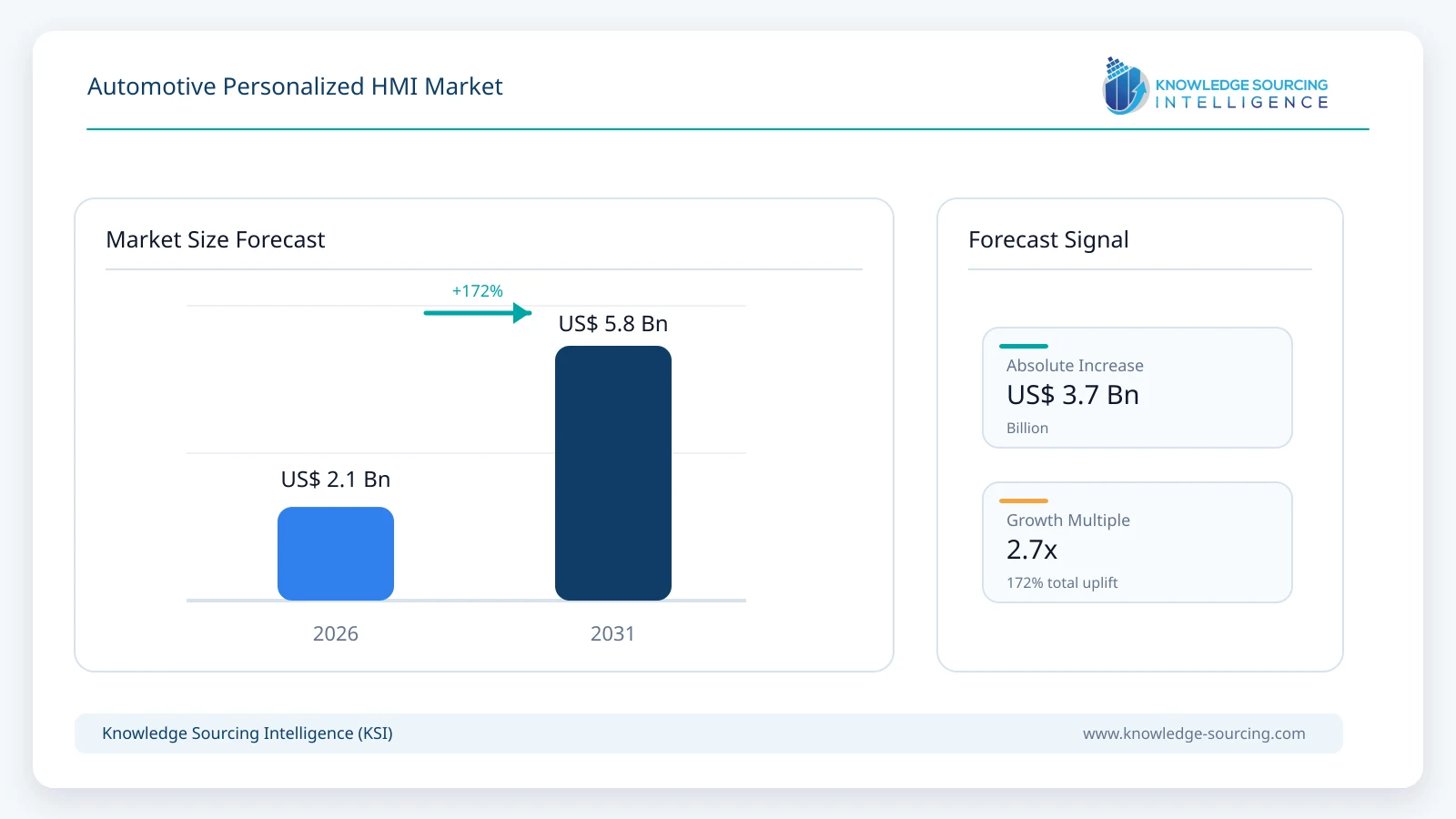
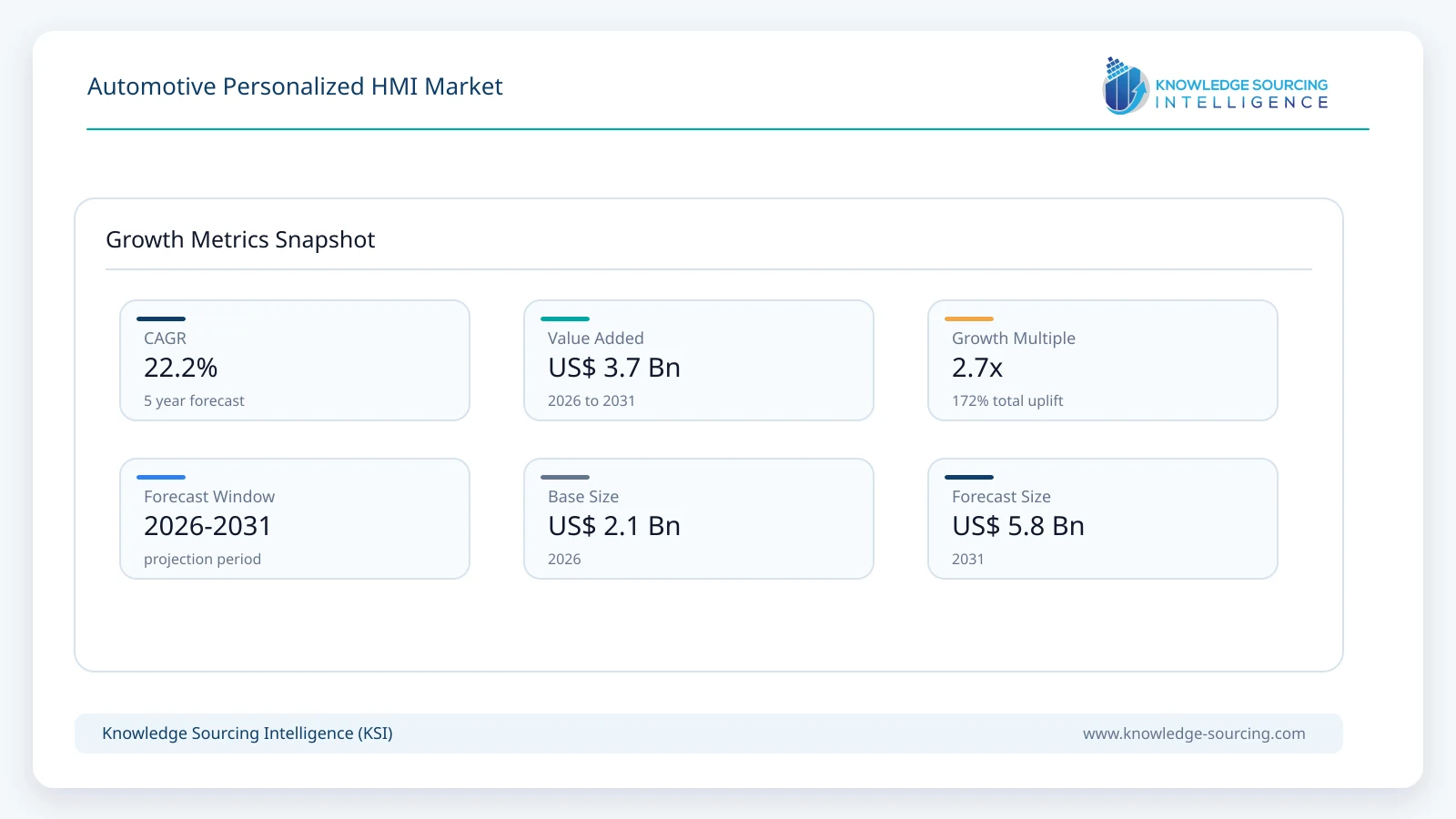
The Automotive Personalized HMI Market is projected to grow from USD 2.15 billion in 2026 to USD 5.85 billion by 2031, at an implied CAGR of 22.16% throughout the forecast period.
Highlights:
- 1Profile-linked display layouts and themes account for an estimated 28% of 2026 market value, reflecting the broad installed base of configurable graphical interfaces.
- 2Personalized voice and conversational HMI represents approximately 26% of revenue in 2026 and gains share as user-specific dialogue capabilities reach more vehicle lines.
- 3Stored profiles and rule-based customization represent 43% of 2026 value, while generative and agentic personalization gains share from a smaller installed base.
- 4Personalization software and integration account for an estimated 61% of 2026 revenue, ahead of dedicated input, recognition and service allocations.
- 5Passenger vehicles contribute approximately 94% of current market value, with premium and upper-midrange vehicles carrying higher personalization content.
- 6Asia Pacific represents an estimated 43% of market value in 2026, followed by Europe, supported by software-centric vehicle launches and OEM differentiation.
Automotive HMI personalization builds on driver profiles, instrument-cluster preferences, radio presets and seat-linked settings, with current platforms extending those preferences across several cockpit channels. Current implementations increasingly coordinate several interface channels, allowing a driver profile to influence display content, voice interaction, route suggestions and notification presentation. Personalized HMI therefore depends on software configuration and domain integration rather than an additional stand-alone cabin product.
BMW Panoramic iDrive distributes selected driver information across windshield projection, the central display and steering controls while adapting the presentation to user preferences. Mercedes-Benz follows a different OEM-controlled approach through MB.OS and fourth-generation MBUX, combining account settings, branded visual design and conversational interaction. Both architectures make consistent software behavior across cockpit surfaces an important part of the vehicle's digital identity.
Cerence provides configurable conversational interfaces, HARMAN Ready Engage combines contextual orchestration with brand-specific avatars, and Visteon supplies cockpit computing suited to personalized applications. These supplier capabilities complement the proprietary operating environments managed by vehicle manufacturers. Because shared cockpit processors serve many other functions, the market valuation includes only the incremental personalization share of hardware and integration.
Market Trends
Profile Continuity Is Spreading Across Interface Channels
Driver recognition increasingly restores coordinated preferences across visual layouts, shortcuts, media and other user-facing controls when an occupant changes vehicles or seating positions. BMW Operating System X links selected personalized content and steering-related preferences within a common software environment. Reliable restoration requires consistent profile permissions and interface behavior rather than isolated settings stored within a single infotainment display.
Vehicles shared among household members or fleet users place greater value on reliable recognition and restoration of separate occupant profiles, especially when accounts span several cockpit domains. The engineering requirement is consistent behavior across account systems, cockpit domains and software versions, not simply storage of preferences. Suppliers that provide reusable profile and permissions frameworks can reduce repeated integration work across vehicle programs.
Conversational HMI Is Becoming More User-Specific
Cerence xUI supports multi-intent speech requests and distinct acoustic zones, allowing in-car assistants to respond to different occupants. Cerence announced the Geely overseas program in January 2026 and expanded its BYD partnership in April 2026, highlighting demand for multilingual, user-aware conversational capabilities. Natural-language input can make stored preferences easier to discover without requiring repeated menu navigation.
Multi-occupant conversational systems must identify the speaking zone, apply profile-specific permissions and retain relevant dialogue context without confusing driver and passenger requests. Reliable recovery during connectivity interruptions also matters for vehicle-grade interaction, particularly where a command affects a physical cabin function. Hybrid edge-cloud designs can preserve low-latency local responses while reserving more complex reasoning for connected services.
OEMs Are Building Branded and Context-Aware Interfaces
HARMAN Ready Engage uses preference information, environmental inputs and OEM-configurable avatars to support a distinct interaction style for each participating vehicle brand. Mercedes-Benz also uses a proprietary MBUX presentation layer while incorporating AI capabilities from technology partners. Branded interfaces allow automakers to differentiate digital experiences even when competing vehicles use similar display panels or computing chips.
Context-aware HMI can prioritize frequently used controls, suppress less relevant suggestions and adjust presentation to the driving situation, but the interface must preserve predictable access to critical information. The design challenge is to make personalization useful without increasing cognitive burden or concealing safety-relevant information. Continuous usability testing and update controls remain important to long-term customer acceptance.
Automotive Personalized HMI Market Segment Analysis
By Personalization Function
Profile-Linked Display Layouts and Themes
Profile-linked display layouts and themes represent approximately USD 602 million in 2026, supported by configurable instrument clusters and central displays that retain individual driver preferences. Drivers can arrange widgets, change display emphasis and retain preferred interface appearance without the vehicle needing a separate display system. BMW Panoramic iDrive shows how these functions can be connected to a broader vehicle operating environment.
Graphical personalization retains considerable revenue through 2031, although its share declines as individualized voice interaction and coordinated multimodal interfaces grow from smaller bases. Commercial value comes from configuration frameworks, graphical development, interface validation and controlled profile restoration rather than the full screen assembly.
By Personalization Capability
Stored Profiles and Rule-Based Customization
Stored profiles and rule-based customization account for an estimated 43% of 2026 market value, including predictable restoration of interface layout, language settings, shortcuts and other frequently used controls. These mature functions require less computing capacity and generally lower operating expense than continuous generative reasoning. Profile reliability remains commercially important even as predictive and conversational features gain attention.
Predictive and agentic personalization is gaining share, but deterministic profile restoration remains necessary for dependable multi-user operation and consistent settings after software updates. Manufacturers continue to require reliable account recovery, privacy controls and consistent behavior after software updates, especially when settings are shared across vehicles.
By Primary Interaction Modality
Visual and Touch Interfaces
Visual and touch interaction contributes approximately 42% of the 2026 market, supported by configurable home screens, shortcuts, navigation views and instrument-cluster settings. Display interfaces remain the easiest channel through which drivers can directly review and change saved preferences. Voice and multimodal interaction are expanding as alternatives to repeated touchscreen tasks.
Voice and coordinated multimodal interfaces gain value through personalized conversation and context-sensitive handoffs among touch, speech and other input channels as the forecast progresses. A spoken request can affect the same profile that configures visual controls, creating additional integration work between applications and vehicle systems.
By Offering
Personalization Software and Integration
Personalization software and integration represent approximately 61% of the 2026 market, including profile-management logic, conversational orchestration, adaptive interfaces, middleware and OEM testing. Visteon and HARMAN illustrate how personalized applications can operate on shared cockpit electronics rather than dedicated new devices. The resulting supplier value is concentrated in engineering, qualification and reusable software frameworks more than separate hardware expenditure.
Personalization software is projected to reach approximately 66% of revenue by 2031 as branded interaction and feature updates become more important than dedicated input hardware. However, shared compute resources must be allocated carefully so the same cockpit processor is not valued independently in both the full HMI market and the personalization subset.
By Geography
Asia Pacific
Asia Pacific represents approximately 43% of market value in 2026, supported by Chinese smart-cabin competition, Japanese and South Korean electronics suppliers, and growth in software-rich vehicle models. Cerence programs with Geely and BYD provide concrete examples of user-aware voice capabilities developed for wider vehicle deployment and overseas markets.
Asia Pacific's share of the personalized HMI market is modeled to increase from approximately 43% in 2026 to 46% by 2031 as connected-cockpit adoption expands. Adoption differs significantly across the region, with high-content Chinese electric vehicles and premium models adopting more advanced functions than price-sensitive entry-level vehicle platforms.
Market Drivers
Expansion of Software-Defined Cockpit Architectures
BMW Operating System X and Mercedes-Benz MB.OS provide coordinated software environments for customizable displays, connected functions and profile-linked settings across vehicle lines. Common cockpit foundations reduce repeated work otherwise required to implement individual preferences across isolated controllers. Automakers and their suppliers can therefore reuse qualified interface and account-management functions more efficiently between programs.
Common profile software, graphical adaptation middleware and validation services account for much of the incremental supplier opportunity as automakers coordinate personalized functions across several controls. Suppliers that can integrate profiles across displays, vehicle settings and input channels are positioned to gain more content per software-rich vehicle.
Broader Deployment of User-Aware Conversational Assistants
Automotive conversational assistants increasingly support follow-up dialogue, locally handled commands and seat-specific requests, as illustrated by recent Cerence xUI vehicle programs. Cerence xUI deployments announced for Geely and BYD indicate that automakers are seeking production-ready platforms rather than demonstration-only language models.
Personalized speech and multimodal controls can reduce repeated menu navigation by allowing drivers to access stored preferences and supported vehicle functions through natural-language requests. Commercial scaling still depends on localization, predictable execution and the ability to distinguish driver commands from passenger requests.
Demand for Recognizable Digital Brand Experiences
Automakers differentiate cockpit software through distinctive interface layouts, interaction sounds and assistant behavior even when competing vehicles rely on similar displays and computing platforms. HARMAN Ready Engage allows OEM-specific avatar personalities and interface orchestration, while Mercedes-Benz retains its branded MBUX experience around third-party AI components.
OEM-branded HMI platforms require configurable design frameworks, profile-dependent graphics and integrated interaction services so personalized behavior remains consistent across vehicle programs. The value is in consistently implemented user behavior rather than solely in more elaborate display hardware.
Increasing Multi-Driver and Shared-Vehicle Use
Multi-driver households and vehicle fleets benefit from identity-linked restoration of language settings, media preferences and frequently used controls, reducing repeated configuration after driver changes. Account-linked profiles also provide a foundation for adapting notifications and interface access according to occupant identity.
Reliable restoration of vehicle profiles requires secure identity management, controlled data transfer and user-specific permissions across shared cockpit and cloud services. These functions add development and maintenance value even in vehicles that do not use generative AI assistants.
Lower-Cost Deployment of Automotive AI Capabilities
Reusable cockpit processors and hybrid AI architectures make contextual interface features technically feasible across more vehicle classes by sharing qualified compute and software foundations. Visteon presented a production-oriented compute solution in January 2026 designed for AI-enhanced and personalized in-vehicle interfaces.
Standardized cockpit compute allows more spending to shift toward personalized software behavior and vehicle integration, rather than separate hardware development for each model. The forecast assumes gradual penetration into upper-midrange vehicles rather than universal near-term adoption.
Market Restraints
Privacy, Identity and Permission Management
Profile-linked automotive interfaces can process personal preferences, user accounts and voice-interaction histories, requiring safeguards that are distinct from conventional anonymous cockpit controls. OEMs must control which data are retained locally, transferred to cloud services or made visible to other occupants. Unclear account permissions can undermine trust in even technically capable personalization features.
Privacy-by-design development becomes more demanding when separate driver or passenger profiles share one interface and must remain isolated across vehicle-use sessions. Supplier performance depends on secure identity restoration and practical controls for deleting or separating personal information.
Interface Complexity and Driver Distraction
Frequent changes to personalized screens can obscure predictable control placement or critical information, requiring automakers to place limits on configurable driver-facing layouts. Driver-facing suggestions need to remain predictable, and safety-critical information cannot depend on an optional profile configuration.
Automakers retain fixed conventions for safety-critical information while testing whether configurable layouts and contextual suggestions remain predictable during vehicle operation. This limits how aggressively adaptive displays and contextual prompts can be deployed during driving.
Regional Language and Localization Requirements
Personalized conversational HMI must recognize accents, regional dialects, mixed-language speech and local services consistently across vehicle markets and user groups. Cerence has emphasized overseas language adaptation in its Geely program, reflecting a real integration burden for global vehicle portfolios.
Localization raises testing costs and can slow deployment of advanced assistants in markets where training data, local content or connectivity are weaker. A successful English-language demonstration does not establish equivalent multilingual production readiness.
Fragmented OEM Software Stacks and Long Qualification Cycles
OEM software environments vary in account permissions, electronic architecture, operating systems and update policies, complicating the reuse of one personalized interface across automakers. Personalization modules must connect reliably to shared displays and control domains even as hardware versions change during a model cycle.
Long-term cybersecurity maintenance, interface qualification and software support can offset the savings from shared profile modules, particularly for smaller suppliers serving several OEMs. Smaller suppliers face particularly high integration demands when pursuing several manufacturers simultaneously.
Uncertain Monetization of Incremental Personalization
Stored profiles and basic customization are commonly included in vehicle equipment packages, limiting the potential to sell straightforward interface restoration as a separate paid service. Charging separately for profile restoration or interface themes can be difficult when similar functions are available on inexpensive consumer devices.
Advanced assistance and branded software experiences may support higher supplier value, but recurring revenue depends on sustained feature use and OEM commercial models. The estimate therefore avoids treating potential subscription revenue as guaranteed expenditure.
Regional Outlook
Asia Pacific
Asia Pacific leads Automotive Personalized HMI revenue in 2026 as Chinese smart-cabin programs combine connected software, responsive interfaces and increasingly individualized digital services. Cerence agreements with Geely and BYD indicate continuing investment in multilingual conversational HMI for both domestic and overseas vehicle programs. Japan and South Korea contribute established electronics, display and software-integration expertise.
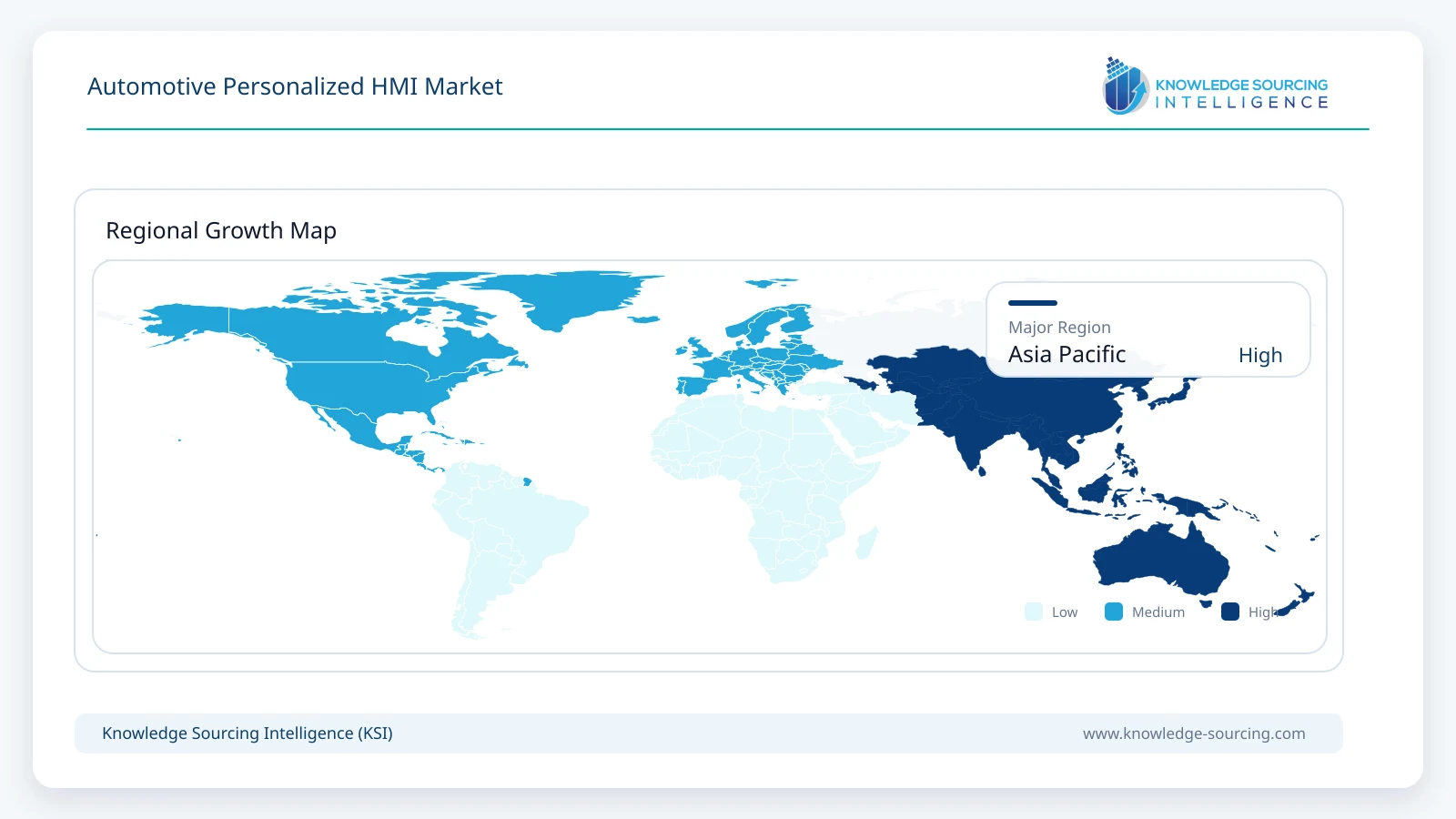
Asia Pacific's personalized HMI market is estimated at approximately USD 925 million in 2026 and USD 2.69 billion in 2031, supported by growing feature content in regional vehicle programs. China accounts for the largest share of regional demand, while India and Southeast Asia offer longer-term adoption opportunities as feature-rich infotainment reaches more vehicle classes. Price-sensitive segments continue to prioritize reliable, lower-cost profile functionality.
Europe
European demand for advanced personalized interfaces benefits from premium automakers investing in branded cockpit operating environments and user-specific interaction designs. BMW Operating System X supports individualized display content, vehicle modes and connected software services, while fourth-generation Mercedes-Benz MBUX integrates conversational assistance within an OEM-controlled environment.
European personalized HMI revenue is estimated at approximately USD 624 million in 2026 and USD 1.58 billion in 2031, supported by premium software-rich vehicle programs. Premium-brand innovation supports relatively high personalization spending per equipped vehicle, although slower vehicle-production growth constrains market expansion compared with Asia Pacific. Regulatory scrutiny around privacy and distraction also increases software qualification requirements.
Competitive Landscape
Automotive Personalized HMI suppliers compete through conversational voice platforms, configurable software frameworks, cockpit electronics and system-level integration rather than a single dedicated hardware category. Cerence participates through automotive conversational AI and localized interaction platforms; HARMAN offers Ready Engage and reusable cockpit technology; Visteon supplies personalized-interface-capable cockpit compute; Panasonic Automotive Systems and Hyundai Mobis provide integrated cockpit electronics and HMI. Bosch, AUMOVIO, DENSO, Alps Alpine and Valeo contribute relevant electronics, controls and system integration.
BMW and Mercedes-Benz retain control over much of their branded interface behavior while external suppliers provide conversational software, cockpit electronics and integration. AUMOVIO is the current name for the former Continental Automotive business following its September 2025 spin-off. Company market-share rankings are not asserted because most suppliers do not separately report personalization-specific revenue.
Recent Developments
April 2026: Cerence expanded its BYD relationship to deploy xUI-based conversational functionality on vehicles beginning with the ATTO 2 DM-i. The agreement supports scalable personalized voice interaction.
January 2026: Cerence announced that Geely Auto selected xUI for an overseas in-car experience, including multi-seat acoustic zones and localized language interaction.
January 2026: Visteon showcased high-performance cockpit computing built around Snapdragon Cockpit Elite, highlighting edge AI capabilities for personalized interfaces.
September 2025: AUMOVIO became an independent publicly listed company following the separation of Continental Automotive, changing the supplier structure for relevant display and HMI technologies.
2025: Mercedes-Benz introduced fourth-generation MBUX in the new CLA architecture, combining MB.OS with personalized interface features and advanced conversational AI.
January 2025: BMW introduced Panoramic iDrive with Operating System X, including configurable presentation, driving modes and connected user-specific functions.
Market Outlook
The Automotive Personalized HMI Market is forecast to reach approximately USD 5.85 billion by 2031 as persistent driver profiles, individualized speech and coordinated multimodal controls become more common in connected vehicles. Personalized voice functions gain share, while graphical layouts remain a substantial installed-base application. Software and integration increasingly account for the largest share of identifiable value as OEMs continue to reuse cockpit hardware across multiple vehicle programs.
Asia Pacific is expected to lead the global personalized HMI market through 2031, while European premium manufacturers remain influential in interface architecture and supplier qualification. Supplier differentiation will center on predictable identity restoration, secure profile handling, localization, user-centric interface design and reliable integration across vehicle domains. Growth remains sensitive to the portion of personalized capability that manufacturers purchase separately rather than develop in-house.
Automotive Personalized HMI Market Scope:
| Report Metric | Details |
|---|---|
| Total Market Size in 2026 | USD 2.15 billion |
| Total Market Size in 2031 | USD 5.85 billion |
| Forecast Unit | USD Billion |
| Growth Rate | 22.16% |
| Study Period | 2021 to 2031 |
| Historical Data | 2021 to 2024 |
| Base Year | 2025 |
| Forecast Period | 2026 – 2031 |
| Segmentation | Personalization Function, Personalization Capability, Primary Interaction Modality, Offering, Vehicle Type, Geography |
| Companies |
|
Market Segmentation
By Personalization Function
Profile-Linked Display Layouts and Themes
Personalized Voice and Conversational HMI
User Recognition and Profile Restoration
Contextual and Multimodal Interface Adaptation
Personalized Shortcuts and Recommendations
By Personalization Capability
Stored Profiles and Rule-Based Customization
Predictive and Context-Aware Personalization
Generative and Agentic Personalization
Cross-Device and Cloud Profile Continuity
By Primary Interaction Modality
Visual and Touch Interfaces
Voice and Conversational Interaction
Multimodal Interaction
Physical, Haptic and Other Interfaces
By Offering
Personalization Software and Integration
Identity and Interaction Hardware Allocation
Connected Services and Lifecycle Support
By Vehicle Type
Passenger Vehicles
Light Commercial Vehicles
Medium and Heavy Commercial Vehicles
By Geography
North America
United States
Canada
Mexico
South America
Brazil
Argentina
Others
Europe
Germany
United Kingdom
France
Italy
Spain
Others
Middle East and Africa
Saudi Arabia
UAE
South Africa
Others
Asia Pacific
China
Japan
South Korea
India
Indonesia
Thailand
Others
Table of Contents
1. EXECUTIVE SUMMARY
2. MARKET SNAPSHOT
2.1. Market Overview
2.2. Market Definition
2.3. Scope of the Study
2.4. Market Segmentation
3. BUSINESS LANDSCAPE
3.1. Market Drivers
3.1.1. Expansion of Software-Defined Cockpit Architectures
3.1.2. Broader Deployment of User-Aware Conversational Assistants
3.1.3. Demand for Recognizable Digital Brand Experiences
3.1.4. Increasing Multi-Driver and Shared-Vehicle Use
3.1.5. Lower-Cost Deployment of Automotive AI Capabilities
3.2. Market Restraints
3.2.1. Privacy, Identity and Permission Management
3.2.2. Interface Complexity and Driver Distraction
3.2.3. Regional Language and Localization Requirements
3.2.4. Fragmented OEM Software Stacks and Long Qualification Cycles
3.2.5. Uncertain Monetization of Incremental Personalization
3.3. Market Opportunities
3.4. Porter’s Five Forces Analysis
3.5. Industry Value Chain Analysis
3.6. Policies and Regulations
3.7. Strategic Recommendations
4. TECHNOLOGICAL OUTLOOK
4.1. Driver and Occupant Profile Management
4.2. Adaptive Graphical Interface Frameworks
4.3. Personalized Conversational and Voice HMI
4.4. Contextual and Multimodal Interface Orchestration
4.5. Edge and Cloud Identity Continuity
4.6. Privacy, Permissions and OTA Lifecycle
5. AUTOMOTIVE PERSONALIZED HMI MARKET BY PERSONALIZATION FUNCTION
5.1. Introduction
5.2. Profile-Linked Display Layouts and Themes
5.3. Personalized Voice and Conversational HMI
5.4. User Recognition and Profile Restoration
5.5. Contextual and Multimodal Interface Adaptation
5.6. Personalized Shortcuts and Recommendations
6. AUTOMOTIVE PERSONALIZED HMI MARKET BY PERSONALIZATION CAPABILITY
6.1. Introduction
6.2. Stored Profiles and Rule-Based Customization
6.3. Predictive and Context-Aware Personalization
6.4. Generative and Agentic Personalization
6.5. Cross-Device and Cloud Profile Continuity
7. AUTOMOTIVE PERSONALIZED HMI MARKET BY PRIMARY INTERACTION MODALITY
7.1. Introduction
7.2. Visual and Touch Interfaces
7.3. Voice and Conversational Interaction
7.4. Multimodal Interaction
7.5. Physical, Haptic and Other Interfaces
8. AUTOMOTIVE PERSONALIZED HMI MARKET BY OFFERING
8.1. Introduction
8.2. Personalization Software and Integration
8.3. Identity and Interaction Hardware Allocation
8.4. Connected Services and Lifecycle Support
9. AUTOMOTIVE PERSONALIZED HMI MARKET BY VEHICLE TYPE
9.1. Introduction
9.2. Passenger Vehicles
9.3. Light Commercial Vehicles
9.4. Medium and Heavy Commercial Vehicles
10. AUTOMOTIVE PERSONALIZED HMI MARKET BY GEOGRAPHY
10.1. Introduction
10.2. North America
10.2.1. United States
10.2.2. Canada
10.2.3. Mexico
10.3. South America
10.3.1. Brazil
10.3.2. Argentina
10.3.3. Others
10.4. Europe
10.4.1. Germany
10.4.2. United Kingdom
10.4.3. France
10.4.4. Italy
10.4.5. Spain
10.4.6. Others
10.5. Middle East and Africa
10.5.1. Saudi Arabia
10.5.2. UAE
10.5.3. South Africa
10.5.4. Others
10.6. Asia Pacific
10.6.1. China
10.6.2. Japan
10.6.3. South Korea
10.6.4. India
10.6.5. Indonesia
10.6.6. Thailand
10.6.7. Others
11. COMPETITIVE ENVIRONMENT AND ANALYSIS
11.1. Major Players and Strategy Analysis
11.2. Market Share Analysis
11.3. Mergers, Acquisitions, Agreements and Collaborations
11.4. Competitive Dashboard
12. COMPANY PROFILES
12.1. Cerence Inc.
12.2. HARMAN International
12.3. Visteon Corporation
12.4. Panasonic Automotive Systems Co., Ltd.
12.5. AUMOVIO SE
12.6. Robert Bosch GmbH
12.7. Hyundai Mobis Co., Ltd.
12.8. DENSO Corporation
12.9. Alps Alpine Co., Ltd.
12.10. Valeo S.A.
12.11. Intellias
12.12. Tata Elxsi Limited
13. APPENDIX
13.1. Currency
13.2. Assumptions
13.3. Base and Forecast Years Timeline
13.4. Key Benefits for Stakeholders
13.5. Research Methodology
13.6. Abbreviations
Navigate
Trusted by the world's leading organizations











