
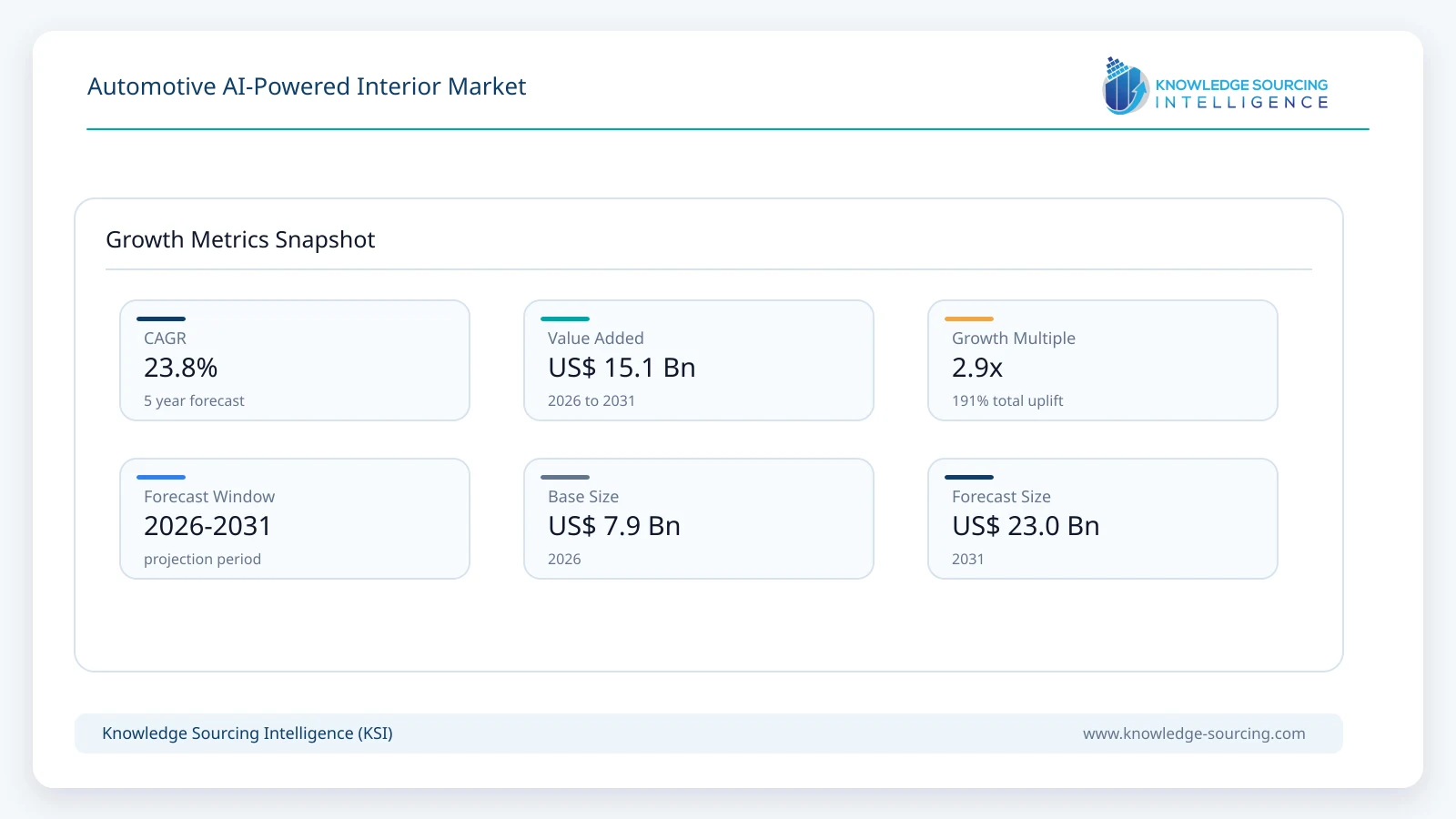
The Automotive AI-Powered Interior Market is forecast to grow at a CAGR of 23.8%, reaching USD 23.0 billion in 2031 from USD 7.9 billion in 2026.
Highlights:
- 1AI-assisted infotainment and cabin HMI represent an estimated 31% of 2026 market value, reflecting early production adoption of conversational and contextual assistants.
- 2Integrated multi-domain cabin orchestration is modeled as the fastest-growing interior-function segment as separate AI features become more tightly coordinated.
- 3Edge and on-device processing account for approximately 40% of market value in 2026, supported by latency, privacy and offline-availability requirements.
- 4Passenger vehicles represent approximately 90% of estimated 2026 revenue, while commercial and specialty vehicle applications offer smaller opportunities.
- 5Asia Pacific accounts for approximately 43% of global value in 2026, driven by software-rich vehicle programs and established electronics supply chains.
- 6Physical cabin actuation and integration contribute additional attributable value beyond the core AI intelligence stack, but both layers belong to one consolidated market.
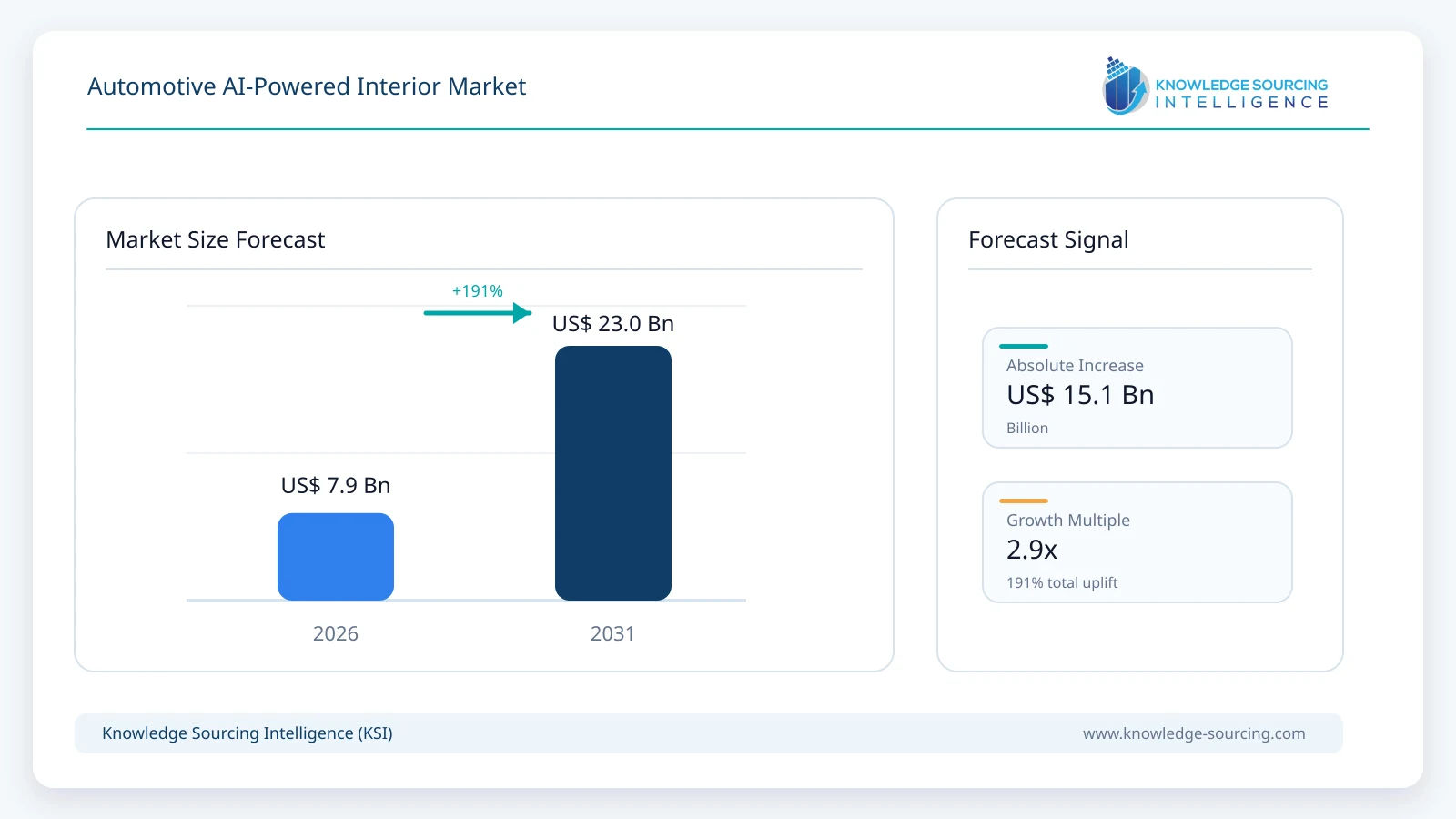
The market covers attributable AI software, inference compute, interior sensing, and incremental intelligent cabin hardware used to interpret occupants and coordinate in-vehicle functions. Qualifying uses include conversational interfaces, occupant-state analysis, predictive comfort, adaptive ambience and integrated cabin orchestration.
LG Electronics' AI Cabin Platform combines on-device vision-language and large-language-model functions to interpret occupant context and support personalized cabin responses. Yanfeng's XiM27 demonstrates how software can coordinate seating, lighting, temperature and entertainment within an integrated interior architecture. Both developments indicate the direction of the technology, although concept demonstrations cannot be treated as confirmed production revenue without a separate vehicle-program award.
Market Overview
AI-enabled automotive cabins increasingly combine spoken requests with camera-based occupant information, vehicle operating conditions, and stored preferences to support coordinated interior responses. Conventional rule-based voice systems respond to predetermined commands, whereas emerging multimodal platforms can infer a request from several signals and coordinate a sequence of cabin functions. Bosch describes an AI cockpit extension platform capable of linking natural-language requests to functions such as seat heating and cabin-temperature adjustment.
Cerence AI announced deployment of xUI in BYD vehicles during 2026, while Qualcomm reports broad adoption of cockpit and edge-AI platforms. LG Electronics presented the AI Cabin Platform as a demonstration of on-device contextual intelligence, and Yanfeng characterizes XiM27 as a drivable, production-ready concept rather than a disclosed volume-production contract.
Deploying AI-based cabin controls across production vehicles requires deterministic response limits, low-power inference, data protection and clearly defined interfaces to safety-relevant vehicle functions. These engineering requirements create revenue for embedded inference, sensor fusion, domain-specific middleware and integration. Existing microphones, cameras and displays can sometimes be reused, reducing hardware additions while increasing software value per equipped vehicle.
Market Trends
On-Device Models Are Extending Cabin Intelligence
LG Electronics' AI Cabin Platform is designed to run vision-language, language, and image-generation workloads locally on Snapdragon Cockpit Elite compute, providing an on-vehicle foundation for contextual responses. Local execution improves responsiveness and allows selected personalization functions to operate without round trips to external cloud servers. Qualcomm also emphasizes model portability across vehicle programs, enabling OEMs to reuse an AI stack while scaling compute performance by vehicle tier.
Automotive AI architectures increasingly divide cabin workloads between local processors and connected services according to the timing and privacy needs of each function. Occupant monitoring and immediate cabin controls favor predictable on-device inference, while cloud infrastructure supports wider knowledge retrieval, evolving model features and fleet updates. Supplier differentiation therefore extends to orchestration, memory use, quantization and security rather than accelerator specifications alone.
Occupant Intelligence Is Connecting to Interior Functions
Valeo and Seeing Machines are advancing in-cabin monitoring by combining automotive cameras, perception software and system integration for occupant-state and driver-attention applications. Occupancy and driver-state information can support safer alerts and provide context for comfort settings when appropriately designed and consented. FORVIA uses an existing driver-monitoring camera as an input to its Cockpit UX Engine, reducing the need for entirely separate sensing equipment.
Occupant-position information can support individual airflow and seating adjustments, while carefully constrained attention data can influence how cabin information is delivered to the appropriate occupant. Privacy constraints and uncertain interpretation of emotions or physiological state limit the degree of automatic intervention appropriate in production vehicles. Sensing suppliers must demonstrate reliable control responses before broad vehicle deployment.
Cabin Platforms Are Moving Toward Cross-Domain Orchestration
HARMAN combines Ready Engage and Ready Care capabilities with broader integrated cabin platforms, while Yanfeng XiM27 demonstrates interaction among cabin controls, occupant understanding and physical interior adjustments. The commercial emphasis is shifting toward a shared software layer capable of coordinating separate suppliers rather than a collection of independent AI-branded features.
Coordinating seating, thermal controls, displays and lighting through one cabin software layer requires communication across electronic control units that may come from different suppliers. Vehicle makers need clearly defined application interfaces, permissions and fallback modes before AI agents can execute multiple interior commands. The most scalable suppliers will provide reusable orchestration frameworks and thoroughly tested interfaces rather than one-off demonstrations.
Segment Analysis
By AI-Enabled Interior Function: AI-Assisted Infotainment and Cabin HMI
AI-assisted infotainment and cabin HMI account for approximately 31% of market value in 2026, supported by the broad use of microphones, screens, and digital assistants in connected vehicles. Existing input and output hardware allows automakers to introduce more capable natural-language interaction without redesigning the entire cockpit. Cerence xUI and Bosch AI cockpit technologies illustrate alternative approaches to translating flexible occupant requests into controlled vehicle actions.
Conversational interfaces continue to generate increasing software value as navigation, media, and vehicle-information requests become more contextual, even as coordinated physical cabin applications gain share. Navigation and media requests are easier to authorize than seat movement or safety-related interventions, which require more exact control logic. AI-enabled interfaces therefore remain a major commercial entry point while the largest architectural changes occur in multi-domain systems.
By AI Capability: Conversational and Generative AI
Conversational and generative AI represent an estimated 33% of 2026 market value through contextual dialogue, voice-assistant integration and natural-language access to authorized vehicle functions. Cerence supplies an automotive-oriented implementation path, while LG and Qualcomm demonstrate how generative functions can be combined with in-vehicle compute and broader context information.
Agentic and cross-domain cabin software is expected to gain share through 2031 as automotive AI moves from answering occupant questions toward carrying out authorized multi-step vehicle commands. Vehicle manufacturers must still determine which controls are permitted, how uncertainty is handled and when conventional deterministic interfaces take priority. This favors domain-specific software engineering over unrestricted general-purpose model deployment.
By Processing Architecture: Edge and On-Device AI
Edge and on-device AI account for an estimated 40% of revenue in 2026 and are forecast to reach 49% in 2031 as automakers prioritize predictable response times and local processing of cabin data. Low-latency inference is important for monitoring and localized comfort responses, while processing sensitive cabin signals inside the vehicle can reduce data-transfer exposure. Automotive compute suppliers are responding with increasingly capable NPUs and unified cockpit architectures.
Hybrid edge-cloud architectures remain valuable because connected infrastructure supports demanding model updates and external content services while local processors manage time-critical interior responses. OEMs are balancing processor cost and heat management against network availability and a longer software lifecycle. The architecture mix should therefore change gradually rather than assuming a complete shift to offline AI.
By Revenue Layer: Incremental Smart Cabin Hardware and Integration
Incremental smart-cabin hardware and AI-specific integration account for approximately 42% of the 2026 value pool, reflecting the expense of intelligent sensing, actuation and physical function integration. The category represents intelligent sensors and actuators, cabin-control integration and AI-specific physical feature premiums beyond the underlying cognition stack. Established seating and HVAC systems remain the foundation, while specialized sensing, actuation, and AI-linked controls provide much of the additional functional content.
Automotive AI software and compute are expected to grow faster than dedicated physical cabin equipment as on-device inference supports richer models and more frequent software updates. Intelligent seating and climate hardware continue expanding in absolute value, but standardized actuators and shared sensor architectures can moderate per-vehicle costs. Suppliers are increasingly evaluated on the ability to add useful functions without replacing established interior assemblies.
By Propulsion: Battery Electric Vehicles
Battery electric vehicles contribute an estimated 30% of AI-powered interior market value in 2026 and are projected to represent 43% by 2031 as centralized electronics become more widely deployed. Many electric-vehicle programs adopt centralized electronics, over-the-air update architectures and large digital interfaces, making AI-enabled interior functions easier to introduce across trim levels. China contributes disproportionately to high-feature EV deployment through an active smart-cabin ecosystem.
Internal-combustion and hybrid vehicles continue to generate substantial revenue because AI functionality depends on electronic architecture rather than propulsion itself. Suppliers capable of deploying one assistant and sensor-fusion stack across multiple powertrain platforms can access larger program volumes and avoid fragmented software maintenance.
Market Drivers
Centralized Cockpit Electronics and Automotive AI Compute
Qualcomm's Snapdragon cockpit platforms provide an automotive-grade computing foundation for voice, perception and other AI workloads, with adoption extending across multiple OEM vehicle programs. Higher compute density permits vision, language and context models to share resources with infotainment and other cabin applications. Reusing a common digital architecture can lower the engineering cost of extending AI functions across vehicle lines.
Centralized cockpit software allows manufacturers to add qualified interaction functions without redesigning each display or physical switch, provided shared computing and vehicle interfaces remain compatible. Automotive OEMs can introduce new services and interface behavior through qualified updates, supporting sustained integration demand after the initial hardware platform is installed.
Demand for Conversational and Context-Aware Interaction
Cerence xUI and Bosch's AI cockpit development demonstrate automotive demand for systems that interpret ordinary-language requests alongside vehicle context and route commands to supported functions. Drivers increasingly expect voice systems to handle follow-up requests and simplify access to existing infotainment and cabin controls. Automotive-specific domain routing is required to turn flexible speech into dependable functions.
Automotive conversational systems generate additional supplier value through domain-specific intent handling, multilingual localization and reliable vehicle-action integration rather than through speech recognition alone. Vehicle manufacturers may reuse existing microphone and display hardware, allowing software capability to expand without proportionate growth in physical input devices.
Occupant Monitoring and Multi-Sensor Context
Valeo's cabin-monitoring portfolio combines automotive camera hardware, perception algorithms and vehicle-system integration to assess occupant presence, position and selected driver states. Occupant position and attention assessment can inform alerts and, within suitable safeguards, support more personalized cabin behavior. Multi-sensor systems are particularly relevant where advanced comfort functions must recognize which occupants are present.
Camera-based cabin intelligence can support additional perception software and sensor-fusion revenue, but wider comfort and safety deployment requires validated classification performance and appropriate privacy safeguards. A shared sensor platform can be commercially attractive when safety and comfort applications are qualified separately.
Adaptive Thermal, Seating and Ambience Capabilities
AI-linked seating, heating, ventilation and lighting can respond to occupant context instead of relying exclusively on stored driver profiles or manual adjustments. Coordinated cabin software interprets preferences alongside relevant environmental information and passes qualified commands to existing interior control systems. Yanfeng XiM27 demonstrates this integration approach, while established thermal and seating suppliers provide much of the hardware foundation required for production applications.
Premium cars and feature-rich SUVs can carry higher per-vehicle content when AI coordinates seat adjustments, localized heating or ventilation and cabin ambience through additional software and actuators. Adoption in mainstream vehicles depends on standardized hardware, limited energy consumption and clear benefits compared with simpler manual controls.
OEM Software Differentiation and Lifecycle Updates
Automakers can differentiate AI-powered interiors through software-led changes to assistant behavior, occupant-specific responses and coordinated comfort after the underlying electronics platform is specified. HARMAN and LG emphasize modular software, branded interactions and in-vehicle experiences that can evolve across the vehicle lifecycle. Recurring qualification, model updates and connected services create opportunities beyond launch-stage components.
Commercial returns for automotive AI platform suppliers depend partly on software ownership, licensing and responsibility for updates, which vary considerably among vehicle manufacturers. Automotive-grade AI platforms that support brand customization and multi-model reuse can scale more efficiently than bespoke implementations.
Market Restraints
Higher Incremental System and Lifecycle Expense
AI-enabled interior systems require incremental spending on automotive-grade inference computing, occupant sensors, integration software and calibration beyond conventional cabin-control hardware. Premium vehicles can absorb richer equipment packages more readily than high-volume economy programs. Automakers must justify this extra content through clear usability or safety benefits.
Vehicle-domain AI deployments entail continuing costs for model validation, cybersecurity updates and long-term software support beyond the initial component purchase. Upfront component quotations can therefore understate the cost of maintaining reliable vehicle-domain interaction across a platform lifecycle.
Privacy and Cabin Data Governance
Interior cameras, microphones and occupant-behavior inference create data-processing and consent requirements beyond those associated with conventional seat or HVAC controls. Automakers need explicit data handling policies, security controls and user-facing choices about recording or personalization. Privacy architecture can restrict the scope of persistent learning and cloud-based interpretation.
Processing camera and voice data within the vehicle can limit external transfer, but local inference still requires clear retention rules, access controls and privacy governance. Vehicle manufacturers must verify retention practices, access rights and the behavior of third-party models across different jurisdictions.
Safety Validation of Generative and Agentic Controls
Generative assistants that interact with seating, climate or visibility-related cabin functions require strict boundaries around ambiguous language and authorized vehicle actions. Incorrect interpretation could trigger an unintended adjustment, so automakers need deterministic fallbacks, explicit permissions and repeatable validation. Established automotive safety and HMI requirements limit the extent to which unconstrained general-purpose models can control physical interior equipment.
Automakers commonly retain physical or deterministic controls for frequently used and safety-relevant functions while AI interfaces undergo additional validation for reliable vehicle interaction. These parallel interfaces add engineering work even where AI promises a simpler user experience.
Processor Cost, Power and Thermal Constraints
On-device automotive language and vision models increase demand for memory bandwidth, accelerator capacity and sustained electrical power within thermally constrained cockpit systems. Vehicle electronics must tolerate long service lives and temperature extremes, while entry-level models face strict bill-of-material limits. Hardware provisioned for future model growth can be expensive at launch.
Model compression and hybrid inference can reduce onboard compute requirements, although cloud-supported execution introduces connectivity needs and additional service dependencies. Suppliers must optimize capability against latency and cost rather than assume the largest model is commercially suitable.
Integration Complexity and Uneven OEM Adoption
Coordinated AI interior functions have to operate across seating, climate, lighting, sensing and cockpit controllers whose software interfaces and update schedules may differ by supplier. Integrated cabin orchestration therefore requires system-level engineering beyond individual component qualification. A concept demonstration does not establish reliable operation over multiple model years.
Premium vehicle platforms can absorb the engineering and hardware costs of complex cabin orchestration more readily than price-sensitive programs, limiting initial production penetration. Broad deployment requires common architectures and reusable software contracts, which can lengthen development and procurement cycles.
Regional Outlook
Asia Pacific
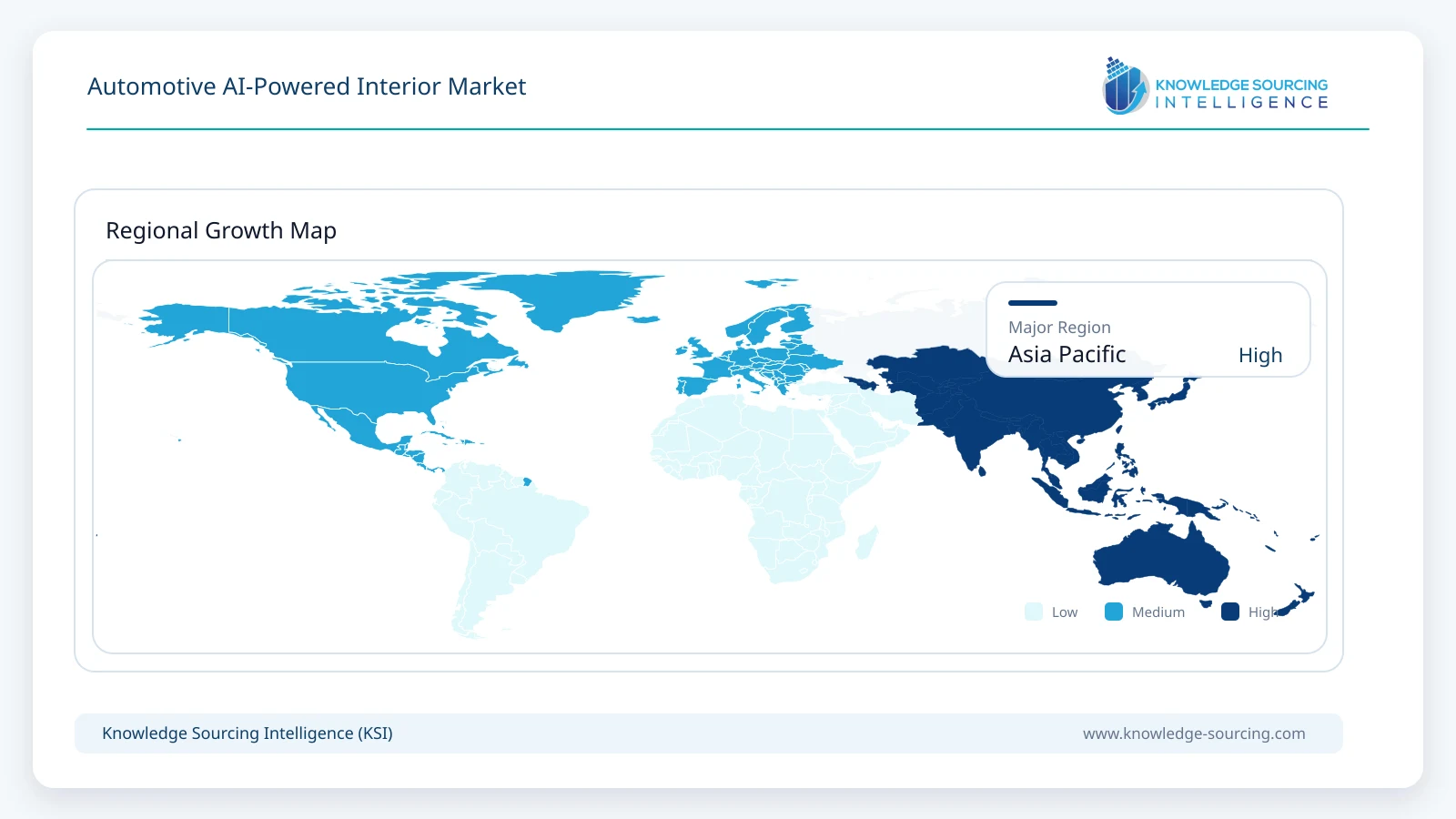
Asia Pacific represents approximately 43% of global AI-powered interior value in 2026, with Chinese smart-cabin programs providing the largest regional source of software-rich vehicle demand. Chinese EV manufacturers frequently integrate digital assistants, rich infotainment and connected interior features within common compute platforms. Qualcomm design wins and Cerence deployments with BYD reflect supplier investment in the regional ecosystem, while Japan and South Korea contribute automotive electronics and sensing capabilities.
AI-powered interior revenue in Asia Pacific is projected to reach approximately USD 10.58 billion by 2031 as more vehicles integrate intelligent cockpit software and occupant-responsive features. The regional outlook still varies substantially: Japanese and Korean automakers emphasize reliability and carefully qualified production systems, while price-sensitive vehicles in India and Southeast Asia generally contain fewer advanced cabin functions.
Europe
Europe accounts for approximately 27% of 2026 market value, supported by premium-vehicle programs, established electronics suppliers and extensive automotive safety and privacy requirements. Bosch AI cockpit extension platform illustrates a practical route to adding new capabilities without replacing every interior control unit. FORVIA and Valeo contribute camera-based functions that combine occupant information with cabin interaction and safety requirements.
European AI-powered interior revenue is projected to reach approximately USD 5.75 billion by 2031 as manufacturers expand qualified software capabilities within existing vehicle electronics platforms. Growth is expected to arise from high-value applications, software evolution and gradual fitment expansion rather than exceptional vehicle-production increases. Security, validation and privacy requirements favor suppliers that can offer repeatable qualification and clear division of responsibility between AI inference and physical cabin control.
Competitive Landscape
Competition in automotive AI-powered interiors spans conversational software, cockpit computing, occupant-perception platforms and Tier 1 suppliers integrating intelligence with physical cabin equipment. HARMAN, LG Electronics, Bosch, Qualcomm and Cerence participate in cabin intelligence and platform orchestration, while Valeo, Seeing Machines and FORVIA provide sensor-based occupant understanding. Yanfeng links smart cabin software with physical interiors, and Panasonic Automotive Systems, Visteon and Gentherm support cockpit integration or specialized comfort functions.
Automotive AI interior suppliers compete on verified production readiness, secure occupant-data handling, controlled vehicle-action routing and software maintenance across a model's service life. Supplier-wide automotive revenue is not a meaningful market-share proxy because major participants supply unrelated systems. Demonstrators such as Yanfeng XiM27 provide technology evidence but should not be recorded as mass-production program awards without separate confirmation.
Recent Developments
29 June 2026: Yanfeng unveiled the XiM27 production-ready drivable concept integrating centralized cabin electronics and generative AI with configurable seating, lighting and comfort functions.
8 April 2026: Cerence AI announced expanded BYD deployment of Cerence xUI for LLM-based conversational assistance in new vehicles for global markets.
13 January 2026: HARMAN announced expanded road-ready in-cabin products including integrated AI, personalization and software-defined vehicle functions.
5 January 2026: Valeo and Seeing Machines presented integrated driver and occupant monitoring solutions using camera-based AI perception and automotive-grade integration.
5 January 2026: Qualcomm announced additional Snapdragon Digital Chassis collaborations, including work with Google on agentic in-vehicle interactions.
11 December 2025: LG Electronics announced its AI Cabin Platform with on-device vision-language, language and image-generation models for CES 2026.
Market Outlook
The Automotive AI-Powered Interior Market is projected to reach USD 23.00 billion by 2031 as occupant-aware intelligence extends beyond standalone voice assistants into coordinated comfort, sensing and interaction functions. AI-assisted HMI remains an important revenue category, while cross-domain orchestration, computer vision and adaptive physical cabin responses contribute a larger portion of advanced deployments. Automotive-grade software, compute and sensing account for a rising share of attributable market value as capabilities improve.
Asia Pacific is expected to retain the largest share of AI-powered interior revenue through 2031, supported by Chinese smart-cabin programs, with Europe and North America remaining important engineering and commercialization centers. OEM programs will increasingly evaluate AI cabin systems by reliability, feature reuse, privacy controls and integration cost rather than demonstration quality alone. Continued adoption depends on proving that AI-enabled responses improve usability and comfort without compromising predictable vehicle operation.
Automotive AI-Powered Interior Market Scope:
| Report Metric | Details |
|---|---|
| Total Market Size in 2026 | USD 7.9 billion |
| Total Market Size in 2031 | USD 23.0 billion |
| Forecast Unit | USD Billion |
| Growth Rate | 23.8% |
| Study Period | 2021 to 2031 |
| Historical Data | 2021 to 2024 |
| Base Year | 2025 |
| Forecast Period | 2026 – 2031 |
| Segmentation | AI-Enabled Interior Function, AI Capability, Processing Architecture, Revenue Layer |
| Companies |
|
Market Segmentation
By AI-Enabled Interior Function
AI-Assisted Infotainment and Cabin HMI
Occupant Intelligence and Safety
Adaptive Comfort, Seating and Wellness
Personalized Lighting, Audio and Entertainment
Integrated Multi-Domain Cabin Orchestration
By AI Capability
Conversational and Generative AI
Computer Vision and Occupant Intelligence
Predictive and Personalization AI
Agentic and Cross-Domain AI
By Processing Architecture
Edge and On-Device AI
Hybrid Edge-Cloud AI
Cloud-Centric AI
By Revenue Layer
AI Software, Middleware and Models
AI Compute and Sensing
Incremental Smart Cabin Hardware and Integration
By Vehicle Type
Passenger Vehicles
Light Commercial Vehicles
Medium and Heavy Commercial Vehicles
By Propulsion
Battery Electric Vehicles
Hybrid Electric Vehicles
Plug-in Hybrid Electric Vehicles
Internal-Combustion Vehicles
Other Propulsion
By Geography
North America
United States
Canada
Mexico
South America
Brazil
Argentina
Others
Europe
Germany
United Kingdom
France
Italy
Spain
Others
Middle East and Africa
Saudi Arabia
UAE
South Africa
Others
Asia Pacific
China
Japan
South Korea
India
Indonesia
Thailand
Others
Table of Contents
1. EXECUTIVE SUMMARY
2. MARKET SNAPSHOT
2.1. Market Overview
2.2. Market Definition
2.3. Scope of the Study
2.4. Market Segmentation
3. BUSINESS LANDSCAPE
3.1. Market Drivers
3.1.1. Centralized Cockpit Electronics and Automotive AI Compute
3.1.2. Demand for Conversational and Context-Aware Interaction
3.1.3. Occupant Monitoring and Multi-Sensor Context
3.1.4. Adaptive Thermal, Seating and Ambience Capabilities
3.1.5. OEM Software Differentiation and Lifecycle Updates
3.2. Market Restraints
3.2.1. Higher Incremental System and Lifecycle Expense
3.2.2. Privacy and Cabin Data Governance
3.2.3. Safety Validation of Generative and Agentic Controls
3.2.4. Processor Cost, Power and Thermal Constraints
3.2.5. Integration Complexity and Uneven OEM Adoption
3.3. Market Opportunities
3.4. Porter’s Five Forces Analysis
3.5. Industry Value Chain Analysis
3.6. Policies and Regulations
3.7. Strategic Recommendations
4. TECHNOLOGICAL OUTLOOK
4.1. On-Device and Hybrid AI Inference
4.2. Computer Vision and Occupant Context
4.3. Conversational and Generative AI
4.4. Agentic Cabin Orchestration
4.5. AI-Enabled Seating, Climate and Lighting
4.6. Privacy, Safety and Model Lifecycle Management
5. AUTOMOTIVE AI-POWERED INTERIOR MARKET BY AI-ENABLED INTERIOR FUNCTION
5.1. Introduction
5.2. AI-Assisted Infotainment and Cabin HMI
5.3. Occupant Intelligence and Safety
5.4. Adaptive Comfort, Seating and Wellness
5.5. Personalized Lighting, Audio and Entertainment
5.6. Integrated Multi-Domain Cabin Orchestration
6. AUTOMOTIVE AI-POWERED INTERIOR MARKET BY AI CAPABILITY
6.1. Introduction
6.2. Conversational and Generative AI
6.3. Computer Vision and Occupant Intelligence
6.4. Predictive and Personalization AI
6.5. Agentic and Cross-Domain AI
7. AUTOMOTIVE AI-POWERED INTERIOR MARKET BY PROCESSING ARCHITECTURE
7.1. Introduction
7.2. Edge and On-Device AI
7.3. Hybrid Edge-Cloud AI
7.4. Cloud-Centric AI
8. AUTOMOTIVE AI-POWERED INTERIOR MARKET BY REVENUE LAYER
8.1. Introduction
8.2. AI Software, Middleware and Models
8.3. AI Compute and Sensing
8.4. Incremental Smart Cabin Hardware and Integration
9. AUTOMOTIVE AI-POWERED INTERIOR MARKET BY VEHICLE TYPE
9.1. Introduction
9.2. Passenger Vehicles
9.3. Light Commercial Vehicles
9.4. Medium and Heavy Commercial Vehicles
10. AUTOMOTIVE AI-POWERED INTERIOR MARKET BY PROPULSION
10.1. Introduction
10.2. Battery Electric Vehicles
10.3. Hybrid Electric Vehicles
10.4. Plug-in Hybrid Electric Vehicles
10.5. Internal-Combustion Vehicles
10.6. Other Propulsion
11. AUTOMOTIVE AI-POWERED INTERIOR MARKET BY GEOGRAPHY
11.1. North America
11.1.1. United States
11.1.2. Canada
11.1.3. Mexico
11.2. South America
11.2.1. Brazil
11.2.2. Argentina
11.2.3. Others
11.3. Europe
11.3.1. Germany
11.3.2. United Kingdom
11.3.3. France
11.3.4. Italy
11.3.5. Spain
11.3.6. Others
11.4. Middle East and Africa
11.4.1. Saudi Arabia
11.4.2. UAE
11.4.3. South Africa
11.4.4. Others
11.5. Asia Pacific
11.5.1. China
11.5.2. Japan
11.5.3. South Korea
11.5.4. India
11.5.5. Indonesia
11.5.6. Thailand
11.5.7. Others
12. COMPETITIVE ENVIRONMENT AND ANALYSIS
12.1. Major Players and Strategy Analysis
12.2. Market Share Analysis
12.3. Product and AI Capability Benchmarking
12.4. OEM Production-Readiness Assessment
12.5. Mergers, Acquisitions, Agreements and Collaborations
12.6. Competitive Dashboard
13. COMPANY PROFILES
13.1. HARMAN International
13.2. LG Electronics Vehicle Solution Company
13.3. Robert Bosch GmbH
13.4. Qualcomm Technologies, Inc.
13.5. Cerence Inc.
13.6. Yanfeng
13.7. Valeo SA
13.8. FORVIA SE
13.9. Panasonic Automotive Systems Co., Ltd.
13.10. Visteon Corporation
13.11. Seeing Machines Limited
13.12. Gentherm Incorporated
14. APPENDIX
14.1. Currency
14.2. Assumptions
14.3. Base and Forecast Years Timeline
14.4. Key Benefits for Stakeholders
14.5. Research Methodology
14.6. Abbreviations
14.7. Data Sources
Navigate
Trusted by the world's leading organizations











