
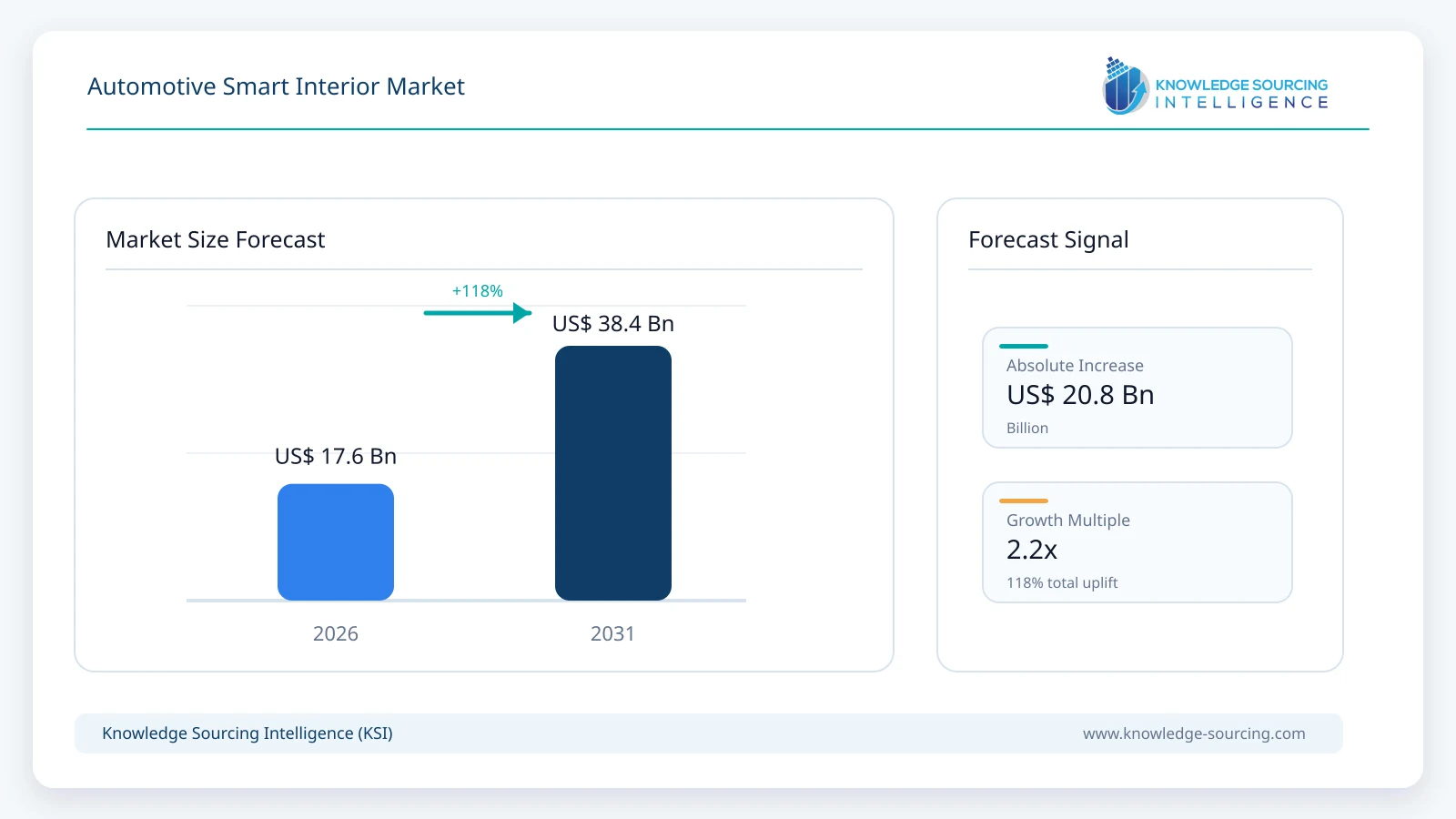
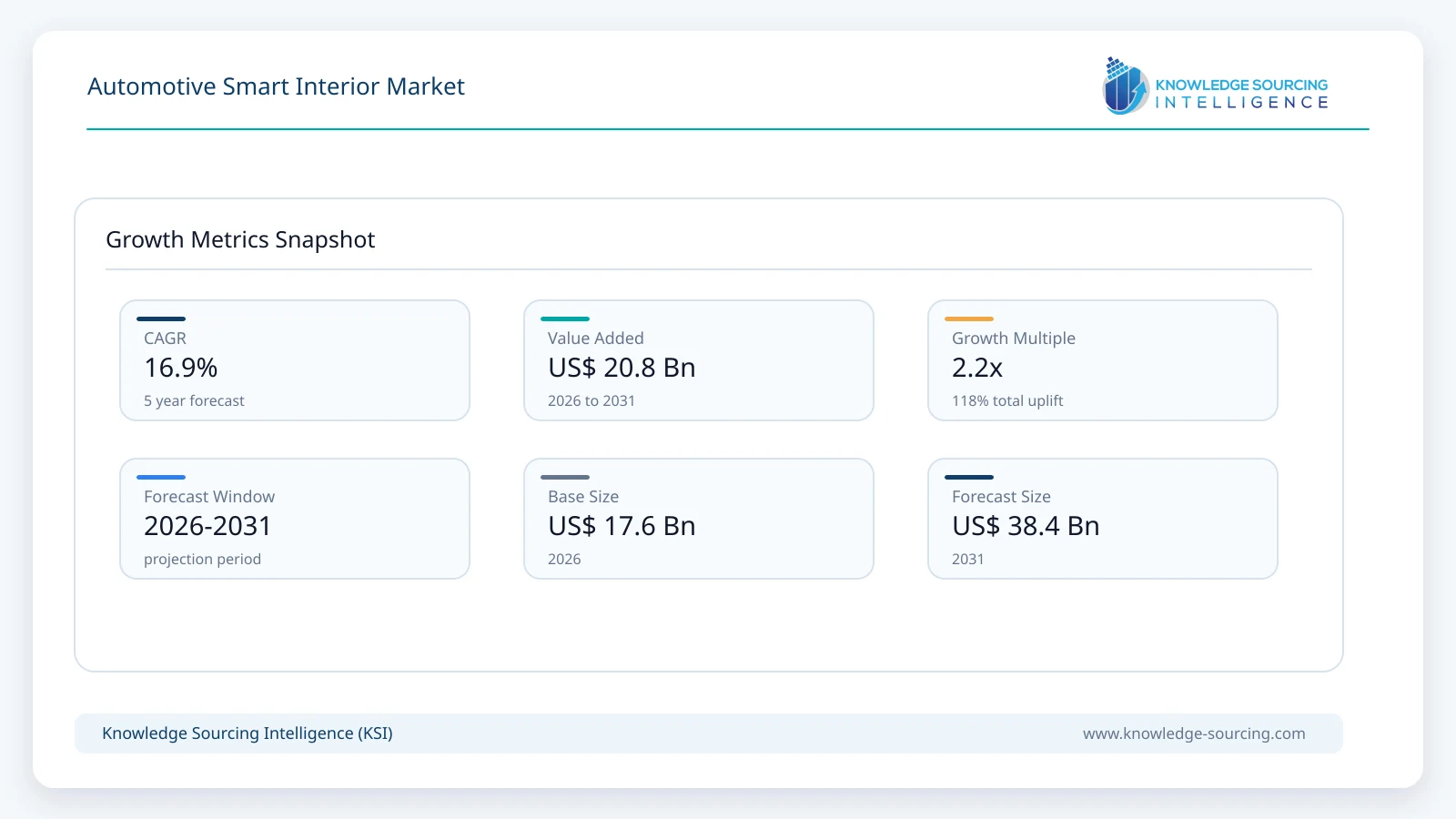
The automotive smart interior market is projected to grow from USD 17.60 billion in 2026 to USD 38.40 billion in 2031, at a CAGR of 16.9% across the forecast period.
Highlights:
- 1Intelligent seating and occupant comfort account for approximately 38% of modeled 2026 market value, supported by powered adjustment, posture response, thermal management and integrated seat intelligence.
- 2Intelligent lighting and interactive illumination represent approximately 33% of 2026 value as networked RGB systems, illuminated trim and functional light communication spread across cabin zones.
- 3Domain-integrated and zonal interior control could rise from approximately 21% of market value in 2026 to 40% by 2031, reflecting consolidation of local electronics and shared occupant data.
- 4Asia Pacific represents an estimated 46% of the 2026 market, supported by Chinese smart-cabin competition and major automotive seating, lighting and interior-systems supply chains.
- 5New interior interfaces increasingly combine sensing, force feedback, optics and decorative materials, raising the importance of integrated manufacturing and vehicle-level qualification.
Demand includes active seating and occupant-comfort assemblies, programmable lighting, electronically responsive trim, touch- and haptic-enabled surfaces and powered adaptive modules. Compared with traditional cabin components, these systems incorporate sensing, control and actuation functions that enhance comfort and interaction while supporting new vehicle-design possibilities.
Yanfeng, Lear, FORVIA, Antolin and Valeo illustrate the range of commercial capabilities involved in smart interior systems, from active comfort mechanisms and seat electronics to embedded surface controls and intelligent illumination. Lear's INTU portfolio addresses occupant comfort, wellness and safety, while Antolin and UltraSense are developing thin control surfaces that combine touch and force detection with haptic feedback. Suppliers increasingly need mechanical, decorative and electronics expertise in the same program because installation quality, cabin safety, durability and serviceability must be validated together.
Smart interior assemblies introduce controlled physical responses into seats, door panels, instrument panels, consoles, overhead structures and other occupant-contact zones. Pressure sensing, electric motors, pneumatic mechanisms and thermal elements can adjust a seat's support and comfort settings; addressable light sources and embedded circuitry add programmable functions to curved decorative panels. The value proposition depends on achieving these functions in production-grade components without compromising surface quality, crash performance or long-term reliability.
Yanfeng's XiM27 drivable concept, presented in June 2026, combines AI-adaptive seats, interactive LUXkin materials, moving cabin furniture and centrally coordinated lighting. The supplier describes the individual innovations as production-ready, but the complete XiM27 concept is not evidence that every system has entered series manufacture. Its relevance is the demonstration of how suppliers can engineer surface, seating and lighting functions to work together under a common vehicle interface.
Valeo's January 2026 award from a premium automaker provides a direct commercialization indicator for smart interior electronics through a high-volume manufacturing program using TactoTek's in-mold structural electronics. Toyota Boshoku's illuminated Lexus ES door trim and Toyoda Gosei's LIN-connected Mazda CX-5 lighting unit demonstrate identified vehicle applications. The different stages of adoption suggest that smart surfaces will enter high-volume vehicles progressively, rather than at the same pace across every product family.
Market Trends
Interior Surfaces Are Becoming Embedded Control Interfaces
Antolin and UltraSense advanced a future-platform Smart Surface HMI initiative in September 2026, integrating touch and force sensing, visual feedback and haptic response within thin interior panels. The approach offers automakers greater styling freedom by reducing exposed switches and openings in consoles, doors and dashboards. Successful production adoption still depends on dependable tactile cues, fault behavior and resistance to incidental activation while a vehicle is moving.
Valeo's awarded TactoTek-based lighting program uses in-mold structural electronics to incorporate electronic and optical functions directly into a formed component. Embedded circuitry can reduce separate housings and help OEM designers use continuous surfaces, but it also connects cosmetic yield to electronic manufacturing quality. Tier 1 suppliers therefore need tighter coordination between mold design, optical distribution, service replacement and validation than is typical for passive trim.
Smart Seating Is Shifting toward Continuous Occupant Response
FORVIA's February 2026 intelligent-seat presentation describes sensing and software that automatically adapt multiple comfort parameters to the occupant's morphology and driving conditions. Lear's INTU technologies and Magna's adaptive-seat development reflect a similar move toward continuous posture and comfort management rather than fixed user-selected positions. Higher revenue per equipped seat comes from the combined sensing, actuation, thermal and embedded-control content, not simply from adding conventional electric adjustment.
Seat-integrated smart functions must operate within the packaging and safety constraints created by seat structures, airbags, belt anchorage and occupant-detection systems. Motors, pneumatic modules and sensors also compete for power, space and service access, making modularity and crash validation central to program economics. Suppliers with established seating engineering and vehicle electronics integration are better placed to translate adaptive functions into production specifications.
Lighting Is Expanding into Functional Interior Communication
Toyoda Gosei's LIN-supported full-color illumination unit, adopted for the new Mazda CX-5, illustrates how cabin lighting increasingly works as a networked electronic function. Beyond appearance, controllable light zones can communicate vehicle status, support occupant identification and provide localized entry or warning cues. Toyota Boshoku's Lexus ES illuminated door trim extends the same development into the structural and decorative surfaces of the cabin, using broad-area light distribution and animated effects.
Interior lighting suppliers face more demanding optical calibration, glare and driver-attention requirements as they add moving effects and event-based signals across multiple materials. Electronics networks may simplify platform variation, but color matching, thermal performance and diagnostic behavior remain difficult when fixtures are embedded in trim. Programmable lighting is expected to carry more value per equipped vehicle than fixed-function lamps, particularly where the same installation supports both personalization and functional communication.
Physical Personalization Is Extending across Cabin Zones
Gentex and Antolin's April 2026 cooperation agreement targets electronically dimmable sun visors for European automakers, allowing a traditionally mechanical overhead component to provide variable glare control. The commercial opportunity extends the use of embedded electronics into touchpoints that historically relied on fixed geometry or manual operation. Automakers will evaluate such products against visibility, homologation, cost, warranty and replacement requirements before committing to large vehicle programs.
Yanfeng's XiM27 combines moving consoles, adaptive seats, variable illumination and zonal comfort into a coordinated physical interior experience. Vehicle-level deployment is likely to remain selective because powered mechanisms, movable interfaces and embedded components increase weight, wiring complexity and qualification demands. The most scalable smart interior designs should reuse common mechanical platforms and standardized electronic interfaces across multiple vehicle variants.
Automotive Smart Interior Market Segment Analysis
By Smart Interior System
Intelligent Seating and Occupant Comfort
Smart seating and occupant comfort form the largest product category in the established model because an equipped seat can include motors, thermal modules, pneumatic support, posture sensors and dedicated controls. Lear, FORVIA and Magna have relevant capabilities spanning active comfort and seat intelligence, while Yanfeng integrates seating with broader interior scenarios. Product differentiation increasingly depends on controlled occupant response and vehicle-grade reliability rather than on the number of manual adjustment directions.
Smart seating and occupant-comfort systems are estimated at USD 6.69 billion in 2026 and USD 13.82 billion in 2031, supported by broader installation in upper-midrange vehicles and additional functionality in premium platforms. The rate of adoption will depend on comfort benefits, restraint-system compatibility, warranty durability and affordability.
By Smart Interior System
Intelligent Lighting and Interactive Illumination
Intelligent lighting and interactive illumination constitute the second-largest product family, integrating addressable electronics, optical guides and illuminated surfaces across door panels, consoles, dashboards and roof areas. Valeo, Toyoda Gosei and Toyota Boshoku show different manufacturing pathways, from IMSE-integrated molded components to networked modules and large-area decorative lighting. Growth increasingly depends on electronics and optical integration rather than conventional fixed illumination.
Intelligent lighting and interactive illumination are modeled at USD 5.81 billion in 2026 and USD 11.33 billion by 2031 as surface coverage, network capability and functional communication increase. Higher penetration of software-addressable systems contributes to value growth, while conventional courtesy and fixed decorative lamps remain outside the qualified portion of this estimate. Optical consistency and vehicle-level electronics validation remain important purchase criteria.
By Control Architecture
Domain-Integrated and Zonal Interior Control
Zonal and domain-integrated architectures coordinate cabin devices through shared networks, vehicle-state messages and higher-level control software rather than keeping every function completely independent. A common occupant profile can influence seat support, lighting behavior and local comfort through one coordinated interaction. Manufacturers can reduce functional fragmentation while retaining specialized embedded controllers where component response or safety requirements demand them.
Domain-integrated and zonal interior control account for an estimated 21% of market value in 2026 and 40% in 2031 as new vehicle architectures support shared device and occupant data. Local controllers will remain necessary within seats, lighting modules and interactive surfaces, but a greater share of cabin functionality will be managed through coordinated electronic systems.
By Propulsion
Battery Electric Vehicles
Battery electric vehicles offer a concentrated market for smart interior products because manufacturers often use differentiated seating, lighting and physical interactions to establish a distinct cabin identity. New-generation electrical architectures can simplify the coordination of multiple devices, although energy consumption and heating loads remain material design considerations.
Battery electric vehicles contribute an estimated 21% of 2026 smart interior value and are expected to reach 36% in 2031, reflecting wider adoption of high-content EV platforms. Hybrid and conventional combustion vehicles remain important sources of volume and premium-feature demand, especially where regional propulsion transitions are slower.
Market Drivers
Premium and Electric-Vehicle Interior Differentiation
Premium and electric-vehicle manufacturers increasingly use electronically adaptive seats, animated illumination and integrated surface controls to differentiate cabins when conventional powertrain features offer limited consumer-facing distinction. The supplier opportunity arises from higher qualified content per equipped vehicle and the potential to offer different functions through shared mechanical platforms. Adoption in cost-sensitive trims will be slower where buyers are less willing to pay for active comfort or decorative electronics.
Adoption of Smart Surfaces and Solid-State HMI
Antolin's smart-surface collaboration with UltraSense and Valeo's IMSE-based lighting award show distinct routes to commercializing electronics within interior trim. Touch, force detection and haptic feedback can reduce separate switch assemblies while allowing the same decorative area to serve several functions. OEM sourcing decisions will depend on input reliability, surface quality, replaceability and the total installed cost relative to conventional controls.
Growth of Occupant-Adaptive Seating
Lear's INTU portfolio, FORVIA's intelligent-seat work and Magna's adaptive-seating development demonstrate sustained supplier investment in sensors, posture adjustment and localized thermal comfort. Higher-value intelligent seating requires a combination of electronic controls, mechanically robust actuators and safe movement logic. Wider adoption should follow where occupants perceive a clear comfort or wellness benefit and where vehicle programs can absorb the additional component cost.
Higher Penetration of Networked Intelligent Lighting
Toyoda Gosei's LIN-controlled Mazda CX-5 lighting unit and Toyota Boshoku's Lexus ES illuminated door trim provide specific vehicle applications for networked and surface-integrated illumination. Control electronics make it possible to coordinate multiple cabin lighting zones and change their function without redesigning every assembly. The principal constraint is maintaining optical consistency, diagnostic reliability and appropriate visual behavior across large cabin surfaces.
Integration with Software-Defined Electrical Architectures
Zonal electrical architectures make it easier for smart seats, interior lighting and adaptive surfaces to exchange occupant-profile and vehicle-state information through shared interfaces. Tier 1 suppliers that engineer electronics alongside mechanical assemblies can support more coordinated passenger experiences while reducing separate wiring and controller requirements.
Market Restraints
Higher Component Cost and Uneven Vehicle-Level Affordability
Sensor-equipped seating, high-resolution lighting elements and haptic control surfaces typically cost more than manual assemblies or fixed-function trim. Vehicle manufacturers may therefore limit full configurations to premium packages or apply lower-content variants in volume vehicles. The economic case improves when a common electronic architecture enables several visible benefits without duplicating controllers, harnesses and mechanical controls.
Functional Safety and Occupant Protection Requirements
Seat movements, adaptive actuators and interior controls installed near airbags and occupant restraints must meet strict mechanical, electrical and safety requirements. Failure behavior becomes particularly important when a function can alter occupant posture or replace a conventional switch used during driving. Validation cost and responsibility can delay adoption, especially when software, trim and restraint systems come from different suppliers.
Durability, Serviceability and Electronic Integration
Smart trim incorporates circuits, sensors, actuators and optical elements in decorative surfaces exposed to abrasion, temperature variation, sunlight, moisture and spills. A cosmetic defect may require replacement of a more expensive electronic assembly, increasing warranty and repair exposure. Long-duration reliability testing must therefore assess material appearance and electronic performance together rather than as independent subsystems.
Driver Distraction and Haptic Usability
Solid-state touch and force interfaces can offer a cleaner cabin appearance but may provide less tactile guidance than mechanical switches when roads are uneven or the driver is distracted. Haptic confirmation, deliberate activation forces and clear functional grouping are required to reduce unintended input. Human-factors testing can restrict the substitution of touch surfaces for safety-relevant physical controls even when the electronics work as designed.
Fragmented OEM Architectures and Qualification Cycles
Automotive interior suppliers must accommodate different OEM network protocols, body-control architectures, crash packages and styling requirements across vehicle platforms. Qualification cycles and dedicated tooling commonly separate a technology demonstration from a high-volume sourcing decision. Development agreements and production-ready concepts consequently provide evidence of technical progress, not proof of current series-production revenue.
Regional Outlook
Asia Pacific
Asia Pacific represents approximately 46% of smart interior revenue in 2026, supported by extensive automotive production and deep regional supply chains for seating, lighting, plastics and electronics. OICA reports approximately 59.2 million vehicles manufactured in Asia Pacific in 2025, while Chinese manufacturers continue to develop increasingly feature-rich cabins across electric and premium vehicles.
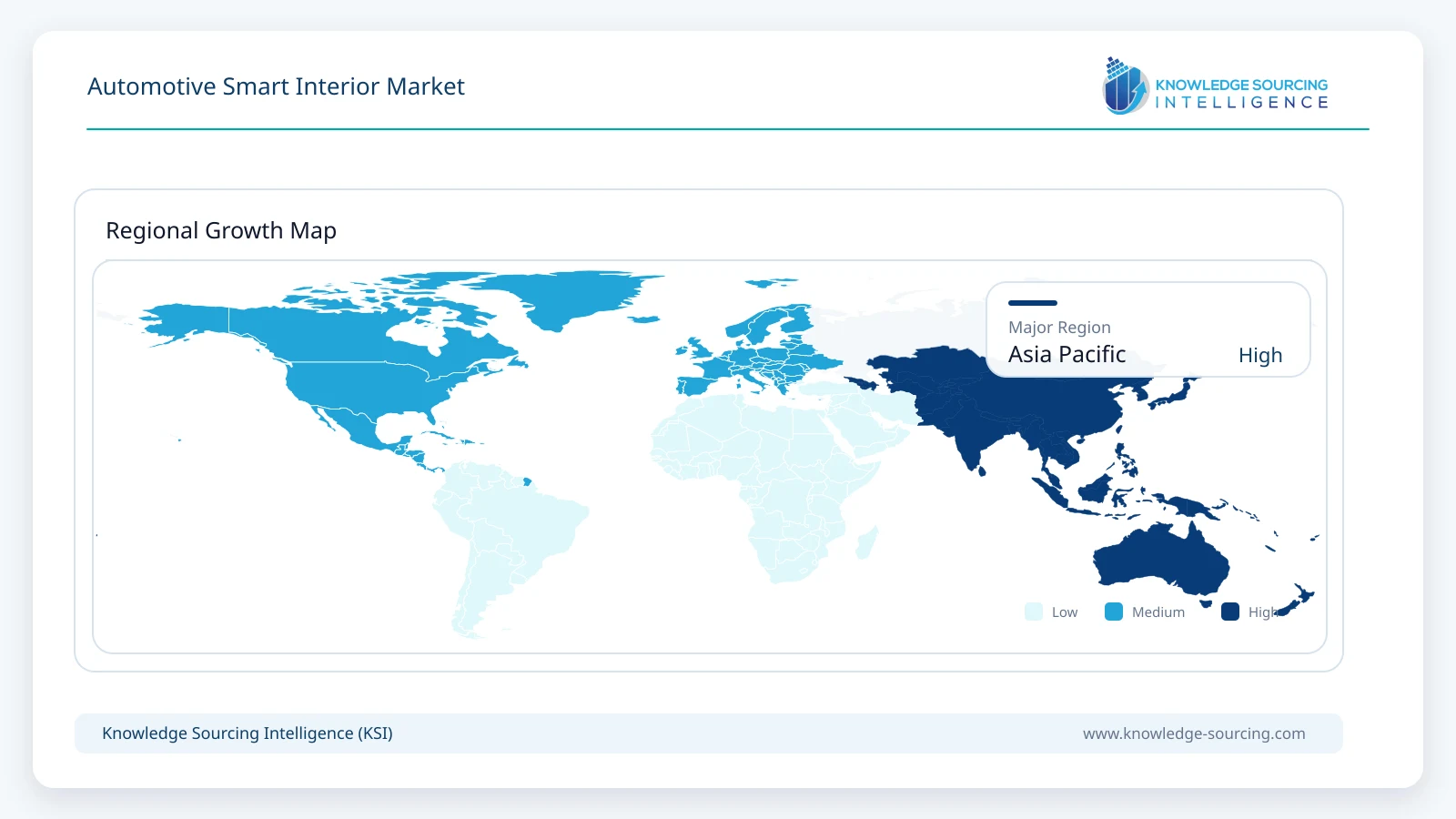
Yanfeng's XiM27, Toyoda Gosei's new Mazda lighting unit and Toyota Boshoku's illuminated Lexus ES door panel demonstrate Asia Pacific supplier activity at different commercialization stages. Japan provides proven production applications, while China's rapid interior technology programs offer a path for faster feature expansion and higher content densities. The region is modeled at USD 19.20 billion by 2031 as active seat, surface and lighting functions spread across additional vehicle platforms.
Europe
European OEMs support high-value smart interior demand through premium seating, refined surface materials, electronically controlled overhead components and integrated lighting applications. FORVIA, Antolin, Valeo and related suppliers bring strong product engineering and regional manufacturing capabilities to these applications. Regulatory, human-factors and validation requirements influence product design, while premium fitment levels can support higher qualified supplier revenue per vehicle than in lower-cost market segments.
Antolin's work with UltraSense on solid-state controls and Gentex on electronically dimmable visors illustrates how European interior programs combine traditional trim engineering with enabling electronics. Commercialization depends on program nominations, robust fault behavior, manufacturing yields and compliance with vehicle-specific requirements. The established forecast places Europe's smart interior market at USD 9.22 billion in 2031, with growth driven more by feature intensity than by overall vehicle production.
Competitive Landscape
Smart interior competition spans full-service interior-system suppliers, intelligent-seating manufacturers, vehicle-lighting specialists and developers of embedded-interface technologies. Yanfeng and Antolin combine large-scale decorative assemblies with system integration, while Lear, FORVIA and Magna supply active seating and occupant-comfort technologies. Valeo and Toyoda Gosei strengthen competition in intelligent light modules and surface electronics, with participation shaped by individual OEM programs rather than a single homogeneous supplier category.
TactoTek's IMSE intellectual property and UltraSense's touch-and-force interface architecture illustrate the importance of enabling technologies that Tier 1 suppliers can integrate into molded surfaces. Gentex contributes electrochromic control of overhead components, Toyota Boshoku provides vehicle-adopted illuminated trim and Gentherm supplies localized thermal technologies. Competition is increasingly determined by electronic integration, interior finish, qualification expertise, regional production and the ability to convert awarded programs into repeatable supplier revenue.
Recent Developments
September 2026: Antolin and UltraSense advanced a smart-surface HMI development initiative for a future global vehicle platform, combining touch and force sensing with haptic and visual feedback. The announcement describes a development program rather than verified vehicle production.
June 2026: Yanfeng unveiled XiM27, a production-ready drivable smart-cabin concept integrating AI-adaptive seating, interactive smart materials and coordinated interior controls. The demonstration establishes technical readiness but not completed mass production of the full concept.
June 2026: Toyota Boshoku announced that its new large-area illuminated door trim was adopted for the Lexus ES, using surface-transmission technology for animated cabin effects and linking smart trim development to a vehicle application.
May 2026: Toyoda Gosei announced use of its LIN-supported full-color interior illumination unit on the new Mazda CX-5, supporting networked color control with flexible vehicle installation.
April 2026: Gentex and Antolin signed a cooperation agreement to bring next-generation dimmable sun visors to the European automotive market, combining electrochromic technology with interior-module integration.
January 2026: Valeo announced a premium-automaker program award for an integrated interior lighting structure using TactoTek IMSE technology and a high-volume manufacturing approach; the award is distinct from completed series-production shipments.
Market Outlook
Smart interior demand through 2031 will be led by higher electronic content in seating, networked lighting and tactile or responsive cabin surfaces. The market is projected to reach USD 38.40 billion in 2031, with intelligent seating retaining the largest system value and smart surface controls increasing their relative contribution. Automakers are expected to favor functions that can be deployed across several models without excessive additional wiring, weight or service complexity.
Asia Pacific is projected to retain the largest regional market position, while European OEM programs remain important for premium features, sensor-integrated surfaces and refined active comfort. Commercial growth will depend on whether suppliers can manufacture attractive, durable and repairable assemblies while controlling semiconductor, actuator and software-integration costs. Companies that link proven product functionality to scalable manufacturing and long-term service quality should be better positioned as smart interior content moves into higher-volume vehicle programs.
Automotive Smart Interior Market Scope:
| Report Metric | Details |
|---|---|
| Total Market Size in 2026 | USD 17.60 billion |
| Total Market Size in 2031 | USD 38.40 billion |
| Forecast Unit | USD Billion |
| Growth Rate | 16.9% |
| Study Period | 2021 to 2031 |
| Historical Data | 2021 to 2024 |
| Base Year | 2025 |
| Forecast Period | 2026 – 2031 |
| Segmentation | Smart Interior System, Primary Function, Control Architecture, Cabin Zone, Interaction and Response Mode, Vehicle Type, Propulsion, Geography |
| Companies |
|
Market Segmentation
By Smart Interior System
Intelligent Seating and Occupant Comfort
Intelligent Lighting and Interactive Illumination
Smart Surfaces and Embedded HMI
Responsive Consoles and Reconfigurable Modules
Active Overhead, Glazing and Other Intelligent Trim
By Primary Function
Adaptive Comfort and Wellness
Touch, Haptic and Surface HMI
Ambience and Personalization
Safety and Contextual Interaction
By Control Architecture
Locally Controlled Intelligent Modules
Networked Distributed Interior Systems
Domain-Integrated and Zonal Interior Control
By Cabin Zone
Seats and Seat-Adjacent Areas
Door Panels and Side Trim
Instrument Panel and Dashboard
Center Console and Floor Modules
Roof, Headliner and Overhead
By Interaction and Response Mode
User-Selectable and Profile-Based
Context-Responsive and Event-Driven
Autonomous Adaptive and Occupant-Aware
Basic Electronically Assisted
By Vehicle Type
Passenger Vehicles
Light Commercial Vehicles
Medium and Heavy Commercial Vehicles and Buses
By Propulsion
ICE and Mild-Hybrid Vehicles
Hybrid and Plug-In Hybrid Vehicles
Battery Electric Vehicles
By Geography
North America
United States
Canada
Mexico
South America
Brazil
Argentina
Others
Europe
Germany
United Kingdom
France
Italy
Spain
Others
Middle East and Africa
Saudi Arabia
UAE
South Africa
Others
Asia Pacific
China
Japan
South Korea
India
Indonesia
Thailand
Others
Table of Contents
1. INTRODUCTION
1.1. Market Overview
1.2. Market Definition
1.3. Scope of the Study
1.4. Market Segmentation
1.5. Currency
1.6. Assumptions
1.7. Base and Forecast Years
1.8. Key Benefits to Stakeholders
2. RESEARCH METHODOLOGY
2.1. Research Design
2.2. Secondary Research
2.3. Primary Research
2.4. Market Estimation
2.5. Segment Modelling
2.6. Data Triangulation and Validation
3. EXECUTIVE SUMMARY
3.1. Key Findings
3.2. Automotive Smart Interior Market Size, 2026–2031
3.3. Smart Interior System Outlook
3.4. Primary Function Outlook
3.5. Control Architecture Outlook
3.6. Cabin Zone Outlook
3.7. Interaction and Response Mode Outlook
3.8. Vehicle Type Outlook
3.9. Propulsion Outlook
3.10. Regional Opportunity Summary
4. MARKET DYNAMICS
4.1. Market Drivers
4.1.1. Premium and Electric-Vehicle Interior Differentiation
4.1.2. Adoption of Smart Surfaces and Solid-State HMI
4.1.3. Growth of Occupant-Adaptive Seating
4.1.4. Higher Penetration of Networked Intelligent Lighting
4.1.5. Integration with Software-Defined Electrical Architectures
4.2. Market Restraints
4.2.1. Higher Component Cost and Uneven Vehicle-Level Affordability
4.2.2. Functional Safety and Occupant Protection Requirements
4.2.3. Durability, Serviceability and Electronic Integration
4.2.4. Driver Distraction and Haptic Usability
4.2.5. Fragmented OEM Architectures and Qualification Cycles
4.3. Market Opportunities
4.4. Porter’s Five Forces Analysis
4.5. Industry Value Chain Analysis
4.6. Policies and Regulations
4.7. Strategic Recommendations
5. TECHNOLOGY OUTLOOK
5.1. Embedded Touch and Force-Sensing Surfaces
5.2. Haptic and Shy-Tech HMI
5.3. Intelligent Seating and Comfort Actuators
5.4. Networked Interior Lighting
5.5. In-Mold Structural Electronics
5.6. Dimmable Glass and Active Overhead Components
5.7. Local, Zonal and Domain-Integrated Control
5.8. Functional Safety and Interior Electronics Validation
6. AUTOMOTIVE SMART INTERIOR MARKET BY SMART INTERIOR SYSTEM
6.1. Introduction
6.2. Intelligent Seating and Occupant Comfort
6.3. Intelligent Lighting and Interactive Illumination
6.4. Smart Surfaces and Embedded HMI
6.5. Responsive Consoles and Reconfigurable Modules
6.6. Active Overhead, Glazing and Other Intelligent Trim
7. AUTOMOTIVE SMART INTERIOR MARKET BY PRIMARY FUNCTION
7.1. Introduction
7.2. Adaptive Comfort and Wellness
7.3. Touch, Haptic and Surface HMI
7.4. Ambience and Personalization
7.5. Safety and Contextual Interaction
8. AUTOMOTIVE SMART INTERIOR MARKET BY CONTROL ARCHITECTURE
8.1. Introduction
8.2. Locally Controlled Intelligent Modules
8.3. Networked Distributed Interior Systems
8.4. Domain-Integrated and Zonal Interior Control
9. AUTOMOTIVE SMART INTERIOR MARKET BY CABIN ZONE
9.1. Introduction
9.2. Seats and Seat-Adjacent Areas
9.3. Door Panels and Side Trim
9.4. Instrument Panel and Dashboard
9.5. Center Console and Floor Modules
9.6. Roof, Headliner and Overhead
10. AUTOMOTIVE SMART INTERIOR MARKET BY INTERACTION AND RESPONSE MODE
10.1. Introduction
10.2. User-Selectable and Profile-Based
10.3. Context-Responsive and Event-Driven
10.4. Autonomous Adaptive and Occupant-Aware
10.5. Basic Electronically Assisted
11. AUTOMOTIVE SMART INTERIOR MARKET BY VEHICLE TYPE
11.1. Introduction
11.2. Passenger Vehicles
11.3. Light Commercial Vehicles
11.4. Medium and Heavy Commercial Vehicles and Buses
12. AUTOMOTIVE SMART INTERIOR MARKET BY PROPULSION
12.1. Introduction
12.2. ICE and Mild-Hybrid Vehicles
12.3. Hybrid and Plug-In Hybrid Vehicles
12.4. Battery Electric Vehicles
13. AUTOMOTIVE SMART INTERIOR MARKET BY GEOGRAPHY
13.1. North America
13.1.1. United States
13.1.2. Canada
13.1.3. Mexico
13.2. South America
13.2.1. Brazil
13.2.2. Argentina
13.2.3. Others
13.3. Europe
13.3.1. Germany
13.3.2. United Kingdom
13.3.3. France
13.3.4. Italy
13.3.5. Spain
13.3.6. Others
13.4. Middle East and Africa
13.4.1. Saudi Arabia
13.4.2. UAE
13.4.3. South Africa
13.4.4. Others
13.5. Asia Pacific
13.5.1. China
13.5.2. Japan
13.5.3. South Korea
13.5.4. India
13.5.5. Indonesia
13.5.6. Thailand
13.5.7. Others
14. COMPETITIVE ENVIRONMENT AND ANALYSIS
14.1. Major Players and Strategy Analysis
14.2. Market Share Analysis
14.3. Mergers, Acquisitions, Agreements and Collaborations
14.4. Smart Surface and Intelligent Seating Benchmarking
14.5. Commercial Program Developments
14.6. Competitive Dashboard
15. COMPANY PROFILES
15.1. Yanfeng Automotive Interiors
15.2. FORVIA
15.3. Antolin
15.4. Valeo
15.5. Lear Corporation
15.6. Magna International Inc.
15.7. Toyota Boshoku Corporation
15.8. Toyoda Gosei Co., Ltd.
15.9. Gentex Corporation
15.10. TactoTek Oy
15.11. UltraSense Systems, Inc.
15.12. Gentherm Incorporated
16. APPENDIX
16.1. Currency
16.2. Assumptions
16.3. Base and Forecast Years Timeline
16.4. Key Benefits for Stakeholders
16.5. Research Methodology
16.6. Abbreviations
16.7. Data Sources
Navigate
Trusted by the world's leading organizations











