
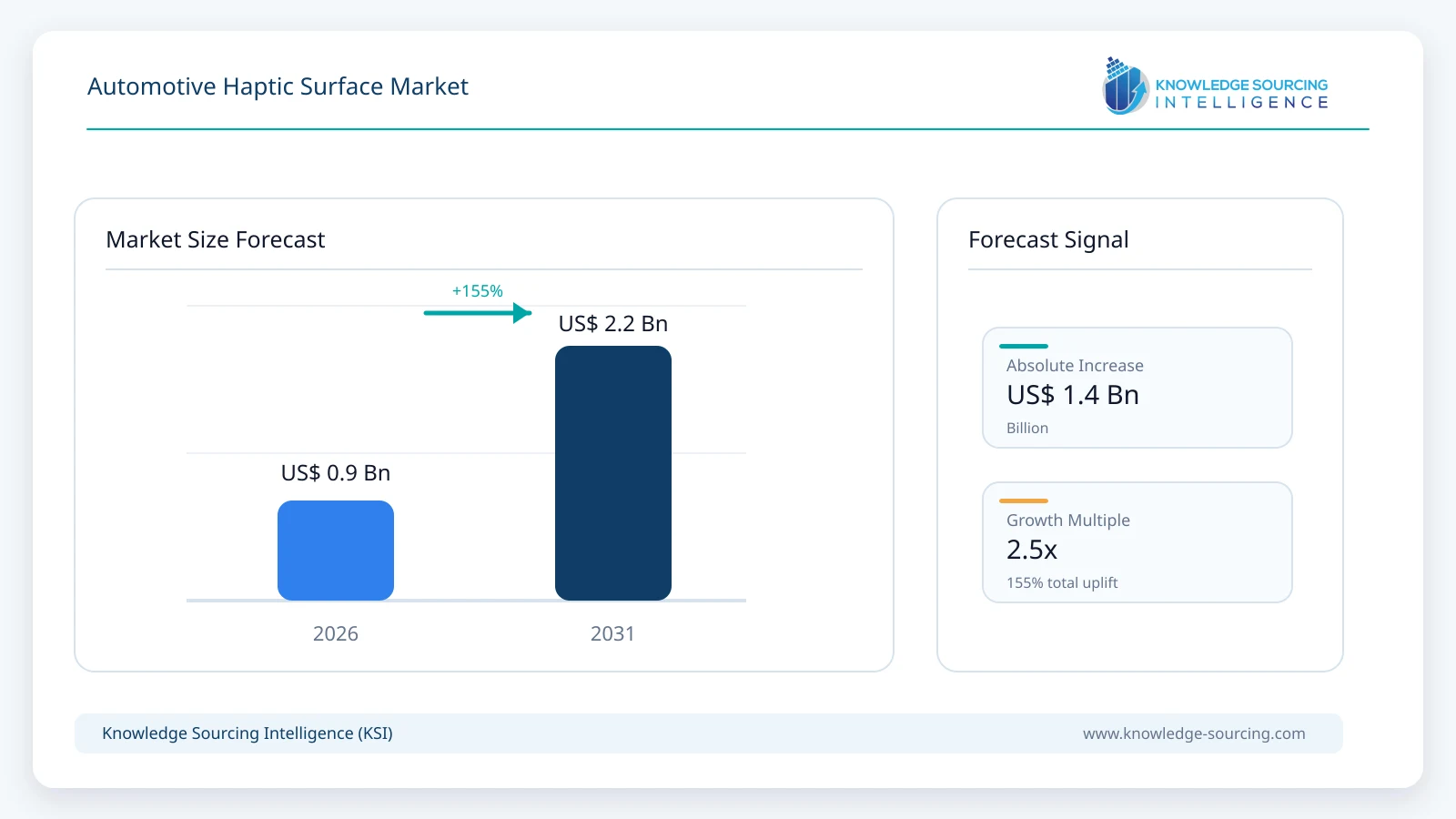
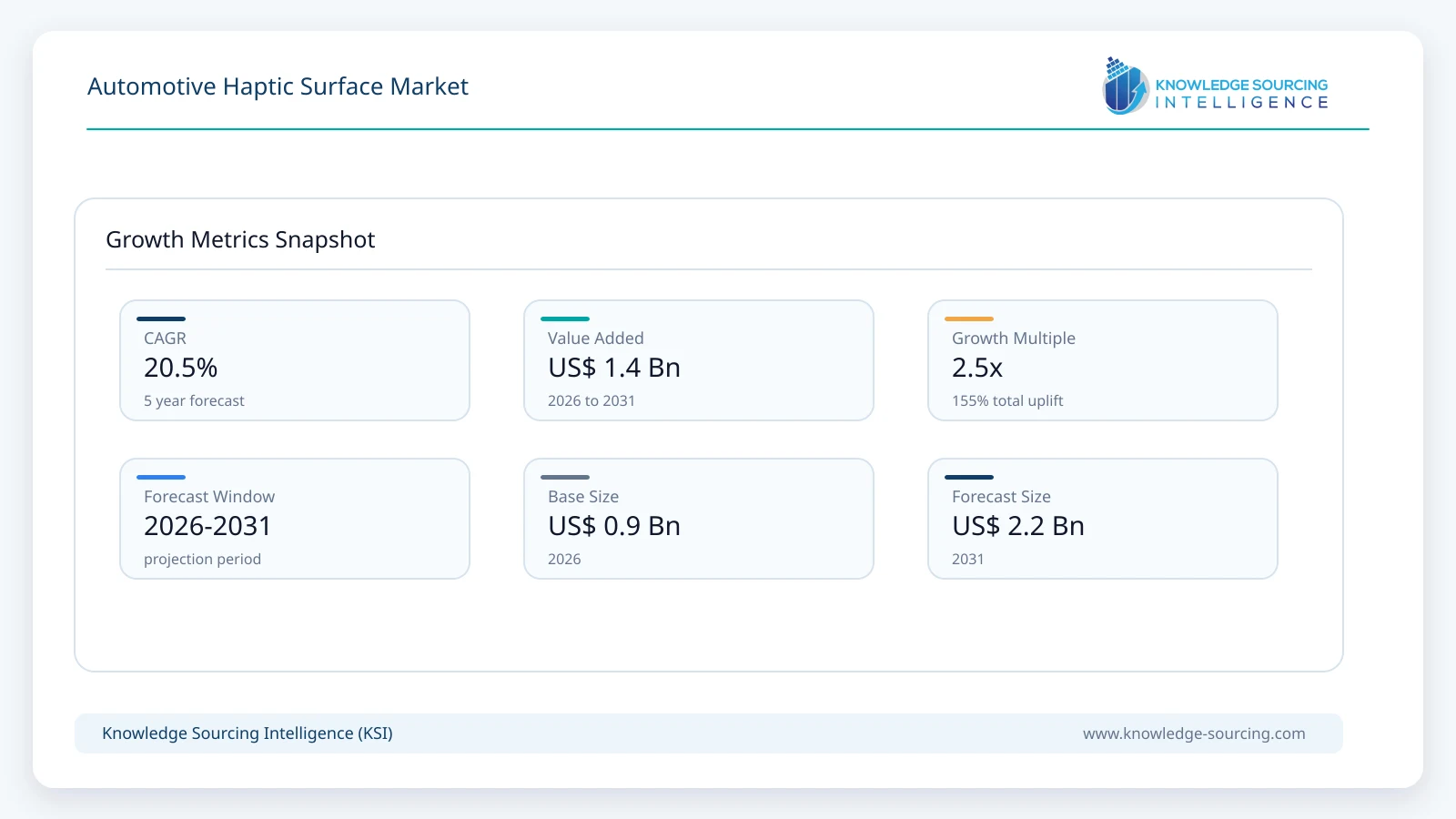
The Automotive Haptic Surface Market is forecast to grow at a CAGR of 20.5%, reaching USD 2.24 billion in 2031 from USD 0.88 billion in 2026.
Highlights:
- 1Center-console and center-stack trim represents an estimated 34% of 2026 haptic surface revenue because these surfaces absorb climate and infotainment controls formerly managed by mechanical switches.
- 2Electromechanical actuators retain an estimated 50% share in 2026 owing to proven vibration output and design familiarity, while piezoelectric solutions gain share in slimmer and more localized surface systems.
- 3Passenger vehicles contribute approximately 95% of 2026 value, with premium and upper-mid-range models representing the leading commercial adoption base.
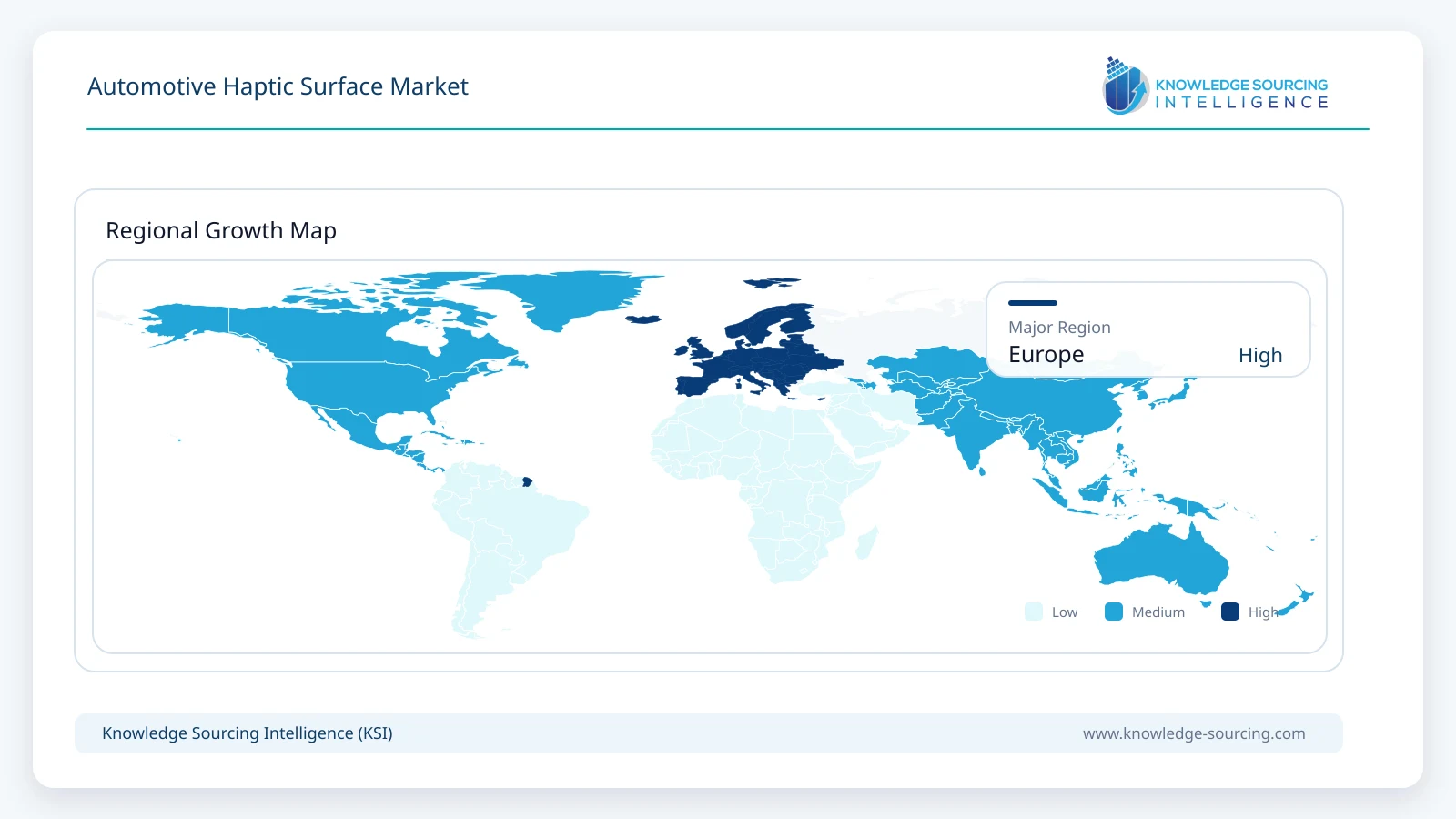
- 4Europe accounts for an estimated 37% of 2026 revenue, supported by high-content vehicle programs and established interior HMI suppliers.
- 5Asia Pacific is projected to account for 38% of global market value by 2031 as Chinese and Korean electronic-interior supply chains support deployment of integrated haptic controls.
- 6Confirmed production of NIO's haptic touch bar and Mobase's solid-state infotainment bar provides stronger evidence of commercialization than prototype-only smart-surface announcements.
Haptic feedback is being engineered into center consoles, door trim, dashboard faceplates and other surfaces housing electronically controlled cabin functions. Suppliers combine sensing, actuation and calibrated response software to provide tactile confirmation while allowing automakers to maintain uninterrupted decorative finishes.
Automakers are adding touch and force sensing to seamless console, dashboard and door surfaces, but occupants still need reliable feedback that an intended action has registered. Valeo supplies control faceplates with configurable mechatronic haptics, while Preh offers actuator-based feedback for smart surfaces and central controls. The commercial requirement is to deliver a repeatable tactile event through different surface carriers without adding switch gaps or excessive actuator hardware.
Market Overview
Haptic interior surfaces create an electronically generated tactile event when occupants press, slide or interact with a concealed control zone. The haptic element may be placed behind a rigid polymer faceplate, laminated glass, a decorative composite or a trim carrier that also contains sensing electronics. Actuators and associated drivers must compensate for surface mass, mounting stiffness and adjacent-component resonance so a single command produces a distinct response rather than an indistinct vibration across the cabin.
Preh's central-control portfolio offers active tactile feedback for touchscreens, touchpads and smart surfaces, and Valeo's faceplates combine capacitive control with configurable mechatronic actuation. Alps Alpine's compact Haptic Reactor range supports constrained automotive control packaging, while TDK Electronics supplies piezoelectric PowerHap actuators for buttons, modules and displays. These competing solutions show that suppliers differentiate through response fidelity, mechanical integration and driver electronics rather than relying on a single standardized actuator format.
Market Trends
Force-Sensing Interfaces Are Entering Series Production
Mobase Electronics and UltraSense reported in October 2025 that a solid-state infotainment touch bar was shipping on a high-volume global SUV platform, combining piezoelectric force sensing, capacitive input, and localized haptic confirmation. The force threshold helps distinguish a deliberate press from incidental contact, while tactile feedback confirms activation without requiring a conventional mechanical button. Integration into a production program gives this design approach greater commercial credibility than a laboratory demonstration.
Boréas Technologies disclosed a separate application in the NIO ET9 center-console TUI Bar in April 2025. Its piezo-based haptic module gives the flat control zone discrete tactile responses matched to the selected function. Vehicle-level evidence indicates that localized actuator technology can be incorporated into a premium interior package where interface appearance and tactile behavior are both part of the product specification.
Piezoelectric Actuation Is Gaining Share in Thin Controls
Piezoelectric actuators can produce a comparatively sharp, fast response in slim packages, making them suitable for surface zones that cannot accommodate conventional mechanical travel. TDK's PowerHap portfolio includes production-status devices for buttons and automotive modules, while Boréas applies piezoelectric actuation to a customer vehicle's center-console touch bar. Such applications support growth in compact modules that combine drivers, actuators and calibrated feedback patterns.
Hidden Controls Are Moving into Decorative Trim
Antolin and UltraSense announced a September 2026 smart-surface development initiative for a future global vehicle platform that combines touch and force sensing with visual and haptic response in a thin solid-state control arrangement. Interior zones identified for these solutions include instrument panels, center consoles, door controls and overhead systems. Development work of this kind broadens the locations in which traditional switchpacks may eventually be replaced by functional trim.
UltraSense's collaboration with Mankiewicz also connects sensing and haptic-ready electronics with hidden-until-lit coatings used in interior design. Aesthetic integration becomes more valuable when manufacturers can retain a consistent decorative finish across inactive and active control zones. Engineering validation remains essential because coating thickness, surface stiffness, and electronic calibration can all affect perceived feedback quality.
Segment Analysis
By Surface Integration Location: Center Console and Center Stack Trim
Center-console and center-stack trim accounts for approximately 34% of haptic surface revenue in 2026 because these locations bring together frequently used climate, media, and vehicle-setting controls. A shared flat control panel can incorporate multiple sensing zones and feedback events without the cutouts required for separate mechanical switches. Valeo's modular faceplate offering and the Mobase infotainment touch-bar production application illustrate the concentration of haptic engineering in this zone.
Console and center-stack surfaces are projected to retain the largest absolute revenue contribution in 2031 even as door and armrest installations gain share. Cost reduction will come from reuse of actuator drivers and standardized calibration workflows, whereas high-end vehicles will continue to demand more localized feedback and decorative-material flexibility.
By Haptic Technology: Electromechanical Actuators
Electromechanical systems account for an estimated 50% of 2026 haptic surface value because compact linear actuators, solenoids and related devices can generate familiar click-like responses across rigid interior panels. Preh's active-haptics offering and Valeo's configurable faceplate actuators demonstrate established integration routes for automotive HMI suppliers. Their commercial strength lies in mature control electronics and established qualification practices.
Piezoelectric systems should take a growing share through 2031 as thin panels and localized response demand compact transducers. The expected shift does not require the disappearance of electromechanical modules: large panels and comparatively economical controls will still favor proven actuator architectures, while more demanding zonal feedback can justify piezoelectric or hybrid designs.
By Haptic Feedback Function: Press and Selection Confirmation
Press and selection confirmation represents approximately 57% of 2026 market revenue because the primary function of a haptic surface is to tell occupants that a command has registered. Digital climate controls and infotainment touch bars gain an immediate usability benefit from an unmistakable localized click or pulse linked to an intended press.
By Commercial Supply Format: Integrated Haptic Smart-Surface Assemblies
Integrated haptic smart-surface assemblies represent approximately 49% of 2026 market value because automakers typically specify validated control panels rather than purchase isolated actuators. Antolin and Mobase illustrate tier-one arrangements that combine sensing, electronic feedback, and physical integration in modules supplied to vehicle manufacturers. Their production responsibilities extend to tactile consistency, acoustic behavior, and repeatable manufacturing quality.
By Vehicle Class: Premium and Upper-Mid-Range Vehicles
Premium and upper-mid-range vehicles account for approximately 55% of 2026 market revenue because these models can absorb the added electronics, actuator calibration and surface-finish costs associated with tactile interfaces. NIO's ET9 application provides a clear example of a premium program using a dedicated haptic touch bar as part of its cabin user experience.
Market Drivers
Integration of Climate and Infotainment Controls into Seamless Panels
Climate, media and passenger-adjustment functions increasingly share electronically configurable control panels with fewer visible switches. On a rigid flat panel, however, conventional capacitive sensing offers little assurance that a command was registered. Localized haptic feedback addresses that deficiency and allows multiple functions to coexist within one decorative surface without requiring separate mechanical mechanisms.
Valeo's configurable faceplates and Mobase's production infotainment touch bar indicate how the functionality can be integrated into repeatable OEM hardware. Every additional qualified control zone creates demand for response tuning, driver electronics and actuator placement, rather than only a larger decorative substrate.
Vehicle Programs Are Demonstrating Commercial Haptic Applications
Boréas' installation in the NIO ET9 and Mobase's announced production ramp establish vehicle-program evidence for haptic surface controls, reducing the uncertainty associated with prototype-only products. UltraSense also disclosed more than three million cumulative shipments of its automotive HMI controller by January 2026, demonstrating controller manufacturing scale even though those shipments cannot be treated as a direct count of haptic surface installations.
Thin Piezoelectric Actuators Support Constrained Interior Packaging
Door armrests, console veneers and narrow dashboard controls offer limited mounting depth for tactile actuators. Compact piezoelectric devices from TDK and Boréas can deliver distinct feedback without the mechanical travel associated with a traditional pushbutton, enabling additional interaction zones within existing interior packaging envelopes.
The resulting demand extends beyond the transducer itself to high-voltage drive circuitry, force-sensing electronics, isolation structures and software calibration. Suppliers offering validated modules can capture integration value while avoiding excessive actuator proliferation across each panel.
Programmable Feedback Supports Platform-Level Design Reuse
Vehicle platforms increasingly share interior electronics while differentiating user experience through software configuration, trim design and feature packaging. Programmable actuator drive profiles allow one physical control surface to generate distinct clicks, slider steps or warning cues for different functions without changing the entire panel assembly.
Electronics Integration Creates New Opportunities for Trim Suppliers
Antolin's work with UltraSense combines interior engineering and industrialization with semiconductors, sensing firmware and haptic feedback. The partnership reflects a change in supplier responsibility as a decorative trim part becomes an electronic HMI assembly requiring qualification across both material and control-system parameters.
Market Restraints
Material Stiffness Can Distort Localized Feedback
Haptic response depends on the mechanical behavior of the surface that carries the actuator. A driver waveform that produces a precise click through rigid plastic can generate a weaker or noisier response through thicker decorative layers, curved glass or composite finishes, while mounting structures can transmit vibration into nearby control zones.
Actuators and Driver Electronics Add Cost to Trim Programs
An electronically actuated surface requires a transducer, power and signal electronics, fastening or bonding provisions and software validation. A simple mechanical switch may cost less in production when a function does not need reconfiguration or a concealed appearance, creating a direct cost challenge in economy vehicles.
User Acceptance Is Sensitive to Control Discoverability
Haptic confirmation occurs after a user interacts with a control, but it cannot guarantee that the intended control location is easy to find. Completely smooth surfaces with moving or hidden zones may require drivers to look away from the road before contact, particularly when a function changes with screen context.
Durability Qualification Slows Industrialization
Haptic trim must retain tactile consistency during years of cabin heating, cooling, vibration, material aging and repeated contact. Adhesives, actuator suspension, and decorative coatings can change mechanical properties over time, altering output even when controller electronics remain functional.
Multi-Supplier Integration Complicates Responsibility and Warranty
A finished haptic surface may combine material from a trim supplier, semiconductors from a sensing specialist, actuators from a component manufacturer, and feedback logic from a software provider. Incorrect force thresholds, audible vibration or inconsistent response can involve several parties, creating difficult root-cause analysis during OEM validation.
Regional Outlook
Europe
Europe represents approximately 37% of global automotive haptic surface revenue in 2026, reflecting the concentration of premium vehicle programs and established interface-engineering suppliers. Valeo, Preh and Antolin are active in surface controls, central HMI and interior integration, while AUMOVIO carries forward the automotive electronics business separated from Continental in September 2025. The region's supplier base supports coordinated development of decorative panels, sensors, actuators and software rather than standalone haptic components.
European growth will depend on qualifying new control zones without undermining the accessibility of essential driving functions. Euro NCAP's October 2026 communication highlighted the importance of direct physical inputs for primary controls, encouraging OEMs to distinguish safety-related switches from configurable comfort interfaces. Haptic surfaces remain commercially relevant where fixed interaction positions and clear feedback can be demonstrated without adding driver distraction.
Asia Pacific
Asia Pacific is expected to provide the fastest growth in haptic surface revenue as its large vehicle-production base is combined with increasingly sophisticated cabin electronics. The NIO ET9 uses Boréas haptics in a Chinese premium vehicle program, while South Korea's Mobase Electronics reported a high-volume SUV touch-bar application with UltraSense. Such examples show that regional adoption is not restricted to European premium brands.
Chinese and Korean electronics suppliers are positioned to scale control modules when haptic drivers, sensing chips and surface integration can be produced on shared manufacturing platforms. India and Southeast Asia contribute additional vehicle-volume opportunities over the forecast period, although cost-sensitive programs are likely to adopt simpler feedback zones before more elaborate textural effects. The region is expected to take a larger share of global revenue by 2031 as more vehicle programs integrate tactile controls beyond the premium segment.
Competitive Landscape
Valeo and Preh compete as integrated automotive HMI suppliers with experience designing control faceplates and active tactile responses. Antolin and Mobase focus on converting sensing and haptic electronics into complete vehicle-interior control assemblies, while UltraSense provides controller hardware, firmware and integration technology to tier-one partners. These differing commercial positions determine which supplier owns the finished surface and which sells constituent electronics or intellectual property.
Boréas Technologies and TDK Electronics contribute piezoelectric actuator and driver technology, while Alps Alpine supplies compact haptic reactors suited to constrained automotive controls. Immersion licenses haptic designs and related know-how, giving integrators access to feedback patterns, algorithms and technical assistance without manufacturing a full trim assembly. HARMAN and AUMOVIO participate through advanced HMI electronics and control architectures that may integrate tactile interfaces into wider cockpit packages.
Recent Developments
8 September 2026: Antolin and UltraSense announced a future-vehicle-platform smart-surface development project combining touch, force sensing and haptic feedback. The announcement is a development milestone rather than evidence of production for that platform.
5 January 2026: UltraSense reported cumulative shipments exceeding three million AEC-Q100 automotive HMI controllers, confirming semiconductor manufacturing scale but not three million haptic surface assemblies.
27 October 2025: Mobase Electronics and UltraSense reported a shipping solid-state infotainment touch bar on a high-volume SUV platform using in-plane piezo force sensing and localized haptics.
27 August 2025: UltraSense and Mankiewicz disclosed a smart-surface collaboration combining hidden-until-lit coatings with sensor and haptic-capable interface electronics. This was a technology partnership, not a disclosed production start.
15 April 2025: Boréas Technologies confirmed use of its haptic module in the NIO ET9 center-console TUI Bar, providing a named vehicle-program deployment example.
16 January 2025: Alps Alpine announced its compact U-Type Haptic Reactor for automotive control packaging, with component mass production having begun in November 2024.
Market Outlook
Center-console and door-mounted haptic surfaces will account for most of the additional revenue through 2031 as automakers consolidate secondary controls into decorative electronic panels. Console modules provide the largest current revenue pool, while door and armrest applications gain share as touch and force sensing becomes more practical through curved or textured materials. Piezoelectric actuation is expected to increase its share where slim packaging and highly defined tactile response justify added driver-electronics complexity.
Europe should remain an important high-value development base, supported by established HMI suppliers and premium OEM requirements. Asia Pacific is projected to take the lead in regional revenue by 2031 as Chinese and Korean OEM programs expand qualifying volume. The most reliable adoption path is through standardized, automotive-qualified assemblies with confirmed installation records rather than through a broad assumption that every illuminated or touch-sensitive panel also contains active haptics.
Automotive Haptic Surface Market Scope:
| Report Metric | Details |
|---|---|
| Total Market Size in 2026 | USD 0.88 billion |
| Total Market Size in 2031 | USD 2.24 billion |
| Forecast Unit | USD Billion |
| Growth Rate | 20.5% |
| Study Period | 2021 to 2031 |
| Historical Data | 2021 to 2024 |
| Base Year | 2025 |
| Forecast Period | 2026 – 2031 |
| Segmentation | Surface Integration Location, Haptic Technology, Haptic Feedback Function, Surface Material Platform |
| Companies |
|
Market Segmentation
By Surface Integration Location
Center Console and Center Stack Trim
Door Panels and Armrests
Dashboard and Display-Adjacent Trim
Overhead and Seat-Adjacent Surfaces
Other Interior Surfaces
By Haptic Technology
Electromechanical Actuators
Piezoelectric Actuators
Hybrid and Multi-Actuator Systems
Electrostatic and Ultrasonic Surface Haptics
By Haptic Feedback Function
Press and Selection Confirmation
Virtual Detents, Sliders and Adjustable Controls
Attention and Status Feedback
Textures and Programmable Multi-Cue Feedback
By Surface Material Platform
Polymer and Decorative Composite Surfaces
Glass and Glass-Composite Surfaces
Wood-Look and Natural-Finish Composites
Metal, Leather-Finish and Other Surfaces
By Commercial Supply Format
Integrated Haptic Smart-Surface Assemblies
Haptic Modules for Surface Integrators
Actuators and Driver Electronics
Haptic Software, Licensing and Calibration Services
By Vehicle Class
Premium and Upper-Mid-Range Vehicles
Mid-Range Vehicles
Mass-Market and Economy Vehicles
By Vehicle Type
Passenger Vehicles
Light Commercial Vehicles
Medium and Heavy Commercial Vehicles
By Propulsion
Battery Electric Vehicles
Plug-In Hybrid Electric Vehicles
ICE and Non-Plug-In Hybrid Vehicles
By Geography
North America
United States
Canada
Mexico
South America
Brazil
Argentina
Others
Europe
Germany
United Kingdom
France
Italy
Spain
Others
Middle East and Africa
Saudi Arabia
United Arab Emirates
South Africa
Others
Asia Pacific
China
Japan
South Korea
India
Indonesia
Thailand
Others
Table of Contents
1. EXECUTIVE SUMMARY
1.1. Key Findings
1.2. Automotive Haptic Surface Market Size, 2026–2031
1.3. Surface Integration Location Outlook
1.4. Haptic Technology Outlook
1.5. Competitive and Regional Outlook
2. MARKET SNAPSHOT
2.1. Market Overview
2.2. Market Definition
2.3. Scope of the Study
2.4. Market Segmentation
3. BUSINESS LANDSCAPE
3.1. Market Drivers
3.1.1. Integration of Climate and Infotainment Controls into Seamless Panels
3.1.2. Vehicle Programs Are Demonstrating Commercial Haptic Applications
3.1.3. Thin Piezoelectric Actuators Support Constrained Interior Packaging
3.1.4. Programmable Feedback Supports Platform-Level Design Reuse
3.1.5. Electronics Integration Creates New Opportunities for Trim Suppliers
3.2. Market Restraints
3.2.1. Material Stiffness Can Distort Localized Feedback
3.2.2. Actuators and Driver Electronics Add Cost to Trim Programs
3.2.3. User Acceptance Is Sensitive to Control Discoverability
3.2.4. Durability Qualification Slows Industrialization
3.2.5. Multi-Supplier Integration Complicates Responsibility and Warranty
3.3. Market Opportunities
3.4. Porter’s Five Forces Analysis
3.5. Industry Value Chain Analysis
3.6. Policies and Regulations
3.7. Strategic Recommendations
4. TECHNOLOGICAL OUTLOOK
4.1. Electromechanical and Linear Haptic Actuators
4.2. Piezoelectric Actuators and Drive Electronics
4.3. Force and Pressure Sensing
4.4. Localized Feedback and Panel Isolation
4.5. Active Surface Texture and Ultrasonic Effects
4.6. Haptic Waveform Software and Calibration
4.7. Shy-Tech and Decorative Surface Integration
4.8. Automotive Environmental and Durability Qualification
5. AUTOMOTIVE HAPTIC SURFACE MARKET BY SURFACE INTEGRATION LOCATION
5.1. Introduction
5.2. Center Console and Center Stack Trim
5.3. Door Panels and Armrests
5.4. Dashboard and Display-Adjacent Trim
5.5. Overhead and Seat-Adjacent Surfaces
5.6. Other Interior Surfaces
6. AUTOMOTIVE HAPTIC SURFACE MARKET BY HAPTIC TECHNOLOGY
6.1. Introduction
6.2. Electromechanical Actuators
6.3. Piezoelectric Actuators
6.4. Hybrid and Multi-Actuator Systems
6.5. Electrostatic and Ultrasonic Surface Haptics
7. AUTOMOTIVE HAPTIC SURFACE MARKET BY HAPTIC FEEDBACK FUNCTION
7.1. Introduction
7.2. Press and Selection Confirmation
7.3. Virtual Detents, Sliders and Adjustable Controls
7.4. Attention and Status Feedback
7.5. Textures and Programmable Multi-Cue Feedback
8. AUTOMOTIVE HAPTIC SURFACE MARKET BY SURFACE MATERIAL PLATFORM
8.1. Introduction
8.2. Polymer and Decorative Composite Surfaces
8.3. Glass and Glass-Composite Surfaces
8.4. Wood-Look and Natural-Finish Composites
8.5. Metal, Leather-Finish and Other Surfaces
9. AUTOMOTIVE HAPTIC SURFACE MARKET BY COMMERCIAL SUPPLY FORMAT
9.1. Introduction
9.2. Integrated Haptic Smart-Surface Assemblies
9.3. Haptic Modules for Surface Integrators
9.4. Actuators and Driver Electronics
9.5. Haptic Software, Licensing and Calibration Services
10. AUTOMOTIVE HAPTIC SURFACE MARKET BY VEHICLE CLASS
10.1. Introduction
10.2. Premium and Upper-Mid-Range Vehicles
10.3. Mid-Range Vehicles
10.4. Mass-Market and Economy Vehicles
11. AUTOMOTIVE HAPTIC SURFACE MARKET BY VEHICLE TYPE
11.1. Introduction
11.2. Passenger Vehicles
11.3. Light Commercial Vehicles
11.4. Medium and Heavy Commercial Vehicles
12. AUTOMOTIVE HAPTIC SURFACE MARKET BY PROPULSION
12.1. Introduction
12.2. Battery Electric Vehicles
12.3. Plug-In Hybrid Electric Vehicles
12.4. ICE and Non-Plug-In Hybrid Vehicles
13. AUTOMOTIVE HAPTIC SURFACE MARKET BY GEOGRAPHY
13.1. North America
13.1.1. United States
13.1.2. Canada
13.1.3. Mexico
13.2. South America
13.2.1. Brazil
13.2.2. Argentina
13.2.3. Others
13.3. Europe
13.3.1. Germany
13.3.2. United Kingdom
13.3.3. France
13.3.4. Italy
13.3.5. Spain
13.3.6. Others
13.4. Middle East and Africa
13.4.1. Saudi Arabia
13.4.2. United Arab Emirates
13.4.3. South Africa
13.4.4. Others
13.5. Asia Pacific
13.5.1. China
13.5.2. Japan
13.5.3. South Korea
13.5.4. India
13.5.5. Indonesia
13.5.6. Thailand
13.5.7. Others
14. COMPETITIVE ENVIRONMENT AND ANALYSIS
14.1. Major Players and Strategy Analysis
14.2. Market Share Analysis
14.3. Mergers, Acquisitions, Agreements and Collaborations
14.4. Haptic Actuator and Surface Technology Benchmarking
14.5. Competitive Dashboard
15. COMPANY PROFILES
15.1. Valeo
15.2. Preh GmbH
15.3. Antolin
15.4. UltraSense Systems, Inc.
15.5. Mobase Electronics Co., Ltd.
15.6. Boréas Technologies Inc.
15.7. Alps Alpine Co., Ltd.
15.8. TDK Electronics AG
15.9. Immersion Corporation
15.10. AUMOVIO SE
15.11. HARMAN International
16. APPENDIX
16.1. Currency
16.2. Assumptions
16.3. Base and Forecast Years Timeline
16.4. Key Benefits for Stakeholders
16.5. Research Methodology
16.6. Abbreviations
Navigate
Trusted by the world's leading organizations











