
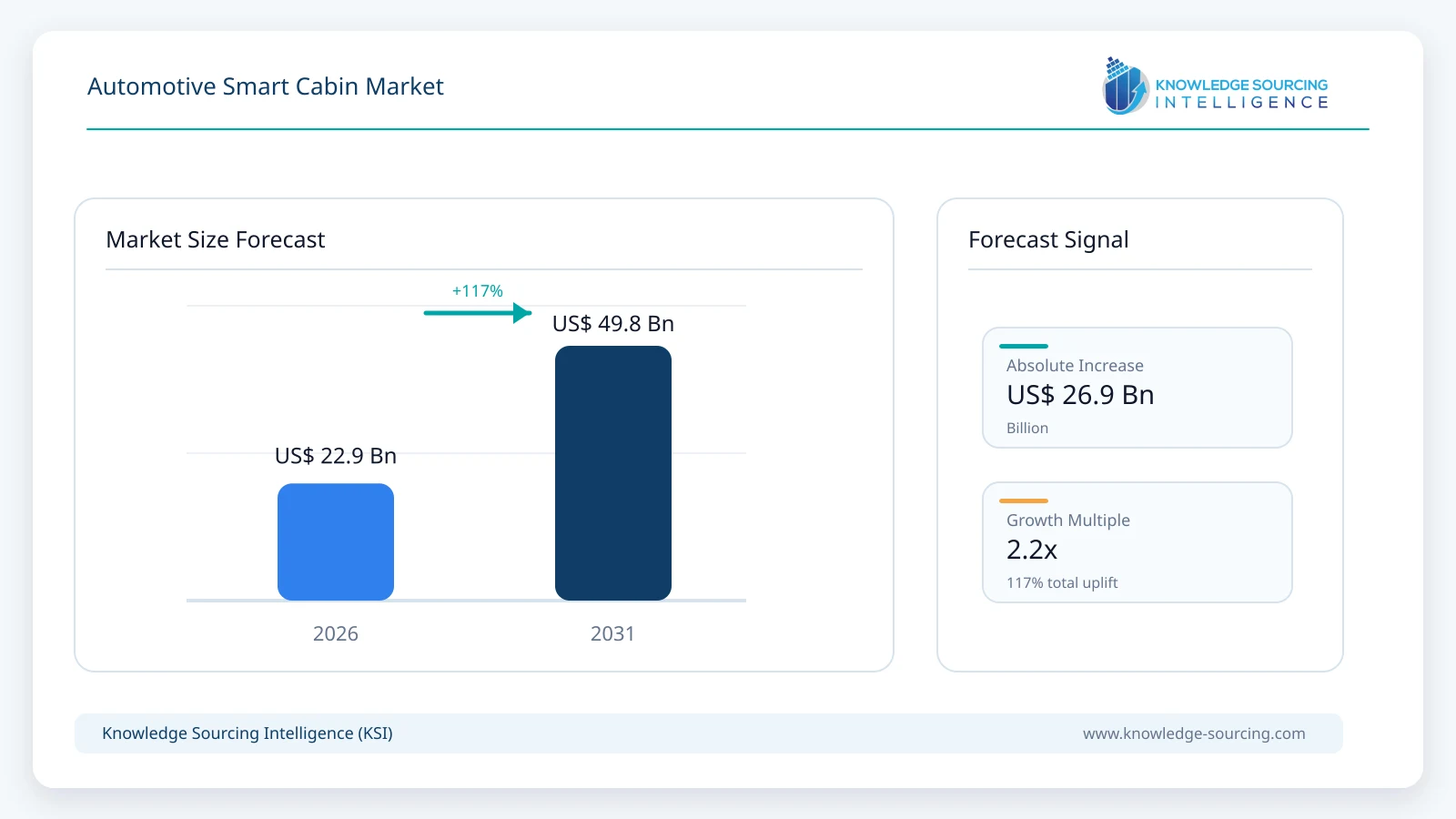
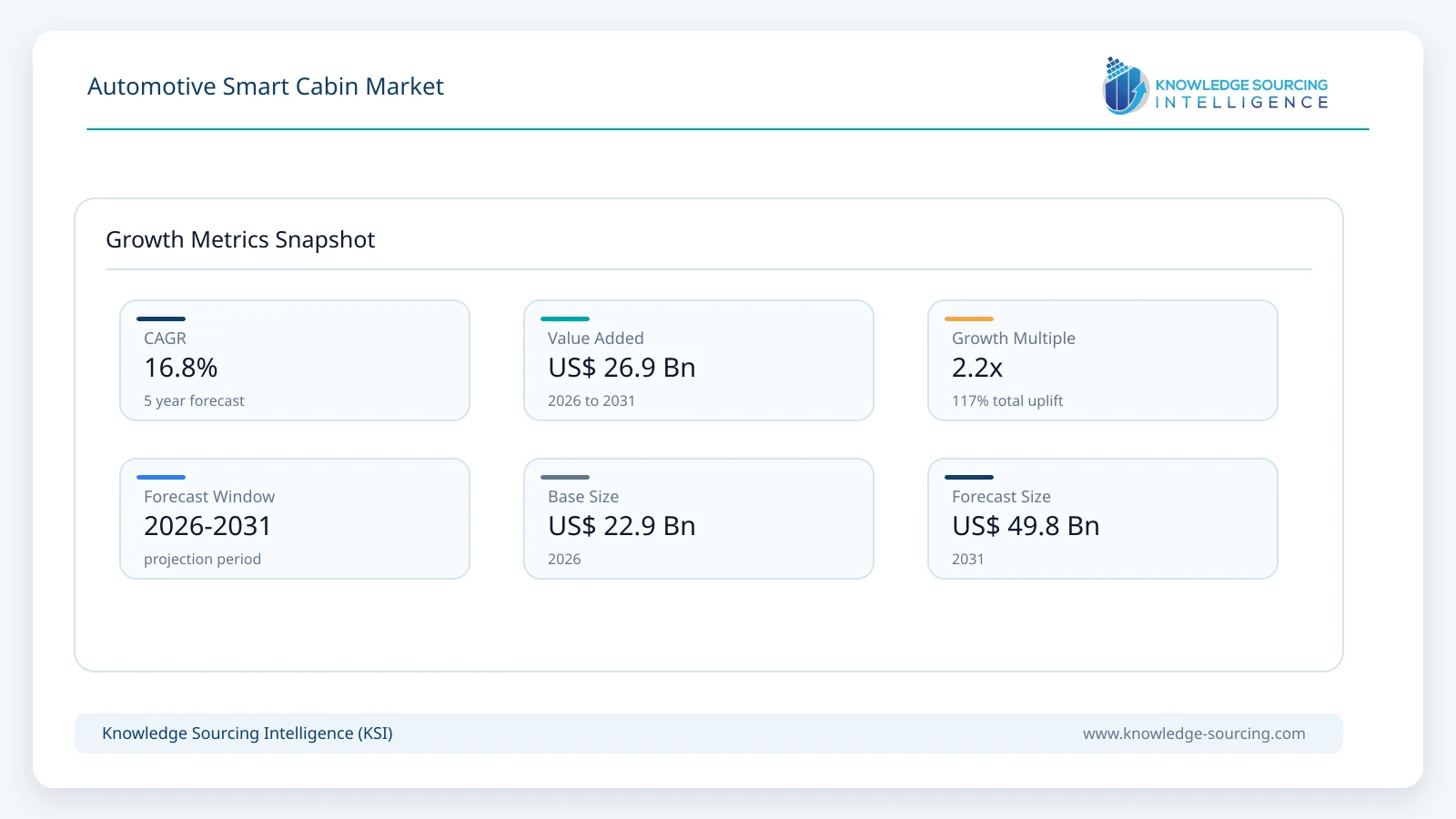
The automotive smart cabin market is forecast to grow from approximately USD 22.90 billion in 2026 to USD 49.80 billion in 2031, at a CAGR of 16.8% during forecast period.
Highlights:
- 1Cabin compute, control and integration electronics represent approximately 26% of 2026 market value, reflecting the importance of processors and electronic coordination behind intelligent functions.
- 2Intelligent infotainment and multimodal HMI account for approximately 29% of 2026 revenue as embedded assistants become more capable of handling natural-language requests.
- 3Domain-integrated smart cabin systems are forecast to increase their share from 37% in 2026 to 48% in 2031.
- 4Asia Pacific accounts for an estimated 44% of 2026 value and is expected to reach 48% by 2031 as regional vehicle programs adopt sophisticated cabin software and electronics.
- 5Passenger vehicles account for approximately 90% of 2026 market value, supported by advanced features in both premium and high-volume models.
- 6Automotive-grade AI integration requires low-latency controls, robust privacy protection and the ability to maintain software over long vehicle lifecycles.
The market comprises vehicle-installed systems that actively interpret occupant inputs or cabin conditions and coordinate a response through voice, displays, sensing, seating, thermal controls, lighting or other interior functions. Revenue is generated through integrated cabin computing, sensing, intelligent HMI, adaptive control electronics and associated supplier software.
Qualcomm’s Cockpit Elite designs, HARMAN’s in-cabin awareness systems and Bosch’s AI extension platform illustrate how cabin functions increasingly depend on shared processors, occupant sensing and reliable interfaces to vehicle controls. These supplier approaches reflect different electronic architectures, but each must translate cabin context into predictable functions across multiple control domains.
Vehicle-installed smart cabin systems integrate occupant-facing cameras, speech and touch interfaces, localized compute and software-controlled climate, seat and lighting functions to recognize and respond to conditions inside the passenger compartment. Speech and touch interfaces, occupant-facing cameras, local processing, smart climate controls, active seating and personalized settings can operate through a common software layer while retaining dedicated safety functions. Revenue varies with the number of cabin zones served, sophistication of the perception stack, onboard processing capability and extent of integration with vehicle actuators.
HARMAN’s January 2026 Ready Care and Ready Aware updates integrate driver and occupant monitoring with automotive-grade software, bringing cabin awareness into a wider connected vehicle platform. Bosch presented an AI extension platform intended to upgrade existing cockpits with voice assistance and scene understanding, while Cerence announced an expanded BYD program using its xUI conversational platform. These examples span finished integration platforms, supplementary AI compute and specialized assistant software, each with a different purchasing and delivery model.
Qualcomm identified eight mass-produced Ride Flex vehicle programs in January 2026 and additional Cockpit and Ride Elite design wins, highlighting the growing role of shared compute in production automotive electronics. LG’s AI Cabin Platform demonstration uses generative models on automotive high-performance computing, offering a more exploratory view of future occupant interaction. Automakers continue evaluating these approaches against automotive safety, power, cost and update requirements; mature supplier platforms are likely to capture value through integration and long-term software support in addition to electronic hardware.
Market Trends
Occupant Context Is Linking Interfaces with Cabin Controls
BMW’s iX3 integrates an Alexa+-enabled Intelligent Personal Assistant designed to interpret natural-language requests involving vehicle information and selected in-car functions, with initial commercial availability announced for Germany and the United States. Voice interaction gains practical value when software can interpret a request against navigation, media and cabin settings rather than merely select a menu. BMW identified Germany and the United States as initial markets, reinforcing the importance of controlled model and language deployment across vehicle programs.
HARMAN’s Ready Engage and Ready Care products link conversational interfaces with occupant awareness, giving OEMs a route to adapt alerts and passenger interactions to the circumstances detected inside a vehicle. Information derived from a driver-monitoring camera can help tailor an alert, content presentation or comfort response, although OEM implementations must preserve the distinction between a user convenience function and a safety-critical warning. The combination creates demand for software integration and sensor processing that isolated control modules cannot supply.
Central Computing Is Changing the Economics of In-Cabin Intelligence
Qualcomm’s January 2026 update disclosed eight mass-production programs using Ride Flex and expanded Cockpit Elite engagements, demonstrating that cockpit and cross-domain processing are moving from engineering programs into vehicle lines. Shared vehicle processors can run cockpit and assistance workloads concurrently, while smart-cabin suppliers compete on predictable interaction, low-latency control and dependable integration with vehicle systems.
Bosch’s AI extension platform, presented at CES 2026, provides an additional computing path for automakers seeking advanced voice and scene-understanding functions on existing cockpit electronics. Upgradable platforms may let manufacturers introduce advanced assistants without a full instrument-panel or electronics redesign, but they also require long-term compatibility testing, memory-resource management, and robust interfaces to seat, climate and other body controllers.
Cabin Perception Is Broadening Beyond Driver Attention
Valeo and Seeing Machines presented joint driver- and occupant-monitoring applications at CES 2026, demonstrating an integrated camera-perception approach applicable to driver readiness and broader in-cabin awareness. The development reflects a shift from stand-alone driver gaze tracking toward systems that recognize occupant position, activity and contextual changes across seating rows. Camera and perception platforms provide a sensor foundation for comfort functions, passenger interactions and restraint-related services, subject to the appropriate safety validation.
OEM contracts for expanded perception, classification and integration determine the incremental revenue associated with multi-purpose occupant-monitoring platforms, while privacy safeguards add non-trivial engineering and validation requirements. These considerations favor integrated platforms capable of supplying several cabin applications from the same set of sensors.
Generative AI Is Entering Production Programs While Concepts Mature
Cerence AI’s April 2026 BYD announcement identifies the ATTO 2 DM-i as an initial deployment route for its xUI conversational assistant, providing a named automaker program rather than an unspecified concept demonstration. Automotive-grade voice platforms must manage connectivity outages, noisy cabins, multiple occupants, and commands that should not be delegated to a language model without confirmation or deterministic control.
LG Electronics presented the AI Cabin Platform as a CES 2026 demonstration of generative models running on automotive high-performance computing, a technology proof point rather than disclosed series-production volume. The presentation established a technical direction but not production fitment volumes. Suppliers that transition these functions into series programs will need to demonstrate edge-compute efficiency, software maintainability and predictable behavior under different driving and network conditions.
Automotive Smart Cabin Market Segment Analysis
By Intelligent System Component
Cabin Compute, Control and Integration Electronics
Cabin compute, control and integration electronics represent an estimated 26% of 2026 smart-cabin market value, covering processor resources, domain interfaces and controllers used for coordinated cabin functions. Automotive electronics suppliers increasingly deliver cabin capability as part of a shared vehicle-computing platform, with revenue tied to the dedicated functions, integration and performance required by automakers.
Cockpit-domain controllers and other shared automotive computing platforms are taking over functions previously distributed among dedicated infotainment, voice and interior-control ECUs, changing the supplier integration workload. Qualcomm’s Cockpit Elite and Bosch’s AI extension platform illustrate different routes to deploying cabin intelligence, one through high-performance integrated compute and the other through enhancement of existing cockpit hardware.
By Primary Cabin Function
Intelligent Infotainment and Multimodal HMI
Intelligent infotainment and multimodal HMI account for approximately 29% of smart-cabin expenditure in 2026, led by conversational assistants, speech processing and unified interfaces already present in higher-content vehicles. Natural-language interaction reduces the need to navigate rigid menus when occupants request navigation, climate adjustments or media selection, provided driving-related attention demands remain central to design.
BMW’s iX3 assistant and Cerence’s BYD xUI program illustrate two distinct commercial channels for cabin AI: vehicle-brand software embedded in an OEM operating environment and a specialist technology supplier licensed into an automaker lineup. The segment grows in absolute value through 2031, although safety-aware occupant monitoring and cabin automation account for more of the incremental expenditure.
By Control Architecture
Domain-Integrated Smart Cabin Systems
Domain-integrated smart cabin systems account for approximately 37% of 2026 market value as shared control electronics increasingly coordinate voice, passenger interaction and selected comfort functions instead of relying on separate modules. OEM engineering teams favor reusable computing platforms that host related cabin functions and support software updates over several model years.
Domain-integrated architectures are expected to contribute 48% of the 2031 smart-cabin market as reusable automotive computing platforms support additional interface and perception functions across vehicle ranges. Qualcomm’s cross-domain designs and Bosch’s add-on AI compute show that integration does not always require abandoning existing electronic modules; automakers can centralize portions of the workload while preserving deterministic control of safety-adjacent functions.
By Processing Model
Onboard and Edge Processing
Onboard and edge AI processing represent approximately 44% of the 2026 market because cabin speech, sensing and immediate control responses benefit from computation inside the vehicle. Local speech recognition, perception and preference logic can reduce response time, preserve important features during poor connectivity and limit transmission of identifiable in-cabin data. The commercial requirement extends beyond processor capacity to thermal design, software optimization and long-term support for embedded models.
Automotive-grade neural accelerators and higher-memory cockpit processors are expected to raise onboard and edge processing to approximately 51% of 2031 smart-cabin market value, reducing dependence on continuous network access. Cloud services remain relevant for information retrieval, fleet-scale updates and advanced assistant tasks, but fail-safe cabin actions generally require reliable vehicle-side control.
By Vehicle Class
Premium and Luxury Vehicles
Premium and luxury vehicles account for an estimated 43% of smart-cabin spending in 2026, reflecting their concentration of high-performance processors, advanced passenger interfaces and multizone control equipment. Multi-row sensing, personalized climate functions, interactive lighting, advanced assistants and sophisticated displays are commonly introduced in higher-priced vehicles where customers are more receptive to additional electronic content.
Premium and luxury smart-cabin systems are expected to gain revenue through 2031, although the segment’s share is projected to decline to approximately 34% as advanced functions spread into mid-range models. Shared software and electronic integration can lower the additional cost of deploying similar features on several vehicle platforms, improving the commercial case outside the luxury segment.
By Geography
Asia Pacific
Asia Pacific accounts for approximately 44% of 2026 smart-cabin market value, supported by Chinese electric-vehicle development, regional electronics supply chains and rapid adoption of advanced interfaces. China provides a large OEM customer base for integrated cockpit and assistant platforms, while Japanese and South Korean suppliers contribute vehicle-grade hardware and software engineering.
Asia Pacific’s share is expected to rise toward 48% by 2031 as higher-content cabin platforms spread across Chinese vehicle lines and regional suppliers improve the cost and reliability of in-vehicle compute. China anchors the volume opportunity, while Japan and South Korea contribute established automotive suppliers, electronics engineering and OEM programs. India and Southeast Asia offer longer-term growth as vehicle electronic content increases, though uptake will remain sensitive to price and model mix.
Market Drivers
Expansion of Vehicle-Integrated AI Assistants
BMW’s new vehicle assistant, Cerence’s BYD xUI program and Qualcomm’s expanding Snapdragon Cockpit base demonstrate growing commercial adoption of language-based interfaces that can operate across infotainment and vehicle functions. BMW’s 2026 Alexa+ introduction and Cerence’s BYD xUI program demonstrate identifiable OEM routes for advanced natural-language interaction. Each new deployment adds requirements for specialized processors, microphones, software validation, automotive interfaces and lifecycle support. The strongest supplier opportunity lies in automotive integration of models with vehicle-specific command permissions, rather than the language model alone. Assistant pricing must also accommodate OEM software ownership and regional language support.
Greater Availability of Occupant and Driver Context
Camera-based driver monitoring, occupant classification and integrated cabin perception allow automakers to associate driver attention and passenger location with relevant interface and comfort responses. Valeo and Seeing Machines are developing combined driver and occupant solutions, while HARMAN links in-cabin awareness with assistance and safety functions. The opportunity is strongest when shared perception hardware supports several approved applications, reducing duplicate sensors across interior systems. Additional revenue is created when the same sensor data can be reused for approved restraint, personalization and cabin-control functions without duplicating sensors or breaching privacy expectations.
Consolidation of Electronic Cabin Architecture
Shared cabin-domain controllers and higher-performance automotive processors replace separate HMI, infotainment and comfort ECUs on selected vehicle platforms, consolidating hardware while increasing software validation requirements. Qualcomm’s Ride Flex deployment and Bosch’s AI extension approach illustrate different commercially relevant architectures. A common hardware platform can lower duplicated ECU content while increasing spending on integration, real-time software partitioning, cybersecurity and qualification of cabin functions. OEMs also gain a common software deployment target across trims, but depend more heavily on supplier competence in virtualization, deterministic response and system-level fault isolation.
Premium Feature Competition and Mid-Market Migration
Premium automakers are combining personalized seat settings, intelligent lighting and conversational assistants into differentiated cabin packages, while common electronic architectures support subsequent introduction into lower-price models. Shared embedded software can subsequently be deployed in broader vehicle ranges at lower incremental development cost, supporting demand in mid-range segments. The financial return depends on software reuse across trims rather than expensive one-off interfaces. Commercial scaling is especially sensitive to the use of common modules across vehicle derivatives and to avoiding costly, model-specific interfaces that cannot be reused in mass-market programs.
Software Lifecycle and Cabin Service Upgrades
Software-based smart-cabin controls allow OEMs to update assistant capabilities, vehicle preferences and selected comfort features without replacing underlying electronic units, provided the platform supports long-term maintenance. Automakers value consistent interfaces throughout a vehicle’s service life, while software suppliers compete for licensed platform content, validation contracts and support programs. Contracted maintenance and supported software upgrades can provide an additional revenue stream alongside initial vehicle fitment.
Market Restraints
High System Integration and Validation Cost
Integrating speech, occupant vision, seat adjustment, lighting and HVAC through several vehicle networks increases the number of hardware interfaces and software states that OEM engineering teams must verify. A new integration can introduce latency, intermittent faults and difficult test combinations across vehicle variants, especially where safety-adjacent alerts share compute with entertainment applications. Integration defects may emerge only in rare occupancy, thermal or infotainment states, adding regression-testing cost and increasing the risk of launch delays when a common controller supports many functions.
Data Privacy and Cybersecurity Exposure
Interior-facing cameras, cabin microphones and identity-linked driver profiles create data-protection and security obligations because these systems can process information about vehicle occupants and their behavior. Automakers must limit unnecessary data collection and restrict access to vehicle functions, while software-update and cybersecurity management create validation and maintenance obligations throughout the vehicle lifecycle. Product development consequently requires local processing choices, explicit retention rules and supported software-update processes, all of which add cost before consumer-facing revenue is realized.
Uneven Consumer Willingness to Pay
Premium vehicle buyers already encounter sophisticated cabin assistance and personalized comfort functions, but cost-sensitive segments face tighter limits on optional electronic content and software-service expenditure. Buyers of entry-level vehicles may prioritize reliability and basic connectivity over gesture controls, AI content or extra sensing, reducing the addressable hardware value per vehicle in cost-sensitive markets. High-price hardware and subscription models are difficult to transfer unchanged into high-volume economy vehicles; suppliers must provide scaled feature sets and consistent baseline reliability.
Limitations of Conversational and Perception AI
In-vehicle speech recognition must cope with road noise, multiple speakers and regional accents, while interior cameras contend with occlusion, lighting variation and changing occupant position. Generative assistants also risk uncertain or unsuitable outputs, requiring deterministic software boundaries before actions affect vehicle controls. Vehicle controls must therefore remain behind deterministic permission and confirmation layers so an uncertain generative-AI response cannot directly issue a safety-critical action.
Compute Power, Energy and Platform Obsolescence
Running larger language and perception models on vehicle hardware raises memory, processor, power and heat-dissipation requirements within the electrical and thermal limits of passenger cars. Vehicle production programs typically have long support cycles, and hardware selected for current workloads may not accommodate future feature demands without additional software optimization. Long vehicle lifecycles also create a mismatch between rapidly changing AI models and automotive hardware qualification, making efficient smaller models and modular software updates commercially important.
Regional Outlook
Asia Pacific
Asia Pacific accounts for approximately 44% of smart-cabin market value in 2026 as Chinese vehicle manufacturers deploy advanced cockpit compute, intelligent assistants and occupant-aware services across premium and selected mainstream models. Qualcomm’s January 2026 disclosures identify Chinese OEM programs involving advanced automotive processors, while Cerence’s BYD agreement connects conversational AI to a named vehicle manufacturer. Regional demand spans premium electric vehicles and increasingly capable mid-market platforms.
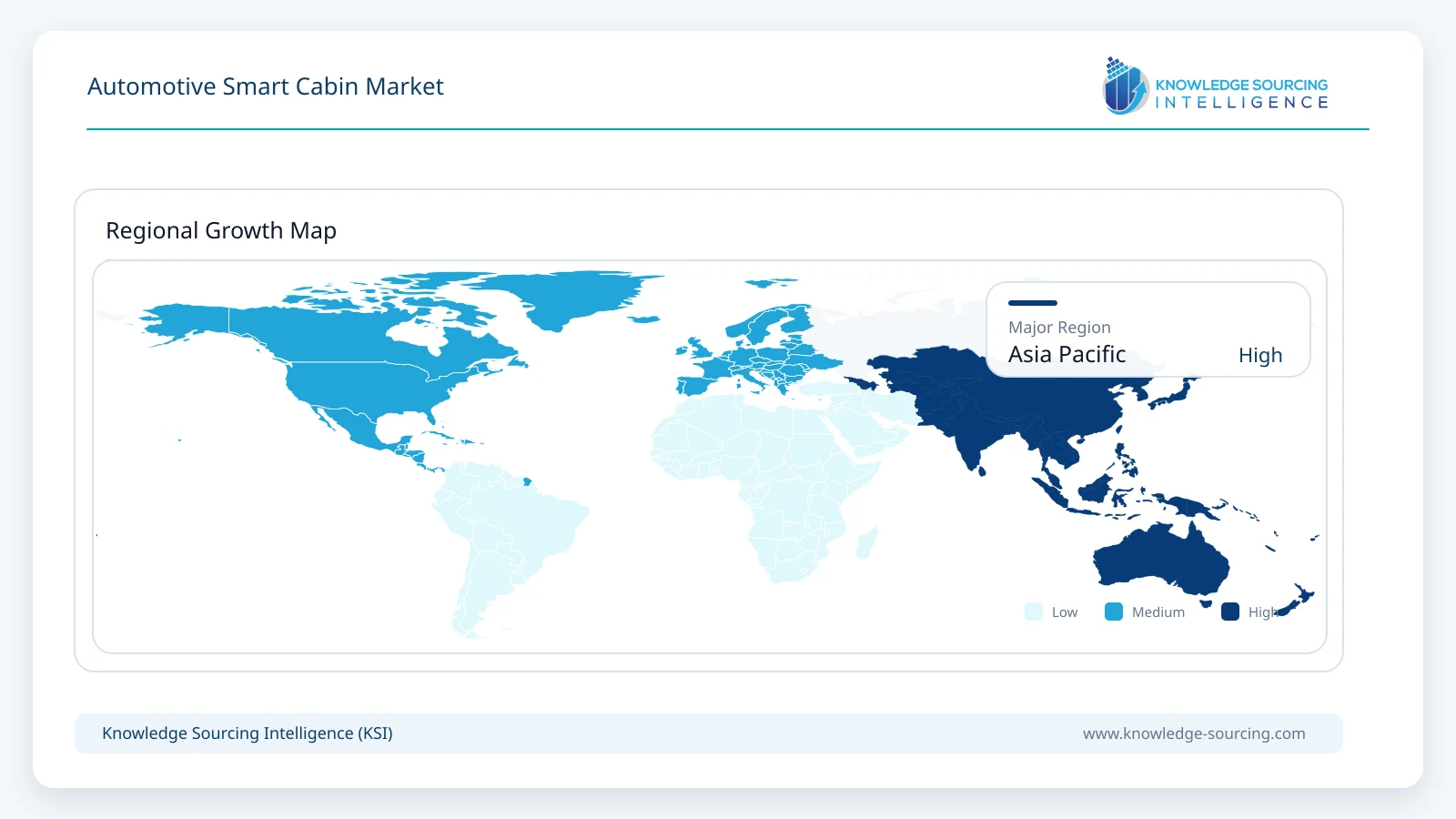
Japan and South Korea contribute automotive electronics, passenger-interface engineering and production-quality system integration to Asia Pacific’s intelligent cabin supply chain. China’s strength in cockpit components and software iteration supports a forecast share approaching 48% by 2031, although actual penetration will depend on program timing, vehicle demand and whether locally developed solutions meet automotive reliability requirements.
Europe
Europe accounts for approximately 28% of smart-cabin expenditure in 2026, led by premium OEM platforms and suppliers developing conversational interfaces, cabin AI and advanced cockpit integration. BMW’s Intelligent Personal Assistant on the iX3 illustrates integration of dialogue with vehicle functions, while Bosch’s AI extension platform and FORVIA’s cockpit-interaction developments provide different supplier routes to feature deployment across several vehicle generations.
European vehicle platforms face strong requirements for driver-attention management, connected-system cybersecurity and dependable electronic control, shaping how AI assistants and interior sensing are qualified for production. The region is projected to expand in absolute value through 2031 while its global share eases to 25% as Asian fitment grows faster. Premium vehicle mix and supplier engineering capabilities maintain higher-value opportunities in automotive AI integration and occupant-aware systems.
Competitive Landscape
HARMAN, LG Electronics, Bosch, Visteon, Panasonic Automotive Systems, Hyundai Mobis and Marelli compete in integrated smart-cabin electronics, while Qualcomm, Cerence and Valeo participate through compute, assistant software and occupant sensing. HARMAN, LG, Bosch, Visteon, Panasonic Automotive Systems, Hyundai Mobis and Marelli compete on system integration and OEM engineering, while Qualcomm supplies processing platforms used by multiple Tier 1 companies. Cerence contributes conversational software, and Valeo participates through cabin perception and monitoring integration.
HARMAN’s Ready Care and Ready Engage combine occupant-state awareness with passenger interaction, whereas Bosch’s AI extension architecture emphasizes adding capabilities to established cockpit platforms. LG’s AI Cabin Platform showcases generative models in a vehicle-integrated architecture, while Bosch’s extension design emphasizes adding intelligence to existing cockpit platforms. Cerence’s BYD deployment is more directly tied to an OEM software program, and Valeo’s CES work with Seeing Machines illustrates the importance of sensor/perception combinations without proving mass deployment on its own.
Smart-cabin supplier selection increasingly depends on repeatable vehicle-grade validation across voice, perception and control software, particularly when a computing platform is shared by functions with different safety criticality. Suppliers must document low-latency behavior, constrained AI actions, cybersecurity readiness and compatibility between passenger experiences and automotive control systems. The combination of proprietary vehicle-domain software, embedded compute and repeatable OEM program execution is likely to become a stronger differentiator than concept demonstrations.
Recent Developments
April 2026: Cerence AI announced its expanded BYD agreement for the xUI conversational assistant, identifying the ATTO 2 DM-i and subsequent global vehicle models as deployment targets for automotive LLM functions.
January 2026: HARMAN introduced updates across its Ready portfolio, including improved cabin monitoring, software-enabled personalization and vehicle-grade integration available for OEM implementation.
January 2026: Qualcomm Technologies announced additional Snapdragon Cockpit and Ride Elite collaborations alongside eight mass-produced programs using Ride Flex, strengthening the case for integrated automotive compute.
January 2026: Bosch presented an AI extension platform at CES 2026 that could add voice and scene-understanding capabilities to existing cockpit systems without complete electronic replacement.
January 2026: Valeo and Seeing Machines presented integrated driver and occupant perception demonstrations at CES 2026, connecting the suppliers’ monitoring software and full-system integration expertise.
January 2026: BMW Group demonstrated the Alexa+-enabled Intelligent Personal Assistant for the BMW iX3 at CES, with Germany and the United States identified as initial markets for the vehicle-integrated feature.
Market Outlook
Automotive smart-cabin systems are expected to gain value as OEM programs incorporate contextual voice interaction, multi-row occupant awareness and coordination of seating, climate and lighting with passenger preferences. Driver and passenger experience features will increasingly share compute and sensing resources, although dedicated safety-related functions will retain stringent validation boundaries. Intelligent HMI and adaptive cabin automation should grow in value as suppliers improve the reuse of software platforms.
Domain-integrated processing and local AI inference are expected to gain share as OEMs seek reliable voice and perception performance without permanent cloud connectivity. OEMs will continue selecting between centralized compute and incremental AI extension based on platform age, software capability and vehicle price. Privacy, cybersecurity and update support will influence supplier selection as strongly as visible assistant features.
Asia Pacific should remain the largest market through 2031 because Chinese vehicle platforms combine large production volumes with faster adoption of advanced cabin electronics and occupant-centered software. Europe retains an important role through premium OEM programs and specialist automotive engineering. Suppliers that combine reliable perception, automotive-grade AI interaction and repeatable cabin integration should be better positioned to win multi-vehicle production programs.
Automotive Smart Cabin Market Scope:
| Report Metric | Details |
|---|---|
| Total Market Size in 2026 | USD 22.90 billion |
| Total Market Size in 2031 | USD 49.80 billion |
| Forecast Unit | USD Billion |
| Growth Rate | 16.8% |
| Study Period | 2021 to 2031 |
| Historical Data | 2021 to 2024 |
| Base Year | 2025 |
| Forecast Period | 2026 – 2031 |
| Segmentation | Intelligent System Component, Primary Cabin Function, Control Architecture, Processing Model,, Vehicle Class, Vehicle Type, Propulsion, Geography |
| Companies |
|
Market Segmentation
By Intelligent System Component
Cabin Compute, Control and Integration Electronics
Occupant Sensing and Contextual Perception
Intelligent HMI and Assistant Systems
Adaptive Comfort and Active Cabin Controls
Lifecycle Software, AI and Integration Services
By Primary Cabin Function
Intelligent Infotainment and Multimodal HMI
Occupant Monitoring and Contextual Safety
Comfort, Climate, Seat and Lighting Coordination
Personalization and Cabin Automation
Intelligent Passenger Services and Other
By Control Architecture
Distributed and Dedicated Intelligence Modules
Domain-Integrated Smart Cabin Systems
Centralized and Cross-Domain Cabin Orchestration
By Processing Model
Onboard and Edge Processing
Hybrid Edge-Cloud Processing
Cloud-Dependent Processing
By Vehicle Class
Premium and Luxury Vehicles
Mid-Range Vehicles
Entry-Level and Economy Vehicles
By Vehicle Type
Passenger Vehicles
Light Commercial Vehicles
Medium and Heavy Commercial Vehicles and Buses
By Propulsion
Internal Combustion and Mild-Hybrid Vehicles
Hybrid and Plug-In Hybrid Vehicles
Battery Electric Vehicles
By Geography
North America
United States
Canada
Mexico
South America
Brazil
Argentina
Others
Europe
Germany
United Kingdom
France
Italy
Spain
Others
Middle East and Africa
Saudi Arabia
UAE
South Africa
Others
Asia Pacific
China
Japan
South Korea
India
Indonesia
Thailand
Others
Table of Contents
1. INTRODUCTION
1.1. Market Overview
1.2. Market Definition
1.3. Scope of the Study
1.4. Market Segmentation
1.5. Currency
1.6. Assumptions
1.7. Base and Forecast Years
1.8. Key Benefits to Stakeholders
2. RESEARCH METHODOLOGY
2.1. Research Design
2.2. Secondary Research
2.3. Primary Research
2.4. Market Estimation
2.5. Segment Modelling
2.6. Data Triangulation and Validation
3. EXECUTIVE SUMMARY
3.1. Key Findings
3.2. Automotive Smart Cabin Market Size, 2026-2031
3.3. Cabin Technology and Application Outlook
3.4. Vehicle and Processing Architecture Outlook
3.5. Regional Opportunity Summary
4. MARKET DYNAMICS
4.1. Market Drivers
4.1.1. Expansion of Vehicle-Integrated AI Assistants
4.1.2. Greater Availability of Occupant and Driver Context
4.1.3. Consolidation of Electronic Cabin Architecture
4.1.4. Premium Feature Competition and Mid-Market Migration
4.1.5. Software Lifecycle and Cabin Service Upgrades
4.2. Market Restraints
4.2.1. High System Integration and Validation Cost
4.2.2. Data Privacy and Cybersecurity Exposure
4.2.3. Uneven Consumer Willingness to Pay
4.2.4. Limitations of Conversational and Perception AI
4.2.5. Compute Power, Energy and Platform Obsolescence
4.3. Market Opportunities
4.4. Porter’s Five Forces Analysis
4.5. Industry Value Chain Analysis
4.6. Smart Cabin Platform Economics
4.7. Policies and Regulations
4.8. Strategic Recommendations
5. TECHNOLOGY OUTLOOK
5.1. Multimodal Voice and Cabin AI
5.2. Occupant Sensing and Contextual Perception
5.3. Cabin Domain Computing and Edge AI
5.4. Intelligent Seating and Thermal Coordination
5.5. Adaptive Cabin Interfaces and Haptics
5.6. Cybersecurity and AI Software Lifecycle
6. AUTOMOTIVE SMART CABIN MARKET BY INTELLIGENT SYSTEM COMPONENT
6.1. Introduction
6.2. Cabin Compute, Control and Integration Electronics
6.3. Occupant Sensing and Contextual Perception
6.4. Intelligent HMI and Assistant Systems
6.5. Adaptive Comfort and Active Cabin Controls
6.6. Lifecycle Software, AI and Integration Services
7. AUTOMOTIVE SMART CABIN MARKET BY PRIMARY CABIN FUNCTION
7.1. Introduction
7.2. Intelligent Infotainment and Multimodal HMI
7.3. Occupant Monitoring and Contextual Safety
7.4. Comfort, Climate, Seat and Lighting Coordination
7.5. Personalization and Cabin Automation
7.6. Intelligent Passenger Services and Other
8. AUTOMOTIVE SMART CABIN MARKET BY CONTROL ARCHITECTURE
8.1. Introduction
8.2. Distributed and Dedicated Intelligence Modules
8.3. Domain-Integrated Smart Cabin Systems
8.4. Centralized and Cross-Domain Cabin Orchestration
9. AUTOMOTIVE SMART CABIN MARKET BY PROCESSING MODEL
9.1. Introduction
9.2. Onboard and Edge Processing
9.3. Hybrid Edge-Cloud Processing
9.4. Cloud-Dependent Processing
10. AUTOMOTIVE SMART CABIN MARKET BY VEHICLE CLASS
10.1. Introduction
10.2. Premium and Luxury Vehicles
10.3. Mid-Range Vehicles
10.4. Entry-Level and Economy Vehicles
11. AUTOMOTIVE SMART CABIN MARKET BY VEHICLE TYPE
11.1. Introduction
11.2. Passenger Vehicles
11.3. Light Commercial Vehicles
11.4. Medium and Heavy Commercial Vehicles and Buses
12. AUTOMOTIVE SMART CABIN MARKET BY PROPULSION
12.1. Introduction
12.2. Internal Combustion and Mild-Hybrid Vehicles
12.3. Hybrid and Plug-In Hybrid Vehicles
12.4. Battery Electric Vehicles
13. AUTOMOTIVE SMART CABIN MARKET BY GEOGRAPHY
13.1. North America
13.1.1. United States
13.1.2. Canada
13.1.3. Mexico
13.2. South America
13.2.1. Brazil
13.2.2. Argentina
13.2.3. Others
13.3. Europe
13.3.1. Germany
13.3.2. United Kingdom
13.3.3. France
13.3.4. Italy
13.3.5. Spain
13.3.6. Others
13.4. Middle East and Africa
13.4.1. Saudi Arabia
13.4.2. UAE
13.4.3. South Africa
13.4.4. Others
13.5. Asia Pacific
13.5.1. China
13.5.2. Japan
13.5.3. South Korea
13.5.4. India
13.5.5. Indonesia
13.5.6. Thailand
13.5.7. Others
14. COMPETITIVE ENVIRONMENT AND ANALYSIS
14.1. Major Players and Strategy Analysis
14.2. Market Share Analysis
14.3. Mergers, Acquisitions, Agreements, and Collaborations
14.4. Smart Cabin Platform Benchmarking
14.5. Competitive Dashboard
15. COMPANY PROFILES
15.1. HARMAN International
15.2. LG Electronics Vehicle Solution Company
15.3. Robert Bosch GmbH
15.4. Qualcomm Technologies, Inc.
15.5. Cerence AI
15.6. Visteon Corporation
15.7. Panasonic Automotive Systems Co., Ltd.
15.8. FORVIA
15.9. Yanfeng
15.10. Valeo
15.11. Hyundai Mobis Co., Ltd.
15.12. Marelli
16. APPENDIX
16.1. Currency
16.2. Assumptions
16.3. Base and Forecast Years
16.4. Key Benefits to Stakeholders
16.5. Research Methodology
16.6. Abbreviations
Navigate
Trusted by the world's leading organizations











