
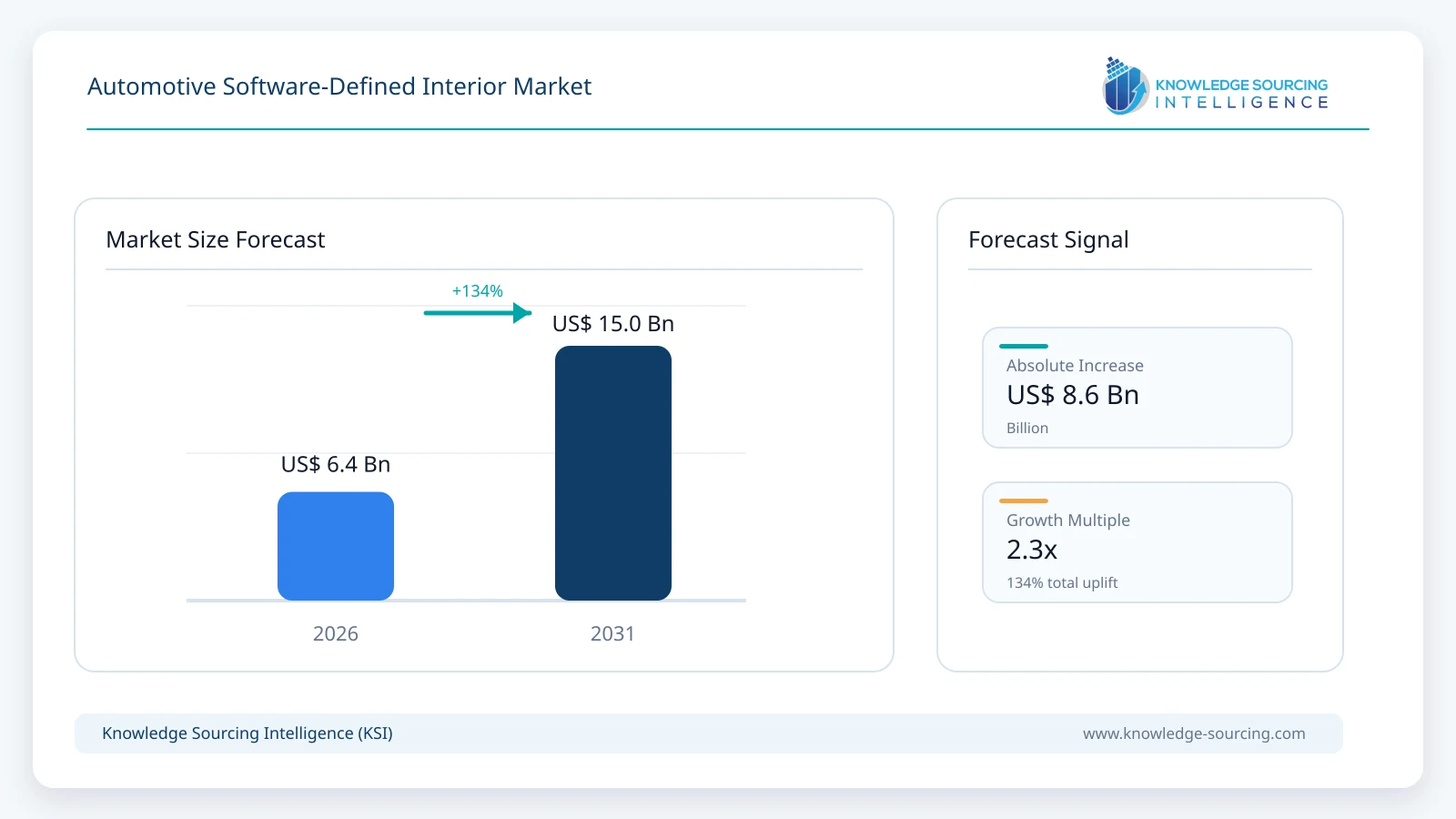
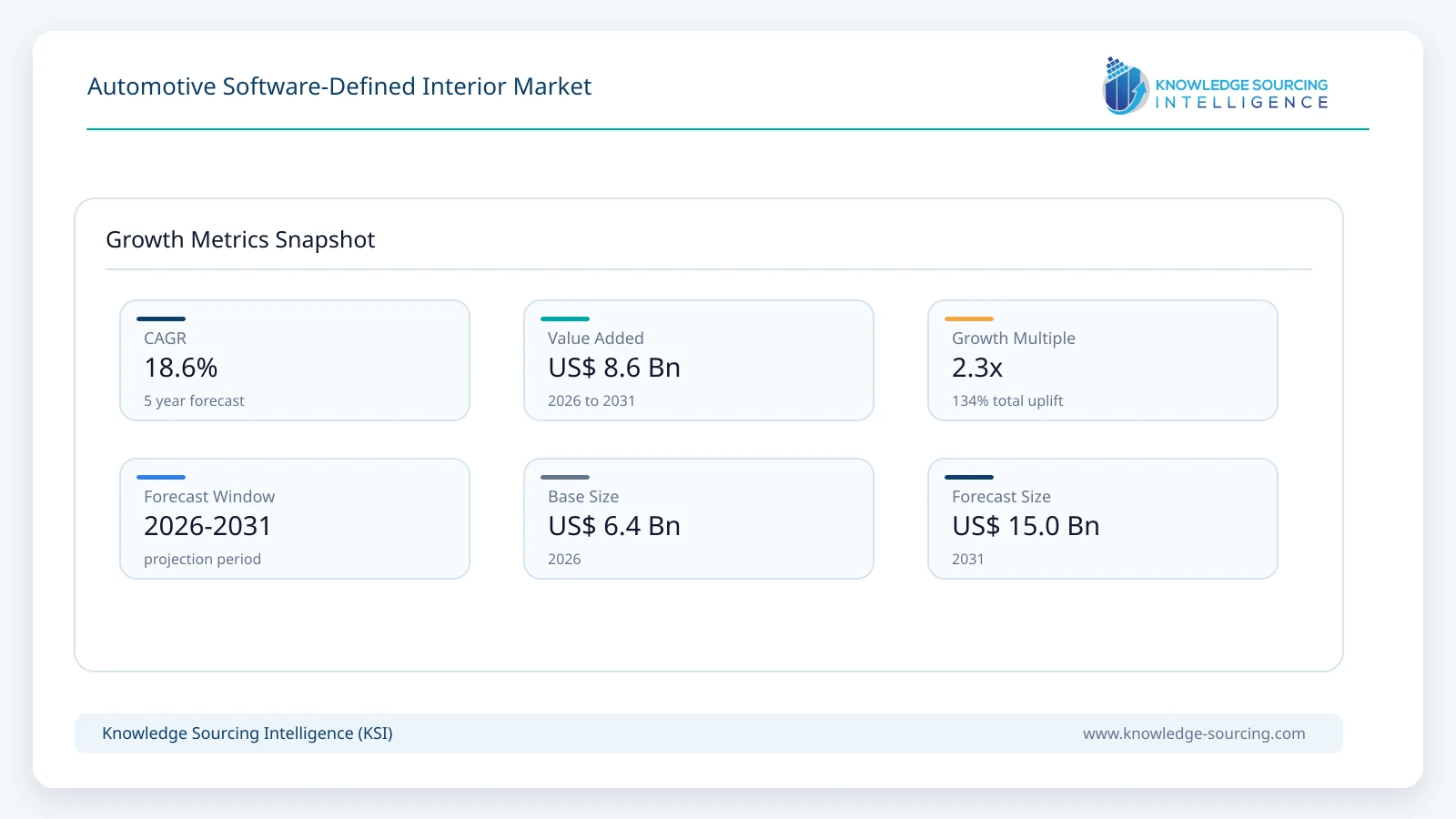
The automotive software-defined interior market is projected to grow from USD 6.40 billion in 2026 to USD 15.00 billion by 2031, at a CAGR of 18.6% over the forecast period.
Highlights:
- 1The global automotive software-defined interior market is estimated at USD 6.40 billion in 2026 and forecast to reach USD 15.00 billion by 2031.
- 2Digital cockpit and interface orchestration is the largest primary cabin function in 2026.
- 3Centralized and cross-domain computing is expected to displace some separate cockpit-domain and distributed controllers by 2031.
- 4OTA-enabled feature enhancement leads the update-capability view, while connected lifecycle services gain share.
- 5Asia Pacific leads value, supported by Chinese software-rich vehicle programs and regional cockpit electronics suppliers.
- 6Cabin software, integration and connected services are gaining importance as automakers move toward centralized and updateable interior platforms.
Centralized cockpit computing is allowing automakers to manage several interior functions within coordinated software stacks rather than through separately coded controllers. Panasonic Automotive Systems’ 2026 Mazda CX-5 program combines infotainment, the instrument cluster and head-up display on an OTA-capable cockpit domain controller, while user profiles restore settings that extend to seating and climate. Shared control of multiple functions increases the role of operating-system isolation, application orchestration and reliable interfaces between software and actuators.
Visteon’s SmartCore architecture and AUMOVIO’s cockpit high-performance-computing portfolio address different levels of integration. Visteon combines cockpit software, displays and vehicle connectivity, while AUMOVIO specifies mixed operating environments using a hypervisor, Linux and Android for instrument and infotainment functions. The supplier challenge is to make software reusable across trim levels without weakening responsiveness, thermal performance or safety-critical display behavior.
Elektrobit’s virtualization tools, QNX’s cockpit-development framework and Cerence’s conversational interfaces give software specialists distinct roles alongside integrated cockpit suppliers. Operating-system development, engineering services and software maintenance contribute to supplier revenue throughout vehicle programs, although automakers continue to retain control of selected proprietary applications.
Market Trends
Centralized software stacks are changing cockpit integration
Panasonic Automotive Systems’ Mazda cockpit-domain-controller award shows how infotainment, head-up display and instrument information can be synchronized on a common software platform. LG Electronics has similarly announced a cluster-and-infotainment solution for Renault Group’s New Trafic E-Tech Electric commercial SDV. Such integration reduces duplicated control logic and encourages OEMs to standardize interface and validation work across several vehicles.
Hypervisor-based cockpit software is needed to isolate safety-relevant information from media and passenger applications with different reliability requirements. Elektrobit’s cockpit demonstrations and QNX Cabin development framework illustrate the software investment needed to separate workloads, develop them virtually and validate updates against production hardware. A consolidated controller may cost more individually, but reuse of software and fewer separate ECUs can improve program-level economics.
Interiors are acquiring functions after the original vehicle sale
Cloud-connected software services and OTA delivery make it possible to refresh cockpit interfaces, applications and selected comfort or media experiences without replacing installed components. HARMAN’s January 2026 Ready portfolio updates include in-cabin orchestration and software-defined vehicle tools that can be integrated across multiple functions. Long-term supplier value consequently depends on update management, compatibility testing, cybersecurity support and service continuity rather than launch engineering alone.
BMW Operating System X demonstrates a parallel OEM-led model in which interface themes, display coordination and personalization are developed internally. OEM ownership of the software layer can reduce external licensing value, but may increase demand for third-party middleware, tooling, localization and hardware-specific integration. Suppliers therefore compete on portability and engineering productivity as well as the visible feature set.
Context-aware interaction is broadening software-defined interior functions
Cerence’s April 2026 BYD announcement connects its xUI conversational software with a planned deployment in the ATTO 2 DM-i and subsequent models. FORVIA’s Cockpit UX Engine uses driver-monitoring camera information to support gaze interaction and comfort-related functions without treating the camera as a new revenue item. Both examples show how additional cabin features can be assembled from software and data already available within the vehicle.
LG’s May 2026 Android Automotive OS-based multi-display demonstration illustrates passenger-specific sign-ins, content sharing and parental controls supported by a shared computing platform. Commercial introduction requires dependable user identification, distraction safeguards and consent management, particularly where passenger entertainment operates alongside driver-facing information. The transition from demonstrations to awarded vehicle programs remains an important competitive distinction.
Automotive Software-Defined Interior Market Segment Analysis
By Revenue Component
Cabin application and HMI software
Cabin application and HMI software represents approximately 32% of the 2026 market, reflecting demand for graphical interfaces, voice integration, personalized interaction and coordinated content across cockpit programs. HARMAN, LG Electronics and Cerence supply integrated experience platforms or specialist application technologies. Software reuse across vehicle models supports licensing and engineering demand, while automakers’ growing ownership of user-facing applications places pressure on independently priced software modules.
By Primary Cabin Function
Digital cockpit and interface orchestration
Digital cockpit and interface orchestration accounts for about 37% of the 2026 market, encompassing the software that distributes information and interaction across instrument clusters, central displays and passenger screens. Panasonic’s Mazda platform and LG’s Renault commercial-vehicle award are examples of unified cockpit control. Cross-domain comfort and personalization is expected to expand faster because software increasingly connects profile, climate, seating, audio and lighting behavior.
By Electronic Architecture
Centralized and cross-domain compute
Cockpit domain controllers generate the largest share of 2026 attributable interior revenue, but centralized and cross-domain platforms are forecast to overtake them by 2031. Virtualized software stacks, common service layers and stronger on-device processing allow more cabin functions to run on shared platforms. The transition requires higher up-front platform integration and more rigorous partitioning, while reducing duplicated engineering across formerly isolated modules.
By Software Update Capability
OTA-enabled feature enhancement
OTA-enabled feature enhancement represents approximately 54% of the 2026 market, as newer cockpit platforms increasingly support remote deployment and maintenance of cabin applications. Cloud-connected lifecycle services are expected to grow faster as software providers maintain user profiles, content, diagnostics and experience updates after vehicle delivery. Suppliers able to support secure cabin software releases across different vehicle generations can build more durable OEM relationships.
By Vehicle Type
Passenger vehicles
Passenger cars and SUVs contribute approximately 90% of 2026 market value, reflecting the volume of display-rich and personalized interiors in premium, mainstream and electric models. Commercial vehicle adoption is more selective and emphasizes clear driver information, fleet-service integration and controlled software updates. LG’s announced Renault commercial SDV cockpit indicates that software consolidation is extending beyond passenger-car programs without implying equivalent feature intensity across all trucks and vans.
By Propulsion
Battery electric vehicles
Internal combustion vehicles remain a substantial installed source of cabin software content, but battery electric vehicles are forecast to become the largest propulsion category by 2031. Battery-electric platforms are frequently launched with new E/E architectures, centralized cockpit processing and digital-first interfaces. Hybrid platforms also add value as automakers extend shared vehicle software across propulsion variants, so electrification is a facilitator rather than a formal requirement for a software-defined interior.
Market Drivers
Consolidation of cockpit and body electronics
Cockpit-domain controllers increasingly combine graphics, instrument information, infotainment and personalization on shared hardware. Panasonic Automotive Systems has confirmed adoption of its centralized controller for the Mazda CX-5, including virtualization and multi-display functions. Suppliers can amortize application code and engineering over several screen layouts and trims, increasing the attractiveness of software platforms that support repeated deployment.
AUMOVIO’s cockpit HPC portfolio likewise provides a common environment for cluster, infotainment and selected cabin-sensing functions. Centralization raises demand for middleware, resource scheduling and configuration tools because failure isolation and update compatibility must be demonstrated even when several user experiences share one processor.
Vehicle lifecycle updates and feature maintenance
HARMAN’s OEM-ready cabin software and QNX Cabin’s cloud development framework are designed for cockpit features that must remain supportable through vehicle ownership periods longer than consumer-device refresh cycles. Reusable update infrastructure supports additional supplier engineering and maintenance revenue from active vehicle platforms.
UN Regulation No. 156 establishes software-update-management requirements in relevant type-approval markets. Compliance adds engineering effort to the software lifecycle, especially where an update can change a driver-facing display or safety-related notification. Validated deployment processes therefore become a competitive requirement rather than a discretionary aftermarket feature.
Expansion of personalized cabin interaction
User-linked cockpit profiles now combine configurable interface layouts, account identity, context-aware voice requests and multiple passenger content sessions. Cerence’s xUI program with BYD and LG’s AAOS-based passenger-account demonstration show differentiated routes to that functionality. Voice, identity and profile layers can be added to a common software stack, improving platform economics when developers avoid bespoke application builds for each vehicle.
Cabin-profile software has to restore saved seat, climate and media preferences reliably while protecting account data when different occupants share a vehicle. Such requirements increase the value of persistent profile management and integration testing.
Higher software reuse across brands and vehicle classes
Multi-brand vehicle groups can deploy different screen layouts and brand interfaces on related cockpit electronics and common operating software. Qualcomm’s AAOS-SDV collaboration with Google and its virtual SoC tools are designed to support software development across hardware and vehicle generations. The same underlying software can therefore be configured for several display arrangements and market-specific services.
Reuse of cockpit middleware across brands reduces non-recurring engineering expenditure while increasing the need for hardware-abstraction layers, validated APIs and configuration management. Suppliers capable of maintaining validated variants across more than one automaker tend to compete on engineering depth and release discipline rather than one-off screen demonstrations.
Growth of digitally differentiated EV and premium cabins
Electric-vehicle launches and premium model refreshes increasingly emphasize configurable displays, voice control, connected applications and linked comfort functions. BMW’s Panoramic iDrive with Operating System X provides a production-directed example of several interaction surfaces managed through common software. The visible quality of the cabin increasingly depends on software synchronization and consistent interaction across physical controls.
Software-coordinated smart surfaces, ambient lighting and configurable comfort zones can be connected through shared cockpit interfaces instead of requiring separate application logic for every module. Interior integrators and software developers increasingly compete on their ability to synchronize physical components, user profiles and digital controls through validated interfaces.
Market Restraints
Safety partitioning and multi-domain validation
Centralized computers must isolate instrument warnings, telltales and other safety-relevant outputs from less critical media or app workloads. Hypervisors and real-time operating software mitigate interference, but integration teams still have to verify execution under processor loading, faults and software updates. Growing application density can therefore lengthen validation work even when the number of discrete controllers falls.
Late changes to a shared cockpit software release can disrupt multiple displays, voice functions and comfort interfaces simultaneously. OEMs may retain distributed control for selected functions until shared compute can meet the same reliability expectations, slowing migration away from domain-specific architectures.
Cybersecurity and software-update compliance costs
Connected applications expose additional interfaces through user accounts, wireless updates, cloud services and third-party software. ISO/SAE 21434 defines lifecycle cybersecurity-engineering processes, while UN Regulations Nos. 155 and 156 address cybersecurity management and software updates in applicable approval systems. Suppliers must maintain threat analysis, software traceability, vulnerability response and validation procedures for each program.
Cybersecurity patches and application maintenance for low-volume vehicle variants can cost disproportionately more when OEMs require customized software stacks. The resulting cost can restrict software-defined features to higher-value programs until shared development and security processes mature.
OEM control over cockpit software and supplier pricing
BMW’s Operating System X illustrates how automakers are taking ownership of user-interface software, operating layers and service environments while continuing to purchase chipsets, middleware and selected integration. Standalone licensors can face pricing pressure when OEMs seek control of user data, application distribution and software-release schedules.
Bundled cockpit electronics and in-house software development are changing the commercial position of specialist suppliers. As automakers procure integrated platforms and retain ownership of high-visibility user interfaces, middleware and application providers face greater pressure to demonstrate differentiated capability, portability and continuing engineering value.
Fragmented hardware and operating-system environments
Automotive software providers support different SoCs, operating systems, display resolutions, communication buses and country-specific applications. Elektrobit’s multi-platform development environment reflects the need to bridge Android interfaces, AUTOSAR systems and embedded Linux. Standardization can reduce variant engineering, but customer-specific security and hardware requirements still produce separate validation paths.
Long production lifetimes also make application compatibility difficult as commercial mobile platforms evolve more quickly than vehicle electronics. Suppliers must balance feature freshness with the need to support processors and software dependencies for many years.
Consumer trust, distraction and recurring-fee resistance
In-cabin updates can change established driver workflows and introduce new visual, audio or voice behavior. Automakers must prevent distracting menus, inconsistent alerts and unsafe interaction during driving, particularly where third-party apps or AI-generated content are involved. Clear default controls and dependable offline functions remain necessary even when connected services are unavailable.
OTA-capable media, comfort and interface options do not automatically translate into recurring customer purchases. Some vehicle owners resist subscription charges for functions they regard as part of the original vehicle, which makes dependable functionality, useful updates and clear consumer benefits important to long-term software monetization.
Regional Outlook
Asia Pacific
China provides the largest concentration of software-intensive interior programs in Asia Pacific, with local EV and technology-oriented vehicle manufacturers emphasizing cockpit updates, voice assistants and coordinated passenger functions. Cerence’s 2026 BYD partnership and Visteon’s collaboration with Mahindra illustrate different forms of regional demand: rapid software localization in China and higher content in selected Indian SUV programs. Japan and South Korea add established cockpit electronics, semiconductor and software-engineering capacity.
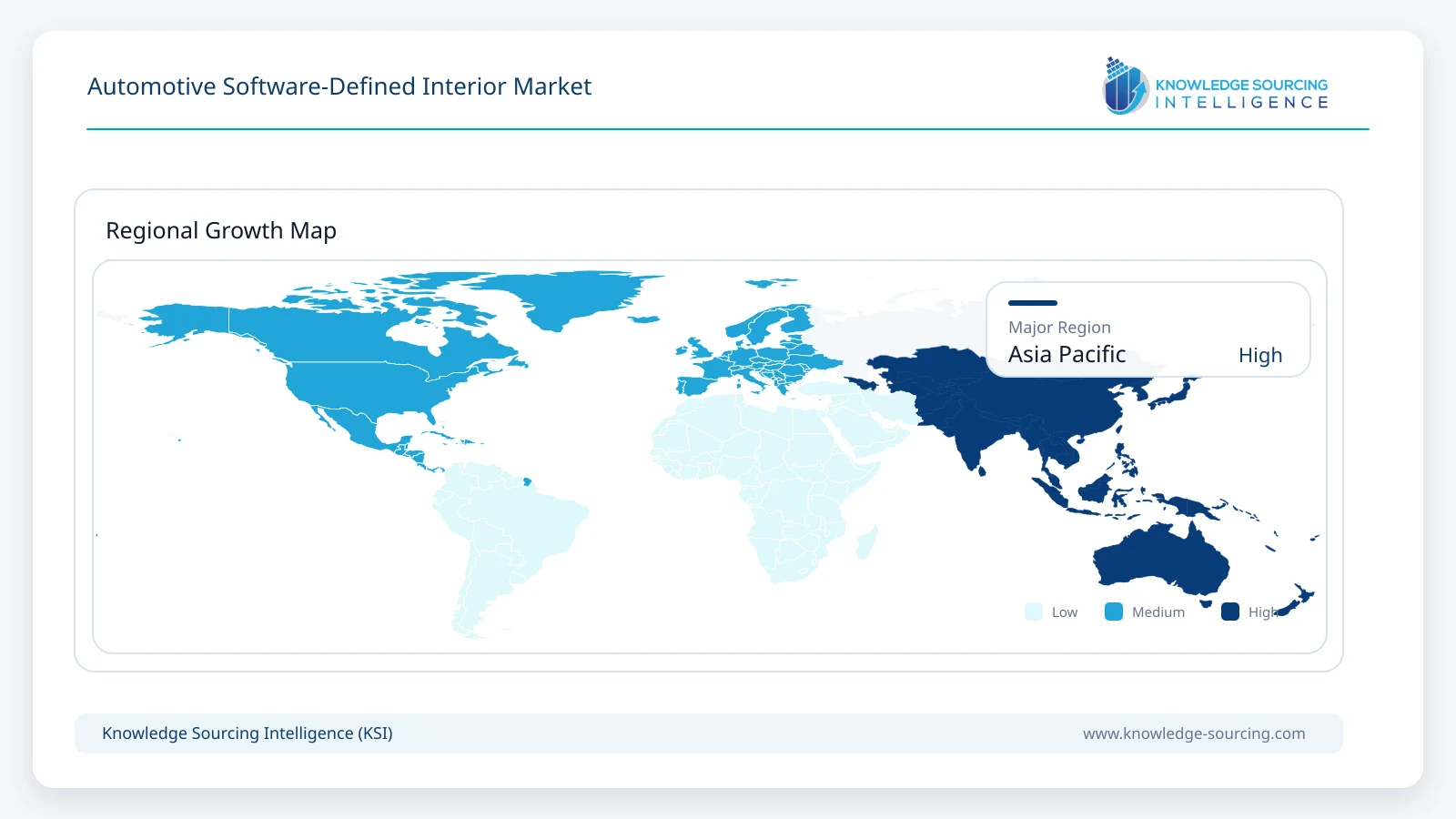
Asia Pacific is estimated to account for approximately 42% of 2026 market value and is expected to increase its position by 2031 as centralized cockpit platforms move further into mainstream vehicles. The region combines vehicle production scale with a dense electronics supply chain. Competition is likely to remain intense because OEM-owned operating stacks coexist with global Tier 1 suppliers and specialist software companies.
North America
Qualcomm’s expanding automotive platform partnerships and HARMAN’s Ready product releases reflect demand for cockpit software engineering, computing platforms and lifecycle services in North America. US automakers and technology partners also continue to invest in centralized E/E architectures for reusable software-defined experiences. Regional demand is weighted toward higher-value connected and digital-cockpit configurations rather than solely domestic assembly volumes.
Software sourcing in North America is shaped by strong semiconductor and middleware ecosystems and by the need to support diverse vehicle programs across the United States, Canada and Mexico. OEM platform standardization can improve adoption across model lines, although cloud infrastructure, software maintenance and program-specific security obligations limit how quickly software revenue scales with the vehicle parc.
Competitive Landscape
HARMAN, Visteon, LG Electronics, Panasonic Automotive Systems and AUMOVIO compete primarily through integrated cockpit programs, software stacks and the ability to coordinate multiple functions reliably. Their position differs from pure application software suppliers because they carry system-level responsibilities for performance, integration and OEM release timing. Panasonic’s confirmed CX-5 adoption and LG’s announced Renault supply agreement demonstrate the importance of awarded vehicle programs in assessing commercial maturity.
QNX and Elektrobit supply operating environments, middleware and development capabilities that sit below the visible interface, while Cerence specializes in voice and conversational interaction. Qualcomm provides the scalable automotive processing and associated software environment used by several Tier 1 suppliers. FORVIA and Yanfeng connect software to physical interior modules, but concept platforms and demonstrations must be distinguished from serial-production bookings when comparing supplier positions.
Recent Developments
October 2026: LG Electronics announced an integrated cluster-and-infotainment supply agreement for Renault Group’s New Trafic E-Tech Electric commercial vehicle. The program extends coordinated cockpit control into electric commercial vehicles.
July 2026: Panasonic Automotive Systems confirmed adoption of its cockpit-domain controller for Mazda’s all-new CX-5. The platform combines infotainment, instrument information, head-up display functionality, OTA support and driver-profile settings.
May 2026: LG Electronics presented an Android Automotive OS-based multi-display solution developed with Google. The demonstration showed how several driver and passenger displays can share a computing platform while supporting different in-cabin applications.
April 2026: Cerence announced that BYD would introduce its xUI conversational assistant in the ATTO 2 DM-i, with additional models planned. The agreement expands the application of multilingual, context-aware voice interaction in vehicle interiors.
January 2026: HARMAN introduced additions to its Ready in-cabin experience and software-defined vehicle portfolio, including technologies that coordinate audio and communication sources. The portfolio offers automakers a broader set of integrated cockpit functions.
January 2026: Visteon presented a high-performance cockpit computing solution built on Snapdragon Cockpit Elite. The platform targets software-intensive applications that require shared processing resources and responsive multi-display operation.
Market Outlook
The automotive software-defined interior market is forecast to expand from USD 6.40 billion in 2026 to USD 15.00 billion in 2031 as coordinated, updateable cabin software reaches more mainstream vehicle platforms. Passenger vehicles will remain the principal revenue source, while battery electric models are expected to account for a larger share of high-content software-defined interiors. Improved software portability across model lines will also help suppliers extend established applications into additional vehicle programs.
Centralized and cross-domain cockpit computing is expected to gain share as virtualized applications gradually replace dedicated controllers and separate software environments. Middleware providers, system integrators and cockpit suppliers will compete on safety partitioning, release reliability, software reuse and maintenance support. Automakers’ decisions about proprietary applications and supplier licensing will remain influential in shaping the balance between engineering contracts and recurring service revenue.
Automotive Software-Defined Interior Market Scope:
| Report Metric | Details |
|---|---|
| Total Market Size in 2026 | USD 6.40 billion |
| Total Market Size in 2031 | USD 15.00 billion |
| Forecast Unit | USD Billion |
| Growth Rate | 18.6% |
| Study Period | 2021 to 2031 |
| Historical Data | 2021 to 2024 |
| Base Year | 2025 |
| Forecast Period | 2026 – 2031 |
| Segmentation | Revenue Component, Primary Cabin Function, Software Update Capability, Vehicle Type, Propulsion, Geography |
| Companies |
|
Market Segmentation
By Revenue Component
Cabin Application and HMI Software
Operating Systems and Middleware
Software Engineering and Integration
Interior Control Electronics
Lifecycle Updates and Connected Software Services
By Primary Cabin Function
Digital Cockpit and Interface Orchestration
Cross-Domain Comfort and Personalization
Occupant Context and Cabin Sensing Integration
Passenger Media and In-Cabin Audio Software
Cabin Lifecycle Management and Security
By Electronic Architecture
Cockpit Domain-Controller Architecture
Centralized and Cross-Domain Computing
Distributed Networked Controllers
By Software Update Capability
Limited In-Service Software Upgrades
OTA-Enabled Feature Enhancement
Cloud-Connected Feature Lifecycle
By Vehicle Type
Passenger Vehicles
Light Commercial Vehicles
Medium and Heavy Commercial Vehicles and Buses
By Propulsion
Internal Combustion Engine Vehicles
Hybrid Electric Vehicles
Battery Electric Vehicles
By Geography
North America
United States
Canada
Mexico
South America
Brazil
Argentina
Others
Europe
Germany
United Kingdom
France
Italy
Spain
Others
Middle East and Africa
Saudi Arabia
United Arab Emirates
South Africa
Others
Asia Pacific
China
Japan
South Korea
India
Indonesia
Thailand
Taiwan
Australia
Others
Table of Contents
1. INTRODUCTION
1.1. Market Overview
1.2. Market Definition
1.3. Scope of the Study
1.4. Market Segmentation
1.5. Currency
1.6. Assumptions
1.7. Base and Forecast Years
1.8. Key Benefits to Stakeholders
2. RESEARCH METHODOLOGY
2.1. Research Design
2.2. Secondary Research
2.3. Primary Research
2.4. Market Estimation
2.5. Segment Modelling
2.6. Data Triangulation and Validation
3. EXECUTIVE SUMMARY
3.1. Key Findings
3.2. Automotive Software-Defined Interior Market Size, 2026–2031
3.3. Revenue Component Outlook
3.4. Cabin Function Outlook
3.5. Electronic Architecture Outlook
3.6. Software Update Capability Outlook
3.7. Vehicle Type and Propulsion Outlook
3.8. Regional Opportunity Summary
4. MARKET DYNAMICS
4.1. Market Drivers
4.1.1. Consolidation of Cockpit and Body Electronics
4.1.2. Vehicle Lifecycle Updates and Feature Maintenance
4.1.3. Expansion of Personalized Cabin Interaction
4.1.4. Software Reuse Across Brands and Vehicle Classes
4.1.5. Growth of Digitally Differentiated Electric and Premium Cabins
4.2. Market Restraints
4.2.1. Safety Partitioning and Multi-Domain Validation
4.2.2. Cybersecurity and Software-Update Compliance Costs
4.2.3. OEM Control over Cockpit Software and Supplier Pricing
4.2.4. Fragmented Hardware and Operating-System Environments
4.2.5. Consumer Trust, Distraction and Recurring-Fee Resistance
4.3. Market Opportunities
4.4. Porter’s Five Forces Analysis
4.5. Industry Value Chain Analysis
4.6. Cockpit Software Platform and Lifecycle Economics
4.7. Regulatory and Cybersecurity Environment
5. TECHNOLOGY OUTLOOK
5.1. Cockpit Domain and Centralized Computing
5.2. Virtualization and Mixed-Criticality Workloads
5.3. Android Automotive, Linux and Real-Time Operating Systems
5.4. Cabin Middleware and Service-Oriented Architectures
5.5. Over-the-Air Updates and Connected Software Services
5.6. Context-Aware AI and Multimodal Cabin Interfaces
5.7. Software Security and Data Protection
6. AUTOMOTIVE SOFTWARE-DEFINED INTERIOR MARKET BY REVENUE COMPONENT
6.1. Introduction
6.2. Cabin Application and HMI Software
6.3. Operating Systems and Middleware
6.4. Software Engineering and Integration
6.5. Interior Control Electronics
6.6. Lifecycle Updates and Connected Software Services
7. AUTOMOTIVE SOFTWARE-DEFINED INTERIOR MARKET BY PRIMARY CABIN FUNCTION
7.1. Introduction
7.2. Digital Cockpit and Interface Orchestration
7.3. Cross-Domain Comfort and Personalization
7.4. Occupant Context and Cabin Sensing Integration
7.5. Passenger Media and In-Cabin Audio Software
7.6. Cabin Lifecycle Management and Security
8. AUTOMOTIVE SOFTWARE-DEFINED INTERIOR MARKET BY ELECTRONIC ARCHITECTURE
8.1. Introduction
8.2. Cockpit Domain-Controller Architecture
8.3. Centralized and Cross-Domain Computing
8.4. Distributed Networked Controllers
9. AUTOMOTIVE SOFTWARE-DEFINED INTERIOR MARKET BY SOFTWARE UPDATE CAPABILITY
9.1. Introduction
9.2. Limited In-Service Software Upgrades
9.3. OTA-Enabled Feature Enhancement
9.4. Cloud-Connected Feature Lifecycle
10. AUTOMOTIVE SOFTWARE-DEFINED INTERIOR MARKET BY VEHICLE TYPE
10.1. Introduction
10.2. Passenger Vehicles
10.3. Light Commercial Vehicles
10.4. Medium and Heavy Commercial Vehicles and Buses
11. AUTOMOTIVE SOFTWARE-DEFINED INTERIOR MARKET BY PROPULSION
11.1. Introduction
11.2. Internal Combustion Engine Vehicles
11.3. Hybrid Electric Vehicles
11.4. Battery Electric Vehicles
12. AUTOMOTIVE SOFTWARE-DEFINED INTERIOR MARKET BY GEOGRAPHY
12.1. North America
12.1.1. United States
12.1.2. Canada
12.1.3. Mexico
12.2. South America
12.2.1. Brazil
12.2.2. Argentina
12.2.3. Others
12.3. Europe
12.3.1. Germany
12.3.2. United Kingdom
12.3.3. France
12.3.4. Italy
12.3.5. Spain
12.3.6. Others
12.4. Middle East and Africa
12.4.1. Saudi Arabia
12.4.2. United Arab Emirates
12.4.3. South Africa
12.4.4. Others
12.5. Asia Pacific
12.5.1. China
12.5.2. Japan
12.5.3. South Korea
12.5.4. India
12.5.5. Indonesia
12.5.6. Thailand
12.5.7. Taiwan
12.5.8. Australia
12.5.9. Others
13. COMPETITIVE ENVIRONMENT AND ANALYSIS
13.1. Major Players and Strategy Analysis
13.2. Market Share Analysis
13.3. Mergers, Acquisitions, Agreements and Collaborations
13.4. Competitive Dashboard
14. COMPANY PROFILES
14.1. HARMAN International
14.2. Visteon Corporation
14.3. LG Electronics Inc.
14.4. Panasonic Automotive Systems Co., Ltd.
14.5. AUMOVIO SE
14.6. Cerence Inc.
14.7. BlackBerry Limited (QNX)
14.8. Elektrobit Automotive GmbH
14.9. Qualcomm Technologies, Inc.
14.10. FORVIA SE
14.11. Robert Bosch GmbH
14.12. Yanfeng Automotive Interiors
15. APPENDIX
Navigate
Trusted by the world's leading organizations











