
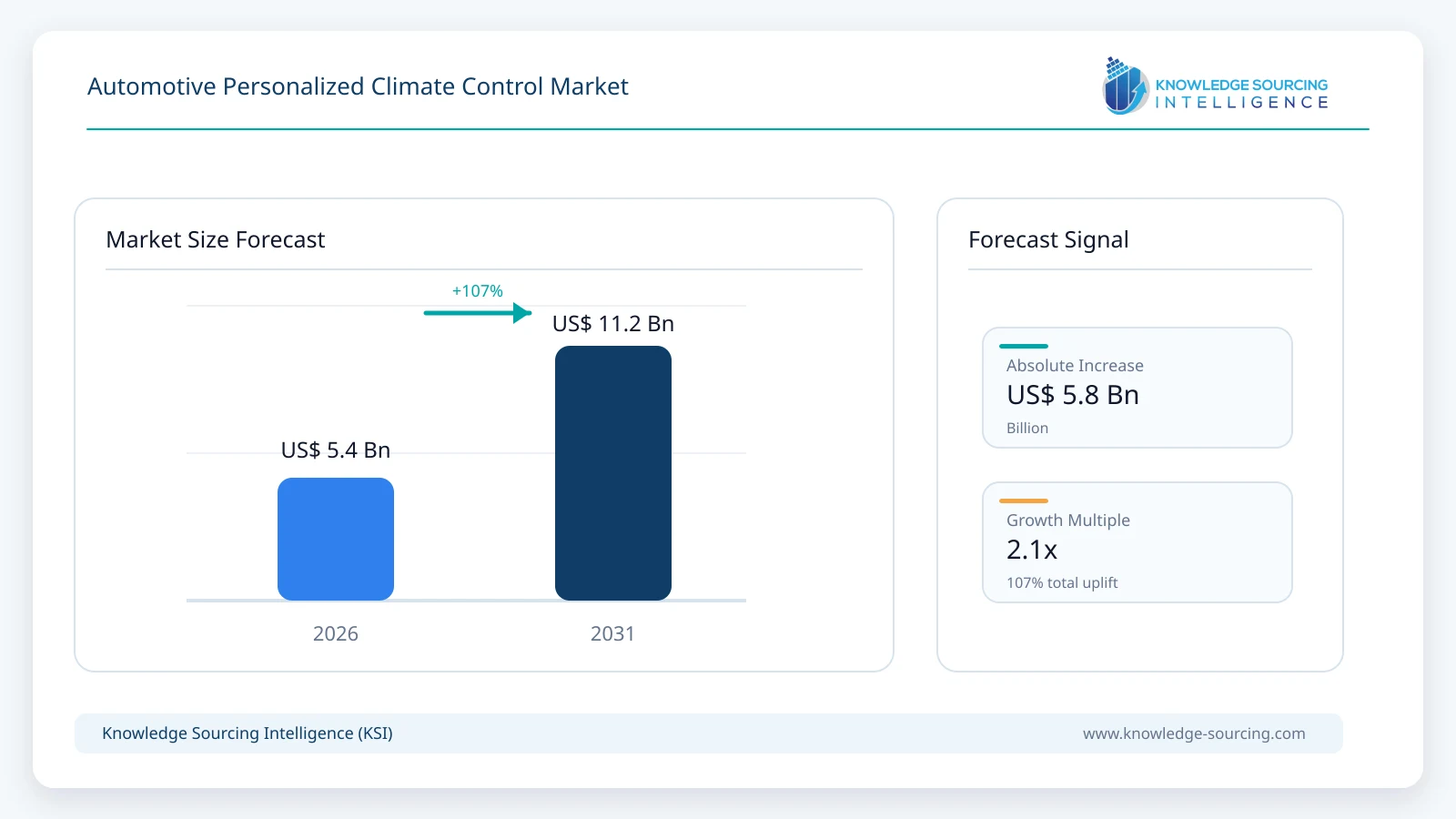
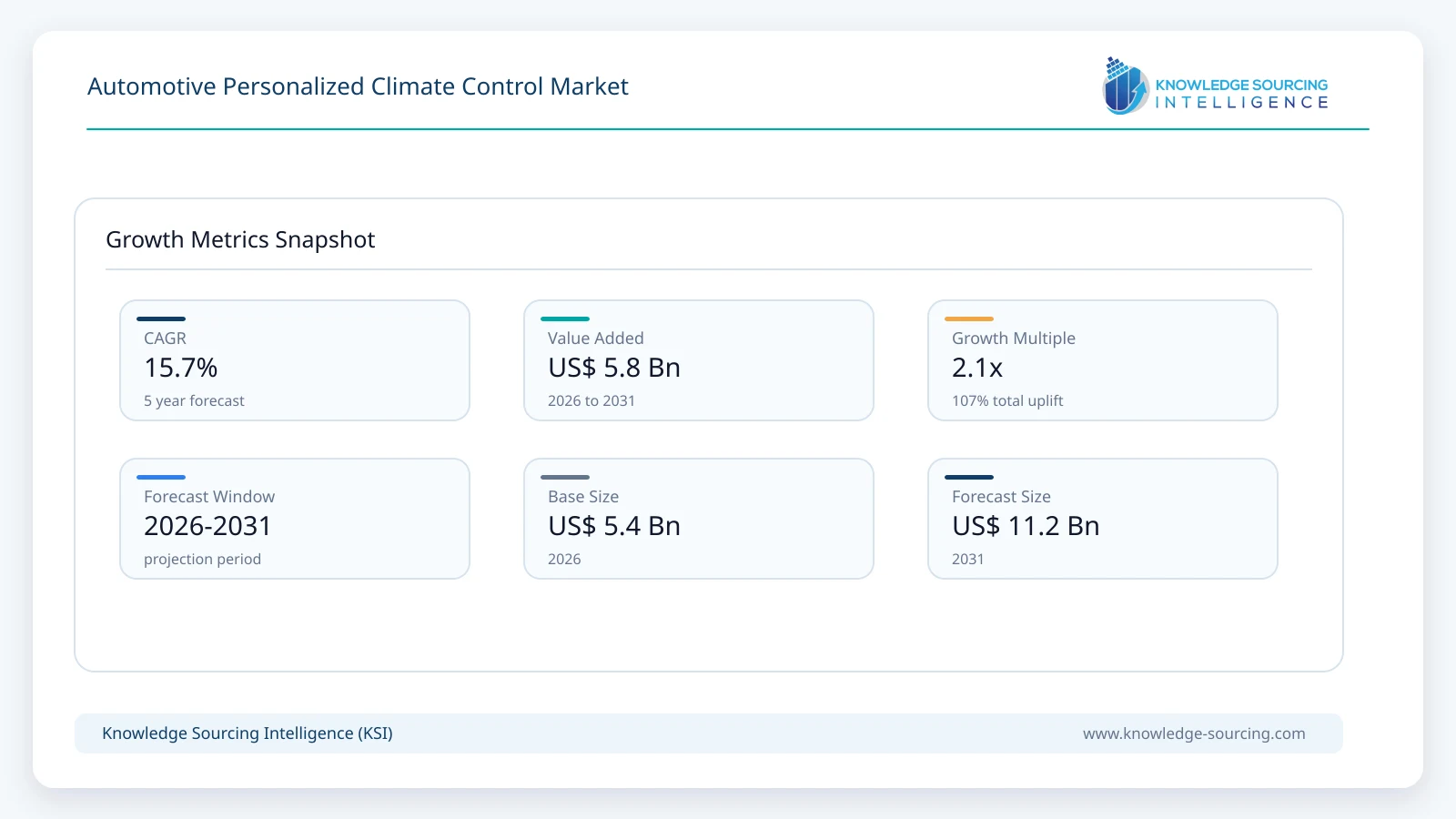
The automotive personalized climate control market is forecast to grow at a CAGR of 15.7%, reaching approximately USD 11.2 billion by 2031 from USD 5.40 billion in 2026.
Key Highlights
• Localized seat and surface thermal systems account for approximately 38% of global market value in 2026 because climate-controlled seats, radiant heating, seat ventilation and other near-body effectors provide the most direct and energy-efficient path to individual thermal comfort.
• Automated occupant-aware personalization represents approximately 51% of market value in 2026 as temperature, airflow and thermal effectors increasingly respond to occupant position, preference, environmental conditions and cabin sensing rather than relying only on manual settings.
• Front-row personalized climate applications account for approximately 57% of 2026 market value because driver and front-passenger positions carry the highest concentration of individual HVAC zones, climate-controlled seats, targeted vents and user-profile integration.
• Premium and luxury vehicles represent approximately 42% of global market value in 2026 because advanced multi-zone HVAC, seat climate control, radiant surfaces and occupant-aware software remain most concentrated in high-content interiors.
• Battery electric vehicles account for approximately 43% of market value in 2026 because personalized microclimate technologies can reduce whole-cabin HVAC demand while supporting the software-rich interiors common to EV platforms.
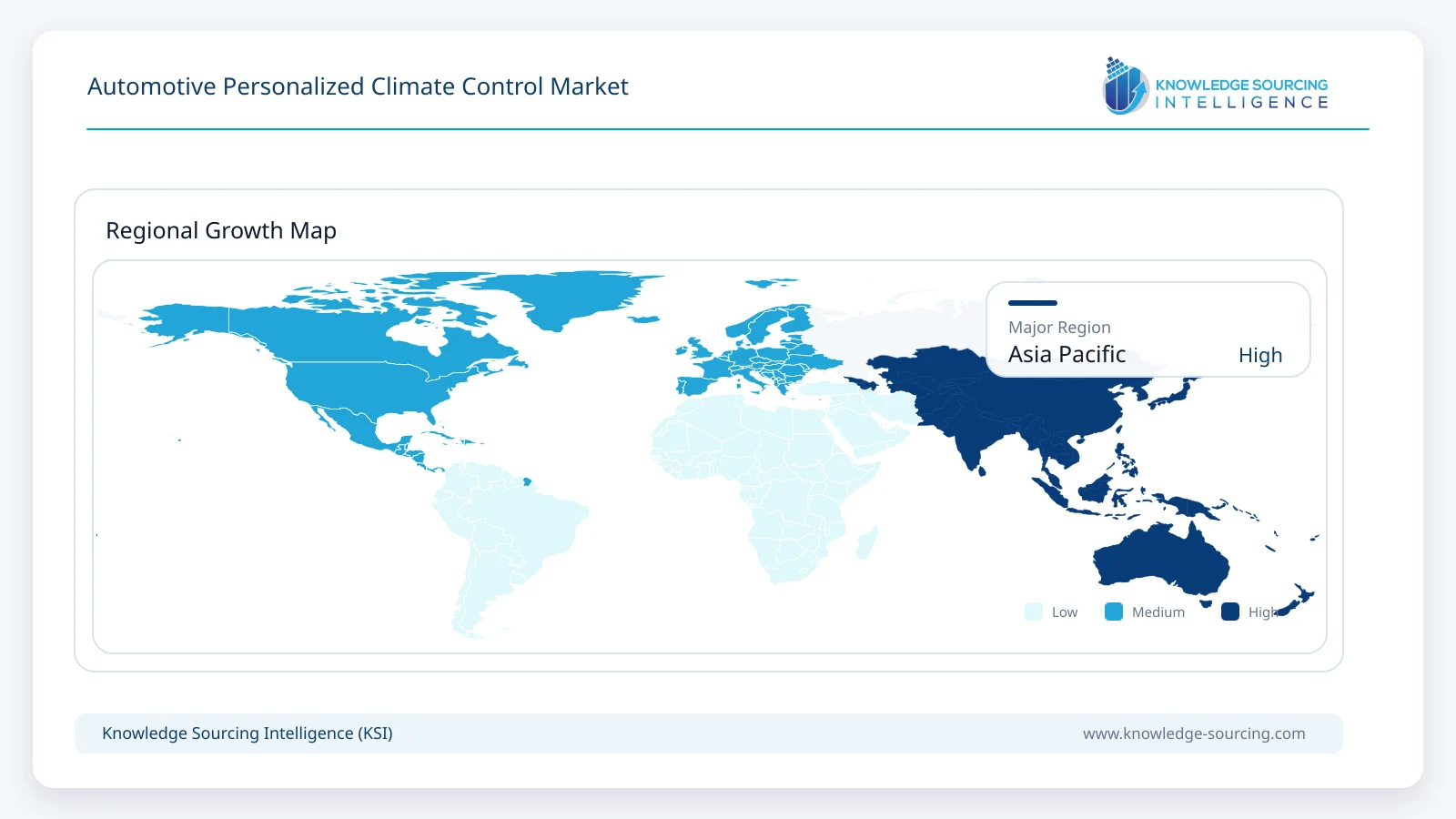
• Asia Pacific represents approximately 42% of global market value in 2026, supported by rapid smart-cabin development in China and established thermal-management capabilities in Japan and South Korea.
The market is moving from manually selected dual-zone temperature settings toward occupant-aware systems that combine central HVAC with seat, surface and airflow effectors to create a separate thermal microclimate for each person.
Commercial deployment is broadening across multiple supplier platforms. Gentherm ClimateSense uses occupant-centric software to coordinate localized conductive, convective and radiant heating and cooling. Lear is scaling ComfortFlex and ComfortMax thermal technologies across global vehicle programs. Valeo's Dual Layer HVAC uses AI-based temperature and airflow algorithms and a four-zone architecture, while Hanon Systems is expanding AI-integrated and software-defined thermal management. DENSO provides personal heating and cooling devices alongside multi-zone HVAC, and MAHLE is developing energy-efficient cabin thermal systems for electrified vehicles.
The strongest commercial proposition combines personalization with energy efficiency. Localized seat heating, ventilation, radiant surfaces and targeted airflow can reach thermal comfort faster than conditioning the full cabin volume, while occupant detection allows unoccupied zones to be reduced or switched off. This is particularly valuable in electric vehicles because cabin heating and cooling directly affect battery range.
Market Overview
Personalized climate control changes automotive thermal management from cabin-level temperature regulation to occupant-level thermal sensation management. Instead of using one central set point for everyone, the vehicle can distribute heating, cooling and airflow according to who is present, where each occupant is seated and what level of thermal comfort each person prefers.
Central HVAC remains important, but local thermal effectors increasingly provide the final layer of personalization. Seat heating and ventilation, radiant panels, steering-wheel heating, neck conditioning and directed air vents can influence perceived comfort more quickly than changing the temperature of the entire cabin air mass.
Gentherm ClimateSense illustrates the integrated approach. Its occupant-centric algorithm predicts thermal sensation and coordinates local heating and cooling effectors with central HVAC, allowing one seating zone to be warmed while another is cooled. The system is designed to reduce central HVAC demand while maintaining individualized comfort.
Valeo is taking a complementary path through intelligent air-based control. Its Dual Layer HVAC combines a four-zone design with AI-driven temperature and airflow algorithms that adjust according to the position of the driver and passengers. DENSO likewise supports multi-zone HVAC and personal heating and cooling devices such as seat ventilation and radiant heaters.
The long-term direction is toward predictive thermal comfort. Vehicles will increasingly use occupant identity, seat position, clothing assumptions, solar load, ambient temperature, prior preferences and possibly physiological information to determine the most efficient combination of airflow, seat conditioning and surface heating without repeated manual input.
Market Trends
Localized Thermal Effectors Are Reducing Reliance on Whole-Cabin HVAC
Seat heating and ventilation, radiant panels and targeted airflow deliver thermal energy close to the body, allowing occupants to feel comfortable before the complete cabin reaches a uniform target temperature. This is especially important during vehicle start-up and in extreme hot or cold conditions.
Localized systems also allow different occupants to receive opposite thermal treatments at the same time, which is difficult to achieve efficiently using conventional central HVAC alone.
Occupant-Aware Automation Is Replacing Manual Multi-Zone Climate Settings
Traditional dual-zone and four-zone systems still depend heavily on user-selected temperature settings. Newer architectures increasingly use seat occupancy, body position, cabin sensors and user profiles to change temperature and airflow automatically.
Valeo's position-aware Dual Layer HVAC and Gentherm's occupant-centric ClimateSense software demonstrate how automation can shift the market from separate manual zones toward continuously optimized personal microclimates.
EV Range Pressure Is Accelerating Personalized Thermal Management
Cabin heating and cooling can materially reduce electric-vehicle range, particularly in extreme temperatures. Personalized climate systems address this by conditioning the occupied person and immediate zone instead of expending energy on empty seats and unused cabin volume.
This creates a dual value proposition: improved thermal comfort and reduced energy demand. Suppliers are therefore integrating personal climate technologies more closely with heat pumps, preconditioning and whole-vehicle thermal-management software.
Software-Defined Thermal Control Is Increasing Personalization Depth
Centralized electronics allow HVAC, seats, radiant surfaces, occupant sensing and user profiles to operate through shared software. The vehicle can remember individual preferences, predict desired settings and update comfort algorithms over the air.
As software becomes more important, value is shifting from fixed hardware settings toward thermal models, control logic and calibration that can improve throughout the vehicle lifecycle.
Second-Row Climate Personalization Is Expanding beyond Flagship Vehicles
Premium rear-seat passengers increasingly receive independent climate zones, ventilated seats and localized controls. The trend is expanding from executive sedans into premium SUVs, MPVs and high-content electric vehicles.
Modular seat climate systems and distributed electronics are expected to lower the cost of extending personalization beyond the front row, increasing content per vehicle through 2031.
Segment Analysis
By Climate Technology: Localized Seat and Surface Thermal Systems
Localized seat and surface thermal systems are projected to generate approximately USD 4.30 billion of market value by 2031. Growth will be driven by climate-controlled seats, seat ventilation, radiant heating, steering-wheel and neck conditioning, and other effectors that act directly on occupant thermal sensation.
The segment will remain the largest because near-body thermal control can improve time-to-comfort while using less energy than conditioning the full cabin volume. Integration with central HVAC software will further increase value per seating position.
By Personalization Method: Automated Occupant-Aware Climate Control
Automated occupant-aware climate control is projected to generate approximately USD 6.10 billion by 2031. These systems combine occupant detection, location, user profiles, environmental sensing and thermal algorithms to determine the appropriate mix of airflow, heating and cooling automatically.
The segment is expected to gain share because automatic personalization reduces manual interaction and allows the system to respond continuously as sunlight, outside temperature, seat occupancy and occupant activity change.
By Occupant Zone: Front-Row Occupants
Front-row personalized climate applications are projected to generate approximately USD 6.00 billion of market value by 2031. Driver and front-passenger positions retain the highest concentration of independent HVAC control, climate seats, targeted vents, heated controls and user-profile integration.
Second-row adoption will expand more rapidly, particularly in premium SUVs and MPVs, but the front row will remain the largest value pool because of higher feature density and stronger connection with driver and vehicle control systems.
By Vehicle Class: Premium and Luxury Vehicles
Premium and luxury vehicles are projected to generate approximately USD 4.40 billion of personalized climate-control market value by 2031. These models provide the strongest early commercialization channel for multi-zone HVAC, climate-controlled seating, radiant surfaces and sensor-based personalization.
Modular effectors and shared software platforms are expected to move simpler occupant-specific thermal functions into upper-mid and mass-market vehicles over the forecast period.
By Propulsion: Battery Electric Vehicles
Battery electric vehicles are projected to generate approximately USD 4.80 billion of market value by 2031. EV platforms provide a strong technical and economic case for personal climate because HVAC energy directly affects range and because centralized electronics support coordinated control across multiple thermal effectors.
Heat-pump integration, preconditioning and smart zone management will strengthen this advantage, allowing personalized climate systems to operate as part of broader vehicle energy-management strategies.
Market Drivers
Growing Demand for Individual Thermal Preferences within Shared Cabins
Occupants frequently prefer different temperatures and airflow levels, particularly when age, clothing, sunlight exposure and activity differ. Personalized climate systems allow each seating position to receive a distinct thermal environment rather than forcing compromise around one cabin set point.
This improves perceived comfort and creates a visible premium feature that automakers can use to differentiate high-content interiors.
EV Energy Efficiency and Driving-Range Optimization
Heating and cooling the complete cabin can consume significant battery energy. Localized climate systems reduce the amount of air and surface area that must be conditioned, improving time-to-comfort while lowering demand on the central HVAC system.
The combination of seat climate, radiant surfaces and smart airflow is therefore becoming part of the broader thermal-efficiency strategy for electric vehicles.
Expansion of Occupant Sensing and User-Profile Technologies
Seat occupancy sensors, in-cabin cameras and digital user profiles allow the vehicle to identify who is present and where they are seated. Climate software can use these inputs to activate only occupied zones and restore personal preferences automatically.
As sensing becomes more accurate, thermal personalization can respond not only to seat occupancy but also to body position, activity and changing cabin conditions.
Growth of Software-Defined and Zonal Vehicle Architectures
Centralized and zonal electronics make it easier to coordinate HVAC units, seat thermal effectors, radiant surfaces and sensors through common software. This supports adaptive algorithms, persistent profiles and over-the-air comfort improvements.
Software-defined architecture also lets OEMs differentiate climate functionality across trims without completely redesigning the underlying thermal hardware.
Vehicle Premiumization and Competition around Cabin Experience
As powertrains become more standardized, cabin experience becomes a stronger source of differentiation. Personalized thermal comfort provides a feature that occupants experience immediately and repeatedly, making it attractive for premium EVs, SUVs and executive vehicles.
Supplier modularity is gradually reducing cost, allowing individual climate functions to migrate into broader vehicle segments.
Market Restraints
Higher Hardware and Integration Cost than Conventional HVAC
Personalized climate systems can require additional vents, valves, seat blowers, heating elements, radiant panels, sensors and controllers. The incremental bill of materials remains difficult to justify in lower-cost vehicles.
Scaling depends on multifunctional components and shared software that can deliver several comfort functions without excessive hardware duplication.
Complex Calibration across Occupants and Environmental Conditions
Thermal comfort varies with body size, clothing, age, sunlight, humidity and personal preference. A control strategy that works for one occupant may feel too warm or too cold for another under identical cabin conditions.
Automakers therefore need extensive human-factors testing and adaptive algorithms, increasing development and calibration effort across global climates.
Packaging and Air-Distribution Constraints
Independent zones require ducts, vents, valves or local effectors that must fit within limited cabin and seat space. Rear-seat personalization can be particularly difficult where packaging, legroom and seat-folding requirements constrain additional hardware.
Suppliers must reduce component size and integrate functions more tightly into seats, consoles and interior surfaces.
Risk of Energy Savings Being Offset by Excessive Feature Use
Personalized climate can reduce central HVAC demand, but complex seat conditioning, pumps, blowers and multiple zones also consume electrical power. Poorly coordinated systems may therefore lose part of the expected energy benefit.
Effective energy management requires the vehicle to prioritize the most efficient thermal effectors and deactivate unused zones automatically.
Privacy and Acceptance of Sensor-Driven Personalization
Advanced climate personalization may use occupant identity, camera data, stored preferences or physiological information. Some users may resist continuous monitoring or cloud-linked comfort profiles.
Local processing, transparent consent and simple manual override will be important as thermal comfort becomes more dependent on occupant data.
Regional Outlook
Asia Pacific
Asia Pacific is the largest regional market and is expected to remain the strongest growth centre through 2031. China is rapidly expanding multi-zone and smart-cabin climate content across premium EVs, while Japan and South Korea contribute deep expertise in HVAC, heat pumps, seating and occupant-focused thermal technologies.
Valeo has secured 10 Dual Layer HVAC contracts with five customers in China, using a four-zone design and AI-based temperature and airflow control. DENSO provides personal heating and cooling devices alongside advanced HVAC, while Hanon Systems is expanding AI-integrated and software-defined thermal-management solutions.
Growth will be supported by rapid EV adoption, premium smart-cabin competition and high vehicle production. Suppliers that can combine personalized comfort with low energy demand and scalable cost are positioned to benefit most from the regional opportunity.
Europe
Europe is a major high-value market because premium automakers and thermal-management suppliers continue to push energy-efficient comfort, heat-pump integration and personalized cabin functions. Gentherm, Lear, Valeo and MAHLE all maintain strong European OEM relationships or development activity.
Lear is scaling ComfortFlex and ComfortMax across European programs including Audi and BMW, while MAHLE is developing efficient cabin-heating technologies such as HeatX Range+. Valeo's localized and intelligent HVAC portfolio also supports the region's strong focus on EV efficiency and passenger comfort.
Growth through 2031 will depend on meeting stringent efficiency targets while maintaining rapid time-to-comfort. Integration with heat pumps, zonal electronics and software-defined vehicle architectures will remain central to competitive differentiation.
Competitive Landscape
The automotive personalized climate control market includes thermal-management, seating and cabin-system suppliers that directly control the thermal environment around individual occupants. Gentherm, Lear, Valeo, Hanon Systems, MAHLE and DENSO are directly active across occupant-centric climate software, multi-zone HVAC, seat thermal systems, heat pumps and localized heating and cooling technologies.
Gentherm is differentiated by ClimateSense, which combines thermophysiology-based software with localized conductive, convective and radiant effectors. Lear combines complete-seat capability with ComfortFlex, ComfortMax and related thermal modules, while Valeo provides multi-zone HVAC and AI-driven occupant-position-based airflow control.
Hanon Systems and MAHLE contribute broader vehicle thermal-management integration, including software-defined control and energy-efficient heat recovery, while DENSO combines multi-zone HVAC, heat pumps and personal heating/cooling devices. Competition is increasingly shifting toward suppliers that can manage comfort and energy efficiency together through integrated hardware and software.
Recent Developments
• 12 August 2026: Hanon Systems was named a 2026 Automotive News PACE Award finalist for its Highly Integrated Cooling Entity, reinforcing its next-generation EV thermal-management architecture and software-defined climate strategy.
• 31 July 2026: Lear reported significant new and conquest awards with Audi for complete seats, ComfortFlex and FlexAir in Europe and North America, expanding production adoption of modular occupant thermal-comfort systems.
• 23 July 2026: Gentherm reported USD 690 million of automotive new-business awards in the second quarter and 14.1% year-over-year growth in Automotive Climate and Comfort Solutions revenue.
• 26 May 2026: Hanon Systems announced its 2030 growth strategy with an explicit focus on strengthening software capabilities for the software-defined vehicle era alongside next-generation thermal-management technologies.
• 1 May 2026: Lear reported new ComfortFlex awards with Audi and BMW and a ComfortMax Seat award with Geely, broadening global adoption of modular personalized thermal-comfort technologies.
• 30 April 2026: Hanon Systems announced that it is expanding AI-based integrated thermal-management solutions and software capabilities to improve energy efficiency across future vehicle platforms.
• 9 February 2026: MAHLE introduced HeatX Range+, a cabin heat-recovery system designed to reduce EV air-conditioning energy demand by approximately 20% while maintaining thermal comfort and cabin air quality.
• 24 September 2025: Valeo announced additional contracts for its Dual Layer four-zone HVAC in China, using AI-driven temperature and airflow algorithms that adjust according to driver and passenger position, with serial production scheduled from 2026.
Market Outlook
The automotive personalized climate control market is expected to expand steadily through 2031 as thermal comfort becomes more occupant-specific, software-controlled and energy-aware. Localized seat and surface effectors will remain the largest hardware value pool, while faster growth is expected in occupant sensing, predictive algorithms and integrated multi-zone control.
The market will increasingly move from manually selected zones toward autonomous thermal personalization. Vehicles will identify who is seated, learn individual preferences and coordinate central HVAC, seat climate, radiant surfaces and targeted airflow in real time according to solar load, outside conditions and energy availability.
Asia Pacific is expected to retain the largest regional share, while Europe remains a major premium engineering and commercialization market. Competitive advantage will depend on rapid time-to-comfort, measurable energy savings, scalable thermal hardware, robust occupant sensing and software that can balance individual preferences with whole-vehicle energy management.
Automotive Personalized Climate Control Market Scope:
| Report Metric | Details |
|---|---|
| Total Market Size in 2026 | USD 5.40 billion |
| Total Market Size in 2031 | USD 11.2 billion |
| Forecast Unit | USD Billion |
| Growth Rate | 15.7% |
| Study Period | 2021 to 2031 |
| Historical Data | 2021 to 2024 |
| Base Year | 2025 |
| Forecast Period | 2026 – 2031 |
| Segmentation | Climate Technology, Personalization Method, Occupant Zone, Vehicle Class, Propulsion, Geography |
| Companies |
|
Market Segmentation
By Climate Technology
Localized Seat and Surface Thermal Systems
Multi-Zone HVAC and Personalized Airflow Systems
Radiant and Infrared Heating Systems
Sensors, Climate Controllers and Software
By Personalization Method
Automated Occupant-Aware Climate Control
Profile-Based Personalized Climate
Manual Multi-Zone Climate Control
By Occupant Zone
Front-Row Occupants
Second-Row Occupants
Third-Row and Rear Occupants
By Vehicle Class
Premium and Luxury Vehicles
Mid-Range Vehicles
Mass-Market and Economy Vehicles
By Propulsion
Battery Electric Vehicles
Hybrid and Plug-in Hybrid Electric Vehicles
Internal Combustion Engine Vehicles
Fuel Cell Electric Vehicles
By Geography
North America
United States
Canada
Mexico
South America
Brazil
Argentina
Others
Europe
Germany
United Kingdom
France
Italy
Spain
Others
Middle East and Africa
Saudi Arabia
UAE
South Africa
Others
Asia Pacific
China
Japan
South Korea
India
Singapore
Others
Table of Contents
1. INTRODUCTION
1.1. Market Overview
1.2. Market Definition
1.3. Scope of the Study
1.4. Market Segmentation
1.5. Currency
1.6. Assumptions
1.7. Base and Forecast Years
1.8. Key Benefits to Stakeholders
2. RESEARCH METHODOLOGY
2.1. Research Design
2.2. Secondary Research
2.3. Primary Research
2.4. Market Estimation
2.5. Segment Modelling
2.6. Data Triangulation and Validation
3. EXECUTIVE SUMMARY
3.1. Key Findings
3.2. Automotive Personalized Climate Control Market Size, 2026-2031
3.3. Climate Technology Outlook
3.4. Personalization Method Outlook
3.5. Occupant Zone Outlook
3.6. Vehicle Class Outlook
3.7. Propulsion Outlook
3.8. Regional Opportunity Summary
4. MARKET DYNAMICS
4.1. Market Drivers
4.1.1. Growing Demand for Individual Thermal Preferences within Shared Cabins
4.1.2. EV Energy Efficiency and Driving-Range Optimization
4.1.3. Expansion of Occupant Sensing and User-Profile Technologies
4.1.4. Growth of Software-Defined and Zonal Vehicle Architectures
4.1.5. Vehicle Premiumization and Competition around Cabin Experience
4.2. Market Restraints
4.2.1. Higher Hardware and Integration Cost than Conventional HVAC
4.2.2. Complex Calibration across Occupants and Environmental Conditions
4.2.3. Packaging and Air-Distribution Constraints
4.2.4. Risk of Energy Savings Being Offset by Excessive Feature Use
4.2.5. Privacy and Acceptance of Sensor-Driven Personalization
4.3. Market Opportunities
4.4. Porter's Five Forces Analysis
4.5. Industry Value Chain Analysis
4.6. Personalized Climate System Economics
4.7. Human-Factors, Energy-Efficiency and Data-Privacy Environment
5. TECHNOLOGY OUTLOOK
5.1. Multi-Zone and Seat-Specific HVAC Control
5.2. Climate-Controlled Seating and Seat Ventilation
5.3. Radiant Heating and Thermal Interior Surfaces
5.4. Targeted Airflow, Neck Conditioning and Localized Ventilation
5.5. Occupant Detection, Position and Thermal-Preference Sensing
5.6. Thermophysiology-Based Comfort Modelling
5.7. AI and Predictive Thermal Comfort Algorithms
5.8. User Profiles and Automatic Preference Restoration
5.9. Smart Recirculation, Humidity and Solar-Load Integration
5.10. Heat Pumps, Preconditioning and EV Energy Optimization
5.11. Climate ECUs, Zonal Controllers and Cross-Domain Software
6. AUTOMOTIVE PERSONALIZED CLIMATE CONTROL MARKET BY CLIMATE TECHNOLOGY
6.1. Introduction
6.2. Localized Seat and Surface Thermal Systems
6.3. Multi-Zone HVAC and Personalized Airflow Systems
6.4. Radiant and Infrared Heating Systems
6.5. Sensors, Climate Controllers and Software
7. AUTOMOTIVE PERSONALIZED CLIMATE CONTROL MARKET BY PERSONALIZATION METHOD
7.1. Introduction
7.2. Automated Occupant-Aware Climate Control
7.3. Profile-Based Personalized Climate
7.4. Manual Multi-Zone Climate Control
8. AUTOMOTIVE PERSONALIZED CLIMATE CONTROL MARKET BY OCCUPANT ZONE
8.1. Introduction
8.2. Front-Row Occupants
8.3. Second-Row Occupants
8.4. Third-Row and Rear Occupants
9. AUTOMOTIVE PERSONALIZED CLIMATE CONTROL MARKET BY VEHICLE CLASS
9.1. Introduction
9.2. Premium and Luxury Vehicles
9.3. Mid-Range Vehicles
9.4. Mass-Market and Economy Vehicles
10. AUTOMOTIVE PERSONALIZED CLIMATE CONTROL MARKET BY PROPULSION
10.1. Introduction
10.2. Battery Electric Vehicles
10.3. Hybrid and Plug-in Hybrid Electric Vehicles
10.4. Internal Combustion Engine Vehicles
10.5. Fuel Cell Electric Vehicles
11. AUTOMOTIVE PERSONALIZED CLIMATE CONTROL MARKET BY GEOGRAPHY
11.1. North America
11.1.1. United States
11.1.2. Canada
11.1.3. Mexico
11.2. South America
11.2.1. Brazil
11.2.2. Argentina
11.2.3. Others
11.3. Europe
11.3.1. Germany
11.3.2. United Kingdom
11.3.3. France
11.3.4. Italy
11.3.5. Spain
11.3.6. Others
11.4. Middle East and Africa
11.4.1. Saudi Arabia
11.4.2. UAE
11.4.3. South Africa
11.4.4. Others
11.5. Asia Pacific
11.5.1. China
11.5.2. Japan
11.5.3. South Korea
11.5.4. India
11.5.5. Singapore
11.5.6. Others
12. COMPETITIVE ENVIRONMENT AND ANALYSIS
12.1. Major Players and Strategy Analysis
12.2. Market Share Analysis
12.3. Personalized Climate Technology Benchmarking
12.4. Product Launches and Development Activity
12.5. Competitive Dashboard
13. COMPANY PROFILES
13.1. Gentherm Incorporated
13.2. Lear Corporation
13.3. Valeo
13.4. Hanon Systems
13.5. MAHLE GmbH
13.6. DENSO Corporation
14. APPENDIX
14.1. Currency
14.2. Assumptions
14.3. Base and Forecast Years Timeline
14.4. Key Benefits for Stakeholders
14.5. Research Methodology
14.6. Abbreviations
14.7. Data Sources
Navigate
Trusted by the world's leading organizations











