
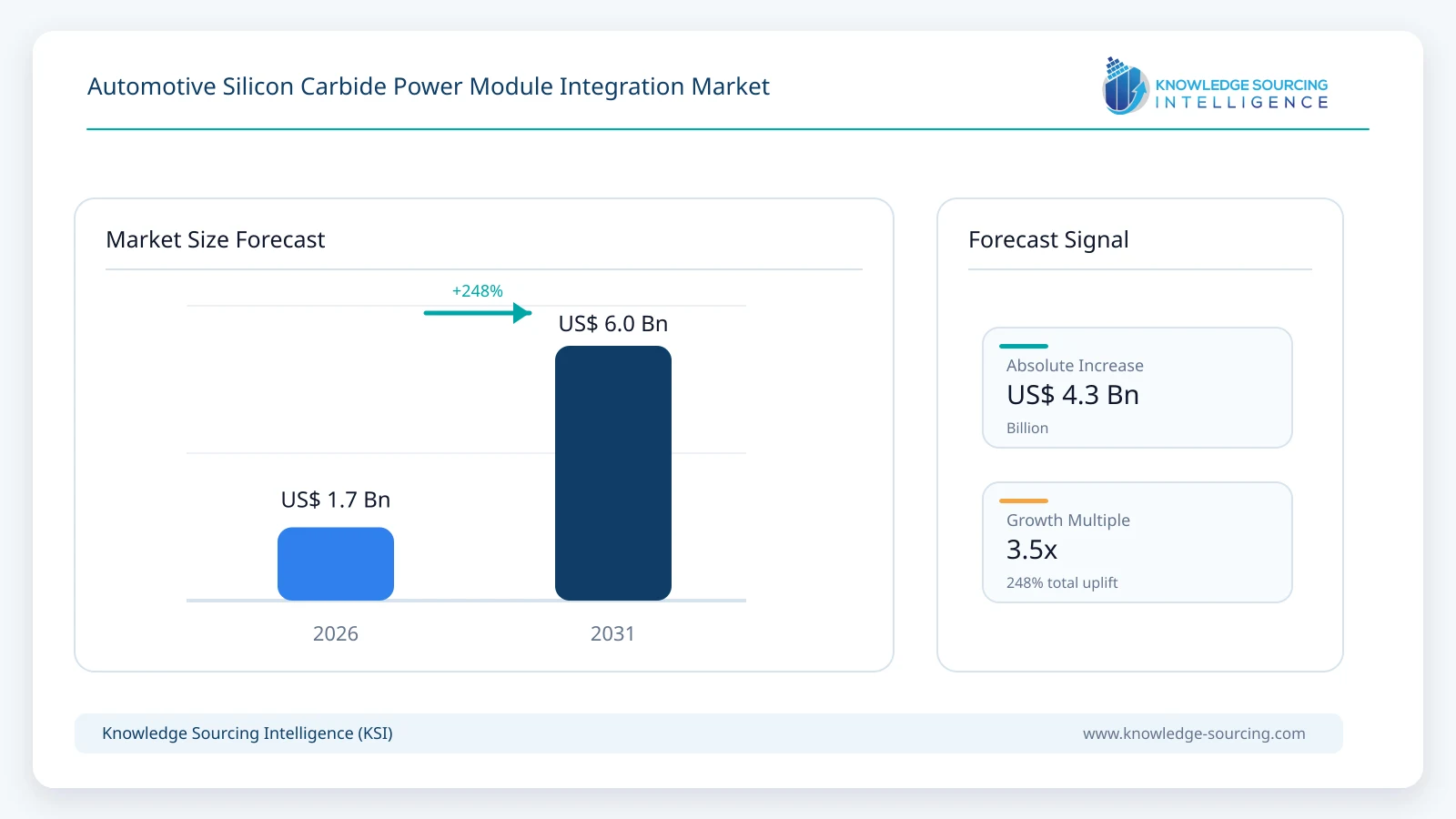
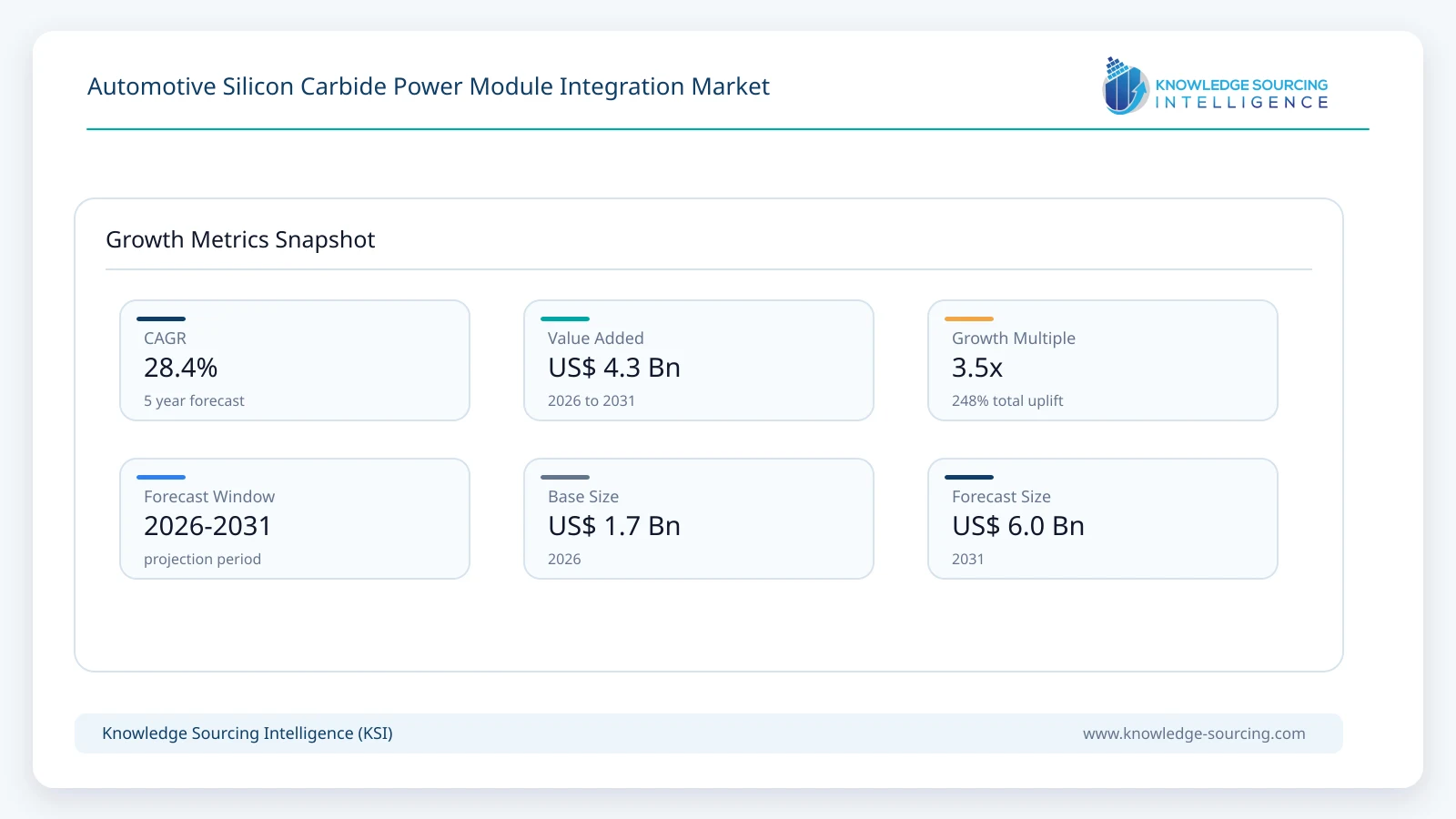
The automotive silicon carbide power-module integration market is projected to expand at a CAGR of 28.4%, increasing from USD 1.74 billion in 2026 to USD 6.05 billion by 2031.
Highlights:
- 1Global revenue is estimated at USD 1.735 billion in 2026 and USD 6.054 billion in 2031, reflecting broader module adoption and higher packaged content per electric vehicle.
- 2Traction inverter applications account for approximately 84% of 2026 supplier value; onboard charger modules form a smaller but increasingly important second application.
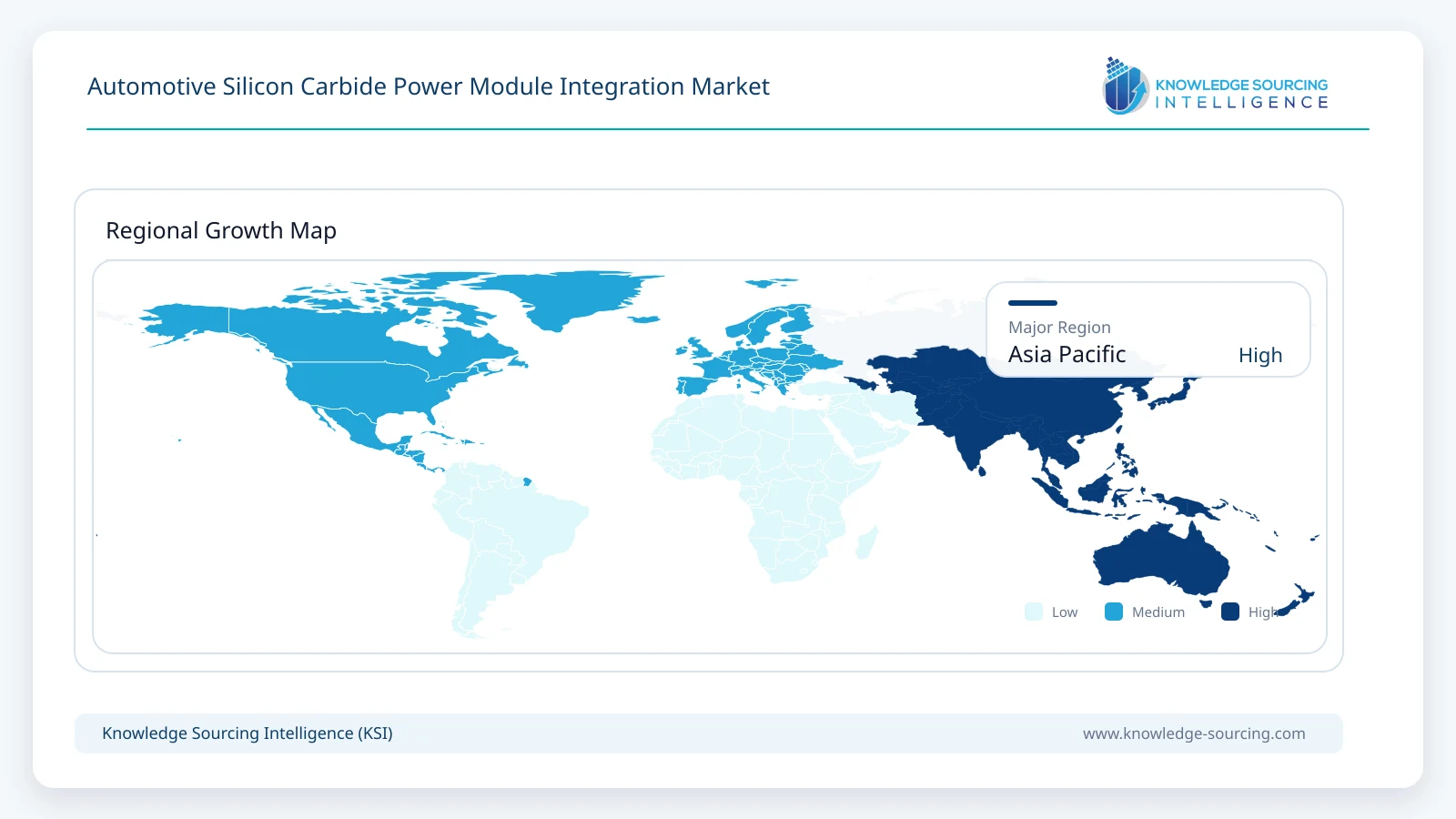
- 3Asia Pacific represents approximately 61% of market value in 2026, linked to China’s dominant electric-vehicle production base and regional power-device supply chains.
- 4Europe is forecast to gain market share through 2031 as European OEMs expand SiC inverter production and secure local module supply.
- 5Sixpack module configurations remain the largest architecture group, while double-sided or advanced thermal packaging gains adoption in high-power platforms.
- 6Automotive suppliers increasingly qualify SiC modules together with gate drives, cooling plates and busbar interfaces rather than as interchangeable semiconductor parts.
The global automotive silicon carbide power-module integration market covers qualified SiC power-switch assemblies and directly associated electrical and thermal integration content supplied for vehicle traction and high-voltage conversion systems. Modules combine multiple semiconductor switches, electrical isolation, substrate and bonding materials, signal connections and cooling interfaces into automotive-capable packages. Their ability to handle high switching speeds with lower conversion losses is particularly valuable in electric drive units where power density, durability and range matter.
Infineon’s HybridPACK Drive G2, ROHM’s TRCDRIVE pack and Semikron Danfoss’ eMPack illustrate the market’s move from individually mounted switching devices toward complete, tested power stages. Integrators can choose six-pack and half-bridge structures, direct-liquid cooling or more advanced bonded interfaces according to inverter power, mechanical envelope and production method. Module value rises when suppliers deliver optimized thermal and connection features, even as semiconductor unit costs decline with scale.
Market Overview
Electric traction inverters turn battery direct current into controlled three-phase power, placing repeated electrical and thermal stress on power-switch assemblies. Silicon carbide MOSFETs reduce switching losses and support higher bus voltages compared with conventional silicon designs in applications where those characteristics justify the premium. Packaged modules add insulation, low-inductance connections, cooling paths and production-ready mounting features; these details determine whether the device-level efficiency benefit survives at inverter level.
Infineon offers automotive CoolSiC modules across 750 V and 1200 V HybridPACK Drive variants, while ROHM’s TRCDRIVE pack targets traction inverters up to 300 kW. STMicroelectronics and Renault’s Ampere have also agreed on SiC power-module supply and collaborated on the inverter powerbox and cooling design. These examples show that semiconductor selection and mechanical/electrical integration are increasingly decided together during vehicle-platform development rather than purchased as unrelated inputs.
Module manufacturing spans substrates and epitaxy, MOSFET fabrication, die attach and sintering, insulated module substrates, molded packaging, testing and final integration with cooling and inverter hardware. Semikron Danfoss’ eMPack platform combines SiC devices with pressed-die and low-inductance packaging for different vehicle power classes. Commercial competition therefore depends on dependable wafer supply, power cycling performance, qualification evidence and automated module assembly as much as headline device efficiency.
Market Trends
Higher-Voltage Platforms Are Raising Power-Module Requirements
Automotive battery systems operating around the 800 V class require power switching assemblies with adequate voltage margin and controlled overshoot under hard acceleration and regenerative braking. Infineon supplies 1200 V CoolSiC module options and introduced a 1300 V automotive HybridPACK module in May 2026. The higher blocking-voltage option supports inverter design as battery operating windows and transient limits become more demanding.
Equipment makers are also balancing module voltage ratings against conduction loss, switching performance and cost. Higher voltage does not make every vehicle a candidate for the most expensive SiC assembly; qualification and inverter power determine where extra voltage margin produces a credible engineering benefit.
Module Cooling Is Moving Closer to the Semiconductor Package
Power-module suppliers are improving thermal paths through pin-fin cooling surfaces, sintered die attachment, double-sided bonding and optimized copper interconnects. Infineon’s new 205°C-rated module and Semikron Danfoss’ pressed-die eMPack design illustrate two routes for improving output capability while preserving acceptable junction temperature under variable drive loads.
Automakers evaluate module heat extraction alongside coolant routing, inverter footprint and long-duration peak-power requirements. Integrating a cooler with the module can simplify vehicle assembly, but the resulting design must also meet service and durability targets through years of thermal cycling.
OEM and Semiconductor Co-Design Is Reducing Interface Complexity
STMicroelectronics’ agreement with Ampere covers the SiC module together with the inverter powerbox and cooling interfaces, a closer design relationship than a stand-alone component purchase. ROHM’s 2026 reference inverter circuits similarly address the module and the surrounding drive-electronics design, helping engineering teams translate device specifications into repeatable inverter layouts.
Integrated packages can shorten the time needed to qualify gate-drive behavior, short-circuit protection, electromagnetic compatibility and power-terminal connections. Successful platforms retain value for module makers through long production cycles, but substantial upfront validation is required before the first unit is shipped.
SiC Is Extending from BEV Traction into PHEV and Onboard Conversion
Battery electric traction systems lead automotive SiC demand because the inverter is a high-power conversion stage exposed to frequent acceleration and regeneration. onsemi’s July 2025 Schaeffler design win demonstrates an additional route into plug-in hybrids, where smaller battery packs and tight packaging can make inverter efficiency valuable.
ROHM’s HSDIP20 modules target onboard charger power-factor correction and resonant conversion stages, extending integrated SiC content beyond traction alone. The value per vehicle is lower in many charging-conversion applications, but module attachment can improve as charger power levels and integrated packaging requirements increase.
Automotive Qualification Is Becoming a Platform Differentiator
Automotive SiC modules combine high-speed switching with demanding vibration, temperature and short-circuit exposure. Infineon positions HybridPACK Drive G2 around automotive qualification and repeatable packaging, while Semikron Danfoss designs eMPack for high-reliability liquid-cooled inverter duty. These attributes are critical when inverter failure would immobilize a vehicle.
Once a module has passed platform-level electrical, thermal and mechanical validation, changing supplier or package geometry may force substantial redesign and retesting. Suppliers with stable manufacturing yields and long-life product commitments therefore hold an advantage over products with attractive laboratory performance but limited automotive production history.
Segment Analysis
By Power Conversion Application: Traction Inverter Modules
Traction inverter assemblies account for about 84% of 2026 market value because a vehicle’s main drive inverter carries much higher switching power than most onboard auxiliary converters. Battery electric models dominate this pool, while selected plug-in hybrids use SiC for improved drive efficiency and packaging. Power-stage packaging, thermal behavior and manufacturing consistency therefore determine the commercial value of the supplied traction module.
Infineon’s HybridPACK Drive G2 and ROHM’s TRCDRIVE packs address vehicle inverter makers through standardized current and voltage variants. Supplier differentiation increasingly comes from low-inductance terminals, cooling arrangements and validated gate-driver compatibility, which can reduce assembly risk for large-scale OEM platforms.
By Module Configuration: Sixpack Integrated Modules
Sixpack modules are projected to account for approximately 50% of market value in 2026 because they bring the three inverter phase legs into a consistent mechanical and cooling assembly. Shared packaging can simplify installation, electrical isolation and thermal contact compared with several separate power stages, especially in compact passenger EV inverters.
Half-bridge and 2-in-1 designs continue to suit flexible layouts and high-current platforms where drive-unit builders want greater freedom over connection geometry. Vehicle makers choose configurations according to inverter power, redundancy requirements, assembly automation and how readily the module can be replaced within an existing platform.
By Thermal Architecture: Direct Liquid-Cooled Modules
Single-sided direct liquid cooling is the largest modeled module thermal architecture in 2026, accounting for approximately 47% of integration revenue. Pin-fin and related designs create a short thermal path between the module substrate and the coolant, reducing the mechanical stack and allowing more power to be handled within a defined inverter envelope.
Double-sided and advanced bonded thermal interfaces increase their modeled share by 2031, particularly in high-power EV traction. The commercial opportunity depends on manufacturing repeatability and the durability of interconnects after repeated temperature changes, rather than cooler performance under a single laboratory test.
By Regional Market: Asia Pacific
Asia Pacific is estimated to account for 61% of 2026 automotive SiC module integration revenue. China provides the largest manufacturing base for electric cars, while Japan and South Korea contribute specialist semiconductor, module packaging and automotive electronics capabilities. The IEA reports that China produced almost three-quarters of the world’s electric cars in 2025, which strengthens the regional manufacturing ecosystem for power electronics suppliers.
China’s broad model range supports multiple SiC architectures, from high-performance 800 V traction systems to more cost-sensitive onboard converters. Although Asia Pacific remains the largest market by 2031, Europe is modeled to grow faster from a smaller base as more local vehicle platforms adopt qualified SiC power stages.
Market Drivers
Higher Electric-Vehicle Production
The IEA expects worldwide electric-car sales to reach approximately 23 million in 2026 following more than 20 million in 2025. Each qualifying traction inverter needs a set of power switches, packaging and thermal connections, so a larger electric-vehicle production base directly expands the potential annual demand for module assemblies.
Module penetration is not identical to the number of electric cars built, because silicon-based inverters and discrete SiC implementations remain common. Market growth comes from both expanding vehicle production and a rising share of platforms selecting complete, qualified SiC power modules.
Expansion of 800 V and Higher-Performance Drivetrains
High-voltage EV platforms favor switching devices that preserve efficiency while accommodating demanding operating voltage and power. Infineon’s 1200 V and 1300 V HybridPACK families give inverter manufacturers practical module choices for these platforms, while Valeo markets an 800 V SiC inverter suited to higher-output applications.
As bus voltage and performance requirements rise, OEMs place greater value on controlled parasitic inductance, insulation clearances and integrated thermal paths. These requirements strengthen the commercial role of complete power-module assemblies relative to device-only procurement.
Inverter Efficiency and Thermal Packaging
Lower switching loss reduces unwanted heat within the inverter and can help extend useful electric range, particularly under load profiles with frequent power transitions. At vehicle level, the benefit is only realized when gate drives, electrical connections and cooling systems are designed around the module’s switching behavior.
Advanced sintering, direct liquid cooling and improved substrate arrangements can reduce package thermal resistance and support smaller inverter hardware. Suppliers that deliver these attributes through a qualified power-stage module can capture additional integration value.
OEM Supply Agreements and Platform Commitments
Infineon’s announced Rivian R2 supply and STMicroelectronics’ agreement with Ampere indicate that module selection is increasingly linked to named vehicle programs and multiyear supply plans. These arrangements provide suppliers with a route to serial volumes and help automakers secure technology and manufacturing capacity.
Semiconductor and module suppliers invest earlier in assembly processes and testing when OEM demand is tied to a defined electric drivetrain. Platform decisions can sustain module revenue over several model years after qualification, increasing visibility compared with open-market component sales.
Packaged SiC Adoption in Onboard Chargers
Onboard charger designs are adopting higher power density and greater integration across power-factor-correction and isolated conversion stages. ROHM’s HSDIP20 SiC modules combine multiple switches into compact assemblies, illustrating the opportunity to replace board-level assembly work with prequalified converter modules.
Charging modules carry a smaller average value per vehicle than main traction modules, but their potential installation base spans electric cars and certain plug-in hybrids. Improved assembly automation and module standardization can make this a meaningful second revenue pool through 2031.
Market Restraints
SiC Module Cost Relative to Silicon Solutions
Automotive traction designers continue to compare silicon IGBT and SiC MOSFET module options according to vehicle price, power level and driving profile. SiC substrates, power-device fabrication and advanced module assembly can command a premium, which may not be recovered through efficiency savings in lower-cost vehicle classes.
Inverter makers therefore optimize die area, voltage class and module design rather than adopt the highest-performing SiC package universally. Silicon alternatives remain a viable competitive constraint for moderate-power applications and price-sensitive markets.
Packaging Reliability and Power-Cycling Demands
High-current SiC modules face repeated changes in junction temperature during acceleration, regenerative braking and charging. Interconnect fatigue, substrate cracking, encapsulation behavior and thermal-interface degradation can undermine reliability even when the semiconductor die performs well in isolation.
Qualification requires extensive thermal cycling, vibration, moisture and electrical-stress testing with the specific inverter cooler and mounting arrangement. Each design revision can delay vehicle release or increase engineering cost before the module enters serial production.
Gate-Drive and Electromagnetic Compatibility Complexity
Fast SiC switching edges can increase voltage overshoot, common-mode noise and unwanted coupling within inverter connections. Designers must control stray inductance, gate resistance, isolation performance and short-circuit response when integrating modules with busbars and controller boards.
Electromagnetic compatibility and insulation testing can make a nominally drop-in power module incompatible with an existing drive-unit architecture. These engineering requirements limit the pace at which OEMs can replace qualified silicon platforms with SiC modules.
Substrate and Manufacturing Supply Concentration
SiC power modules depend on qualified substrates, epitaxial material, device fabrication, module substrates and specialized sinter or bond processes. Disruption in one layer can restrict output even where demand exists for packaged traction power stages.
Automotive customers demand consistent wafer quality and long-duration traceability, making supplier changes difficult once modules enter a vehicle program. Manufacturers must balance secure volume supply with inventory commitments and the financial risk of adding capacity ahead of confirmed orders.
Vehicle-Platform Redesign and Certification Cycles
Power-module footprint, cooler geometry, switching waveform and electrical interfaces are typically designed into the traction inverter early in vehicle development. Moving to a different package can require revised busbars, gate-control boards, liquid cooling hardware and mechanical tolerance checks.
Existing validated silicon or discrete-SiC platforms may consequently continue in production even when a newer packaged module offers better performance. Longer automotive design cycles slow substitution and can defer revenue recognition until the next scheduled platform refresh.
Regional Outlook
Asia Pacific
China is the leading production and deployment center for SiC module integration because its automotive industry manufactures a large share of global electric cars and supports a broad range of high-voltage drive systems. The IEA estimates China produced nearly 75% of electric cars globally in 2025. Chinese OEM programs also provide manufacturing scale for local packaging and international semiconductor suppliers, while Japan and South Korea contribute strong high-reliability power electronics capabilities.
Asia Pacific represents approximately 61% of global market value in 2026 and remains the largest region in 2031. Rising SiC penetration and more integrated thermal packaging support absolute revenue expansion, although a growing European contribution gradually reduces the region’s share. High competition in China also increases pressure to reduce module cost per kilowatt without compromising operating life.
Europe
European OEMs and module suppliers are developing SiC traction power stages as vehicle platforms migrate toward higher battery voltages and compact integrated drive units. STMicroelectronics’ Ampere agreement couples semiconductor supply with an inverter powerbox design, while Infineon and Semikron Danfoss provide qualified module architectures for local and international customers. Such relationships favor coordinated design of the switching stage, liquid cooler and power connections.
Europe accounts for an estimated 21% of 2026 market revenue and is projected to reach 23% by 2031, giving it the fastest modeled regional growth from the five-region structure. Germany and France provide important automotive engineering demand, with additional activity across other European production locations. Cost pressure remains significant as suppliers balance SiC capacity investments with changing electric-car production plans.
Competitive Landscape
Infineon, ROHM, STMicroelectronics, onsemi and Semikron Danfoss compete through combinations of SiC device technology, automotive-grade power-module packaging and production qualification. Infineon’s HybridPACK platform emphasizes broad current and voltage coverage; ROHM targets high-density molded assemblies; STMicroelectronics works with OEM powerbox requirements; and Semikron Danfoss stresses low-inductance automotive packaging. Manufacturing yield, package durability and dependable OEM delivery schedules are increasingly important buying criteria.
Tier-1 powertrain integrators such as Schaeffler and Valeo contribute a different layer of expertise through inverter and drive-unit integration, software controls and thermal architecture. They may source SiC modules or devices while selling a larger assembled inverter, while contributing inverter controls and thermal design that influence supplier selection. Their packaging choices shape which SiC device technologies can reach serial vehicle production.
Vehicle manufacturers evaluate a supplier’s electrical and thermal performance alongside automotive qualification history, defect rates, manufacturing redundancy, life-cycle support and willingness to co-develop module terminals or coolers. Packaging know-how is therefore a strategic asset: lower switching loss alone is insufficient unless performance is maintained after high-volume automated assembly and long-term vehicle operation.
Recent Developments
September 2026: ROHM confirmed use of its SiC MOSFETs in BMW Neue Klasse Gen 6 electric powertrain systems, highlighting broader adoption of SiC traction technology.
June 2026: Semikron Danfoss and Nexperia signed an agreement to explore automotive SiC module development, combining semiconductor expertise with module packaging capabilities.
May 2026: Infineon introduced a 1300 V HybridPACK Drive SiC module with a continuous 205°C operating-temperature rating for advanced traction inverter design.
March 2026: ROHM published new three-phase inverter reference designs covering TRCDRIVE and other SiC module packages to support faster converter integration.
December 2025: Fuji Electric and Bosch announced cooperation on mechanically compatible SiC power modules, common terminal arrangements and cooling interfaces for electric vehicle inverters.
May 2025: Infineon announced planned supply of SiC and silicon HybridPACK Drive G2 power modules for the Rivian R2 electric vehicle platform, beginning in 2026.
Market Outlook
Qualified SiC module demand should expand as electric-car production grows, the share of BEVs using SiC traction power stages increases and more vehicles adopt higher-voltage architectures. Integration content will shift toward thermal and electrical packaging that enables inverter makers to extract device performance without adding assembly steps or compromising durability. The strongest demand remains linked to serial traction inverter programs, rather than stand-alone semiconductor catalog sales.
Packaging economics are expected to change as manufacturing yields improve and larger vehicle programs support standardized module families. Higher-power vehicles are likely to adopt more advanced cooling and bonding technologies, while cost-sensitive programs retain silicon or lower-content alternatives. Onboard charging conversion adds a smaller but growing stream of module demand that can diversify suppliers beyond traction inverters.
Asia Pacific will remain the leading regional market because of electric-vehicle manufacturing scale, while Europe offers a faster-growth integration opportunity linked to local module supply and advanced drivetrain engineering. Long-duration qualification, supply security and the ability to co-design inverter interfaces are likely to determine which suppliers turn vehicle nominations into sustained packaged-module revenue.
Automotive Silicon Carbide Power Module Integration Market Scope
| Report Metric | Details |
|---|---|
| Total Market Size in 2026 | USD 1.74 billion |
| Total Market Size in 2031 | USD 6.05 billion |
| Forecast Unit | Billion |
| Growth Rate | 28.4% |
| Study Period | 2021 to 2031 |
| Historical Data | 2021 to 2024 |
| Base Year | 2025 |
| Forecast Period | 2026 – 2031 |
| Segmentation | Power Conversion Application, Power Module Configuration, Device Blocking Voltage, Thermal and Packaging Architecture, Vehicle Type, Integration Scope, Direct Customer, Propulsion Architecture, Geography |
| Companies |
|
Market Segmentation
By Power Conversion Application
Traction Inverter Power Modules
Onboard Charger Conversion Modules
Auxiliary High-Voltage Conversion Modules
By Power Module Configuration
Sixpack Integrated Modules
Half-Bridge and 2-in-1 Modules
Multiswitch Converter Modules
Other Qualified Layouts
By Device Blocking Voltage
Up to 900 V
Above 900 V to 1300 V
Above 1300 V
By Thermal and Packaging Architecture
Single-Sided Direct Liquid Cooling
Baseplate or Indirect Liquid Cooling
Double-Sided / Advanced Bonded Cooling
By Vehicle Type
Passenger Battery Electric Vehicles
Passenger Plug-in Hybrids
Electric Light Commercial Vehicles
Electric Buses and Heavy-Duty Trucks
By Integration Scope
Qualified Power Module Assembly
Module with Integrated Cooling Interface
Extended Power-Stage Assembly
By Direct Customer
OEM-Owned Powertrain Integration
Tier-1 Inverter and E-Drive Integrators
By Propulsion Architecture
Battery Electric
Plug-in Hybrid
By Geography
North America
United States
Canada
Mexico
South America
Brazil
Argentina
Others
Europe
Germany
United Kingdom
France
Italy
Spain
Others
Middle East and Africa
Saudi Arabia
UAE
South Africa
Others
Asia Pacific
China
Japan
South Korea
India
Indonesia
Thailand
Taiwan
Others
Table of Contents
1. EXECUTIVE SUMMARY
1.1. Market Opportunity and Key Findings
1.2. Market Size and Growth, 2026–2031
1.3. Power-Module Technology Outlook
1.4. Regional Opportunity Summary
2. MARKET SNAPSHOT
2.1. Market Overview
2.2. Market Definition
2.3. Scope of the Study
2.4. Market Segmentation
3. BUSINESS LANDSCAPE
3.1. Market Drivers
3.1.1. Higher Electric-Vehicle Production
3.1.2. Expansion of 800 V and Higher-Performance Drivetrains
3.1.3. Inverter Efficiency and Thermal Packaging
3.1.4. OEM Supply Agreements and Platform Commitments
3.1.5. Packaged SiC Adoption in Onboard Chargers
3.2. Market Restraints
3.2.1. SiC Module Cost Relative to Silicon Solutions
3.2.2. Packaging Reliability and Power-Cycling Demands
3.2.3. Gate-Drive and Electromagnetic Compatibility Complexity
3.2.4. Substrate and Manufacturing Supply Concentration
3.2.5. Vehicle-Platform Redesign and Certification Cycles
3.3. Market Opportunities
3.4. Porter’s Five Forces Analysis
3.5. Industry Value Chain Analysis
3.6. Policies, Qualification and Standards
3.7. Strategic Recommendations
4. TECHNOLOGICAL OUTLOOK
4.1. SiC MOSFET Module Packaging
4.2. Sixpack and Half-Bridge Power Stages
4.3. Sintered and Advanced Thermal Interfaces
4.4. Gate-Drive and Low-Inductance Integration
4.5. 750–1300 V SiC Module Families
4.6. Automotive Power-Cycling Qualification
5. AUTOMOTIVE SIC POWER MODULE INTEGRATION MARKET BY POWER CONVERSION APPLICATION
5.1. Introduction
5.2. Traction inverter power modules
5.3. Onboard charger conversion modules
5.4. Auxiliary high-voltage conversion modules
6. AUTOMOTIVE SIC POWER MODULE INTEGRATION MARKET BY POWER MODULE CONFIGURATION
6.1. Introduction
6.2. Sixpack integrated modules
6.3. Half-bridge and 2-in-1 modules
6.4. Multiswitch converter modules
6.5. Other qualified layouts
7. AUTOMOTIVE SIC POWER MODULE INTEGRATION MARKET BY DEVICE BLOCKING VOLTAGE
7.1. Introduction
7.2. Up to 900 V
7.3. Above 900 V to 1300 V
7.4. Above 1300 V
8. AUTOMOTIVE SIC POWER MODULE INTEGRATION MARKET BY THERMAL AND PACKAGING ARCHITECTURE
8.1. Introduction
8.2. Single-sided direct liquid cooling
8.3. Baseplate or indirect liquid cooling
8.4. Double-sided / advanced bonded cooling
9. AUTOMOTIVE SIC POWER MODULE INTEGRATION MARKET BY VEHICLE TYPE
9.1. Introduction
9.2. Passenger battery electric vehicles
9.3. Passenger plug-in hybrids
9.4. Electric light commercial vehicles
9.5. Electric buses and heavy-duty trucks
10. AUTOMOTIVE SIC POWER MODULE INTEGRATION MARKET BY INTEGRATION SCOPE
10.1. Introduction
10.2. Qualified power module assembly
10.3. Module with integrated cooling interface
10.4. Extended power-stage assembly
11. AUTOMOTIVE SIC POWER MODULE INTEGRATION MARKET BY DIRECT CUSTOMER
11.1. Introduction
11.2. OEM-owned powertrain integration
11.3. Tier-1 inverter and e-drive integrators
12. AUTOMOTIVE SIC POWER MODULE INTEGRATION MARKET BY PROPULSION ARCHITECTURE
12.1. Introduction
12.2. Battery electric
12.3. Plug-in hybrid
13. AUTOMOTIVE SIC POWER MODULE INTEGRATION MARKET BY GEOGRAPHY
13.1. North America
13.1.1. United States
13.1.2. Canada
13.1.3. Mexico
13.2. South America
13.2.1. Brazil
13.2.2. Argentina
13.2.3. Others
13.3. Europe
13.3.1. Germany
13.3.2. United Kingdom
13.3.3. France
13.3.4. Italy
13.3.5. Spain
13.3.6. Others
13.4. Middle East and Africa
13.4.1. Saudi Arabia
13.4.2. UAE
13.4.3. South Africa
13.4.4. Others
13.5. Asia Pacific
13.5.1. China
13.5.2. Japan
13.5.3. South Korea
13.5.4. India
13.5.5. Indonesia
13.5.6. Thailand
13.5.7. Taiwan
13.5.8. Others
14. COMPETITIVE ENVIRONMENT AND ANALYSIS
14.1. Major Players and Strategy Analysis
14.2. Market Share Analysis
14.3. Mergers, Acquisitions, Agreements and Collaborations
14.4. Competitive Dashboard
15. COMPANY PROFILES
15.1. Infineon Technologies AG
15.2. ROHM Co., Ltd.
15.3. STMicroelectronics N.V.
15.4. onsemi
15.5. Semikron Danfoss
15.6. Robert Bosch GmbH
15.7. Mitsubishi Electric Corporation
15.8. Fuji Electric Co., Ltd.
15.9. Schaeffler AG
15.10. Valeo SE
16. APPENDIX
16.1. Currency
16.2. Assumptions
16.3. Base and Forecast Years Timeline
16.4. Key Benefits for Stakeholders
16.5. Research Methodology
16.6. Abbreviations
Navigate
Trusted by the world's leading organizations











