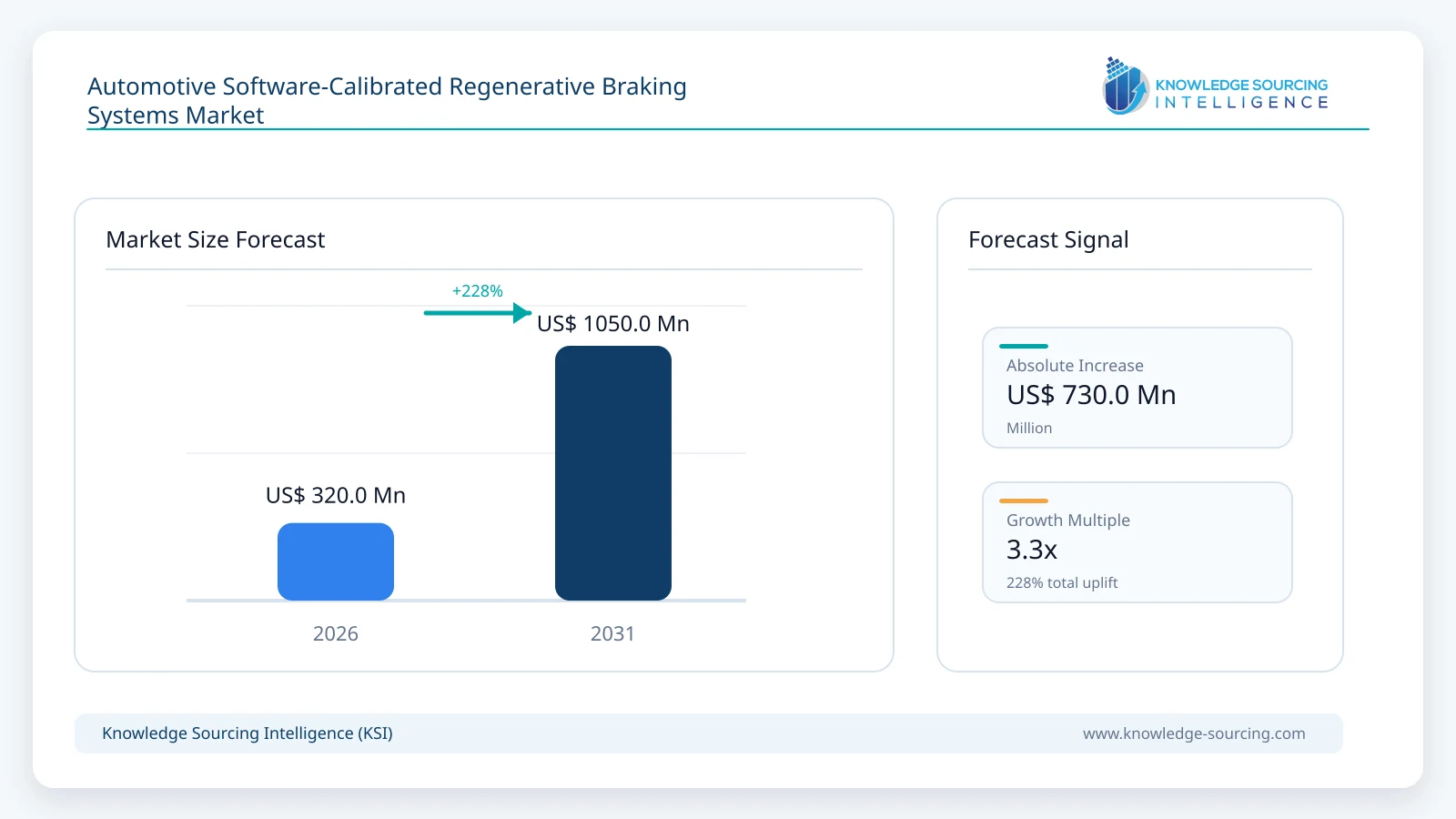
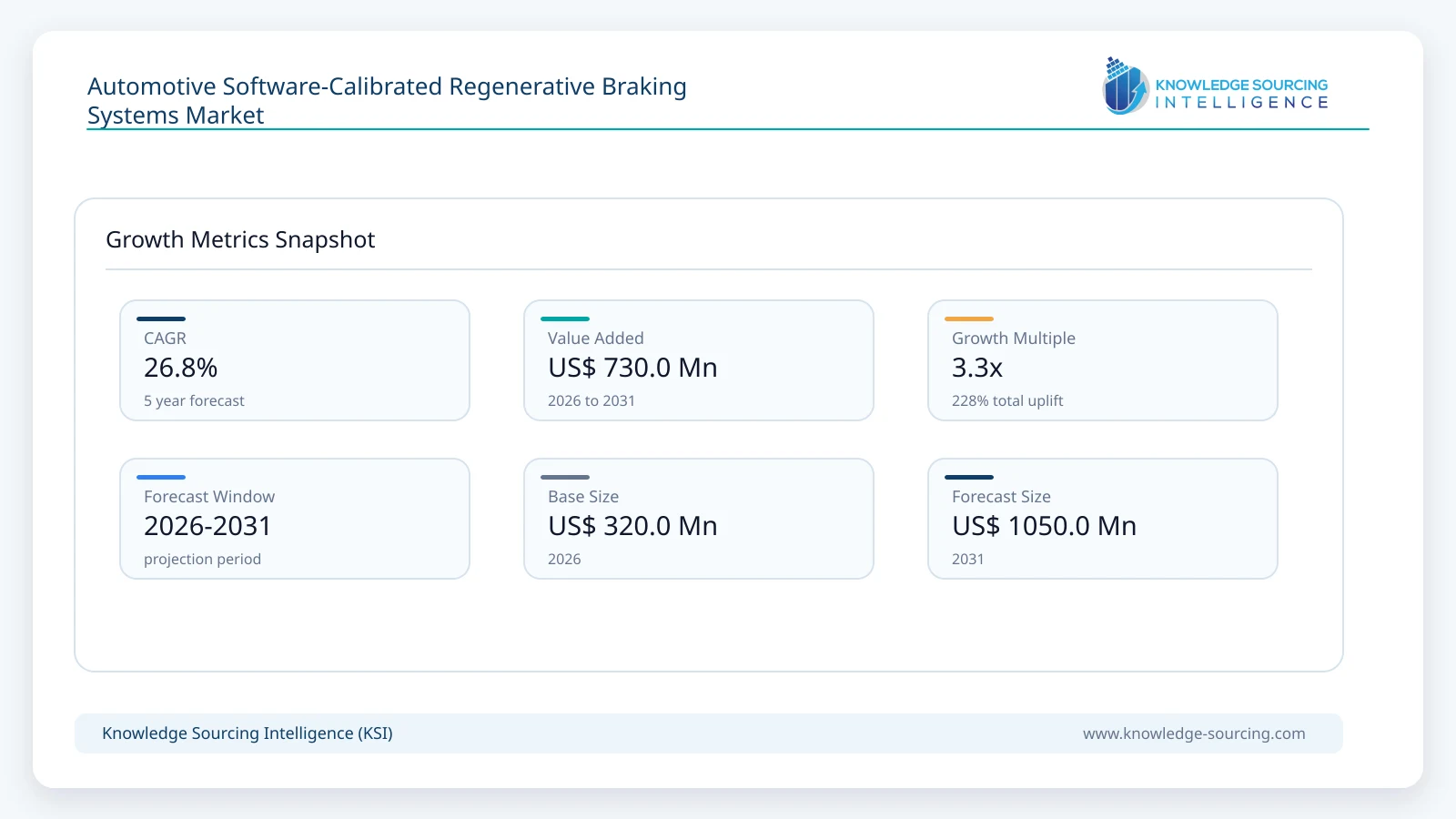
The automotive software-calibrated regenerative braking systems market is projected to expand at a CAGR of 26.8%, increasing from USD 320 million in 2026 to USD 1,050 million by 2031.
Highlights:
- 1Global modeled supplier-attributable revenue increases from USD 320 million in 2026 to USD 1,050 million by 2031, equivalent to 26.8% annual growth.
- 2BEV applications represent about 53% of 2026 value, while PHEV and full-hybrid brake blending provide a meaningful second demand pool.
- 3Friction and motor-torque blending accounts for 50% of 2026 software-calibrated regenerative-braking revenue.
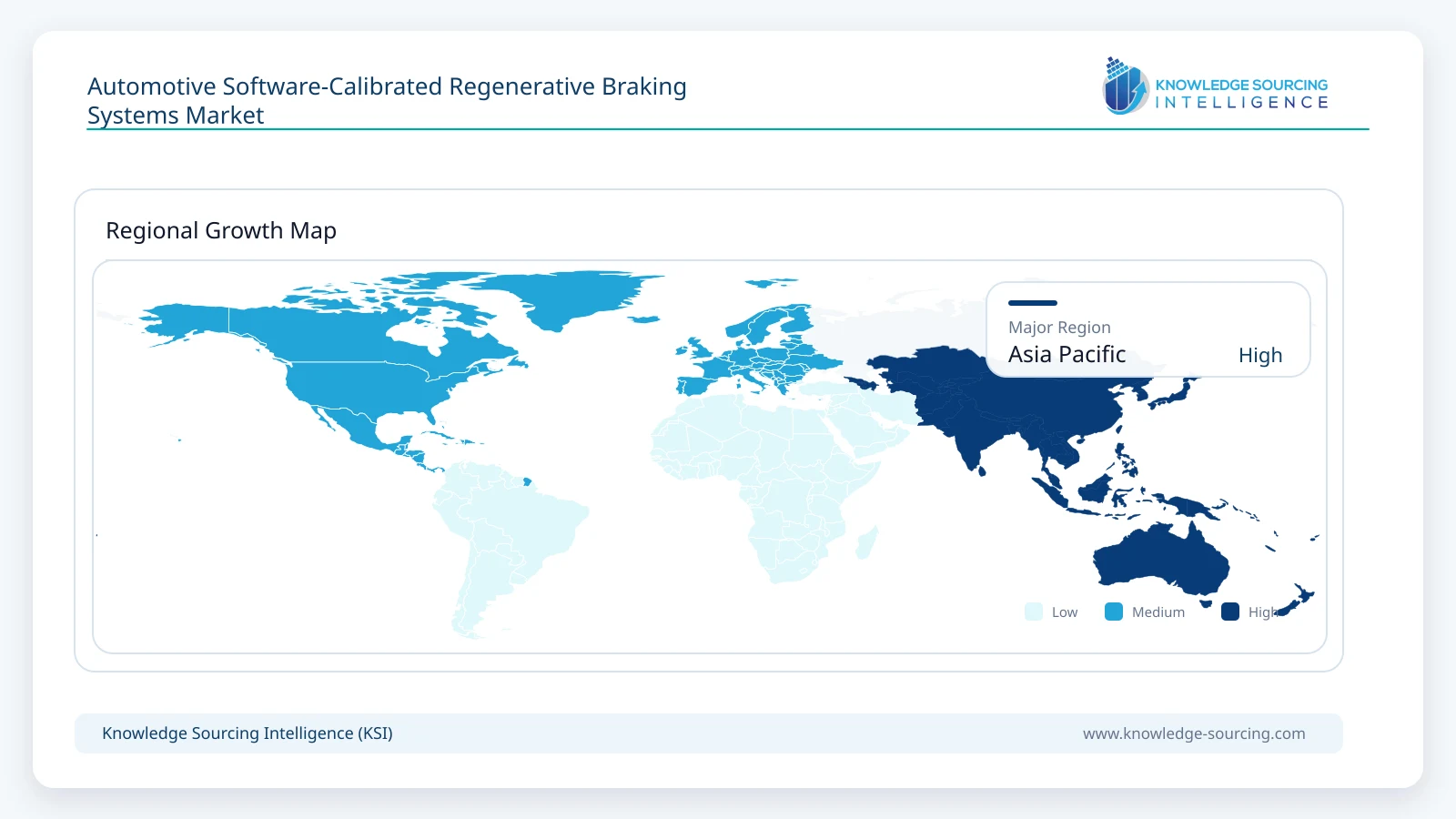
- 4Asia Pacific contributes an estimated 57% of 2026 market value, supported by China’s EV manufacturing and Japanese and Korean hybrid/braking supply networks.
- 5Sensor-adaptive blending and traffic-aware regeneration are gaining share from simpler map-based settings as safety and vehicle software architectures develop.
- 6Brake-by-wire adoption changes the hosting architecture for regeneration logic, but full electrohydraulic and electromechanical actuator sales are not treated as control-software revenue.
Software-calibrated regenerative braking coordinates the negative torque requested from electric motors with friction-brake pressure and vehicle-stability limits. Vehicle manufacturers pay for embedded control functions, calibration and validation that determine how consistently an electric or hybrid vehicle slows down while recovering energy. Brake-pedal simulators, electrohydraulic modules and electronic stability systems host these functions, but the commercial value measured here arises from their vehicle-specific software and integration rather than from the complete brake hardware.
Bosch offers software-adjusted braking through iBooster and its integrated power brake, while ADVICS supplies cooperative regeneration control used in vehicle programs including Toyota RAV4. ZF and AUMOVIO integrate recuperation into brake-by-wire platforms, and emerging wheel-level actuation places more demands on torque allocation across axles. The software content per fitted vehicle can rise even as control electronics consolidate, because braking comfort, battery limits, traction safety and automated-driving requests must all be calibrated together.
Market Overview
Electric vehicles recover energy when an electric traction motor generates braking torque, but the amount available changes with battery charge acceptance, motor speed, temperature and wheel grip. Conventional friction brakes remain essential for a full stop, rapid emergency deceleration and operation when the battery cannot absorb the requested energy. Coordinated controllers must therefore follow driver demand, switch between motor and friction torque smoothly and preserve anti-lock and stability-control priorities throughout a braking event.
Bosch's iBooster controls supporting hydraulic force by software when paired with ESP hev, while ADVICS designs cooperative regenerative systems to vary hydraulic pressure as regeneration changes. ZF's integrated brake control and AUMOVIO's MK C2 further concentrate brake functions in tested electronic modules. Their commercial significance is not only the maximum energy recovered but also stable pedal feel, repeatable stopping response, diagnostic assurance and calibration across different EV and hybrid platforms.
New braking architectures extend the software work needed to coordinate drive axles, vehicle-motion control and friction actuators. ZF has demonstrated coordination between electric drivelines and braking for commercial vehicles, Hyundai offers driver-selectable and automatic regeneration on current EVs, and Knorr-Bremse markets electric-vehicle motion control for braking-energy recovery. Suppliers that can reuse validated control modules while adjusting them to the tire, inverter, battery and vehicle mass can reduce OEM engineering effort and improve software margins.
Market Trends
Software Is Taking More Responsibility for Friction–Regeneration Transitions
Integrated electronic brakes can vary hydraulic pressure in step with electric-motor negative torque, reducing the deceleration discontinuities experienced when a battery reaches an acceptance limit. Bosch's iBooster and integrated power brake use software-adjusted support and pedal characterization; ADVICS' new cooperative system retains independent front and rear control while changing its hydraulic pressure source. These designs create repeatable interfaces between the braking ECU and the powertrain torque controller.
Vehicle programs require separate calibration under full battery state of charge, cold operation, low motor speed and high demand. Software suppliers therefore sell value in smoothly maintained deceleration and well-controlled transitions, not simply in maximum kilowatt-hours recovered during a standardized test. Extensive calibration creates an incentive to reuse proven controller families across multiple battery and drive-unit variants.
Driver-Selectable and Adaptive Recovery Are Expanding
Hyundai's Smart Regeneration automatically adjusts deceleration according to road gradient, nearby traffic and driving speed, while i-PEDAL allows eligible vehicles to provide strong lift-off deceleration and low-speed stopping control. These functions require coordinated torque maps, driver-interface logic and safety fallbacks rather than a single fixed coast-down setting. Their adoption differentiates software performance even when motors and friction-brake components are largely shared.
One-pedal control is not a replacement for friction braking or a guarantee of stopping in all road conditions. Hyundai's owner instructions restrict behavior on low-grip surfaces and under certain battery conditions. OEM calibration must preserve intuitive deceleration while managing the changing regeneration ceiling, making robust control logic and driver communication central to the commercial package.
Integrated Brake-by-Wire Platforms Are Changing Software Interfaces
AUMOVIO's MK C2 consolidates master cylinder, booster and electronic stability control functions, while ZF offers brake-by-wire designs spanning hydraulic and electromechanical implementations. These platforms place more braking decisions inside common software architectures, making recuperation coordination and actuator fallback behavior closely coupled. The BMW–AUMOVIO agreement announced in July 2026 extends MK C2 deliveries through the mid-2030s.
Software integration becomes more demanding when the powertrain, brake and chassis domains communicate through centralized controllers. Suppliers need deterministic response timing, carefully governed updates and independent safety mechanisms. Complete brake module prices remain much larger than the regen software share, so market growth reflects incremental functional content and validation rather than every brake-by-wire installation at its entire selling price.
Axle-Level Coordination Is Becoming More Important
ADVICS' cooperative regenerative system distributes control between front and rear wheels to improve energy recovery and vehicle behavior, and ZF's commercial-vehicle synergy work links motor braking with stability supervision. Electric SUVs with two driven axles and commercial vehicles with several propulsion layouts require torque limits to be coordinated across driveline and friction interfaces. The software challenge becomes more complex than adjusting one motor's generator torque.
Axle-level coordination must respect tire adhesion, road grade, available axle torque and stability intervention. A smoother integration of friction and regenerative torque can improve energy efficiency without requiring the driver to manage each power source. Tier 1 suppliers with access to both brake and drive data are well positioned, though integrated vehicle-motion software remains a neighboring and overlapping value pool.
Electromechanical Brake Development Is Raising Calibration Requirements
Brembo reported Sensify entering production in May 2026 with wheel-level software-defined braking, while AUMOVIO demonstrated a mixed hydraulic and electromechanical arrangement on Volkswagen's Mission Efficiency concept in September 2026. These developments show how physical brake architecture is diversifying beyond conventional single hydraulic circuits. The described Volkswagen configuration is a near-production demonstrator, not proof of high-volume rollout of that exact brake setup.
Electromechanical actuators introduce new constraints involving clamp-force control, actuator thermal conditions and fault behavior. Regenerative torque remains subject to motor and battery limits, so designers must synchronize independently controlled wheel brakes with propulsion requests. This creates a longer-term software opportunity, but qualification schedules and unit cost prevent assuming all vehicle platforms move immediately to dry brake-by-wire designs.
Segment Analysis
By Vehicle Propulsion Type: Battery Electric Vehicles
Battery electric vehicles lead the modeled segment with about 53% of 2026 revenue because their principal drive motors handle frequent regenerative deceleration and their braking systems can actively substitute friction torque. The IEA expects 23 million global BEV and PHEV car sales in 2026, giving suppliers a growing pool of eligible platforms, although only a subset carries the higher-content software configurations modeled here.
Hyundai's adaptive regeneration illustrates how drive modes and road conditions can alter a vehicle's slowing behavior, while Bosch and ADVICS supply control platforms used to coordinate friction braking. Plug-in hybrids and full hybrids remain important because electric recovery must blend with conventional driveline operation; their attributed control spend does not automatically equal that of a larger-battery BEV.
By Control Function: Friction and Motor Torque Blending
Friction and motor-torque blending represents half of the modeled 2026 market because seamless transfer between electric and mechanical deceleration is necessary across battery charge levels, weather and driving conditions. Bosch's ESP hev/iBooster arrangement and ADVICS' regenerative hydraulic coordination provide established supplier examples of this functional requirement. The commercial offering combines control algorithms, tuning maps, diagnostics and platform-specific testing.
Adaptive coast-down, stability-prioritized recuperation and battery-constrained recovery add further revenue as OEMs expand regenerative modes. They are classified by the principal purchased function in the internal model rather than counted repeatedly whenever the same brake controller supports several related algorithms. The highest-value programs integrate braking behavior across multiple motors and wheels while maintaining consistent driver feel.
By Calibration Strategy: Sensor-Adaptive Brake Blending
Sensor-adaptive calibration is gaining value because fixed deceleration maps cannot handle the full range of battery acceptance, road grip, axle loading and traffic conditions. Brake-control software can modify regeneration requests using wheel-speed, stability and powertrain signals, preserving predictable deceleration without unnecessarily sacrificing energy recovery. Automated regeneration functions also consider driving context as documented in Hyundai's vehicle instructions.
This segment's forecast share increases as manufacturers offer configurable driving modes and greater integration between chassis and energy management. Road-aware and traffic-predictive schemes remain smaller in 2026 because they require additional sensing, interface design and validation. Their integration must not compromise the safety-critical base braking path when input data is uncertain.
By Actuation Architecture: Integrated Electrohydraulic Braking
Integrated electrohydraulic systems account for the largest share of 2026 software-calibrated regenerative braking value because one-box units consolidate the booster, pressure control and stability functions in a vehicle-ready assembly. Bosch's integrated power brake, AUMOVIO's MK C2, ZF's integrated brake control and HL Mando's IDB2 all provide suitable environments for configurable recuperation behavior. Only the attributable software and calibration content is counted in this market.
Electromechanical architectures gain share as they progress from development into customer programs, but their wheel-level dynamics and fail-safe requirements demand extensive engineering. Brembo's Sensify production milestone provides evidence of software-defined actuation, not a disclosed regenerative-braking license fee. Traditional modular brake systems remain viable in cost-focused HEV and lower-powered vehicle platforms.
Market Drivers
Expansion of Electrified Vehicle Production
Global BEV and PHEV manufacturing creates a growing base for regenerative calibration as producers bring additional vehicle models and powertrain variants into series production. The IEA reports almost 22 million electric cars made in 2025 and expects 23 million BEV/PHEV sales during 2026. Growing unit volumes make reuse of qualified braking software across multiple platforms commercially valuable.
Hybrid-electric vehicles also use coordinated friction and electrical braking, but they are not included in the IEA plug-in EV total. The model adds an independently assumed eligible HEV base rather than treating every passenger car as a software-calibrated regenerative product. Revenue grows with qualifying fitment and attributable supplier content, not merely gross vehicle output.
Improved Deceleration Comfort and Pedal Consistency
Driver demands for smooth braking require precise transitions when motor recuperation weakens near low speed, at full battery charge or during cold operation. Bosch's software-adjusted iBooster and ADVICS' cooperative control address the resulting need to coordinate motor braking with hydraulic pressure. Premium vehicles in particular differentiate regenerative modes through pedal response and predictable lift-off behavior.
Maintaining consistent feel across model derivatives requires software mapping and vehicle testing rather than reusing one calibration unchanged. Suppliers with robust validation data can win long-cycle programs and charge for integration and tuning, while automation of calibration workflows can support higher margins as vehicle configurations proliferate.
Growth of Integrated Brake and Motion Controllers
AUMOVIO's MK C2 series agreement with BMW and ZF's extensive brake-by-wire portfolio show that control functionality increasingly ships inside integrated electronic brake products. Software architecture is becoming a larger purchasing criterion when vehicle makers seek recuperation, stability control and automated braking from a coordinated system.
Brake-platform consolidation creates a path to more reusable control libraries, diagnostics and validated variants, even when the number of dedicated ECUs decreases. The relevant spend is the portion attributable to regeneration algorithms and vehicle-program calibration rather than the value of the mechanical actuator, fluid circuit or wheel brakes.
Adaptive Axle and Battery-Aware Energy Recovery
Dual-motor passenger EVs and electrified commercial vehicles can distribute generator torque across more than one axle, expanding the number of operating conditions to calibrate. ADVICS independently controls front and rear braking, and ZF's electric-drive/brake synergy work emphasizes recuperation without undermining vehicle stability. Software must reconcile motor capability, available tire grip and the friction torque needed for each wheel.
Battery acceptance and motor temperature can reduce allowed regeneration even when a driver requests strong braking. Inverter, battery and brake controllers therefore exchange limits rapidly and safely. Platforms that incorporate these boundaries effectively can deliver more repeatable real-world recovery and lower brake wear than simpler fixed-threshold configurations.
Software-Defined Braking and Vehicle Mode Differentiation
Hyundai offers automatic regeneration and one-pedal driving modes that change the driver experience without requiring wholly separate propulsion hardware. Brembo's Sensify production start and AUMOVIO's evolving by-wire designs further show how software can define braking behavior as part of a broader chassis package. Flexible calibration lets OEMs offer distinct vehicle-mode responses across trim levels and drive configurations.
Regeneration functions still need a validated safety-critical core. Platform suppliers that package multiple allowed modes with diagnostic protections and controlled updates can capture recurring engineering contracts, particularly when the same controller is used across electric and hybrid vehicle lines.
Market Restraints
Safety-Critical Braking Validation Requirements
Brake software changes must be tested against emergency deceleration, stability intervention, sensor faults and failures of the propulsion system. The braking controller cannot depend on a high regeneration level being available when friction braking is needed for a safe stop. Automotive functional-safety and fault-detection requirements create extensive validation work around even modest torque-map changes.
Qualification includes hardware-in-the-loop testing, proving-ground operation, different tire loads and software integration with the brake ECU and inverter. This raises the cost of introducing new modes and can favor reused, previously approved functions over frequent feature experimentation across vehicle platforms.
Battery and Motor Limits Reduce Recoverable Energy
High battery state of charge, low temperature and limited charge acceptance can constrain regenerative torque independently of braking demand. Low vehicle speeds and drive-motor operating limits can also require friction braking even when a vehicle advertises strong one-pedal deceleration. These boundaries restrict the energy-saving value that control software alone can achieve.
Controls must smoothly substitute mechanical braking without leaving a mismatch in total deceleration. The resulting calibration challenge is particularly demanding across HEV and PHEV battery sizes, where acceptance ceilings and available electric torque vary considerably. Vehicle manufacturers are unlikely to pay for advanced functions unless the benefit is repeatable in real-world duty cycles.
Diverse Braking Hardware and Controller Interfaces
Brake blending software must be tailored to the pressure-source design, motor inverter interface, stability controller and brake pedal simulator used in each vehicle architecture. Traditional boosters, one-box electrohydraulic actuators and dry brake-by-wire units have different response dynamics and fallback mechanisms. A software function validated with one supplier module may require substantial retesting on another.
This limits the speed of cross-platform reuse and can produce fragmented integration responsibility between brake suppliers and e-drive developers. Standardized signals reduce effort but cannot eliminate physical differences in axle loading, tire grip, actuator response and battery acceptance. OEMs may keep core algorithms in-house to control these interfaces.
Cost Sensitivity in Entry-Priced Electrified Vehicles
Regenerative braking capability already exists in many electric and hybrid powertrains, so additional spending needs to produce measurable comfort, safety or energy-recovery value. A complex road-aware package may provide too little incremental benefit in lower-priced vehicles with modest motor power and limited sensing hardware. In these models, simpler calibrated maps often meet customer expectations.
OEM sourcing decisions may bundle regeneration logic within a broader brake controller rather than purchase a separately priced feature. Suppliers must justify the engineering content through platform reuse and avoid requiring more processor capacity or sensors than the incremental improvement warrants. This limits the pace of value growth per fitted vehicle.
Long Development Cycles and Controlled Software Updates
Vehicle braking programs can remain in production for many model years after validation, making the timing of new software deployments dependent on platform refreshes and supplier nominations. Safety-critical updates also require configuration control, cybersecurity testing and rollback provisions, not just remote delivery of a revised drive mode. A function that works in a prototype may need lengthy evidence before customer release.
The brakes must remain effective when communication with the powertrain domain is disrupted or sensor information becomes unreliable. Conservative fallback behavior can reduce the efficiency benefit under unusual operating conditions, while service complexity and warranty obligations raise the cost of supporting new control variants through the vehicle life.
Regional Outlook
Asia Pacific
Asia Pacific accounts for approximately 57% of estimated 2026 software-calibrated regenerative-braking demand, with China providing the largest BEV and PHEV assembly base and Japan maintaining a well-established hybrid braking supply chain. The IEA reports that China manufactured almost three-quarters of the world's electric cars in 2025. ADVICS' RAV4 and e Vitara programs, alongside Hyundai Mobis' integrated brake portfolio, show regional participation in both regenerative hardware and the calibrations needed to make it effective.
China's breadth of electric models creates volume opportunities for integrated brake-control suppliers, while Japanese and Korean producers emphasize durability and energy efficiency in hybrid and fully electric drivetrains. The modeled region remains the largest through 2031, although pricing pressure and the in-house control capabilities of leading OEMs constrain the value suppliers can capture per installed vehicle.
Europe
European braking developers have substantial expertise in electronically controlled boosters, combined friction-regeneration algorithms and safety-critical chassis software. Bosch, ZF, AUMOVIO and Brembo supply or develop platforms designed to coordinate brake pressure, energy recuperation and vehicle-motion functions. The BMW–AUMOVIO agreement and Brembo's 2026 Sensify production start provide evidence of active investment in more programmable actuation architectures.
Europe represents approximately 24% of 2026 market revenue in the internal model, with higher software content often associated with integrated brake modules and premium BEVs. Growth to 2031 depends on the scale of electrified vehicle programs, the qualification of by-wire functionality and the use of reusable vehicle-motion software. Revenue is attributed to where the calibration-equipped vehicles are built, not automatically to the headquarters of the brake supplier.
Competitive Landscape
Regenerative braking software is commonly delivered inside a broader electronic brake product, creating overlapping competencies between brake-system makers, electric-driveline suppliers and vehicle software teams. Bosch combines integrated brake hardware with software-adjusted hydraulic support, while ZF contributes both integrated brake products and control work coordinating electric drivelines with service brakes. AUMOVIO's MK C2 represents a large series-production platform with configurable brake functions.
ADVICS has particularly direct OEM evidence through the cooperative systems selected for Toyota RAV4 and Suzuki e Vitara, while HL Mando and Hyundai Mobis provide alternative integrated braking architectures. Knorr-Bremse addresses commercial electric vehicles with motion control that optimizes blending, and Brembo's Sensify uses software-defined wheel actuation. Astemo is relevant to future integrated chassis control, although published vehicle-regeneration sales are less directly established than for mature brake suppliers.
Supplier market share cannot be inferred from the installed volume or published contract value of complete braking assemblies. The differentiated economic position lies in validated brake-to-drive interfaces, repeatable pedal feel, recovery efficiency under actual battery conditions and the resources needed to support long vehicle production programs. Automotive manufacturers retain substantial ownership of torque limits and vehicle-level braking calibration, even when Tier 1 suppliers provide the control stack.
Recent Developments
September 2026: AUMOVIO equipped Volkswagen’s near-production Mission Efficiency demonstrator with a mixed hydraulic/electromechanical braking layout designed to optimize recuperation and reduce residual drag; the event was a technology demonstration, not a confirmed volume launch.
July 2026: AUMOVIO and BMW Group expanded their long-term electronic braking relationship, including MK C2 series supply through the mid-2030s; regeneration is one function in the complete brake-system program.
May 2026: Brembo and Ningbo Huaxiang agreed to cooperate on Chinese localization of Sensify software-defined braking, extending prospective manufacturing and application reach.
December 2025: ADVICS confirmed Toyota’s sixth-generation RAV4 uses its updated cooperative regenerative braking system with an electric-cylinder pressure architecture.
July 2025: ZF introduced its comprehensive wet, dry and hybrid brake-by-wire portfolio, supporting platform migration toward more programmable vehicle braking systems.
Market Outlook
Software-calibrated regeneration should expand with BEV, PHEV and HEV production as manufacturers seek greater energy recovery without sacrificing stable stopping response. The most durable opportunity lies in blending software that continues to work when charge acceptance, tire grip or motor output changes abruptly. Advanced one-pedal and road-aware features can add differentiated content, but will remain subordinate to safety-critical braking performance.
Integrated electrohydraulic units are likely to remain the principal hosting architecture over the forecast period, while the share of electromechanical and centralized control approaches increases from a smaller base. Revenue growth will come from broader qualifying fitment, more complex tuning and attributable engineering contracts. Greater platform scale may reduce per-vehicle calibration costs for mature functions even as software complexity rises.
Asia Pacific remains the largest market because of manufacturing scale and hybrid-electric expertise, while European brake and chassis developers retain a substantial supplier presence. OEMs and Tier 1 companies able to verify energy recovery over realistic routes, preserve predictable pedal feel and manage safety-approved software variants will be best placed to secure long-term platform work.
Market Scope
| Report Metric | Details |
|---|---|
| Total Market Size in 2026 | USD 320 million |
| Total Market Size in 2031 | USD 1,050 million |
| Forecast Unit | Million |
| Growth Rate | 26.8% |
| Study Period | 2021 to 2031 |
| Historical Data | 2021 to 2024 |
| Base Year | 2025 |
| Forecast Period | 2026 – 2031 |
| Segmentation | Vehicle Propulsion Type, Regenerative Control Function, Calibration Strategy,Brake Actuation Architecture, Software Deployment Architecture, Revenue Component, Vehicle Class, Driven Axle Configuration, Geography |
| Companies |
|
Market Segmentation
By Vehicle Propulsion Type
Battery Electric Vehicles
Plug-in Hybrid Electric Vehicles
Full Hybrid Electric Vehicles
By Regenerative Control Function
Friction and Motor Torque Blending
Adaptive One-Pedal and Coast Regeneration
Stability and Traction-Coordinated Recovery
Battery-Acceptance and Energy-Constrained Recovery
By Calibration Strategy
Calibrated Map-Based and Mode-Selectable Regeneration
Sensor-Adaptive Brake Blending
Road and Traffic Predictive Regeneration
By Brake Actuation Architecture
Integrated Electrohydraulic Brake Modules
Modular Booster and Stability Brake Systems
Electromechanical and Dry Brake-by-Wire Systems
By Software Deployment Architecture
Brake Controller Embedded Calibration
Powertrain Controller-Coordinated Logic
Centralized Vehicle Motion Control
By Revenue Component
Embedded Regeneration Software Content
Program Calibration and Validation Engineering
Directly Attributable Updates and Integration Services
By Vehicle Class
Passenger Cars and SUVs
Light Commercial Vehicles
Buses and Medium/Heavy Commercial Vehicles
By Driven Axle Configuration
Single-Driven-Axle Regeneration
Dual-Axle All-Wheel-Drive Regeneration
Multi-Axle and Commercial Electric-Drive Configurations
By Geography
North America
United States
Canada
Mexico
South America
Brazil
Argentina
Others
Europe
Germany
United Kingdom
France
Italy
Spain
Others
Middle East and Africa
Saudi Arabia
UAE
South Africa
Others
Asia Pacific
China
Japan
South Korea
India
Indonesia
Thailand
Taiwan
Others
Table of Contents
1. EXECUTIVE SUMMARY
1.1. Market Opportunity and Key Findings
1.2. Market Size and Growth, 2026–2031
1.3. Regenerative Braking Control Outlook
1.4. Regional Opportunity Summary
2. MARKET SNAPSHOT
2.1. Market Overview
2.2. Market Definition
2.3. Scope of the Study
2.4. Market Segmentation
3. BUSINESS LANDSCAPE
3.1. Market Drivers
3.1.1. Expansion of Electrified Vehicle Production
3.1.2. Improved Deceleration Comfort and Pedal Consistency
3.1.3. Growth of Integrated Brake and Motion Controllers
3.1.4. Adaptive Axle and Battery-Aware Energy Recovery
3.1.5. Software-Defined Braking and Vehicle Mode Differentiation
3.2. Market Restraints
3.2.1. Safety-Critical Braking Validation Requirements
3.2.2. Battery and Motor Limits Reduce Recoverable Energy
3.2.3. Diverse Braking Hardware and Controller Interfaces
3.2.4. Cost Sensitivity in Entry-Priced Electrified Vehicles
3.2.5. Long Development Cycles and Controlled Software Updates
3.3. Market Opportunities
3.4. Porter’s Five Forces Analysis
3.5. Industry Value Chain Analysis
3.6. Policies and Regulations
3.7. Strategic Recommendations
4. TECHNOLOGICAL OUTLOOK
4.1. Regenerative and Friction Brake Torque Coordination
4.2. Integrated Electrohydraulic Brake Control
4.3. Adaptive One-Pedal and Coast Regeneration
4.4. Stability-Aware Multi-Axle Recuperation
4.5. Battery-Constrained Braking Calibration
4.6. Electromechanical and Centralized Brake Control
5. AUTOMOTIVE SOFTWARE-CALIBRATED REGENERATIVE BRAKING SYSTEMS MARKET BY VEHICLE PROPULSION TYPE
5.1. Introduction
5.2. Battery Electric Vehicles
5.3. Plug-in Hybrid Electric Vehicles
5.4. Full Hybrid Electric Vehicles
6. AUTOMOTIVE SOFTWARE-CALIBRATED REGENERATIVE BRAKING SYSTEMS MARKET BY REGENERATIVE CONTROL FUNCTION
6.1. Introduction
6.2. Friction and Motor Torque Blending
6.3. Adaptive One-Pedal and Coast Regeneration
6.4. Stability and Traction-Coordinated Recovery
6.5. Battery-Acceptance and Energy-Constrained Recovery
7. AUTOMOTIVE SOFTWARE-CALIBRATED REGENERATIVE BRAKING SYSTEMS MARKET BY CALIBRATION STRATEGY
7.1. Introduction
7.2. Calibrated Map-Based and Mode-Selectable Regeneration
7.3. Sensor-Adaptive Brake Blending
7.4. Road and Traffic Predictive Regeneration
8. AUTOMOTIVE SOFTWARE-CALIBRATED REGENERATIVE BRAKING SYSTEMS MARKET BY BRAKE ACTUATION ARCHITECTURE
8.1. Introduction
8.2. Integrated Electrohydraulic Brake Modules
8.3. Modular Booster and Stability Brake Systems
8.4. Electromechanical and Dry Brake-by-Wire Systems
9. AUTOMOTIVE SOFTWARE-CALIBRATED REGENERATIVE BRAKING SYSTEMS MARKET BY SOFTWARE DEPLOYMENT ARCHITECTURE
9.1. Introduction
9.2. Brake Controller Embedded Calibration
9.3. Powertrain Controller-Coordinated Logic
9.4. Centralized Vehicle Motion Control
10. AUTOMOTIVE SOFTWARE-CALIBRATED REGENERATIVE BRAKING SYSTEMS MARKET BY REVENUE COMPONENT
10.1. Introduction
10.2. Embedded Regeneration Software Content
10.3. Program Calibration and Validation Engineering
10.4. Directly Attributable Updates and Integration Services
11. AUTOMOTIVE SOFTWARE-CALIBRATED REGENERATIVE BRAKING SYSTEMS MARKET BY VEHICLE CLASS
11.1. Introduction
11.2. Passenger Cars and SUVs
11.3. Light Commercial Vehicles
11.4. Buses and Medium/Heavy Commercial Vehicles
12. AUTOMOTIVE SOFTWARE-CALIBRATED REGENERATIVE BRAKING SYSTEMS MARKET BY DRIVEN AXLE CONFIGURATION
12.1. Introduction
12.2. Single-Driven-Axle Regeneration
12.3. Dual-Axle All-Wheel-Drive Regeneration
12.4. Multi-Axle and Commercial Electric-Drive Configurations
13. AUTOMOTIVE SOFTWARE-CALIBRATED REGENERATIVE BRAKING SYSTEMS MARKET BY GEOGRAPHY
13.1. North America
13.1.1. United States
13.1.2. Canada
13.1.3. Mexico
13.2. South America
13.2.1. Brazil
13.2.2. Argentina
13.2.3. Others
13.3. Europe
13.3.1. Germany
13.3.2. United Kingdom
13.3.3. France
13.3.4. Italy
13.3.5. Spain
13.3.6. Others
13.4. Middle East and Africa
13.4.1. Saudi Arabia
13.4.2. UAE
13.4.3. South Africa
13.4.4. Others
13.5. Asia Pacific
13.5.1. China
13.5.2. Japan
13.5.3. South Korea
13.5.4. India
13.5.5. Indonesia
13.5.6. Thailand
13.5.7. Taiwan
13.5.8. Others
14. COMPETITIVE ENVIRONMENT AND ANALYSIS
14.1. Major Players and Strategy Analysis
14.2. Market Share Analysis
14.3. Mergers, Acquisitions, Agreements and Collaborations
14.4. Competitive Dashboard
15. COMPANY PROFILES
15.1. Robert Bosch GmbH
15.2. ZF Friedrichshafen AG
15.3. AUMOVIO SE
15.4. ADVICS Co., Ltd.
15.5. Brembo N.V.
15.6. Hyundai Mobis Co., Ltd.
15.7. HL Mando Corporation
15.8. Knorr-Bremse AG
15.9. Astemo, Ltd.
15.10. AISIN Corporation
16. APPENDIX
16.1. Currency
16.2. Assumptions
16.3. Base and Forecast Years Timeline
16.4. Key Benefits for Stakeholders
16.5. Research Methodology
16.6. Abbreviations
Navigate
Trusted by the world's leading organizations