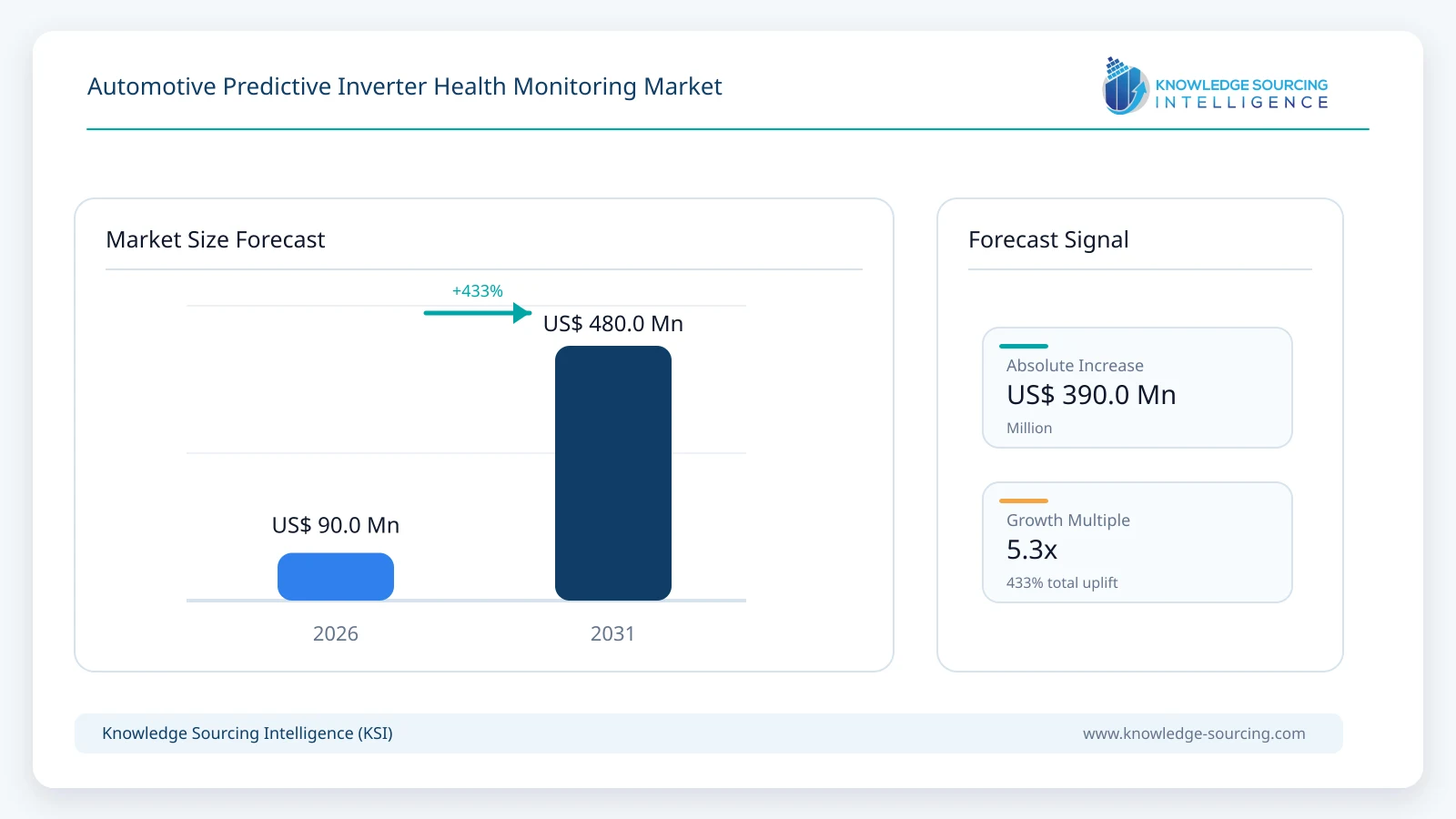
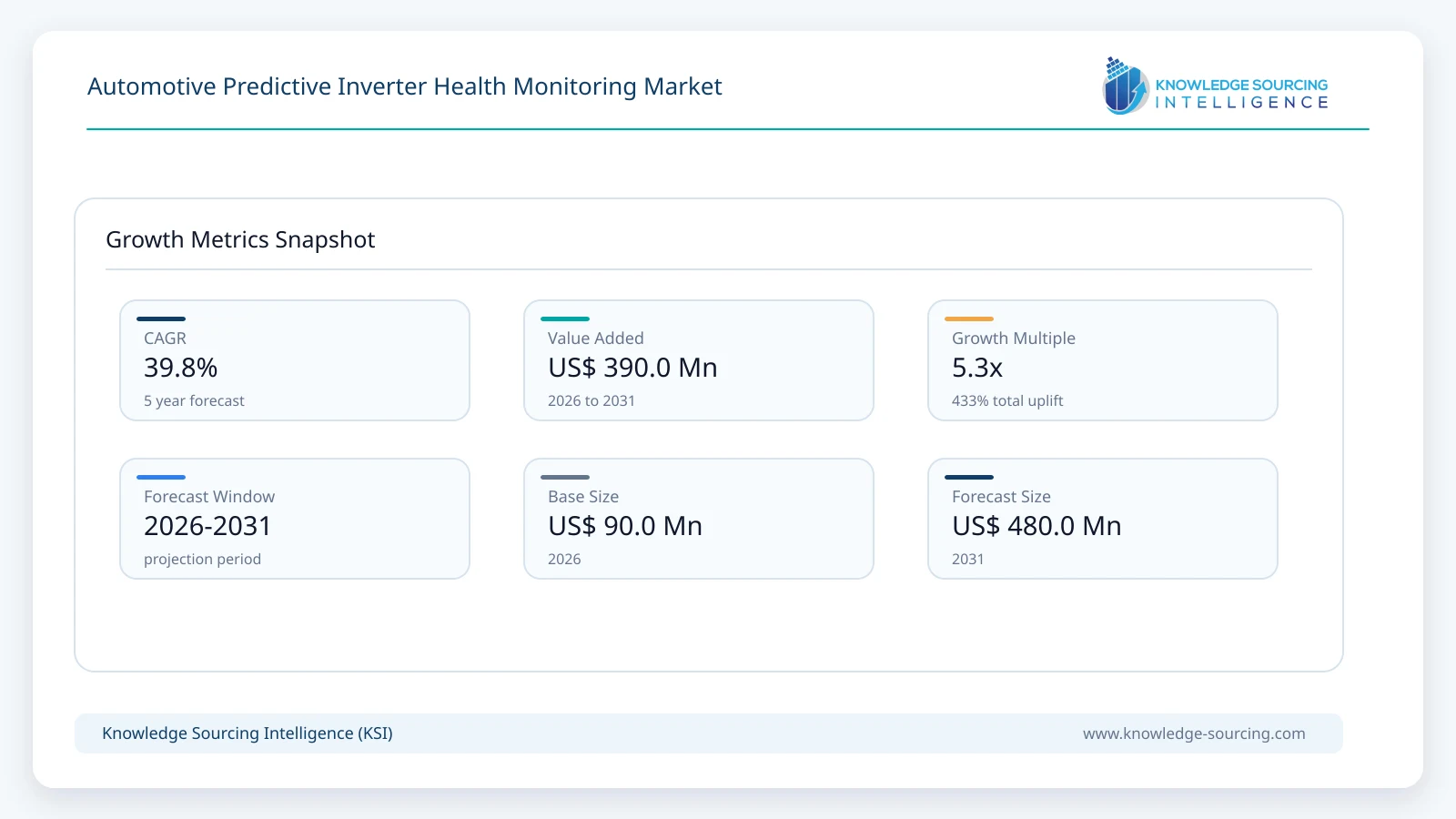
The automotive predictive inverter health monitoring market is forecast to grow at a CAGR of 39.8%, increasing from USD 90 million in 2026 to USD 480 million by 2031.
Highlights:
- 1Global attributable revenue increases from USD 90 million in 2026 to USD 480 million by 2031.
- 2Embedded diagnostic features and edge analytics account for 56% of modeled 2026 supplier value, while connected services expand through the forecast.
- 3Battery electric vehicle applications generate approximately 83% of 2026 demand owing to their traction-inverter installed base.
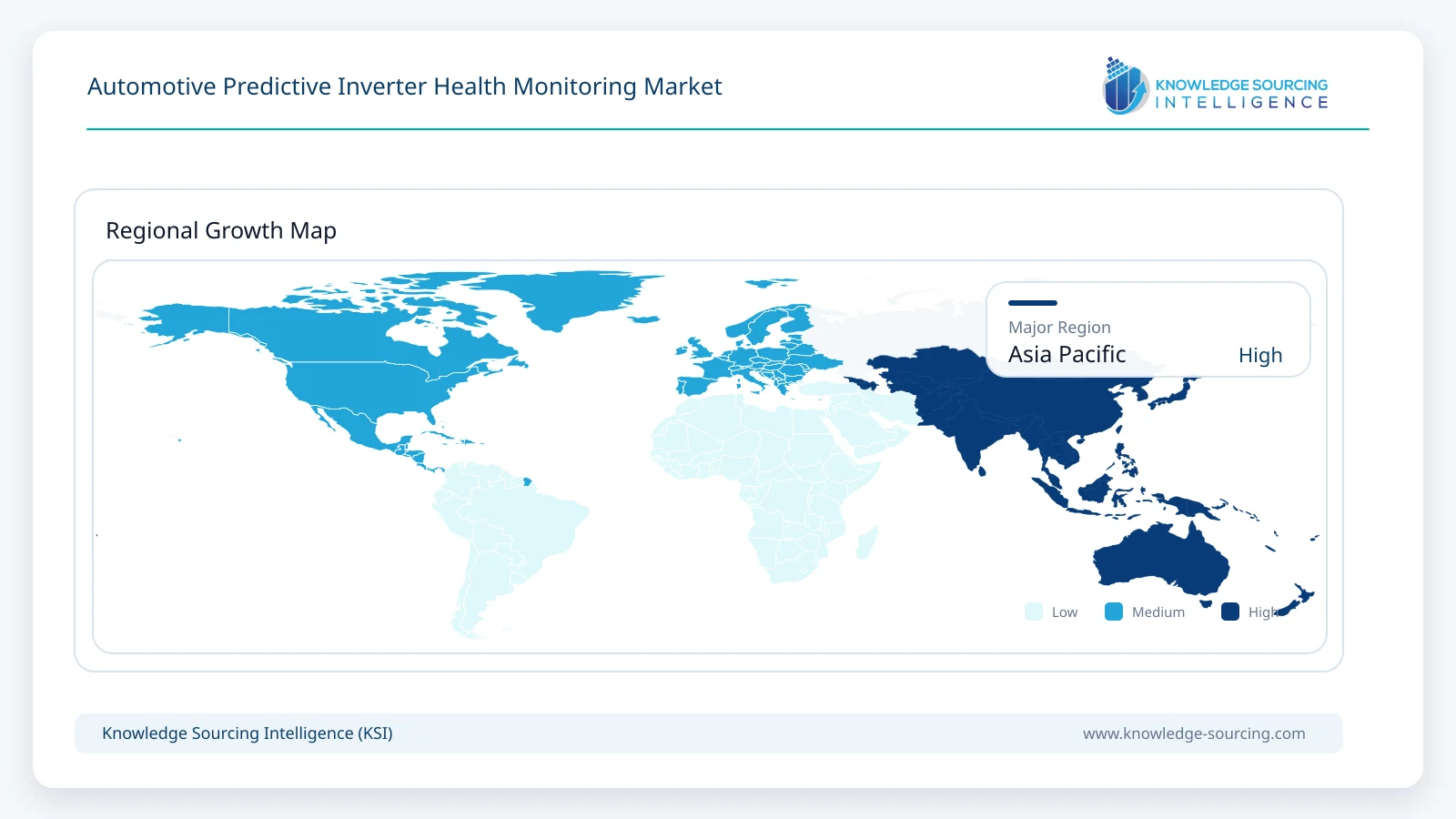
- 4Asia Pacific holds the largest 2026 regional position, supported by China’s electric-vehicle production scale.
- 5Device-health information from qualified gate drivers is improving the practical foundation for degradation modeling.
- 6Commercialization is constrained by rigorous functional-safety validation and the challenge of separating wear from normal driving variation.
Predictive inverter health monitoring combines electrical and thermal signals with models that identify changes in traction-inverter operating condition across a vehicle’s service life. Monitoring solutions interpret power-switch conduction characteristics, gate-drive status, capacitor ripple conditions, cooling effectiveness and related diagnostic histories. Automotive control-unit suppliers provide embedded measurement and processing, while drivetrain and connected-service providers use the resulting features to support maintenance decisions and fleet availability.
NXP’s third-generation traction-inverter reference design incorporates the GD3162 gate driver and device-health monitoring capability, while Infineon’s EiceDRIVER 1EDI304xAS offers power-device state monitoring and digital diagnostics. Bosch supports connected powertrain condition analysis through component models, and ZF applies fleet-oriented health monitoring to electric driveline systems. Their commercial offerings differ in scope and maturity, but they illustrate how inverter health functions are being developed at both power-electronics and vehicle-service levels.
Market Overview
Electric-vehicle traction inverters repeatedly convert high-voltage DC battery energy into controlled three-phase output while experiencing variations in current, switching temperature and regenerative loading. Instantaneous protection detects events such as desaturation or overtemperature, but a predictive function must determine whether repeated stress is changing an inverter component’s future reliability. Electrical state, temperature history and model-based aging indicators therefore become more valuable when they can distinguish a developing fault from a permissible operating condition.
NXP identifies device-health monitoring in its GD3162-based inverter reference architecture, enabling engineering teams to connect power-device operating characteristics to the controller. Infineon’s June 2026 isolated gate-driver family adds device state monitoring and an SPI diagnostic path within production inverter electronics. Texas Instruments also positions isolated gate-driver diagnostics as a means of identifying early semiconductor failures. These components provide useful observations, but software calibration, load normalization and validation remain essential before data can be used to issue remaining-life predictions.
Bosch offers connected powertrain diagnostics that combine vehicle telemetry, domain algorithms and digital models to assess component health and residual service life. ZF’s April 2026 electric-axle monitoring announcement demonstrates a fleet-oriented path for detecting thermal or cooling anomalies in an electric driveline. These services create the commercial conditions for inverter-specific predictive analysis, especially where vehicle downtime is costly, but disclosed system packages generally do not publish a separate inverter-only price or attachment rate.
Market Trends
Device-State Observability Is Being Built into Inverter Electronics
Automotive gate drivers increasingly report power-device temperature and status alongside protection events, allowing the inverter controller to observe more than an isolated fault flag. Infineon’s EiceDRIVER 1EDI304xAS includes power-device state monitoring, digital filtering and an SPI interface, while NXP’s GD3162 architecture supports condition-oriented analysis. These features give engineering teams more consistent diagnostic inputs without requiring a separate large sensing module.
Power-switch degradation still has to be inferred from measurements under comparable voltage, current and temperature conditions. Algorithms that normalize these operating effects can reduce false warnings, but calibration must be specific to the power module, gate-drive configuration and cooling arrangement. The engineering effort creates software and validation opportunities that are distinct from the price of an ordinary gate driver.
Connected Powertrain Services Are Creating a Route to Predictive Maintenance
Bosch combines onboard diagnostics, cloud data and powertrain models to identify anomalous component behavior and estimate remaining service life. For traction inverters, vehicle fleets can provide repeated observations across temperature, route, load and vehicle age that an individual controller cannot easily collect. Higher quality operating histories can make a degradation estimate more useful to service teams.
ZF’s AxTrax 2 LF health monitoring connects electric-drive anomalies to fleet and OEM service workflows, including abnormal heating or cooling signatures. Commercial value is greatest when an identified trend changes a maintenance decision, reduces roadside failures or helps prioritize workshop capacity. Access to vehicle data and responsibility for follow-up action therefore shape how providers charge for these functions.
800 V Platforms Increase the Need for Thermal and Electrical Context
High-voltage silicon-carbide traction inverters operate with fast switching edges and substantial variations in operating load, making the relationship between temperature, gate-drive behavior and electrical insulation particularly important. Semiconductor-level state observations must be interpreted together with inverter coolant conditions and duty cycle before an aging signal is considered abnormal.
Inverter designers increasingly integrate sensing and protection within automotive-qualified components to minimize harnessing and board area. More compact electronics can lower installation burden, but the prediction software must avoid confusing design-to-design variability with true deterioration. Platform-specific training and test coverage consequently remain a substantial development expense.
Service-Oriented Diagnostics Are Linking the Vehicle and Workshop
ETAS introduced a next-generation diagnostic approach in July 2026 for software-defined commercial vehicles, using service-oriented access and AI-assisted fault analysis to improve repair workflows. Inverter-specific health applications can use the same architecture to move validated fault indicators from vehicle controllers into fleet systems and service tools.
Diagnostic programs increasingly require a clear chain from measured electrical behavior to a technician’s action, rather than dashboards of raw sensor values. Standardized access and traceable event histories can improve root-cause identification, while privacy, vehicle cybersecurity and proprietary inverter data restrict the number of companies that can deploy independent cloud models.
Reliability Models Are Becoming More Important than Fault Counts
Automotive inverter suppliers face variable vehicle duty cycles, so the number of temperature or current events is not itself a reliable estimate of remaining service life. Physics-informed models track cumulative electrical and thermal exposure, while statistical and machine-learning approaches search for sustained departures from expected operating behavior. Both approaches need verified failure histories and careful threshold management.
ISO/TR 9839:2023 discusses predictive maintenance methods for degrading faults in safety-related electronic hardware. It provides relevant engineering concepts but does not require a dedicated inverter health-monitoring product. Commercial adoption will depend on OEM evidence that predictive alerts are timely, explainable and compatible with the inverter’s functional-safety strategy.
Segment Analysis
By Revenue Offering: Embedded Diagnostic Features and Edge Analytics
Embedded inverter diagnostics form the largest revenue pool because each qualifying vehicle requires reliable access to switching-stage and controller observations before a health algorithm can operate. The segment represents approximately 56% of modeled 2026 value and includes only the incremental diagnostic content and licenses associated with predictive functions, rather than the full price of the inverter controller or gate-driver hardware.
NXP and Infineon supply qualified sensing and diagnostic paths that are suitable inputs for onboard trend analysis. OEMs prefer functions that can run within existing controller computing budgets while preserving safety reaction times. Connected subscriptions can then add fleet-level comparison and service functions without duplicating the vehicle’s base protection capabilities.
By Monitored Element: Power Semiconductor Switching Stage
Power semiconductor switching stages account for the largest monitored-element allocation in 2026, reflecting the importance of silicon-carbide and silicon power devices in traction energy conversion. Device-voltage behavior, current, thermal history and gate-drive observations can help assess changes in switching characteristics when the inverter operating point is properly controlled.
Module-health diagnostics compete for measurement bandwidth, controller memory and qualification resources. Interest should increase in high-power and high-voltage applications where a switch-related fault can immobilize an expensive drive unit, but the monitoring feature must demonstrate incremental reliability benefit beyond conventional safety protection.
By Deployment Architecture: Connected Edge-Cloud Monitoring
Connected edge-cloud architectures are projected to expand faster than purely onboard monitoring as automakers use fleet operating data to refine degradation models. The onboard inverter controller performs immediate health screening and retains safety-critical reactions, while periodic backhaul supports longer-term trend assessment and service recommendations.
Bosch and ZF illustrate broader connected drivetrain service models that can support inverter-specific analysis when the required signals and agreements are available. Connected services carry higher data-governance requirements and must avoid transferring detailed waveform data unnecessarily. Most suppliers are likely to exchange selected diagnostic features rather than raw high-frequency inverter records.
By Vehicle Class: Electric Commercial Vehicles
Electric commercial vehicles represent a smaller installed population than passenger EVs but offer stronger operational reasons to detect incipient inverter faults. Repeated routes, high utilization and centrally managed maintenance can make predictive warnings easier to validate against service records and more valuable to the buyer.
ZF’s electric-axle condition monitoring is a relevant commercial-vehicle example, although the full service is not limited to inverters. Successful fleet packages will need to associate health indicators with specific repairs and measurable avoided downtime rather than sell diagnostic scores without an operating response.
Market Drivers
Expansion of Electric-Vehicle Traction Inverter Installations
The IEA projects global electric-car sales of approximately 23 million in 2026, expanding the production population that can adopt advanced inverter diagnostics. Each battery electric or plug-in hybrid vehicle has at least one electric traction conversion system, while selected dual-motor models have additional inverter content. A larger installed base therefore raises the number of potential monitoring licenses and connected service accounts.
Health-monitoring attachment remains well below universal inverter fitment because conventional fault protection already meets core safety needs. Revenue growth depends on the smaller subset of programs that buys prognostics, and not on assigning a predictive monitoring charge to every vehicle produced.
Automotive-Qualified Gate Drivers with Device-State Signals
Infineon’s production EiceDRIVER family and NXP’s GD3162 platform demonstrate that power-stage operating information is becoming available within automotive-qualified inverter electronics. Device state and temperature observations can be interpreted over time without adding a separate full diagnostic control unit.
Embedded visibility can lower the incremental hardware cost of predictive functions and make program qualification more manageable. Revenue then shifts toward calibrated firmware, system analysis and validation as suppliers turn those signals into reliable condition assessments.
Growing Commercial-Fleet Uptime Requirements
Electric bus and commercial-vehicle operators schedule maintenance around fleet availability, making unexpected inverter faults especially disruptive. ZF’s April 2026 AxTrax 2 LF condition-monitoring announcement shows how e-drive operating data can enter fleet health and repair workflows.
When alerts are tied to a planned workshop slot, fleet managers can reduce unplanned interventions. The ability to quantify that benefit supports recurring software fees, provided data quality and the diagnostic cause of a warning are sufficiently reliable.
Higher Power Density and Advanced Semiconductor Operation
Silicon-carbide modules and compact 800 V inverter architectures can operate at high switching speeds and demanding thermal loads. Device aging, cooling abnormalities and DC-link behavior become more difficult to assess from simple fault-code histories across varied driving conditions.
Power-electronics suppliers that integrate suitable measurements with validated health models can help OEMs preserve drive-unit performance over the warranty period. Software quality and electrical-domain expertise become more valuable than the number of monitored signals alone.
Development of Connected Powertrain Diagnostic Platforms
Bosch uses cloud-based powertrain models and component data to detect anomalies and assess residual service life, while ETAS supports service-oriented diagnostic access and assisted troubleshooting. These products give OEMs a route to deliver inverter-specific insights through existing connected-vehicle service channels.
Connected service frameworks also reduce the need for each vehicle platform to build separate workshop interfaces. Integration and data-access agreements remain important, but a reusable diagnostic workflow can support multiple inverter generations and increase the commercial life of predictive software.
Market Restraints
Distinguishing Aging from Normal Electrical and Thermal Variation
Traction inverter currents, switching temperatures and loss characteristics vary substantially with torque demand, battery voltage and cooling conditions. A change in measured device behavior may reflect a temporary operating point rather than permanent damage, so a predictive algorithm must normalize the signal against comparable conditions.
False warnings can create unnecessary service visits and weaken OEM confidence, while missed degradation can expose the vehicle to a high-cost failure. Qualification therefore requires representative road cycles, hardware variability and realistic end-of-life observations.
Functional-Safety and Verification Burden
Health algorithms interact with inverter systems that already contain tightly validated fault protection and torque-control functions. An additional diagnosis must not delay safety reactions, corrupt control timing or issue unsupported commands to the power stage.
ISO/TR 9839:2023 sets out considerations for predictive maintenance of degrading electronic faults, but it does not eliminate the need for an OEM-specific safety case. Long vehicle-platform testing cycles can postpone launch even where prototypes perform well.
Limited Longitudinal Failure and Aging Data
Inverters are designed to operate reliably for many years, making genuine field-failure examples less common than normal operating records. Data sets can therefore contain millions of healthy observations but relatively few documented failures, especially for newer silicon-carbide power modules.
Poorly balanced training data can make statistically attractive health scores unreliable in the field. Suppliers need a combination of accelerated testing, validated physics models and sufficiently diverse vehicle histories before claiming accurate remaining-life estimates.
Data Rights, Connectivity and Cybersecurity Requirements
Connected inverter monitoring depends on access to vehicle-control data that OEMs and drivetrain suppliers often treat as proprietary. Cloud transfers must be constrained to authorized information, and software updates must preserve secure diagnostic access throughout the vehicle life.
Limited connectivity and uneven service infrastructure can also reduce the value of remote prediction. Providers must design useful onboard behavior and clear ownership of data, alerts and maintenance obligations rather than assume continuous access to fleet telemetry.
Difficulty Justifying a Separate Predictive Monitoring Budget
Automotive inverters already contain current, temperature and fault-protection systems, so manufacturers compare dedicated predictive features with extending ordinary diagnostic software. Incremental cost is difficult to justify when the vehicle has a low expected repair rate or an inverter replacement policy based on fixed warranty procedures.
Commercial adoption is strongest where the health signal leads to fewer breakdowns, better warranty decisions or measurable fleet availability. Suppliers must establish those outcomes through validated vehicle programs before OEMs approve an additional monitoring feature charge.
Regional Outlook
Asia Pacific
China’s large electric-car manufacturing base provides Asia Pacific with the leading opportunity for predictive inverter monitoring. The IEA reports that China produced almost three-quarters of global electric cars in 2025, while Japan and South Korea maintain extensive automotive semiconductor and drivetrain engineering capabilities. Regional inverter volume therefore creates a substantial population for qualified embedded health features as OEMs release new control platforms.
Asia Pacific represents an estimated 51% of global attributable revenue in 2026. The ability to deploy a low-cost embedded feature across major vehicle programs is especially important in China’s competitive market, while connected analytics gain ground where manufacturers can access fleet service data. Adoption will differ by OEM design, service policy and powertrain architecture rather than following electric-car output automatically.
Europe
European powertrain suppliers are linking vehicle electronics and lifecycle services as electric-drive systems become more integrated. ZF has presented predictive monitoring for electric commercial axles, while Bosch provides connected powertrain diagnostics and ETAS supports service-oriented vehicle information. Semiconductor and control engineering capacity in Germany and neighboring markets strengthens the regional development base for inverter-specific condition monitoring.
Europe accounts for an estimated 27% of 2026 market value and is modeled to increase its contribution by 2031. OEM attention to warranty expenditure, high-voltage drivetrain qualification and commercial fleet uptime supports a higher-value diagnostic mix. Regional growth is still dependent on successful vehicle-program rollouts and the commercial separation of inverter health features from broader powertrain service contracts.
Competitive Landscape
Competition divides between semiconductor and embedded-control suppliers that provide the device-health signals, and drivetrain software specialists that interpret those signals over time. NXP, Infineon and Texas Instruments offer automotive inverter monitoring and protection capabilities, while STMicroelectronics, Renesas and onsemi supply related qualified inverter-control and power-electronics platforms. Their component roles cannot be treated as equal to revenue from complete predictive monitoring solutions.
Bosch and ZF compete closer to the vehicle and service interface, using drivetrain domain knowledge and connected diagnostics to support operational decisions. ETAS provides diagnostic software infrastructure that can integrate health indicators with workshops and development functions. OEM buyers may source the monitoring algorithm through an inverter Tier 1, an in-house software team or a connected-services supplier; pricing depends on how much of the feature is embedded versus invoiced separately.
Inverter health functions are typically validated around a particular power module, thermal design and duty-cycle profile. The strongest suppliers combine calibrated electrical measurements, field-service interpretation and the ability to maintain software across multiple vehicle generations. Long-term competitive advantage will depend on credible condition estimates, automotive qualification, reliable data access and the ability to support multiple vehicle generations.
Recent Developments
25 August 2026: Texas Instruments introduced TMCS2100-Q1 multiaxial current sensing for EV traction inverters, offering an additional measurement option for future condition analysis.
9 July 2026: ETAS presented Next Generation Diagnostics for software-defined commercial vehicles, linking AI-assisted fault identification with service workflows.
3 June 2026: Infineon Technologies introduced production EiceDRIVER 1EDI304xAS traction-inverter gate drivers with power-device state monitoring and SPI diagnostics.
3 June 2026: NXP Semiconductors published an X-in-1 traction-inverter application note describing GD3162 communications and device-state access in integrated inverter control designs.
13 April 2026: ZF Friedrichshafen announced driveline condition-monitoring software for AxTrax 2 LF electric axle applications, including thermal or cooling-anomaly identification for fleet health services.
8 September 2025: ZF Friedrichshafen presented Vehicle Health Monitoring using operating data to forecast drivetrain and chassis condition and guide maintenance decisions.
Market Outlook
Predictive inverter health monitoring is expected to develop from advanced on-controller diagnostics into coordinated degradation analysis across inverter electronics, vehicle gateways and fleet platforms. Automotive-qualified gate drivers are making device-state signals more practical to obtain, while connected services can compare patterns across different vehicles and duty cycles. Growth should favor functions that identify a specific maintenance action rather than produce an isolated reliability score.
Inverter platforms using higher-voltage silicon-carbide devices will require careful separation of operating variation from aging, including thermal, load and switching effects. Demand for physics-informed algorithms and validated hybrid models should therefore increase alongside adoption of 800 V-class drives. Independent monitoring cost must remain proportionate to the expected failure risk, especially in cost-sensitive passenger vehicles.
Asia Pacific is projected to retain the largest value pool through 2031, while Europe will remain important for software-led drivetrain monitoring and fleet applications. Supplier performance will be measured through warning accuracy, the cost of validation and sustained access to qualified vehicle data. Integration into existing inverter electronics and maintenance systems is likely to be more successful than building an expensive stand-alone monitoring controller.
Automotive Predictive Inverter Health Monitoring Market Scope
| Report Metric | Details |
|---|---|
| Total Market Size in 2026 | USD 90 million |
| Total Market Size in 2031 | USD 480 million |
| Forecast Unit | Million |
| Growth Rate | 39.8% |
| Study Period | 2021 to 2031 |
| Historical Data | 2021 to 2024 |
| Base Year | 2025 |
| Forecast Period | 2026 – 2031 |
| Segmentation | Primary Monitored Inverter Element, Primary Health Assessment Method, Revenue Offering, Diagnostic Deployment Architecture, Vehicle Class, Propulsion Type, Traction Inverter Voltage Class, Direct Purchasing Channel, Geography |
| Companies |
|
Market Segmentation
By Primary Monitored Inverter Element
Power Semiconductor Switching Stage
DC-Link Capacitors
Gate-Drive and Isolation Stage
Thermal and Cooling Interfaces
Electrical Connections and Busbars
By Primary Health Assessment Method
Physics-Based Degradation Models
Statistical Condition Trending
Machine-Learning Anomaly Detection
Hybrid Physics and Data Models
By Revenue Offering
Embedded Diagnostic Features and Edge Analytics
Connected Predictive Analytics Services
Platform Engineering and Validation
By Diagnostic Deployment Architecture
In-Vehicle Edge Only
Connected Edge-Cloud
Cloud-Led with Onboard Data Collection
By Vehicle Class
Passenger Cars and SUVs
Electric Light Commercial Vehicles
Electric Buses
Electric Medium and Heavy Trucks
By Propulsion Type
Battery Electric Vehicles
Plug-in Hybrid and Range-Extended Vehicles
By Traction Inverter Voltage Class
Up to 500 V
Above 500 V to 900 V
Above 900 V
By Direct Purchasing Channel
OEM Engineering and Platform Programs
Tier-1 Inverter and E-Drive Suppliers
Fleet and Aftersales Service Channels
By Geography
North America
United States
Canada
Mexico
South America
Brazil
Argentina
Others
Europe
Germany
France
United Kingdom
Italy
Spain
Others
Middle East and Africa
Saudi Arabia
United Arab Emirates
South Africa
Others
Asia Pacific
China
Japan
South Korea
India
Indonesia
Thailand
Taiwan
Others
Table of Contents
1. EXECUTIVE SUMMARY
1.1. Market Opportunity and Key Findings
1.2. Global Market Size and Growth, 2026–2031
1.3. Inverter Health Technology Outlook
1.4. Regional Opportunity Summary
2. MARKET SNAPSHOT
2.1. Market Overview
2.2. Market Definition
2.3. Scope of the Study
2.4. Market Segmentation
3. BUSINESS LANDSCAPE
3.1. Market Drivers
3.1.1. Expansion of Electric-Vehicle Traction Inverter Installations
3.1.2. Automotive-Qualified Gate Drivers with Device-State Signals
3.1.3. Growing Commercial-Fleet Uptime Requirements
3.1.4. Higher Power Density and Advanced Semiconductor Operation
3.1.5. Development of Connected Powertrain Diagnostic Platforms
3.2. Market Restraints
3.2.1. Distinguishing Aging from Normal Electrical and Thermal Variation
3.2.2. Functional-Safety and Verification Burden
3.2.3. Limited Longitudinal Failure and Aging Data
3.2.4. Data Rights, Connectivity and Cybersecurity Requirements
3.2.5. Difficulty Justifying a Separate Predictive Monitoring Budget
3.3. Market Opportunities
3.4. Porter’s Five Forces Analysis
3.5. Industry Value Chain Analysis
3.6. Policies and Regulations
3.7. Strategic Recommendations
4. TECHNOLOGICAL OUTLOOK
4.1. Power-Device and Gate-Drive State Monitoring
4.2. DC-Link and Thermal Condition Indicators
4.3. Physics-Based Degradation and Lifetime Models
4.4. Statistical and Machine-Learning Anomaly Detection
4.5. Connected Inverter Health Analytics
4.6. Functional Safety and Diagnostic Data Interfaces
5. AUTOMOTIVE PREDICTIVE INVERTER HEALTH MONITORING MARKET BY PRIMARY MONITORED INVERTER ELEMENT
5.1. Introduction
5.2. Power Semiconductor Switching Stage
5.3. DC-Link Capacitors
5.4. Gate-Drive and Isolation Stage
5.5. Thermal and Cooling Interfaces
5.6. Electrical Connections and Busbars
6. AUTOMOTIVE PREDICTIVE INVERTER HEALTH MONITORING MARKET BY PRIMARY HEALTH ASSESSMENT METHOD
6.1. Introduction
6.2. Physics-Based Degradation Models
6.3. Statistical Condition Trending
6.4. Machine-Learning Anomaly Detection
6.5. Hybrid Physics and Data Models
7. AUTOMOTIVE PREDICTIVE INVERTER HEALTH MONITORING MARKET BY REVENUE OFFERING
7.1. Introduction
7.2. Embedded Diagnostic Features and Edge Analytics
7.3. Connected Predictive Analytics Services
7.4. Platform Engineering and Validation
8. AUTOMOTIVE PREDICTIVE INVERTER HEALTH MONITORING MARKET BY DIAGNOSTIC DEPLOYMENT ARCHITECTURE
8.1. Introduction
8.2. In-Vehicle Edge Only
8.3. Connected Edge-Cloud
8.4. Cloud-Led with Onboard Data Collection
9. AUTOMOTIVE PREDICTIVE INVERTER HEALTH MONITORING MARKET BY VEHICLE CLASS
9.1. Introduction
9.2. Passenger Cars and SUVs
9.3. Electric Light Commercial Vehicles
9.4. Electric Buses
9.5. Electric Medium and Heavy Trucks
10. AUTOMOTIVE PREDICTIVE INVERTER HEALTH MONITORING MARKET BY PROPULSION TYPE
10.1. Introduction
10.2. Battery Electric Vehicles
10.3. Plug-in Hybrid and Range-Extended Vehicles
11. AUTOMOTIVE PREDICTIVE INVERTER HEALTH MONITORING MARKET BY TRACTION INVERTER VOLTAGE CLASS
11.1. Introduction
11.2. Up to 500 V
11.3. Above 500 V to 900 V
11.4. Above 900 V
12. AUTOMOTIVE PREDICTIVE INVERTER HEALTH MONITORING MARKET BY DIRECT PURCHASING CHANNEL
12.1. Introduction
12.2. OEM Engineering and Platform Programs
12.3. Tier-1 Inverter and E-Drive Suppliers
12.4. Fleet and Aftersales Service Channels
13. AUTOMOTIVE PREDICTIVE INVERTER HEALTH MONITORING MARKET BY GEOGRAPHY
13.1. North America
13.1.1. United States
13.1.2. Canada
13.1.3. Mexico
13.2. South America
13.2.1. Brazil
13.2.2. Argentina
13.2.3. Others
13.3. Europe
13.3.1. Germany
13.3.2. France
13.3.3. United Kingdom
13.3.4. Italy
13.3.5. Spain
13.3.6. Others
13.4. Middle East and Africa
13.4.1. Saudi Arabia
13.4.2. United Arab Emirates
13.4.3. South Africa
13.4.4. Others
13.5. Asia Pacific
13.5.1. China
13.5.2. Japan
13.5.3. South Korea
13.5.4. India
13.5.5. Indonesia
13.5.6. Thailand
13.5.7. Taiwan
13.5.8. Others
14. COMPETITIVE ENVIRONMENT AND ANALYSIS
14.1. Major Players and Strategy Analysis
14.2. Market Share Analysis
14.3. Mergers, Acquisitions, Agreements and Collaborations
14.4. Competitive Dashboard
15. COMPANY PROFILES
15.1. Robert Bosch GmbH
15.2. ZF Friedrichshafen AG
15.3. NXP Semiconductors N.V.
15.4. Infineon Technologies AG
15.5. Texas Instruments Incorporated
15.6. ETAS GmbH
15.7. STMicroelectronics N.V.
15.8. onsemi
15.9. Renesas Electronics Corporation
15.10. Schaeffler AG
16. APPENDIX
16.1. Currency
16.2. Assumptions
16.3. Base and Forecast Years Timeline
16.4. Key Benefits for Stakeholders
16.5. Research Methodology
16.6. Abbreviations
Navigate
Trusted by the world's leading organizations