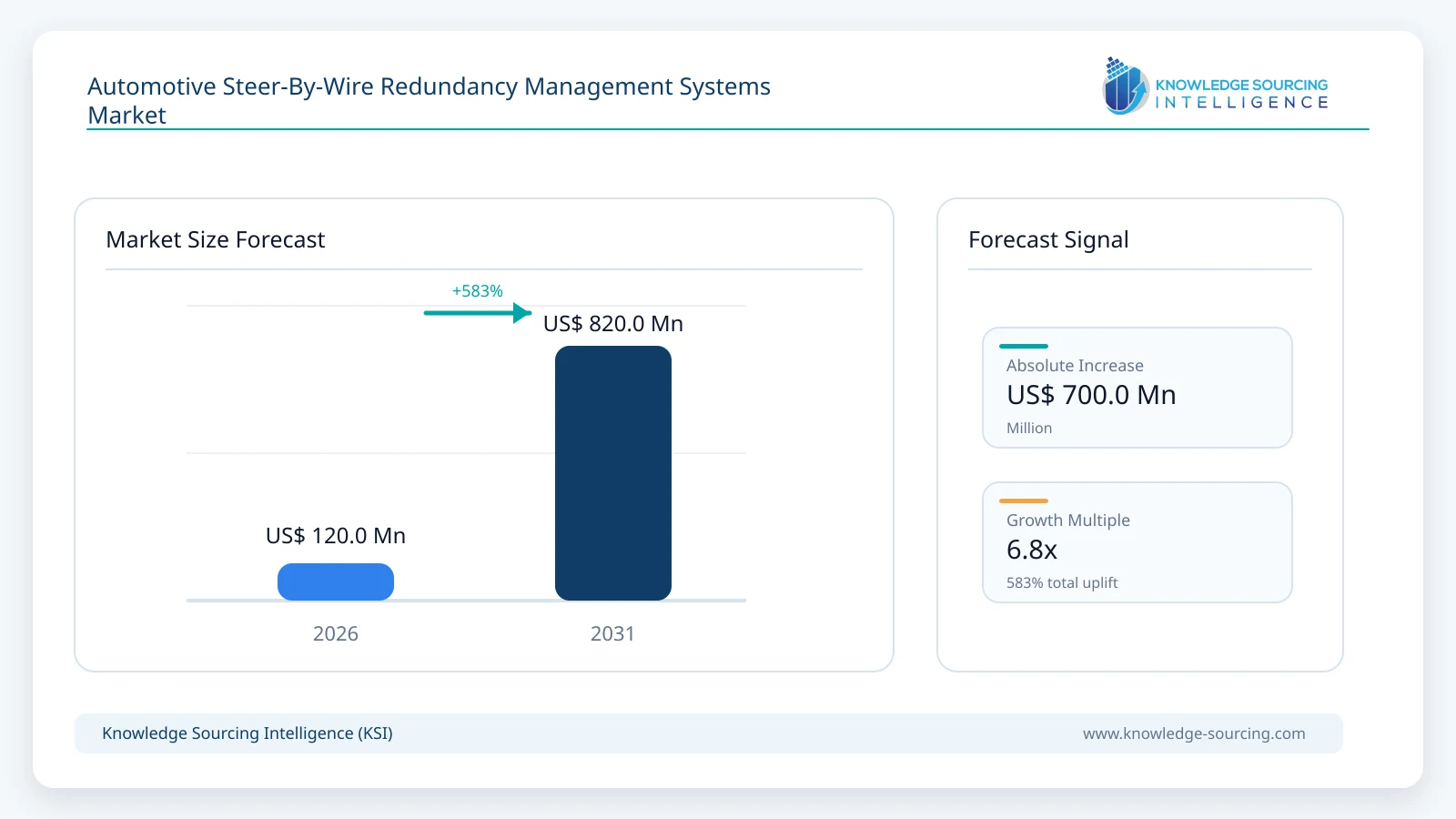
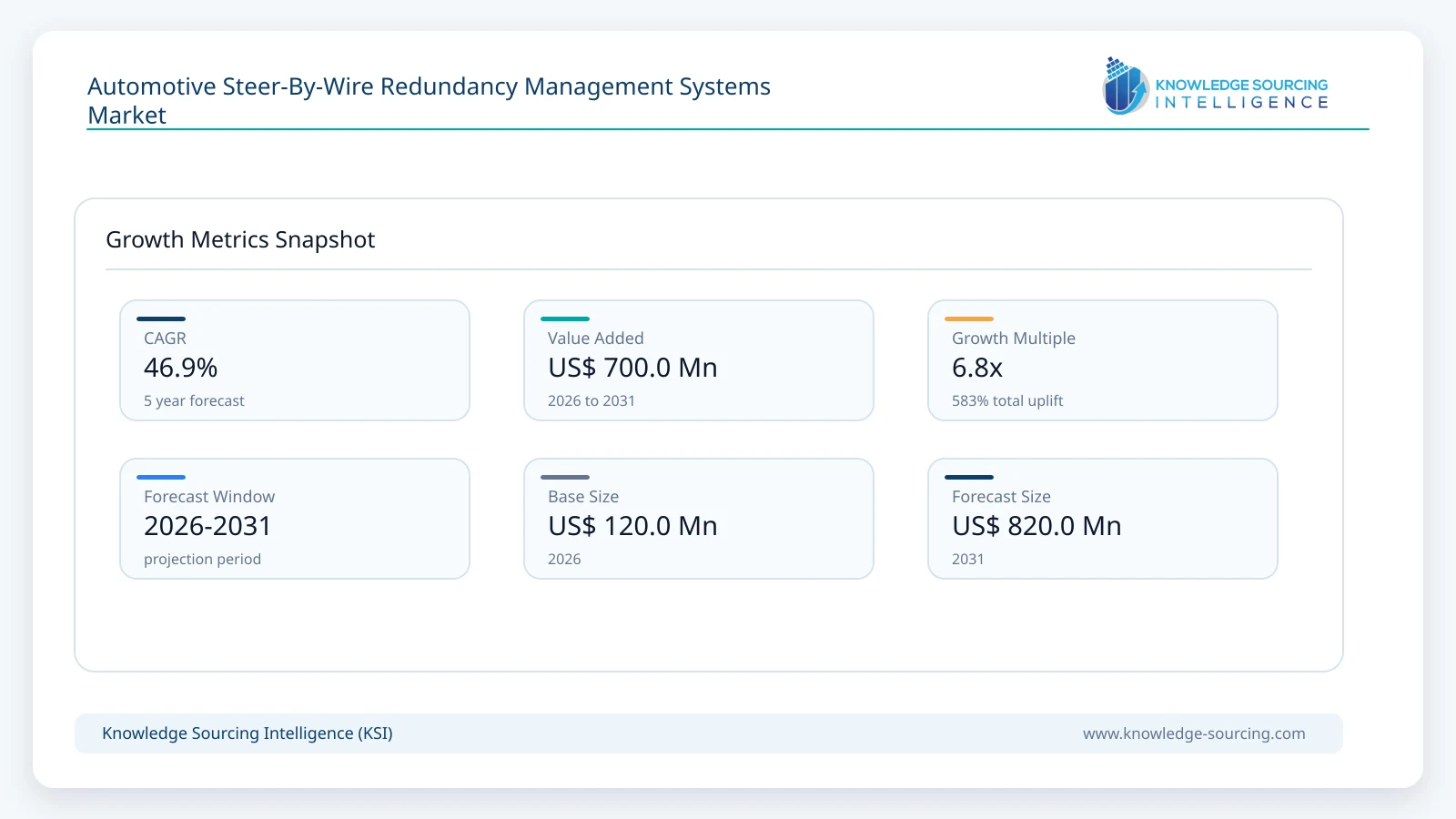
The automotive steer-by-wire redundancy management systems market is projected to expand at a CAGR of 46.9%, increasing from USD 120 million in 2026 to USD 820 million by 2031.
Highlights:
- 1The market is estimated to rise from USD 120 million in 2026 to USD 820 million by 2031 as more production platforms adopt linkless steering.
- 2Parallel active dual-channel arrangements account for approximately 50% of modeled 2026 value; hot-standby and vehicle-level fallback remain commercially relevant alternatives.
- 3Passenger cars and SUVs account for approximately 90% of value in 2026, reflecting early production in premium and technology-led vehicles.
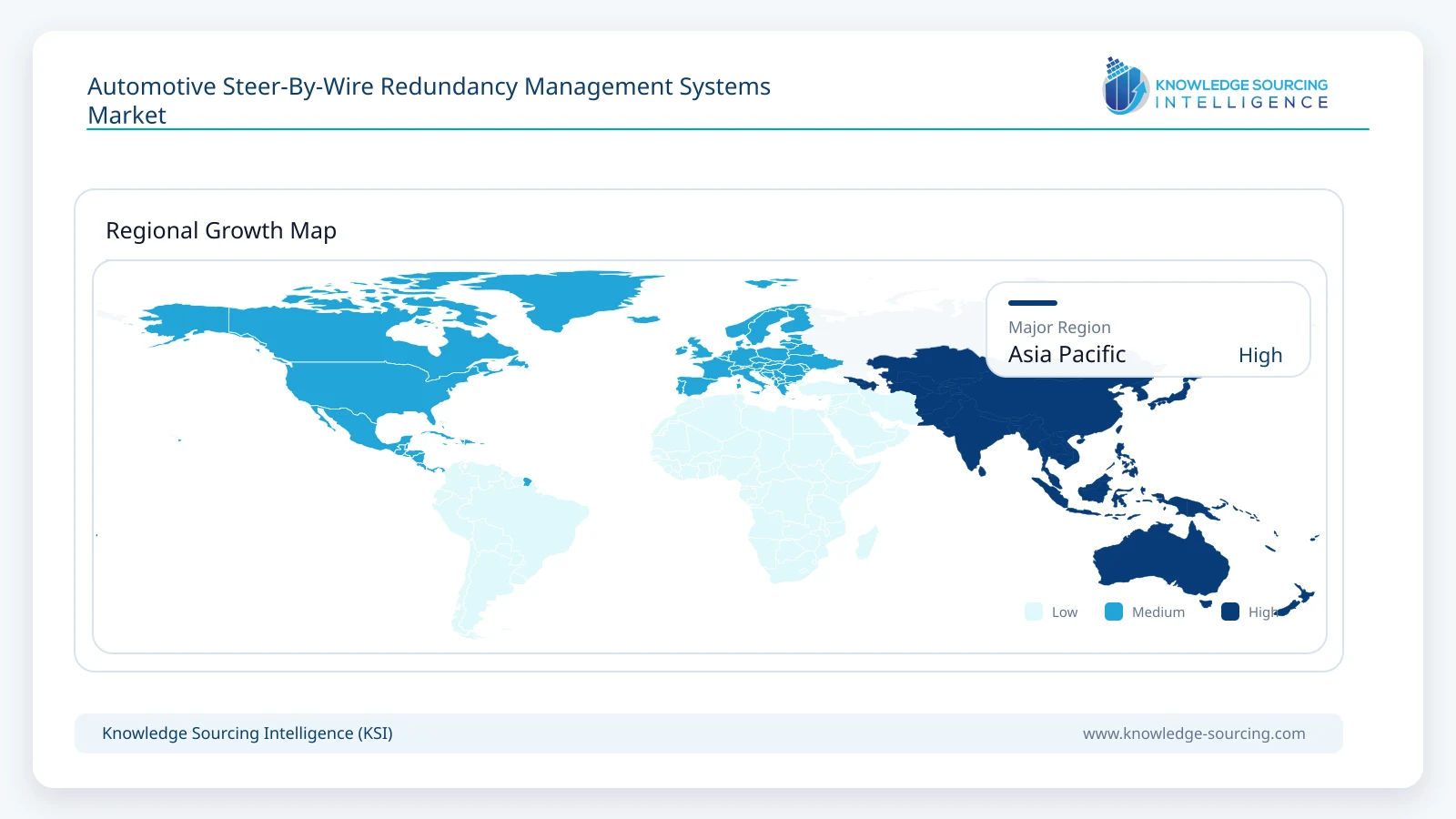
- 4Asia Pacific represents approximately 61% of 2026 demand, supported by Chinese series-production programs and Japanese steering-system engineering.
- 5Independent vehicle power feeds and local emergency reserves provide complementary protection against loss of normal steering electricity.
- 6Multiple suppliers have reached serial production, but global installation counts and separately identifiable redundancy-system prices are not reported publicly.
Automotive steer-by-wire redundancy management links the steering-wheel actuator, road-wheel actuator, independent electrical supplies, redundant computing channels and safety supervision into a fault-tolerant steering function. The purchased content comprises qualified failover electronics, reserve-energy elements, channel health logic, fault-isolation software and directly attributable safety engineering. A redundant motor channel does not protect steering if its backup power feed, command link or fault-detection logic can fail in the same event, which makes the architecture a vehicle-level design decision.
ZF supplies a complete linkless steering system for the NIO ET9, including a redundant gear actuator and software, while JTEKT equips Lexus RZ applications with a local Libuddy backup supply. Mercedes-Benz introduced a steer-by-wire option on the EQS using independent signal paths and a last-resort combination of rear-wheel steering and selective braking. These programs show why safety managers must verify remaining steering authority under specific electrical and mechanical fault conditions instead of merely switching between duplicated devices.
Market Overview
Linkless steering transmits the driver’s steering command electronically to a road-wheel actuator rather than through a rigid steering shaft. The safety architecture must maintain credible command interpretation even when an electronic control unit, communication link, supply rail or motor phase becomes unavailable. Dual-channel controllers, independent supplies, watchdogs and plausibility monitors therefore become parts of the steering function itself. The degree of redundancy varies with vehicle safety objectives, actuator design and the operating state that must be retained after a fault.
Nexteer’s April 2026 production release identifies dual controllers, dual supplies, multiple communication links and dual actuation paths on its first series steer-by-wire program. ZF reports production use on the NIO ET9, and JTEKT identifies a dedicated high-temperature capacitor reserve in the Lexus RZ architecture. The documented hardware choices support more than one purchasing model: some OEMs buy a complete steering assembly with integrated safety content, while others specify control, power and sensing devices across multiple tiers.
Automotive-grade semiconductor providers contribute the control and diagnostic elements underpinning these architectures. Infineon offers safety MCUs, protected gate drivers, redundant steering sensors and power-management devices, while Texas Instruments, NXP, Renesas and Melexis support relevant safety-control, power or sensing functions. These suppliers help vehicle and steering-system manufacturers implement independent lanes, but published component portfolios alone do not prove series vehicle installation. The commercial market is therefore concentrated in qualified system programs, with wider component opportunities following validated platform adoption.
Market Trends
Production Programs Are Making Failover Architecture a Purchasing Requirement
ZF’s production contract for NIO ET9 and Nexteer’s first series steer-by-wire program demonstrate that redundancy can no longer be treated only as a demonstrator feature. Actuator designers must establish a verified fallback route for the complete steering chain, covering sensors, computation, power, communications and the electric motor path. Nexteer describes controller and actuator duplication as part of the safety design rather than a late-stage electronics accessory.
Qualification now ties individual modules to vehicle-specific failure behavior. OEM engineers may change the number of actively driven channels, the location of controller arbitration or the capacity of emergency energy reserves, but each choice creates additional verification work. Suppliers with reusable fault-management software, qualified power devices and proven test processes can lower launch risk across vehicle platforms.
Dedicated Backup Energy Is Entering Production Steering Designs
JTEKT’s Libuddy reserve in the Lexus RZ addresses the case in which normal vehicle power is lost but enough steering operation must remain to move toward a safe position. A capacitor or other local energy reserve must be monitored for state of readiness, routed through protected switching electronics and sized for the vehicle’s safe-response strategy. It cannot be evaluated only by its nominal energy capacity.
Independent dual vehicle feeds remain a second route, particularly where the vehicle already contains protected low-voltage networks. Integrated reserve and supply-switching architectures can improve availability but add tests for ageing, charging faults, voltage dips and partial short circuits. These requirements raise the value of coordinated power-management control relative to a simple backup component.
Chassis Functions Are Becoming Part of the Steering Safety Case
Mercedes-Benz describes continued lateral control using rear-axle steering and selective wheel braking if the primary steer-by-wire system is lost. This approach moves redundancy management beyond one steering actuator into coordinated control of the vehicle’s remaining motion-control resources. The fallback must be predictable across speeds, road friction and actuator availability, not merely theoretically possible.
Cross-domain operation increases interaction between steering safety logic, chassis controllers and independent brake or rear-steering systems. It also creates a distinct engineering challenge: the vehicle must identify exactly which control functions remain trusted after a common electrical or communication fault. Supplier programs that validate these interactions can support more advanced automation without assuming every vehicle will use the same architecture.
Safety Semiconductors Are Supporting Smaller Multi-Lane Controllers
Infineon’s steering product architecture uses lock-step safety processing, protected supplies and redundant sensing, while Texas Instruments identifies redundant steering controls as a core electronic power steering requirement. Dual-die position sensors and advanced power supervision can reduce the assembly footprint of a multi-lane safety design and simplify manufacturing across 12 V and 48 V systems.
The engineering trade-off remains between functional independence and the cost of duplicating electronic channels. Common enclosures, shared oscillators, heat exposure or a single network gateway can undermine a nominally redundant system. Higher-value components are those that help engineers demonstrate true fault separation and reproducible response through automotive qualification.
Steering Software Is Moving Toward Controlled Fail-Operational Updates
Steer-by-wire controllers use software to evaluate channel consistency, classify faults, change authority between lanes and select the allowed degraded steering response. ZF and Bosch present steering as a software-integrated chassis system, making interface management increasingly important when OEM platforms use centralized computing or change steering behavior through vehicle software.
Changes to diagnostic thresholds or arbitration logic can affect the safety evidence supporting the system. OEMs therefore need disciplined release control, compatibility checks and regression testing when steering algorithms are updated. Reusable, vehicle-qualified software modules may capture additional supplier value, but new functions are adopted cautiously because steering remains safety critical.
Segment Analysis
By Redundancy Topology: Parallel Active Dual-Channel Systems
Parallel active dual-channel systems account for approximately 50% of modeled value in 2026 because suppliers can continuously compare sensor and controller behavior while retaining a second steering-control path. Nexteer’s production architecture illustrates the broader use of duplicated supplies, command links and actuator paths when the steering shaft is removed. Continuous channel monitoring can improve fault response but requires careful control of shared failure mechanisms.
Hot-standby architectures also remain viable where the secondary lane can take over within the steering safety response window. Vehicle-level fallback systems grow through 2031 as chassis cooperation becomes more sophisticated, but their adoption depends on validated relationships between steering, braking, power and automation controllers.
By Revenue Component: Redundant Control and Safety Electronics
Redundant controller hardware represents the largest individual revenue component in the 2026 model, at approximately 35% of market value. Safety processors, protected supplies, watchdogs, fault-isolation circuitry and supervision interfaces provide physical means to separate control paths. Infineon’s safety motor-control and sensor portfolio illustrates how suppliers integrate ASIL-oriented devices for this purpose.
Backup-energy and supply-switching hardware forms the next major component, while licensed safety logic and engineering services become increasingly important as vehicle platforms develop different fallback strategies. System suppliers compete on how efficiently these elements can be qualified as a complete steering safety design rather than on electronic device specifications alone.
By Backup Power Architecture: Independent Dual Vehicle Supply Feeds
Independent dual vehicle-supply feeds account for approximately 48% of modeled 2026 revenue because they provide separate power branches without requiring every vehicle to install a large local reserve. Protected distribution, current monitoring and independent control logic help ensure that one power fault does not disable both steering lanes. Supplier designs are adapted to the vehicle’s 12 V or 48 V electrical architecture and battery layout.
Dedicated local energy reserves gain relevance when short-duration steering must remain possible after broader vehicle power loss. JTEKT’s Lexus RZ application provides a named production example. The economic choice depends on available energy, required steering torque, safe-state maneuvering and validation of reserve health throughout vehicle life.
By Vehicle Type: Passenger Cars and SUVs
Passenger cars and SUVs account for approximately 90% of the 2026 market, reflecting premium sedan and SUV programs where steer-by-wire has reached production. NIO ET9, Lexus RZ and Mercedes-Benz EQS give suppliers a base of named vehicles with different steering-wheel designs and redundancy approaches. Passenger demand is primarily driven by OEM program launches rather than aftermarket retrofits.
Light commercial vehicles and specialized automated shuttles form a smaller opportunity but may value fail-operational steering where downtime or the absence of a human steering fallback is important. These applications need different power reserves and functional safety evidence, so their integration value per platform can differ from that of a conventional passenger car.
Market Drivers
Serial Production of Linkless Steering Platforms
ZF’s NIO ET9 program, JTEKT’s Lexus RZ installation and Nexteer’s first 2026 series steer-by-wire launch demonstrate purchase demand for systems that operate without a mechanical steering connection. Each production vehicle must contain tested electrical and software paths capable of managing relevant failures, making redundancy architecture an intrinsic part of OEM steering procurement.
As manufacturers expand the technology across related models, suppliers can reuse controller packages and safety software while reducing qualification costs per vehicle. The addressable value rises through both additional steer-by-wire installations and higher content in platforms with more demanding steering-availability requirements.
Safety Requirements for Independent Control Paths
Steer-by-wire safety cases must address situations such as controller faults, inconsistent position signals and interrupted actuator commands. Nexteer’s dual-channel production design and Bosch’s redundant logic, power and communication architecture establish the physical basis for managing these risks. A robust system must isolate the failed path without mistaking normal transient behavior for a critical fault.
Automotive functional safety processes create substantial demand for qualified electronics, fault-handling software and repeatable vehicle-level verification. Suppliers that demonstrate clear fault coverage and controlled steering availability are better positioned to secure long-duration platform nominations.
Demand for Backup Electrical Power
JTEKT’s use of a local emergency energy reserve demonstrates that redundant steering controllers still need electricity to remain useful after a supply disturbance. Backup power devices, switches and voltage monitors help maintain enough authority for the safe response defined by the vehicle program. These elements have to work across temperature extremes and battery ageing.
Greater electrification and protected low-voltage distribution give OEMs several ways to provide secondary supply branches. The market benefits when safety engineering specifies a tested power-failover function rather than assuming the main battery and a duplicated electronic control unit are sufficient.
Expansion of Software-Defined Chassis Control
Bosch and ZF position steer-by-wire within wider vehicle motion-control architectures, where electronic steering can exchange commands with braking and other chassis actuators. This increases the importance of software that checks communication integrity, determines the trusted control path and coordinates the permitted response to individual subsystem failures.
Engineering contracts can cover integration of multiple steering actuators, communication paths and chassis software interfaces. Well-qualified modules help OEMs retain steering performance as platforms shift from dedicated controllers toward zonal or centralized computing.
Development of Automated Mobility Platforms
Mercedes-Benz describes redundant steering, braking, compute and power supply in its 2026 automated mobility work. Driverless and highly assisted vehicle programs place greater emphasis on retaining lateral control when a single element fails, since a conventional human-controlled mechanical backup may be unavailable.
Although commercial volumes for such platforms remain uncertain, their safety cases require deeper analysis of fault combinations, degraded operation and reserve energy. This encourages new architecture and validation spending by steering suppliers, safety electronics specialists and OEM software teams.
Market Restraints
High Cost of Independent Steering Safety Channels
A complete fail-operational steering design may duplicate processors, power feeds, sensors, communication interfaces and portions of electric actuation. This raises content cost relative to conventional electric power steering, especially when the vehicle architecture cannot reuse an existing protected electrical supply.
For cost-sensitive passenger platforms, the added safety hardware must justify itself through the intended driving function and reliability requirements. Some manufacturers may continue with conventional assisted steering or retain mechanical links rather than adopt a full linkless design.
Complex Validation of Common-Cause Faults
Duplicated controllers can still share vulnerable harnesses, thermal environments, connectors or software components. Engineers must prove that a common disturbance cannot disable both channels and that arbitration remains stable when intermittent faults create conflicting steering measurements.
Qualification extends across bench, hardware-in-loop, proving ground and complete-vehicle tests. Mercedes-Benz cites extensive testing before its 2026 EQS rollout, illustrating how a credible safety case can demand substantial calendar time and engineering budget.
Limited Reserve Energy and Power-Failover Durability
Steering actuators can draw significant transient electrical power during parking or evasive maneuvers. Small local energy reserves must therefore balance package size, lifetime capacity, thermal exposure and the period for which useful steering authority should remain after a supply fault.
JTEKT’s backup capacitor establishes technical feasibility but does not make every vehicle suitable for the same storage architecture. Inadequate state-of-health estimation, wiring faults or unrecognized reserve deterioration could erode the protection expected by the OEM.
Vehicle-Level Interface and Software Update Complexity
A steering fallback that interacts with rear-wheel steering, braking and automated driving controls depends on compatible command priority and reliable network behavior. Mercedes-Benz’s coordinated lateral fallback illustrates the potential benefit and the integration burden of using several chassis actuators.
Updates to steering arbitration or fault thresholds can affect the platform safety case and require regression testing across vehicle variants. OEMs may postpone advanced features until software release processes can demonstrate consistent control over these interactions.
Slow Qualification and Model-Specific Deployment
Production steer-by-wire programs remain concentrated in selected models rather than the wider global passenger-car fleet. Platform programs must satisfy regional steering rules, OEM safety targets, driver-feedback preferences and supply-chain requirements before replacing established steering hardware.
Suppliers can build reusable safety electronics, but actuator layout and emergency-control requirements often change across vehicle families. Long vehicle-development cycles and limited near-term production bases reduce the speed at which a successful launch can be converted into industrywide adoption.
Regional Outlook
Asia Pacific
Asia Pacific accounts for approximately 61% of modeled 2026 global market value, supported by Chinese steer-by-wire production launches and Japan’s established steering technology supply base. ZF’s NIO ET9 contract and Nexteer’s 2026 Chinese OEM program demonstrate actual local deployment, while JTEKT’s Lexus RZ system adds a direct automotive example of backup electrical energy and fault-tolerant steering architecture. These programs create engineering and purchasing demand that extends beyond steering comfort functions.
China remains the largest single country within the regional market through 2031, while Japan and South Korea contribute safety-electronics, vehicle steering and component expertise. Volume growth remains conditional on additional model nominations and reliable high-volume production of redundant control modules. Pricing pressure in China will encourage suppliers to standardize safety processors and electrical protection without compromising independent steering channels.
Europe
Europe accounts for an estimated USD 32 million in 2026 and is modeled to reach approximately USD 250 million by 2031. ZF, Bosch and European automotive engineering teams play a central role in developing redundant steering actuators and control software, while Mercedes-Benz’s October 2026 EQS availability adds a visible European production application. The supplier ecosystem benefits from established power-electronics competence, functional safety engineering and platform qualification processes.
Mercedes-Benz combines independent steering signal paths with possible rear-axle and wheel-braking intervention when the normal steering function is unavailable. This higher-content architecture provides an example of how redundancy management can extend into chassis-level safety coordination. Wider European adoption will depend on cost discipline, the availability of automotive-grade backup components and the ability to reuse validated controllers across model ranges.
Competitive Landscape
ZF, Nexteer and JTEKT are among the clearest suppliers with documented steer-by-wire production programs and direct safety-system involvement. ZF integrates wheel and steering-rack actuators with software; Nexteer emphasizes independent controllers, power supplies, networks and actuator paths; JTEKT combines its linkless steering with a local backup energy solution. Bosch offers a comprehensive steer-by-wire portfolio built around redundant commands and electrical supplies. Supplier competition centers on proven fault isolation, fallback reliability and repeated vehicle-program qualification rather than a published ranking of steering sales.
Semiconductor firms provide another important part of the competitive landscape. Infineon supplies safety MCUs, motor-control drivers, power-monitoring ICs and redundant position sensing; Texas Instruments and NXP support safety-oriented power and control functions; Renesas offers lock-step controller technology; and Melexis provides position-sensing options for redundant vehicle systems. Their products are enabling content, not automatically complete steering solutions. Automotive steering integrators determine which component stacks reach production and how much value is attributable to redundancy management.
OEM purchasing decisions usually involve the entire steering safety case, including secure power supply, verified control software and data interchange with chassis systems. Suppliers able to integrate these elements into proven platforms and maintain long-term software support can reduce qualification effort for future vehicle programs. Collaboration is therefore likely to occur across steering specialists, electronics manufacturers and vehicle-motion software providers.
Recent Developments
October 2026: Mercedes-Benz made steer-by-wire available to order globally on the new EQS, describing redundant signal paths and lateral fallback through rear-wheel steering and selective braking.
May 2026: JTEKT introduced the Syncusteer name for its linkless steering system and confirmed installations in the Lexus RZ and Toyota e-Palette, expanding its commercial platform visibility.
April 2026: Nexteer announced the start of series production for its first steer-by-wire program with a Chinese OEM, citing dual power, control, communication and actuation redundancy.
January 2026: Mercedes-Benz outlined an automated mobility ecosystem built around the S-Class with redundancy for steering, braking, computing and power, illustrating a wider safety architecture under development.
October 2025: JTEKT confirmed installation of its steer-by-wire system and Libuddy backup energy device in Lexus RZ applications, documenting a specific production steering power reserve.
February 2025: ZF announced steer-by-wire series production for the NIO ET9, supplying steering-wheel actuation, redundant road-wheel actuation and software for a linkless steering platform.
Market Outlook
Steer-by-wire redundancy management is positioned to expand as automotive manufacturers qualify more vehicle programs in which the road wheels are commanded entirely through electronic signals. The most immediate value remains with redundant controllers, monitored power branches, fault arbitration and tested actuator failover. Greater use of standardized safety devices should gradually reduce unit content costs, even while the number of eligible vehicle installations rises sharply.
The next generation of steering safety designs will combine redundant sensing and independent power with increasingly coordinated vehicle-motion fallback. Local emergency energy reserves and integrated chassis control are likely to coexist because vehicles have different electrical networks, steering loads and safe-response objectives. OEMs will continue to require extensive verification of common-cause failures and software updates before adopting new variants.
Asia Pacific is expected to retain the largest share of market value through 2031, supported by regional production programs, while Europe benefits from high-content steering and safety engineering. Suppliers that control software, reserve energy interfaces and verified cross-channel operation will be well placed to capture more of the incremental content associated with production steer-by-wire systems.
Market Scope
| Report Metric | Details |
|---|---|
| Total Market Size in 2026 | USD 120 million |
| Total Market Size in 2031 | USD 820 million |
| Forecast Unit | Million |
| Growth Rate | 46.9% |
| Study Period | 2021 to 2031 |
| Historical Data | 2021 to 2024 |
| Base Year | 2025 |
| Forecast Period | 2026 – 2031 |
| Segmentation | Redundancy Management Function, Revenue Component, Redundancy Topology, Backup Power Architecture, System Integration Location,Vehicle Type, Propulsion Type, Direct Purchasing Customer, Geography |
| Companies |
|
Market Segmentation
By Redundancy Management Function
Channel Fault Detection and Arbitration
Backup Power Continuity and Switchover
Communication Link Supervision
Steering Actuator Path Reconfiguration
Vehicle-Level Fallback Coordination
By Revenue Component
Redundant Control and Safety Electronics
Backup Energy and Supply-Switchover Hardware
Safety Software and Diagnostic Logic
Integration, Validation and Lifecycle Services
By Redundancy Topology
Parallel Active Dual-Channel Systems
Hot-Standby Redundant Lane Systems
Multi-Actuator and Vehicle-Level Fallback Systems
By Backup Power Architecture
Independent Dual Vehicle Supply Feeds
Local Dedicated Energy Reserve
Hybrid Reserve and Coordinated Vehicle Supply
By System Integration Location
Road-Wheel / Rack-Control Electronics
Distributed Steering-Wheel and Rack Modules
Central Chassis or Zonal Safety Controller
By Vehicle Type
Passenger Cars and SUVs
Light Commercial Vehicles
Buses, Heavy Vehicles and Automated Shuttles
By Propulsion Type
Battery Electric Vehicles
Hybrid and Plug-in Hybrid Vehicles
Internal Combustion Engine Vehicles
By Direct Purchasing Customer
Steering Tier-1 System Integrators
OEM-Directed Steering Safety Programs
Chassis and Zonal Electronics Integrators
By Geography
North America
United States
Canada
Mexico
South America
Brazil
Argentina
Others
Europe
Germany
United Kingdom
France
Italy
Spain
Others
Middle East and Africa
Saudi Arabia
United Arab Emirates
South Africa
Others
Asia Pacific
China
Japan
South Korea
India
Thailand
Indonesia
Taiwan
Australia
Others
Table of Contents
1. EXECUTIVE SUMMARY
1.1. Market Opportunity and Key Findings
1.2. Global Market Size and Growth, 2026–2031
1.3. Redundancy Architecture Outlook
1.4. Regional Market Outlook
2. MARKET SNAPSHOT
2.1. Market Overview
2.2. Market Definition
2.3. Scope of the Study
2.4. Market Segmentation
3. BUSINESS LANDSCAPE
3.1. Market Drivers
3.1.1. Serial Production of Linkless Steering Platforms
3.1.2. Safety Requirements for Independent Control Paths
3.1.3. Demand for Backup Electrical Power
3.1.4. Expansion of Software-Defined Chassis Control
3.1.5. Development of Automated Mobility Platforms
3.2. Market Restraints
3.2.1. High Cost of Independent Steering Safety Channels
3.2.2. Complex Validation of Common-Cause Faults
3.2.3. Limited Reserve Energy and Power-Failover Durability
3.2.4. Vehicle-Level Interface and Software Update Complexity
3.2.5. Slow Qualification and Model-Specific Deployment
3.3. Market Opportunities
3.4. Porter’s Five Forces Analysis
3.5. Industry Value Chain Analysis
3.6. Policies and Regulations
3.7. Strategic Recommendations
4. TECHNOLOGICAL OUTLOOK
4.1. Dual-Channel Steering Electronics
4.2. Independent Power and Reserve Energy
4.3. Steering Command and Communication Supervision
4.4. Safe Actuator Reconfiguration
4.5. Vehicle-Level Lateral Fallback
4.6. Functional Safety and Qualification
5. AUTOMOTIVE STEER-BY-WIRE REDUNDANCY MANAGEMENT SYSTEMS MARKET BY REDUNDANCY MANAGEMENT FUNCTION
5.1. Introduction
5.2. Channel Fault Detection and Arbitration
5.3. Backup Power Continuity and Switchover
5.4. Communication Link Supervision
5.5. Steering Actuator Path Reconfiguration
5.6. Vehicle-Level Fallback Coordination
6. AUTOMOTIVE STEER-BY-WIRE REDUNDANCY MANAGEMENT SYSTEMS MARKET BY REVENUE COMPONENT
6.1. Introduction
6.2. Redundant Control and Safety Electronics
6.3. Backup Energy and Supply-Switchover Hardware
6.4. Safety Software and Diagnostic Logic
6.5. Integration, Validation and Lifecycle Services
7. AUTOMOTIVE STEER-BY-WIRE REDUNDANCY MANAGEMENT SYSTEMS MARKET BY REDUNDANCY TOPOLOGY
7.1. Introduction
7.2. Parallel Active Dual-Channel Systems
7.3. Hot-Standby Redundant Lane Systems
7.4. Multi-Actuator and Vehicle-Level Fallback Systems
8. AUTOMOTIVE STEER-BY-WIRE REDUNDANCY MANAGEMENT SYSTEMS MARKET BY BACKUP POWER ARCHITECTURE
8.1. Introduction
8.2. Independent Dual Vehicle Supply Feeds
8.3. Local Dedicated Energy Reserve
8.4. Hybrid Reserve and Coordinated Vehicle Supply
9. AUTOMOTIVE STEER-BY-WIRE REDUNDANCY MANAGEMENT SYSTEMS MARKET BY SYSTEM INTEGRATION LOCATION
9.1. Introduction
9.2. Road-Wheel / Rack-Control Electronics
9.3. Distributed Steering-Wheel and Rack Modules
9.4. Central Chassis or Zonal Safety Controller
10. AUTOMOTIVE STEER-BY-WIRE REDUNDANCY MANAGEMENT SYSTEMS MARKET BY VEHICLE TYPE
10.1. Introduction
10.2. Passenger Cars and SUVs
10.3. Light Commercial Vehicles
10.4. Buses, Heavy Vehicles and Automated Shuttles
11. AUTOMOTIVE STEER-BY-WIRE REDUNDANCY MANAGEMENT SYSTEMS MARKET BY PROPULSION TYPE
11.1. Introduction
11.2. Battery Electric Vehicles
11.3. Hybrid and Plug-in Hybrid Vehicles
11.4. Internal Combustion Engine Vehicles
12. AUTOMOTIVE STEER-BY-WIRE REDUNDANCY MANAGEMENT SYSTEMS MARKET BY DIRECT PURCHASING CUSTOMER
12.1. Introduction
12.2. Steering Tier-1 System Integrators
12.3. OEM-Directed Steering Safety Programs
12.4. Chassis and Zonal Electronics Integrators
13. AUTOMOTIVE STEER-BY-WIRE REDUNDANCY MANAGEMENT SYSTEMS MARKET BY GEOGRAPHY
13.1. North America
13.1.1. United States
13.1.2. Canada
13.1.3. Mexico
13.2. South America
13.2.1. Brazil
13.2.2. Argentina
13.2.3. Others
13.3. Europe
13.3.1. Germany
13.3.2. United Kingdom
13.3.3. France
13.3.4. Italy
13.3.5. Spain
13.3.6. Others
13.4. Middle East and Africa
13.4.1. Saudi Arabia
13.4.2. United Arab Emirates
13.4.3. South Africa
13.4.4. Others
13.5. Asia Pacific
13.5.1. China
13.5.2. Japan
13.5.3. South Korea
13.5.4. India
13.5.5. Thailand
13.5.6. Indonesia
13.5.7. Taiwan
13.5.8. Australia
13.5.9. Others
14. COMPETITIVE ENVIRONMENT AND ANALYSIS
14.1. Major Players and Strategy Analysis
14.2. Market Share Analysis
14.3. Mergers, Acquisitions, Agreements and Collaborations
14.4. Competitive Dashboard
15. COMPANY PROFILES
15.1. ZF Friedrichshafen AG
15.2. Nexteer Automotive Group Limited
15.3. JTEKT Corporation
15.4. Robert Bosch GmbH
15.5. Infineon Technologies AG
15.6. Texas Instruments Incorporated
15.7. NXP Semiconductors N.V.
15.8. Renesas Electronics Corporation
15.9. Melexis N.V.
16. APPENDIX
16.1. Currency
16.2. Assumptions
16.3. Base and Forecast Years Timeline
16.4. Key Benefits for Stakeholders
16.5. Research Methodology
16.6. Abbreviations
Navigate
Trusted by the world's leading organizations