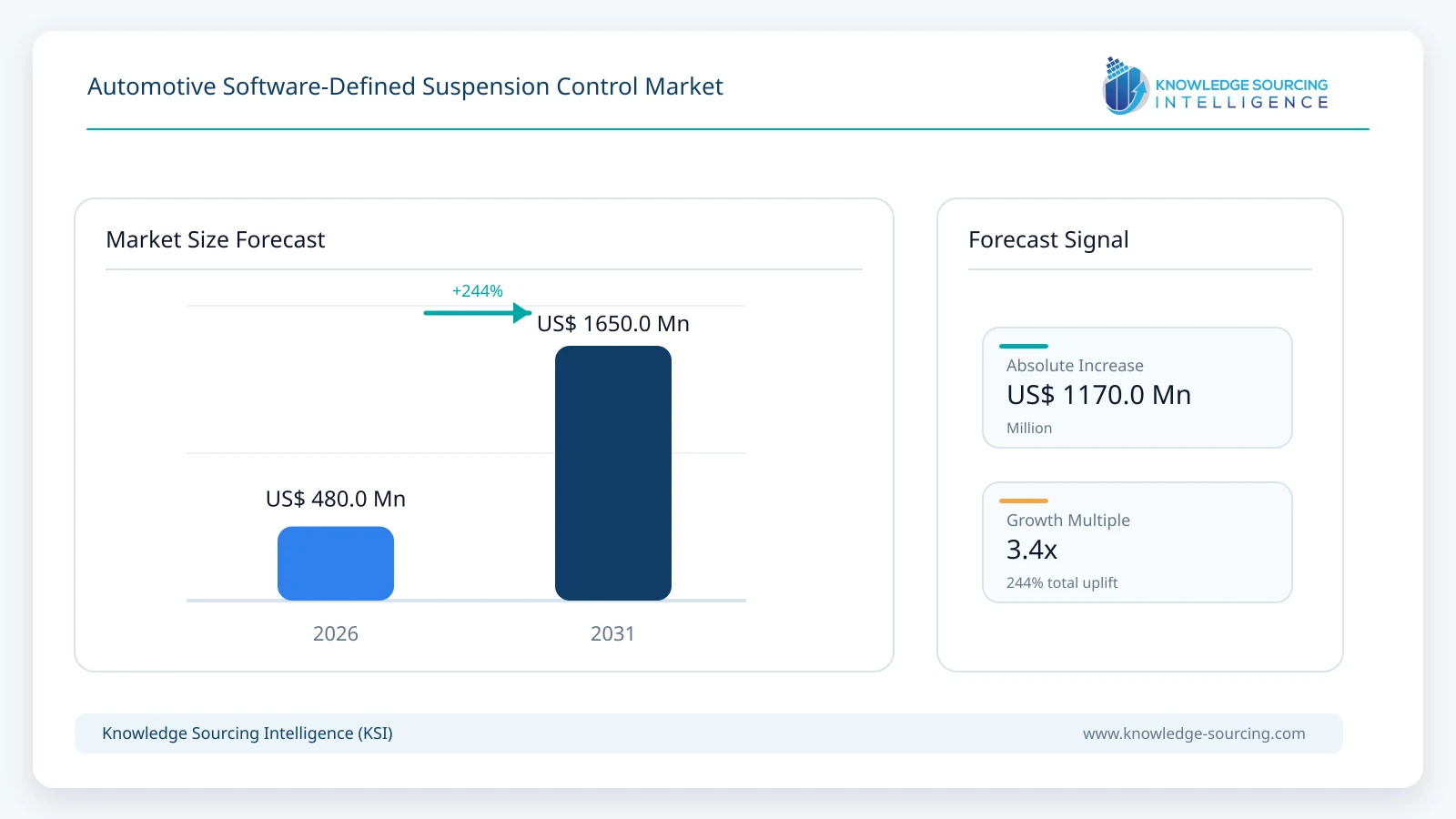
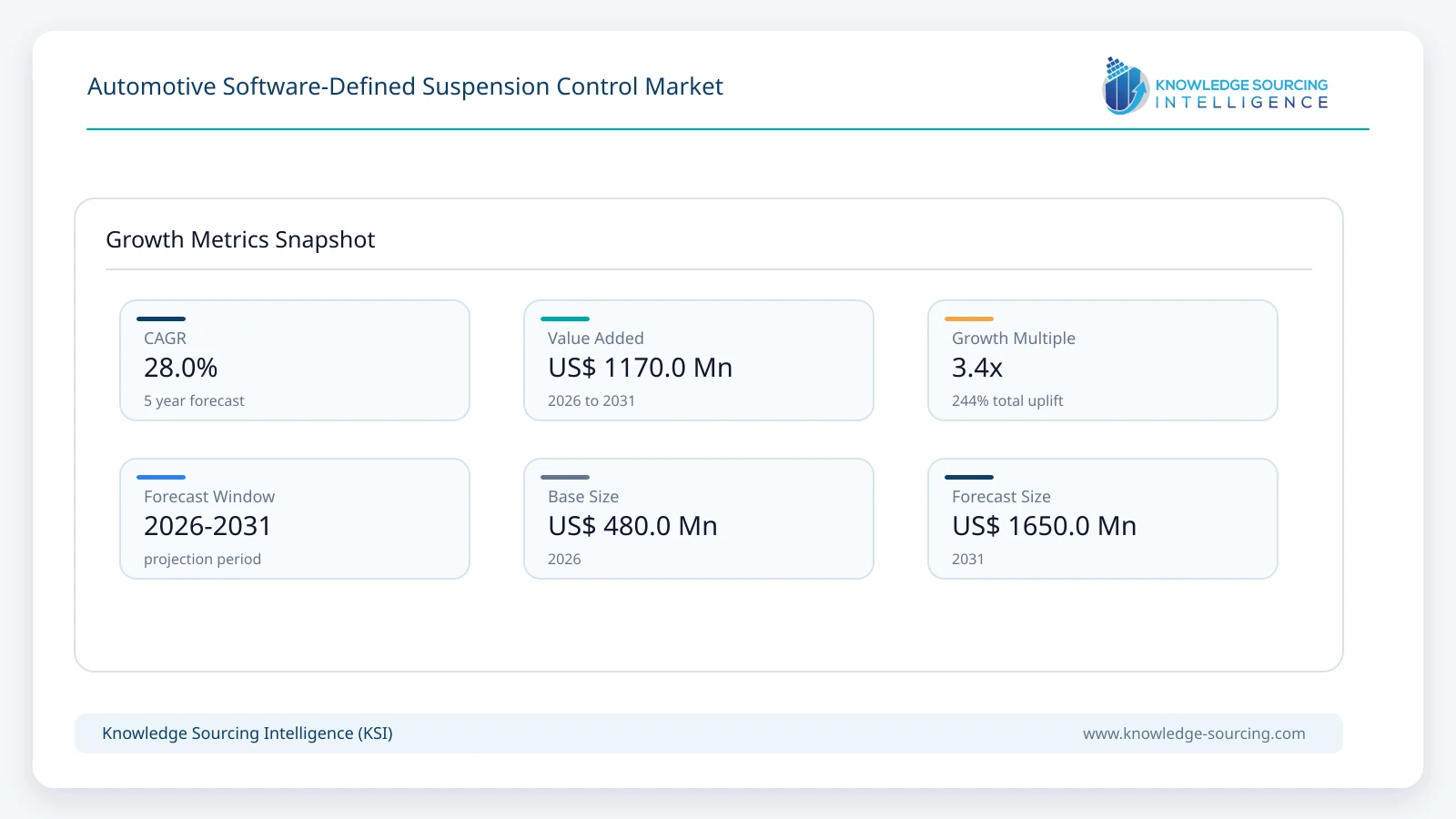
The automotive software-defined suspension control market is growing at a CAGR of 28.0%, from USD 480 million in 2026 to USD 1,650 million by 2031.
Highlights:
- 1Global supplier revenue is estimated at USD 480 million in 2026 and USD 1.65 billion in 2031.
- 2Dedicated suspension controllers represent approximately 62.5% of 2026 revenue, while cross-domain control gains weight.
- 3Semi-active damper control contributes approximately 54.2% of 2026 value and remains the broadest commercial application.
- 4SUVs and crossovers account for approximately 59.4% of 2026 revenue, supported by premium and high-mass vehicle adoption.
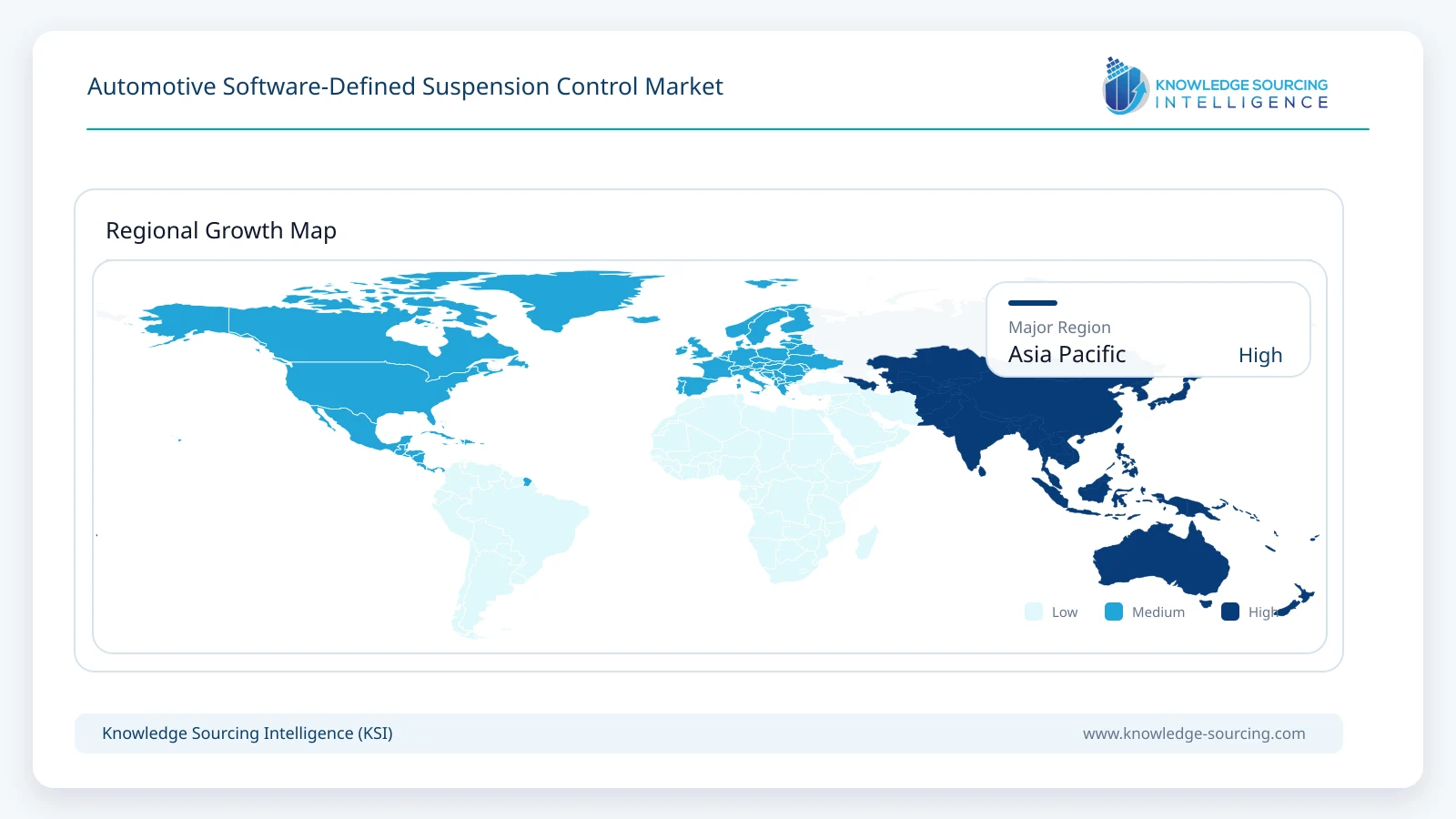
- 5Asia Pacific is the largest modeled region at approximately 40% of global value in 2026, while Europe remains an important engineering hub.
- 6Road-preview, centralized chassis coordination and software recalibration raise the value of control content beyond conventional damping maps.
Software-defined suspension control uses electronic commands and calibrated algorithms to adapt damping, ride height or active wheel forces while the vehicle is moving. Relevant products include dedicated suspension ECUs, suspension-specific functions executed on cross-domain computers, predictive road-preview software and directly associated engineering. Applications range from continuously adjustable shock absorbers to multi-chamber air suspension and high-end fully active systems with motor-pump units. Automakers use these controls to distinguish comfort, stability and road holding without relying entirely on mechanical changes.
ZF connects CDC and sMOTION dampers to cubiX vehicle motion software, while Bosch offers a Vehicle Motion Management architecture coordinating suspension with braking, steering and powertrain functions. Tenneco and BWI Group provide electronically controlled damping architectures that can be calibrated for distinct vehicle programs. These offerings illustrate an industry transition toward reusable control code, vehicle-level sensing and higher software engineering content, and can make future vehicle programs easier to calibrate across different driving modes.
Market Overview
Adaptive suspension systems adjust the resistance or active force at each corner of a vehicle in response to acceleration, steering, wheel movement and road irregularities. Software defines how quickly a damper responds, how comfort and handling modes differ and when the system must revert to a conservative operating state. ZF’s longstanding CDC platform shows that electronically controlled damping is already a mature automotive function, while its sMOTION technology illustrates how more active wheel control creates a more complex software and power-management requirement.
Bosch’s Vehicle Motion Management works across vertical, lateral and longitudinal vehicle movements, allowing software functions to operate independently of a single suspension actuator design. Tenneco’s CVSA2 uses separate electronic compression and rebound regulation, and BWI Group’s MagneRide relies on digitally commanded magnetorheological damping. Supplier differentiation increasingly rests on controller interfaces and calibration that can be reused across vehicle platforms.
Predictive chassis systems are adding camera, cloud and vehicle-network signals to conventional accelerometer-based control. Mercedes-Benz has deployed cloud-informed damping on newer luxury platforms, and ZF introduced AI Road Sense to adapt chassis actuators to changing road conditions. Production qualification remains essential because preview inputs can be incomplete or delayed. Commercial adoption depends on software reuse, actuator compatibility and verified OEM program awards.
Market Trends
Chassis Functions Are Moving from Separate ECUs to Coordinated Software
Suspension controllers traditionally adjust damping from body accelerometers, wheel movement and steering inputs within a dedicated electronic unit, but central vehicle-motion architectures now coordinate those decisions with braking and drivetrain commands. Bosch describes Vehicle Motion Management as an independent software system spanning the vehicle’s six degrees of freedom, while ZF connects its CDC and sMOTION actuators through cubiX.
Automakers gain platform flexibility when suspension control logic can operate on a shared controller rather than being fixed to one damper supplier’s electronic box. Control latency, sensor synchronization and clear fault-handling responsibilities remain important qualification conditions as suspension functions are migrated to zonal or central compute platforms.
Road Preview Is Adding Value Beyond Reactive Damping
ZF’s January 2026 AI Road Sense announcement combines chassis signals with camera information and, on its higher variant, LiDAR-based terrain profiling to inform the response of connected suspension actuators. Mercedes-Benz also introduced cloud-informed damper regulation on its 2026 Maybach GLS, using prior vehicle observations to adjust suspension response before the next vehicle reaches a long speed bump.
Predictive control can reduce abrupt body movement without keeping the suspension permanently firm, but the function must continue working when cameras are obscured or connected road reports are unavailable. Camera-enabled and cloud-assisted programs are gaining commercial attention, while more advanced sensing combinations still need model-specific validation before they can be treated as high-volume production content.
Dual-Valve and Active Actuators Increase Software Calibration Content
Tenneco expanded its CVSA2 portfolio in June 2026 with a steel-tube damper variant offering separate electronic control of compression and rebound. ZF’s sMOTION and ClearMotion’s active ride products go further by commanding forces that oppose body movement, not merely changing the resistance of a passive hydraulic circuit.
Independent rebound and compression control allows engineers to tune comfort, handling and wheel contact across a wider operating range. The commercial value shifts toward reusable algorithms and engineering services, but suppliers must keep platform-specific durability, ride-mode transitions and fail-safe behavior aligned with the validated actuator characteristics.
Electric SUV Mass and Premium Comfort Requirements Support Adoption
Battery electric SUVs combine substantial mass with the quiet cabin environment and rapid torque response that can make body movements more noticeable to occupants. Porsche uses Active Ride to control pitch and roll on the Taycan, while BWI Group confirmed MagneRide for the high-performance Polestar 5 in September 2025.
SUVs offer greater space and transaction prices for electrically controlled damping and body-leveling options than small passenger cars. Wider adoption will depend on measurable ride improvements per unit of added control cost and on reliable service procedures for the linked actuators.
Software Recalibration and Feature Differentiation Are Changing OEM Programs
BWI Group describes MagneRide as digitally tunable across model variants and markets, allowing engineers to change suspension characteristics through software calibration rather than repeated mechanical redesign. Bosch’s platform-oriented Vehicle Motion Management model similarly separates functions from specific hardware architecture.
Over-the-air updates may eventually extend selected suspension functions after vehicle delivery, but safety-critical ride and handling behavior requires tightly controlled software releases. The ability to sell upgrades will depend on OEM approval, secure deployment, continued hardware compatibility and customer willingness to pay.
Segment Analysis
By Control Architecture: Dedicated Suspension Control Units
Dedicated suspension control modules represent approximately 62.5% of modeled 2026 revenue because current semi-active damping and electronic air systems are commonly qualified as distinct controllers that exchange vehicle-speed, steering and acceleration information with other networks. AUMOVIO markets a scalable chassis control unit for vertical dynamics, while established electronically controlled damping programs from ZF and Tenneco use tested local actuation interfaces.
The dedicated-control share is expected to decline as software functions are consolidated with brake, steering and powertrain control on selected high-end platforms. By 2031, buyers are expected to compare the software and integration capability of suppliers more closely than the price of a standalone controller.
By Suspension Technology: Semi-Active Damper Control
Semi-active electronically controlled damping is the largest modeled technology group, accounting for approximately 54.2% of 2026 market value. Unlike fully active suspension, semi-active control changes damping resistance without requiring an actuator to generate independent lifting forces.
Full active systems command higher attributable control value per vehicle but remain concentrated in premium programs such as Porsche Active Ride and NIO vehicles fitted with ClearMotion technology. Its percentage share is expected to moderate through 2031 as higher-function systems increase faster from a smaller base.
By Primary Control Function: Predictive Road-Preview Control
Predictive road-preview functions account for a smaller part of 2026 revenue but are expected to expand faster than conventional adaptive damping. ZF’s AI Road Sense identifies changing surfaces through connected chassis data and optional external sensors, while Mercedes-Benz uses Car-to-X information to prepare AIRMATIC damping for approaching speed bumps.
Commercial value depends on dependable position and timing data, confidence in the road classification and a safe return to ordinary vehicle-state control when preview inputs fail. Over time, wider vehicle camera fitment and common computing platforms should lower the incremental integration effort, provided OEMs validate the same function across multiple terrains and vehicle loads.
By Vehicle Type: SUVs and Crossovers
SUVs and crossovers represent approximately 59.4% of modeled 2026 suspension-control revenue, supported by a high concentration of electronically controlled dampers, air suspension and active body control options in premium and upper-midrange models. Their mass, ride height and comfort demands make adaptive chassis behavior especially valuable.
The SUV contribution is modeled to remain the largest through 2031 as electric and hybrid crossovers spread advanced chassis options beyond flagship models. Reducing control cost without weakening ride performance remains a central supplier challenge.
Market Drivers
Rising Production Fitment of Electronically Controlled Dampers
Electronically controlled dampers are being adopted across more passenger-car and SUV model ranges because they offer a way to improve handling and ride comfort without a full active suspension. Tenneco expanded the CVSA2 family in June 2026, while BWI Group’s MagneRide has moved beyond its original performance-car applications.
Commercial demand follows factory fitment of software-defined functions rather than the overall production of conventional shock absorbers. Suppliers with repeatable product platforms and tested interfaces can support new applications without restarting every element of development.
Growth of Cross-Domain Vehicle Motion Coordination
Bosch’s Vehicle Motion Management and ZF’s cubiX demonstrate the shift toward coordinated control of braking, steering, powertrain and suspension responses. The suspension component of these systems can limit body pitch during braking, adjust damping for lateral maneuvers and balance ride comfort with tire contact.
Cross-domain control increases the importance of standardized sensors, communication timing and common calibration tools. Suspension suppliers can benefit when shared motion platforms still require specialist vertical control algorithms and calibration expertise.
Commercial Rollout of Predictive Road-Preview Functions
ZF unveiled AI Road Sense in January 2026, and Mercedes-Benz’s July 2026 Maybach GLS release described cloud-based predictive damping. These developments connect existing suspension actuation with new data inputs that describe road conditions before the car reaches them.
Route-aware control has the strongest near-term fit in premium cars and SUVs where occupants value smooth body response and cameras or cloud connections are already present. Commercialization will therefore reflect successive model approvals rather than immediate universal adoption of every announced AI capability.
Higher Vehicle Mass and Performance Requirements
Large battery electric SUVs and high-output sports vehicles impose demanding loads on suspension hardware during acceleration, braking and cornering. Porsche’s Active Ride and the selected MagneRide application on Polestar 5 show that automakers are deploying software-controlled vertical dynamics to preserve body stability without using permanently harsh damping settings.
Battery mass is one driver, but combustion and hybrid SUV platforms also require improved load and pitch control. Adoption remains concentrated where the incremental ride benefit can justify integration and validation expenditure within an OEM’s vehicle budget.
Platform-Level Reuse and Software Calibration Flexibility
Suspension suppliers can configure vehicle-specific ride characters through calibration maps, control logic and validated operating modes rather than redesigning each damper from first principles. BWI Group explicitly describes software tuning as a way to accelerate engineering changes, while Bosch supports hardware-independent motion-control deployment across customers.
Reusable control architectures favor suppliers that own interfaces, tuning tools, safety documentation and long-term update support. The modeled share of services increases carefully as cloud-informed prediction and secure feature deployment become more practical across connected vehicle platforms.
Market Restraints
Cost and Packaging of Controllable Suspension Hardware
Software-defined suspension requires electronically addressable dampers or active ride components, supporting sensors and appropriately powered electronics. These additions are considerably more expensive than conventional passive dampers for entry-level cars.
Suppliers are reducing hardware cost through integrated valves and controller standardization, but full active systems still require more costly actuators, thermal management and power supply. Chassis-control suppliers must demonstrate that software and electronics deliver distinct benefits worth their added cost.
Safety Validation and Controller Timing Requirements
Suspension control influences wheel loading and body motion during braking and high-speed maneuvers, requiring predictable response and well-defined safe states. Combining vertical control with steering and brake functions can improve coordination but also complicate the handling of timing faults, sensor disagreement and network interruptions.
Automotive calibration and environmental testing can take substantial vehicle-program effort across loads, tires, road surfaces and temperature ranges. These obligations slow rapid aftermarket-style feature rollout and favor established OEM and Tier 1 engineering organizations.
Sensor and Road-Preview Reliability Constraints
Predictive chassis algorithms use combinations of accelerometers, wheel travel, cameras and cloud reports to anticipate road conditions. Wet pavement, camera obstruction, snow cover and inconsistent road-map information can reduce prediction confidence.
Automakers therefore retain conventional sensing as a dependable operating basis, even when advanced preview functions are marketed. The need for reliable fallback and local sensor processing can constrain the economic advantage of connected services on lower-priced models.
Fragmented Actuator Interfaces and Proprietary Platforms
Suspension actuator suppliers use different valve command ranges, response characteristics, control frequencies and hydraulic or electromechanical designs. Tenneco’s CVSA2, BWI Group’s MagneRide and ZF’s active systems consequently require distinct tuning and diagnostic logic despite performing related ride functions.
Vehicle-level software platforms promise greater portability, but OEMs still need tested abstraction layers and validated actuator descriptions. Interface fragmentation raises calibration costs and can preserve incumbent supplier positions over several vehicle generations.
Uncertain Monetization of Post-Sale Chassis Features
Automakers are developing software-updatable vehicle architectures, but buyers already expect basic ride stability and safe damping performance to be included in a vehicle’s purchase price. Optional suspension modes or cloud-informed preview may create paid upgrade opportunities, yet user willingness to subscribe to ride functions has not been demonstrated at broad industry scale.
OEMs may prefer to bundle suspension functionality in trim packages and use periodic software updates as a customer-retention tool rather than charge separate recurring fees. Rapid growth in remote update capability should not be confused with equivalent growth in recurring suspension-software spending.
Regional Outlook
Asia Pacific
China’s large vehicle-manufacturing base and broad adoption of electronically controlled chassis features make Asia Pacific the largest modeled region for suspension-control content in 2026. BYD has developed its DiSus-C, DiSus-A and DiSus-P intelligent body-control architectures, while ClearMotion began supplying active suspension for NIO’s ET9 through its Chinese production operations.
Asia Pacific is estimated to represent 40% of 2026 market value and around 46% by 2031 as additional upper-midrange vehicle models adopt adjustable damping and connected chassis functions. Control suppliers must respond to local OEM calibration preferences and varying electronically adjustable damper architectures.
Europe
European premium automakers and Tier 1 suppliers lead many of the most developed active ride and cross-domain control applications. ZF’s serial sMOTION products, Bosch’s Vehicle Motion Management and Porsche’s Active Ride provide evidence that software tuning now affects both the ride experience and the design of suspension electronics.
Europe accounts for approximately 31% of modeled 2026 revenue and is projected to remain a major engineering and commercialization center through 2031. Cost competition with Asian OEMs encourages modular control architectures capable of serving more than one vehicle class without the cost of a full bespoke active system.
Competitive Landscape
ZF combines CDC and sMOTION actuation with the cubiX software platform, positioning itself across mature semi-active and advanced active suspension control. Bosch takes a different route through Vehicle Motion Management, in which vertical dynamics are coordinated with braking, steering and propulsion and can be supplied without tying the entire solution to one actuator brand.
Tenneco’s Monroe Ride Solutions and BWI Group concentrate on electronically controlled damping programs that can be calibrated for many model variants. Monroe’s CVSA2 architecture offers independent compression and rebound regulation; BWI’s MagneRide uses electronically controlled magnetorheological fluid and emphasizes repeatable digital tuning. The value of their software content is closely linked to the actuator and vehicle-program economics.
Astemo and KYB participate in electronically adjustable damping and development pathways, although not every supplied damper represents an independently priced software-defined platform. Competition therefore centers on software ownership, calibration effort, functional safety, vehicle-level integration and the ability to reuse control code across geographically dispersed production programs.
Recent Developments
21 July 2026: Mercedes-Benz introduced the updated Maybach GLS with cloud-informed AIRMATIC damping and E-ACTIVE BODY CONTROL, illustrating commercial use of predictive and high-frequency ride control.
23 June 2026: Tenneco / Monroe Ride Solutions launched a steel-tube CVSA2 dual-valve suspension variant for European OEMs after earlier Chinese applications, extending production-oriented electronically controlled damping options.
6 January 2026: ZF unveiled AI Road Sense at CES, combining chassis signals and optional environmental preview with cubiX-controlled CDC and sMOTION. The company also described later software-based chassis functions.
17 September 2025: BWI Group announced the Polestar 5 Performance’s selection of its digitally tunable MagneRide system, linking software calibration with a named premium electric vehicle program.
8 September 2025: Bosch said Vehicle Motion Management had been adopted by more than two dozen automakers worldwide, validating interest in coordinated vehicle motion software while not disclosing suspension-only revenue.
Market Outlook
Electronically controlled damper programs are expected to remain the principal installed base for software-defined suspension control through 2031, but the fastest expansion in software value should come from advanced preview, centrally coordinated vehicle dynamics and more complex four-corner active ride functions. Vehicle makers are likely to deploy these technologies progressively across performance and premium SUV trims before moving toward lower-cost configurations. Engineers will continue to balance actuator response and sensor input quality against reliability, controller cost and safety obligations.
Supplier business models will combine production hardware-software content with program engineering and selective connected functions. Standardized software interfaces can reduce repeated calibration work across models, while changes to active hydraulic or magnetorheological damper hardware still require careful tuning. Upgrades over the vehicle’s life may become more commercially important, but they are unlikely to displace one-time OEM program revenue within the forecast period.
Asia Pacific is projected to remain the leading manufacturing-led market, supported by China’s range of premium EV and SUV applications, while Europe remains a major center for vertically integrated chassis engineering. Suppliers with a combination of validated algorithms, dependable actuation partners, flexible architecture and documented vehicle production programs are best positioned to convert growth in electronically controlled suspensions into enduring revenue from their software and integration content.
Automotive Software-Defined Suspension Control Market Scope
| Report Metric | Details |
|---|---|
| Total Market Size in 2026 | USD 480 million |
| Total Market Size in 2031 | USD 1,650 million |
| Forecast Unit | Million |
| Growth Rate | 28.0% |
| Study Period | 2021 to 2031 |
| Historical Data | 2021 to 2024 |
| Base Year | 2025 |
| Forecast Period | 2026 – 2031 |
| Segmentation | Control Architecture, Suspension Technology, Primary Control Function, Commercial Delivery Model, Vehicle Type, Propulsion Type, Sensing and Preview Input, Geography |
| Companies |
|
Market Segmentation
By Control Architecture
Dedicated Suspension Control Units
Cross-Domain Chassis Controllers
Centralized or Virtualized Control
By Suspension Technology
Semi-Active Damper Control
Electronically Controlled Air Suspension
Fully Active Suspension Control
By Primary Control Function
Continuous Adaptive Damping
Predictive Road-Preview Control
Ride Height and Load Leveling
Body-Motion and Wheel-Load Control
By Commercial Delivery Model
Embedded Production Control Content
Program Engineering and Calibration
Connected and Upgrade Services
By Vehicle Type
Passenger Cars and Hatchbacks
SUVs and Crossovers
Light Commercial Vehicles
Buses and Heavy-Duty Vehicles
By Propulsion Type
Internal Combustion Engine Vehicles
Hybrid Electric Vehicles
Plug-in Hybrid Electric Vehicles
Battery Electric Vehicles
By Sensing and Preview Input
Vehicle-State Signals
Camera and Local Road Preview
Connected and Multimodal Road Intelligence
By Geography
North America
United States
Canada
Mexico
South America
Brazil
Argentina
Others
Europe
Germany
United Kingdom
France
Italy
Spain
Others
Middle East and Africa
Saudi Arabia
United Arab Emirates
South Africa
Others
Asia Pacific
China
Japan
South Korea
India
Indonesia
Thailand
Taiwan
Others
Table of Contents
1. EXECUTIVE SUMMARY
1.1. Market Opportunity and Key Findings
1.2. Market Size and Growth, 2026–2031
1.3. Technology and Segment Outlook
1.4. Regional Opportunity Summary
2. MARKET SNAPSHOT
2.1. Market Overview
2.2. Market Definition
2.3. Scope of the Study
2.4. Market Segmentation
3. BUSINESS LANDSCAPE
3.1. Market Drivers
3.1.1. Rising Production Fitment of Electronically Controlled Dampers
3.1.2. Growth of Cross-Domain Vehicle Motion Coordination
3.1.3. Commercial Rollout of Predictive Road-Preview Functions
3.1.4. Higher Vehicle Mass and Performance Requirements
3.1.5. Platform-Level Reuse and Software Calibration Flexibility
3.2. Market Restraints
3.2.1. Cost and Packaging of Controllable Suspension Hardware
3.2.2. Safety Validation and Controller Timing Requirements
3.2.3. Sensor and Road-Preview Reliability Constraints
3.2.4. Fragmented Actuator Interfaces and Proprietary Platforms
3.2.5. Uncertain Monetization of Post-Sale Chassis Features
3.3. Market Opportunities
3.4. Porter's Five Forces Analysis
3.5. Industry Value Chain Analysis
3.6. Policies and Regulations
3.7. Strategic Recommendations
4. TECHNOLOGICAL OUTLOOK
4.1. Semi-Active Damping Control Algorithms
4.2. Predictive Road-Preview and Sensor Fusion
4.3. Cross-Domain Chassis Motion Coordination
4.4. Active Ride and Wheel-Load Management
4.5. Suspension Control Software Updates and Calibration
4.6. Functional Safety and Actuator Interface Validation
5. AUTOMOTIVE SOFTWARE-DEFINED SUSPENSION CONTROL MARKET BY CONTROL ARCHITECTURE
5.1. Introduction
5.2. Dedicated Suspension Control Units
5.3. Cross-Domain Chassis Controllers
5.4. Centralized or Virtualized Control
6. AUTOMOTIVE SOFTWARE-DEFINED SUSPENSION CONTROL MARKET BY SUSPENSION TECHNOLOGY
6.1. Introduction
6.2. Semi-Active Damper Control
6.3. Electronically Controlled Air Suspension
6.4. Fully Active Suspension Control
7. AUTOMOTIVE SOFTWARE-DEFINED SUSPENSION CONTROL MARKET BY PRIMARY CONTROL FUNCTION
7.1. Introduction
7.2. Continuous Adaptive Damping
7.3. Predictive Road-Preview Control
7.4. Ride Height and Load Leveling
7.5. Body-Motion and Wheel-Load Control
8. AUTOMOTIVE SOFTWARE-DEFINED SUSPENSION CONTROL MARKET BY COMMERCIAL DELIVERY MODEL
8.1. Introduction
8.2. Embedded Production Control Content
8.3. Program Engineering and Calibration
8.4. Connected and Upgrade Services
9. AUTOMOTIVE SOFTWARE-DEFINED SUSPENSION CONTROL MARKET BY VEHICLE TYPE
9.1. Introduction
9.2. Passenger Cars and Hatchbacks
9.3. SUVs and Crossovers
9.4. Light Commercial Vehicles
9.5. Buses and Heavy-Duty Vehicles
10. AUTOMOTIVE SOFTWARE-DEFINED SUSPENSION CONTROL MARKET BY PROPULSION TYPE
10.1. Introduction
10.2. Internal Combustion Engine Vehicles
10.3. Hybrid Electric Vehicles
10.4. Plug-in Hybrid Electric Vehicles
10.5. Battery Electric Vehicles
11. AUTOMOTIVE SOFTWARE-DEFINED SUSPENSION CONTROL MARKET BY SENSING AND PREVIEW INPUT
11.1. Introduction
11.2. Vehicle-State Signals
11.3. Camera and Local Road Preview
11.4. Connected and Multimodal Road Intelligence
12. AUTOMOTIVE SOFTWARE-DEFINED SUSPENSION CONTROL MARKET BY GEOGRAPHY
12.1. North America
12.1.1. United States
12.1.2. Canada
12.1.3. Mexico
12.2. South America
12.2.1. Brazil
12.2.2. Argentina
12.2.3. Others
12.3. Europe
12.3.1. Germany
12.3.2. United Kingdom
12.3.3. France
12.3.4. Italy
12.3.5. Spain
12.3.6. Others
12.4. Middle East and Africa
12.4.1. Saudi Arabia
12.4.2. United Arab Emirates
12.4.3. South Africa
12.4.4. Others
12.5. Asia Pacific
12.5.1. China
12.5.2. Japan
12.5.3. South Korea
12.5.4. India
12.5.5. Indonesia
12.5.6. Thailand
12.5.7. Taiwan
12.5.8. Others
13. COMPETITIVE ENVIRONMENT AND ANALYSIS
13.1. Major Players and Strategy Analysis
13.2. Market Share Analysis
13.3. Mergers, Acquisitions, Agreements and Collaborations
13.4. Competitive Dashboard
14. COMPANY PROFILES
14.1. ZF Friedrichshafen AG
14.2. Robert Bosch GmbH
14.3. Tenneco Inc.
14.4. ClearMotion Inc.
14.5. AUMOVIO SE
14.6. BWI Group
14.7. Astemo, Ltd.
14.8. KYB Corporation
15. APPENDIX
15.1. Currency
15.2. Assumptions
15.3. Base and Forecast Years Timeline
15.4. Key Benefits for Stakeholders
15.5. Research Methodology
15.6. Abbreviations
Navigate
Trusted by the world's leading organizations