
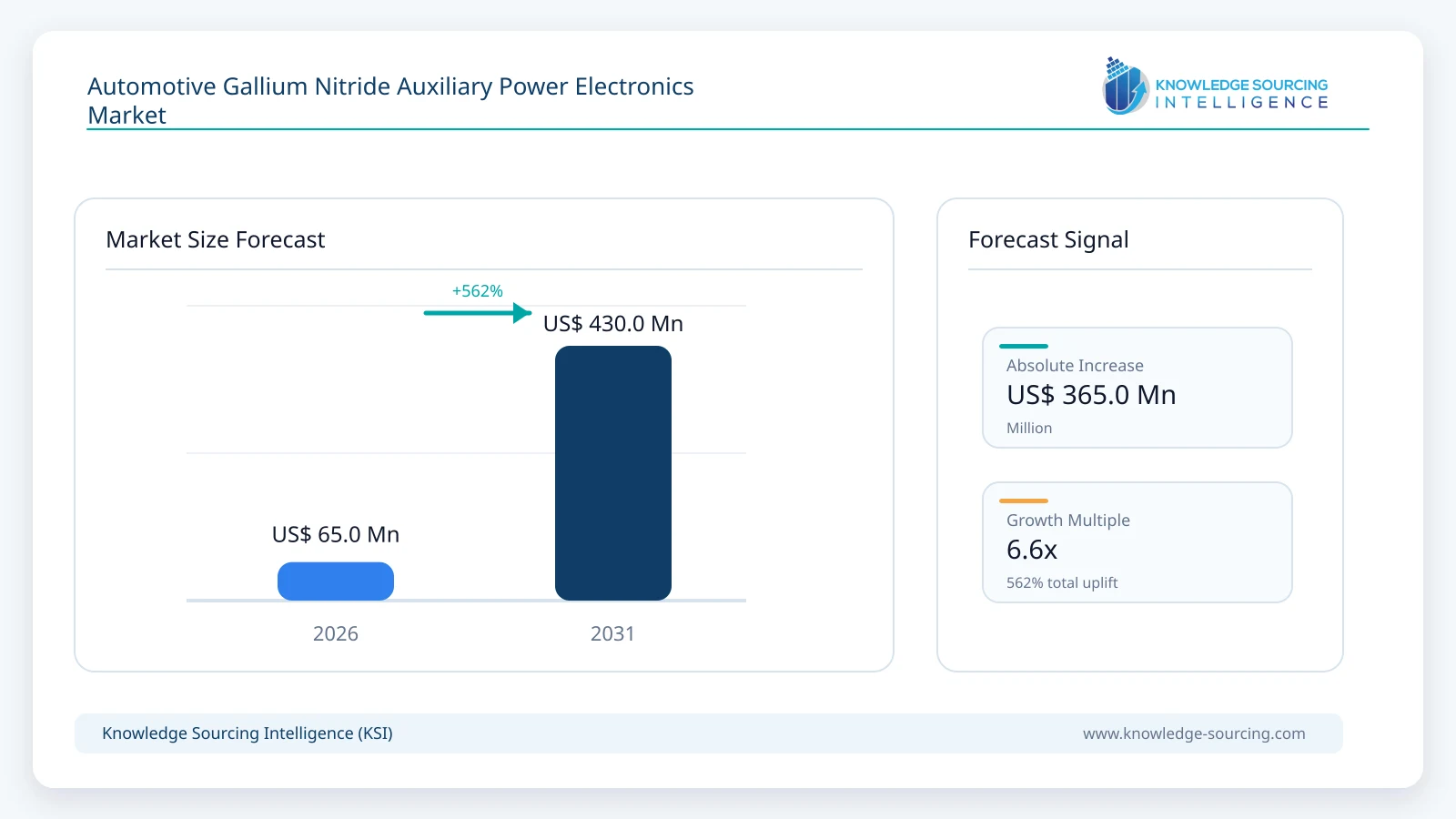
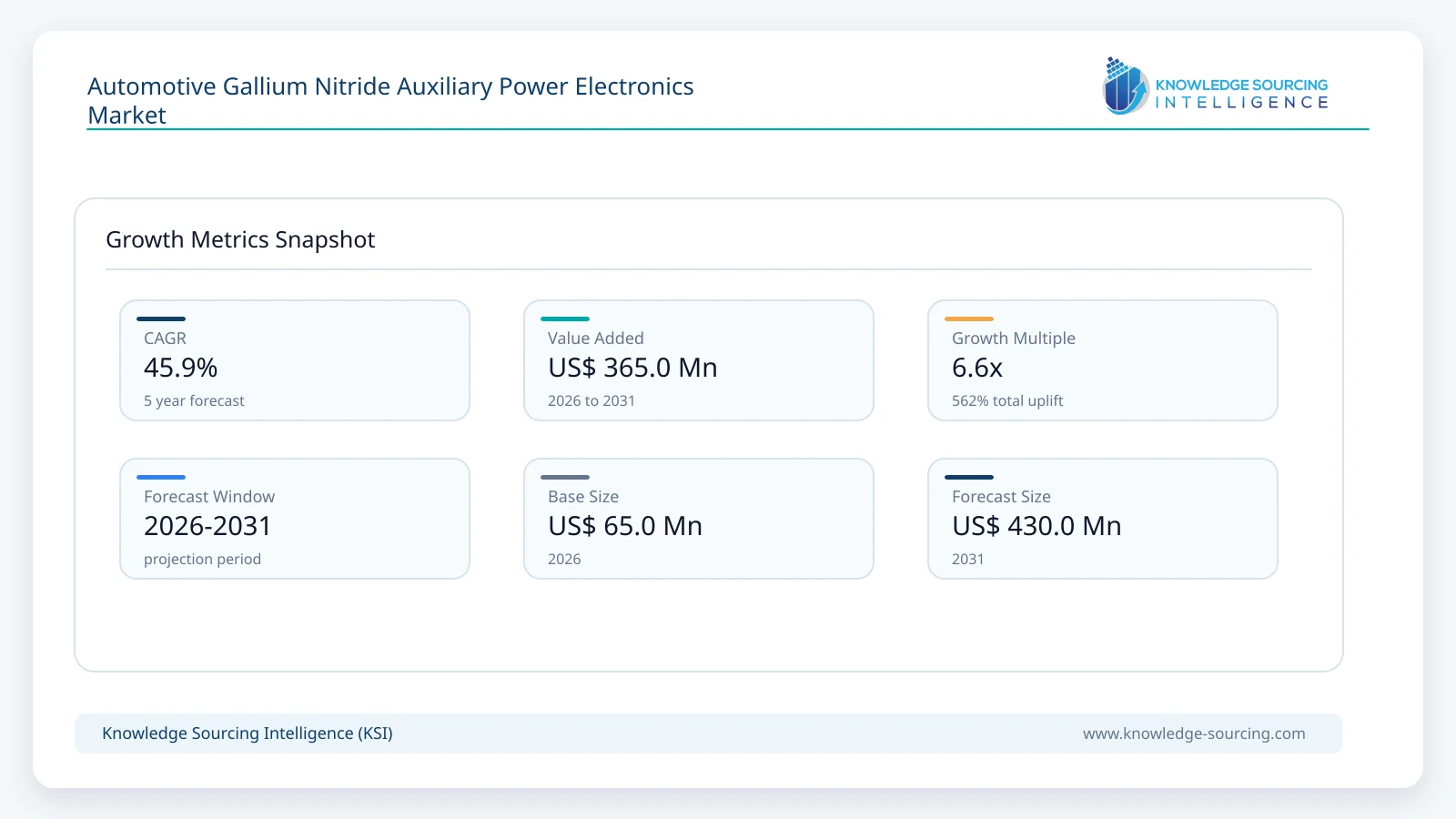
The Automotive Gallium Nitride Auxiliary Power Electronics Market is forecast to grow at a CAGR of 45.9%, reaching USD 430.0 million in 2031 from USD 65.0 million in 2026.
Highlights:
- 148 V/12 V bidirectional conversion represents approximately 41% of the estimated 2026 market, with emerging high-voltage-to-low-voltage conversion growing fastest through 2031.
- 2Asia Pacific accounts for about 55% of 2026 supplier value, reflecting the region’s vehicle-electronics manufacturing base and growing electrification activity.
- 3Europe is modeled as the fastest-growing major region as automotive-qualified GaN content reaches additional premium and electric vehicle platforms.
- 4Low-voltage GaN devices rated at up to 100 V form the largest 2026 device-voltage class, supported by dual-voltage and localized power conversion.
- 5Integrated GaN power ICs gain share as vehicle engineers seek smaller switch-and-driver assemblies with controlled electromagnetic behavior.
- 6The commercial market remains substantially smaller than total automotive DC/DC expenditure because silicon and SiC continue to serve most power-electronics installations.
Automotive GaN auxiliary power electronics includes GaN switching devices, integrated GaN power ICs and their attributable packaged power-stage content used in 48 V/12 V conversion, high-voltage-to-low-voltage auxiliary supplies, zonal electronics and selected electrically driven auxiliary loads. The category is differentiated from complete traction inverter systems and main onboard charging power trains by its role in lower-power vehicle distribution and supporting subsystems. The purchased value is concentrated in qualified power conversion content rather than the selling price of an entire vehicle electrical system.
Infineon has commercialized AEC-Q101-qualified 100 V CoolGaN automotive transistors, while EPC offers qualified GaN devices and reference platforms for bidirectional 48 V/12 V conversion. Texas Instruments and Renesas have demonstrated compact integrated architectures for distributing power from 48 V to conventional 12 V loads. These developments give OEMs a wider choice of devices and validated layouts, although reference designs should not be equated with confirmed series-production fitment.
Market Overview
Vehicle electronics increasingly require power delivery between 12 V, 48 V and high-voltage battery domains while accommodating sensors, processors, body electronics and electrically driven auxiliaries. GaN switches operate efficiently at high switching frequency, allowing engineers to reduce inductor size and achieve compact power-conversion layouts when thermal, cost, and electromagnetic constraints are managed. The largest near-term opportunity lies in 48 V/12 V power stages and distributed supply units that carry recurring electrical loads rather than the full high-power drivetrain.
Infineon’s 100 V CoolGaN family is positioned for zone control, main DC/DC conversion and high-performance auxiliaries. TI’s 960 W four-phase 48 V-to-12 V reference design uses integrated GaN switching to deliver an 80 A-class output in a compact package, while Renesas describes a bidirectional GaN layout operating at 500 kHz. The reference designs demonstrate achievable electrical performance, but actual vehicle-program ramp rates remain a separate commercial decision.
Power semiconductor suppliers compete through device efficiency, gate-drive integration, manufacturing quality and automotive qualification. The value chain includes GaN wafer fabrication, transistor packaging, protection and driver electronics, DC/DC board design and vehicle-level validation. Higher-voltage GaN for HV/LV conversion may broaden the market, although automotive qualification, insulation requirements and established silicon or silicon-carbide designs mean commercial adoption will proceed selectively.
Market Trends
48 V/12 V Power Conversion Is Moving Toward GaN-Ready Designs
Automakers adopting 48 V auxiliary buses need bidirectional conversion to serve existing 12 V circuits while supplying higher-power electronic functions. EPC offers AEC-qualified GaN FETs and 1–2 kW reference designs for this duty, demonstrating the potential to use faster switching and fewer magnetic components in a defined power envelope. Infineon’s 100 V automotive-qualified family gives production engineers an additional component sourcing option.
Converter development teams compare GaN assemblies with mature silicon MOSFET designs using total converter cost, efficiency under variable load and long-term reliability. GaN does not automatically win each program, but compact power stages are valuable where zonal packaging and space constraints create a clear system-level advantage.
Zonal Electrical Architectures Increase Localized Power-Density Requirements
Zonal control units group electronic loads closer to where they operate, creating demand for smaller distributed converters rather than relying entirely on centralized supplies. Texas Instruments demonstrated a 48 V-input, 960 W integrated-GaN reference stage in May 2026, using four interleaved conversion phases to supply 12 V loads. This is directly relevant to power distribution in zone controllers, ADAS domains and other electronics-rich subsystems.
Local converter selection is influenced by cooling, connector and harness arrangements as much as semiconductor performance. Suppliers that provide a repeatable GaN switch-driver and protection architecture may reduce engineering effort across several zonal control modules, although high-volume OEM validation is still needed before reference-stage concepts become routine installed content.
Integrated GaN Power Stages Are Reducing Driver and Package Complexity
STMicroelectronics has demonstrated STi2GaN integration of GaN power and logic for scalable 48 V/12 V conversion, while TI offers integrated switches through its automotive reference architecture. Combined power and drive functions can reduce sensitive board interconnects, simplify thermal layout, and give designers more control over fast switching behavior. The value proposition increasingly includes robust packaging rather than bare switching-device performance alone.
Automotive qualification subjects tightly packaged power stages to temperature, vibration, electrical transients and long service requirements. Integrators must verify that reduced component count translates into acceptable failure behavior and repairability. These engineering requirements favor suppliers able to document package-level endurance alongside conversion efficiency.
High-Voltage Auxiliary Supplies Expand the Addressable GaN Content
Battery electric vehicles require isolated and non-isolated low-power supplies for control electronics, emergency functions and battery-connected auxiliaries. Navitas qualified its high-power GaNSafe products to automotive component standards in April 2025, while Power Integrations offers a 900 V PowiGaN variant in its automotive InnoSwitch3-AQ auxiliary flyback family. These are distinct from the main energy path of an onboard charger or traction inverter.
GaN’s higher-frequency capability can reduce passive-component volume for selected HV-to-LV converters, particularly where only modest auxiliary power is needed. Designers must still meet creepage, isolation and electromagnetic compatibility requirements, and silicon or SiC may remain more economical at certain power and voltage combinations.
Supplier Qualification and Wafer Strategy Shape Commercial Rollout
Infineon’s October 2025 automotive CoolGaN launch and onsemi’s June 2026 GaNEXUS sampling indicate that suppliers are extending product portfolios into new voltage and integration classes. Innoscience has also introduced AEC-Q101 100 V automotive devices and developed integrated SolidGaN products. Commercial maturity varies materially between offered devices, engineering samples, and publicly demonstrated converter designs.
Vehicle programs typically require controlled production changes, long product availability, and traceable reliability data. GaN suppliers must translate attractive laboratory conversion performance into repeatable manufacturing and module-level validation before large platform nominations can support sustained revenue.
Segment Analysis
By Application: 48 V/12 V Bidirectional Conversion
48 V/12 V DC/DC electronics account for approximately 41% of modeled 2026 market revenue because dual-voltage distribution has direct applications in mild-hybrid and increasingly electronics-intensive vehicle platforms. Switching from 48 V supply rails to established 12 V loads requires compact, robust power stages capable of handling high current and variable demand. EPC’s AEC-qualified eGaN devices and Infineon’s automotive 100 V family address the semiconductor requirements of these applications.
The segment is modeled at USD 110 million by 2031 as qualified vehicle installations expand and a larger number of converters adopt GaN content. Silicon MOSFET designs remain cost-competitive, so the pace depends on measurable packaging and efficiency benefits rather than the total population of vehicles equipped with 48 V systems.
By GaN Device Voltage Class: Up to 100 V
GaN switches rated up to 100 V account for 60% of modeled 2026 revenue, supported by automotive-qualified products for 12 V/48 V conversion and nearby localized power stages. Device qualification and familiar DC/DC topologies make this class more accessible than high-voltage GaN applications with greater insulation and transient constraints. Integration with gate-drive and control features adds value where repeated zone-controller designs can share a qualified power architecture.
Higher-voltage device classes gain share toward 2031 as auxiliary conversion from traction-battery rails becomes more common. These newer designs will face more extensive system qualification, which is why published product sampling and design demonstrations have been separated from confirmed vehicle volume in the market analysis.
By Power-Stage Integration: Integrated GaN Power ICs
Integrated GaN power ICs combine switching transistors with some combination of drivers, monitoring or protective functions, reducing external component count and sensitive circuit paths. Texas Instruments’ automotive reference design shows how integrated switching can be used in multiphase 48 V conversion, while STMicroelectronics has demonstrated integrated GaN power-stage architecture for scalable 48 V/12 V systems. Their commercial advantage is strongest in compact electronics modules with repeated designs.
The integrated-IC category is modeled to increase from USD 22 million in 2026 to USD 178 million in 2031, gaining share as qualified integrated products become more broadly available. Suppliers must demonstrate stable performance in actual automotive temperature, EMC, and lifetime tests; integration alone does not guarantee an OEM design win.
By Vehicle Propulsion Type: Battery Electric Vehicles
Battery electric vehicles represent the largest modeled propulsion-related demand group because they combine high-voltage batteries with 12 V and 48 V control loads, distributed computing and additional auxiliary conversion requirements. The IEA expects global electric-car sales to reach approximately 23 million in 2026, providing a substantial eligible vehicle population for power electronics suppliers. The actual GaN-equipped fraction remains much smaller than the total number of EVs sold.
BEV auxiliary GaN revenue is modeled to reach USD 226 million in 2031 as HV/LV and local power-conversion placements grow. Plug-in hybrids and 48 V mild-hybrid vehicles also contribute through bidirectional conversion, but differing voltage architectures create distinct switching ratings and conversion requirements.
Market Drivers
Wider Use of Dual-Voltage 12 V/48 V Electrical Systems
Automotive electrical architectures increasingly use 48 V rails to support higher-power functions without excessive harness current, while continuing to serve widespread 12 V loads. Each dual-voltage design needs efficient step-down or bidirectional conversion. EPC’s automotive-qualified device portfolio and Renesas’ application design give engineers practical GaN options for these high-current paths.
GaN adoption rises when a supplier can reduce magnetic size, cooling demand or converter packaging enough to offset device and qualification costs. The addressable revenue therefore expands with both 48 V platform adoption and GaN share within eligible converters, not with vehicle electrification alone.
Higher Power Demand from Zonal and Domain Electronics
Zone controllers, vehicle processors and active safety electronics place increasing demands on localized power supplies. TI’s 2026 48 V-to-12 V GaN demonstration is aimed at zone control and electronic domain modules, making this a concrete use case for higher conversion density. Local supply placement can help vehicle engineers balance electrical losses, harness layout and module packaging.
An OEM can reuse similar GaN stages across multiple electronic zones only after EMC behavior, cooling and fault handling are validated. Common designs create the potential for repeat purchases over vehicle generations and raise the value of integrated switching products.
Compact Conversion for Battery-Connected Auxiliary Loads
High-voltage vehicle platforms require lower-power supplies for control electronics, safety systems and auxiliary networks separate from the traction inverter. Navitas’ automotive-qualified GaNSafe product family and Power Integrations’ GaN-based automotive flyback switches show how high-voltage GaN can serve selected conversion stages. Such applications can benefit from smaller transformers and efficient isolated conversion.
The supplier opportunity is concentrated in qualified GaN power devices and associated power-stage content rather than the price of an entire charger or inverter. Higher-voltage adoption remains slower than low-voltage conversion because transient and insulation requirements increase design and qualification work.
Availability of Automotive-Qualified GaN Product Families
Infineon’s AEC-Q101 100 V CoolGaN launch in October 2025 expanded the number of available automotive-qualified low-voltage devices. EPC and Innoscience also market AEC-qualified automotive GaN products, giving system designers multiple implementation options across power classes and packaging types. Qualification provides an entry requirement for vehicle electronics programs and reduces early sourcing uncertainty.
Component-level qualification is not the same as a completed OEM vehicle program, but it allows Tier-1 integrators to conduct longer power-cycling, circuit protection, and durability evaluations with defined products. The number of technically feasible applications grows as these product families mature.
Growing Preference for Integrated Power-Stage Packaging
Integrated driver-and-switch packages reduce board traces and can help control parasitic inductance in high-frequency converters. STMicroelectronics’ integrated GaN architecture and TI’s converter reference approach illustrate how power-stage packaging is becoming an important design variable in 48 V electronics. Smaller complete stages can also make it easier to fit power conversion near distributed loads.
Integration value depends on whether manufacturers can achieve repeatable assembly, temperature behavior and fault protection across production batches. Vendors that meet these constraints can gain a broader role in OEM electronics design than a supplier of stand-alone GaN transistors.
Market Restraints
Silicon MOSFET Competition in Cost-Sensitive 12 V/48 V Designs
Conventional silicon MOSFETs serve a large installed design base in automotive low-voltage power conversion, with established supply chains and predictable manufacturing costs. A GaN stage must offer a measurable reduction in system size, power loss or integration complexity to offset its device and redesign premium. For low-power circuits, the benefit can be too small to justify replacing a qualified silicon solution.
Purchasing decisions therefore depend on complete converter economics rather than semiconductor efficiency under a single operating point. This limits near-term GaN penetration even where the technology meets automotive temperature and reliability requirements.
Fast-Switching EMI and Gate-Drive Design Requirements
GaN’s rapid voltage transitions can increase electromagnetic noise and stress-sensitive circuit nodes if the package and PCB layout are not optimized. Vehicle power supplies operate close to processors, sensors and communication networks, increasing the importance of conducted and radiated emissions control. High-frequency conversion may reduce magnetics but can also require careful shielding and filter design.
Engineers must qualify gate-drive voltage margins, short-circuit responses and fault behavior alongside the complete supply module. Additional EMC redesign can offset part of the packaging benefit and slow substitution on established vehicle platforms.
Vehicle Qualification and Long Product-Life Commitments
Automotive power electronics are exposed to temperature cycles, vibration, humidity, voltage transients, and multiyear operating obligations. New GaN packages require validation at semiconductor, PCB, converter, and vehicle levels before suppliers can enter large series programs. A reference design or an automotive-qualified device alone does not demonstrate system-level qualification.
Changing the GaN device or foundry after an OEM platform is approved can require fresh testing and supplier sign-off. Longer qualification cycles constrain how rapidly new devices can replace incumbent technologies, particularly in safety-related auxiliary power paths.
Supply-Chain and Packaging Maturity for High-Voltage GaN
High-voltage GaN devices must satisfy demanding insulation, package reliability, and manufacturing consistency requirements while competing with established SiC and silicon options. Several supplier portfolios remain at the sampling or design-evaluation stage for automotive HV conversion. The limited number of fully validated module architectures creates additional sourcing risk for programs requiring long availability.
Foundry capacity, package changes and material yields can affect qualification timelines even when underlying device performance is promising. Automotive customers are likely to favor suppliers with demonstrated alternate sourcing and stable quality control before making GaN a core production technology.
Limited Economics in Low-Utilization Auxiliary Loads
Some vehicle auxiliary loads operate intermittently or draw comparatively little power, reducing the absolute energy savings from a higher-efficiency GaN switch. Established silicon controllers can be cheaper where magnetic size or thermal performance is not a primary constraint. Lower-value modules also face strict cost ceilings from OEM electronics purchasing teams.
GaN suppliers must identify applications with enough switching activity, packaging pressure or repeated board content to generate a credible lifecycle benefit. This makes expansion uneven across vehicle subsystems rather than a uniform conversion of all auxiliary electronics.
Regional Outlook
Asia Pacific
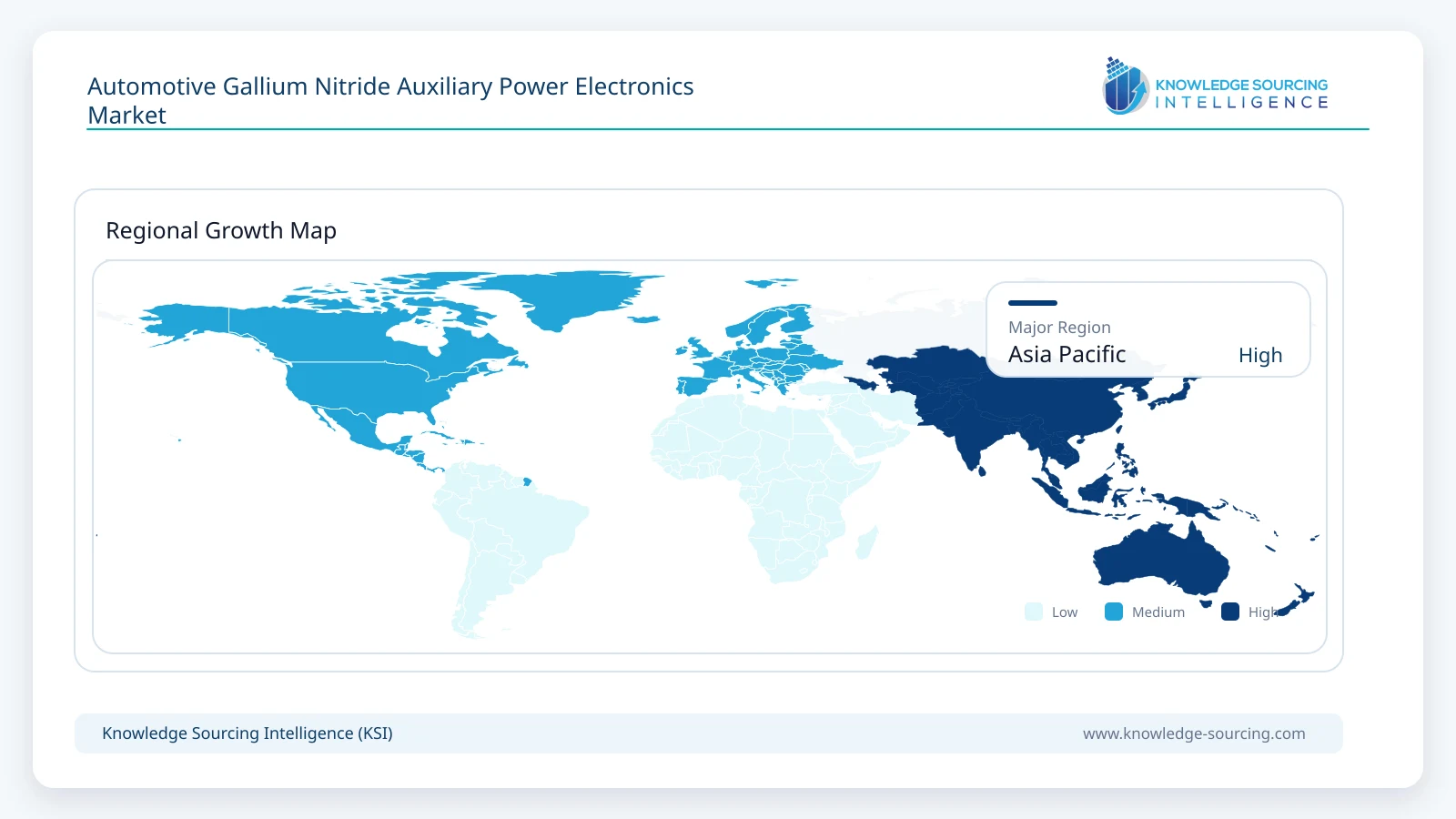
Asia Pacific is the leading modeled regional market, accounting for around 55% of 2026 revenue. China’s large electric-vehicle production base creates a broad setting for 48 V, local electronics and high-voltage auxiliary conversion programs, while Japan, South Korea and Taiwan contribute semiconductor and automotive-electronics supply capacity. The IEA estimates that China produced nearly three-quarters of electric cars worldwide in 2025, although that manufacturing share is not a direct measure of GaN deployment.
The region is forecast to reach USD 229 million by 2031 as locally manufactured vehicle electronics incorporate more qualified GaN switching content. Manufacturers must compete with efficient low-cost silicon designs, making package-level price and reliability important factors in China’s highly competitive automotive supply base.
Europe
European vehicle-platform engineering increasingly addresses 48 V distribution, high-voltage auxiliary conversion and compact electronics modules. Infineon’s automotive CoolGaN portfolio provides a relevant regional supplier capability, while European OEM and Tier-1 design programs evaluate smaller power stages for electric and electronics-rich vehicles. The commercial path depends on long supplier qualification cycles and integrating the GaN stage within a complete control or conversion assembly.
Europe accounts for an estimated 22% of market revenue in 2026 and is modeled to reach USD 111 million in 2031, making it the fastest-growing major region from the five-region baseline. Germany remains the principal regional engineering center, with broader adoption dependent on approved series-program designs rather than general EV sales growth alone.
Competitive Landscape
Infineon, EPC, Texas Instruments, STMicroelectronics, Renesas, Navitas, Innoscience and Power Integrations bring different approaches to automotive GaN conversion. Infineon and EPC emphasize qualified low-voltage switches, while TI and ST illustrate closer integration of switching and control. Navitas and Power Integrations provide higher-voltage GaN options that can address selected auxiliary supplies, with distinct qualification and output-power limits.
onsemi’s GaNEXUS sampling program and ROHM’s GaN manufacturing work extend the broader technology landscape, although neither announcement establishes material 2026 revenue from this narrowly defined automotive auxiliary market. Suppliers are competing primarily through qualification history, package reliability, driver behavior and vehicle-system integration support rather than verifiable company-specific market shares.
OEMs and Tier-1 integrators evaluate device suppliers on cost per converter, development support, temperature performance and supply continuity. Attributable GaN spending is distributed across chip, IC and packaged-stage transactions; complete vehicle DC/DC module sales are not a direct equivalent of semiconductor value, particularly where silicon and GaN appear in separate circuit sections.
Recent Developments
July 2026: Innoscience reported recognition of its automotive-grade integrated SolidGaN device at the CSPSD 2026 event, supporting product visibility without providing independently audited vehicle-installation numbers.
June 2026: onsemi introduced GaNEXUS devices spanning 40–650 V at sampling stage, expanding its GaN portfolio for high-density power conversion; automotive auxiliary use remains a potential application rather than an announced OEM award.
May 2026: Texas Instruments published its 960 W, four-phase GaN 48 V-to-12 V automotive reference design, showing a compact integrated switching arrangement for zonal power applications. The board is a validation design, not a confirmed vehicle shipment.
February 2026: ROHM announced steps to strengthen GaN supply capability and automotive technology development, addressing manufacturing readiness but not confirming a new GaN auxiliary vehicle production program.
October 2025: Infineon introduced its first AEC-Q101-qualified 100 V automotive CoolGaN transistor family for zone control, 48 V/12 V conversion and higher-performance auxiliary applications.
April 2025: Navitas announced automotive qualification of its high-power GaNSafe IC products for applications that include high-voltage-to-low-voltage DC/DC conversion, expanding the potential qualified device pool.
Market Outlook
Automotive auxiliary GaN demand is projected to expand as 48 V conversion and distributed power electronics become more common across electric, hybrid and electronics-intensive vehicle platforms. Integrated switching stages should increase their share of supplier value where they materially reduce layout complexity and passive-component size. Low-voltage designs remain the most established part of the market in the near term, while higher-voltage auxiliary DC/DC gains importance over the forecast period.
Automotive qualification, supply continuity and complete converter economics will determine where GaN takes share from silicon rather than simply adding to existing semiconductor spend. Asia Pacific retains the largest production-linked demand pool, while Europe offers strong growth through advanced electronics platforms and qualified component suppliers. Successful participants will be those that combine reliable GaN devices with documented system-level integration performance.
Automotive Gallium Nitride Auxiliary Power Electronics Market Scope:
| Report Metric | Details |
|---|---|
| Total Market Size in 2026 | USD 65.0 million |
| Total Market Size in 2031 | USD 430.0 million |
| Forecast Unit | USD Million |
| Growth Rate | 45.9% |
| Study Period | 2021 to 2031 |
| Historical Data | 2021 to 2024 |
| Base Year | 2025 |
| Forecast Period | 2026 – 2031 |
| Segmentation | Application, GaN Device Voltage Class, Power-Stage Integration, Conversion Topology |
| Companies |
|
Market Segmentation
By Application
48 V/12 V Bidirectional Conversion
High-Voltage-to-Low-Voltage DC/DC
Zonal and Localized Auxiliary Power
Auxiliary Motor and Specialized Load Power
By GaN Device Voltage Class
Up to 100 V
Above 100 V to 200 V
Above 200 V to 900 V
By Power-Stage Integration
Discrete GaN Switching Assemblies
Integrated GaN Power ICs
GaN-Based Packaged Power Stages
By Conversion Topology
Multiphase Buck and Buck-Boost
Isolated Flyback and Resonant DC/DC
Point-of-Load Conversion
Auxiliary Motor and Other Switching Stages
By Vehicle Propulsion Type
Battery Electric Vehicles
Plug-in Hybrid Electric Vehicles
48 V Mild-Hybrid Vehicles
Other 12 V/48 V Vehicle Platforms
By Vehicle Type
Passenger Cars and SUVs
Light Commercial Vehicles
Buses and Heavy Commercial Vehicles
By Power Distribution Architecture
48 V/12 V Dual-Voltage Systems
400 V Battery-Connected Auxiliary Systems
800 V-Class Battery-Connected Auxiliary Systems
Other Distributed Power Architectures
By Direct Customer
Tier-1 and Contract Power-Electronics Integrators
OEM-Owned Power-Electronics Operations
By Geography
North America
United States
Canada
Mexico
South America
Brazil
Argentina
Others
Europe
Germany
France
United Kingdom
Italy
Spain
Others
Middle East and Africa
Saudi Arabia
UAE
South Africa
Others
Asia Pacific
China
Japan
South Korea
India
Taiwan
Indonesia
Thailand
Others
Table of Contents
1. EXECUTIVE SUMMARY
1.1. Market Opportunity and Key Findings
1.2. Market Size and Growth, 2026–2031
1.3. Application and Technology Outlook
1.4. Regional Opportunity Summary
2. MARKET SNAPSHOT
2.1. Market Overview
2.2. Market Definition
2.3. Scope of the Study
2.4. Market Segmentation
3. BUSINESS LANDSCAPE
3.1. Market Drivers
3.1.1. Wider Use of Dual-Voltage 12 V/48 V Electrical Systems
3.1.2. Higher Power Demand from Zonal and Domain Electronics
3.1.3. Compact Conversion for Battery-Connected Auxiliary Loads
3.1.4. Availability of Automotive-Qualified GaN Product Families
3.1.5. Growing Preference for Integrated Power-Stage Packaging
3.2. Market Restraints
3.2.1. Silicon MOSFET Competition in Cost-Sensitive 12 V/48 V Designs
3.2.2. Fast-Switching EMI and Gate-Drive Design Requirements
3.2.3. Vehicle Qualification and Long Product-Life Commitments
3.2.4. Supply-Chain and Packaging Maturity for High-Voltage GaN
3.2.5. Limited Economics in Low-Utilization Auxiliary Loads
3.3. Market Opportunities
3.4. Porter’s Five Forces Analysis
3.5. Industry Value Chain Analysis
3.6. Automotive Qualification and Regulations
3.7. Strategic Recommendations
4. TECHNOLOGICAL OUTLOOK
4.1. 48 V/12 V GaN Power Conversion
4.2. High-Voltage-to-Low-Voltage GaN Conversion
4.3. GaN Switching and Gate-Drive Integration
4.4. Multiphase and Isolated Converter Topologies
4.5. Package Reliability and Electromagnetic Compatibility
4.6. Automotive Qualification and Testing
5. AUTOMOTIVE GALLIUM NITRIDE AUXILIARY POWER ELECTRONICS MARKET BY APPLICATION
5.1. Introduction
5.2. 48 V/12 V Bidirectional Conversion
5.3. High-Voltage-to-Low-Voltage DC/DC
5.4. Zonal and Localized Auxiliary Power
5.5. Auxiliary Motor and Specialized Load Power
6. AUTOMOTIVE GALLIUM NITRIDE AUXILIARY POWER ELECTRONICS MARKET BY GAN DEVICE VOLTAGE CLASS
6.1. Introduction
6.2. Up to 100 V
6.3. Above 100 V to 200 V
6.4. Above 200 V to 900 V
7. AUTOMOTIVE GALLIUM NITRIDE AUXILIARY POWER ELECTRONICS MARKET BY POWER-STAGE INTEGRATION
7.1. Introduction
7.2. Discrete GaN Switching Assemblies
7.3. Integrated GaN Power ICs
7.4. GaN-Based Packaged Power Stages
8. AUTOMOTIVE GALLIUM NITRIDE AUXILIARY POWER ELECTRONICS MARKET BY CONVERSION TOPOLOGY
8.1. Introduction
8.2. Multiphase Buck and Buck-Boost
8.3. Isolated Flyback and Resonant DC/DC
8.4. Point-of-Load Conversion
8.5. Auxiliary Motor and Other Switching Stages
9. AUTOMOTIVE GALLIUM NITRIDE AUXILIARY POWER ELECTRONICS MARKET BY VEHICLE PROPULSION TYPE
9.1. Introduction
9.2. Battery Electric Vehicles
9.3. Plug-in Hybrid Electric Vehicles
9.4. 48 V Mild-Hybrid Vehicles
9.5. Other 12 V/48 V Vehicle Platforms
10. AUTOMOTIVE GALLIUM NITRIDE AUXILIARY POWER ELECTRONICS MARKET BY VEHICLE TYPE
10.1. Introduction
10.2. Passenger Cars and SUVs
10.3. Light Commercial Vehicles
10.4. Buses and Heavy Commercial Vehicles
11. AUTOMOTIVE GALLIUM NITRIDE AUXILIARY POWER ELECTRONICS MARKET BY POWER DISTRIBUTION ARCHITECTURE
11.1. Introduction
11.2. 48 V/12 V Dual-Voltage Systems
11.3. 400 V Battery-Connected Auxiliary Systems
11.4. 800 V-Class Battery-Connected Auxiliary Systems
11.5. Other Distributed Power Architectures
12. AUTOMOTIVE GALLIUM NITRIDE AUXILIARY POWER ELECTRONICS MARKET BY DIRECT CUSTOMER
12.1. Introduction
12.2. Tier-1 and Contract Power-Electronics Integrators
12.3. OEM-Owned Power-Electronics Operations
13. AUTOMOTIVE GALLIUM NITRIDE AUXILIARY POWER ELECTRONICS MARKET BY GEOGRAPHY
13.1. North America
13.1.1. United States
13.1.2. Canada
13.1.3. Mexico
13.2. South America
13.2.1. Brazil
13.2.2. Argentina
13.2.3. Others
13.3. Europe
13.3.1. Germany
13.3.2. France
13.3.3. United Kingdom
13.3.4. Italy
13.3.5. Spain
13.3.6. Others
13.4. Middle East and Africa
13.4.1. Saudi Arabia
13.4.2. UAE
13.4.3. South Africa
13.4.4. Others
13.5. Asia Pacific
13.5.1. China
13.5.2. Japan
13.5.3. South Korea
13.5.4. India
13.5.5. Taiwan
13.5.6. Indonesia
13.5.7. Thailand
13.5.8. Others
14. COMPETITIVE ENVIRONMENT AND ANALYSIS
14.1. Major Players and Strategy Analysis
14.2. Market Share Analysis
14.3. Mergers, Acquisitions, Agreements and Collaborations
14.4. Competitive Dashboard
15. COMPANY PROFILES
15.1. Infineon Technologies AG
15.2. Efficient Power Conversion Corporation
15.3. Texas Instruments Incorporated
15.4. STMicroelectronics N.V.
15.5. Renesas Electronics Corporation
15.6. Navitas Semiconductor Corporation
15.7. onsemi
15.8. Innoscience Technology
15.9. Power Integrations, Inc.
15.10. ROHM Co., Ltd.
16. APPENDIX
16.1. Currency
16.2. Assumptions
16.3. Base and Forecast Years Timeline
16.4. Key Benefits for Stakeholders
16.5. Research Methodology
16.6. Abbreviations
Navigate
Trusted by the world's leading organizations











