
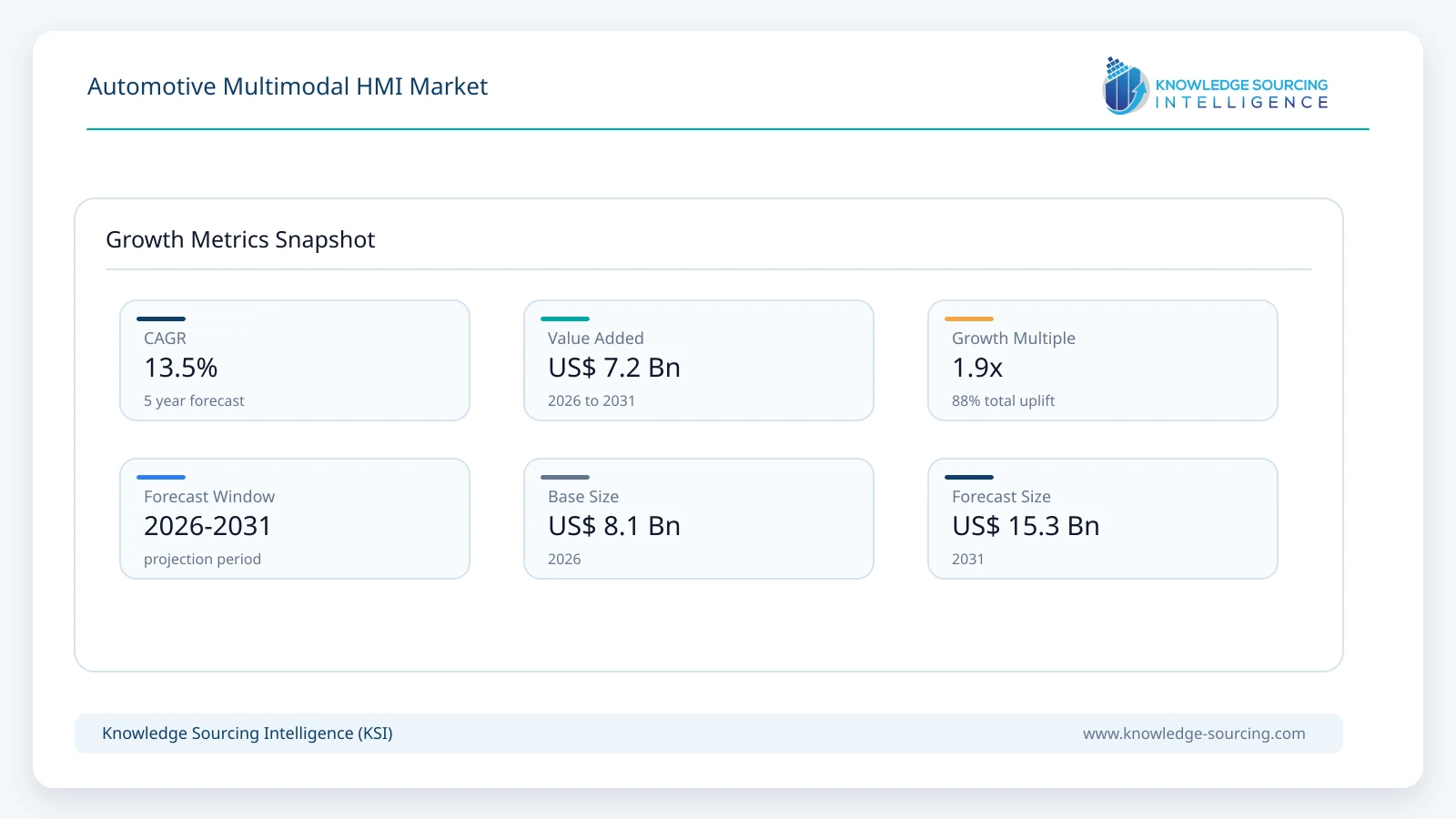
The Automotive Multimodal HMI Market is projected to expand at a CAGR of 13.5%, increasing from USD 8.10 billion in 2026 to USD 15.26 billion by 2031.
Highlights:
- 1Hardware accounts for approximately 46% of global market value in 2026 because displays, microphones, haptic actuators, control interfaces and selected gesture or gaze sensors remain necessary to deliver multimodal interaction, although software is expected to gain share faster through 2031.
- 2Screen-centric multimodal architectures represent approximately 47% of 2026 market value as the center display remains the main interaction anchor in most production vehicles, increasingly supplemented by voice, steering-wheel controls, haptics and contextual feedback.
- 3Infotainment and navigation account for approximately 36% of 2026 market value because these functions support the widest set of voice, touch and visual interactions and are typically the first domain in which OEMs deploy advanced conversational and multimodal features.
- 4Passenger vehicles generate approximately 92% of 2026 market value, supported by the scale of connected-car production, rapid digital-cockpit penetration and strong OEM competition around user experience and software differentiation.
- 5Asia Pacific represents approximately 42% of global market value in 2026, reflecting the scale of vehicle production in China, Japan, South Korea and India and the rapid adoption of AI-rich smart-cockpit systems among Chinese and regional OEMs.
- 6Context-adaptive and AI-orchestrated HMI is the fastest-expanding interaction architecture, with an implied CAGR of roughly 24.5% through 2031 as multimodal systems increasingly use vehicle state, cabin sensing and generative AI to infer intent and reduce interaction steps.
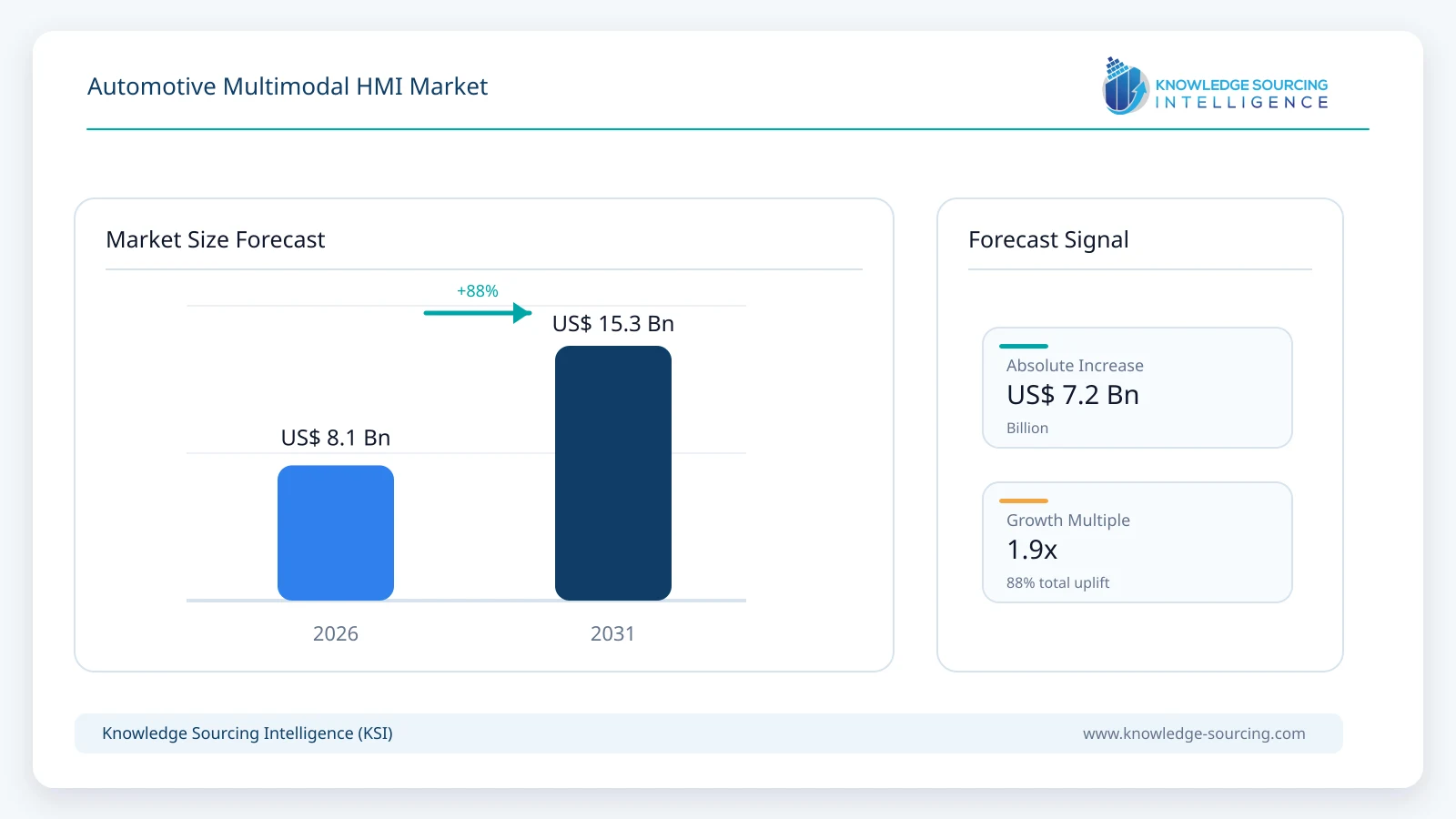
The market is moving from fixed screen-and-button layouts toward coordinated interaction systems in which voice, touch, haptics, physical controls, gaze, gesture and contextual signals work as a single interface. The strongest value creation is increasingly concentrated in the software that interprets intent, chooses the appropriate modality, manages feedback and preserves a consistent user experience across displays, steering-wheel controls, head-up displays and conversational assistants.
Commercial deployment is broadening across both established cockpit suppliers and AI-focused software companies. HARMAN is positioning multimodal, behavior-aware interaction within intelligent cockpit platforms; Bosch and Qualcomm are scaling centralized cockpit compute capable of AI-powered conversational functions; Cerence is extending in-car assistants toward agentic and multimodal AI; Visteon is combining voice, cameras, vehicle data and cockpit software through cognitoAI; Panasonic, LG, Elektrobit, FORVIA and AUMOVIO are integrating HMI functions with cockpit domain controllers, multi-display systems and software-defined vehicle architectures. The competitive boundary is therefore shifting from individual input devices toward the orchestration layer that makes multiple input and output channels behave as one coherent system.
Market Overview
A multimodal HMI allows the driver or passenger to complete the same or related vehicle tasks through more than one coordinated interaction channel. A navigation destination may be entered by voice or touch; an incoming call can be accepted through a steering-wheel control, touch surface, or spoken command; climate settings may be changed through voice, display controls, or haptic physical interfaces. The defining element is not the presence of several controls in the cabin, but the software coordination that maintains consistent state, feedback and intent across them.
Production architectures typically combine a graphical HMI running on an infotainment or cockpit compute platform with speech recognition, natural-language processing, audio processing, touch input and physical controls. Premium systems increasingly add gaze, gesture, camera-based context, occupant identity and driver-state inputs. These additional signals can help the system decide when to use visual, audible, or haptic feedback and whether an interaction should be simplified, delayed, or moved to another modality while the vehicle is in motion.
The technology is becoming more important as cockpit feature density rises. Large displays have created a convenient surface for software features, but deep menus can increase glance time and cognitive workload. Voice reduces the need to look away from the road for some tasks, while physical or haptic controls remain effective for frequently used functions that require immediate confirmation. Multimodal design therefore becomes a way to allocate each task to the interaction channel that best matches urgency, complexity, and driving context rather than forcing all functions into one interface style.
The market encompasses the incremental hardware, software, middleware and engineering associated with multimodal interaction, including speech and conversational software, HMI frameworks, multimodal fusion, haptic interfaces, gesture or gaze inputs, user-intent engines and the portion of cockpit integration required to coordinate them. Market value is concentrated where these functions are embedded in production vehicle programs and connected to infotainment, vehicle controls, driver assistance, or personalized cabin systems.
Market Trends
Automotive HMI Is Shifting from Screen-First Design to Modality Orchestration
The center display remains the dominant cockpit surface, but leading vehicle programs are increasingly distributing interaction across voice, touch, steering-wheel controls, head-up displays and haptic feedback. BMW Panoramic iDrive, for example, combines physical and digital controls, touch, voice, a panoramic windshield information layer and steering-wheel haptics in one operating concept. Similar architectures are appearing across digital-cockpit platforms from major Tier 1 suppliers.
This transition changes HMI engineering from screen design into system orchestration. The value lies in deciding which modality should receive a request, how the result is confirmed, and whether the interaction must change because of vehicle speed, driver state or cabin context. Suppliers that can maintain one interaction model across several displays and control surfaces are therefore gaining relevance relative to vendors focused on an isolated display or input device.
Generative AI Is Turning Voice from Command Input into an Intent Layer
Automotive voice systems are moving beyond fixed command grammars toward natural-language assistants that can understand broader phrasing, carry context across multiple turns and execute actions across several vehicle domains. Cerence xUI, Qualcomm cockpit platforms, HARMAN intelligent-cockpit software and new OEM assistants are using large language models or agentic frameworks to make voice a more flexible front end for navigation, climate, media, productivity and vehicle functions.
The important multimodal change is that voice no longer has to operate as a separate feature. The assistant can interpret what is shown on a display, use camera or vehicle signals as context, present visual confirmation, and hand control back to touch or a physical switch when appropriate. This reduces the friction created when users must learn separate command systems for each modality and increases the commercial value of orchestration software, embedded AI, and low-latency on-device inference.
Physical and Haptic Controls Are Re-Emerging as Complements to Touch
The industry is moving away from the assumption that every cockpit function should migrate to a touchscreen. Euro NCAP's 2026 driver-engagement framework evaluates the placement, clarity, and ease of essential vehicle controls and gives explicit attention to physical controls and acceptable voice or touch implementations. OEMs are therefore balancing digital flexibility with direct physical or haptic access for high-frequency and safety-relevant tasks.
This does not reverse cockpit digitization. Instead, it creates a stronger case for multimodal combinations in which a physical action provides immediate tactile confirmation while displays and voice carry richer or less frequent functions. Haptic steering-wheel controls, force touch, localized tactile feedback and context-sensitive buttons can also reduce visual search, making them commercially useful components of premium and mass-market multimodal HMI architectures.
Gaze, Gesture and Cabin Context Are Moving from Sensing into Interaction
Interior cameras and time-of-flight sensing are increasingly used not only for driver monitoring but also to understand where occupants are looking, which screen they are addressing, and whether a gesture or voice command is intended for a specific zone. LG, Visteon and other cockpit suppliers are demonstrating HMI concepts that combine gaze, motion, voice, and vehicle data so the interface can interpret user intent more precisely than any single sensor allows.
Contextual interaction is especially valuable in cabins with multiple displays and passengers. A voice command can be routed to the correct seat, gaze can identify the referenced object or screen, and gesture can provide a low-effort confirmation. The commercial opportunity grows as the same cameras and compute resources used for safety or occupant monitoring are reused for HMI, lowering incremental hardware cost and increasing the software content that can be monetized.
Centralized Compute Is Making Multimodal HMI More Software-Defined
Cockpit domain controllers and high-performance vehicle computers are consolidating workloads that were previously distributed across infotainment, cluster and display ECUs. Qualcomm, Bosch, Visteon, Panasonic, FORVIA, LG and AUMOVIO all support architectures in which a common compute platform drives multiple cockpit functions and interfaces. This creates the processing headroom required for speech, graphics, sensor fusion and AI to operate with lower latency and more consistent state management.
Centralization also changes the lifecycle of HMI. Software frameworks, AI models, voice functions and personalization logic can be updated over the air without replacing the core cockpit hardware, while OEMs can reuse one HMI stack across several vehicle lines. The resulting market increasingly rewards hardware abstraction, modular middleware, cross-SoC portability and validation tools that keep a multimodal experience stable as vehicle software evolves.
Segment Analysis
By Offering: Hardware
Hardware is the largest offering category in 2026 because multimodal interaction still depends on physical endpoints: center displays, microphones, speakers, steering-wheel controls, haptic actuators, touch sensors and, in higher-end systems, cameras or time-of-flight devices for gesture and gaze. The broad move toward larger and more integrated digital cockpits also keeps hardware content high even as software assumes a larger role in user-experience differentiation.
Hardware contributes approximately USD 3.73 billion in 2026 and is expected to approach USD 5.95 billion by 2031. Its share is projected to ease from about 46% to 39% as software grows faster, particularly in conversational AI, multimodal orchestration, personalization and context-aware interaction. The strongest hardware opportunities will be in components that support several functions at once, such as integrated displays with haptics, microphones with zonal audio processing and interior sensors reused across monitoring and HMI.
By HMI Architecture: Screen-Centric Multimodal HMI
Screen-centric multimodal HMI leads in 2026 because most production cockpits still use the central display as the primary interaction surface and add voice, steering-wheel controls or haptics around it. This architecture is relatively easy to scale across vehicle price points because OEMs can preserve a common touchscreen-led user interface while layering additional modalities for navigation, media, climate and communication functions.
Screen-centric systems account for approximately USD 3.81 billion in 2026 and could reach around USD 5.49 billion by 2031. The category continues to grow in absolute value, but its share is expected to decline as context-adaptive and voice-first architectures become more capable. The transition will be gradual because touch remains efficient for browsing, maps and visual selection, particularly when the vehicle is stationary or a passenger is interacting with the system.
By Primary Application: Infotainment and Navigation
Infotainment and navigation form the largest application value pool because they combine complex visual information with frequent voice, touch and physical-control interaction. Route search, map manipulation, media selection, messaging and connected services all benefit from allowing users to switch between modalities without resetting the task. These functions are also tightly linked to smartphone ecosystems and cloud services, which accelerate software feature renewal.
The application contributes approximately USD 2.92 billion in 2026 and is expected to reach about USD 4.58 billion by 2031. Its relative share will gradually decline as multimodal interaction spreads deeper into ADAS, vehicle settings, productivity and personalized cabin functions. Even so, infotainment remains the primary volume platform on which automakers introduce conversational AI and cross-screen interaction before extending the same orchestration layer to broader vehicle domains.
By Vehicle Type: Passenger Vehicles
Passenger vehicles dominate the market because digital-cockpit adoption, connected infotainment and consumer expectations for smartphone-like interaction are concentrated in high-volume cars, SUVs and MPVs. Premium brands have historically introduced advanced voice, gesture and haptic systems first, but Chinese EV makers and global mass-market OEMs are rapidly moving AI assistants and larger digital interfaces into mid-price vehicles.
Passenger vehicles account for approximately USD 7.45 billion in 2026 and are projected to exceed USD 13.65 billion by 2031. Commercial vehicles will grow faster from a smaller base as digital driver workplaces, fleet communication and hands-free operation become more important, but passenger vehicles retain the largest value pool because of production scale, faster feature turnover and the strong role of HMI in brand differentiation.
Market Drivers
Expansion of Software-Defined Vehicle and Centralized Cockpit Architectures
Software-defined vehicles are creating the technical foundation for multimodal HMI by consolidating processing, connectivity, and software services into reusable vehicle platforms. Cockpit domain controllers can coordinate cluster, center display, head-up display, audio, cameras, and voice through one compute environment, reducing the need to synchronize separate ECUs with different software lifecycles.
The commercial effect is significant because multimodal functions can be deployed across several models with less duplicated engineering. Qualcomm reported a USD 45 billion automotive design-win pipeline in 2026, while Bosch and Qualcomm stated that their cockpit collaboration had scaled from one million units in 2023 to ten million in less than three years. This level of platform scale lowers the marginal cost of adding additional HMI modalities and strengthens demand for common software frameworks and orchestration layers.
Rapid Adoption of Generative AI and Agentic In-Car Assistants
Large language models are expanding the number of tasks that can be completed through natural speech and allowing the assistant to interpret ambiguous requests, maintain context and coordinate multiple services. Cerence, Qualcomm, HARMAN, Visteon and LG are all moving toward AI systems that use voice together with vehicle state, cameras or infotainment context. This makes conversational interaction more useful for real production tasks rather than limiting voice to fixed commands.
As the assistant becomes an intent layer, the surrounding HMI must support visual confirmation, touch fallback, physical override and context-sensitive feedback. This creates additional value for multimodal software beyond voice recognition itself. Edge AI also reduces latency and improves privacy for vehicle control, while hybrid cloud processing allows broader knowledge and productivity functions when connectivity is available.
Stronger Focus on Driver Distraction and Human-Factors Performance
The growth of large displays has increased concern about glance time, menu depth and the cognitive burden of touch-only interfaces. Euro NCAP introduced a new 2026 HMI assessment for essential controls that evaluates placement, clarity and ease of use, while its technical procedure distinguishes direct physical input, direct voice input and different levels of touch-menu complexity. These criteria are encouraging OEMs to design a balanced control strategy rather than maximize screen usage.
Multimodal HMI gives engineers more flexibility to minimize eyes-off-road interaction. Voice can handle destination entry or communication, haptics can confirm an action without visual checking, and physical controls can preserve direct access to frequent functions. The strongest systems will not simply add more modalities; they will select the right one for the driving task and provide a predictable fallback when speech, touch or sensing is unavailable.
OEM Competition around Digital Experience and Brand Differentiation
The cockpit has become one of the most visible areas of differentiation as powertrains, connectivity and advanced driver-assistance features become increasingly standardized. BMW, Mercedes-Benz, Chinese EV brands and other manufacturers are investing in branded operating systems, AI assistants, panoramic displays and distinctive control concepts to create a recognizable user experience that persists across vehicle models.
Multimodal interaction expands the number of ways an OEM can express brand identity through sound, voice persona, motion graphics, tactile feedback, lighting and adaptive behavior. This increases demand for configurable HMI frameworks and AI platforms that can be deeply branded rather than presented as a generic third-party interface. It also creates recurring software value as new assistant capabilities and interaction features are added after sale.
Growth of Smart-Cockpit Adoption in China and the Wider Asia Pacific Region
Asia Pacific is driving a large share of incremental smart-cockpit volume. OICA reported that Asia-Oceania produced more than 59 million vehicles in 2025, with China alone producing over 34 million. Chinese OEMs are competing aggressively on large displays, AI assistants, multi-zone interaction and rapid software release cycles, while Japanese and South Korean suppliers continue to scale advanced cockpit platforms globally.
The regional ecosystem also benefits from dense semiconductor, display, camera and electronics supply chains that shorten development cycles and lower component cost. Qualcomm highlighted expanded 2026 collaborations with Chinese manufacturers including Li Auto, Leapmotor, Zeekr, Great Wall Motor, NIO and Chery, supporting broader diffusion of AI-capable cockpit platforms across price segments and export markets.
Market Restraints
Driver Distraction and Cognitive Load from Poorly Coordinated Interfaces
Adding more input methods does not automatically make an HMI safer or easier to use. A system that presents inconsistent commands across voice, touch and physical controls can increase cognitive load, while excessive visual animation or poorly timed prompts may distract the driver. Multimodal design therefore requires task-level human-factors testing rather than feature counting.
The challenge becomes more difficult as over-the-air updates modify menus, assistant behavior and display content during the vehicle lifecycle. OEMs must verify that new interaction logic does not undermine previously validated safety performance or create conflicting feedback between modalities. This raises testing cost and can slow deployment of new features compared with consumer electronics.
Recognition Errors, False Activations and Ambiguous User Intent
Voice, gesture and gaze are probabilistic inputs and can fail under cabin noise, accents, sunglasses, lighting changes, passenger movement or unusual seating positions. The system must also determine who is speaking or gesturing and whether the action is intentional. False activation is especially damaging in a vehicle because it can change climate, navigation or other settings while the driver is occupied.
Multimodal fusion can improve accuracy by combining signals, but it also increases software complexity. Suppliers need robust confidence scoring, multi-zone processing and fallback logic so the vehicle does not execute an unsafe or unwanted action when one modality is uncertain. Validation across languages, demographics, cabin layouts and vehicle noise conditions remains a substantial engineering burden.
Higher Compute, Sensor and Integration Cost in Advanced Architectures
A basic voice-and-touch interface can operate on conventional infotainment hardware, but context-adaptive multimodal systems may require higher-performance processors, additional microphones, interior cameras, haptic actuators, more memory and larger software stacks. AI inference also creates thermal and power demands that compete with graphics, entertainment and driver-assistance workloads on shared compute platforms.
These costs limit the speed at which premium functions reach entry-level vehicles. OEMs increasingly respond by reusing existing sensors and central compute, but that approach depends on sufficient processing headroom and careful workload isolation. Suppliers must therefore demonstrate that incremental multimodal features deliver enough safety, convenience or brand value to justify their hardware and validation cost.
Privacy, Cybersecurity and Data-Governance Requirements
Advanced HMI increasingly processes voice, identity, gaze, camera images, location, preferences and potentially calendar or account data. As in-car assistants gain agentic capabilities, they may also act on external services on behalf of the user. This creates a materially larger privacy and cybersecurity surface than a conventional button or touchscreen interface.
UN vehicle cybersecurity requirements, regional privacy rules and OEM security standards place strong emphasis on secure software updates, data minimization and access control. Local processing can reduce exposure, but many generative-AI functions still depend on cloud services. Vendors must therefore support clear consent, strong authentication, encrypted communication and separation between safety-critical vehicle control and less trusted external applications.
Long Automotive Development Cycles versus Rapid AI Evolution
Vehicle programs are engineered and validated over several years, while generative-AI models, speech systems and consumer interaction patterns can change within months. An HMI architecture selected early in development can therefore become dated before the end of the vehicle lifecycle, especially if the hardware lacks memory, compute or software abstraction for later AI workloads.
The industry is addressing this gap through modular software, centralized compute and dedicated AI accelerators, but long-term compatibility remains difficult. Suppliers need stable APIs, model portability, version control and validation processes that allow new capabilities to be introduced without destabilizing the cockpit. The cost of maintaining several vehicle generations simultaneously can be substantial for both OEMs and software vendors.
Regional Outlook
Asia Pacific
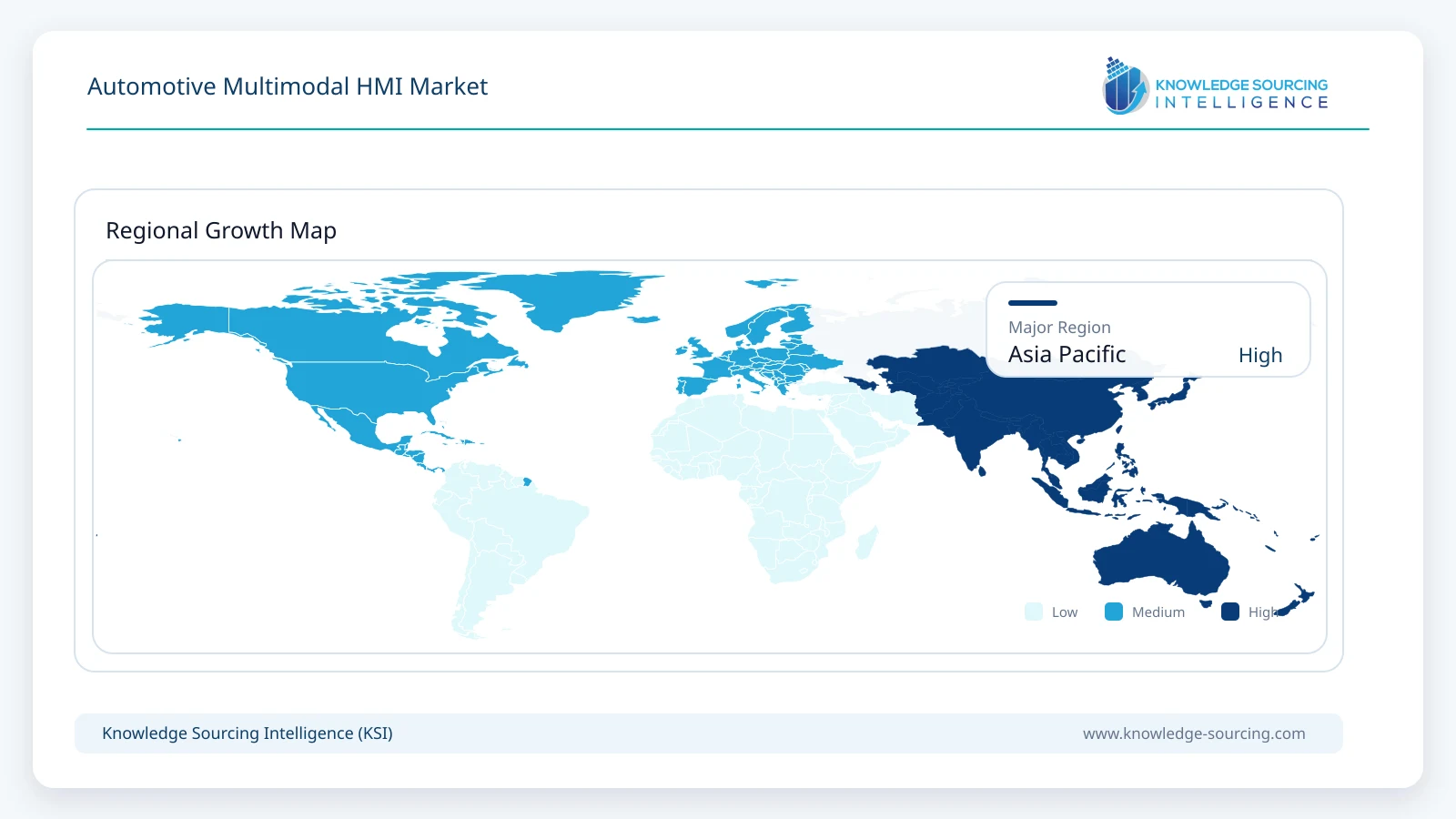
Asia Pacific is the largest regional automotive multimodal HMI market, accounting for approximately 42% of global value in 2026. The region combines the world's largest vehicle-production base with rapid smart-cockpit adoption, particularly in China, where manufacturers use voice assistants, multi-screen interfaces, personalization and AI features as core product differentiators. Japan and South Korea add strong Tier 1, electronics, display and software capabilities, while India is expanding connected and premium-feature content across new vehicle programs.
China is the main growth engine. OICA reported more than 34.5 million vehicles produced in China during 2025, and leading domestic OEMs continue to shorten cockpit-development cycles and introduce high-compute platforms across a wide range of vehicle prices. Qualcomm, Cerence, Visteon and other global suppliers are expanding partnerships with Chinese manufacturers, while regional electronics companies provide displays, processors, audio, cameras and touch technologies required for multimodal HMI.
The region is expected to increase its share to roughly 46% by 2031, supported by high production scale, faster AI feature adoption and growing exports of software-rich Chinese vehicles. Competitive performance will depend on local-language support, low-cost edge AI, compatibility with regional app ecosystems and the ability to adapt the same interaction framework to fast-changing vehicle programs.
Europe
Europe represents approximately 27% of global market value in 2026 and remains one of the most influential regions for automotive HMI design. Premium OEM concentration, strong cockpit engineering capabilities and the 2026 Euro NCAP framework create a market in which usability, physical-control strategy, voice interaction and driver-distraction performance are commercially important rather than purely cosmetic design choices.
European OEMs are also major adopters of centralized cockpit architectures and branded software platforms. BMW's Panoramic iDrive combines touch, haptic and voice interaction, while Volkswagen Group is moving toward a zonal software-defined vehicle architecture supported by high-performance cockpit compute. Bosch, FORVIA, AUMOVIO, HARMAN, Elektrobit and other Europe-based suppliers provide a dense ecosystem spanning cockpit controllers, HMI software, displays, voice, sensing and integration.
Growth through 2031 will increasingly come from software and adaptive interaction rather than simply adding more display area. Systems that reduce menu depth, keep essential controls intuitive and coordinate voice or physical inputs with driver state will be better positioned under Europe's safety-oriented assessment environment. Cybersecurity, privacy and long-term OTA validation will remain important purchasing criteria for AI-enabled HMI platforms.
Competitive Landscape
The automotive multimodal HMI market combines cockpit Tier 1 suppliers, semiconductor and compute-platform vendors, voice and AI software specialists, HMI middleware companies and electronics suppliers. HARMAN, Bosch, Visteon, Panasonic, LG, FORVIA, AUMOVIO and Valeo compete through integrated cockpit hardware and system engineering, while Cerence and Elektrobit provide specialized software layers that can be deployed across multiple OEM and Tier 1 platforms.
Qualcomm has become an important enabling player because Snapdragon Cockpit platforms provide the CPU, GPU, NPU and software environment required to run graphics, voice, generative AI and sensor-driven interaction on the same automotive compute foundation. The company reported USD 1.1 billion of automotive revenue in Q1 FY2026 and a USD 45 billion design-win pipeline, indicating the scale at which high-performance cockpit compute is moving into production programs.
Software differentiation is increasing. Cerence is extending conversational AI toward multi-step, multimodal and edge-capable assistants; Visteon cognitoAI fuses cameras, infotainment, vehicle sensors and voice; HARMAN is emphasizing behavior-aware HMI and AI orchestration; Elektrobit provides multimodal HMI engineering and tooling; and FORVIA is integrating driver state and cockpit context into user-experience software. This shifts competition toward intent interpretation, orchestration, brand customization and lifecycle support rather than the standalone performance of one input technology.
System integration remains a substantial barrier to entry. OEMs need a consistent HMI across displays, audio, steering-wheel controls, vehicle functions, mobile ecosystems and safety domains, often over several vehicle generations and processor families. Suppliers with production-proven cockpit platforms, broad OEM relationships, strong human-factors validation and the ability to update software without destabilizing vehicle functions are therefore better positioned than vendors offering isolated multimodal demonstrations.
Recent Developments
7 July 2026: Panasonic Automotive Systems announced that its cockpit domain controller had been adopted for the all-new Mazda CX-5, integrating infotainment, head-up display and instrument cluster control with synchronized visual, lighting and audio feedback and integrated voice control.
30 June 2026: BMW introduced the new X5 and iX5 with BMW Panoramic iDrive and Operating System X, using a multimodal operating logic that combines touch, haptic and voice interaction and links these inputs with panoramic and head-up displays.
April 2026: Bosch and Qualcomm expanded their automotive collaboration after scaling Snapdragon-based cockpit integration platforms from one million delivered units in 2023 to ten million in less than three years, supporting multi-display systems and AI-powered conversational voice functions.
8 April 2026: Cerence AI expanded its partnership with BYD to deploy Cerence xUI in new BYD vehicles, adding LLM-powered multi-step conversational interaction and orchestration across automotive domains for global markets.
19 March 2026: Qualcomm highlighted a USD 45 billion automotive design-win pipeline and expanded work with global and Chinese OEMs on AI-enabled digital cockpit platforms, including generative-AI and agentic functions within Snapdragon Digital Chassis.
January 2026: Volkswagen Group and Qualcomm signed a letter of intent covering long-term supply of Snapdragon cockpit technology for Volkswagen Group's future zonal software-defined vehicle architecture, with multimodal voice or gesture controls cited among supported cockpit experiences.
6 January 2026: Visteon launched an NVIDIA-powered AI-ADAS Compute Module and cognitoAI architecture that fuses cameras, infotainment, vehicle data and voice to deliver contextual, proactive in-cabin experiences.
6-9 January 2026: Cerence demonstrated enhanced multimodal edge AI for its xUI platform at CES 2026, combining CaLLM Edge with dedicated AI hardware to reduce latency and support more reliable in-vehicle interaction without continuous cloud connectivity.
January 2026: LG demonstrated its AI Cabin Platform at CES 2026, using generative AI, in-vehicle cameras and Snapdragon Cockpit Elite compute to provide context-aware, on-device assistance within the digital cockpit.
Market Outlook
The automotive multimodal HMI market is driven by the growing integration of advanced in-vehicle interfaces that combine visual displays, voice commands, gesture recognition, and context-aware interactions. Screen-centric systems remain widely adopted, while voice-first and adaptive interfaces are gaining importance as vehicle manufacturers prioritize intuitive and safer user experiences. Software development is becoming increasingly important as generative AI, intent engines, orchestration middleware, and personalization capabilities are integrated with shared cockpit computing and sensor platforms.
The most important architectural shift will be from parallel controls toward coordinated interaction. Voice, touch, haptics, displays, gaze and gesture will increasingly share one context model so the vehicle can understand who is interacting, what the user intends and which output channel is safest or most convenient. Centralized compute and reusable HMI frameworks will accelerate this shift by allowing features to scale across multiple models and to improve through software updates after production.
Asia Pacific is expected to remain the largest regional value pool and increase its share through 2031, while Europe continues to influence human-factors and control-design standards through safety assessment and premium-vehicle innovation. Competitive advantage will depend on low-latency multimodal fusion, natural-language quality, robust fallback behavior, privacy-preserving edge processing, hardware portability and the ability to maintain a coherent HMI as vehicle software evolves over a long product lifecycle.
Automotive Multimodal HMI Market Scope:
| Report Metric | Details |
|---|---|
| Total Market Size in 2026 | USD 8.10 billion |
| Total Market Size in 2031 | USD 15.26 billion |
| Forecast Unit | USD Billion |
| Growth Rate | 13.5% |
| Study Period | 2021 to 2031 |
| Historical Data | 2021 to 2024 |
| Base Year | 2025 |
| Forecast Period | 2026 – 2031 |
| Segmentation | Offering, HMI Architecture, Primary Application, Vehicle Type |
| Companies |
|
Market Segmentation
By Offering
Hardware
Software
Integration and Services
By HMI Architecture
Screen-Centric Multimodal HMI
Voice-First Multimodal HMI
Context-Adaptive and AI-Orchestrated HMI
Gesture, Gaze and Haptic-Rich Multimodal HMI
By Primary Application
Infotainment and Navigation
Vehicle Controls and Comfort
ADAS and Driver-Assistance Interaction
Communication and Productivity
Personalization and Passenger Experience
By Vehicle Type
Passenger Vehicles
Light Commercial Vehicles
Medium and Heavy Commercial Vehicles and Buses
By Geography
North America
United States
Canada
Mexico
South America
Brazil
Argentina
Others
Europe
Germany
United Kingdom
France
Italy
Spain
Others
Middle East and Africa
Saudi Arabia
UAE
South Africa
Others
Asia Pacific
China
Japan
South Korea
India
Indonesia
Thailand
Others
Table of Contents
1. INTRODUCTION
1.1. Market Overview
1.2. Market Definition
1.3. Scope of the Study
1.4. Market Segmentation
1.5. Currency
1.6. Assumptions
1.7. Base and Forecast Years
1.8. Key Benefits to Stakeholders
2. RESEARCH METHODOLOGY
2.1. Research Design
2.2. Secondary Research
2.3. Primary Research
2.4. Market Estimation
2.5. Segment Modelling
2.6. Data Triangulation and Validation
3. EXECUTIVE SUMMARY
3.1. Key Findings
3.2. Automotive Multimodal HMI Market Size, 2026-2031
3.3. Offering Outlook
3.4. HMI Architecture Outlook
3.5. Primary Application Outlook
3.6. Vehicle Type Outlook
3.7. Regional Opportunity Summary
4. MARKET DYNAMICS
4.1. Market Drivers
4.1.1. Expansion of Software-Defined Vehicle and Centralized Cockpit Architectures
4.1.2. Rapid Adoption of Generative AI and Agentic In-Car Assistants
4.1.3. Stronger Focus on Driver Distraction and Human-Factors Performance
4.1.4. OEM Competition around Digital Experience and Brand Differentiation
4.1.5. Growth of Smart-Cockpit Adoption in China and the Wider Asia Pacific Region
4.2. Market Restraints
4.2.1. Driver Distraction and Cognitive Load from Poorly Coordinated Interfaces
4.2.2. Recognition Errors, False Activations and Ambiguous User Intent
4.2.3. Higher Compute, Sensor and Integration Cost in Advanced Architectures
4.2.4. Privacy, Cybersecurity and Data-Governance Requirements
4.2.5. Long Automotive Development Cycles versus Rapid AI Evolution
4.3. Market Opportunities
4.4. Porter's Five Forces Analysis
4.5. Industry Value Chain Analysis
4.6. Multimodal HMI Hardware, Software and Integration Economics
4.7. Human-Factors, Euro NCAP, Cybersecurity and Privacy Environment
5. TECHNOLOGY OUTLOOK
5.1. Touch and High-Resolution Display Interaction
5.2. Voice Recognition, Natural-Language Understanding and LLM Assistants
5.3. Physical Controls, Force Touch and Haptic Feedback
5.4. Gesture and Proximity Interaction
5.5. Gaze, Eye Tracking and Attention-Aware HMI
5.6. Multimodal Fusion, Intent Recognition and Interaction Orchestration
5.7. Context-Aware AI and Personalization
5.8. Driver-State and Cabin-Sensing Integration
5.9. Edge AI and Hybrid Edge-Cloud Processing
5.10. Cockpit Domain Controllers and Centralized Compute
5.11. Multi-Seat, Multi-Zone and Passenger Interaction
5.12. OTA Updates and HMI Software Lifecycle Management
6. AUTOMOTIVE MULTIMODAL HMI MARKET BY OFFERING
6.1. Introduction
6.2. Hardware
6.3. Software
6.4. Integration and Services
7. AUTOMOTIVE MULTIMODAL HMI MARKET BY HMI ARCHITECTURE
7.1. Introduction
7.2. Screen-Centric Multimodal HMI
7.3. Voice-First Multimodal HMI
7.4. Context-Adaptive and AI-Orchestrated HMI
7.5. Gesture, Gaze and Haptic-Rich Multimodal HMI
8. AUTOMOTIVE MULTIMODAL HMI MARKET BY PRIMARY APPLICATION
8.1. Introduction
8.2. Infotainment and Navigation
8.3. Vehicle Controls and Comfort
8.4. ADAS and Driver-Assistance Interaction
8.5. Communication and Productivity
8.6. Personalization and Passenger Experience
9. AUTOMOTIVE MULTIMODAL HMI MARKET BY VEHICLE TYPE
9.1. Introduction
9.2. Passenger Vehicles
9.3. Light Commercial Vehicles
9.4. Medium and Heavy Commercial Vehicles and Buses
10. AUTOMOTIVE MULTIMODAL HMI MARKET BY GEOGRAPHY
10.1. North America
10.1.1. United States
10.1.2. Canada
10.1.3. Mexico
10.2. South America
10.2.1. Brazil
10.2.2. Argentina
10.2.3. Others
10.3. Europe
10.3.1. Germany
10.3.2. United Kingdom
10.3.3. France
10.3.4. Italy
10.3.5. Spain
10.3.6. Others
10.4. Middle East and Africa
10.4.1. Saudi Arabia
10.4.2. UAE
10.4.3. South Africa
10.4.4. Others
10.5. Asia Pacific
10.5.1. China
10.5.2. Japan
10.5.3. South Korea
10.5.4. India
10.5.5. Indonesia
10.5.6. Thailand
10.5.7. Others
11. COMPETITIVE ENVIRONMENT AND ANALYSIS
11.1. Major Players and Strategy Analysis
11.2. Market Share Analysis
11.3. Multimodal HMI Platform Benchmarking
11.4. Voice-Touch-Haptic-Gesture-Gaze Architecture Comparison
11.5. Edge versus Hybrid Cloud HMI Benchmarking
11.6. Human-Factors and Driver-Distraction Benchmarking
11.7. OEM Programs and Production Readiness
11.8. Competitive Dashboard
12. COMPANY PROFILES
12.1. HARMAN International
12.2. Robert Bosch GmbH
12.3. Cerence Inc.
12.4. Qualcomm Technologies, Inc.
12.5. Visteon Corporation
12.6. Panasonic Automotive Systems Co., Ltd.
12.7. LG Electronics Vehicle Solution Company
12.8. Elektrobit Automotive GmbH
12.9. FORVIA
12.10. AUMOVIO SE
12.11. Valeo
13. APPENDIX
13.1. Currency
13.2. Assumptions
13.3. Base and Forecast Years Timeline
13.4. Key Benefits for Stakeholders
13.5. Research Methodology
13.6. Abbreviations
13.7. Data Sources
Navigate
Trusted by the world's leading organizations











