
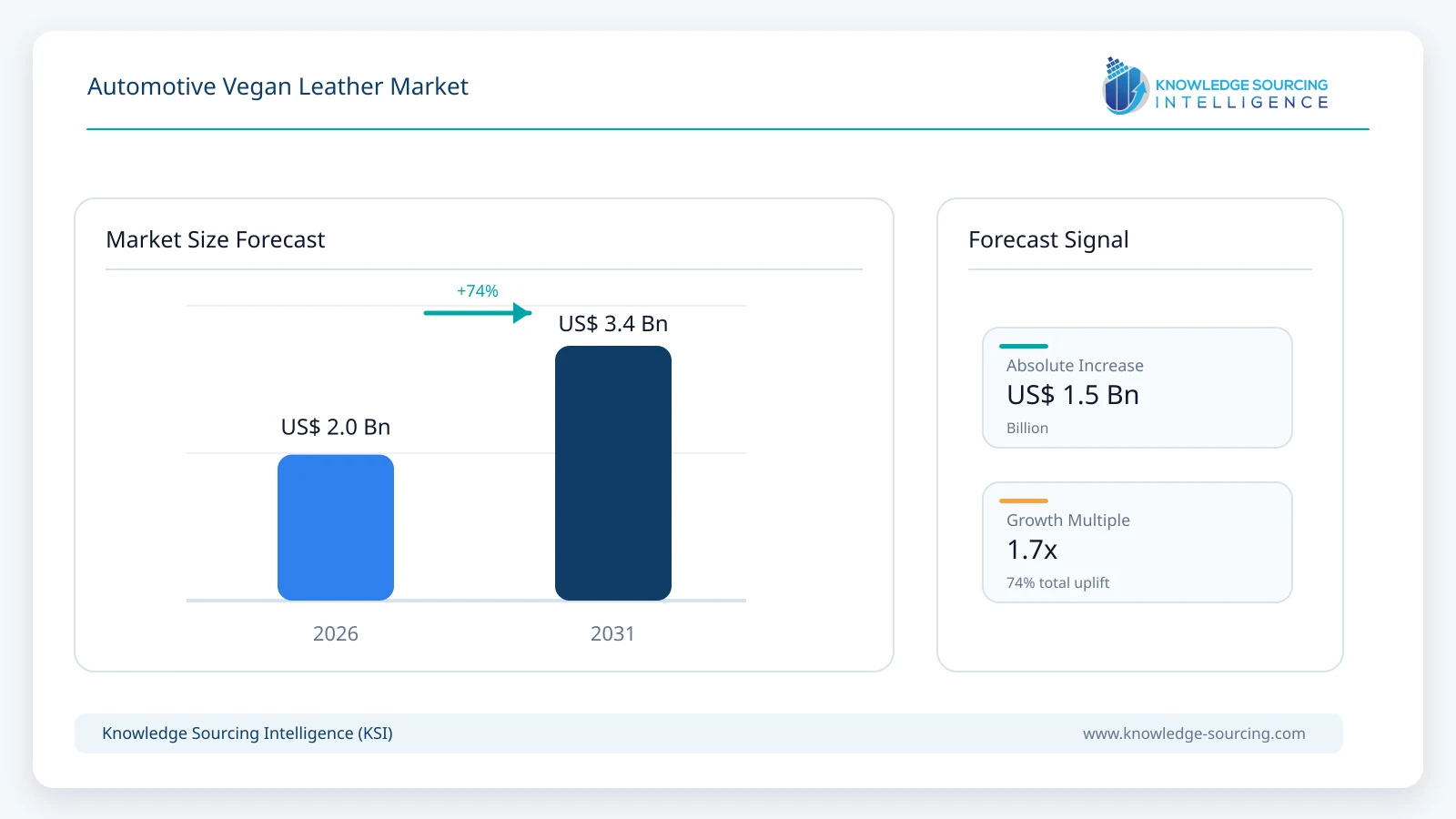
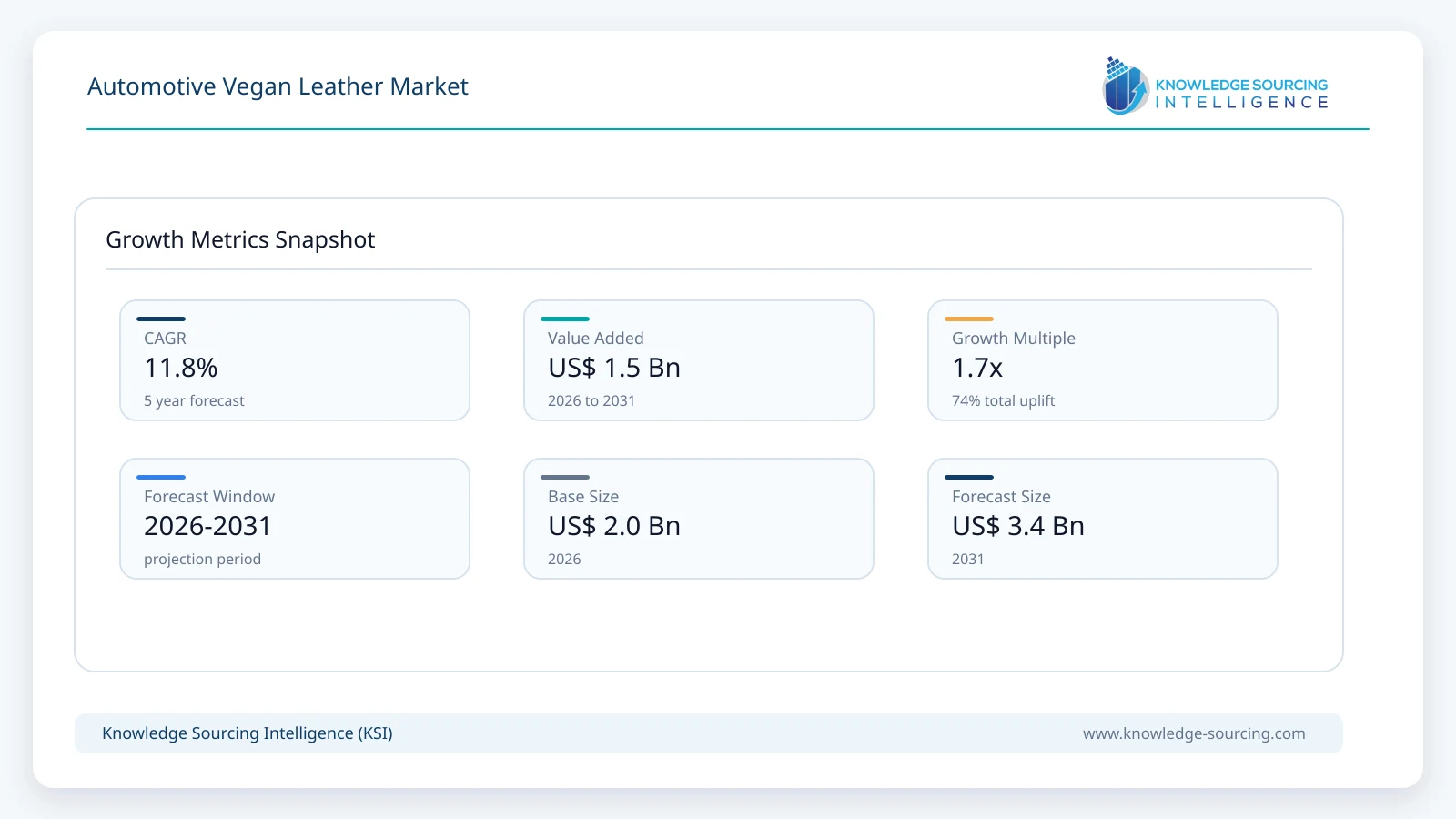
The automotive vegan leather market is projected to expand at a CAGR of 11.8%, increasing from USD 1.96 billion in 2026 to USD 3.42 billion by 2031.
Highlights:
- 1Animal-free PU leather accounts for approximately 55.6% of the estimated 2026 market, supported by premium-feel seating and cockpit coverings.
- 2Animal-free PVC and vinyl coverings represent approximately 33.7% of 2026 value, reflecting established lower-cost production and application flexibility.
- 3Seat upholstery contributes approximately 68% of market value in 2026 because seats require the greatest leather-look covering area.
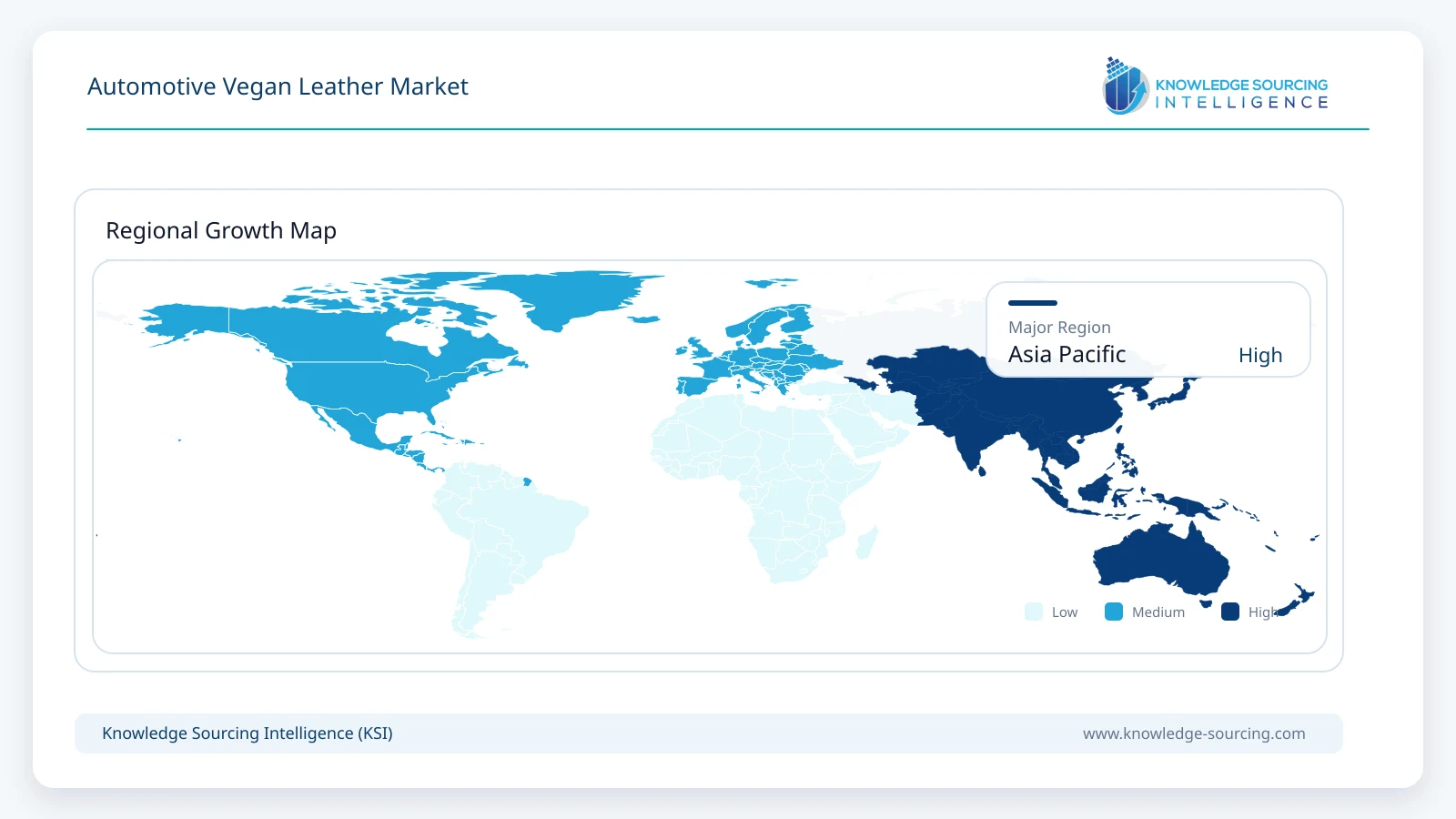
- 4Asia Pacific accounts for approximately 44% of modeled value in 2026, while Europe contributes around 28% through premium interior specifications.
- 5Original-equipment supply represents approximately 95% of demand because vehicle programs require qualified surfaces and color-matched material lots.
- 6Independent vegan certification is expanding, but documented animal-free materials and third-party-certified materials are not interchangeable evidence categories.
The market includes automotive-grade leather-look polyurethane, PVC/vinyl and engineered microfiber or bio-derived coverings that are specifically documented or designated as animal-free. Material sales cover coated rolls, laminated substrates and prepared upholstery-facing surfaces, rather than the value of complete seats or instrument-panel assemblies.
BMW uses its Veganza surface across multiple vehicle lines, Polestar offers animal-free MicroTech and WeaveTech materials, and Continental supplies Benova surface solutions. Material specification differs by vehicle program, with genuine leather remaining available on selected trims despite leather-free standard packages. As a result, automotive vegan leather competes on softness, wear resistance, color repeatability, price and verifiable material origin across a broad range of cabin surfaces.
Market Overview
Animal-free automotive leather-look surfaces generally combine a PU or vinyl-based finish with woven, knitted or nonwoven textile backing. Coating thickness, grain formation, lamination and perforation influence touch, durability and breathability. Manufacturers select constructions according to the component, since a steering-wheel covering must deliver grip and cleaning resistance while a seat bolster requires abrasion and flex endurance. Materials marketed as vegan require additional confidence that animal-origin substances are not introduced through coatings, adhesives or other constituents.
Continental positions Benova as a vegan surface-material family and offers Acella for a wider range of synthetic-leather applications. Seiren develops QUOLE with automotive-grade aesthetic and performance options, including solvent-free and biomass-containing versions. FORVIA offers Ecorium, containing recycled PET and hemp, as an alternative to animal leather. These technologies serve different price and specification requirements, and bio-derived input claims should not be treated as substitutes for animal-free product assurance.
Automakers increasingly specify coordinated non-animal surfaces across more than one interior component. BMW’s Veganza appears on seats and selected door and instrument-panel surfaces, while Polestar presents MicroTech and WeaveTech as vegan alternatives. Mercedes-Benz has introduced independent assessment of a more complete interior package, including materials outside leather-like seating. For the supply chain, broader cabin coverage adds color-matching, traceability and multi-component testing to existing surface-quality requirements.
Market Trends
Verified Animal-Free Supply Is Moving Beyond Upholstery Descriptions
Mercedes-Benz worked with The Vegan Society to certify materials used in a specified interior package for the electric GLC and then extended certified availability to the electric C-Class in 2026. The assessment covers constituents and processing practices across numerous supplier components rather than relying solely on the absence of visible leather. Such programs put greater emphasis on input declarations, supplier auditability and consistent documentation for coatings and laminates. Material manufacturers already able to provide documented animal-free grades have a stronger starting position for these OEM requirements.
Premium Vegan Surfaces Are Expanding Across Mainstream Model Families
BMW offers Veganza seating across several vehicle categories, ranging from the 2 Series and X3 to its larger sedans and SUVs. Polestar supplies vinyl-based WeaveTech and bio-attributed MicroTech as distinct vegan trim options, while Volvo uses Nordico with recycled polyester backing. A growing range of grains, finishes and perforation designs allows synthetic surfaces to match differing brand interiors without using animal hides. The principal source of incremental demand is wider specification and greater covering area, not a guaranteed shift away from genuine leather across all premium vehicles.
Recycled and Bio-Attributed Inputs Are Becoming More Prominent
Volvo identifies Nordico as a PVC-based premium material with bio-attributed inputs and a recycled-polyester textile backing. FORVIA uses recycled PET and hemp in Ecorium, while Seiren offers QUOLE Bio with renewable polymer and fiber inputs. These formulations illustrate how animal-free upholstery can incorporate a separate set of recycled or renewable characteristics. Producers still need to assess lifecycle impacts and recyclability by construction, particularly where laminated polymer-and-fabric layers complicate separation after vehicle dismantling.
Segment Analysis
By Material Type: Polyurethane Vegan Leather
Documented animal-free polyurethane surfaces lead the market because PU systems offer substantial flexibility in tactile feel, embossing, surface gloss and coating construction. Automotive applications range from premium seat faces to steering and door coverings. Continental’s advanced surface portfolio and Seiren’s QUOLE family illustrate the emphasis on durability, low emissions and detailed finish control. PU vegan leather is modeled at approximately USD 1.09 billion in 2026, with market value projected to reach USD 2.06 billion in 2031 as higher-specification trim gains share.
By Material Type: PVC and Vinyl Vegan Leather
Animal-free PVC and vinyl-based coverings provide established processing economics and robust surface performance across vehicle-interior designs. Polestar identifies WeaveTech as a vegan PVC-based leather alternative, and Volvo uses a bio-attributed PVC construction in Nordico. Demand remains sensitive to polymer-related environmental scrutiny, particularly where buyers compare virgin formulations with recycled or renewable-attributed alternatives. The PVC and vinyl category is estimated at USD 660 million in 2026 and is expected to remain significant through 2031 despite losing share to PU and engineered alternatives.
By Application: Seat Upholstery
Seat upholstery is the main purchasing destination for vegan leather because seat cushions, backrests, bolsters and head restraints account for extensive occupant-facing material area. OEM suppliers need stable color and grain across successive model-year batches, and upholstery coverings must tolerate repeated flexing, abrasion and cleaning. BMW’s Veganza and Polestar’s MicroTech are commercially documented seating applications, while Continental offers a range of seat-cover constructions. Seat upholstery accounts for approximately 68% of 2026 market value, with a gradual share shift toward other cabin surfaces.
By Sales Channel: OEM
Automotive original-equipment programs dominate purchases of documented vegan leather because upholstery surfaces are typically specified during model development and validated with the entire trim assembly. Suppliers coordinate surface color, perforation and backing construction with seat and cockpit engineering teams. Certified interior programs may add ingredient declarations and material-source verification to conventional automotive qualification processes. OEM demand is estimated at approximately 95% of market value in 2026, leaving a smaller aftermarket for fitted replacement covers and customization.
Market Drivers
OEM Expansion of Explicitly Leather-Free Interior Packages
BMW extends Veganza across multiple passenger-car ranges, while Polestar identifies MicroTech and WeaveTech as vegan surface alternatives. OEM specification makes animal-free leather-look surfaces a repeatable production purchase rather than a discretionary aftermarket upgrade. The largest effect is in original-equipment seat covers, where matching door inserts and steering coverings increase the amount of qualified material used per vehicle.
Verification and Traceability of Animal-Free Supply Chains
Mercedes-Benz introduced Vegan Society-certified GLC interior fittings in 2025 and extended the arrangement to the electric C-Class in April 2026. The certification process examines materials and processing inputs instead of relying on a leather-free appearance claim. Suppliers capable of documenting additives, adhesives, backings and upstream handling should benefit as automakers seek assurance across complete interior packages.
Improving Performance of Premium Non-Animal Surfaces
Continental offers Benova and Acella surfaces for automotive use, while Seiren develops QUOLE synthetic coverings with automotive-specific finish and performance options. Improved abrasion behavior, grain consistency, cleanability and softness allow selected animal-free surfaces to substitute for genuine leather in highly visible cabin areas. Automotive qualification remains essential because trim surfaces must maintain appearance under abrasion, heat exposure, ultraviolet radiation and repeated cleaning.
Broader Supply of Recycled and Bio-Attributed Coverings
Volvo specifies Nordico using bio-attributed PVC and recycled polyester backing, and Polestar markets MicroTech with renewable vinyl and recycled textile content. FORVIA supplies Ecorium as an alternative to animal leather using recycled PET and hemp. These developments expand the choice of animal-free surfaces for OEMs seeking documented material attributes, although recycled or bio-based content alone does not establish vegan certification.
Greater Premium-Surface Coverage in Mass-Market Cabins
Leather-look finishes are spreading beyond seat cushions into doors, instrument panels, armrests and steering wheels, particularly in higher equipment grades. Standardized coated surfaces can provide repeatable texture and color over large cabin areas without the variation associated with hides. Growth in covering area per vehicle therefore contributes to market revenue alongside vehicle output and the mix of models offering animal-free trim.
Market Restraints
Unverified Additives and Ambiguous Vegan Claims
A polymer coating may be free of animal hide while still using adhesives, processing aids or other inputs whose origin has not been documented. Independent certification of complete interior packages requires more detailed supply-chain information than routine artificial-leather qualification. Incomplete ingredient records may prevent some synthetic leather from being counted in a verified animal-free purchasing category.
Vehicle-Grade Durability and Cabin Safety Requirements
Leather-look coatings and backing assemblies must withstand abrasion, heat aging, humidity, ultraviolet exposure and repeated contact with cleaning products. US FMVSS 302 specifies flammability requirements for listed occupant-compartment components, while manufacturers add their own odor, fogging and colorfastness specifications. New animal-free formulations therefore face validation cycles that can slow program awards and increase qualification expense.
Price and Processing Cost of Premium Constructions
Coated polyurethane systems, recycled carriers and engineered microfiber surfaces can require greater process control than basic vinyl coverings. Softer finishes, perforation, specialized textures and verified input tracing may also add conversion cost. Automakers targeting lower-priced trims can retain conventional synthetic materials without a documented vegan claim when the additional assurance offers limited purchase-value differentiation.
Environmental Tradeoffs of Fossil-Derived Polymers
Animal-free does not automatically mean low-carbon, bio-based, recyclable or plastic-free. PU and PVC surfaces still depend on polymer chemistry, coating and backing structures that complicate recycling and can affect lifecycle impacts. Suppliers making broad environmental claims need product-specific evidence; an animal-free designation by itself does not establish superiority across all sustainability metrics.
Limited Transparency of Material-Specific Revenue
Public automotive disclosures generally identify vehicle trim packages and material portfolios without reporting square meters sold or standalone revenue from vegan-designated grades. Many synthetic coverings are supplied through multiple conversion and tier-one stages, making public company revenue an imprecise indicator of the verified animal-free subset. Market estimates consequently require bounded adoption and realized-value assumptions rather than direct aggregation of supplier financial statements.
Regional Outlook
Asia Pacific
Asia Pacific provides the largest concentration of modeled demand for documented vegan leather, supported by automotive production and synthetic-surface conversion networks in China, Japan, South Korea and India. Vehicle manufacturers operating in the region offer a mix of economical PVC coatings and more advanced PU constructions for premium-feel seating. BMW’s introduction of Veganza-equipped models in India illustrates the movement of leather-free trim options beyond European and North American launches. Asia Pacific represents approximately 44% of estimated 2026 global value and is projected to increase market share through 2031.
Europe
Europe remains important for premium interior design and documented animal-free product assurance. Mercedes-Benz offers Vegan Society-certified packages on selected electric models, BMW applies Veganza across multiple vehicle ranges, and Volvo emphasizes recycled or bio-attributed surface material constructions. European sourcing practices place considerable attention on emissions, chemical compliance and the ability to document material ingredients throughout the conversion chain. Europe contributes approximately 28% of modeled market value in 2026, with a substantial share of higher-specification interior surfaces.
Competitive Landscape
The automotive vegan leather supply chain includes coating specialists, textile and microfiber producers, polymer technology suppliers and seat-interior integrators. Continental offers dedicated animal-free surface systems; Seiren competes through automotive synthetic materials and specialized finishing; and FORVIA develops complete seating applications around selected non-animal coverings. BASF and Covestro contribute polyurethane chemistry, while other producers serve coated-textile and artificial-leather markets with varying levels of documented animal-free qualification.
Competition centers on tactile quality, abrasion endurance, hydrolysis resistance, low fogging, flame-performance compliance and consistency across long vehicle-program production runs. Independent evidence of animal-free processing can differentiate a specific material grade, but a supplier’s general synthetic-leather portfolio is not automatically certified vegan. Complete seating system suppliers also influence commercial adoption through OEM program selection, material integration and durability testing. Supplier rankings based on vegan-material revenue are not consistently disclosed in public reporting.
Recent Developments
April 2026, Mercedes-Benz C-Class: The Vegan Society confirms that the all-electric Mercedes-Benz C-Class is the manufacturer’s second model offering Vegan Trademark-certified interior fittings. The extension broadens third-party assurance beyond the 2025 GLC introduction.
April 2026, Continental: Continental Surface Solutions presents Benova Protect at its SPACE D North American design concept, describing the material as PETA-Approved Vegan. The demonstration indicates continuing development of independently designated animal-free automotive surface platforms.
2026, BMW 7 Series: BMW specifies Veganza seat surfaces as standard in the updated 7 Series while continuing to offer optional Merino genuine leather. The dual offering demonstrates that a premium segment can support both animal-free and animal-hide interiors.
2026, new BMW X5/iX5: BMW presents Veganza as standard upholstery on the new X5, with coordinated Veganza surfaces on the instrument panel and doors for relevant seat configurations. The specification supports broader animal-free leather-look material coverage on a premium SUV platform.
September 2025, Mercedes-Benz GLC: Mercedes-Benz announces a Vegan Society-certified interior package for its electric GLC, following assessment of approximately 100 material components across interior suppliers. The certification establishes an unusually detailed example of whole-cabin animal-free assurance.
2025, BMW X3 India: BMW identifies Veganza as vegan upholstery in the locally launched X3, confirming the use of animal-free leather-look seats outside Western European premium-car markets. This is evidence of geographic expansion, not proof of uniform adoption throughout a national vehicle fleet.
Market Outlook
Automotive vegan leather demand is expected to rise as animal-free trim becomes a more routine option across passenger-vehicle equipment packages. Polyurethane coverings should gain value share through premium seat and cockpit applications, while vinyl materials retain a substantial role in lower-cost constructions and bio-attributed offerings. More complete interior-design programs will also increase requirements for coordinated textures and verified inputs across steering wheels, doors and consoles. Demand will remain tied to material area per vehicle and the proportion of production programs specifying documented animal-free grades.
Asia Pacific is likely to generate the largest absolute increase in material demand, supported by vehicle assembly scale and regional coating capacity. European manufacturers should remain important in higher-assurance applications where supplier disclosure and third-party assessment influence purchasing. Material technology providers will need to demonstrate product durability and traceability while keeping conversion costs competitive. Independent vegan verification should expand, although certification is expected to remain one purchasing attribute rather than a universal requirement for all synthetic automotive coverings.
Automotive Vegan Leather Market Scope
| Report Metric | Details |
|---|---|
| Total Market Size in 2026 | USD 1.96 billion |
| Total Market Size in 2031 | USD 3.42 billion |
| Forecast Unit | Billion |
| Growth Rate | 11.8% |
| Study Period | 2021 to 2031 |
| Historical Data | 2021 to 2024 |
| Base Year | 2025 |
| Forecast Period | 2026 – 2031 |
| Segmentation | Material Type, Application, Sales Channel, Vehicle Type, Geography |
| Companies |
|
Market Segmentation
By Material Type
Documented Animal-Free Polyurethane (PU) Leather
Documented Animal-Free PVC/Vinyl Leather
Other Vegan Microfiber and Bio-Based Leather Alternatives
By Application
Seat Upholstery
Door, Pillar and Side Trim
Steering-Wheel and Control Coverings
Instrument Panels and Consoles
Other Leather-Look Cabin Surfaces
By Sales Channel
OEM
Aftermarket
By Vehicle Type
Passenger Vehicles
Light Commercial Vehicles
Medium/Heavy Commercial Vehicles and Buses
By Geography
North America
United States
Canada
Mexico
South America
Brazil
Argentina
Others
Europe
Germany
United Kingdom
France
Italy
Spain
Others
Middle East and Africa
Saudi Arabia
UAE
South Africa
Others
Asia Pacific
China
Japan
India
South Korea
Indonesia
Thailand
Others
Table of Contents
1. EXECUTIVE SUMMARY
2. MARKET SNAPSHOT
2.1. Market Overview
2.2. Market Definition
2.3. Scope of the Study
2.4. Market Segmentation
3. BUSINESS LANDSCAPE
3.1. Market Drivers
3.1.1. OEM Expansion of Explicitly Leather-Free Interior Packages
3.1.2. Verification and Traceability of Animal-Free Supply Chains
3.1.3. Improving Performance of Premium Non-Animal Surfaces
3.1.4. Broader Supply of Recycled and Bio-Attributed Coverings
3.1.5. Greater Premium-Surface Coverage in Mass-Market Cabins
3.2. Market Restraints
3.2.1. Unverified Additives and Ambiguous Vegan Claims
3.2.2. Vehicle-Grade Durability and Cabin Safety Requirements
3.2.3. Price and Processing Cost of Premium Constructions
3.2.4. Environmental Tradeoffs of Fossil-Derived Polymers
3.2.5. Limited Transparency of Material-Specific Revenue
3.3. Market Opportunities
3.4. Porter’s Five Forces Analysis
3.5. Industry Value Chain Analysis
3.6. Policies and Regulations
3.7. Strategic Recommendations
4. TECHNOLOGICAL OUTLOOK
4.1. PU Coating and Textile Lamination
4.2. PVC and Vinyl Surface Technologies
4.3. Microfiber and Engineered Backing Systems
4.4. Waterborne and Solvent-Free Formulations
4.5. Bio-Attributed and Recycled-Content Surfaces
4.6. Animal-Free Verification and Qualification
5. AUTOMOTIVE VEGAN LEATHER MARKET BY MATERIAL TYPE
5.1. Introduction
5.2. Documented Animal-Free Polyurethane (PU) Leather
5.3. Documented Animal-Free PVC/Vinyl Leather
5.4. Other Vegan Microfiber and Bio-Based Leather Alternatives
6. AUTOMOTIVE VEGAN LEATHER MARKET BY APPLICATION
6.1. Introduction
6.2. Seat Upholstery
6.3. Door, Pillar and Side Trim
6.4. Steering-Wheel and Control Coverings
6.5. Instrument Panels and Consoles
6.6. Other Leather-Look Cabin Surfaces
7. AUTOMOTIVE VEGAN LEATHER MARKET BY SALES CHANNEL
7.1. Introduction
7.2. OEM
7.3. Aftermarket
8. AUTOMOTIVE VEGAN LEATHER MARKET BY VEHICLE TYPE
8.1. Introduction
8.2. Passenger Vehicles
8.3. Light Commercial Vehicles
8.4. Medium/Heavy Commercial Vehicles and Buses
9. AUTOMOTIVE VEGAN LEATHER MARKET BY GEOGRAPHY
9.1. Introduction
9.2. North America
9.2.1. By Material Type
9.2.2. By Application
9.2.3. By Sales Channel
9.2.4. By Vehicle Type
9.2.5. By Country
9.2.5.1. United States
9.2.5.2. Canada
9.2.5.3. Mexico
9.3. South America
9.3.1. By Material Type
9.3.2. By Application
9.3.3. By Sales Channel
9.3.4. By Vehicle Type
9.3.5. By Country
9.3.5.1. Brazil
9.3.5.2. Argentina
9.3.5.3. Others
9.4. Europe
9.4.1. By Material Type
9.4.2. By Application
9.4.3. By Sales Channel
9.4.4. By Vehicle Type
9.4.5. By Country
9.4.5.1. Germany
9.4.5.2. United Kingdom
9.4.5.3. France
9.4.5.4. Italy
9.4.5.5. Spain
9.4.5.6. Others
9.5. Middle East and Africa
9.5.1. By Material Type
9.5.2. By Application
9.5.3. By Sales Channel
9.5.4. By Vehicle Type
9.5.5. By Country
9.5.5.1. Saudi Arabia
9.5.5.2. UAE
9.5.5.3. South Africa
9.5.5.4. Others
9.6. Asia Pacific
9.6.1. By Material Type
9.6.2. By Application
9.6.3. By Sales Channel
9.6.4. By Vehicle Type
9.6.5. By Country
9.6.5.1. China
9.6.5.2. Japan
9.6.5.3. India
9.6.5.4. South Korea
9.6.5.5. Indonesia
9.6.5.6. Thailand
9.6.5.7. Others
10. COMPETITIVE ENVIRONMENT AND ANALYSIS
10.1. Major Players and Strategy Analysis
10.2. Market Share Analysis
10.3. Mergers, Acquisitions, Agreements and Collaborations
10.4. Competitive Dashboard
11. COMPANY PROFILES
11.1. Continental AG
11.2. Seiren Co., Ltd.
11.3. FORVIA SE
11.4. Kyowa Leather Cloth Co., Ltd.
11.5. Ultrafabrics, Inc.
11.6. BASF SE
11.7. Covestro AG
11.8. Mayur Uniquoters Limited
11.9. Kuraray Co., Ltd.
11.10. Toray Industries, Inc.
11.11. Toyota Boshoku Corporation
11.12. Adient plc
12. APPENDIX
12.1. Currency
12.2. Assumptions
12.3. Base and Forecast Years Timeline
12.4. Key Benefits for Stakeholders
12.5. Research Methodology
12.6. Abbreviations
Navigate
Trusted by the world's leading organizations











