
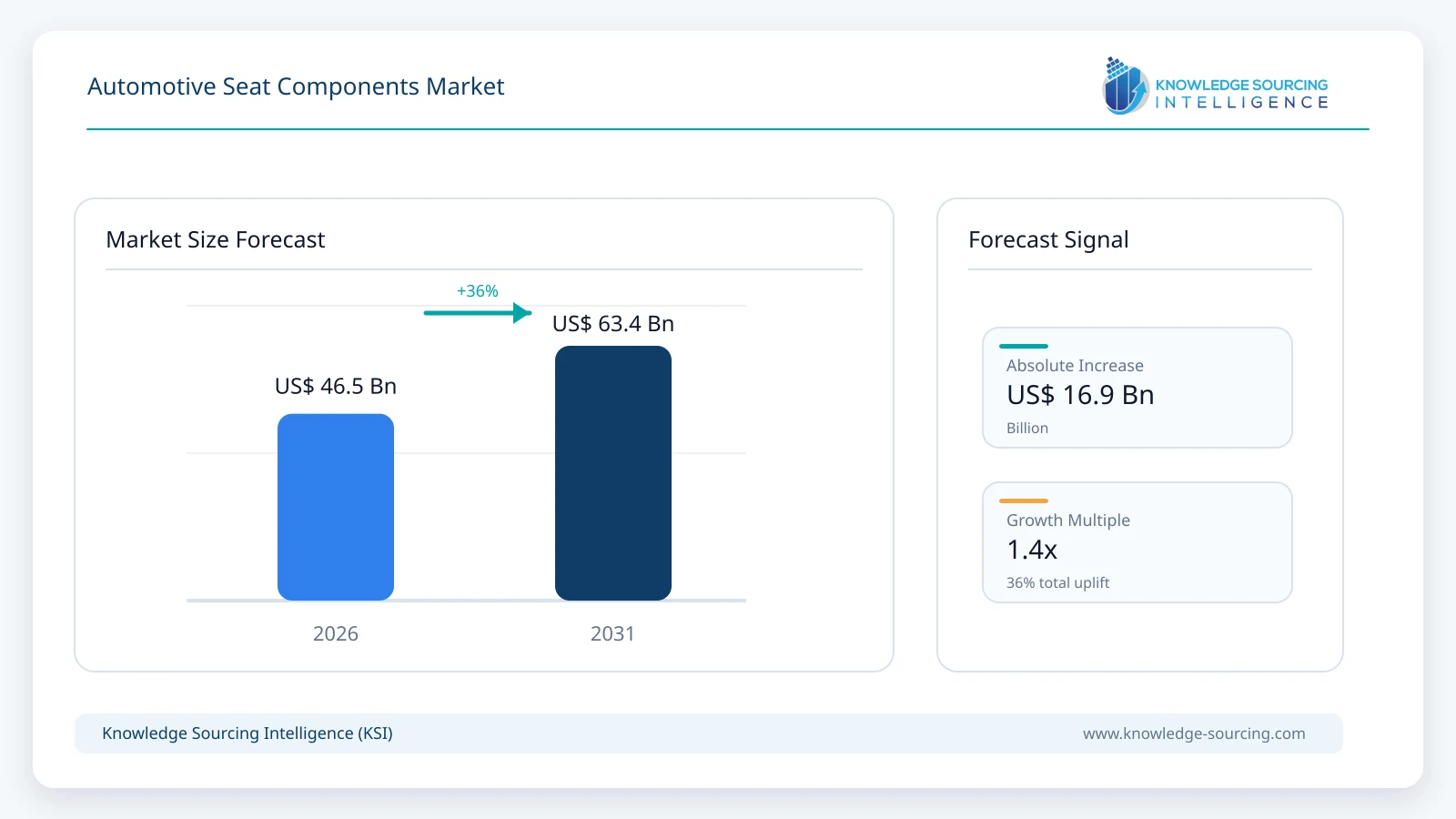
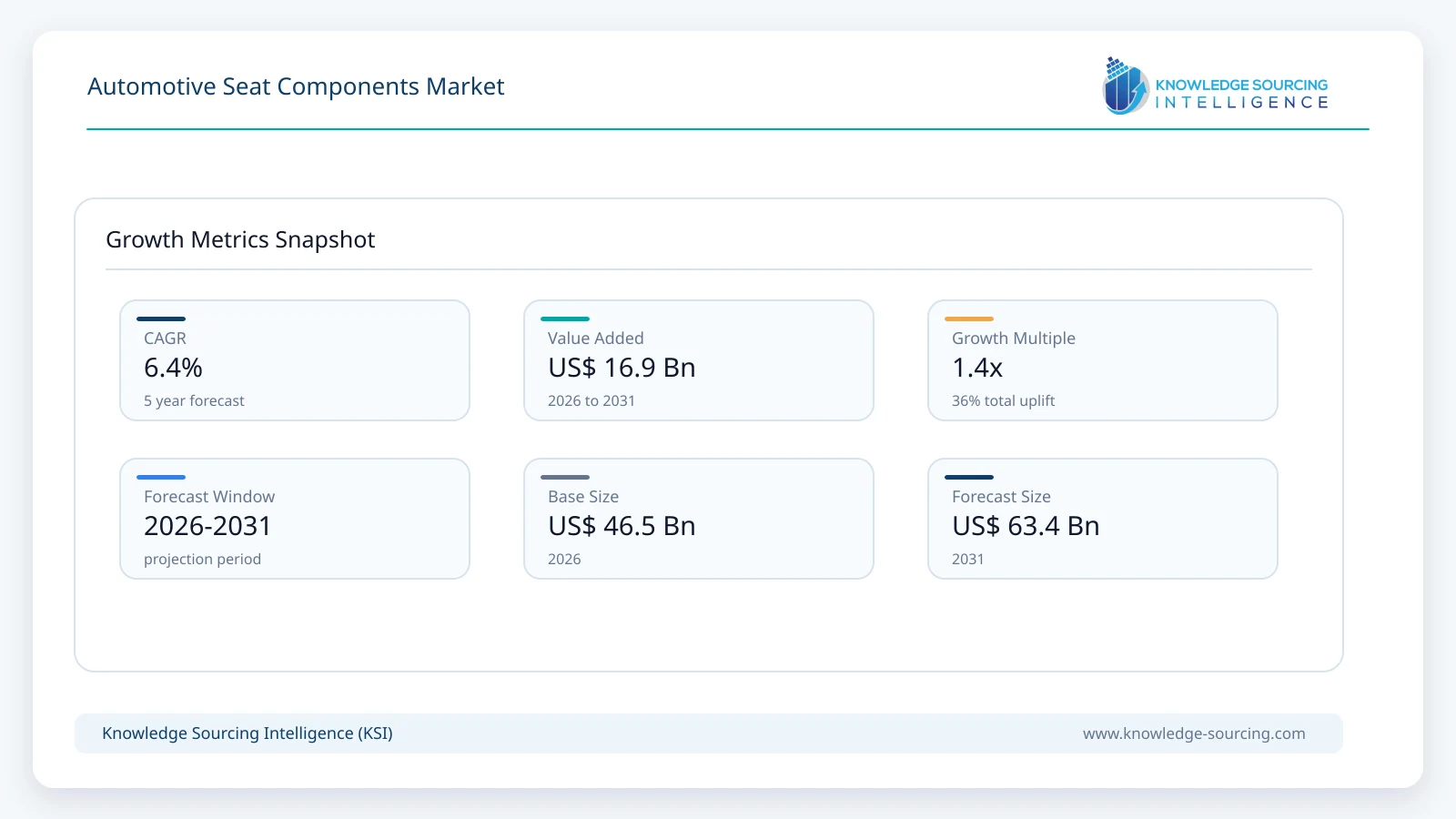
The automotive seat components market is estimated at approximately USD 46.5 billion in 2026 and is projected to reach about USD 63.4 billion by 2031, representing a CAGR of 6.4% during the forecast period.
Highlights:
- 1Seat structures, rails, recliners and mechanical adjustment components account for approximately 32% of global market value in 2026 because they form the crash-critical load-bearing architecture of front and rear seating systems.
- 2Foam, cushioning and energy-management components represent approximately 19% of 2026 market value, supported by large unit volumes and rising demand for lower-profile, lower-emission and more sustainable cushioning materials.
- 3Trim covers and surface materials account for approximately 21% of 2026 market value as OEMs continue to differentiate vehicles through seat appearance, tactility, breathable surfaces and premium stitching or formed-trim technologies.
- 4Thermal, lumbar and massage components represent approximately 15% of market value in 2026 and are among the fastest-growing component groups as climate-control seats and pneumatic comfort expand beyond luxury vehicles.
- 5Motors, actuators, controllers and seat sensors account for approximately 13% of market value in 2026 and are gaining share as powered adjustment, memory, occupant sensing and adaptive comfort become more common.
- 6Passenger vehicles represent approximately 91% of global market value in 2026, while Asia Pacific is the largest regional market due to vehicle-production scale and rapid adoption of premium seating content in China, Japan, South Korea and India.
The market is evolving from a largely mechanical and trim-driven component base toward a more integrated mix of lightweight structures, precision mechanisms, advanced cushioning, thermal comfort, pneumatic systems, sensors and electronics. Seat structures, rails, recliners, locking devices and adjustment hardware remain the largest value pool because every seat requires a crash-critical load-bearing architecture, while heating, ventilation, lumbar, massage, powered adjustment, memory and sensing functions are expanding into broader passenger-vehicle segments and increasing component value per seat.
Competitive positioning increasingly depends on combining lower mass, modular assembly, reduced part count, sustainability and higher electronic content without compromising crash performance, craftsmanship or manufacturing cost. Adient, Lear, FORVIA, Magna, Toyota Boshoku and Brose maintain vertically integrated capabilities across structures, mechanisms, foam, trim or complete seat subsystems, while specialists such as Gentherm provide thermal and pneumatic comfort technologies. This supplier mix reflects a market in which mechanical durability remains fundamental but incremental value is increasingly captured through comfort, sensing and electronically controlled functionality.
Market Overview
A complete automotive seat is assembled from structural, mechanical, cushioning and trim components that must operate as one safety-critical system. Seat frames, side members, cross tubes, tracks, recliners, height adjusters, latches and folding mechanisms define geometry, crash load paths and movement, while foam, suspension systems, trim covers, head restraints and armrests determine comfort, appearance and occupant support. High-strength steel, aluminum and mixed-material structures remain central to load-bearing components, while alternative cushioning and formed-trim technologies such as Lear's FlexAir and Adient's Sculpted Soft Trim are being developed to reduce weight, sewing complexity and end-of-life material burden.
Thermal comfort, actuation and sensing are becoming increasingly important layers within the seat architecture as heating mats, ventilation fans, pneumatic lumbar cells, massage systems, electric motors, position sensors and controllers move into higher-volume programs. Gentherm's portfolio illustrates the shift from simple seat heating toward networked microclimate and wellness functions, while powered adjustment, memory, occupancy sensing and automated positioning require reliable local electronics and communication interfaces. As software-defined vehicle architectures expand, more seat functions are expected to share centralized power and control logic while retaining local actuators and sensors at the seat, increasing the importance of modular interfaces and diagnostics.
Market Trends
Seat Structures and Mechanisms Are Becoming Lighter and More Modular
Structural seat components are being redesigned to reduce mass without sacrificing crash performance or stiffness. High-strength steels, optimized stamped sections, aluminum parts and fewer-piece frame architectures are increasingly used to lower weight and simplify welding. FORVIA's 2026 Luxeed program includes lightweight metal frames, while major suppliers continue to redesign recliners, tracks and folding mechanisms for compact packaging and automated assembly.
Modular seat-component architecture is becoming equally important because suppliers need to reduce manual assembly while supporting more variants from common hardware families. Adient's ModuTec concept separates major seat subassemblies so they can be built offline and sequenced rapidly into the main production line, reflecting a broader effort to standardize interfaces and reuse component families across several seat variants and vehicle derivatives.
Thermal, Lumbar and Massage Components Are Moving Down-Market
Heating has become common across many passenger-vehicle segments, while ventilation, lumbar and massage are moving steadily from premium products toward upper-midrange vehicles. Gentherm reported strong growth in lumbar and massage solutions during 2025, and suppliers such as FORVIA, Lear and Adient are developing compact pneumatic and airflow systems that can be integrated into thinner seat packages.
Thermal and pneumatic seat components are gaining value not only as comfort features but also as tools for energy-efficient occupant conditioning and wellness. Seat-centric heating and cooling can target the occupant more directly than full-cabin HVAC, which is especially attractive in electric vehicles where climate-control energy affects driving range, supporting continued demand for fans, blowers, heating elements, valves, air cells and dedicated comfort-control electronics.
Foam and Cushioning Materials Are Entering a Sustainability Redesign
Polyurethane foam remains the dominant cushioning material because it combines comfort, resilience, processability and cost. However, suppliers are under increasing pressure to reduce fossil-based content, emissions and end-of-life waste. Adient and Dow commercially launched seating foam using ISCC PLUS certified renewable-content attribution in August 2026, while Lear promotes FlexAir as a recyclable alternative to conventional foam.
Cushioning-material substitution will remain gradual because any alternative must meet flammability, odor, durability, compression-set and crash-energy requirements across long vehicle lives. Near-term adoption is therefore more likely to favor lower-emission formulations, bio-attributed feedstocks, thinner foam constructions and hybrid cushioning systems than a universal replacement of polyurethane.
Trim Covers Are Becoming More Automated and Functionally Integrated
Traditional seat trim relies heavily on cut-and-sew operations, making craftsmanship and labor major cost factors. Adient's Sculpted Soft Trim uses formed breathable material to reduce sewing and enable complex concave surfaces, while Lear integrates heating and ventilation technologies into trim through its ComfortMax architecture. These approaches reduce part count and create new design freedom.
Functional trim will gain importance as heating elements, ventilation pathways, sensors and decorative features move closer to the visible seat surface. Suppliers that combine material science, lamination, automated forming, stitching and embedded electronics can capture more value than vendors supplying a conventional cover alone.
Seat Electronics Are Moving toward Adaptive, Software-Controlled Comfort
Powered adjustment is becoming more sophisticated as seats add memory, automatic ingress/egress, zero-gravity positions and body-size adaptation. FORVIA's Luxeed award includes automatic real-time seat adjustment based on occupant morphology and vehicle driving conditions, demonstrating how software is beginning to influence the behavior of mechanisms and comfort components.
Software-controlled seat adjustment increases demand for motors, position sensors, electronic controllers and standardized communication interfaces because more mechanical functions must respond dynamically to occupant and vehicle data. The seat is therefore becoming a distributed electromechanical node within the vehicle architecture, requiring reliable power management and diagnostics in addition to conventional mechanical durability.
Segment Analysis
By Component Type: Structures and Mechanisms
Structures and mechanisms form the largest component segment because every automotive seat requires load-bearing frames and controlled movement hardware. The category includes seat tracks, recliners, height adjusters, folding mechanisms, latches, pivots and structural members engineered to withstand crash loads while maintaining low operating effort and minimal free play. Major suppliers including Adient, Lear, FORVIA, Magna, Brose and Toyota Boshoku maintain dedicated capability in these parts.
Structures and mechanisms represent approximately USD 14.88 billion of market value in 2026 and could approach USD 19.8 billion by 2031. Growth will be supported by higher power-seat penetration, multi-axis adjustment, reconfigurable rear seating and lightweight frame programs. The segment will remain cost-sensitive, however, because OEMs expect continuous mass reduction and manufacturing efficiency from mature mechanical components.
By Component Type: Trim Covers and Surface Materials
Trim covers and surface materials are the second-largest value pool because they combine high unit volumes with substantial variation in material, color, stitching and craftsmanship. The segment includes textiles, leather, synthetic leather, laminated fabrics and formed decorative surfaces used across seat cushions, backrests, head restraints and armrests.
Trim covers and surface materials account for approximately USD 9.77 billion in 2026 and are expected to exceed USD 13 billion by 2031 as premiumization supports richer materials and decorative execution across passenger-vehicle programs. Sustainability is simultaneously driving recycled textiles, lower-impact leather alternatives and designs that simplify disassembly, making automation of forming and sewing increasingly important to margin improvement.
By Function: Structural and Adjustment Components
Structural and adjustment components dominate by function because they are required across virtually every vehicle class and seat position. Manual and powered recline, fore-aft travel, height adjustment, folding and easy-entry functions depend on reliable tracks, gears, latches, pivots and supporting frames, with front seats carrying the highest mechanism content.
Structural and adjustment components represent roughly USD 18.6 billion of 2026 market value and should expand steadily as powered movement and flexible seating increase mechanical content across more positions. Electrification of adjustment and greater second-row configurability will add value through more sophisticated mechanisms and local actuation even though the category remains mature relative to thermal and electronic functions.
By Material Platform: Steel and Metal-Dominant Components
Steel remains the dominant material platform for structural seat components because of its strength, formability, weldability and cost. High-strength grades allow thinner sections, while aluminum is used selectively for weight reduction in premium or highly optimized structures. Metal also remains essential in tracks, recliners, hinges and locking systems where wear resistance and crash integrity are critical.
Metal-dominant components account for approximately 35% of market value in 2026. Their share is expected to decline modestly as electronics, comfort systems and polymer-rich cushioning grow faster, but absolute demand will remain substantial because every seat still requires a robust structural skeleton.
By Vehicle Type: Passenger Vehicles
Passenger cars, SUVs, crossovers and MPVs dominate demand because they combine high global production with the greatest amount of powered adjustment, thermal comfort, decorative trim and occupant-sensing content. Premium features are increasingly migrating into mainstream passenger vehicles, raising component value per seat even where overall vehicle volumes are mature.
Passenger vehicles account for approximately USD 42.32 billion in 2026 and could approach USD 57 billion by 2031. Commercial vehicles remain important for durable frames, suspension and ergonomic adjustment, but passenger platforms will generate most incremental value through comfort electronics, thermal systems and premium trim.
Market Drivers
Higher Comfort and Convenience Content per Vehicle
Seat heating, ventilation, lumbar support, massage, memory and multi-way adjustment are spreading across more vehicle segments. Each additional comfort feature requires dedicated hardware such as fans, heating elements, pneumatic bladders, valves, motors, sensors and control electronics, directly increasing seat-component value per vehicle.
Comfort-content growth is strongest in China, North America and premium European programs, although falling component costs are broadening adoption across additional vehicle segments globally. Modular and standardized interfaces allow OEMs to add heating, ventilation, lumbar or massage functions without redesigning the complete seat, increasing the addressable opportunity for component suppliers.
Electrification and the Shift toward Seat-Centric Thermal Comfort
Electric vehicles create a strong incentive to manage occupant comfort efficiently because cabin HVAC can reduce driving range. Heating or cooling the occupant through the seat can reduce dependence on conditioning the entire cabin, which increases the strategic value of climate-control seats, localized heaters, airflow systems and intelligent comfort controllers.
Seat-centric thermal comfort also aligns with vehicle pre-conditioning and personalized climate profiles, allowing software to coordinate seat heating, ventilation and HVAC settings around individual occupants. This integration gives suppliers of thermal components and embedded electronics a route from commodity hardware toward higher-value climate and comfort systems.
Lightweighting and Packaging Pressure in EV and Flexible Interiors
Battery mass increases the importance of reducing weight elsewhere in the vehicle, and seats are significant interior structures. OEMs are demanding thinner frames, lighter mechanisms, lower-profile foam and more efficient component packaging while still adding comfort and adjustment functions.
Flexible and reconfigurable interiors intensify lightweighting and packaging requirements because zero-gravity, reclining, folding and movable seats need compact tracks, strong latches and mechanisms that provide greater travel without increasing mass or floor height. These constraints support engineering investment in high-strength materials and more integrated mechanism designs.
Growth of Powered, Adaptive and Sensor-Enabled Seating
Seats increasingly respond to occupant position, preferences and vehicle state. Powered adjusters, memory functions and automatic ingress/egress are already established in premium vehicles, while newer systems use occupant morphology, posture or driving conditions to select seat position and support.
Adaptive and sensor-enabled seating increases demand for motors, actuators, position sensors, occupancy sensing and local electronics because seat functions increasingly respond to occupant and vehicle-state data. The component opportunity expands further as safety and comfort systems share seat-position information and software updates enable additional functions on existing hardware.
Sustainability Requirements across Foam, Trim and Structures
Automakers are setting stronger recycled-content and lifecycle-emissions targets for interior materials. Seats contain large quantities of foam, textiles, polymers and metal, making the component value chain a major target for renewable feedstocks, recycled fabrics, lighter frames and design-for-disassembly.
Suppliers that can demonstrate lower-carbon materials without affecting odor, wear, crash or craftsmanship performance are likely to gain sourcing advantages. Sustainable content is therefore becoming a purchasing criterion alongside price, quality and weight.
Market Restraints
High Validation Burden for Safety-Critical Structures and Mechanisms
Seat frames, tracks and recliners carry occupant loads during severe crashes and must remain locked under high forces. New materials, thinner sections or redesigned mechanisms therefore require extensive durability, crash and misuse validation before entering production.
The long qualification cycle slows substitution and favors established suppliers with proven test capability. A component that reduces cost or mass cannot be adopted quickly if it changes crash behavior or introduces uncertainty in long-term fatigue performance.
Persistent Cost Pressure on Mature Mechanical and Soft-Trim Components
Many seat components are high-volume and highly engineered but still face aggressive OEM price targets. Tracks, recliners, foam and trim are frequently subject to annual cost-down expectations, while raw-material and labor inflation can be difficult to recover fully.
Margin protection in mature mechanical and soft-trim components increasingly depends on automation, vertical integration, material optimization and global sourcing. The pressure is particularly intense for labor-heavy cut-and-sew operations and mature manual mechanisms where product differentiation is limited.
Complexity from Growing Electrical and Comfort Content
Adding motors, heaters, blowers, pneumatic cells, sensors and controllers increases wiring, connectors, diagnostics and thermal-management requirements within a confined seat package. Each additional feature also introduces failure modes that can affect warranty cost and perceived quality.
Seat suppliers must coordinate mechanical, electrical and software interfaces across many sub-suppliers. The integration burden can offset some of the value gained from premium features, particularly on high-volume platforms with many trim and option combinations.
Raw-Material Volatility and Supply-Chain Exposure
Seat components depend on steel, aluminum, polyurethane chemicals, textiles, leather, electronic components and specialty plastics. Price or availability disruptions can affect multiple component families simultaneously and can be difficult to pass through under long-term automotive supply contracts.
Just-in-time seat production amplifies raw-material and component supply risk because a shortage of even a low-cost mechanism or electronic controller can stop complete seat assembly when all other components are available. Supply-chain resilience and dual-sourcing capability therefore remain important sourcing considerations alongside piece cost.
Recycling Complexity in Multi-Material and Electronics-Rich Seats
Modern seats combine steel, polymers, foam, fabrics, adhesives, wiring, electronics and sometimes leather or coated materials. These combinations make end-of-life separation difficult and can conflict with circularity targets even when individual materials are technically recyclable.
Design-for-disassembly, mono-material concepts and removable electronic modules can improve seat-component recyclability, but these approaches may increase tooling or engineering cost. Suppliers must therefore balance circular design with assembly speed, durability and premium appearance.
Regional Outlook
Asia Pacific
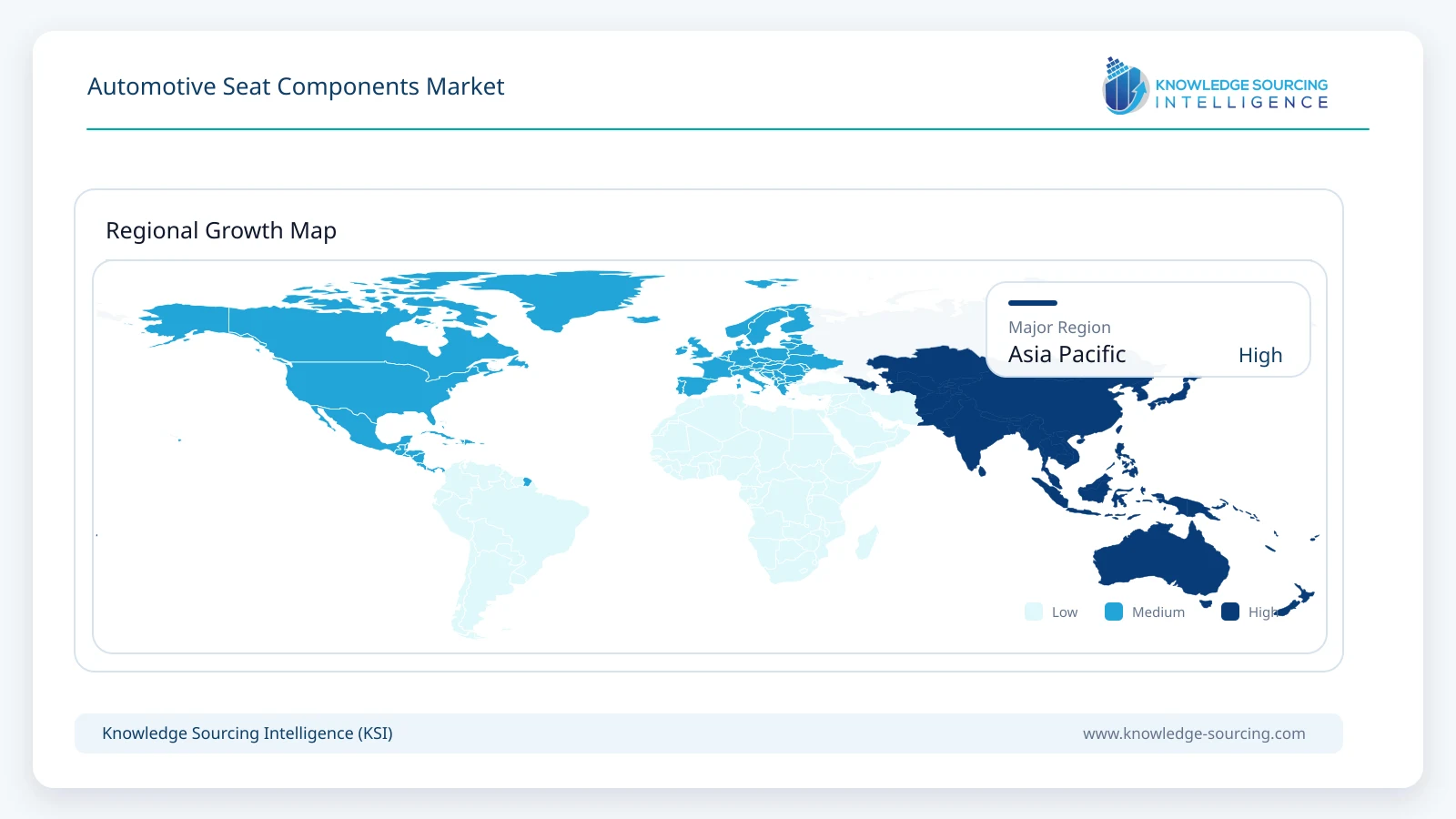
Asia Pacific is the largest automotive seat components market, supported by high vehicle production in China, Japan, South Korea and India. China is especially important because domestic EV manufacturers are rapidly adopting zero-gravity seats, multi-way adjustment, ventilation, massage and electronically controlled comfort functions that increase component value per vehicle.
Asia Pacific also benefits from a deep seat-component supplier base that supports both high-volume mechanical production and rapid deployment of advanced comfort technologies. Toyota Boshoku, TS Tech, NHK Spring and Tachi-S have strong Asian operations, while Adient, Lear, FORVIA, Magna, Brose and Gentherm maintain significant local manufacturing and engineering footprints; Toyota Boshoku's 2026 acquisition of the remaining stake in its Indonesian seat-device subsidiary further reinforces the strategic importance of locally produced recliners and seat slides.
Asia Pacific growth through 2031 will be supported by both vehicle-production scale and rising seat-component content per vehicle as comfort, actuation and sensing expand across more programs. China should remain the strongest technology driver, while India and Southeast Asia create additional demand for localized structures, mechanisms, foam and trim as production capacity expands.
Europe
Europe is a major high-value market for seat components because premium vehicles and stringent safety expectations support advanced structures, powered mechanisms, thermal comfort and sophisticated trim. European suppliers also play a leading role in lightweight seating, zero-gravity concepts, sustainable materials and integrated safety development.
FORVIA, Brose, Magna and Gentherm maintain strong regional operations, while Adient and Lear supply a broad range of component and complete-seat programs. The January 2026 FORVIA award with a major European automaker includes front seat structures, foam and trim covers for North American production, illustrating how European-developed component platforms are deployed globally.
European seat-component growth is expected to be driven more by value per vehicle than by production volume as electrification, premium comfort and adaptive safety increase demand for lighter mechanisms, sensor integration and advanced thermal or pneumatic systems. This mix supports continued high engineering content even in a relatively mature vehicle market.
Competitive Landscape
The automotive seat components market combines vertically integrated global seating suppliers with specialist mechanism, foam, trim and comfort-technology companies. Adient, Lear, FORVIA and Magna compete across multiple component layers including structures, mechanisms, foam, trim and complete seating systems, providing strong purchasing scale and the ability to optimize the seat as a complete architecture.
Toyota Boshoku, TS Tech, NHK Spring and Tachi-S are important Asian suppliers with deep capabilities in structures, mechanisms, trim and complete seats. Brose specializes in seat structures, adjusters, motors and mechatronic movement systems, while Gentherm has a differentiated position in climate-control seats, lumbar, massage and comfort electronics.
Competitive advantage increasingly depends on how effectively suppliers integrate the frame, mechanism, cushion, cover and comfort system within one manufacturable seat architecture. Vertical integration can reduce weight and part count while improving assembly efficiency, although specialist suppliers remain important where thermal, pneumatic or electronic technologies require deeper expertise than a general seat assembler can economically maintain in-house.
Future differentiation will center on lightweight structures, modular component families, automated manufacturing, sustainable materials and software-connected comfort. Scale and local manufacturing remain critical because most components ultimately feed just-in-time seat assembly plants located close to OEM vehicle production.
Recent Developments
4 August 2026: Adient and Dow commercially launched a next-generation polyurethane seating foam using ISCC PLUS certified renewable-content attribution, expanding the availability of lower-fossil-content cushioning materials for automotive seats.
27 April 2026: Adient acquired an automotive seating foam plant in Romulus, Michigan, adding the facility to its regional foam network and strengthening vertical integration in seat cushioning production.
24 April 2026: Adient introduced ProForce Massage Flow, a seat-comfort technology designed to integrate massage functionality more efficiently into automotive seating architectures.
2 April 2026: Toyota Boshoku completed the full acquisition of PT. Toyota Boshoku Device Indonesia, a manufacturer of seat recliners and seat slides, to strengthen competitiveness in seat structural components.
23 February 2026: Adient announced Sculpted Soft Trim, an automated formed-trim technology for large panels, headrests, armrests and other seat parts that reduces reliance on complex sewing operations.
18 February 2026: FORVIA won a multi-year seating program with Luxeed in China that includes lightweight metal seat frames, zero-gravity seating and automatic real-time seat adjustment based on occupant morphology and driving conditions.
29 January 2026: FORVIA secured new business with a major European automaker covering front seat structures, foam, trim covers and complete seat assembly for North American production.
Market Outlook
The automotive seat components market is expected to expand from approximately USD 46.500 billion in 2026 to about USD 63.380 billion by 2031. Mechanical structures and trim will remain the largest absolute value pools, but the fastest value growth will come from thermal comfort, massage, powered actuation, sensors and electronics.
The central structural change through 2031 will be the consolidation of more functions into fewer modular component families, allowing OEMs to expand seat variants without proportionally increasing assembly complexity. Lighter frames, standardized mechanisms, formed trim, lower-emission cushioning and compact comfort modules will therefore become increasingly important to scalable seat architectures.
Asia Pacific will remain the largest regional market, while Europe continues to lead in high-value safety, comfort and sustainability engineering. Supplier success will depend on balancing low-cost high-volume production with innovation in weight, modularity, recyclability, occupant comfort and electronically controlled seat functions.
Automotive Seat Components Market Scope
| Report Metric | Details |
|---|---|
| Total Market Size in 2026 | USD 46.5 billion |
| Total Market Size in 2031 | USD 63.4 billion |
| Forecast Unit | Billion |
| Growth Rate | 6.4% |
| Study Period | 2021 to 2031 |
| Historical Data | 2021 to 2024 |
| Base Year | 2025 |
| Forecast Period | 2026 – 2031 |
| Segmentation | Component Type, Function, Material Platform, Seat Position, Vehicle Type, Geography |
| Companies |
|
Market Segmentation
By Component Type
Seat Structures and Frames
Tracks, Recliners, Adjusters and Mechanisms
Foam and Cushioning Components
Trim Covers and Surface Materials
Head Restraints, Armrests and Soft Components
Thermal, Lumbar and Massage Components
Motors, Actuators, Controllers and Sensors
By Function
Structural and Adjustment Components
Comfort and Ergonomic Components
Thermal and Wellness Components
Safety and Sensing Components
By Material Platform
Steel and Metal-Dominant Components
Foam and Elastomeric Components
Textile, Leather and Synthetic Surface Materials
Polymer and Composite Components
Electronic and Mixed-Material Components
By Seat Position
Front-Row Seat Components
Second-Row Seat Components
Third-Row and Specialty Seat Components
By Vehicle Type
Passenger Vehicles
Light Commercial Vehicles
Medium and Heavy Commercial Vehicles
Buses and Coaches
By Geography
North America
United States
Canada
Mexico
South America
Brazil
Argentina
Others
Europe
Germany
United Kingdom
France
Italy
Spain
Others
Middle East and Africa
Saudi Arabia
UAE
South Africa
Others
Asia Pacific
China
Japan
South Korea
India
Indonesia
Thailand
Others
Table of Contents
1. INTRODUCTION
1.1. Market Overview
1.2. Market Definition
1.3. Scope of the Study
1.4. Market Segmentation
1.5. Currency
1.6. Assumptions
1.7. Base and Forecast Years
1.8. Key Benefits to Stakeholders
2. RESEARCH METHODOLOGY
2.1. Research Design
2.2. Secondary Research
2.3. Primary Research
2.4. Market Estimation
2.5. Segment Modelling
2.6. Data Triangulation and Validation
3. EXECUTIVE SUMMARY
3.1. Key Findings
3.2. Automotive Seat Components Market Size, 2026-2031
3.3. Component Type Outlook
3.4. Function Outlook
3.5. Material Platform Outlook
3.6. Seat Position Outlook
3.7. Vehicle Type Outlook
3.8. Regional Opportunity Summary
4. MARKET DYNAMICS
4.1. Market Drivers
4.1.1. Higher Comfort and Convenience Content per Vehicle
4.1.2. Electrification and the Shift toward Seat-Centric Thermal Comfort
4.1.3. Lightweighting and Packaging Pressure in EV and Flexible Interiors
4.1.4. Growth of Powered, Adaptive and Sensor-Enabled Seating
4.1.5. Sustainability Requirements across Foam, Trim and Structures
4.2. Market Restraints
4.2.1. High Validation Burden for Safety-Critical Structures and Mechanisms
4.2.2. Persistent Cost Pressure on Mature Mechanical and Soft-Trim Components
4.2.3. Complexity from Growing Electrical and Comfort Content
4.2.4. Raw-Material Volatility and Supply-Chain Exposure
4.2.5. Recycling Complexity in Multi-Material and Electronics-Rich Seats
4.3. Market Opportunities
4.4. Porter's Five Forces Analysis
4.5. Industry Value Chain Analysis
4.6. Seat Component Cost, Content and Vertical Integration Economics
4.7. Safety, Flammability, Material and Sustainability Requirements
5. TECHNOLOGY OUTLOOK
5.1. High-Strength Steel and Lightweight Seat Structures
5.2. Recliners, Tracks, Latches and Folding Mechanisms
5.3. Electric Seat Motors and Multi-Axis Actuation
5.4. Polyurethane, Bio-Attributed and Alternative Cushioning
5.5. Recyclable and Low-Profile Cushioning Technologies
5.6. Formed Trim, Automated Sewing and Sustainable Textiles
5.7. Seat Heating, Ventilation and Active Cooling
5.8. Lumbar, Massage and Pneumatic Comfort Systems
5.9. Occupancy, Position and Safety Sensors
5.10. Seat Control Electronics, Memory and Adaptive Comfort
5.11. Modular Seat Subassemblies and Automated Assembly
5.12. Design-for-Disassembly and Circular Seat Components
6. AUTOMOTIVE SEAT COMPONENTS MARKET BY COMPONENT TYPE
6.1. Introduction
6.2. Seat Structures and Frames
6.3. Tracks, Recliners, Adjusters and Mechanisms
6.4. Foam and Cushioning Components
6.5. Trim Covers and Surface Materials
6.6. Head Restraints, Armrests and Soft Components
6.7. Thermal, Lumbar and Massage Components
6.8. Motors, Actuators, Controllers and Sensors
7. AUTOMOTIVE SEAT COMPONENTS MARKET BY FUNCTION
7.1. Introduction
7.2. Structural and Adjustment Components
7.3. Comfort and Ergonomic Components
7.4. Thermal and Wellness Components
7.5. Safety and Sensing Components
8. AUTOMOTIVE SEAT COMPONENTS MARKET BY MATERIAL PLATFORM
8.1. Introduction
8.2. Steel and Metal-Dominant Components
8.3. Foam and Elastomeric Components
8.4. Textile, Leather and Synthetic Surface Materials
8.5. Polymer and Composite Components
8.6. Electronic and Mixed-Material Components
9. AUTOMOTIVE SEAT COMPONENTS MARKET BY SEAT POSITION
9.1. Introduction
9.2. Front-Row Seat Components
9.3. Second-Row Seat Components
9.4. Third-Row and Specialty Seat Components
10. AUTOMOTIVE SEAT COMPONENTS MARKET BY VEHICLE TYPE
10.1. Introduction
10.2. Passenger Vehicles
10.3. Light Commercial Vehicles
10.4. Medium and Heavy Commercial Vehicles
10.5. Buses and Coaches
11. AUTOMOTIVE SEAT COMPONENTS MARKET BY GEOGRAPHY
11.1. North America
11.1.1. United States
11.1.2. Canada
11.1.3. Mexico
11.2. South America
11.2.1. Brazil
11.2.2. Argentina
11.2.3. Others
11.3. Europe
11.3.1. Germany
11.3.2. United Kingdom
11.3.3. France
11.3.4. Italy
11.3.5. Spain
11.3.6. Others
11.4. Middle East and Africa
11.4.1. Saudi Arabia
11.4.2. UAE
11.4.3. South Africa
11.4.4. Others
11.5. Asia Pacific
11.5.1. China
11.5.2. Japan
11.5.3. South Korea
11.5.4. India
11.5.5. Indonesia
11.5.6. Thailand
11.5.7. Others
12. COMPETITIVE ENVIRONMENT AND ANALYSIS
12.1. Major Players and Strategy Analysis
12.2. Market Share Analysis
12.3. Seat Structure and Mechanism Benchmarking
12.4. Foam, Cushioning and Trim Technology Benchmarking
12.5. Thermal and Pneumatic Comfort Benchmarking
12.6. Actuation, Sensor and Electronics Benchmarking
12.7. Manufacturing Footprint and Vertical Integration
12.8. Competitive Dashboard
13. COMPANY PROFILES
13.1. Adient plc
13.2. Lear Corporation
13.3. FORVIA
13.4. Magna Seating
13.5. Toyota Boshoku Corporation
13.6. Brose Fahrzeugteile SE & Co. KG
13.7. Gentherm Incorporated
13.8. TS TECH Co., Ltd.
13.9. NHK Spring Co., Ltd.
13.10. Tachi-S Co., Ltd.
13.11. Woodbridge
13.12. Kongsberg Automotive
14. APPENDIX
14.1. Currency
14.2. Assumptions
14.3. Base and Forecast Years Timeline
14.4. Key Benefits for Stakeholders
14.5. Research Methodology
14.6. Abbreviations
14.7. Data Sources
Navigate
Trusted by the world's leading organizations











