
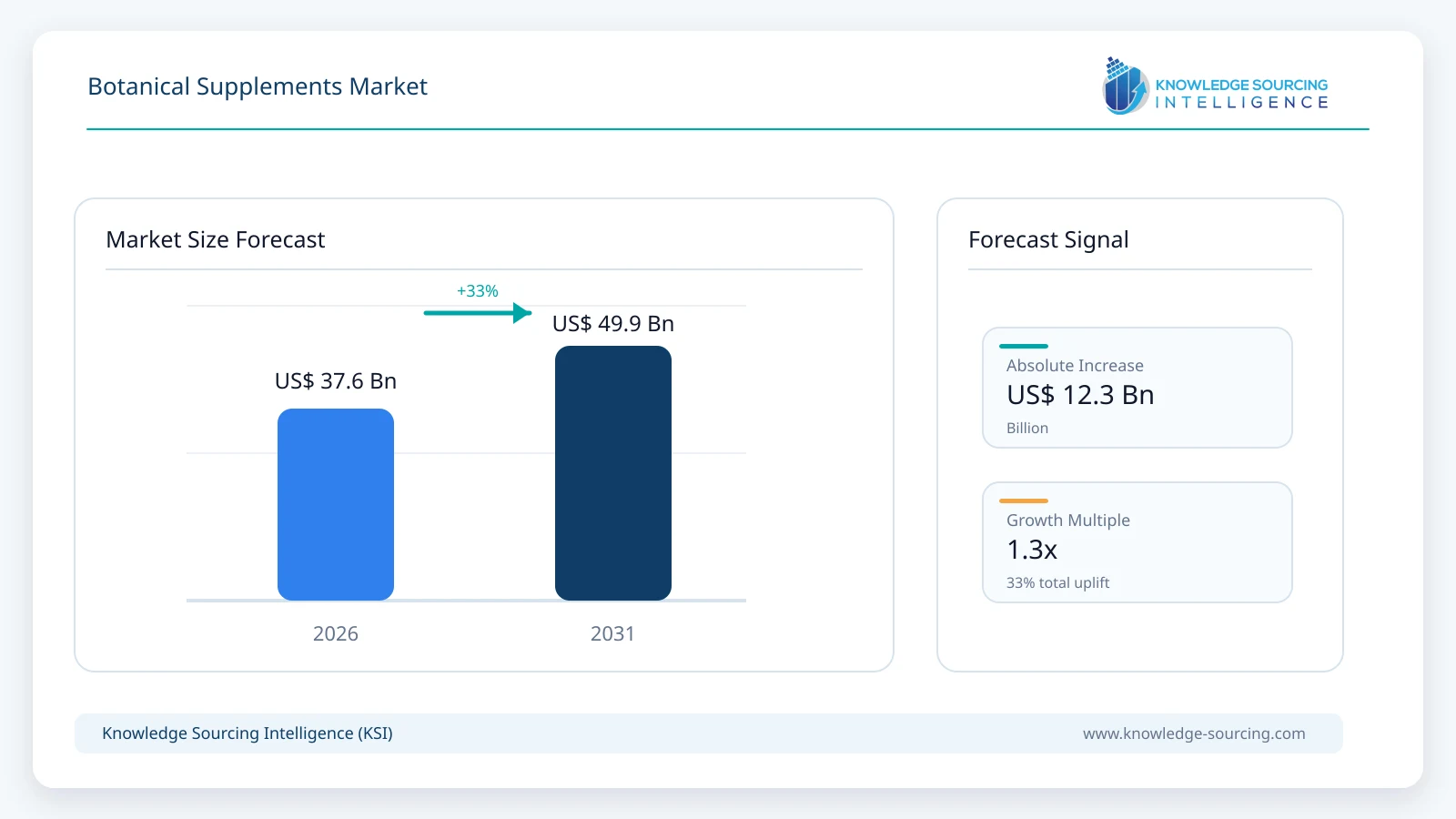
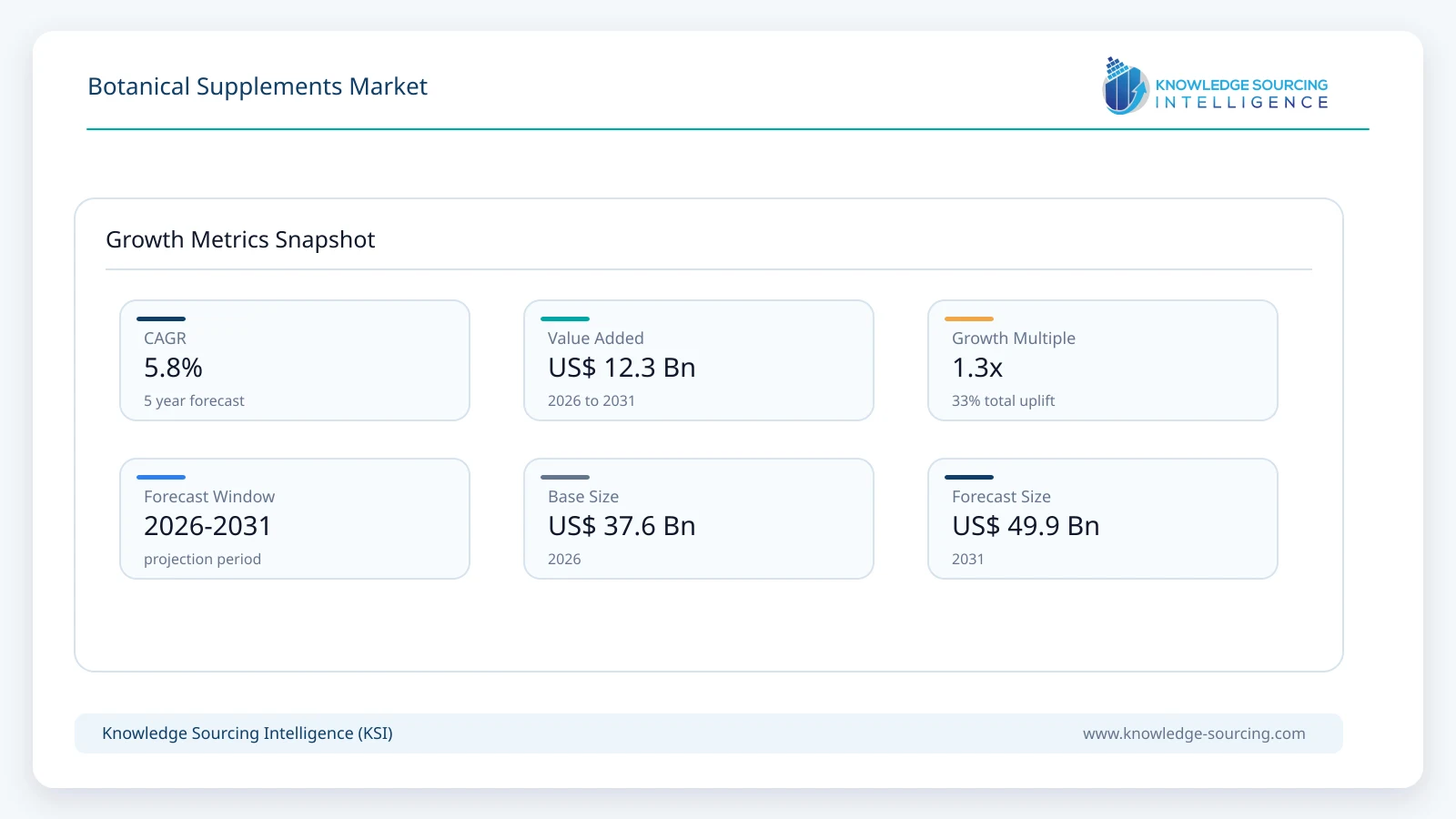
The botanical supplements market is projected to grow at a CAGR of 5.8% over the forecast period, increasing from USD 37.6 billion in 2026 to USD 49.9 billion by 2031.
Highlights:
- 1Leaf-derived botanicals account for approximately 29% of global botanical supplement revenue in 2026.
- 2Flower-based products are projected to grow at approximately 7.0% annually through 2031.
- 3Capsules account for approximately 36% of global botanical supplement revenue in 2026.
- 4Online channels generate about 24% of global botanical supplement sales in 2026.
- 5North America accounts for approximately 34% of global botanical supplement revenue in 2026.
- 6Standardization, traceability and third-party quality verification are becoming stronger competitive differentiators.
Market Overview
Botanical supplements sit within the wider dietary supplement market but are differentiated by the origin and complexity of their active materials. The U.S. Food and Drug Administration defines dietary ingredients to include herbs and other botanicals as well as their concentrates, metabolites, constituents and extracts. Products may be supplied as tablets, capsules, gummies, powders or liquids, but they remain dietary supplements only when they are intended for ingestion and marketed as supplements rather than as conventional foods or drugs. This distinction matters commercially because botanical drugs, functional beverages and topical botanical cosmetics follow different regulatory and purchasing pathways. For this report, the market covers ingestible finished botanical supplement products and excludes conventional foods, topical personal-care products and prescription botanical drugs.
The supply chain starts with cultivation or wild collection, followed by drying, extraction, concentration, standardization, formulation, testing, and finished-product manufacturing. Quality is harder to control than for single-molecule ingredients because botanical materials vary with species, plant part, growing conditions, harvest timing, and extraction method. Leading suppliers therefore compete on verified botanical identity, marker-compound specifications, contaminant testing, traceable sourcing, and evidence supporting dose selection. NIH notes that botanical supplements are chemically complex and inherently variable, while FDA oversight places responsibility on manufacturers for product safety and truthful labeling. These requirements raise the commercial value of controlled cultivation, validated extraction, and analytical testing capabilities.
Market Trends
Standardized extracts and documented quality are replacing generic herbal positioning
The market is becoming more ingredient-specific. Consumers may still recognize a product by the herb name, but brands increasingly differentiate through standardized active compounds, clinically studied extracts, validated botanical identity and testing transparency. NOW Foods markets standardized extracts alongside whole-herb products, while Gaia Herbs publishes farm-to-supplement traceability and laboratory-testing information and added third-party quality verification through SuppCo in 2026. The same direction is visible upstream, where ingredient suppliers sell branded extracts with defined marker compounds rather than undifferentiated powders. This improves formulation consistency and supports higher-value positioning, but it also raises documentation and quality-control requirements for manufacturers that want to compete in premium channels.
Stress, sleep, cognitive support and healthy aging are diversifying demand beyond immunity
Pandemic-era immune-support purchasing has normalized, but the category is finding new demand in stress management, sleep, cognition, digestive health and healthy aging. The American Botanical Council reported that U.S. retail sales of herbal supplements returned to growth in 2023 and increased again in 2024, with sales reaching a record level. The ingredient mix is also changing. Ashwagandha has moved into mainstream stress-support products, while rhodiola, ginkgo, turmeric, milk thistle and digestive botanicals remain active categories. Gaia Herbs introduced five Regenerative Organic Certified tincture blends in 2026 targeting stress, focus, sleep, heart, and immune support. This broader set of use occasions makes growth less dependent on one seasonal wellness theme and supports repeat consumption across multiple consumer groups.
Market Drivers
Preventive wellness and continued consumer spending support recurring botanical demand
Botanical supplements benefit from a large established consumer base rather than from a single emerging application. NIH has estimated that Americans spend about USD 60 billion annually on dietary supplements overall, with many products containing botanical and other natural ingredients. A separate national government survey cited by the National Toxicology Program found natural products, including dietary supplements, used by roughly 18% of U.S. adults. Within herbal supplements specifically, U.S. retail sales increased 5.4% in 2024 according to the American Botanical Council. The market therefore enters the 2026-2031 period with recurring household demand, broad retail availability and a large installed base of users already familiar with plant-derived wellness products.
Digital retail and personalized supplement models improve discovery and repeat purchasing
Online retail is lowering the distribution barrier for specialist botanical brands and giving consumers access to a wider assortment than most physical stores can carry. Digital channels also support subscriptions, education, ingredient-specific search and product comparison, all of which fit a category where buyers often research herbs before purchase. Larger nutrition companies are moving further into technology-enabled personalization. Herbalife announced an agreement in March 2026 to acquire certain assets from Bioniq, a personalized-supplement company, with the objective of combining individualized nutrition technology with its global distribution network. Botanical supplements can benefit from the same infrastructure because stress, sleep, digestive, and healthy-aging formulations are increasingly sold as part of broader personalized wellness routines.
Market Restraint
Ingredient variability, adulteration risk and uneven evidence increase compliance and trust costs
Botanical supplements are commercially attractive because of their ingredient diversity, but the same diversity creates a structural constraint. Species substitution, variability in active constituents, contamination, adulteration, and inconsistent extraction can make two products carrying the same herb name materially different. FDA does not pre-approve most dietary supplements before sale in the United States, leaving manufacturers responsible for safety, identity, and truthful claims, while new dietary ingredients can require notification and supporting safety information. The Botanical Safety Consortium was created specifically to improve methods for evaluating complex botanical mixtures, and its FDA-NIH-HESI collaboration was renewed in 2025. Companies therefore need stronger sourcing controls, analytical testing, and claim substantiation, which raises costs and slows commercialization for higher-quality products. Weak-quality products can also damage consumer confidence across an entire ingredient category.
Segment Analysis
By Source - Leaves
Leaf-derived botanical supplements are projected to generate approximately USD 14.3 billion in market revenue by 2031. The segment includes established ingredients such as green tea, ginkgo, moringa, senna, peppermint and various whole-leaf or standardized leaf extracts used across antioxidant, digestive, metabolic and cognitive-support products. Leaves retain scale because they are suitable for capsules, tablets, powders, teas and liquid extracts and are supported by long-established sourcing networks. Roots and rhizomes are another important group through turmeric, ginger, ginseng and ashwagandha, while flowers are expanding faster from a smaller base through products positioned around relaxation, sleep and mood support.
By Product Form - Capsules
Capsule-format botanical supplements are projected to reach approximately USD 17.4 billion in revenue by 2031. Capsules remain well suited to botanicals because they can carry concentrated powders and standardized dry extracts without the flavor-masking requirements of liquids or gummies. They also allow brands to communicate a measured dose clearly and can accommodate multi-ingredient blends. Tablets continue to hold a substantial position in mass retail, while powders are important for higher-dose botanicals and green blends. Gummies are growing faster than the mature capsule and tablet categories, particularly where extracts can be delivered at effective doses without compromising taste or stability.
By Distribution Channel - Online
Online botanical supplement sales are projected to grow at approximately 9.0% annually between 2026 and 2031. E-commerce gives smaller and specialist brands access to national or international customers and supports a broader range of single-herb, practitioner-oriented and premium formulations than most physical retailers stock. Search behavior also fits the market because consumers frequently shop by ingredient, health goal, certification or dosage form rather than by brand alone. Offline channels remain larger in absolute value through pharmacies, drug stores, supermarkets, specialty health retailers and direct-selling networks, but digital channels are expected to continue gaining share as subscriptions and repeat ordering become more common.
By Application - General Health and Wellness
General health and wellness applications are projected to generate approximately USD 18.4 billion in global botanical supplement revenue by 2031. The segment captures products purchased for broad daily wellness, antioxidant support, vitality and healthy aging rather than for one narrow function. Stress, sleep and cognitive support are growing faster than this mature category, helped by continued consumer interest in adaptogens and nootropic-style botanical formulations. Digestive health also remains commercially important through psyllium, ginger, peppermint and other botanicals, while immunity retains a sizeable installed base even after the exceptional pandemic-period demand has normalized.
By Geography - North America
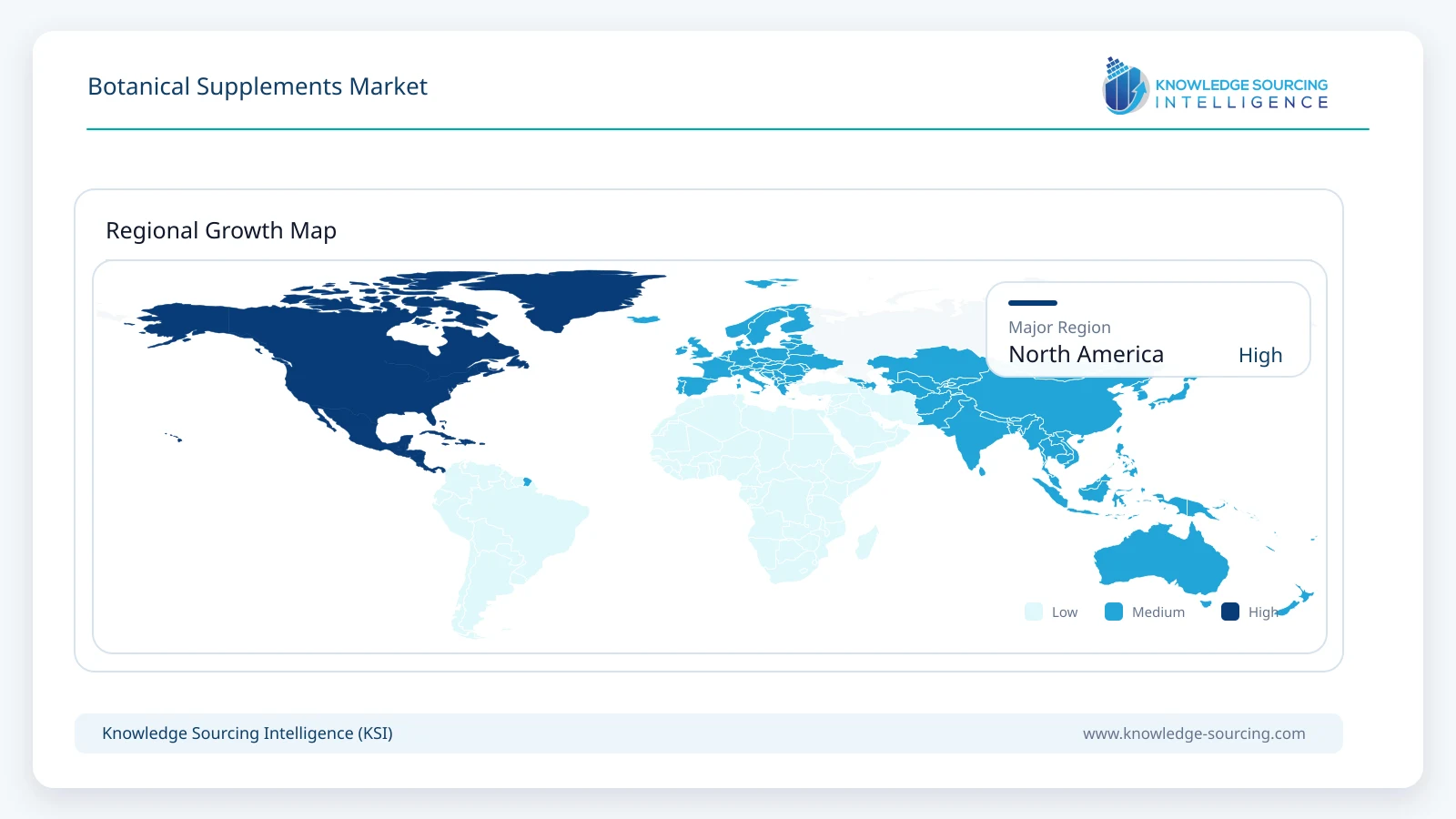
North America is projected to reach approximately USD 16.9 billion in botanical supplement revenue by 2031. The region combines high supplement awareness, deep pharmacy and specialty-retail distribution, sophisticated e-commerce, a large practitioner channel and a mature branded-supplement industry. The United States is the principal market and continues to support product innovation in standardized extracts, adaptogens, gummies, tinctures and personalized supplement programs. Asia Pacific has a different advantage through established traditional medicine systems, large ingredient-sourcing networks and expanding middle-class wellness spending. India is particularly important for Ayurvedic ingredients and branded wellness products, while China, Japan, South Korea and Australia contribute through traditional botanicals, premium supplements and natural-health retail channels.
Competitive Environment
Competition is fragmented across global nutrition companies, dedicated herbal supplement brands, traditional-medicine companies, direct-selling organizations and specialist botanical ingredient suppliers. Herbalife, Nature's Sunshine, Amway, H&H Group through Swisse, Kirin through Blackmores, Dabur and Himalaya combine consumer brands with international distribution. Gaia Herbs, NOW Foods, Traditional Medicinals and New Chapter compete through specialist natural-health positioning, while Bio-Botanica, PLT Health Solutions, Sabinsa and Arjuna Natural provide extracts and formulation inputs to branded-product manufacturers. The market therefore does not have one dominant business model. Scale matters in procurement and distribution, while specialist brands compete through ingredient authority, transparency and trusted sourcing.
Recent company performance indicates that demand remains active but uneven across regions. Nature's Sunshine reported first-quarter 2026 net sales of USD 122.9 million, up 9% year on year, followed by second-quarter sales of USD 117.0 million, up 2% as currency and China softened. Herbalife reported that its targeted nutrition category represented 30.0% of 2025 net sales and that India sales increased 5.3% to USD 889.6 million. These figures include products outside the strict botanical-supplement scope, but they show continued commercial investment in nutrition and wellness platforms that carry herbal products. Competitive advantage is increasingly linked to quality systems, product evidence, digital customer retention and the ability to source consistent botanical material at scale.
Recent Developments
July 2026: Gaia Herbs launched a new Regenerative Organic Certified herbal tincture line with five formulations for stress, focus, sleep, heart and immune support.
March 2026: Gaia Herbs announced a partnership with SuppCo for third-party supplement quality verification covering sourcing, manufacturing transparency and testing practices.
March 2026: Herbalife announced an agreement to acquire certain assets from Bioniq to expand personalized nutritional supplement capabilities and technology-enabled wellness services.
2026: Nature's Sunshine reported continued sales growth in the first half of the year, including 9% year-on-year growth in the first quarter and 2% growth in the second quarter.
August 2025: The FDA, NIH's National Institute of Environmental Health Sciences and HESI renewed their Botanical Safety Consortium memorandum for five years to continue work on botanical safety assessment methods.
Botanical Supplements Market Scope:
| Report Metric | Details |
|---|---|
| Total Market Size in 2026 | USD 37.6 billion |
| Total Market Size in 2031 | USD 49.9 billion |
| Forecast Unit | USD Billion |
| Growth Rate | 5.8% |
| Study Period | 2021 to 2031 |
| Historical Data | 2021 to 2024 |
| Base Year | 2025 |
| Forecast Period | 2026 – 2031 |
| Segmentation | Source, Product Form, Distribution Channel, Application |
| Companies |
|
Market Segmentation
By Source
Leaves
Herbs and Aerial Parts
Flowers
Roots and Rhizomes
Fruits, Seeds and Other Botanical Sources
By Product Form
Capsules
Tablets
Powder
Liquid and Tinctures
Gummies
Others
By Distribution Channel
Online
Offline
Pharmacies and Drug Stores
Supermarkets and Hypermarkets
Specialty Health and Wellness Stores
Direct Selling and Other Offline Channels
By Application
General Health and Wellness
Stress, Sleep and Cognitive Support
Digestive Health
Immunity
Energy and Weight Management
Bone, Joint and Mobility Support
Women's Health
Others
By Geography
North America
USA
Canada
Mexico
South America
Brazil
Argentina
Others
Europe
Germany
France
United Kingdom
Italy
Spain
Others
Middle East and Africa
Saudi Arabia
UAE
South Africa
Others
Asia Pacific
China
India
Japan
South Korea
Australia
Others
Table of Contents
1. EXECUTIVE SUMMARY
2. MARKET SNAPSHOT
2.1. Market Overview
2.2. Market Definition
2.3. Market Segmentation
3. BUSINESS LANDSCAPE
3.1. Market Drivers
3.1.1. Preventive Wellness and Continued Consumer Spending Support Recurring Botanical Demand
3.1.2. Digital Retail and Personalized Supplement Models Improve Discovery and Repeat Purchasing
3.2. Market Restraint
3.2.1. Ingredient Variability, Adulteration Risk and Uneven Evidence Increase Compliance and Trust Costs
3.3. Market Opportunities
3.4. Porter's Five Forces Analysis
3.5. Industry Value Chain Analysis
3.6. Policies and Regulations
3.7. Strategic Recommendations
4. PRODUCT AND TECHNOLOGY OUTLOOK
4.1. Standardized Botanical Extracts
4.2. Adaptogens and Stress-Support Formulations
4.3. Gummies and Consumer-Friendly Delivery Formats
4.4. Traceable and Regenerative Botanical Supply Chains
4.5. Personalized Botanical Supplement Platforms
5. BOTANICAL SUPPLEMENTS MARKET BY SOURCE
5.1. Introduction
5.2. Leaves
5.3. Herbs and Aerial Parts
5.4. Flowers
5.5. Roots and Rhizomes
5.6. Fruits, Seeds and Other Botanical Sources
6. BOTANICAL SUPPLEMENTS MARKET BY PRODUCT FORM
6.1. Introduction
6.2. Capsules
6.3. Tablets
6.4. Powder
6.5. Liquid and Tinctures
6.6. Gummies
6.7. Others
7. BOTANICAL SUPPLEMENTS MARKET BY DISTRIBUTION CHANNEL
7.1. Introduction
7.2. Online
7.3. Offline
7.3.1. Pharmacies and Drug Stores
7.3.2. Supermarkets and Hypermarkets
7.3.3. Specialty Health and Wellness Stores
7.3.4. Direct Selling and Other Offline Channels
8. BOTANICAL SUPPLEMENTS MARKET BY APPLICATION
8.1. Introduction
8.2. General Health and Wellness
8.3. Stress, Sleep and Cognitive Support
8.4. Digestive Health
8.5. Immunity
8.6. Energy and Weight Management
8.7. Bone, Joint and Mobility Support
8.8. Women's Health
8.9. Others
9. BOTANICAL SUPPLEMENTS MARKET BY GEOGRAPHY
9.1. Introduction
9.2. North America
9.2.1. USA
9.2.2. Canada
9.2.3. Mexico
9.3. South America
9.3.1. Brazil
9.3.2. Argentina
9.3.3. Others
9.4. Europe
9.4.1. Germany
9.4.2. France
9.4.3. United Kingdom
9.4.4. Italy
9.4.5. Spain
9.4.6. Others
9.5. Middle East and Africa
9.5.1. Saudi Arabia
9.5.2. UAE
9.5.3. South Africa
9.5.4. Others
9.6. Asia Pacific
9.6.1. China
9.6.2. India
9.6.3. Japan
9.6.4. South Korea
9.6.5. Australia
9.6.6. Others
10. COMPETITIVE ENVIRONMENT AND ANALYSIS
10.1. Major Players and Strategy Analysis
10.2. Market Share Analysis
10.3. Mergers, Acquisitions, Agreements and Collaborations
10.4. Competitive Dashboard
11. COMPANY PROFILES
11.1. Herbalife Ltd.
11.2. Nature's Sunshine Products, Inc.
11.3. Gaia Herbs, Inc.
11.4. Nestle Health Science
11.5. Amway Corporation (Nutrilite)
11.6. H&H Group (Swisse Wellness)
11.7. Kirin Holdings
11.8. Dabur India Limited
11.9. Himalaya Wellness Company
11.10. NOW Foods
11.11. New Chapter, Inc.
11.12. Pharmavite LLC
11.13. Traditional Medicinals, Inc.
11.14. Bio-Botanica, Inc.
11.15. PLT Health Solutions, Inc.
11.16. Sabinsa Corporation
11.17. Arjuna Natural Pvt. Ltd.
11.18. Ricola Group AG
12. APPENDIX
12.1. Currency
12.2. Assumptions
12.3. Base and Forecast Years Timeline
12.4. Key Benefits for Stakeholders
12.5. Research Methodology
12.6. Abbreviations
Navigate
Trusted by the world's leading organizations











