
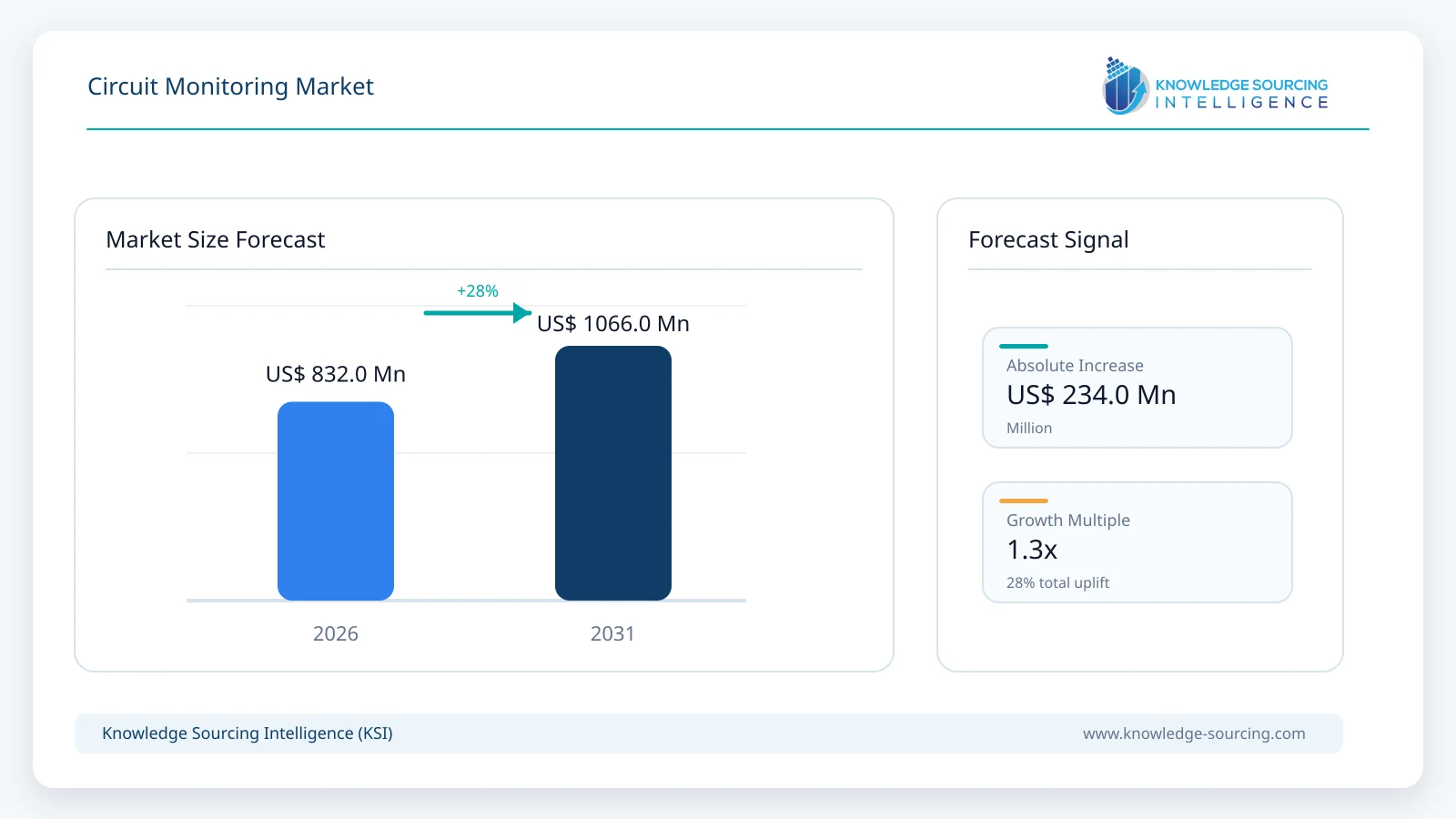
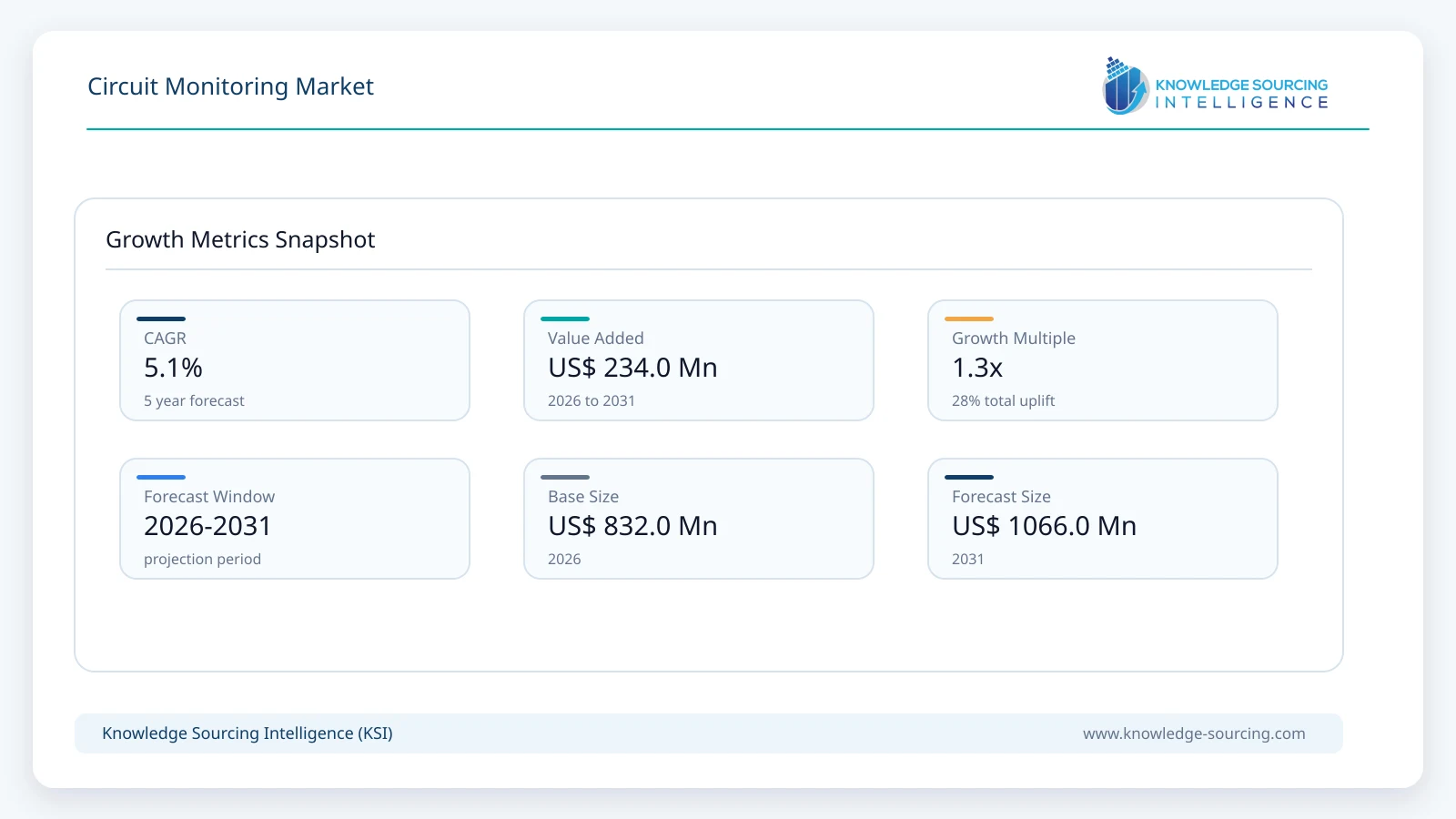
The circuit monitoring market is forecast to grow at a CAGR of 5.1%, reaching USD 1,066.0 million in 2031 from USD 832.0 million in 2026.
Highlights:
- 1Industries are increasingly deploying circuit monitoring systems to improve electrical safety and prevent unexpected equipment failures.
- 2Facility managers are integrating real-time monitoring technologies to track circuit performance and detect abnormalities.
- 3Manufacturers are adopting intelligent circuit monitoring solutions to optimize energy consumption and operational efficiency.
- 4Businesses are implementing remote monitoring capabilities to strengthen predictive maintenance and minimize electrical downtime.
The circuit monitoring market is gaining momentum as electricity consumption increases across data centers, commercial buildings, industrial facilities, and residential infrastructure. Circuit monitoring systems measure electrical parameters at individual branch circuits or multiple distribution points, helping facility operators understand power consumption, identify abnormal loads, and improve the management of electrical distribution networks. Depending on the configuration, these systems monitor current, voltage, power, energy consumption, and other electrical characteristics across alternating current (AC) and direct current (DC) applications.
Unlike conventional electrical metering, which generally measures consumption at a primary distribution point, branch circuit monitoring provides more granular visibility into the electricity used by individual circuits or connected equipment. This capability is particularly important in facilities containing multiple electrical loads, including server racks, manufacturing machinery, heating and cooling systems, lighting networks, and electric vehicle charging infrastructure. By identifying uneven load distribution and unusual consumption patterns, circuit monitoring supports preventive maintenance, electrical capacity planning, and energy efficiency initiatives.
Increasing electricity demand, the expansion of digital infrastructure, and the modernization of electrical distribution systems are creating favorable conditions for market development. The U.S. Energy Information Administration (EIA), in its January 2026 Short-Term Energy Outlook, forecast that U.S. electricity consumption would increase by 1% in 2026 and 3% in 2027, with growing demand from large computing facilities identified as a major factor. These projections highlight the need for more detailed electrical measurement and load management as utilities and building operators accommodate changing consumption patterns.
At the same time, increasing deployment of renewable energy systems, distributed generation, battery energy storage, and electric vehicle charging equipment is changing the requirements of building-level power distribution. Circuit monitoring can help operators measure consumption across connected loads, evaluate the effects of new equipment, and identify circuits approaching their operating limits. However, monitoring equipment alone does not guarantee electrical safety or prevent all power failures. Its effectiveness depends on appropriate installation, suitable protection devices, accurate measurements, and integration with the wider electrical management system.
Circuit Monitoring Market Growth Drivers:
Growing residential electrification and building modernization are supporting demand for circuit monitoring.
Residential construction and the electrification of household equipment are creating opportunities for circuit monitoring solutions. Modern homes increasingly accommodate high-demand electrical appliances, heat pumps, electric vehicle chargers, distributed solar generation, battery storage, and smart home systems. These additions can increase the complexity of household electricity consumption and place greater demands on existing distribution panels. Circuit-level monitoring helps homeowners, electrical contractors, and facility managers understand how individual loads contribute to total consumption and whether additional electrical capacity or load management may be required.
The opportunity extends beyond newly constructed homes. Existing residential buildings may require electrical upgrades as consumers replace conventional appliances with electric alternatives or install home charging infrastructure. Retrofitting compatible monitoring devices into electrical distribution panels can provide more detailed consumption information without requiring a complete replacement of the electrical installation. This approach can be attractive to property owners seeking to improve energy visibility while managing renovation costs.
Government construction statistics provide useful context for this demand. According to the U.S. Census Bureau's Monthly Construction Spending release published on October 1, 2026, residential construction spending in August 2026 was estimated at a seasonally adjusted annual rate of USD 882.3 billion, up 1.1% from the revised July estimate of USD 872.7 billion. This figure measures the annualized rate of construction spending rather than the number of homes completed, and it should not be interpreted as direct evidence of circuit monitoring sales.
Nevertheless, residential construction and electrical renovation create potential installation opportunities for smart distribution equipment. As homeowners adopt more electrically intensive technologies, monitoring can provide useful information about circuit utilization, peak demand, and the operation of connected appliances. Demand will depend on the cost of monitoring devices, the complexity of the electrical installation, consumer awareness, and the availability of compatible home energy management systems.
Developments in residential electrical management are also supporting this trend. On January 13, 2026, ABB announced the launch of ReliaHome Flex, a modular residential energy management system designed to help homeowners add high-demand appliances without costly service upgrades. The company stated that its associated application provides real-time visibility, customizable automations, and control of connected circuits. Although the product is not equivalent to a dedicated multichannel branch circuit monitoring system, its introduction illustrates the wider shift toward circuit-level visibility and managed household electrification.
Data center expansion and increasing electricity demand are strengthening the need for granular power measurement.
Data centers represent an important application area for circuit monitoring because they operate large numbers of servers, storage systems, networking equipment, cooling units, and auxiliary electrical loads. Operators must understand how power is distributed across server racks, power distribution units, uninterruptible power supply systems, and other critical equipment. Branch circuit monitoring provides visibility into current consumption and available electrical capacity, supporting rack-level planning and helping operators identify circuits that may be approaching their rated limits.
As data centers expand to support cloud computing, artificial intelligence, digital services, and enterprise applications, electrical capacity planning has become increasingly important. AI infrastructure can introduce high-density loads and rapidly changing power demand. In these environments, monitoring data can help operators evaluate consumption patterns, detect unexpected load changes, and make better-informed decisions about equipment deployment and infrastructure utilization. These capabilities are particularly relevant where maintaining service availability is a priority.
The EIA's May 19, 2026 analysis, Data center server energy use grows across the commercial building stock, projects that electricity consumption by data center servers will increase substantially over the long term. In its Annual Energy Outlook 2026 scenarios, the agency estimated that server electricity consumption across the commercial building stock could reach between 446 billion and 818 billion kilowatt-hours by 2050. The upper end reflects the agency's high-electricity-demand case rather than a single-point forecast.
These projections reinforce the importance of managing electrical infrastructure as digital facilities grow. However, server electricity consumption is not the same as total data center electricity demand, which also includes cooling, power conversion, and other facility operations. Nor does rising electricity consumption translate directly into a specific increase in circuit monitoring revenue. Instead, it creates a broader operational requirement for accurate electrical measurement, capacity visibility, and coordinated power management.
In addition, operators increasingly need monitoring systems that communicate with building management platforms, data center infrastructure management software, and supervisory control systems. Solutions supporting established communication protocols can help integrate branch-level measurements with existing operational tools. As a result, suppliers offering scalable sensors, compact measurement units, remote data access, and reliable communications may be better positioned to serve new and upgraded data center facilities.
Industrial automation and commercial building investments are creating further installation opportunities.
Industrial facilities depend on reliable electrical distribution to support motors, production lines, automated machinery, control panels, and process equipment. An electrical fault or unexpected interruption can affect production schedules, equipment availability, and operating costs. Circuit monitoring helps maintenance teams identify changes in current consumption, evaluate the distribution of electrical loads, and investigate potential abnormalities before they develop into more disruptive operational problems.
Manufacturers are also adopting more connected equipment and digital maintenance practices. When circuit-level measurements are integrated with industrial control or asset management platforms, operators can compare electrical consumption across production areas and identify equipment operating outside expected conditions. Monitoring information can contribute to maintenance investigations, although it should be combined with suitable diagnostic methods rather than treated as a standalone predictor of every electrical or mechanical failure.
Commercial buildings present a similar opportunity. Offices, hospitals, hotels, shopping centers, educational institutions, and large public facilities operate diverse electrical loads, including lighting, elevators, ventilation, refrigeration, and information technology equipment. Circuit monitoring can help building managers distinguish consumption by area or equipment group, evaluate demand during different operating periods, and identify avoidable energy use. The resulting information can support energy audits, equipment scheduling, and building modernization projects.
Official construction data demonstrate the scale of investment in infrastructure where electrical monitoring may be deployed. The U.S. Census Bureau reported that total construction spending in August 2026 was estimated at a seasonally adjusted annual rate of USD 2,203.1 billion. Within this total, nonresidential construction spending was estimated at USD 773.0 billion, while residential construction spending reached USD 882.3 billion. These are broad construction indicators rather than measurements of spending on electrical equipment, but they provide context for the scale of the built environment requiring electrical distribution and management.
Commercial and industrial customers are also under pressure to manage electricity costs and improve operational efficiency. Circuit monitoring provides a measurement layer that can help identify where energy is being consumed and whether particular loads are operating as expected. Adoption, however, will depend on project economics, the age of existing infrastructure, the cost of installation, and whether facility operators can use the resulting information to support measurable operational improvements.
Circuit Monitoring Market Restraints:
Installation costs and integration complexity can limit adoption, particularly in smaller facilities.
The initial cost of circuit monitoring equipment can be a barrier for organizations with limited budgets or relatively simple electrical installations. A complete deployment may require current sensors, measurement units, communication gateways, software, wiring, commissioning, and integration with existing electrical distribution systems. The total project cost depends on the number of circuits monitored, the measurement requirements, the installation environment, and the level of software functionality required.
Retrofitting monitoring devices into operational facilities may also require careful planning to minimize disruption. Electrical panels can have limited space, and existing equipment may not support straightforward integration with modern monitoring systems. In some installations, customers must coordinate with electrical contractors, facility engineers, and information technology teams to ensure correct configuration and secure communication. These requirements can increase deployment time and reduce the attractiveness of monitoring for smaller buildings or low-priority circuits.
Interoperability is another consideration. Monitoring devices from different suppliers may use different communication protocols, data formats, or management interfaces. Although widely used protocols can simplify integration, compatibility still needs to be confirmed for the intended application. Buyers must also assess cybersecurity, access controls, software maintenance, and the long-term availability of replacement components.
Furthermore, monitoring equipment should not be confused with protective devices. A monitoring sensor can report an abnormal current, but it does not necessarily interrupt the circuit. Effective electrical protection requires appropriately rated breakers, fuses, residual-current protection where applicable, and installation practices that comply with relevant codes and standards. The need to combine measurement with suitable protection can increase the complexity of system selection and deployment.
To address these challenges, suppliers are developing compact sensors, modular measurement units, and systems designed for integration with existing switchboards. Simplified installation, remote configuration, clear reporting, and compatibility with established communication standards can help reduce engineering effort. Nevertheless, customers must evaluate total cost of ownership, including installation, software, maintenance, and the practical value of the data collected.
Data quality, cybersecurity, and limited technical expertise remain operational challenges.
Circuit monitoring systems depend on accurate measurements and appropriate configuration. Incorrect sensor placement, unsuitable measurement ranges, communication failures, or inconsistent calibration can reduce the usefulness of collected data. Facility operators must also understand the distinction between current, power, energy consumption, and power quality measurements to avoid drawing incorrect conclusions from monitoring dashboards.
Cybersecurity becomes more important when monitoring devices are connected to enterprise networks or remotely accessible management platforms. Unauthorized access to electrical monitoring systems could expose operational information or create a pathway into connected infrastructure if devices are inadequately secured. Organizations should therefore consider network segmentation, secure authentication, software updates, encrypted communications where supported, and access permissions during procurement and implementation.
Small and medium-sized businesses may also lack specialist staff to interpret circuit-level information. Monitoring systems deliver greater value when measurements are linked to operational decisions, such as investigating persistent loads, evaluating equipment schedules, or planning electrical upgrades. Suppliers that provide clear interfaces, technical support, and actionable reporting can help customers overcome these barriers.
Circuit Monitoring Market Segmentation Analysis:
Branch and multi-circuit monitoring is expected to remain an important segment as facilities seek more detailed electrical visibility.
By type, the circuit monitoring market is segmented into modular monitoring and branch and multi-circuit monitoring. These categories serve related but distinct requirements, and their suitability depends on the number of circuits, the available panel space, the desired measurement detail, and the need to integrate monitoring with existing infrastructure.
Branch and multi-circuit monitoring provides measurements across several individual electrical branches through a shared monitoring architecture. Depending on the system design, multiple current sensors connect to one or more measurement units, allowing operators to collect circuit-level data without deploying a separate standalone meter for every load. This architecture can be useful in data centers, commercial buildings, industrial control panels, and power distribution systems where many circuits must be monitored within a limited space.
One of the principal advantages of this segment is the ability to compare consumption across different circuits. For example, data center operators can examine power demand across server racks, while building managers can evaluate electricity consumption across lighting, ventilation, and other electrical loads. Industrial users can also investigate differences in consumption between production areas or equipment groups. Such information supports capacity planning, energy management, and the identification of unusual load patterns.
Branch monitoring is particularly relevant to installations where panel density and scalability matter. A multichannel system can simplify the collection of measurements across numerous circuits, provided the system's sensor capacity, accuracy, and communication architecture match the application. The ability to expand monitoring coverage over time may also benefit facilities that add equipment in stages.
However, the segment's growth depends on more than the number of circuits monitored. Buyers must consider sensor compatibility, measurement accuracy, electrical isolation, installation requirements, data resolution, and communication reliability. High-density monitoring can provide substantial operational visibility, but it also creates a larger volume of data that must be organized and interpreted effectively. Accordingly, suppliers that combine scalable hardware with practical software tools may have an advantage in complex installations.
Modular monitoring offers a flexible approach for installations that require monitoring capacity to be configured or expanded according to specific needs. Modular architectures can accommodate different measurement requirements and may be suitable for facilities that expect gradual expansion or need to integrate monitoring into existing electrical panels. The benefits depend on the product design, including how modules connect, how data is communicated, and whether additional components can be installed without major changes to the wider system.
Modular solutions may appeal to industrial customers and building operators who want to begin with a limited number of monitored circuits before expanding coverage. They can also help system integrators match equipment to different project sizes. Nevertheless, the most suitable configuration depends on total installation costs, channel capacity, future expansion needs, and compatibility with the customer's electrical infrastructure.
Circuit Monitoring Market Geographical Outlook:
North America is expected to maintain a significant position, supported by data center investment and electrical infrastructure modernization.
North America represents an important regional market for circuit monitoring because of its established data center industry, large commercial building stock, industrial base, and continued investment in electrical infrastructure. The United States is particularly relevant because the expansion of cloud computing, artificial intelligence infrastructure, advanced manufacturing, and building electrification is increasing the importance of reliable electrical distribution and detailed load management.
Government energy forecasts reinforce this demand context. In its January 2026 outlook, the U.S. Energy Information Administration identified increasing electricity use by large computing facilities as a major contributor to the expected growth in national electricity consumption. Its subsequent May 2026 analysis examined the potential long-term increase in data center server electricity use. Together, these reports highlight the importance of understanding electrical loads as computing infrastructure expands.
The region's large installed base of commercial and industrial buildings also creates opportunities for retrofitting monitoring systems. Existing facilities may need better circuit-level visibility as they install additional servers, upgrade cooling equipment, add electric vehicle charging, or integrate on-site energy storage. Modular monitoring systems can be particularly relevant where operators want to improve visibility without completely replacing existing distribution infrastructure.
Canada also provides opportunities through commercial construction, industrial investment, and infrastructure modernization. However, regional growth is subject to differences in construction activity, electricity prices, building regulations, and the economics of monitoring installations. A growing market for data center capacity does not automatically result in equivalent growth in monitoring hardware, since the degree of adoption varies across operators and projects.
Competition in North America includes established electrical equipment suppliers and specialist monitoring providers. Companies such as ABB, Siemens, Eaton, and other electrical technology manufacturers offer products across adjacent categories, including power measurement, circuit protection, energy management, and electrical distribution. Product availability, system compatibility, technical support, and integration capabilities are important competitive considerations.
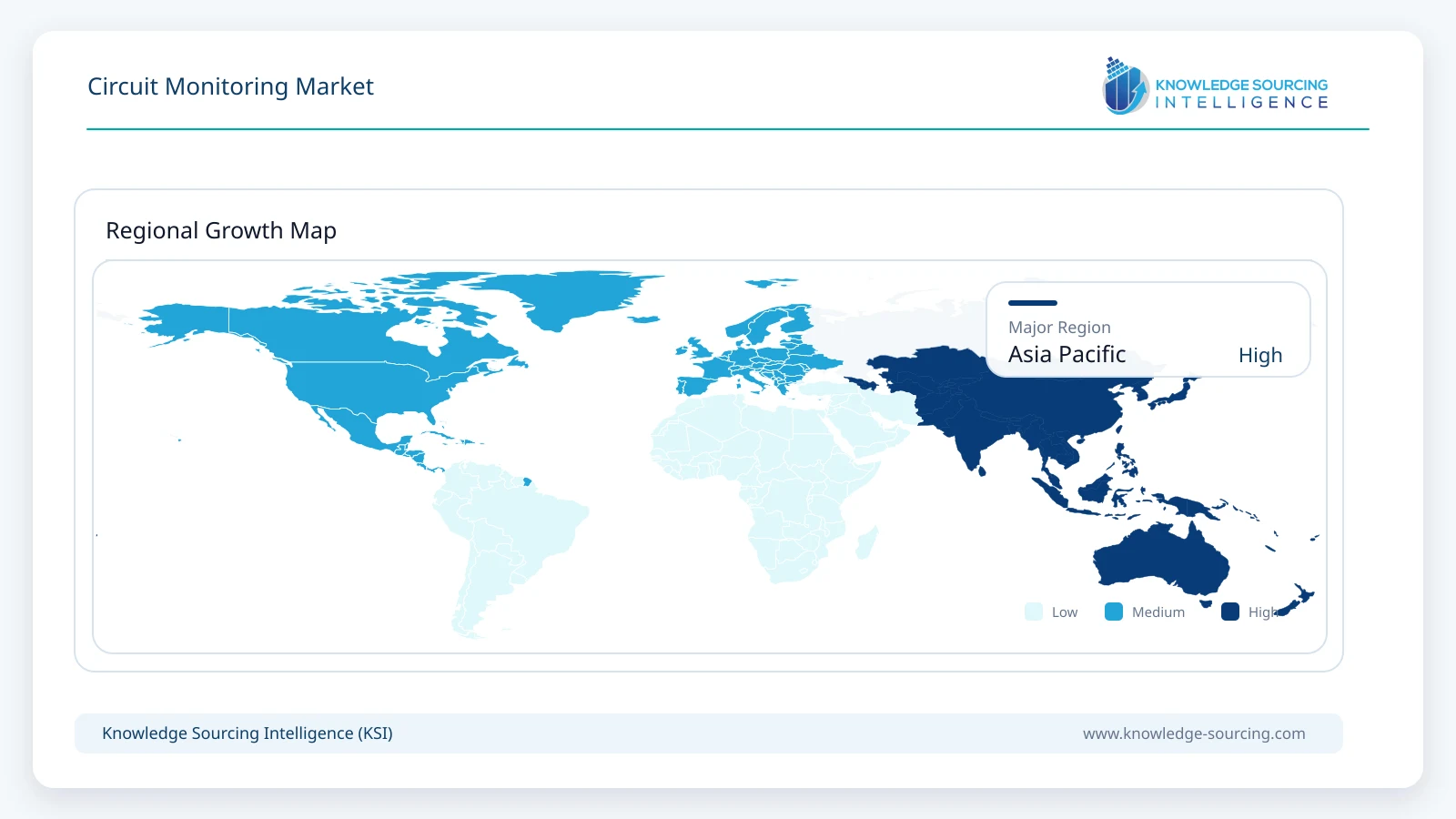
Asia Pacific offers growth opportunities through industrial expansion, electrification, and data center development.
Asia Pacific is positioned to benefit from continued industrial development, urbanization, digital infrastructure investment, and the modernization of electrical distribution networks. China, India, Japan, South Korea, and other regional economies have substantial manufacturing activities and growing requirements for reliable power distribution across commercial and industrial facilities.
Industrial automation is an important demand factor. Manufacturing plants increasingly depend on connected machinery, automated production systems, and digital monitoring tools to improve operational visibility. Circuit monitoring can support these efforts by measuring electrical loads across equipment groups and helping maintenance teams investigate abnormal consumption patterns. The scale of the opportunity varies according to industrial investment, the complexity of production facilities, and the level of digital adoption.
Data center development also creates opportunities in major digital infrastructure markets across the region. As operators add server capacity and supporting electrical infrastructure, branch circuit monitoring can help evaluate power distribution and available capacity. The relevance of monitoring is particularly high in facilities that require detailed visibility across multiple power distribution points.
At the same time, renewable energy deployment and building electrification are changing the requirements of electrical systems. Facilities integrating solar generation, energy storage, and electric vehicle charging may need additional measurements to understand the behavior of connected loads. Monitoring solutions that support AC and DC applications and integrate with broader energy management platforms may therefore find opportunities in selected installations.
Europe represents another important market, supported by industrial automation, energy efficiency priorities, and efforts to modernize electricity networks. On June 2, 2025, the European Commission published guidance on anticipatory investments in electricity grids, citing estimated requirements of EUR 730 billion for distribution networks and EUR 477 billion for transmission networks by 2040. These figures relate to wider grid development requirements, not to circuit monitoring expenditure, but they demonstrate the scale of planned electricity infrastructure needs.
In South America, the Middle East, and Africa, market opportunities may emerge from commercial construction, industrial development, utility modernization, and new digital infrastructure. However, adoption can vary substantially with project financing, local technical requirements, access to skilled installers, and the availability of supporting infrastructure. Across all regions, demand will depend on the practical benefits of circuit monitoring rather than electricity consumption alone.
Circuit Monitoring Market Key Developments:
May 2026: ABB Romania introduced the SACE Emax 3 air circuit breaker, featuring advanced sensing, real-time analytics, and predictive maintenance capabilities for data centers, industrial plants, hospitals, and other critical facilities.
March 2026: Siemens announced enhancements to its SENTRON Electronic Circuit Protection Device, including planned integrated residual current monitoring, strengthening its roadmap for digitally monitored electrical protection in demanding applications.
January 2026: ABB launched ReliaHome Flex, a modular residential energy management system providing real-time circuit visibility and customizable controls for homeowners adding high-demand electrical appliances.
These developments illustrate the wider convergence of circuit protection, electrical measurement, digital monitoring, and energy management. They should not all be interpreted as launches of dedicated branch circuit monitoring products. Rather, they demonstrate how suppliers are incorporating measurement, diagnostics, and connected functionality into the broader electrical distribution ecosystem.
Circuit Monitoring Market Competitive Landscape:
The circuit monitoring market includes established electrical equipment manufacturers and specialized providers of monitoring hardware and software. Competition is shaped by measurement accuracy, sensor density, installation flexibility, electrical safety, communication capabilities, software integration, and lifecycle support. Suppliers that can deliver reliable measurements while simplifying installation and data interpretation may be better positioned to address complex commercial, industrial, and critical power applications.
ABB offers a dedicated Circuit Monitoring System designed for AC and DC branch monitoring in distribution panels and critical power applications. According to the company's product information, the system supports up to 96 sensors per bus interface and includes communication options such as Modbus RTU, Modbus TCP, and SNMP. These features are relevant to installations that require multiple circuit measurements and integration with facility management systems.
Siemens competes across circuit protection and connected electrical distribution. Its March 2026 announcement concerning the SENTRON Electronic Circuit Protection Device highlighted plans to introduce integrated residual current monitoring functionality. Such developments show the increasing overlap between protection devices and digital monitoring capabilities, particularly in applications where early identification of electrical abnormalities is important.
Eaton and other established electrical technology providers participate in adjacent areas such as power distribution, energy measurement, circuit protection, and power management. Specialist monitoring suppliers also serve customers that require compact sensors, high channel counts, or application-specific monitoring systems. Competitive differentiation increasingly depends on the ability to integrate hardware, communications, software, and technical support into a practical solution.
For buyers, the selection process should consider the intended electrical application, the number of circuits to be monitored, measurement accuracy, supported communication protocols, cybersecurity, installation requirements, and the availability of maintenance services. A system designed for a data center may have different requirements from a residential energy management installation or an industrial control panel. Consequently, no single monitoring architecture is suitable for every application.
Circuit Monitoring Market Outlook:
The circuit monitoring market is expected to benefit from rising electricity demand, digital infrastructure expansion, industrial automation, and the electrification of buildings and transportation. The increasing complexity of electrical distribution systems is creating a stronger need for circuit-level measurements that help operators understand consumption, assess available capacity, and investigate abnormal electrical behavior.
Data centers and other critical power facilities are likely to remain important applications because they require detailed visibility across multiple distribution points. Commercial and industrial facilities also offer opportunities as operators modernize electrical infrastructure and integrate monitoring into energy management and maintenance processes. Residential applications may expand as electric vehicle charging, heat pumps, distributed generation, and home energy management systems become more common.
However, market adoption will depend on equipment affordability, compatibility with existing installations, measurement reliability, cybersecurity, and the ability to convert monitoring data into operational improvements. Monitoring should also be distinguished from electrical protection: reliable installations require appropriate protective devices, qualified installation practices, and compliance with applicable standards.
Overall, the market's longer-term prospects are supported by the growing importance of electrical visibility and efficient power distribution. Suppliers offering scalable monitoring hardware, straightforward integration, and useful diagnostic capabilities are positioned to address evolving customer requirements across residential, commercial, industrial, and critical power environments.
Circuit Monitoring Market Scope
| Report Metric | Details |
|---|---|
| Total Market Size in 2026 | USD 832.0 million |
| Total Market Size in 2031 | USD 1,066.0 million |
| Forecast Unit | Million |
| Growth Rate | 5.1% |
| Study Period | 2021 to 2031 |
| Historical Data | 2021 to 2024 |
| Base Year | 2025 |
| Forecast Period | 2026 – 2031 |
| Segmentation | Type, Current, End-Users, Geography |
| Companies |
|
| Customization Scope | 15% Free Customization included with purchase — Request Custom Breakdown → |
| Sample & Data Access | PDF Sample, Excel Databook & Analyst Briefing — Download Free Sample → |
Market Segmentation
By Type
Modular Circuit Monitoring
Branch & Multi-Circuit Monitoring
By Current
AC
DC
By End-Users
Residential
Commercial
Industrial
By Geography
North America
United States
Canada
Mexico
South America
Brazil
Argentina
Others
Europe
United Kingdom
Germany
France
Spain
Others
Middle East and Africa
Saudi Arabia
UAE
Israel
Others
Asia Pacific
Japan
China
India
South Korea
Indonesia
Thailand
Others
Table of Contents
1. INTRODUCTION
1.1. Market Overview
1.2. Market Definition
1.3. Scope of the Study
1.4. Market Segmentation
1.5. Currency
1.6. Assumptions
1.7. Base and Forecast Years Timeline
1.8. Key benefits for the stakeholders
2. RESEARCH METHODOLOGY
2.1. Research Design
2.2. Research Process
3. EXECUTIVE SUMMARY
3.1. Key Findings
4. MARKET DYNAMICS
4.1. Market Drivers
4.2. Market Restraints
4.3. Porter’s Five Forces Analysis
4.3.1. Bargaining Power of Suppliers
4.3.2. Bargaining Power of Buyers
4.3.3. The Threat of New Entrants
4.3.4. Threat of Substitutes
4.3.5. Competitive Rivalry in the Industry
4.4. Industry Value Chain Analysis
4.5. Analyst View
5. CIRCUIT MONITORING MARKET BY TYPE
5.1. Introduction
5.2. Modular Circuit Monitoring
5.3. Branch & Multi-Circuit Monitoring
6. CIRCUIT MONITORING MARKET BY CURRENT
6.1. Introduction
6.2. AC
6.3. DC
7. CIRCUIT MONITORING MARKET BY END-USERS
7.1. Introduction
7.2. Residential
7.3. Commercial
7.4. Industrial
8. CIRCUIT MONITORING MARKET BY GEOGRAPHY
8.1. Introduction
8.2. North America
8.2.1. By Type
8.2.2. By End-Users
8.2.3. By Country
8.2.3.1. United States
8.2.3.2. Canada
8.2.3.3. Mexico
8.3. South America
8.3.1. By Type
8.3.2. By End-Users
8.3.3. By Country
8.3.3.1. Brazil
8.3.3.2. Argentina
8.3.3.3. Others
8.4. Europe
8.4.1. By Type
8.4.2. By End-Users
8.4.3. By Country
8.4.3.1. United Kingdom
8.4.3.2. Germany
8.4.3.3. France
8.4.3.4. Spain
8.4.3.5. Others
8.5. Middle East and Africa
8.5.1. By Type
8.5.2. By End-Users
8.5.3. By Country
8.5.3.1. Saudi Arabia
8.5.3.2. UAE
8.5.3.3. Israel
8.5.3.4. Others
8.6. Asia Pacific
8.6.1. By Type
8.6.2. By End-Users
8.6.3. By Country
8.6.3.1. Japan
8.6.3.2. China
8.6.3.3. India
8.6.3.4. South Korea
8.6.3.5. Indonesia
8.6.3.6. Thailand
8.6.3.7. Others
9. COMPETITIVE ENVIRONMENT AND ANALYSIS
9.1. Major Players and Strategy Analysis
9.2. Market Share Analysis
9.3. Mergers, Acquisitions, Agreements, and Collaborations
9.4. Competitive Dashboard
10. COMPANY PROFILES
10.1. ABB
10.2. GE
10.3. Senva Inc
10.4. Schneider Electric
10.5. MPL Technology Group
10.6. Omron
10.7. Bay Power Inc.
10.8. Toshiba
10.9. Eaton Corporation
10.10. CircuitMeter Inc.





Frequently asked questions
What is the forecasted market value for circuit monitoring in 2031?
The Circuit Monitoring Market is projected to reach USD 1,066.0 million by 2031.
What is the compound annual growth rate (CAGR) for this market?
The Circuit Monitoring Market is forecast to grow at a 5.1% CAGR.
What are the primary growth drivers for the Circuit Monitoring Market?
Increasing electricity demand, digital infrastructure, and electrical system modernization drive growth.
What types of facilities benefit most from circuit monitoring systems?
Data centers, commercial, industrial, and residential facilities benefit significantly.
What key electrical parameters do these systems monitor?
Systems monitor current, voltage, power, and energy consumption.
What specific U.S. trend impacts market demand?
U.S. electricity consumption growth, especially from large computing facilities, boosts demand.
Cite this report
Knowledge Sourcing Intelligence. (Oct 2026). Circuit Monitoring Market - Strategic Insights and Forecasts (2026-2031). https://www.knowledge-sourcing.com/report/circuit-monitoring-market