
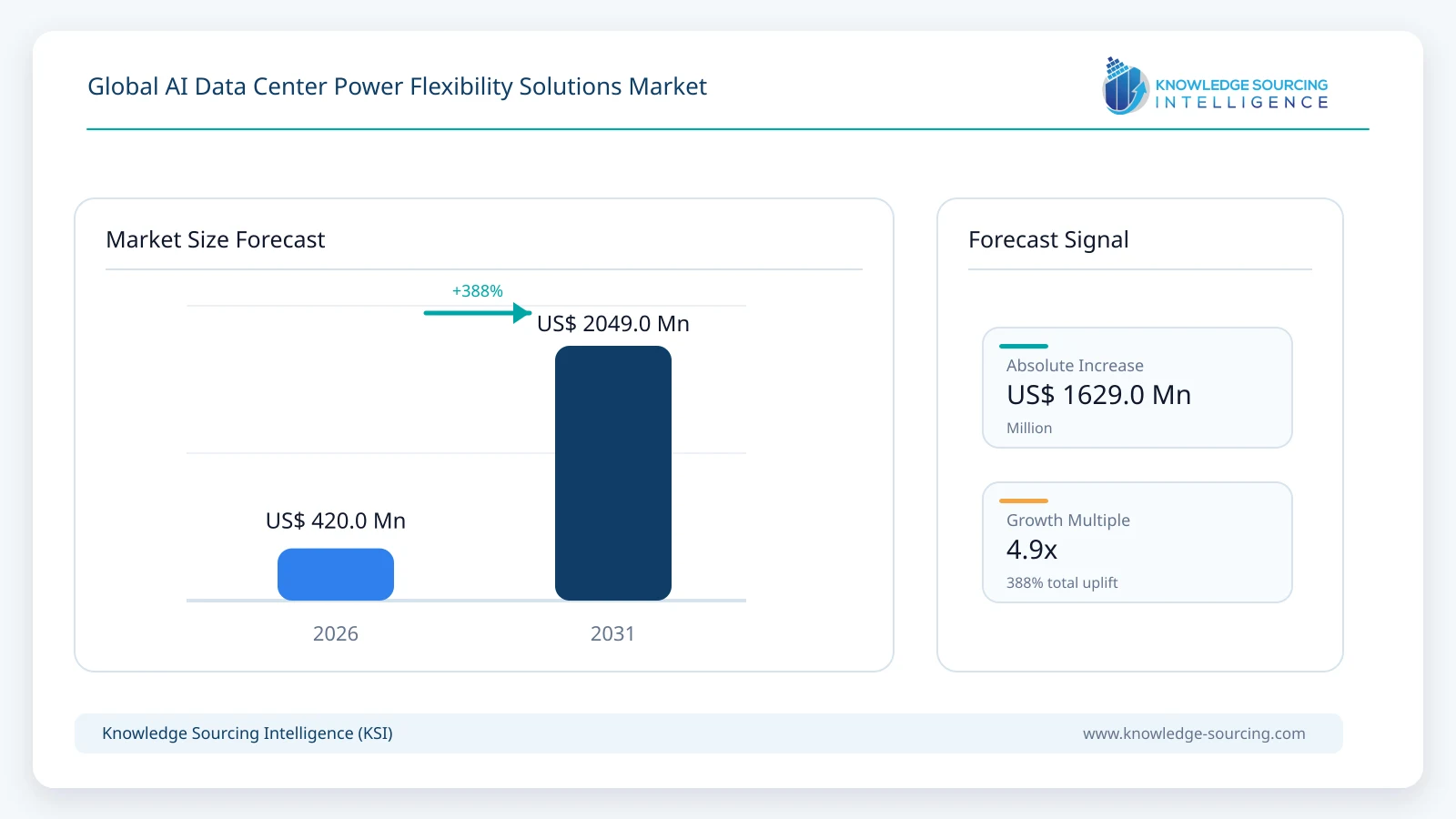
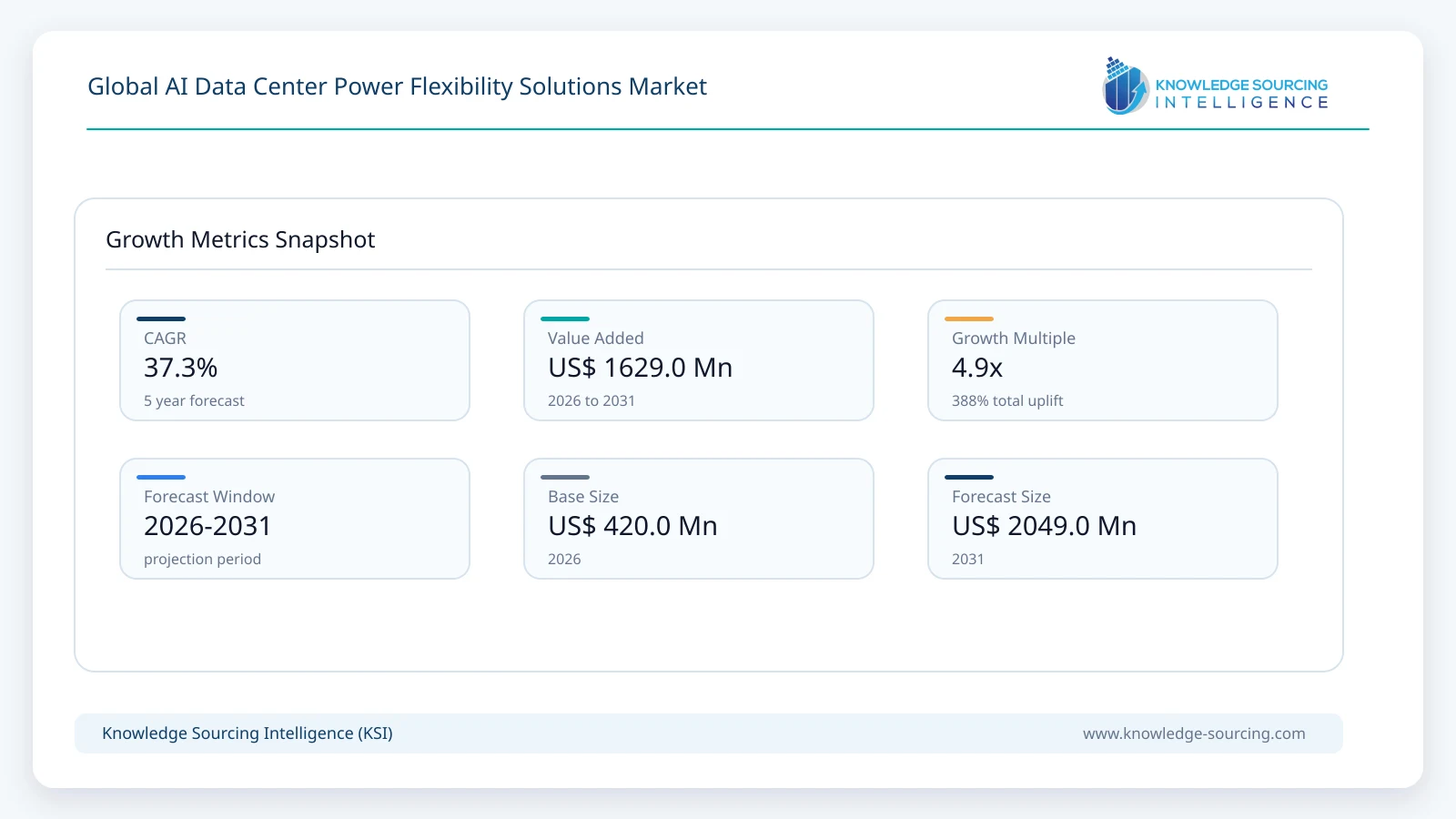
The global AI data center power flexibility solutions market is expected to grow from USD 420.0 million in 2026 to USD 2,049 million by 2031, at a CAGR of 37.3% throughout the forecast period.
Highlights:
- 1Google reached 1 GW of contracted data-center demand response across multiple U.S. utility partnerships in March 2026.
- 2AI workloads create an unusually flexible load class because selected training and batch jobs can be delayed, shifted or geographically reassigned.
- 3A UK demonstration reduced a 96-GPU NVIDIA Blackwell Ultra cluster's electricity demand by more than one-third in under a minute.
- 4Power flexibility can improve grid utilization and help data centers secure capacity where conventional interconnection timelines are constrained.
- 5The AI Energy Management Alliance launched in September 2026 to develop interoperable approaches for grid-responsive AI data centers.
- 6Flexible interconnection models are becoming an alternative to treating every new data center as an inflexible round-the-clock peak load.
- 7Existing UPS and battery capacity can support flexibility when coordinated with workload orchestration, reducing the need for dedicated new storage.
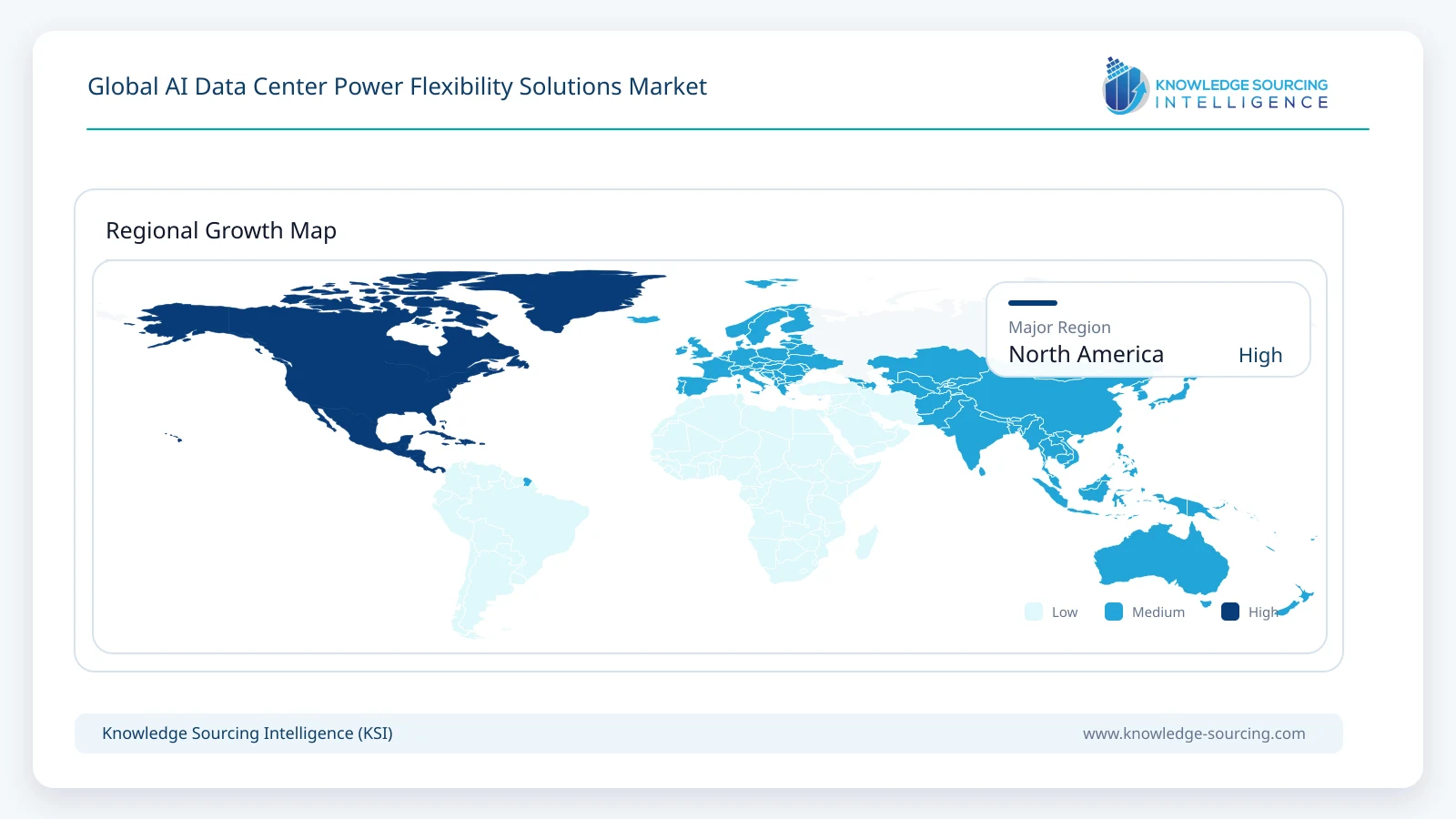
- 8North America leads early commercialization because hyperscale AI expansion and grid-connection constraints are developing simultaneously.
Data center electrical systems have traditionally been designed around reliability: the facility requests a defined amount of grid capacity and its computing workload is treated as largely inflexible. AI changes that assumption because not every computational task has the same urgency. Real-time inference and latency-sensitive customer services may require uninterrupted processing, while model training, batch inference, data preprocessing and checkpointing can offer varying degrees of timing or location flexibility.
Power-flexibility software maps those workload characteristics against grid conditions and facility constraints. When a utility or system operator requests a reduction, the control layer can slow or defer eligible jobs, cap accelerator power, move workloads to another site, use available battery capacity or combine several actions. The system must preserve service-level agreements and protect model-training progress while delivering a measurable power response to the grid.
The commercial opportunity is distinct from conventional data center energy management. Energy-management platforms primarily monitor and optimize internal electricity consumption, cooling and power usage effectiveness. Power-flexibility solutions are outward-facing: their value is the ability to change the facility's grid demand at a requested time, quantify the response and participate in planning, demand-response or flexible-interconnection arrangements.
Power Flexibility Capability Comparison
Capability | Primary Control Action | Typical Response Window | Grid / Operator Value |
Workload-Aware Demand Response | Delay, slow or pause eligible AI jobs | Seconds to hours | Reduces peak demand without interrupting critical workloads |
GPU / Cluster Power Capping | Lower accelerator or cluster power draw | Seconds to minutes | Provides rapid, measurable load reduction |
Temporal Workload Shifting | Move flexible jobs to lower-stress hours | Hours | Shifts energy away from grid peaks and constrained periods |
Geographical Workload Shifting | Move compute to another data-center region | Minutes to hours | Relieves local grid congestion while preserving computing output |
UPS / BESS Coordination | Temporarily serve load from onsite stored energy | Milliseconds to hours | Reduces grid draw and supports rapid grid events |
Flexible Interconnection Control | Operate within dynamic power limits from utility or grid operator | Continuous | Can accelerate connection where firm grid capacity is limited |
Market Dynamics
Grid Connection Constraints Are Turning Flexibility into a Capacity Solution
The International Energy Agency reported in 2026 that more than 2,500 GW of generation, storage and large-load projects are stalled in grid-connection queues globally. Data centers are part of this pressure because their demand is geographically concentrated and can require hundreds of megawatts at individual campuses. Treating all requested capacity as an inflexible peak requirement can trigger expensive transmission, generation and substation upgrades. Flexible connection models create an alternative in which a data center agrees to reduce consumption during a limited number of stressed hours.
AI Workloads Provide More Controllable Demand Than Conventional Data Center Loads
Machine-learning workloads are computationally intensive but not uniformly time-critical. Google has demonstrated that portions of its machine-learning demand can be shifted or limited for demand response. Emerald AI's demonstrations go further by coordinating GPU workloads and power telemetry to meet requested reduction targets while maintaining service-level constraints. This makes AI computing unusually suitable for software-controlled demand flexibility compared with industrial loads that cannot easily pause production.
Utilities Gain a New Tool for Integrating Large Data Center Loads
Demand response can allow utilities to use existing grid assets more efficiently during rare peak periods instead of building all infrastructure around the theoretical maximum simultaneous load. Google's 1 GW milestone shows that flexible demand is moving into long-term utility capacity planning rather than remaining limited to short pilot projects. The company is also a founding member of EPRI's DCFlex initiative, which is developing frameworks for valuing data center demand response as a capacity resource.
Service-Level Requirements Limit the Share of Load That Can Be Flexible
Critical inference, cloud services, storage and networking cannot simply be interrupted during every grid event. The available flexible load therefore depends on workload mix, customer contracts, accelerator utilization, training checkpoints and the ability to move jobs across time or geography. Operators must maintain strict controls around which workloads can respond, how quickly they can recover and how much power reduction can be guaranteed.
Technology Outlook
Grid-Aware Workload Orchestration
The central technology is a scheduling layer that understands both computing requirements and power-system conditions. It classifies jobs by urgency, predicts their electricity requirement and adjusts execution when grid constraints or prices change. Emerald AI's Conductor platform and FlexSysAI's orchestration approach illustrate this emerging category, in which software translates grid instructions into computing actions rather than controlling only traditional facility equipment.
Fast GPU Power Control
AI accelerators can change power consumption rapidly, creating the potential for sub-minute demand response. The March 2026 UK trial reduced consumption of a 96-GPU NVIDIA Blackwell Ultra cluster by more than one-third in under a minute. Fast response can make AI facilities useful for grid services that require more rapid action than conventional load shifting, provided workload performance and thermal conditions remain controlled.
Geographical Compute Flexibility
Cloud and AI infrastructure increasingly operates across multiple regions. Workloads that are not tied to a specific location can be moved toward sites with more available electricity, lower grid stress or lower prices. This capability turns geographical redundancy into an energy-management tool and can complement temporal shifting within a single facility.
Flexible Interconnection and Dynamic Power Limits
Flexible interconnection agreements allow a utility to connect a large customer earlier or at greater capacity if the customer can operate within dynamic limits during constrained conditions. Software must receive utility signals, forecast facility demand and enforce the contracted envelope. This can reduce the risk that an AI project waits years for fully firm transmission or generation upgrades.
Global AI Data Center Power Flexibility Solutions Market Segment Analysis
By Solution
Software is the core commercial layer because workload scheduling, power telemetry, grid-signal processing and response verification require continuous orchestration. Integration services are also important because data center operators must connect computing schedulers with electrical systems, utility interfaces and existing energy-management platforms. Dedicated control hardware is comparatively limited because many power-flexibility functions can use existing servers, controllers, UPS systems and batteries.
By Flexibility Mechanism
Workload shifting offers the strongest differentiation from traditional demand response because the computing task itself can move in time or location. Power capping provides fast reduction without fully stopping jobs, while storage coordination allows a facility to reduce grid demand without reducing computing load. Hybrid implementations combine several mechanisms to increase the amount and duration of response.
By Workload
AI training is well suited to planned temporal flexibility where checkpointing and scheduling can preserve progress. Batch inference and data processing can also be shifted when output deadlines allow. Real-time inference is less flexible because latency commitments are often strict, although geographical routing and stored-energy support can reduce grid demand without interrupting the service.
By Data Center Type
Hyperscale AI facilities are the leading early adopters because their load is large enough to materially affect utility planning and because they operate sophisticated workload orchestration across multiple regions. AI cloud providers and GPU-as-a-service operators represent another important group. Colocation adoption requires coordination between facility-level power controls and customer workloads, making commercial agreements more complex.
By Grid Interaction
Utility demand response is the most mature model, with the data center reducing demand when called by the utility. Flexible interconnection embeds controllability into the connection agreement itself. Wholesale market participation could create additional revenue where regulations allow aggregated load or batteries to provide capacity and ancillary services.
Market and Demand Indicators
Indicator | Latest Development | Market Relevance |
Global data-center electricity use | Gartner forecasts 565 TWh of global data-center electricity consumption in 2026, up 26% year over year. | Rapid load growth increases the value of controllable demand. |
AI share of power use | Gartner expects AI-optimized servers to account for 31% of data-center power consumption in 2026. | Creates a large and fast-growing addressable load base for AI-specific flexibility. |
Contracted demand response | Google reported 1 GW of data-center demand-response capacity under long-term U.S. utility contracts on March 19, 2026. | Demonstrates commercial utility-scale adoption beyond pilots. |
Fast flexibility demonstration | National Grid reported on March 2, 2026 that a 96-GPU cluster cut power by more than one-third in under a minute. | Shows that AI compute can provide rapid grid response while protecting critical workloads. |
Commercial pilot | Silicon Valley Power and Emerald AI launched a flexible-data-center pilot on April 21, 2026 in Santa Clara. | Links flexibility directly to unlocking capacity in a constrained AI data-center hub. |
Industry coordination | Emerald AI, Google and NVIDIA launched the AI Energy Management Alliance on September 16, 2026. | Signals movement toward common technical and commercial frameworks. |
North America Market Analysis
North America leads the emerging market because the United States combines the world's largest concentration of hyperscale AI infrastructure with severe grid-interconnection pressure in several data-center hubs. Google has moved demand response into long-term utility contracts, while Silicon Valley Power is testing flexible operation specifically to unlock additional grid capacity in Santa Clara. Utilities in regions with large AI development pipelines are increasingly considering tariff, planning and connection structures that recognize controllable demand.
The technology ecosystem is also concentrated in the region. Emerald AI, NVIDIA and Google launched the AI Energy Management Alliance in September 2026, and U.S.-based trials have involved EPRI, Oracle Cloud Infrastructure, Digital Realty, PJM Interconnection, Salt River Project and Arizona Public Service. These projects test different flexibility durations and control actions, ranging from fast power reductions to sustained curtailment and workload rescheduling.
The strongest commercial opportunity through 2031 is likely to come from power-constrained markets where flexibility can reduce time to interconnection or avoid expensive incremental grid upgrades. This creates a financial value proposition that can exceed ordinary energy-cost savings. Operators that can demonstrate a reliable, auditable response without violating customer service commitments may gain access to capacity that would otherwise be delayed.
Competitive Landscape
The market is still forming and includes specialist AI power-orchestration developers, cloud operators, demand-response aggregators and data-center infrastructure companies. Emerald AI is an early specialist with a platform designed specifically to convert AI compute into a grid-responsive load. L?D Technologies launched a compute-flexibility platform for AI inference, while FlexSysAI is testing geographical and temporal workload shifting in Australia. Google is developing flexibility internally at hyperscale and also working with utilities and aggregators.
Demand-response providers such as Voltus, CPower and GridBeyond offer grid-market and aggregation capabilities that can complement workload-aware controls. Schneider Electric, Eaton, Siemens, Vertiv and other infrastructure suppliers are positioned to integrate facility power controls, batteries and energy-management systems with compute-side orchestration. Competitive advantage will depend on the ability to prove response reliability, protect service levels, integrate with heterogeneous computing environments and convert flexibility into measurable grid or interconnection value.
Recent Developments
September 2026: Emerald AI, Google and NVIDIA launched the AI Energy Management Alliance to advance grid-responsive data centers that dynamically manage electricity use according to power-system conditions.
September 2026: FlexSysAI, ResetData, CSIRO and the University of Queensland announced an Australian pilot using AI workload orchestration to shift GPU computing across time and location in response to electricity-system conditions.
August 2026: Emerald AI announced a USD 150 million Series A financing to expand its power-flexibility platform for AI data centers.
June 2026: Google and Voltus announced a three-year agreement designed to unlock up to 100 MW of additional capacity in the PJM region through coordinated flexible distributed energy resources.
June 2026: Emerald AI announced its first DSX Flex deployment with NVIDIA and Silicon Valley Power, moving grid-responsive AI infrastructure from demonstration toward commercial deployment.
April 2026: Silicon Valley Power and Emerald AI launched a pilot in Santa Clara to test whether flexible AI data centers can unlock grid capacity while maintaining workload performance.
April 2026: LoD Technologies launched CL?D, a compute-flexibility platform for AI inference designed to align workload execution with real-time grid conditions.
March 2026: Google announced that it had signed 1 GW of data-center demand response across long-term utility agreements in the United States.
March 2026: National Grid, Emerald AI, EPRI, Nebius and NVIDIA reported a UK trial in which a 96-GPU Blackwell Ultra cluster reduced electricity demand by more than one-third in under a minute without disrupting critical workloads.
Global AI Data Center Power Flexibility Solutions Market Scope:
| Report Metric | Details |
|---|---|
| Total Market Size in 2026 | USD 420.0 million |
| Total Market Size in 2031 | USD 2,049 million |
| Forecast Unit | Million |
| Growth Rate | 37.3% |
| Study Period | 2021 to 2031 |
| Historical Data | 2021 to 2024 |
| Base Year | 2025 |
| Forecast Period | 2026 – 2031 |
| Segmentation | Solution, Flexibility Mechanism, Workload, Data Center Type, Grid Interaction, Geography |
| Companies |
|
Market Segmentation
By Solution
Workload and Power Orchestration Software
Grid Integration and Response Software
Control and Telemetry Integration
Consulting and Integration Services
By Flexibility Mechanism
Temporal Workload Shifting
Geographical Workload Shifting
GPU / Cluster Power Capping
UPS / Battery Coordination
Hybrid Flexibility
By Workload
AI Training
Batch Inference
Real-Time Inference
Data Processing and Other Flexible Compute
By Data Center Type
Hyperscale / AI Factory
AI Cloud / GPU-as-a-Service
Colocation
Enterprise and Sovereign AI
By Grid Interaction
Demand Response
Flexible Interconnection
Capacity and Grid Services
Price / Carbon Responsive Operation
By Geography
North America
United States
Canada
South America
Brazil
Chile
Rest of South America
Europe
United Kingdom
Germany
Ireland
Netherlands
Rest of Europe
Middle East and Africa
United Arab Emirates
Saudi Arabia
South Africa
Rest of Middle East and Africa
Asia Pacific
China
Australia
India
Japan
Singapore
Rest of Asia Pacific
Table of Contents
Table of Contents
1. EXECUTIVE SUMMARY
2. MARKET SNAPSHOT
2.1. Market Overview
2.2. Market Segmentation
3. BUSINESS LANDSCAPE
3.1. Market Drivers
3.1.1. Grid Connection Constraints Are Turning Flexibility into a Capacity Solution
3.1.2. AI Workloads Provide More Controllable Demand Than Conventional Data Center Loads
3.1.3. Utilities Gain a New Tool for Integrating Large Data Center Loads
3.2. Market Restraints
3.2.1. Service-Level Requirements Limit the Share of Load That Can Be Flexible
3.3. Market Opportunities
3.4. Porter's Five Forces Analysis
3.5. Industry Value Chain Analysis
3.6. Utility Tariffs, Interconnection and Grid-Market Requirements
4. TECHNOLOGICAL OUTLOOK
4.1. Grid-Aware Workload Orchestration
4.2. Fast GPU Power Control
4.3. Geographical Compute Flexibility
4.4. Flexible Interconnection and Dynamic Power Limits
5. GLOBAL AI DATA CENTER POWER FLEXIBILITY SOLUTIONS MARKET BY SOLUTION
5.1. Workload and Power Orchestration Software
5.2. Grid Integration and Response Software
5.3. Control and Telemetry Integration
5.4. Consulting and Integration Services
6. GLOBAL AI DATA CENTER POWER FLEXIBILITY SOLUTIONS MARKET BY FLEXIBILITY MECHANISM
6.1. Temporal Workload Shifting
6.2. Geographical Workload Shifting
6.3. GPU / Cluster Power Capping
6.4. UPS / Battery Coordination
6.5. Hybrid Flexibility
7. GLOBAL AI DATA CENTER POWER FLEXIBILITY SOLUTIONS MARKET BY WORKLOAD
7.1. AI Training
7.2. Batch Inference
7.3. Real-Time Inference
7.4. Data Processing and Other Flexible Compute
8. GLOBAL AI DATA CENTER POWER FLEXIBILITY SOLUTIONS MARKET BY DATA CENTER TYPE
8.1. Hyperscale / AI Factory
8.2. AI Cloud / GPU-as-a-Service
8.3. Colocation
8.4. Enterprise and Sovereign AI
9. GLOBAL AI DATA CENTER POWER FLEXIBILITY SOLUTIONS MARKET BY GRID INTERACTION
9.1. Demand Response
9.2. Flexible Interconnection
9.3. Capacity and Grid Services
9.4. Price / Carbon Responsive Operation
10. GLOBAL AI DATA CENTER POWER FLEXIBILITY SOLUTIONS MARKET BY GEOGRAPHY
10.1. North America
10.1.1. United States
10.1.2. Canada
10.2. South America
10.2.1. Brazil
10.2.2. Chile
10.2.3. Rest of South America
10.3. Europe
10.3.1. United Kingdom
10.3.2. Germany
10.3.3. Ireland
10.3.4. Netherlands
10.3.5. Rest of Europe
10.4. Middle East and Africa
10.4.1. United Arab Emirates
10.4.2. Saudi Arabia
10.4.3. South Africa
10.4.4. Rest of Middle East and Africa
10.5. Asia Pacific
10.5.1. China
10.5.2. Australia
10.5.3. India
10.5.4. Japan
10.5.5. Singapore
10.5.6. Rest of Asia Pacific
11. COMPETITIVE ENVIRONMENT AND ANALYSIS
11.1. Major Players and Strategy Analysis
11.2. Emerging Platform Landscape
11.3. Utility and Data Center Partnerships
11.4. Competitive Dashboard
12. COMPANY PROFILES
12.1. Emerald AI
12.2. Google LLC
12.3. NVIDIA Corporation
12.4. L?D Technologies
12.5. FlexSysAI
12.6. Voltus, Inc.
12.7. GridBeyond Limited
12.8. CPower Energy Management
12.9. Schneider Electric SE
12.10. Eaton Corporation plc
12.11. Siemens AG
12.12. Vertiv Holdings Co.
12.13. Digital Realty Trust, Inc.
12.14. Nebius Group N.V.
12.15. Oracle Corporation
12.16. Microsoft Corporation
12.17. Amazon Web Services, Inc.
12.18. Equinix, Inc.
13. RECENT DEVELOPMENTS
14. APPENDIX
14.1. Currency
14.2. Assumptions
14.3. Base and Forecast Years Timeline
14.4. Abbreviations
Navigate
Trusted by the world's leading organizations











