
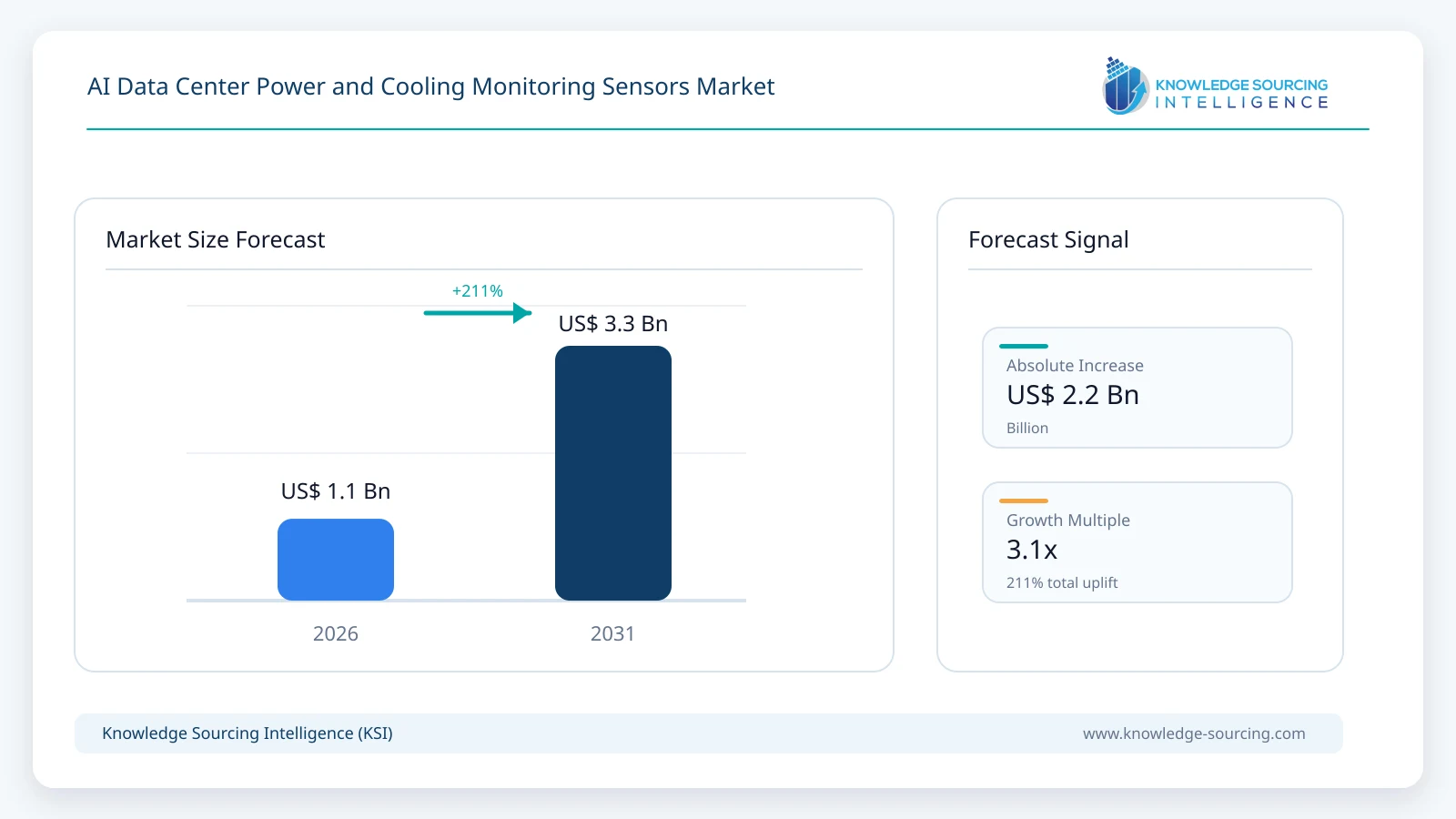
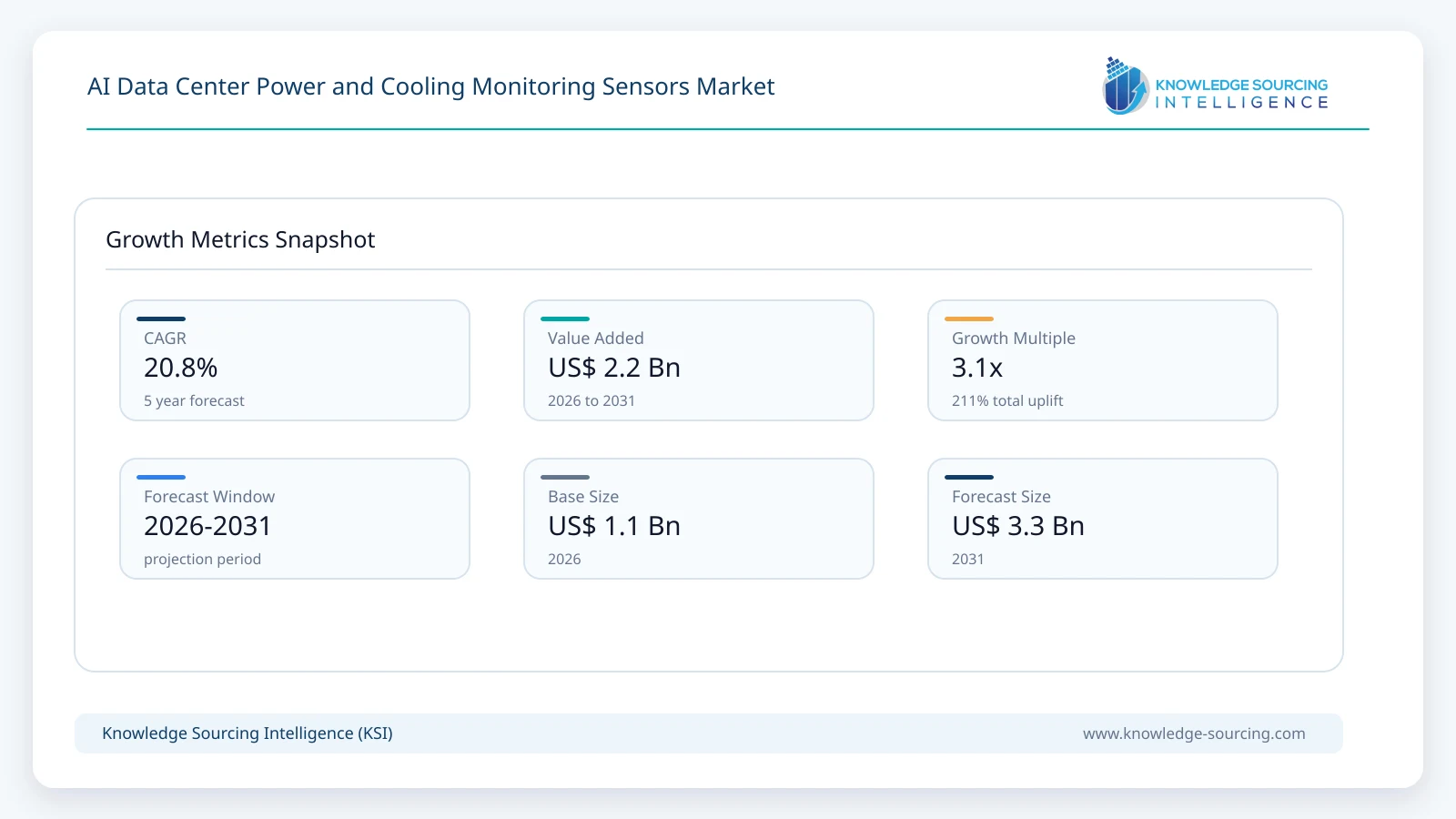
The AI Data Center Power and Cooling Monitoring Sensors Market is estimated at USD 1.05 billion in 2026 and is projected to reach USD 3.27 billion by 2032, representing a CAGR of 20.8% during 2026-2032.
Highlights:
- 1Rack temperature, humidity and airflow sensing remain the largest installed hardware layer.
- 2Liquid-cooling leak and fluid-condition sensing is the fastest-growing sensor category through 2032.
- 3AI load swings create demand for faster rack and circuit power telemetry.
- 4North America leads demand through hyperscale AI and liquid-cooling deployment.
Market Overview
The physical sensing layer spans several electrical and thermal domains. At the rack, operators monitor inlet and outlet temperature, humidity, dew point, and airflow to verify that residual air-cooled components remain within operating limits. Vertiv Geist environmental sensors combine temperature, humidity, dew point, and airflow measurements and connect directly to intelligent rack power distribution units or environmental monitors. Vaisala provides higher-accuracy temperature and humidity transmitters used where tighter control or calibration stability is required. These sensors remain important even in liquid-cooled AI racks because power supplies, networking, storage, and other components may continue to reject heat to air.
Liquid cooling adds a second sensor stack. Coolant Distribution Units (CDUs) and secondary fluid networks require temperature, flow, and pressure measurement at multiple points to confirm heat transfer, detect restrictions, and protect cold plates from thermal shock or loss of flow. Leak sensors are placed near manifolds, hose connections, under racks, and along piping routes. Schneider Electric notes that advanced monitoring platforms use sensors to identify leaks and changes in temperature or pressure before failures damage high-value AI hardware. Vertiv similarly emphasizes leak detection and intervention as best practice for both cold-plate and rear-door liquid-cooling systems.
Power monitoring becomes more granular as rack density rises. Intelligent rack PDUs and inline meters measure current, voltage, active power, energy, and power factor at the inlet, branch, or outlet level. Raritan's PX4 architecture adds residual-current monitoring and detailed electrical measurements, while environmental sensors can connect through the same rack device. The commercial boundary between a sensor and an intelligent PDU is therefore increasingly integrated; this study counts only the identifiable metering and sensing content rather than the full power-distribution device.
Market Drivers
Liquid cooling creates new sensing points throughout the thermal chain
Direct-to-chip systems introduce a technology cooling loop that must be continuously observed rather than treated as passive plumbing. Each CDU, manifold, and major branch can require temperature, pressure, flow, and leak sensing, while fluid condition affects corrosion, fouling, and long-term cold-plate performance. Schneider Electric's 2026 guidance identifies sensor failures, coolant degradation, clogged filters and leaks among the operational risks that can rapidly affect high-density AI systems. More liquid-cooled megawatts therefore increase sensor content per rack and per MW even as traditional room-air cooling declines.
AI power density increases the value of rack-level electrical telemetry
AI racks are moving from tens of kilowatts toward several hundred kilowatts, making circuit loading, current imbalance and electrical faults more consequential. Raritan's rack and inline meters provide granular current, voltage, power, power factor, and energy measurements, while residual-current sensors can detect leakage conditions before they create safety or uptime problems. The market opportunity is driven not simply by more meters, but by more measurement points per rack and faster sampling requirements as power becomes concentrated into fewer, higher-value rack-scale systems.
Closed-loop automation depends on sensor quality
Digital twins, predictive maintenance and autonomous cooling platforms cannot operate reliably without trustworthy physical measurements. Sensor drift, calibration errors or failed pressure and temperature probes can cause false alarms or incorrect control actions. Vaisala emphasizes low-drift measurement for AI-ready cooling, while Schneider Electric identifies monitoring as a core element of liquid-cooling reliability. As more facilities move toward automated setpoint control, the commercial importance of sensor accuracy, redundancy and calibration increases beyond the cost of the individual device.
Brownfield AI retrofits expand standalone monitoring demand
Existing data centers often add high-density AI racks before replacing the full monitoring architecture. Operators can deploy rack sensors, inline power meters, leak-detection cables and local gateways without rebuilding the entire BMS or DCIM stack. Vertiv Geist and Raritan products are designed for plug-and-play sensor expansion, creating a practical retrofit path. This supports a large installed-base opportunity alongside sensors embedded in new CDUs, intelligent PDUs and modular AI infrastructure.
Restraints and Adoption Challenges
The main restraint is increasing sensor integration inside larger equipment platforms. CDUs, intelligent PDUs, chillers and rack systems increasingly include sensing as standard, which can reduce the visible stand-alone sensor market and compress unit pricing. Hyperscale operators also purchase sensors in high volumes and can drive down average selling prices. Sensor proliferation creates its own operational challenge: thousands of measurement points require calibration, naming, network connectivity, and maintenance. Wireless sensing can simplify deployment but may be avoided in selected mission-critical zones because of battery maintenance, radio-policy or reliability requirements. Finally, better analytics can sometimes reduce the number of sensors required by inferring conditions from fewer high-quality measurement points.
Segment Analysis
By Sensor Type
Temperature, humidity, dew point, and airflow sensing represent the largest installed hardware layer in 2026 because these measurements are deployed broadly across rack rows, air inlets, return paths, and critical rooms. Their unit value is relatively low, but the number of measurement points is large. High-density AI increases sensor density around rack inlets and liquid-cooling interfaces where small thermal deviations can affect accelerator performance.
Liquid-cooling monitoring is the fastest-growing segment through 2032. Flow, pressure, coolant temperature, leak detection, and fluid-condition sensing expand directly with liquid-cooled racks, CDUs, and secondary networks. Leak detection carries especially high operational value because a small failure can damage high-value compute equipment. Power and electrical sensing remains another major category, increasingly embedded within rack PDUs and inline meters but counted here only for the sensing and metering content.
Sensor Category | Revenue Contribution | Growth Direction | Primary AI Data Center Application |
Temperature/humidity/dew point/airflow | Largest installed layer | Strong | Rack environment, residual air cooling and condensation control |
Coolant temperature/flow/pressure | Fast-growing | Very strong | Validate direct-liquid cooling performance and hydraulic stability |
Leak detection | Growing high-value category | Fastest | Detect coolant or water intrusion before hardware damage |
Rack and circuit power metering | Large installed layer | Strong | Current, voltage, power, energy and capacity monitoring |
Residual-current / electrical-fault sensing | Smaller 2026 base | Fast | Detect leakage currents and abnormal electrical conditions |
Vibration / equipment-condition sensing | Emerging supporting layer | Fast | Pump, fan and mechanical predictive-maintenance monitoring |
Market and Technology Indicators
Indicator | Revenue Contribution | Market Impact |
Liquid-cooling failure modes | Schneider Electric identifies leaks, sensor failures, coolant degradation and pump issues as critical AI cooling risks. | Expands need for redundant flow, pressure, temperature and leak monitoring. |
Fluid management | Schneider Electric states advanced platforms use sensors to detect leaks and changes in temperature and pressure. | Links sensor data directly to AI hardware protection. |
Leak-detection best practice | Vertiv published dedicated 2026 guidance for cold-plate and rear-door liquid-cooling leak detection. | Supports standalone and embedded leak-sensing demand. |
Integrated CDU monitoring | Vertiv CoolChip CDU 600 includes intelligent flow monitoring and leak-detection support. | Shows sensing becoming standard inside AI thermal equipment. |
AI-ready environmental measurement | Vaisala showcased high-accuracy data-center sensors at Data Center World 2026. | Confirms continued investment in precision environmental sensing. |
Rack power telemetry | Raritan PX4 supports detailed power, residual-current and environmental sensing at rack level. | Combines electrical and environmental telemetry within high-density racks. |
Regional Opportunity
North America
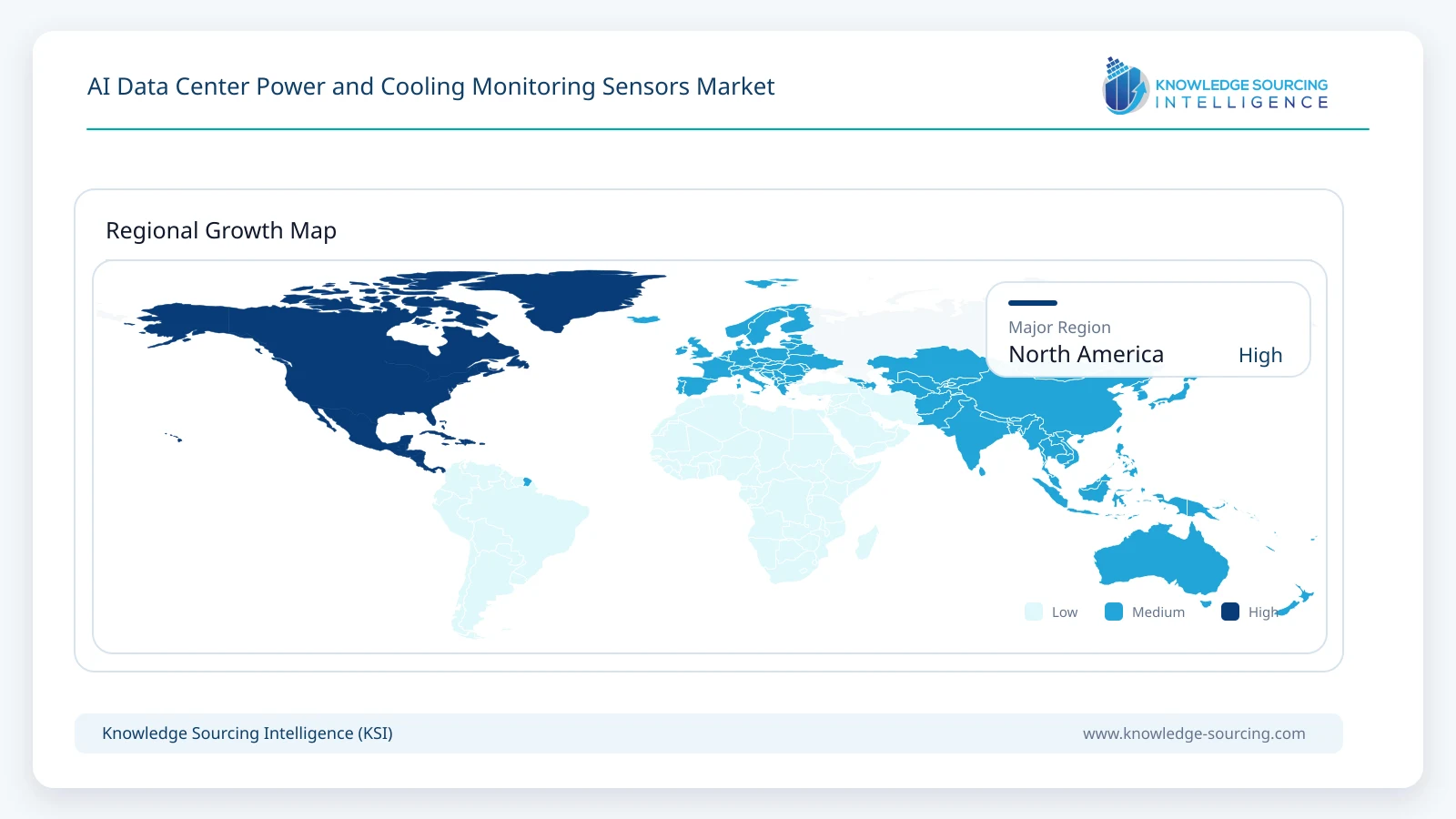
North America is the largest market for AI data-center power and cooling monitoring sensors because the United States combines rapid hyperscale AI construction with a large installed base of existing facilities being upgraded for liquid cooling. New AI campuses require sensing at the rack, CDU, secondary fluid network, electrical distribution, and facility-cooling layers, while brownfield projects often add standalone environmental and leak sensors before broader infrastructure replacement. This creates demand across both embedded and retrofit sensor architectures.
The supplier ecosystem is broad. Vertiv and Legrand's Raritan and Server Technology brands combine rack power telemetry with environmental sensing. Schneider Electric integrates sensors across its EcoStruxure, Motivair and critical-power portfolios. Vaisala supplies precision temperature, humidity and dew-point measurement for cooling control. Sensaphone, AKCP and RLE Technologies focus on environmental, leak and remote monitoring, while Honeywell, Johnson Controls and Siemens participate through building and facility sensing. nVent contributes leak, temperature, and rack-infrastructure monitoring within critical environments.
Liquid cooling is the strongest incremental demand driver. High-density AI deployments create many more sensing points for flow, pressure, temperature, and leaks than conventional air-cooled racks. Operators also require tighter correlation between rack power and cooling performance, increasing the value of synchronized telemetry. Through 2032, North American growth is expected to be led by embedded CDU sensing, rack-level power telemetry, leak detection and higher-accuracy environmental measurement in both new AI factories and retrofit data halls.
Europe benefits from strong energy-efficiency requirements, mature BMS adoption and a significant colocation base, supporting precision sensing and metering. Asia Pacific combines rapid AI data-center deployment with electronics and sensor manufacturing, especially in China, Japan, South Korea, Taiwan, Singapore, Malaysia and India. The Middle East is emerging as a large greenfield market where sensor networks can be designed into AI campuses from initial construction rather than layered onto legacy infrastructure.
Competitive Landscape
The competitive landscape spans critical-infrastructure suppliers, industrial measurement companies and specialist environmental-monitoring vendors. Schneider Electric, Vertiv and Legrand have strong positions because they combine sensors with rack power, cooling and monitoring hardware. Vaisala differentiates through measurement accuracy and calibration stability, particularly for temperature, humidity and dew point. Honeywell, Johnson Controls and Siemens participate through broader building automation and industrial sensing portfolios that can be integrated into data-center control systems.
Specialist vendors remain important in retrofit and distributed monitoring. Sensaphone, AKCP and RLE Technologies offer environmental, leak and remote-monitoring systems that can be deployed without replacing the primary BMS. nVent combines sensing with rack and liquid-cooling infrastructure, while Belimo and Endress+Hauser contribute flow, pressure, temperature and hydronic measurement technologies relevant to liquid-cooled data-center systems. TE Connectivity and Amphenol participate through component-level temperature, pressure and electrical sensing that can be embedded within power and cooling equipment.
Competitive differentiation centers on accuracy, drift, response time, sensor density, ease of deployment, protocol support, calibration requirements and reliability under continuous operation. In AI data centers, vendors also need to support tighter integration across rack power and liquid cooling. The most defensible positions are therefore moving from isolated sensors toward validated sensing ecosystems that connect reliably to PDUs, CDUs, BMS, DCIM and autonomous-control platforms without locking customers into a single software layer.
Major companies and ecosystem participants covered: Schneider Electric, Vertiv, Legrand / Raritan / Server Technology, Vaisala, Honeywell, Johnson Controls, Siemens, Sensaphone, AKCP, RLE Technologies, nVent, Belimo, Endress+Hauser, TE Connectivity and Amphenol.
Recent Developments
July 2026: Schneider Electric published updated guidance on liquid-cooling failures in AI data centers, identifying sensor failures, leaks, coolant degradation and pump faults as critical monitoring requirements.
June 2026: Schneider Electric published fluid-management guidance describing continuous leak, temperature and pressure sensing as a core reliability requirement for direct-to-chip systems.
April 2026: Vaisala showcased high-accuracy temperature and humidity sensors engineered for AI-ready data-center cooling at Data Center World in Washington, D.C.
2026: Vertiv published dedicated guidance on leak detection and intervention for cold-plate and rear-door liquid-cooling deployments.
2026: Vertiv CoolChip CDU platforms integrated intelligent flow monitoring, temperature control and leak-detection functionality within high-density AI cooling equipment.
2026: Legrand Raritan PX4 platforms continued expansion of granular rack power, residual-current and environmental sensing within a common monitoring architecture.
2026: Vertiv Geist environmental-monitoring platforms supported combined temperature, humidity, dew point, airflow and leak sensing across rack and room environments.
2026: Liquid-cooling commissioning guidance increasingly emphasized pressure testing, leak detection, fluid sampling and continuous coolant monitoring before AI racks enter production.
AI Data Center Power and Cooling Monitoring Sensors Market Scope:
| Report Metric | Details |
|---|---|
| Total Market Size in 2026 | USD 1.05 billion |
| Total Market Size in 2031 | USD 3.27 billion |
| Forecast Unit | USD Billion |
| Growth Rate | 20.8% |
| Study Period | 2021 to 2031 |
| Historical Data | 2021 to 2024 |
| Base Year | 2025 |
| Forecast Period | 2026 – 2031 |
| Segmentation | By Sensor Type, Deployment Layer, Monitoring Objective, Deployment Type |
| Companies |
|
Market Segmentation
By Sensor Type
Temperature, Humidity, Dew Point and Airflow Sensors
Coolant Temperature, Flow and Pressure Sensors
Leak Detection Sensors and Cables
Rack and Circuit Power Metering Sensors
Residual-Current and Electrical-Fault Sensors
Vibration and Equipment-Condition Sensors
By Deployment Layer
Rack and Cabinet
Rack PDU and Row Power Distribution
Coolant Distribution Unit
Secondary Fluid Network
Data Hall and White Space
Facility Mechanical and Electrical Rooms
By Monitoring Objective
Thermal Performance and Condensation Control
Liquid-Cooling Reliability
Energy and Capacity Monitoring
Electrical Safety and Fault Detection
Predictive Maintenance and Equipment Health
By Deployment Type
Greenfield AI Factories
Hyperscale and Colocation Expansions
Brownfield AI Retrofits
Sovereign and Enterprise AI Facilities
By Customer Type
Hyperscale Cloud Providers
Neocloud and GPU-Cloud Operators
Colocation Providers
Enterprise and High-Performance Computing
Equipment OEMs and System Integrators
By Region
North America
United States
Canada
Europe
Asia Pacific
Middle East
Rest of World
Table of Contents
1. Executive Summary
1.1. Market Opportunity and Key Findings
1.2. Sensor Density Evolution in AI Data Centers
1.3. Principal Revenue Pools
2. Market Overview
2.1. Physical Sensing Layer in AI Infrastructure
2.2. Rack Environmental Monitoring
2.3. Liquid-Cooling Monitoring Requirements
2.4. Rack and Circuit Power Telemetry
2.5. Sensor Gateways and Edge Monitoring
20323.1. Global Market Revenue
3.2. Annual Growth Analysis
3.3. Sensor Content per Rack and MW
3.4. Embedded versus Standalone Sensor Revenue
4. Market by Sensor Type
4.1. Temperature, Humidity, Dew Point and Airflow Sensors
4.2. Coolant Temperature, Flow and Pressure Sensors
4.3. Leak Detection Sensors and Cables
4.4. Rack and Circuit Power Metering Sensors
4.5. Residual-Current and Electrical-Fault Sensors
4.6. Vibration and Equipment-Condition Sensors
5. Market by Deployment Layer
5.1. Rack and Cabinet
5.2. Rack PDU and Row Power Distribution
5.3. Coolant Distribution Unit
5.4. Secondary Fluid Network
5.5. Data Hall and White Space
5.6. Facility Mechanical and Electrical Rooms
6. Market by Monitoring Objective
6.1. Thermal Performance and Condensation Control
6.2. Liquid-Cooling Reliability
6.3. Energy and Capacity Monitoring
6.4. Electrical Safety and Fault Detection
6.5. Predictive Maintenance and Equipment Health
7. Market by Deployment Type
7.1. Greenfield AI Factories
7.2. Hyperscale and Colocation Expansions
7.3. Brownfield AI Retrofits
7.4. Sovereign and Enterprise AI Facilities
8. Market by Customer Type
8.1. Hyperscale Cloud Providers
8.2. Neocloud and GPU-Cloud Operators
8.3. Colocation Providers
8.4. Enterprise and High-Performance Computing
8.5. Equipment OEMs and System Integrators
9. Regional Market
9.1. North America
9.1.1. United States
9.1.2. Canada
9.2. Europe
9.3. Asia Pacific
9.4. Middle East and Rest of World
10. Market Dynamics
10.1. Drivers
10.1.1. Expansion of Liquid-Cooled AI Infrastructure
10.1.2. Rising Rack Power Density
10.1.3. Dependence of Closed-Loop Automation on Sensor Quality
10.1.4. Brownfield AI Monitoring Upgrades
10.2. Restraints
10.2.1. Sensor Integration within Larger Equipment Platforms
10.2.2. Hyperscale Pricing Pressure
10.2.3. Calibration and Sensor-Fleet Management Complexity
10.2.4. Sensor Consolidation through Advanced Analytics
11. Competitive Landscape
11.1. Market Structure and Competitive Intensity
11.2. Portfolio Breadth Across Power, Environmental and Liquid-Cooling Sensing
11.3. Embedded versus Standalone Sensor Positioning
11.4. Integration with PDU, CDU, BMS and DCIM Ecosystems
11.5. OEM and Infrastructure-Platform Partnerships
12. Company Profiles
12.1. Schneider Electric
12.2. Vertiv
12.3. Legrand
12.4. Vaisala
12.5. Honeywell
12.6. Johnson Controls
12.7. Siemens
12.8. Sensaphone
12.9. AKCP
12.10. RLE Technologies
12.11. nVent
12.12. Belimo
12.13. Endress+Hauser
12.14. TE Connectivity
12.15. Amphenol
13. Appendix
Navigate
Trusted by the world's leading organizations











