
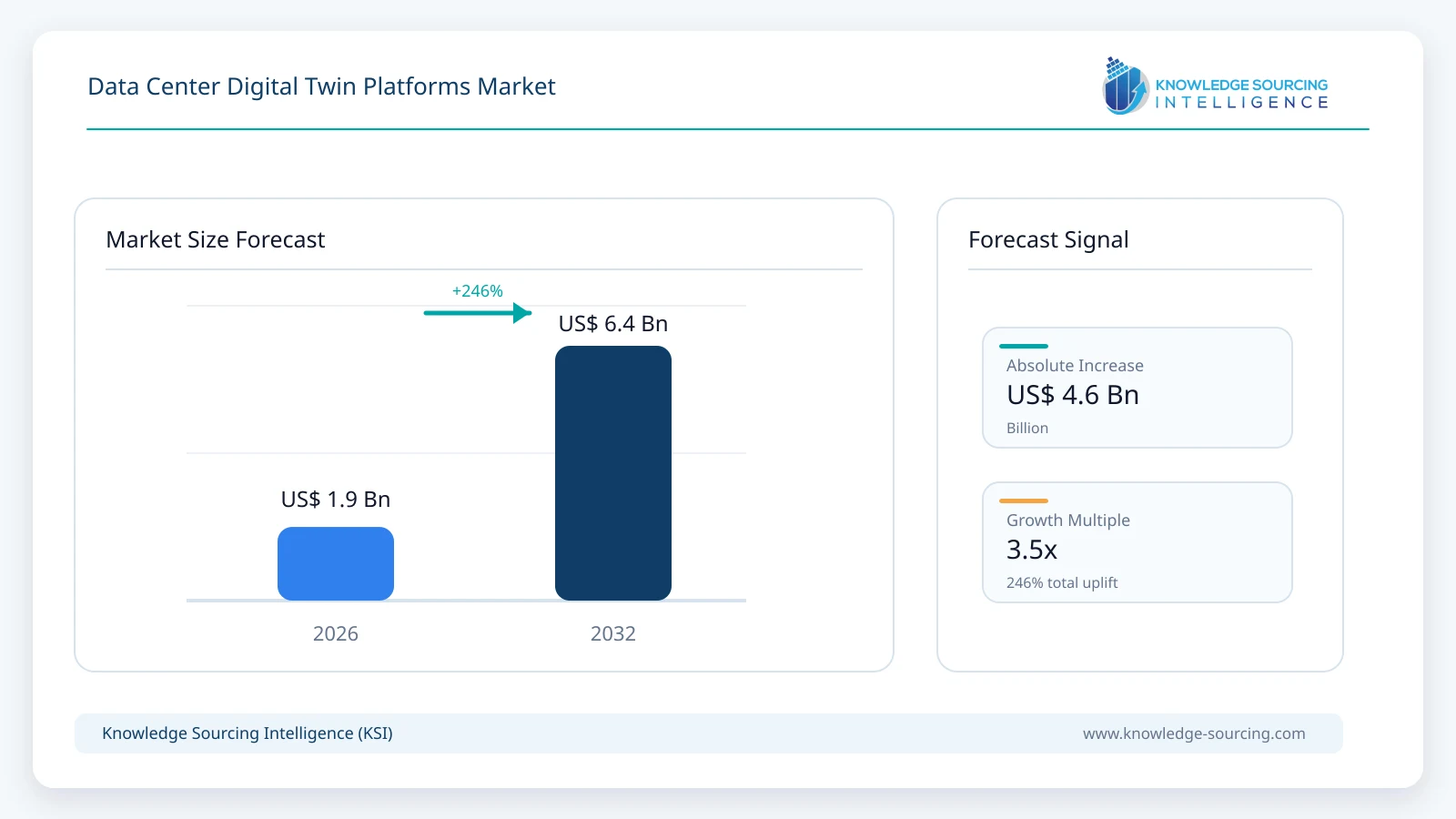
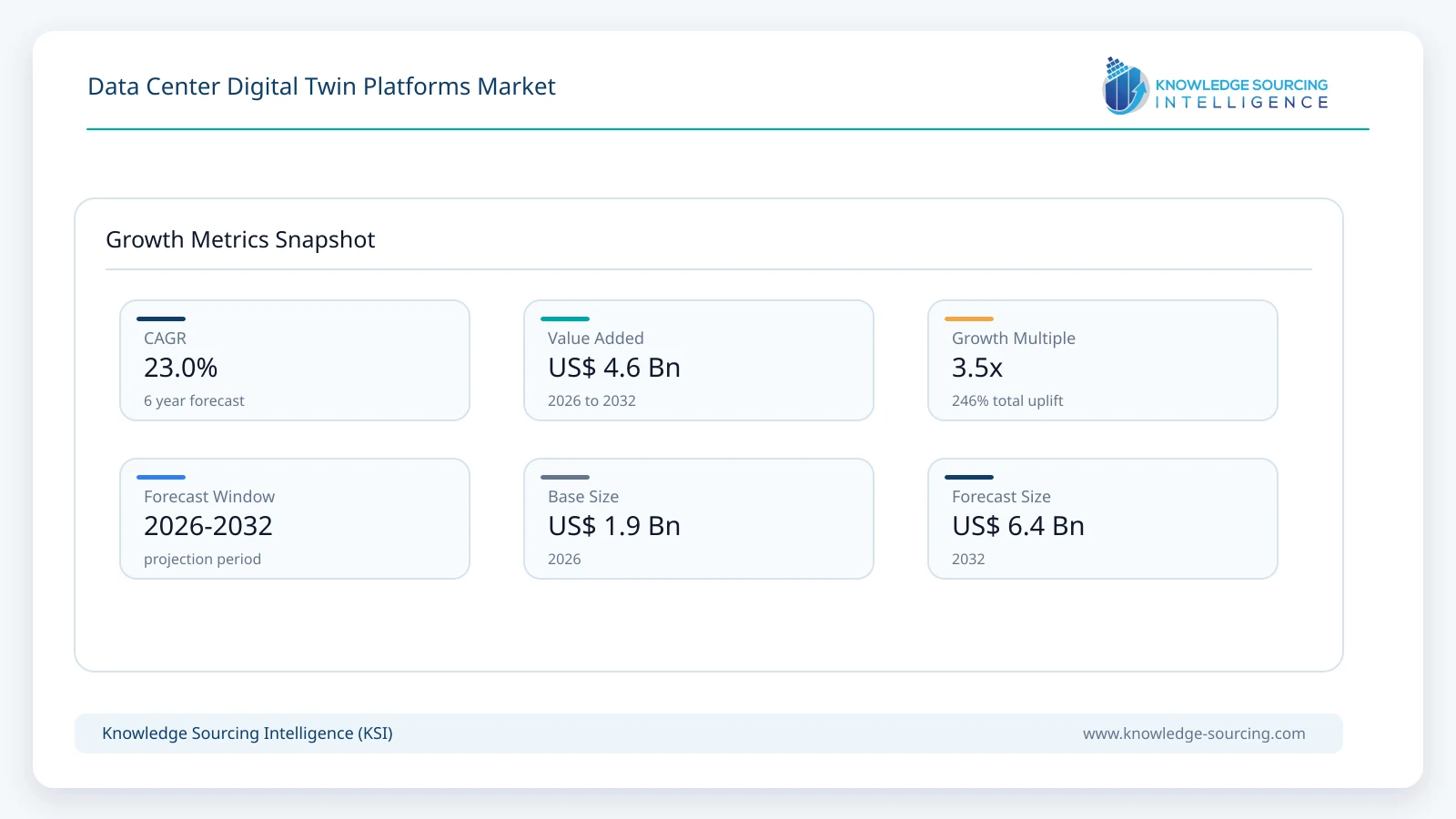
The Data Center Digital Twin Platforms Market is estimated at USD 1.85 billion in 2026 and is projected to reach USD 6.40 billion by 2032, representing a CAGR of 23.0% over 2026-2032.
Highlights:
- 1AI factories are accelerating demand for physics-based digital twins across complete infrastructure lifecycles.
- 2NVIDIA Omniverse DSX is creating a common simulation layer across major infrastructure vendors.
- 3Cadence combines live operational data with computational fluid dynamics for continuously updated twins.
- 4Vertiv is moving modular AI infrastructure from document-based design toward production-grade digital models.
- 5Digital twins reduce commissioning risk by validating power, cooling and rack configurations before deployment.
- 6Operational twins increasingly connect DCIM and building-management telemetry with physics-based scenario testing.
- 7High-density liquid cooling increases the value of coupled thermal and hydraulic simulation capabilities.
- 8North America leads adoption through hyperscale AI construction and a concentrated software ecosystem.
- 9Greenfield AI factories provide the strongest environment for full lifecycle digital-twin deployment today.
- 10Brownfield facilities use twins primarily for capacity planning, cooling optimization and retrofit validation.
- 11OpenUSD interoperability is becoming important as multiple engineering platforms contribute simulation-ready infrastructure models.
- 12Autonomous optimization is emerging as twins connect predictive analytics with real-time facility control systems.
Traditional data center planning separates electrical design, mechanical design, information technology deployment, building models and operations into different tools. That structure becomes increasingly difficult at AI-factory scale because a single rack-level change can alter power distribution, coolant flow, floor loading, network topology and facility heat rejection at the same time. Digital twins provide a common virtual environment where those dependencies can be represented before equipment is installed and then recalibrated as the operating facility changes. The commercial value is strongest when the twin is not a static three-dimensional model but a simulation-capable environment that remains connected to live facility data.
The 2026 NVIDIA Vera Rubin DSX reference architecture illustrates this transition. NVIDIA's Omniverse DSX Blueprint is intended to create physically accurate AI factory twins spanning design, buildout and operations. Cadence is integrating validated models of rack-scale systems into its Reality Digital Twin Platform; Schneider Electric and AVEVA are connecting power, cooling and lifecycle engineering; Siemens is integrating AI data-center reference architectures with Omniverse DSX; Eaton is contributing grid-to-chip infrastructure models; and Vertiv is developing model-based twins for integrated physical infrastructure. This creates a multi-vendor digital engineering layer rather than a single-vendor facility model.
Operational use is expanding in parallel. Cadence Reality DC Digital Twin can connect to building management system and DCIM data so that the model stays calibrated to its physical counterpart. Schneider Electric's EcoStruxure IT Advisor uses a live digital model for asset, power, cooling and environmental capacity planning. Sunbird positions three-dimensional visualization and sensor overlays as a digital twin of the operating data center. The technology therefore spans two purchasing centers: engineering teams seeking faster, safer design validation and operations teams seeking more accurate capacity, energy and change-management decisions.
Market Drivers
AI infrastructure requires coupled power, cooling and compute validation
AI data centers increasingly deploy rack-scale systems whose electrical and thermal behavior cannot be evaluated independently. Direct liquid cooling, higher coolant supply temperatures, dense busways, large power blocks and changing GPU operating points require mechanical and electrical teams to work from the same assumptions. A digital twin allows rack, cooling, power and facility models to be tested as one system. NVIDIA's DSX ecosystem is important because infrastructure suppliers are contributing simulation-ready models instead of forcing each operator to recreate component behavior independently. As validated model libraries expand, the time and engineering effort required to build a useful facility twin declines, improving the economic case for broader adoption.
Faster build cycles increase the cost of design and commissioning errors
AI infrastructure economics place a premium on time to first compute. A delay caused by cooling imbalance, insufficient electrical margin or an incompatible rack deployment can strand expensive accelerators and defer revenue. Digital twins shift more validation into the virtual design stage, where alternative layouts, failure scenarios and equipment changes can be tested before physical installation. Vertiv's 2026 transition toward digitally validated OneCore and SmartRun infrastructure reflects this purchasing requirement. The value proposition is not limited to avoiding rework; it also includes earlier qualification of new hardware generations and the ability to reuse validated design blocks across multiple sites.
Live operational twins improve capacity utilization and change planning
Data centers rarely operate exactly as initially designed. IT loads change, racks are added, cooling equipment degrades and redundancy conditions shift. Connecting a digital twin to live telemetry allows the model to be recalibrated and used for operational decisions. Operators can test a proposed deployment, cooling adjustment or maintenance event against the current state of the facility before implementation. This is particularly useful in brownfield sites where capacity appears available in aggregate but local constraints in power, airflow or cooling distribution prevent safe deployment. Operational twins therefore extend the commercial life of the platform beyond the design project and support recurring software and services revenue.
Market Restraints
The principal restraint is model quality. A twin produces useful results only when geometry, equipment characteristics, live telemetry and operating assumptions are sufficiently accurate. Building and maintaining this data layer can be expensive in older facilities where drawings are incomplete or instrumentation is inconsistent. Interoperability also remains uneven across BIM, DCIM, building controls, electrical models and simulation engines. Large operators may therefore deploy several specialized twins rather than one universal model. Cybersecurity and data-governance requirements add further complexity because operational twins can expose detailed facility topology, asset data and control-system information. These constraints favor platforms with strong integration tooling, model libraries and clear separation between simulation and control functions.
Data Center Digital Twin Platforms Market Segment Analysis
By Component
Software platforms represent the largest component because the core commercial value comes from modeling, physics simulation, visualization, scenario analysis and ongoing synchronization with facility data. Services remain material, particularly for model creation, calibration, data integration and implementation in brownfield environments. Over time, repeatable component libraries and open interchange formats should reduce the service intensity required for greenfield projects, while operational support and model maintenance create a recurring services opportunity.
By Application
Design and engineering simulation is the largest application in 2026 because power, airflow, liquid cooling and rack layouts must be validated before construction or major capacity additions. Operational optimization is expected to expand faster through 2032 as more twins remain connected after commissioning. Live twins support capacity planning, thermal optimization, maintenance scenarios, failure analysis and deployment planning. The transition from project-based simulation to persistent operational twins is one of the most important changes in the market because it converts digital twin software from an engineering tool into a lifecycle infrastructure platform.
Table 1. Principal Digital Twin Capabilities and Commercial Use Cases
Capability | Typical Data / Model Layer | Primary Data Center Use |
Physics-based thermal simulation | CFD, airflow, liquid cooling and heat-transfer models | Cooling design, hotspot prevention and retrofit validation |
Electrical system simulation | Power topology, load flow, protection and equipment models | Capacity validation, redundancy analysis and power-path changes |
3D asset and spatial twin | Rack, room, cabling and equipment geometry | Capacity planning, change management and remote collaboration |
Operational digital twin | Live BMS, DCIM, sensor and asset telemetry | Continuous optimization, scenario testing and incident analysis |
Network digital twin | Logical topology, switch configuration and traffic behavior | Provisioning validation, automation testing and upgrade simulation |
AI-assisted optimization | Surrogate models, predictive analytics and optimization engines | Faster scenario evaluation and increasingly autonomous recommendations |
Market and Adoption Indicators
Table 2. Recent Indicators Supporting Data Center Digital Twin Adoption
Indicator | Latest Development | Market Relevance |
AI factory reference architecture | NVIDIA made the Omniverse DSX digital-twin blueprint generally available in March 2026. | Creates a shared simulation architecture across major AI infrastructure vendors. |
High-density design validation | Switch is modeling its EVO Chamber, designed for up to 2 MW per cabinet, in the Cadence Reality platform. | Extreme rack density increases the value of physics-based validation before deployment. |
Model-based modular infrastructure | Vertiv introduced SmartRun digital-twin capability in June 2026 and expanded digitally validated OneCore deployment. | Moves digital twins into repeatable infrastructure configuration and deployment workflows. |
Lifecycle integration | Schneider Electric and AVEVA integrated lifecycle digital-twin capabilities with NVIDIA Omniverse DSX in March 2026. | Extends the twin from engineering into operations and maintenance. |
Simulation acceleration | Cadence reports GPU-accelerated workflows and operational efficiency benefits from its Omniverse integration. | Reduces the computing and engineering burden of high-fidelity data-center simulation. |
Regional Opportunity
North America
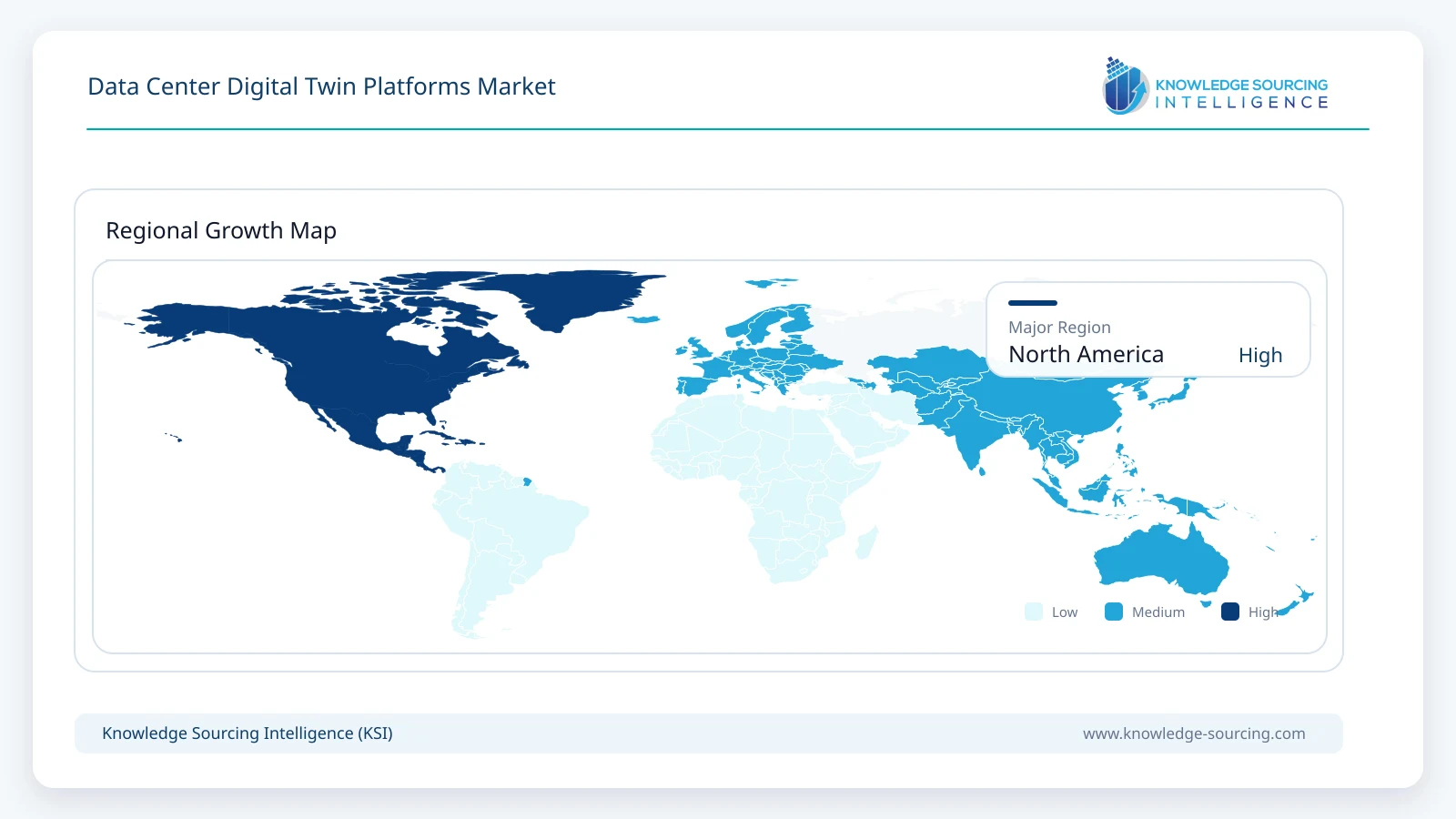
North America is the largest early market because the region combines hyperscale cloud investment, AI-factory construction, established DCIM adoption and a dense supplier ecosystem. NVIDIA, Cadence, Schneider Electric, Vertiv, Eaton, Bentley Systems, PTC, Sunbird and other relevant platform or infrastructure providers have substantial commercial activity in the United States.
The region also contains many of the first AI facilities where rack density, liquid cooling and power constraints make pre-build simulation economically valuable. Large operators can justify digital twin spending when a design decision affects tens or hundreds of megawatts of infrastructure or delays high-value accelerator capacity.
Adoption is strongest in greenfield hyperscale and AI-factory projects because the data model can be established during design and carried into commissioning and operation. Brownfield demand is also significant, but implementation is more selective. Existing facilities often begin with a specific business problem such as thermal capacity, rack deployment, energy optimization or a major liquid-cooling retrofit. Successful projects can then expand into a broader operational twin as asset data and telemetry quality improve. This phased adoption pattern supports both enterprise platforms and specialized simulation vendors rather than forcing the market toward a single architecture.
The regional market is also benefiting from vendor convergence around interoperable model formats and NVIDIA Omniverse. The DSX ecosystem allows electrical, cooling, compute and building models from multiple suppliers to participate in the same digital workflow. This does not eliminate proprietary simulation engines, but it reduces friction between disciplines and increases the value of reusable, validated component models. Through 2032, the strongest North American demand is expected from hyperscalers, AI cloud operators, colocation providers adding high-density capacity, and engineering firms delivering standardized AI campuses.
Europe is supported by strong industrial digital-twin capabilities, data-center efficiency requirements and suppliers such as Siemens, Schneider Electric and Dassault Systemes. Asia Pacific combines rapid AI infrastructure construction with a major manufacturing and engineering base, particularly in Taiwan, Japan, South Korea, Singapore and China. Middle Eastern demand is concentrated in large greenfield AI campuses where integrated design and simulation can be incorporated from project inception. These regions remain important but are discussed more selectively than North America in the research description.
Competitive Landscape
Competition spans dedicated data-center simulation vendors, industrial digital-twin platforms, DCIM suppliers and critical-infrastructure companies. Cadence has a strong position in physics-based data-center simulation through Reality DC, combining computational fluid dynamics with operational twins and validated AI-system models. NVIDIA is becoming an important ecosystem layer through Omniverse DSX and DSX Air rather than competing only as a traditional facility-management vendor. Schneider Electric combines EcoStruxure IT, ETAP and AVEVA capabilities across power, facility operations and lifecycle engineering, while Siemens and Dassault Systemes bring broader industrial digital-twin and model-based systems engineering portfolios.
Vertiv and Eaton are extending the market from software into simulation-ready physical infrastructure. Their strategy is to provide digital models of modular power and cooling systems so that complete AI factory configurations can be validated before deployment. Sunbird Software remains relevant in operational data-center modeling and three-dimensional visualization, while Bentley Systems, PTC, Autodesk, ABB, Honeywell and other industrial software or infrastructure vendors participate through asset twins, engineering platforms and facility lifecycle tools. Competitive differentiation increasingly depends on model fidelity, interoperability, reusable equipment libraries and the ability to preserve the twin from design into operations.
No single platform currently owns every layer of the data center twin. Thermal simulation, electrical engineering, BIM, network simulation, DCIM and operational analytics continue to use specialized engines. The market is therefore moving toward federated twins connected by shared data models and visualization environments. Vendors that can accept third-party models, connect live facility telemetry and maintain validated behavior across new GPU and cooling generations are positioned to capture the most durable recurring revenue.
Major companies and ecosystem participants covered: NVIDIA, Cadence Design Systems, Schneider Electric, Siemens, Dassault Systemes, Vertiv, Eaton, Bentley Systems, PTC, Sunbird Software, FNT Software, ABB, Honeywell, Autodesk and Hexagon.
Recent Developments
June 2026: Vertiv introduced a production-grade SmartRun digital-twin capability integrated with the NVIDIA Omniverse DSX Blueprint for AI factory infrastructure.
March 2026: NVIDIA made the Omniverse DSX Digital Twin Blueprint generally available with the Vera Rubin DSX AI Factory reference design.
March 2026: Cadence expanded Reality Digital Twin support for NVIDIA GB300 NVL72 and collaborated with Switch on a physics-accurate model of high-density EVO Chamber infrastructure.
March 2026: Schneider Electric and AVEVA announced lifecycle digital-twin integration with NVIDIA Omniverse DSX for gigawatt-scale AI factories.
March 2026: Siemens announced AI data-center reference architectures integrated with the NVIDIA Omniverse DSX blueprint.
March 2026: Eaton introduced its Beam Rubin DSX platform and integrated grid-to-chip power and cooling infrastructure with NVIDIA DSX designs.
February 2026: Vertiv announced a higher-fidelity digital-twin approach for OneCore integrated modular infrastructure and an initial collaboration with Hut 8.
Data Center Digital Twin Platforms Market Scope:
| Report Metric | Details |
|---|---|
| Total Market Size in 2026 | USD 1.85 billion |
| Total Market Size in 2032 | USD 6.40 billion |
| Forecast Unit | USD Billion |
| Growth Rate | 23.0% |
| Study Period | 2021 to 2032 |
| Historical Data | 2021 to 2024 |
| Base Year | 2025 |
| Forecast Period | 2026 – 2032 |
| Segmentation | Component, Digital Twin Function, Technical Layer, Data Center Type, Geography |
| Companies |
|
Market Segmentation
By Component
Software Platforms
Implementation, Integration and Modeling Services
Support and Model Maintenance Services
By Digital Twin Function
Design and Engineering Simulation
Commissioning and Validation
Operational Digital Twin and Capacity Planning
Predictive Maintenance and Failure Analysis
Network Digital Twin and Automation Validation
By Technical Layer
Thermal and Computational Fluid Dynamics Models
Electrical System Models
3D Spatial and Asset Models
Live Telemetry and Data Integration
AI Optimization and Surrogate Models
By Data Center Type
Hyperscale and AI Factories
Colocation Data Centers
Enterprise Data Centers
Edge and Distributed Facilities
By Geography
North America
United States
Canada
Europe
Asia Pacific
Middle East and Rest of World
Table of Contents
1. EXECUTIVE SUMMARY
1.1. Market Opportunity and Key Findings
1.2. Adoption Timeline
1.3. Principal Revenue Pools
2. MARKET OVERVIEW
2.1. Evolution from Static Models to Operational Twins
2.2. AI Factory Infrastructure Complexity
2.3. Digital Twin Architecture and Data Layers
2.4. OpenUSD and Multi-Vendor Interoperability
3. MARKET SIZE AND FORECAST, 2026-2032
3.1. Global Market Revenue
3.2. Annual Growth Analysis
3.3. Software versus Services Revenue
3.4. Adoption by Installed Capacity and New Build Activity
4. MARKET BY COMPONENT
4.1. Software Platforms
4.2. Implementation, Integration and Modeling Services
4.3. Support and Model Maintenance Services
5. MARKET BY DIGITAL TWIN FUNCTION
5.1. Design and Engineering Simulation
5.2. Commissioning and Validation
5.3. Operational Digital Twin and Capacity Planning
5.4. Predictive Maintenance and Failure Analysis
5.5. Network Digital Twin and Automation Validation
6. MARKET BY TECHNICAL LAYER
6.1. Thermal and Computational Fluid Dynamics Models
6.2. Electrical System Models
6.3. 3D Spatial and Asset Models
6.4. Live Telemetry and Data Integration
6.5. AI Optimization and Surrogate Models
7. MARKET BY DATA CENTER TYPE
7.1. Hyperscale and AI Factories
7.2. Colocation Data Centers
7.3. Enterprise Data Centers
7.4. Edge and Distributed Facilities
8. REGIONAL MARKET
8.1. North America
8.1.1. United States
8.1.2. Canada
8.2. Europe
8.3. Asia Pacific
8.4. Middle East and Rest of World
9. TECHNOLOGY AND COMMERCIALIZATION OUTLOOK
9.1. AI Factory Reference Architectures
9.2. Physics-Based Simulation and GPU Acceleration
9.3. Operational Twin Integration with DCIM and BMS
9.4. OpenUSD and Simulation-Ready Component Libraries
9.5. Autonomous Optimization and Agentic Operations
9.6. Cybersecurity and Data Governance
10. COMPETITIVE LANDSCAPE
10.1. Value Chain
10.2. Data Center Simulation Platforms
10.3. Industrial Digital Twin Platforms
10.4. DCIM and Operational Twin Vendors
10.5. Critical Infrastructure and Simulation-Ready Equipment Vendors
10.6. Partnerships and Ecosystem Development
11. COMPANY PROFILES
11.1. NVIDIA
11.2. Cadence Design Systems
11.3. Schneider Electric
11.4. Siemens
11.5. Dassault Systemes
11.6. Vertiv
11.7. Eaton
11.8. Bentley Systems
11.9. PTC
11.10. Sunbird Software
11.11. FNT Software
11.12. ABB
11.13. Honeywell
11.14. Autodesk
11.15. Hexagon
12. APPENDIX
12.1. Definitions and Abbreviations
12.2. Digital Twin Capability Classification
12.3. Application and Deployment Framework
12.4. Source and Data Notes
Navigate
Trusted by the world's leading organizations











