
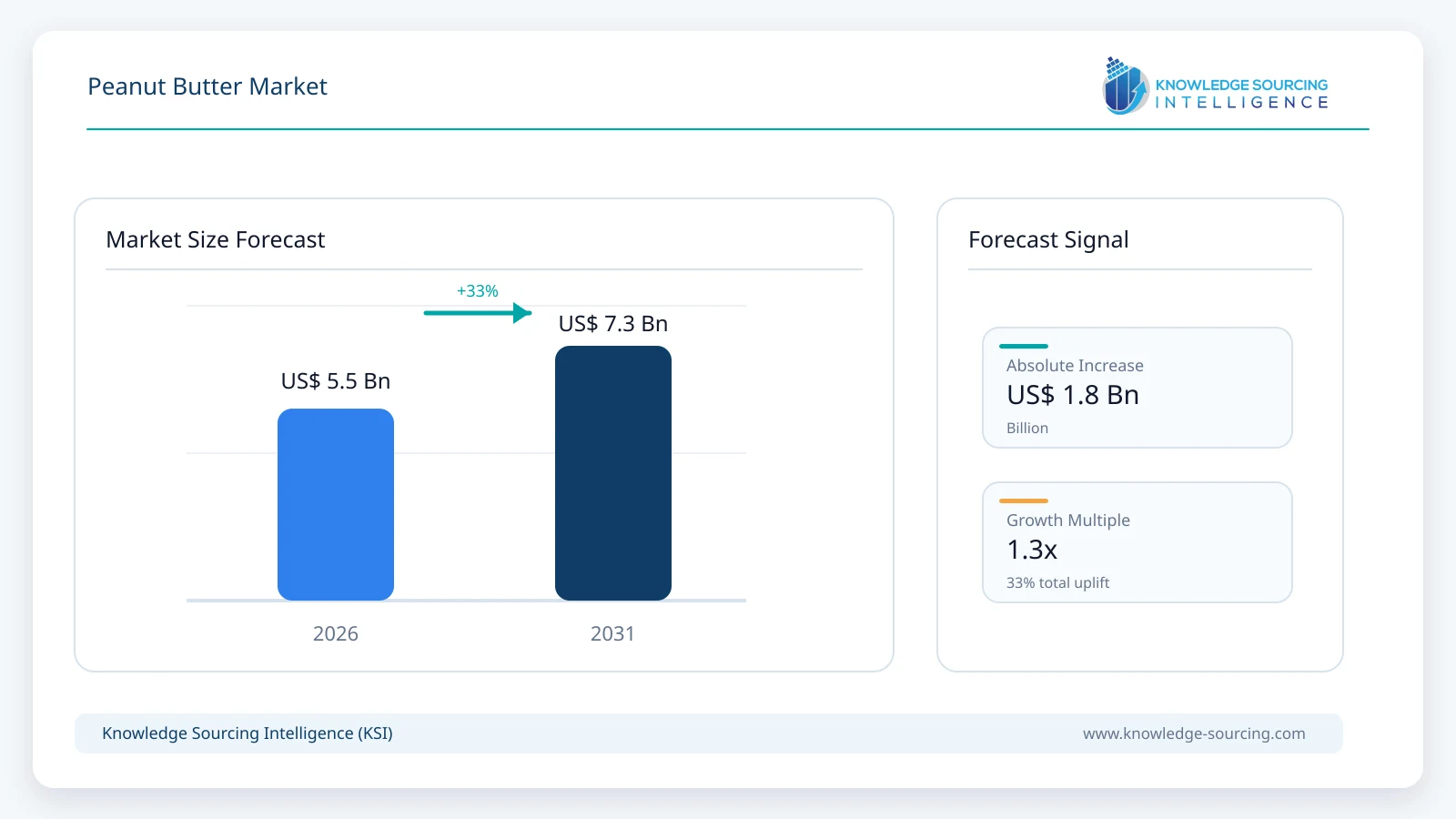
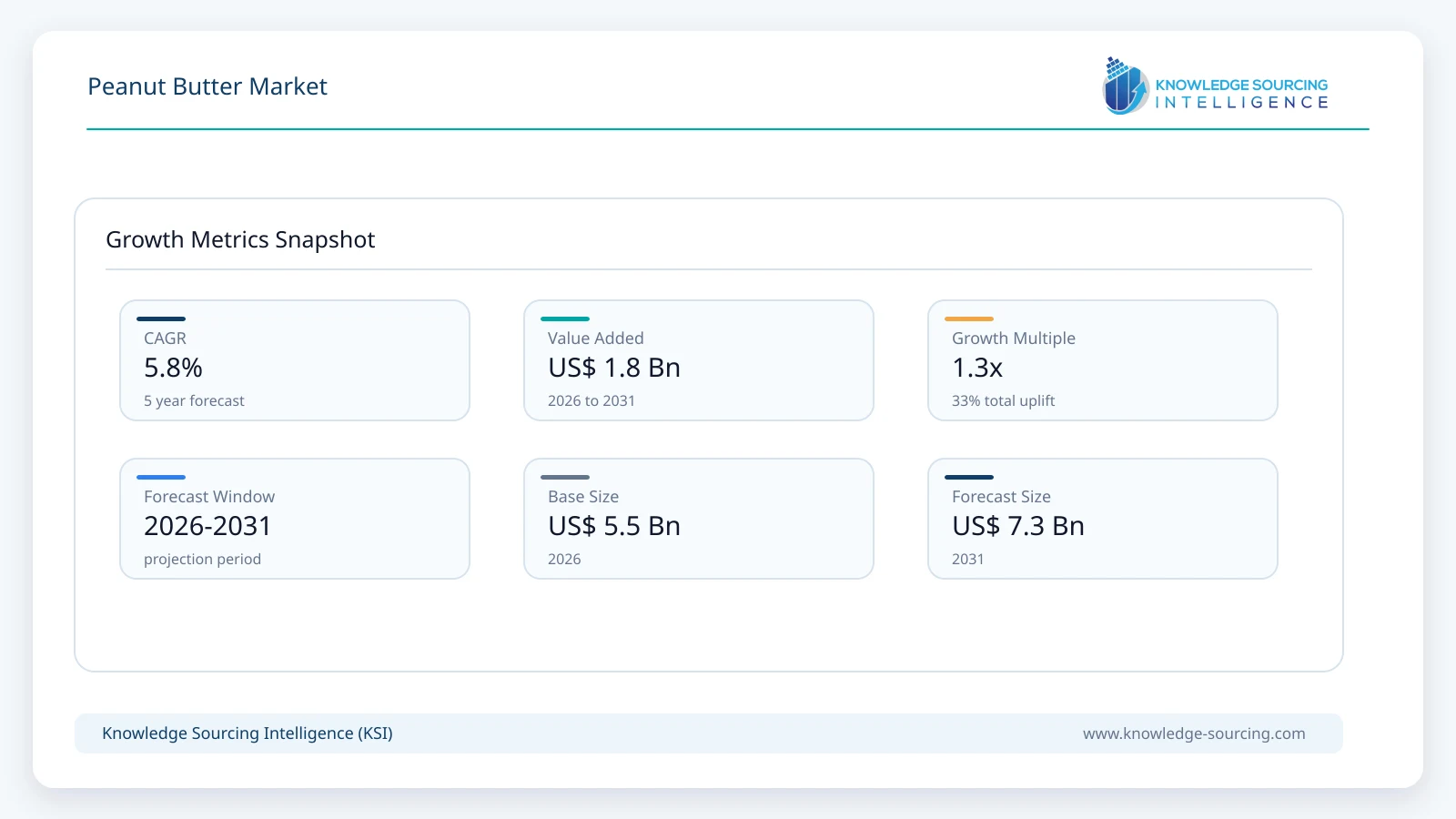
The global peanut butter market is expected to grow at a CAGR of 5.8% to attain USD 7.30 billion in 2031 from USD 5.50 billion in 2026.
Highlights:
- 1Processed and stabilized peanut butter remains the largest type segment, while natural formulations grow faster.
- 2North America remains the largest regional market because peanut butter is deeply embedded in household consumption.
- 3Asia Pacific records faster growth as India and Southeast Asia expand high-protein snacking categories.
- 4Jif remained the leading U.S. peanut butter brand based on Circana data through March 2026.
- 5Whole Earth launched a one-ingredient 100% Nuts range in the United Kingdom in June 2026.
- 6Portable pouches, squeeze formats and powdered peanut butter are broadening consumption beyond breakfast and sandwiches.
Peanut butter is moving beyond its traditional role as a breakfast or sandwich spread and becoming a broader protein-snacking ingredient. The category benefits from a favorable nutritional profile, long shelf life, low refrigeration requirement and relatively low cost per gram of protein compared with many tree-nut butters. In mature markets, value growth increasingly comes from natural formulations, portability, functional positioning and premium roasting rather than simple household penetration. The J.M. Smucker Company described Jif as the leading U.S. peanut butter brand based on Circana point-of-sale data through March 2026 and refreshed the brand in August 2026 to emphasize snacking occasions beyond PB&J.
The competitive structure also varies sharply by geography. Jif, SKIPPY and Peter Pan dominate large parts of the U.S. mass market, Kraft Peanut Butter remains a leading Canadian brand, and Bega Peanut Butter and Sanitarium are important in Australia and New Zealand. Natural specialists such as Once Again, Crazy Richard's, ManiLife, Mayver's, Pic's and Fix & Fogg compete on simple ingredient lists, roasting, origin and texture. India has become an increasingly important growth market through brands such as Pintola, Dr. Oetker's FunFoods portfolio, Nuflower and Alpino, while Marico has largely discontinued Saffola Peanut Butter as it concentrates resources on fewer, larger food opportunities.
Raw peanut availability and quality remain important because product economics are sensitive to crop yields, aflatoxin controls, oil content and grade. Manufacturers increasingly differentiate through high-oleic peanuts, single-origin sourcing, all-natural processing and no-sugar-added formulations. Kraft sells both conventional stabilized and 100% peanut variants in Canada, Mayver's markets 100% Australian high-oleic peanut butter, and PB2 operates a powdered format that removes most of the peanut oil. These formats serve distinct consumer needs and support category expansion without requiring a single dominant formulation.
Market Trends
Natural and One-Ingredient Peanut Butter Is Moving Into the Mainstream
Demand for products with shorter ingredient lists is reshaping the category. Whole Earth expanded its UK range in June 2026 with smooth and crunchy 100% Nuts peanut butter made only from roasted peanuts, while Kraft continues to sell Only Peanuts products in Canada. Once Again, Crazy Richard's, ManiLife and Mayver's similarly emphasize formulations with peanuts and minimal added ingredients. This trend does not eliminate stabilized peanut butter, which remains preferred by many households for spreadability and shelf stability, but it is increasing premiumization and giving specialist brands a stronger competitive position.
Convenience Formats Are Extending Peanut Butter Into More Snacking Occasions
Packaging innovation is moving peanut butter away from the kitchen jar. Jif is renaming its portable Jif To Go range as Jif Dippers as part of its 2026 brand refresh, Fix & Fogg markets squeeze pouches for on-the-go use, and Mayver's sells squeezy formats in Australia. Portable packaging supports gym, travel, school and outdoor consumption and can increase revenue per gram relative to family jars. It also supports e-commerce and convenience-store distribution where smaller serving sizes are better suited to impulse purchasing.
Powdered and High-Protein Formats Broaden the Health and Fitness Use Case
Powdered peanut butter has created a distinct lower-fat, higher-protein use case in smoothies, baking and fitness-oriented diets. PB2 presses roasted peanuts to remove much of the oil and sells both powdered and conventional spread formats, while Mayver's markets powdered peanut butter with materially lower fat than standard spread. Indian brands increasingly emphasize high-protein variants as well. These products do not replace conventional peanut butter but allow the category to participate in protein powders, functional snacking and calorie-managed diets.
Emerging-Market Brands Are Building Scale Through Digital and Modern Retail
India is one of the clearest examples of category expansion beyond traditional North American demand. Pintola operates across natural, performance and flavored peanut butter and has built a broad e-commerce assortment, while Alpino states that it crossed the INR 100 crore revenue milestone in 2026 after expanding internationally. Nuflower continues to position itself as a private-label peanut butter manufacturer for export markets. Modern retail and online channels reduce the distribution disadvantage faced by newer brands and allow peanut butter to reach consumers outside major metropolitan areas.
Market Drivers
Protein-Led Snacking Supports Everyday Consumption
Peanut butter provides a convenient combination of protein, fats and shelf stability that fits breakfast, snack and fitness occasions. The category benefits as consumers increasingly seek protein outside traditional meals and incorporate spreads into toast, fruit, rice cakes, oatmeal, smoothies and savory dishes. Jif's 2026 repositioning explicitly targets broader snacking occasions, while brands in India and Australia market peanut butter around fitness and high-protein consumption. This creates growth without depending solely on increased sandwich consumption.
Affordability Relative to Tree-Nut Butters Protects the Mass Market
Peanut butter generally remains less expensive than almond, cashew and mixed nut butters because peanut cultivation and processing are more scalable and the crop is widely available. This preserves a large value-tier consumer base even as premium nut spreads gain attention. The category can therefore serve both mainstream households and premium clean-label consumers, reducing the risk that natural and organic innovation turns peanut butter into a purely high-income product.
Product Versatility Expands Usage Across Sweet and Savory Foods
Peanut butter is increasingly used beyond direct spreading. Consumers use it in sauces, marinades, smoothies, baking, desserts and savory Asian-inspired dishes. Kraft, Jif, ManiLife and other brands actively market recipe versatility, while foodservice and industrial manufacturers use peanut butter in bakery, confectionery and snack products. This breadth increases household consumption frequency and reduces dependence on a single eating occasion.
Market Restraints
Allergen Risk, Crop Volatility and Alternative Spreads Limit Category Expansion
Peanuts are a major regulated food allergen, which limits use in schools, institutional foodservice and households with allergy concerns. Manufacturers must also manage aflatoxin risk, crop-quality variability and commodity-price changes. Once Again highlights repeated aflatoxin and pathogen testing as part of its quality program, illustrating the control burden associated with peanut processing. Competition from almond, cashew, sunflower-seed and chocolate spreads creates additional shelf pressure, while premium natural peanut butter can face faster oil separation and shorter perceived convenience than stabilized products.
Segment Analysis
By Type - Processed / Stabilized Peanut Butter
Processed and stabilized peanut butter is estimated at approximately USD 3.6 billion in 2026 and remains the largest type segment. Mainstream products use small amounts of stabilizers, oils, sugar or salt to maintain spreadability and prevent oil separation, making them well suited to family retail and foodservice. Natural peanut butter is smaller but grows faster as consumers seek simpler formulations, no added sugar and fewer processing aids. Major manufacturers increasingly offer both formats rather than choosing one or the other.
By Texture - Creamy / Smooth
Creamy and smooth peanut butter is estimated to account for approximately USD 4.0 billion in 2026. The format dominates because it is easier to spread, works well in baking and sauces, and is widely accepted by children and family households. Crunchy products remain a substantial secondary segment and are often positioned around stronger texture and roast experience. Premium brands increasingly offer both textures to avoid forcing consumers into a single sensory profile.
By Packaging - Jars
Jars remain the largest packaging segment, accounting for the majority of retail market value in 2026. Plastic jars dominate mass-market products because they are lightweight and resealable, while glass is used by selected premium brands. Pouches, squeeze packs and single-serve cups grow faster from a small base because they support portability, portion control and outdoor use. Packaging innovation is therefore becoming a practical route to expanding consumption occasions rather than merely a sustainability decision.
By Distribution Channel - Offline Retail
Offline retail remains the dominant distribution channel through supermarkets, mass merchants, club stores, convenience stores and specialty retailers. Peanut butter is a routine grocery purchase and benefits from strong shelf visibility alongside jams, breakfast products and spreads. Online sales are growing faster, especially for premium natural brands, bulk packs and performance-oriented products, because e-commerce reduces geographic barriers for smaller producers and allows wider flavor and size assortments than physical shelves.
By Geography - North America
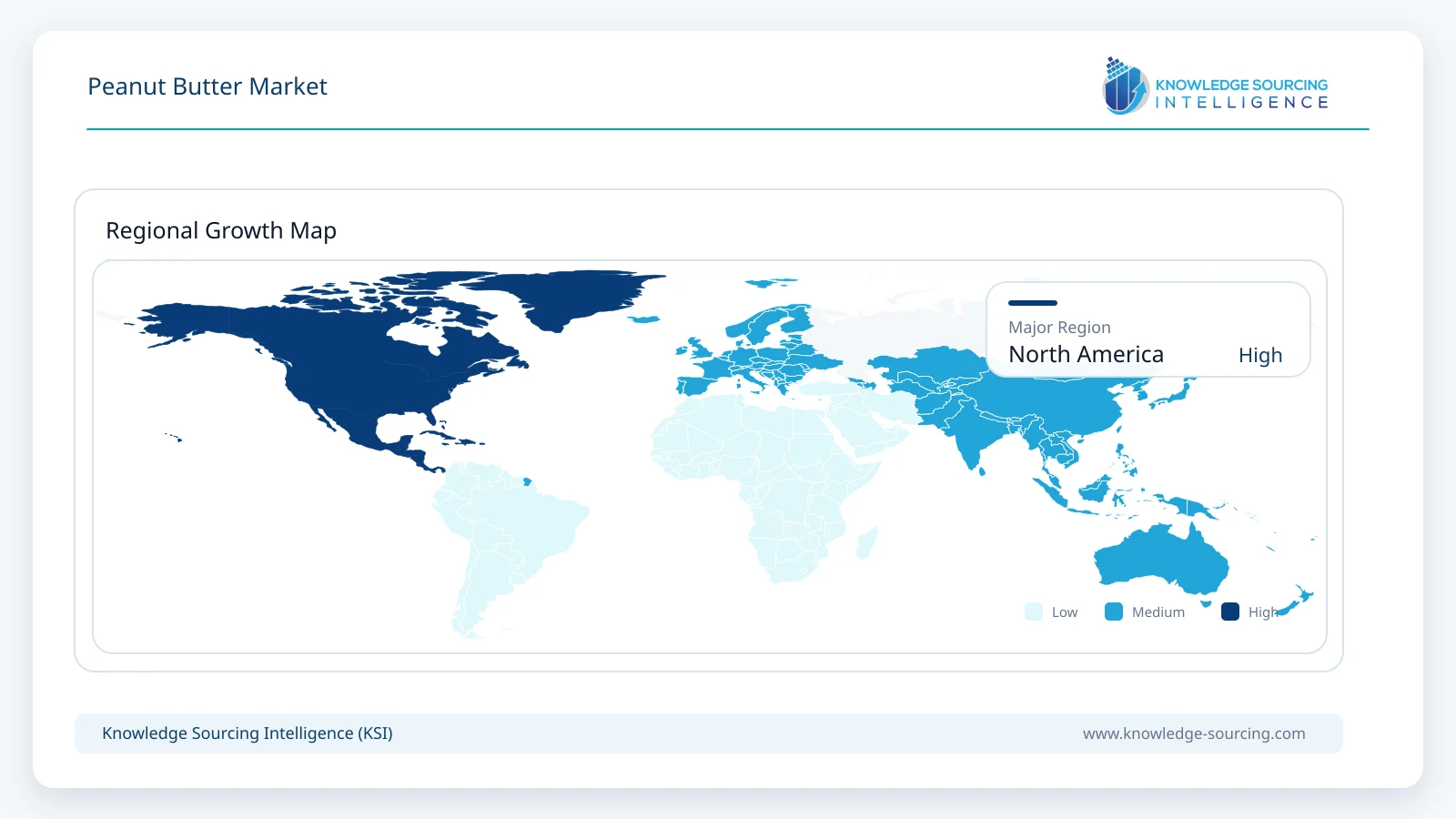
North America remains the largest regional market, supported by high household penetration in the United States and Canada. Jif, SKIPPY, Peter Pan and Kraft represent major mass-market brands, while natural specialists create a broad premium segment. Asia Pacific grows faster from a smaller base, with India providing one of the strongest growth opportunities through fitness, digital commerce and modern retail. Australia and New Zealand also support mature premium and natural peanut butter segments through brands such as Bega, Mayver's, Sanitarium, Pic's and Fix & Fogg.
Competitive Environment
The market combines large packaged-food companies and specialist peanut butter manufacturers. The J.M. Smucker Company owns Jif, Hormel Foods owns SKIPPY, Post Consumer Brands owns Peter Pan, and The Kraft Heinz Company remains active through Kraft Peanut Butter in Canada. Dr. Oetker sells peanut butter within its India spreads portfolio, while Bega Group has a leading Australian spreads position that includes Bega Peanut Butter. Specialist companies compete on natural ingredients, roast profile, origin, powdered formats and portability rather than advertising scale alone.
Recent Developments
August 2026: Jif announced its first major brand refresh in more than 30 years, with updated packaging and a stronger focus on snacking occasions.
June 2026: SKIPPY returned to Canada through a strawberry-stripe peanut butter launch at Costco Canada West.
June 2026: Whole Earth launched 100% Nuts smooth and crunchy peanut butter in the United Kingdom using one ingredient, roasted peanuts.
2026: Fix & Fogg expanded into the United Kingdom through Whole Foods Market and planned additional peanut butter flavors for the year.
2026: Alpino stated that it crossed INR 100 crore in revenue and expanded its protein-focused consumer platform.
2026: Nuflower Foods & Nutrition showcased private-label peanut butter manufacturing capabilities at PLMA Amsterdam and FOODEX Japan.
Peanut Butter Market Scope
| Report Metric | Details |
|---|---|
| Total Market Size in 2026 | USD 5.50 billion |
| Total Market Size in 2031 | USD 7.30 billion |
| Forecast Unit | Billion |
| Growth Rate | 5.8% |
| Study Period | 2021 to 2031 |
| Historical Data | 2021 to 2024 |
| Base Year | 2025 |
| Forecast Period | 2026 – 2031 |
| Segmentation | Type, Texture, Packaging, Distribution Channel, Geography |
| Companies |
|
Market Segmentation
By Type
Processed / Stabilized Peanut Butter
Natural Peanut Butter
Powdered and Other Specialized Formats
By Texture
Creamy / Smooth
Crunchy
By Packaging
Jars
Pouches and Squeeze Packs
Single-Serve Cups / Packets
Others
By Distribution Channel
Offline Retail
Supermarkets and Hypermarkets
Convenience Stores
Specialty and Other Retail
Online Retail
By Geography
North America
United States
Canada
Mexico
South America
Brazil
Argentina
Others
Europe
United Kingdom
Germany
France
Spain
Italy
Others
Middle East & Africa
Saudi Arabia
UAE
South Africa
Others
Asia Pacific
India
China
Japan
Australia
New Zealand
South Korea
Others
Table of Contents
1. EXECUTIVE SUMMARY
2. MARKET SNAPSHOT
2.1. Market Overview
2.2. Market Definition
2.3. Scope of the Study
2.4. Market Segmentation
3. BUSINESS LANDSCAPE
3.1. Market Drivers
3.1.1. Protein-Led Snacking Supports Everyday Consumption
3.1.2. Affordability Relative to Tree-Nut Butters Protects the Mass Market
3.1.3. Product Versatility Expands Usage Across Sweet and Savory Foods
3.2. Market Restraints
3.2.1. Allergen Risk, Crop Volatility and Alternative Spreads Limit Category Expansion
3.3. Market Opportunities
3.4. Porter's Five Forces Analysis
3.5. Industry Value Chain Analysis
3.6. Policies and Regulations
3.7. Strategic Recommendations
4. TECHNOLOGICAL OUTLOOK
4.1. High-Oleic Peanut Processing
4.2. Natural and One-Ingredient Formulation
4.3. Powdered Peanut Butter Processing
4.4. Squeeze and Portable Packaging
4.5. Roasting, Grinding and Texture Control
4.6. Aflatoxin and Pathogen Detection
5. GLOBAL PEANUT BUTTER MARKET BY TYPE
5.1. Introduction
5.2. Processed / Stabilized Peanut Butter
5.3. Natural Peanut Butter
5.4. Powdered and Other Specialized Formats
6. GLOBAL PEANUT BUTTER MARKET BY TEXTURE
6.1. Introduction
6.2. Creamy / Smooth
6.3. Crunchy
7. GLOBAL PEANUT BUTTER MARKET BY PACKAGING
7.1. Introduction
7.2. Jars
7.3. Pouches and Squeeze Packs
7.4. Single-Serve Cups / Packets
7.5. Others
8. GLOBAL PEANUT BUTTER MARKET BY DISTRIBUTION CHANNEL
8.1. Introduction
8.2. Offline Retail
8.2.1. Supermarkets and Hypermarkets
8.2.2. Convenience Stores
8.2.3. Specialty and Other Retail
8.3. Online Retail
9. GLOBAL PEANUT BUTTER MARKET BY GEOGRAPHY
9.1. Introduction
9.2. North America
9.2.1. United States
9.2.2. Canada
9.2.3. Mexico
9.3. South America
9.3.1. Brazil
9.3.2. Argentina
9.3.3. Others
9.4. Europe
9.4.1. United Kingdom
9.4.2. Germany
9.4.3. France
9.4.4. Spain
9.4.5. Italy
9.4.6. Others
9.5. Middle East & Africa
9.5.1. Saudi Arabia
9.5.2. UAE
9.5.3. South Africa
9.5.4. Others
9.6. Asia Pacific
9.6.1. India
9.6.2. China
9.6.3. Japan
9.6.4. Australia
9.6.5. New Zealand
9.6.6. South Korea
9.6.7. Others
10. COMPETITIVE ENVIRONMENT AND ANALYSIS
10.1. Major Players and Strategy Analysis
10.2. Mass-Market, Natural and Functional Positioning
10.3. Product Innovation and Packaging Strategy
10.4. Distribution, Private Label and Regional Expansion
10.5. Competitive Dashboard
11. COMPANY PROFILES
11.1. The J.M. Smucker Company
11.2. Hormel Foods Corporation
11.3. Post Consumer Brands
11.4. The Kraft Heinz Company
11.5. Dr. Oetker India
11.6. Bega Group
11.7. Sanitarium Health Food Company
11.8. Pintola
11.9. PB2 Foods, Inc.
11.10. Crazy Richard's Peanut Butter Company
11.11. Once Again Nut Butter
11.12. Peanut Butter & Co.
11.13. Galdisa USA
11.14. ManiLife
11.15. Mayver's
11.16. Pic's Peanut Butter
11.17. Fix & Fogg
11.18. Nuflower Foods & Nutrition Pvt. Ltd.
11.19. Alpino Health Foods
12. APPENDIX
12.1. Currency
12.2. Assumptions
12.3. Base and Forecast Years Timeline
12.4. Key Benefits for Stakeholders
12.5. Research Methodology
12.6. Abbreviations
LIST OF FIGURES
LIST OF TABLES
Navigate
Trusted by the world's leading organizations











