
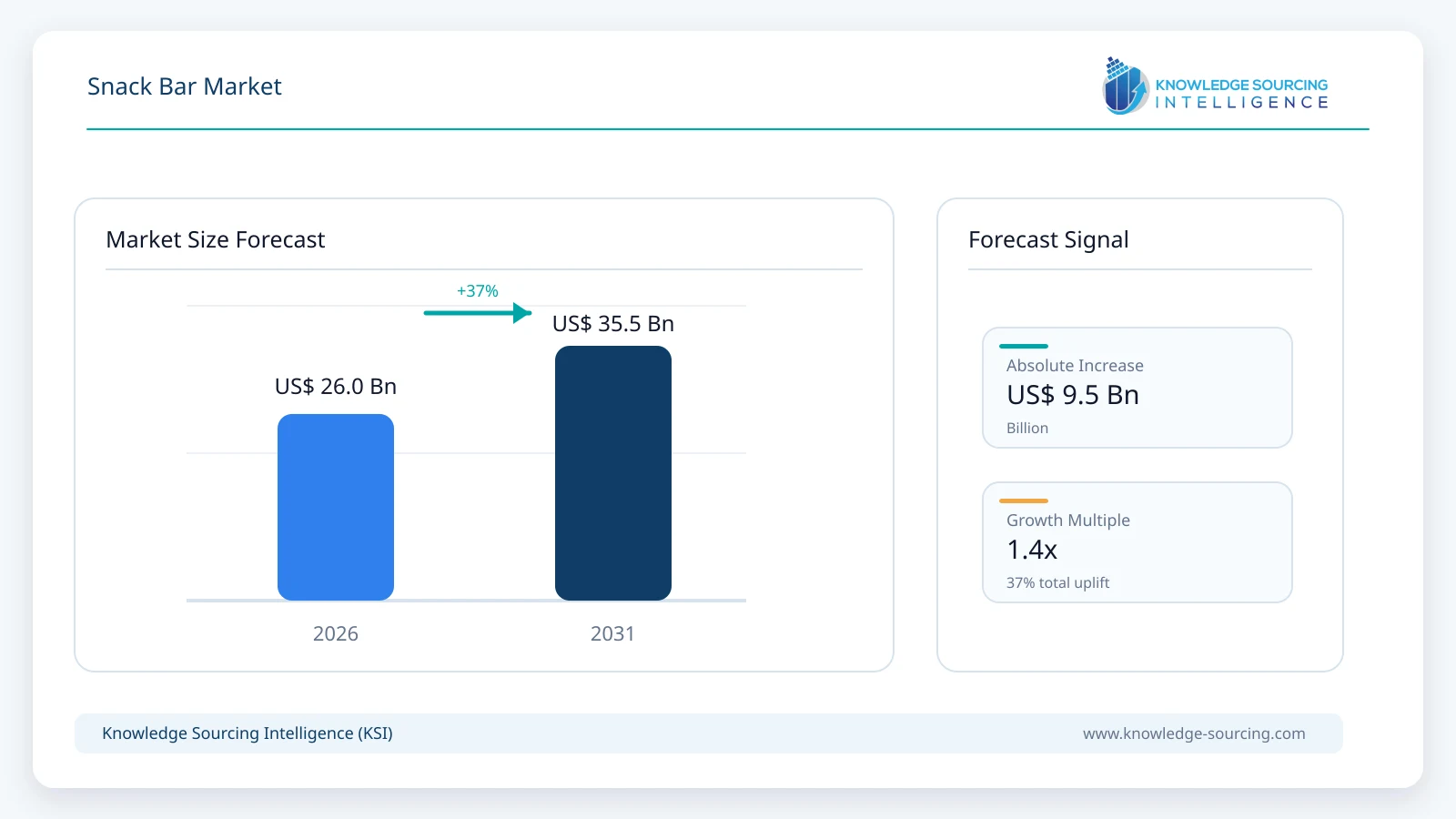
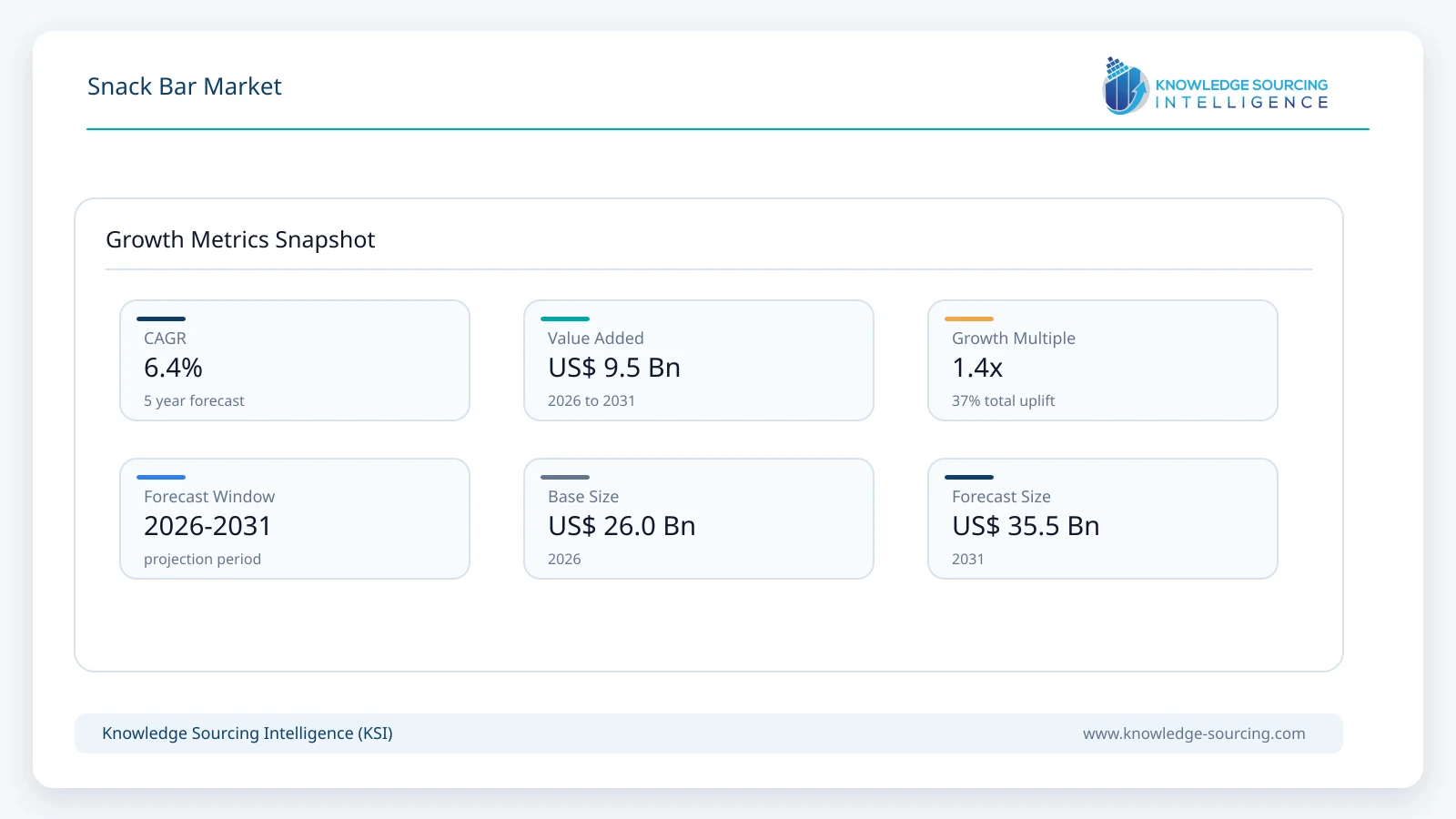
The global snack bar market is forecast to grow from USD 26.0 billion in 2026 to USD 35.5 billion in 2031, representing a CAGR of approximately 6.4% during the forecast period.
Highlights:
- 1Energy and nutrition bars account for approximately 44% of global snack bar market value in 2026, supported by strong consumer demand for protein, functional ingredients and meal-supplement formats.
- 2Offline channels account for approximately 81% of global market value in 2026, reflecting the importance of supermarkets, convenience stores, pharmacies, gyms and mass retail.
- 3Online distribution is the fastest-growing major channel through 2031, supported by direct-to-consumer brands, marketplace availability and multipack purchasing.
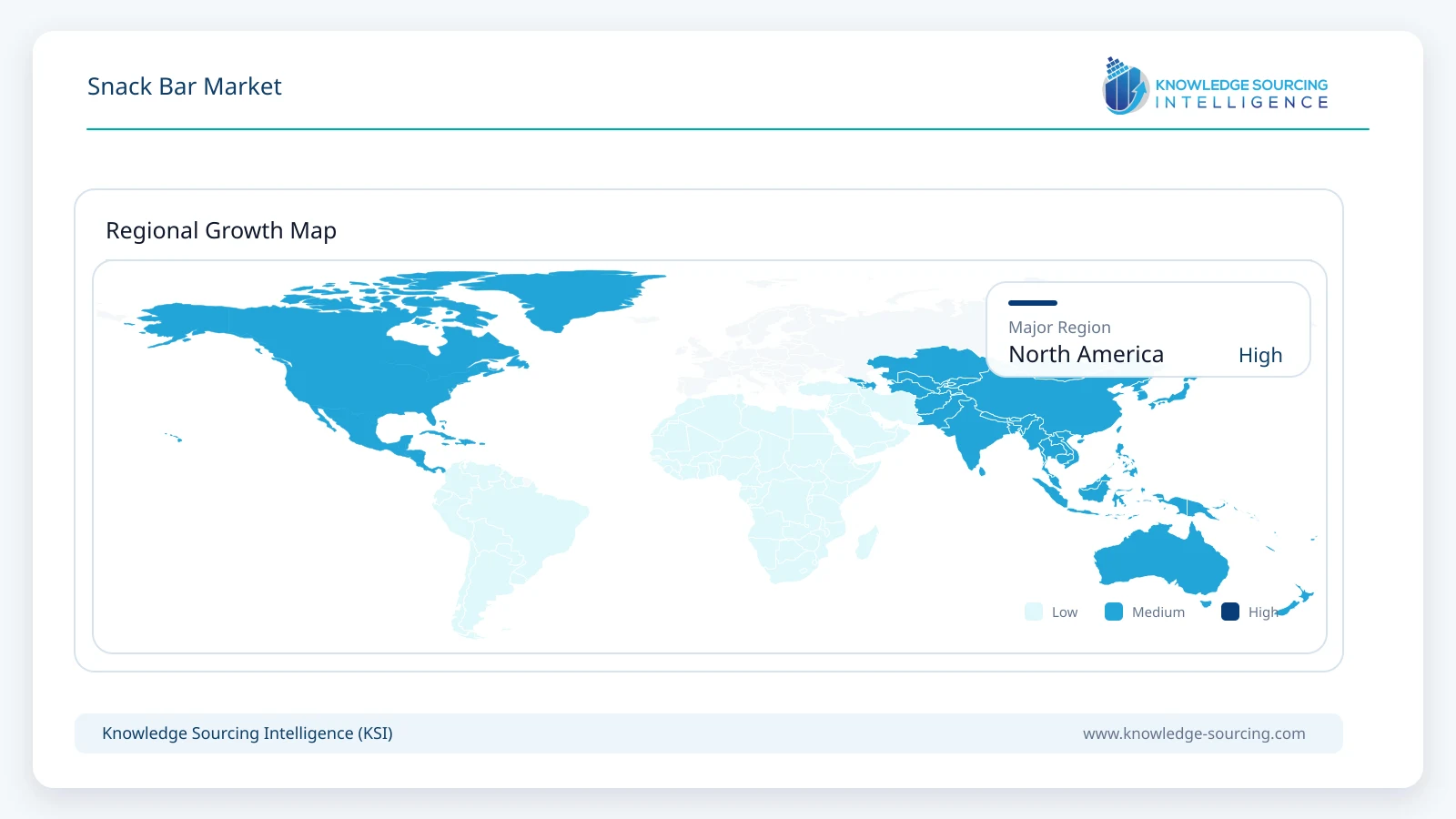
- 4North America accounts for approximately 49% of global snack bar market value in 2026, supported by a mature protein-bar category and high penetration of packaged on-the-go snacks.
- 5The United States remains the largest individual market in 2026, with Circana reporting USD 10.9 billion in snack and granola bar retail sales during the 52 weeks ending March 22, 2026.
Report Overview
Snack bars include packaged ready-to-eat bars designed for between-meal consumption, convenient nutrition, meal supplementation or energy intake. The market includes granola and muesli bars, fruit bars, energy and nutrition bars and other cereal-, nut-, seed- and protein-based bar formats. Confectionery bars, standalone chocolate bars and conventional biscuits are excluded unless positioned and sold primarily as snack or nutrition bars.
The 2026 market base reflects a stronger current category than the previous KSI 2025 estimate indicated. Circana data reported by Snack Food & Wholesale Bakery shows that the U.S. snack bars and granola bars category generated approximately USD 10.9 billion in retail sales during the 52 weeks ending March 22, 2026, increasing 7.1% year over year. The nutritional and intrinsic-health-value bar subcategory alone generated approximately USD 5.9 billion and increased 15.4%, while traditional breakfast, cereal and snack bars declined. This split indicates that market growth is increasingly being driven by functional nutrition rather than uniform expansion across all bar types.
The current market is therefore characterized by two simultaneous trends. Traditional cereal and breakfast-bar categories face mature demand and stronger price competition, while high-protein, fiber-enhanced, low-sugar and functional bars continue expanding rapidly. PepsiCo's 2026 Quaker launches include Protein Granola Bars and Chewy Protein Granola Bars, while Perfect Snacks introduced a refrigerated bar combining 20 grams of protein with prebiotic fiber. These developments demonstrate how manufacturers are repositioning bars around more specific nutritional benefits rather than relying only on portability.
Market Trends
Protein and Functional Nutrition Are Reshaping the Category
Protein has become one of the strongest product-development themes in snack bars, but the category is increasingly moving beyond a simple high-protein claim. Manufacturers are adding prebiotic fiber, whole grains, lower-sugar formulations and cleaner ingredient lists to differentiate products within an increasingly crowded market. Perfect Snacks launched Protein + Prebiotics in March 2026 with 20 grams of protein and prebiotic fiber, while PepsiCo expanded Quaker's bar portfolio with Protein Granola Bars and Chewy Protein Granola Bars. Circana data illustrates the commercial effect: nutritional and intrinsic-health-value bars generated USD 5.9 billion in U.S. sales in the 52 weeks ending March 22, 2026, increasing 15.4%, substantially outperforming conventional breakfast and cereal bars. This shift increases competition between traditional cereal-bar manufacturers, sports-nutrition brands and mainstream packaged-food companies, as all three increasingly target consumers seeking convenient functional nutrition.
Taste and Texture Are Becoming More Important in Protein Bars
Early protein bars were often marketed primarily around macronutrient content, but consumers increasingly expect the sensory quality of conventional snacks alongside nutritional benefits. Manufacturers are therefore investing in layered textures, softer centers, crisp inclusions and dessert-inspired flavors that reduce the distinction between functional bars and indulgent snacks. FITCRUNCH introduced its Puff N' Crunchy Protein Bars in July 2026 with layered soft, crisp and chocolate-coated textures, while Perfect Snacks continues to use refrigerated formats built around peanut butter and whey protein. Better sensory performance expands the category beyond athletes and dedicated fitness consumers because bars can compete for general snacking occasions rather than only post-workout use. The result is a broader market in which taste, texture and convenience are increasingly as important as headline protein content, especially as competing products converge around similar nutritional claims.
Traditional Granola Bars Are Being Reformulated Rather Than Disappearing
Conventional granola and cereal bars remain important but are being adapted to reflect changing consumer expectations. PepsiCo expanded Quaker's 2026 portfolio with protein-enhanced granola bars, while General Mills continues supporting Nature Valley across both traditional crunchy granola and protein formats. Circana data shows that granola bars generated approximately USD 1.8 billion in U.S. sales during the latest reported period, increasing only modestly, while conventional breakfast, cereal and snack bars declined. This does not indicate the disappearance of cereal-based bars; instead, the category is fragmenting between value-oriented traditional products and more functional formulations positioned around protein, whole grains, fiber or reduced sugar. Manufacturers with established granola brands therefore have an opportunity to use existing consumer recognition while introducing new nutritional propositions rather than building entirely new brands.
Regulation Is Increasing Pressure on Health-Oriented Claims
Health-positioned snack bars increasingly need to support their claims with formulations that meet tighter nutritional standards. The U.S. Food and Drug Administration's updated definition of the voluntary “healthy” claim requires products to contain meaningful quantities of recommended food groups while remaining within defined limits for saturated fat, sodium and added sugars. The FDA specifically identifies snack bars high in added sugar as products that may no longer qualify under the revised framework. This creates stronger incentives to reduce added sugars and use whole grains, nuts, seeds and other recognizable ingredients when brands want to communicate a broader health proposition. The regulation does not prevent indulgent snack bars from competing successfully, but it raises the distinction between products marketed as functional or nutritionally beneficial and those positioned primarily around taste and convenience.
Market Drivers
Demand for Convenient Protein Is Expanding Beyond Sports Nutrition
Protein consumption is increasingly part of mainstream food behavior rather than a niche sports-nutrition practice. PepsiCo reported in 2026 that 62% of surveyed Americans were looking to increase protein intake during the year and that 63% would select snacks with added protein over conventional alternatives. This consumer shift supports growth in bars because they provide a portable format that can deliver meaningful protein without preparation or refrigeration in most cases. The market opportunity extends beyond high-performance protein bars into products designed for breakfast, children's snacks, office consumption and general between-meal use. Manufacturers are responding with a wider range of protein levels and price points rather than targeting only consumers seeking 20 grams or more per serving. This broadens the addressable market and supports continued innovation across both premium and mass-market brands.
Convenience and Portion Control Support Regular Consumption
Snack bars fit well with eating patterns in which consumers replace or supplement conventional meals with smaller eating occasions throughout the day. Their shelf stability, portability and pre-portioned format make them suitable for commuting, school, travel, work and outdoor activities. These characteristics are difficult to replicate with many fresh snacks because bars require no utensils, preparation or temperature control. Convenience-store distribution reinforces this behavior because products can be purchased individually for immediate consumption, while supermarkets and warehouse clubs support multipack purchasing for household use. The format also allows manufacturers to target several need states using similar production infrastructure, ranging from indulgent granola bars to protein-heavy meal supplements. This versatility supports recurring demand even as specific nutritional trends change over time.
Developing Markets Offer a Longer Penetration Runway
Snack bar penetration remains lower in many developing markets than in North America and Western Europe, but organized retail, modern convenience stores and online commerce are improving access. Rising disposable incomes and busier urban lifestyles increase the attractiveness of packaged portable snacks, while the spread of fitness and protein consumption introduces additional demand for nutrition bars. In India, Cutis Consumer launched a protein bar at INR 20 in March 2026 with a strategy focused specifically on Tier 2, Tier 3 and Tier 4 cities, illustrating how brands are attempting to move protein-bar consumption beyond premium metropolitan consumers. Local affordability remains essential, meaning growth in developing markets is likely to depend on smaller pack sizes and locally appropriate price points rather than direct replication of premium Western protein-bar formats.
Market Restraints and Challenges
Traditional Bar Categories Are Showing Maturity
Growth is not uniform across the snack bar market. Circana data shows that U.S. breakfast, cereal, snack bars and clusters generated approximately USD 2.3 billion during the 52 weeks ending March 22, 2026 but declined 6.4% year over year. Several leading brands also recorded declines within this subcategory, indicating that market expansion is increasingly concentrated in specific functional segments rather than conventional bars as a whole. Mature products face competition not only from newer protein bars but also from yogurt, meat snacks, protein chips, beverages and other convenient formats that increasingly make similar nutritional claims. Manufacturers therefore need to reformulate or reposition mature brands rather than assume that broader snacking growth will automatically translate into higher bar sales.
Ingredient Costs and Premium Formulations Can Raise Retail Prices
Snack bars frequently contain nuts, oats, cocoa, whey protein, plant proteins, dried fruit, seeds, fibers and specialty sweeteners, exposing manufacturers to several agricultural and commodity-price cycles. Products emphasizing clean labels or high protein often use relatively expensive ingredients and can require more complex manufacturing than basic cereal bars. Premium prices may be accepted by health-conscious or fitness-oriented consumers, but they restrict penetration when economic conditions weaken or when consumers compare bars with less expensive conventional snacks. Manufacturers therefore need to balance nutritional differentiation with affordability, especially in developing markets where a high per-serving price can substantially limit repeat purchasing.
Snack Bar Market Segment Analysis
By Product
Energy and Nutrition Bars
Energy and nutrition bars are projected to generate approximately USD 17.1 billion by 2031, remaining the largest and fastest-expanding major product group as protein, fiber and functional nutrition increasingly shape category growth. The segment includes protein bars, energy bars and other products positioned around specific nutritional benefits rather than conventional cereal snacking alone. Circana's U.S. data provides a clear indicator of this shift, with nutritional and intrinsic-health-value bars increasing 15.4% during the latest reported 52-week period while conventional breakfast and cereal bars declined. Innovation is broadening the segment beyond traditional fitness use through lower-protein family products, meal-supplement bars, prebiotic formulations and indulgent formats that combine strong nutrition credentials with more conventional snack textures. Protein remains the most visible claim, but competition increasingly depends on the complete formulation, including fiber, sugar content, ingredient quality and taste.
By Distribution Channel
Online
Online distribution is projected to reach approximately USD 8.2 billion by 2031, increasing its share as consumers purchase multipacks, specialist nutrition brands and subscription-oriented products through marketplaces and direct-to-consumer websites. Digital retail is particularly suitable for snack bars because products are shelf stable, compact and comparatively inexpensive to ship relative to fresh foods. E-commerce also allows smaller brands to reach national markets without immediately obtaining broad supermarket distribution, while established companies can use online platforms to test new flavors and bundle formats. Physical retail remains the largest channel because individual bars are frequently impulse purchases and supermarkets, convenience stores and mass retailers provide extensive category visibility. However, online sales gain share as consumers increasingly purchase nutrition products in larger quantities and use digital channels to compare protein content, ingredients, reviews and price per serving.
Major Region
North America
North America is projected to generate approximately USD 16.4 billion in snack bar revenue by 2031, remaining the largest regional market. The region combines high category awareness with extensive supermarket, convenience, club, pharmacy, gym and online distribution, while protein consumption and functional snacking are already established consumer behaviors.
U.S. Circana data indicates that snack bars and granola bars generated USD 10.9 billion in retail sales during the 52 weeks ending March 22, 2026, providing a substantial base before Canadian and Mexican consumption is included. The region is also a major innovation center, with companies including General Mills, Mondel?z, PepsiCo, Mars, Perfect Snacks and 1440 Foods competing across traditional granola, protein and functional formats. Growth moderates relative to earlier category-expansion periods because penetration is already high, but premiumization and protein-focused innovation continue supporting value growth.
Major Country
United States
The United States remains the largest individual snack bar market and is projected to generate approximately USD 13.6 billion by 2031. Current retail data shows unusually strong divergence between bar subcategories: nutritional and intrinsic-health-value bars are expanding rapidly, while conventional breakfast and cereal bars are contracting. This shifts the competitive center of the market toward brands such as CLIF, Barebells, FITCRUNCH, Perfect Bar and other protein- or function-led products, while established cereal-bar suppliers increasingly add protein and fiber to conventional portfolios. U.S. labeling rules also influence formulation because brands using explicit health positioning need to manage added sugar, saturated fat and sodium alongside protein and whole-grain claims. The combination of high consumption, strong retail infrastructure, rapid product innovation and an established nutrition market keeps the United States central to the global category through 2031.
Competitive Environment and Analysis
The snack bar market combines multinational packaged-food companies, dedicated nutrition brands and fast-growing specialist businesses. General Mills participates through Nature Valley, while Mondel?z owns CLIF and several adjacent snacking businesses. PepsiCo competes through Quaker and continued 2026 investment in protein-oriented product extensions. Mars owns KIND, while 1440 Foods operates brands including Pure Protein and FITCRUNCH. Perfect Snacks participates in refrigerated nutrition bars, while companies such as Barebells, MadeGood, RXBAR, LÄRABAR, Quest Nutrition and GoMacro compete through differentiated nutritional or ingredient positioning.
Competitive advantage increasingly depends on brand recognition, retail distribution, taste, formulation, protein content, clean-label credibility and pricing rather than basic product availability. Mature cereal-bar brands benefit from extensive household penetration and retailer relationships, while newer nutrition brands can gain share quickly when they combine strong sensory performance with a clear functional proposition. The continued expansion of protein across adjacent snack categories also means bar manufacturers increasingly compete with protein chips, meat snacks, drinks and other portable nutrition formats rather than only with other bars.
Recent Developments
July 2026: FITCRUNCH introduced Puff N' Crunchy Protein Bars, combining protein and fiber with a layered soft-and-crisp texture.
July 2026: General Mills introduced limited-edition Nature Valley packaging connected with major U.S. national parks across Crunchy, Protein and Sweet & Salty Nut products.
June 2026: PepsiCo expanded Quaker's protein-bar portfolio with Chocolate Pretzel Protein Granola Bars and additional Chewy Protein Granola Bar flavors.
March 2026: Perfect Snacks introduced Protein + Prebiotics refrigerated bars containing 20 grams of protein and prebiotic fiber.
March 2026: Cutis Consumer launched an INR 20 protein bar in India with an expansion strategy targeting lower-tier cities and mass-market affordability.
Market Outlook
Growth is increasingly concentrated in energy, protein and nutrition-oriented bars, while conventional breakfast and cereal bars face more mature demand.
Product development is expected to focus on protein, fiber, reduced sugar, clean ingredients and improved sensory quality. Online distribution gains share, but supermarkets and convenience stores remain essential because bars continue to benefit from impulse and immediate-consumption occasions.
North America remains the largest regional market through 2031, led by the United States, although Asia Pacific and other developing regions provide a longer penetration runway as organized retail and protein-oriented nutrition become more widely available. The market therefore develops through a combination of functional premiumization in mature markets and broader category penetration in developing economies.
Snack Bar Market Scope:
| Report Metric | Details |
|---|---|
| Total Market Size in 2026 | USD 26.0 billion |
| Total Market Size in 2031 | USD 35.5 billion |
| Forecast Unit | Billion |
| Growth Rate | 6.4% |
| Study Period | 2021 to 2031 |
| Historical Data | 2021 to 2024 |
| Base Year | 2025 |
| Forecast Period | 2026 – 2031 |
| Segmentation | Product, Distribution Channel, Geography |
| Companies |
|
Market Segmentation
BY PRODUCT
Granola/Muesli
Fruit
Energy and Nutrition
Others
BY DISTRIBUTION CHANNEL
Online
Offline
Supermarkets/Hypermarkets
Convenience Stores
Specialty Stores
Others
BY GEOGRAPHY
North America
By Product
By Distribution Channel
By Country
United States
Canada
Mexico
South America
By Product
By Distribution Channel
By Country
Brazil
Argentina
Others
Europe
By Product
By Distribution Channel
By Country
United Kingdom
Germany
France
Italy
Spain
Others
Middle East and Africa
By Product
By Distribution Channel
By Country
Saudi Arabia
UAE
South Africa
Others
Asia Pacific
By Product
By Distribution Channel
By Country
China
India
Japan
South Korea
Indonesia
Thailand
Australia
Others
Table of Contents
1. EXECUTIVE SUMMARY
2. MARKET SNAPSHOT
2.1. Market Overview
2.2. Market Definition
2.3. Scope of the Study
2.4. Market Segmentation
3. BUSINESS LANDSCAPE
3.1. Market Drivers
3.2. Market Restraints
3.3. Market Opportunities
3.4. Porter’s Five Forces Analysis
3.5. Industry Value Chain Analysis
3.6. Protein and Functional Nutrition Outlook
3.7. Ingredient and Formulation Trends
3.8. Regulatory and Food Labelling Environment
3.9. Strategic Recommendations
4. SNACK BAR MARKET BY PRODUCT
4.1. Introduction
4.2. Granola/Muesli
4.3. Fruit
4.4. Energy and Nutrition
4.5. Others
5. SNACK BAR MARKET BY DISTRIBUTION CHANNEL
5.1. Introduction
5.2. Online
5.3. Offline
5.3.1. Supermarkets/Hypermarkets
5.3.2. Convenience Stores
5.3.3. Specialty Stores
5.3.4. Others
6. SNACK BAR MARKET BY GEOGRAPHY
6.1. Introduction
6.2. North America
6.2.1. By Product
6.2.2. By Distribution Channel
6.2.3. By Country
6.2.3.1. United States
6.2.3.2. Canada
6.2.3.3. Mexico
6.3. South America
6.3.1. By Product
6.3.2. By Distribution Channel
6.3.3. By Country
6.3.3.1. Brazil
6.3.3.2. Argentina
6.3.3.3. Others
6.4. Europe
6.4.1. By Product
6.4.2. By Distribution Channel
6.4.3. By Country
6.4.3.1. United Kingdom
6.4.3.2. Germany
6.4.3.3. France
6.4.3.4. Italy
6.4.3.5. Spain
6.4.3.6. Others
6.5. Middle East and Africa
6.5.1. By Product
6.5.2. By Distribution Channel
6.5.3. By Country
6.5.3.1. Saudi Arabia
6.5.3.2. UAE
6.5.3.3. South Africa
6.5.3.4. Others
6.6. Asia Pacific
6.6.1. By Product
6.6.2. By Distribution Channel
6.6.3. By Country
6.6.3.1. China
6.6.3.2. India
6.6.3.3. Japan
6.6.3.4. South Korea
6.6.3.5. Indonesia
6.6.3.6. Thailand
6.6.3.7. Australia
6.6.3.8. Others
7. COMPETITIVE ENVIRONMENT AND ANALYSIS
7.1. Major Players and Strategy Analysis
7.2. Market Share Analysis
7.3. Mergers, Acquisitions, Agreements, and Collaborations
7.4. Competitive Dashboard
8. COMPANY PROFILES
8.1. General Mills, Inc.
8.2. Mondel?z International, Inc.
8.3. PepsiCo, Inc.
8.4. Mars, Incorporated
8.5. 1440 Foods
8.6. Kellanova
8.7. The Simply Good Foods Company
8.8. Perfect Snacks
8.9. Barebells Functional Foods
8.10. MadeGood Foods Inc.
8.11. GoMacro, LLC
8.12. Quest Nutrition
8.13. Weetabix Limited
8.14. Hero Group
8.15. The Hain Celestial Group, Inc.
9. APPENDIX
9.1. Market Definition and Scope
9.2. Currency
9.3. Assumptions
9.4. Base and Forecast Years
9.5. Research Methodology
9.6. Segment Modelling
9.7. Data Triangulation and Validation
9.8. Abbreviations
Navigate
Trusted by the world's leading organizations











