
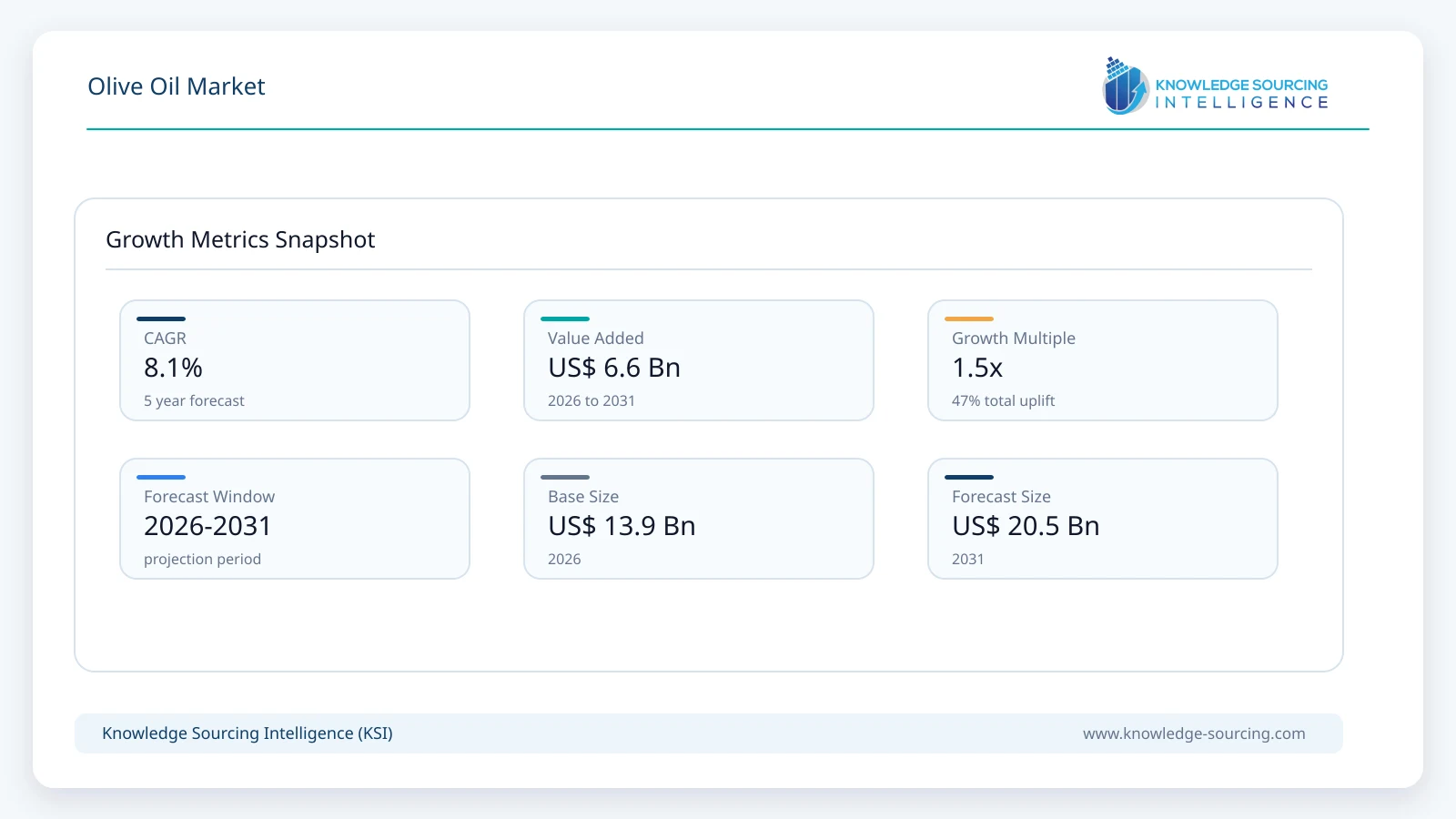
The Olive Oil market is forecast to grow at a CAGR of 8.1%, reaching USD 20.5 billion in 2031 from USD 13.9 billion in 2026.
Highlights:
- 1Virgin Oil represents approximately 65% of the global market value in 2026 and increases to around 68% by 2031.
- 2Physical and Mechanical processing accounts for approximately 72% of market value in 2026 and gains share with the expansion of virgin oils.
- 3Retail Households remain the largest industry segment at approximately 61% of market value in 2026.
- 4Online distribution is projected to increase from around 16% of global market value in 2026 to approximately 22% by 2031.
- 5Europe accounts for approximately 47% of the global market value in 2026 but loses modest share as consumption grows outside traditional producing markets.
- 6Asia Pacific increases from approximately 15% to 18% of the global market value through 2031.
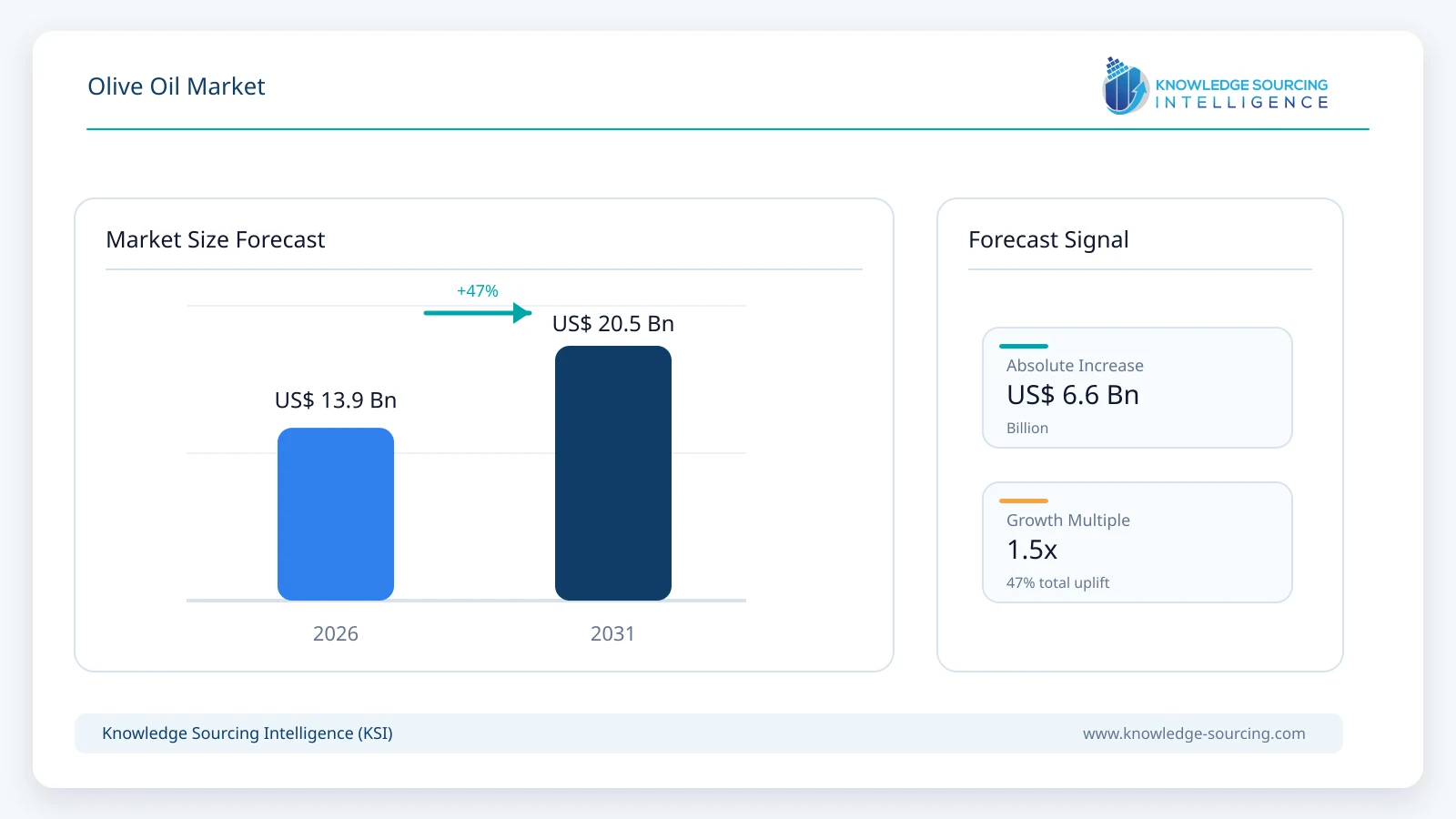
Growth in market value is expected to remain stronger than the expansion in physical consumption as higher-value virgin oils, branded extra-virgin products and new international markets account for a larger proportion of spending. Global olive oil consumption is estimated at approximately 3.25 million tonnes in the 2025/26 crop year, compared with about 3.22 million tonnes in 2024/25, while consumption has almost doubled since 1990/91.
The market entered 2026 with materially better supply conditions than during the earlier shortage period. Global production recovered from approximately 2.59 million tonnes in 2023/24 to 3.57 million tonnes in 2024/25 and is estimated at around 3.44 million tonnes in 2025/26. Spain remains the largest producer, while Italy, Greece, Portugal, Türkiye and Tunisia provide a substantial part of additional global supply. The return of production to more normal levels has reduced some of the severe price pressure seen during the previous shortage and has supported a recovery in consumption.
Virgin Oil accounts for approximately 65% of market value in 2026 and is projected to increase to around 68% by 2031. The category captures most extra-virgin and premium products, where origin, olive variety, harvest quality and extraction process support higher average selling prices. Refined and pomace oils remain important in mainstream cooking, food manufacturing and foodservice, but their contribution to total value grows more slowly.
Europe represents approximately 47% of global market value in 2026. The region remains the largest market because Spain, Italy and other Mediterranean countries combine high per-capita consumption with substantial domestic production. Its share nevertheless declines to around 44% by 2031 as demand grows faster in North America and Asia Pacific. This continues a longer-term shift in consumption away from the European Union, whose share of global olive oil consumption has fallen materially over the past two decades.
Market Growth Drivers and Trends
Growth of Olive Oil Consumption Outside Traditional European Markets
Olive oil consumption is becoming less dependent on its historical Mediterranean base. The European Union accounted for more than 70% of world consumption in 2004/05, but its share has fallen to around 45% in recent crop years as demand has expanded in the United States, Brazil and other non-producing markets. The United States imported more than 437,000 tonnes during the 2024/25 crop year, 20.6% above the previous season, with virgin oils accounting for 73.5% of imports. Brazil imported almost 81,000 tonnes in 2024/25 and recorded a 40.5% increase during the first six months of 2025/26. These markets remain much smaller on a per-capita basis than Spain or Italy, leaving more room for category penetration over the forecast period.
The existing KSI page correctly identifies Asia Pacific as an important area of development, but the earlier supporting figures should be refreshed rather than retained unchanged. Demand in China, India, Japan and South Korea remains considerably lower than in Mediterranean countries, although higher household incomes, imported-food distribution and increased use of olive oil in international cuisine continue to broaden consumption. The regional market is therefore projected to grow faster than Europe and increase from approximately 15% of global value in 2026 to around 18% by 2031.
Shift Toward Virgin and Extra-Virgin Olive Oil
The market is moving toward products that compete on origin, quality and processing rather than only on cooking functionality. Extra-virgin oils can be differentiated by country, region, olive variety, harvest date, organic certification and sensory profile, giving producers greater scope to maintain pricing above refined olive oil and most other edible oils. The existing KSI page already identifies higher-quality products and flavoured oils as a growth area, and this remains relevant when placed within the broader shift toward premium virgin oils.
This change is visible across leading company portfolios. Deoleo operates international brands including Bertolli, Carbonell and Carapelli and has placed premiumisation at the centre of its current EVOO-lution strategy. Monini, Olitalia, Oleoestepa, Colavita and other established suppliers maintain extensive extra-virgin ranges differentiated by origin and intended use. Virgin Oil is therefore estimated to increase from approximately USD 9.04 billion in 2026 to USD 13.94 billion by 2031, while its share rises from 65% to around 68%.
Recovery of Global Olive Oil Production
The recovery in production after the 2023/24 shortage has improved product availability and reduced some of the pressure that had restricted consumption. World olive oil output increased by approximately 38% in 2024/25 to around 3.57 million tonnes. Production is estimated to moderate to approximately 3.44 million tonnes in 2025/26, but this remains well above the level recorded during the previous shortage. Spain produced an estimated 1.42 million tonnes in 2024/25, while Türkiye and Tunisia also recorded substantial increases.
The return of supply has already affected producer prices. Extra-virgin olive oil prices in Bari were materially lower year-on-year during several months of 2026, while prices in Spain remained below the extreme levels reached during the earlier shortage. A more balanced supply environment improves affordability for households and allows retailers to restore promotions, although olive oil remains exposed to agricultural volatility.
Expansion in Foodservice and Food Manufacturing
Households account for most olive oil spending, but foodservice and food manufacturing provide a growing part of incremental demand. Restaurants use virgin oils for salads, finishing, sauces and Mediterranean dishes, while refined and pomace oils remain relevant where cooking cost and heat performance are more important. Olitalia maintains a dedicated foodservice operation with separate kitchen and table ranges and states that it has more than 30 years of experience serving professional users.
NielsenIQ research conducted for Olitalia in 2025 identified the company as the preferred oil brand among surveyed Italian chefs and purchasing decision-makers in restaurants, pizzerias and hotels with kitchens. This illustrates the commercial importance of professional oil products rather than treating olive oil demand as a purely household category. HoReCa is consequently projected to increase from approximately 16% of global market value in 2026 to around 17% by 2031.
Food manufacturers represent another expanding channel. Olive oil is used in sauces, dressings, bakery products, prepared foods and premium packaged products, where its presence can also support product positioning. The Food & Beverage Industry segment is therefore projected to grow faster than household retail and increase from approximately 18% to 19% of global market value.
Innovation in Packaging and Product Format
Product innovation is increasingly focused on convenience, portion control and packaging in addition to flavour. The current KSI page already highlights flavoured olive oils, including garlic, chilli, basil and truffle variants, as one area of differentiation. More recent developments show that packaging is also being used to improve usability and reduce waste.
Borges introduced a dual-outlet DUO cap in June 2026 that allows consumers to select a finer or heavier pouring flow by changing the orientation of the bottle. Olitalia markets squeeze-format products designed to provide greater control during cooking and has also introduced alternative packaging including bag-in-box formats. These developments do not change the fundamental market structure, but they allow established brands to differentiate products in a category where the underlying ingredient remains relatively standardized.
Market Restraints
Weather-Driven Production Volatility
Olive oil supply remains highly dependent on weather conditions in a small number of Mediterranean producing countries. Drought, high temperatures, excessive rainfall and alternate-bearing cycles can materially change harvest volumes from one crop year to the next. World production fell to approximately 2.59 million tonnes in 2023/24 before rising to 3.57 million tonnes the following year, demonstrating how quickly raw-material availability can change.
The existing KSI page correctly identifies climate variability as a major structural risk, but the current evidence provides a stronger basis for the argument. The volatility affects processors, branded suppliers and retailers because changes in agricultural output can lead to large movements in procurement cost and consumer pricing within a relatively short period.
Premium Pricing Relative to Other Edible Oils
Olive oil continues to compete with sunflower, soybean, rapeseed, corn and other vegetable oils that are generally cheaper for everyday cooking. The price differential is particularly important in countries where olive oil is not part of the traditional household diet.
Virgin and extra-virgin oils can sustain higher prices when consumers understand their origin and quality differences, but the same premium can limit household penetration in price-sensitive markets. Refined and pomace oils remain important because they provide lower-priced entry points into the category.
Traceability and Product Authenticity
The existing KSI page also correctly identifies traceability as an important industry issue. Product grade, origin and extraction method materially influence olive oil pricing, which makes authentication especially important in premium extra-virgin products.
Large producers and retailers increasingly invest in testing, sourcing controls and traceability systems to support grade and origin claims. These measures improve confidence in the category but add procurement, testing and compliance costs. They are particularly important where oils from multiple countries or harvests are blended before bottling.
Geographic Concentration of Production
Global supply remains concentrated in Spain and a relatively small group of Mediterranean countries. European producers accounted for around 2.11 million tonnes in 2024/25, with Spain contributing approximately 1.42 million tonnes. Italy, Greece, Portugal, Türkiye and Tunisia provide much of the remaining internationally traded supply.
The concentration leaves import-dependent countries exposed to harvest conditions and pricing in a limited number of regions. New production in Australia, South America and other markets provides some diversification, but it remains too small to offset a severe Mediterranean production decline.
Consumer Understanding of Olive Oil Grades
The distinction between extra-virgin, virgin, refined and pomace oils is not always clear to consumers outside established olive-oil markets. Product quality and price therefore depend partly on the industry's ability to explain extraction method, grade, origin and intended culinary use.
This is more important in developing markets where olive oil competes against familiar local cooking oils with substantially lower prices. Companies seeking faster growth in Asia and other emerging consumption markets need to combine distribution expansion with consumer education rather than relying only on wider retail availability.
Olive Oil Market Segmentation Analysis
By Product Type
Virgin Oil
Virgin Oil accounts for approximately USD 9.04 billion, or 65% of global market value, in 2026. It covers oils obtained through mechanical or physical processes without refining and captures most extra-virgin products sold through premium retail, specialty food and foodservice channels.
The category grows faster than the overall market and reaches approximately USD 13.94 billion by 2031. Higher average selling prices, stronger consumer preference for extra-virgin oils and increased consumption outside traditional producing markets raise its share to around 68% by the end of the forecast period.
Refined Oil
Refined Oil represents approximately USD 3.48 billion, or 25% of market value, in 2026. It provides a more neutral flavour and generally lower price than extra-virgin olive oil and remains relevant across household cooking, food processing and blended products.
The segment reaches approximately USD 4.71 billion by 2031 but declines to around 23% of market value. Demand continues to expand in absolute terms, although higher-value virgin products capture a larger part of incremental spending.
Pomace Oil
Pomace Oil accounts for approximately USD 1.39 billion, or 10% of global market value, in 2026. The product is derived from the residual olive material left after mechanical extraction and normally requires additional extraction and refining before consumption.
The category remains important in foodservice and price-sensitive cooking applications where users want an olive-derived oil at a lower cost than extra-virgin products. Market value reaches approximately USD 1.85 billion by 2031, while its share declines modestly to around 9%.
By Production
Physical and Mechanical processing accounts for approximately 72% of market value in 2026. This category covers mechanically extracted virgin oils and is therefore closely aligned with the higher-value part of the olive oil market. Its share increases to around 75% by 2031 as extra-virgin and other virgin products gain a larger part of total spending.
Chemical processing, as defined in the existing KSI segmentation, covers refining and extraction routes associated primarily with refined olive oil and olive-pomace oil. The category accounts for approximately 28% of market value in 2026 and declines to around 25% by 2031. The terminology should be retained for consistency with the published report, but the report methodology should clarify that refining and pomace extraction involve different production stages rather than one uniform chemical process.
Bby Distribution
Offline distribution accounts for approximately 84% of global market value in 2026. Supermarkets represent the largest part of this channel because olive oil remains a routine grocery purchase in established markets and supermarket shelves accommodate multiple price points, origins and package sizes. Hypermarkets also remain important for larger pack formats and value-oriented household purchases.
Online sales account for approximately 16% of market value in 2026 and are projected to reach around 22% by 2031. Digital distribution is particularly relevant to premium, organic, imported and single-origin oils because producers can explain product provenance and quality more effectively than through conventional shelf placement. E-commerce also supports international expansion for smaller premium brands that do not yet have broad supermarket distribution.
By Industry
Retail Households account for approximately USD 8.48 billion, or 61% of global market value, in 2026. Household use covers daily cooking, salad dressing, finishing and specialty applications, with product choice ranging from basic refined oils to high-value extra-virgin products.
The Food & Beverage Industry accounts for approximately 18% of market value. Olive oil is used in sauces, dressings, bakery products, prepared meals and premium packaged foods, and its share is projected to increase to around 19% by 2031.
HoReCa represents approximately 16% of global market value in 2026. Restaurants, hotels and catering operators use both premium extra-virgin oils and lower-cost cooking oils depending on application. The segment is projected to reach approximately USD 3.49 billion by 2031 and increase to around 17% of total market value.
Geographical Outlook
Europe represents approximately 47% of global market value in 2026 and remains the largest regional market. Spain and Italy combine large domestic consumption with extensive production and branded processing capacity, while France, Germany and the United Kingdom provide substantial imported demand. The region reaches approximately USD 9.02 billion by 2031, although its global share declines to around 44% as non-European markets grow faster.
North America accounts for approximately 18% of global value in 2026. The United States dominates regional demand and imported more than 437,000 tonnes of olive oil during the 2024/25 crop year, with virgin oils accounting for almost three-quarters of volume. Higher consumer familiarity with Mediterranean food, wider supermarket distribution and established premium brands support continued expansion through 2031.
Asia Pacific represents approximately 15% of market value in 2026 and is projected to increase to around 18% by 2031. China, India, Japan and South Korea provide the principal markets, while Taiwan, Thailand and Indonesia remain smaller but developing consumption bases. Growth is being supported by imported-food distribution, higher household purchasing power and broader awareness of olive oil as a cooking and finishing ingredient.
South America accounts for approximately 8% of global market value. Brazil is the main import market and accounted for around 9% of world olive oil imports on average, according to the International Olive Council. Virgin oils represented about 85% of Brazilian imports in 2024/25, showing that the country's market is already strongly oriented toward the higher-value part of the category.
Middle East & Africa represents approximately 12% of global market value. The region combines producing countries in North Africa with import markets in the Gulf. Tunisia remains an important production and export base, while Saudi Arabia and the UAE support packaged retail demand.
Recent Developments
July 2026, Deoleo published its first-half 2026 financial information as it continued implementation of the EVOO-lution strategy. The programme follows a recovery in raw-material availability and focuses on stronger brand positioning, procurement efficiency and international growth.
June 2026, Borges introduced its DUO cap for glass olive-oil bottles. The dual-opening system allows consumers to select a fine or larger pouring flow and is designed to improve control and reduce product waste.
June 2026, Olio ROI established ROI USA Inc. to support expansion of its premium Italian olive-oil business in the United States. The move increases the company's direct commercial presence in one of the world's largest olive-oil import markets.
February 2026, Deoleo reported FY2025 EBITDA of EUR 50 million, an increase of 50%, and net profit of EUR 20 million. The company linked the improvement to normalized olive-oil production, consumption recovery and implementation of its EVOO-lution strategy.
During the first half of the 2025/26 crop year, Brazilian olive-oil imports increased 40.5% compared with the corresponding period of the previous season. Virgin oils accounted for 85% of Brazil's olive-oil imports during 2024/25.
During the 2024/25 crop year, U.S. olive-oil imports reached 437,309 tonnes, an increase of 20.6%. Virgin olive oils accounted for 73.5% of imported volume, demonstrating the importance of higher-grade oils within the largest non-European import market.
Competitive Environment
The olive oil market combines branded multinational suppliers, large agricultural cooperatives, vertically integrated processors, private-label manufacturers and premium regional producers. Agricultural sourcing is an important competitive factor because harvest conditions directly affect product availability and gross margin.
Deoleo has one of the broadest international branded positions through Bertolli, Carbonell and Carapelli. Sovena operates across production, private label and branded oils, while Salov markets Filippo Berio internationally. Acesur, Dcoop, Borges and Oleoestepa provide substantial Spanish sourcing and processing capability.
Italian suppliers including Monini, Olitalia, Pietro Coricelli and Colavita compete through premium positioning, origin and international distribution. Pompeian has a substantial U.S. presence, while Certified Origins participates strongly in traceable origin-based and private-label supply.
The existing KSI company list remains partly useful, particularly Deoleo, Sovena, Borges, Minerva, Gallo and Urzante. Albert Heijn should not remain in the core supplier set because it is primarily a retailer rather than an olive-oil producer. The final company universe should therefore place greater weight on companies that participate directly in production, processing, bottling and branded olive-oil supply.
Olive Oil Market Scope:
| Report Metric | Details |
|---|---|
| Total Market Size in 2026 | USD 13.9 billion |
| Total Market Size in 2031 | USD 20.5 billion |
| Forecast Unit | Billion |
| Growth Rate | 8.1% |
| Study Period | 2021 to 2031 |
| Historical Data | 2021 to 2024 |
| Base Year | 2025 |
| Forecast Period | 2026 – 2031 |
| Segmentation | Product Type, Production, Distribution, Industry, Geography |
| Companies |
|
Market Segmentation
By Product Type
Virgin Oil
Refined Oil
Pomace Oil
By Production
Physical/Mechanical
Chemical
By Distribution
Offline
Supermarkets
Hypermarkets
Others
Online
By Industry
Retail Households
Food and Beverage Industry
HoReCa Industry (Hotels, Restaurants, and Catering)
Others
By Geography
North America
USA
Canada
Mexico
South America
Brazil
Argentina
Rest of South America
Europe
United Kingdom
Germany
France
Italy
Spain
Rest of Europe
Middle East and Africa
Saudi Arabia
UAE
Rest of Middle East and Africa
Asia Pacific
China
India
Japan
South Korea
Taiwan
Thailand
Indonesia
Rest of Asia-Pacific
Table of Contents
1. EXECUTIVE SUMMARY
2. MARKET SNAPSHOT
2.1. Market Overview
2.2. Market Definition
2.3. Scope of the Study
2.4. Market Segmentation
3. BUSINESS LANDSCAPE
3.1. Market Drivers
3.1.1. Growth of Olive Oil Consumption Outside Traditional European Markets
3.1.2. Shift Toward Virgin and Extra-Virgin Olive Oil
3.1.3. Recovery in Global Olive Production and Product Availability
3.1.4. Expansion of Olive Oil Use in Foodservice and Packaged Foods
3.1.5. Growth of Premium, Digital and International Distribution
3.2. Market Restraints
3.2.1. Weather-Driven Volatility in Olive Harvests and Raw-Material Supply
3.2.2. Higher Consumer Prices Compared with Other Edible Oils
3.2.3. Product Authentication, Grade Verification and Traceability Requirements
3.2.4. Geographic Concentration of Global Olive Production
3.2.5. Limited Consumer Understanding of Olive Oil Grades in Emerging Markets
3.3. Market Opportunities
3.4. Porter’s Five Forces Analysis
3.5. Industry Value Chain Analysis
3.6. Policies and Regulations
3.7. Strategic Recommendations
4. PRODUCTION AND PROCESSING OUTLOOK
4.1. Olive Cultivation and Harvesting
4.2. Mechanical Extraction and Cold Processing
4.3. Refining Technologies
4.4. Olive Pomace Extraction
4.5. Quality Control, Grade Verification and Traceability
5. OLIVE OIL MARKET BY PRODUCT TYPE
5.1. Introduction
5.2. Virgin Oil
5.3. Refined Oil
5.4. Pomace Oil
6. OLIVE OIL MARKET BY PRODUCTION
6.1. Introduction
6.2. Physical/Mechanical
6.3. Chemical
7. OLIVE OIL MARKET BY DISTRIBUTION
7.1. Introduction
7.2. Offline
7.2.1. Supermarkets
7.2.2. Hypermarkets
7.2.3. Others
7.3. Online
8. OLIVE OIL MARKET BY INDUSTRY
8.1. Introduction
8.2. Retail Households
8.3. Food and Beverage Industry
8.4. HoReCa Industry (Hotels, Restaurants, and Catering)
8.5. Others
9. OLIVE OIL MARKET BY GEOGRAPHY
9.1. Introduction
9.2. North America
9.2.1. By Product Type
9.2.2. By Production
9.2.3. By Distribution
9.2.4. By Industry
9.2.5. By Country
9.2.5.1. USA
9.2.5.2. Canada
9.2.5.3. Mexico
9.3. South America
9.3.1. By Product Type
9.3.2. By Production
9.3.3. By Distribution
9.3.4. By Industry
9.3.5. By Country
9.3.5.1. Brazil
9.3.5.2. Argentina
9.3.5.3. Rest of South America
9.4. Europe
9.4.1. By Product Type
9.4.2. By Production
9.4.3. By Distribution
9.4.4. By Industry
9.4.5. By Country
9.4.5.1. United Kingdom
9.4.5.2. Germany
9.4.5.3. France
9.4.5.4. Italy
9.4.5.5. Spain
9.4.5.6. Rest of Europe
9.5. Middle East and Africa
9.5.1. By Product Type
9.5.2. By Production
9.5.3. By Distribution
9.5.4. By Industry
9.5.5. By Country
9.5.5.1. Saudi Arabia
9.5.5.2. UAE
9.5.5.3. Rest of Middle East and Africa
9.6. Asia Pacific
9.6.1. By Product Type
9.6.2. By Production
9.6.3. By Distribution
9.6.4. By Industry
9.6.5. By Country
9.6.5.1. China
9.6.5.2. India
9.6.5.3. Japan
9.6.5.4. South Korea
9.6.5.5. Taiwan
9.6.5.6. Thailand
9.6.5.7. Indonesia
9.6.5.8. Rest of Asia-Pacific
10. COMPETITIVE ENVIRONMENT AND ANALYSIS
10.1. Major Players and Strategy Analysis
10.2. Market Share Analysis
10.3. Mergers, Acquisitions, Agreements and Collaborations
10.4. Competitive Dashboard
11. COMPANY PROFILES
11.1. Deoleo, S.A.
11.2. Sovena Group
11.3. Salov S.p.A.
11.4. Acesur
11.5. Dcoop S. Coop. And.
11.6. Borges International Group
11.7. Monini S.p.A.
11.8. Olitalia S.r.l.
11.9. Pietro Coricelli S.p.A.
11.10. Colavita S.p.A.
11.11. Pompeian, Inc.
11.12. Oleoestepa S.C.A.
11.13. Grupo Ybarra Alimentación
11.14. Certified Origins
11.15. CHO Group
11.16. Gallo Worldwide
11.17. Mueloliva y Minerva
11.18. Aceites Maeva
11.19. Jaencoop Grupo
11.20. Avril Group
12. APPENDIX
12.1. Currency
12.2. Assumptions
12.3. Base and Forecast Years Timeline
12.4. Key Benefits for Stakeholders
12.5. Research Methodology
12.6. Abbreviations
Navigate
Trusted by the world's leading organizations











