
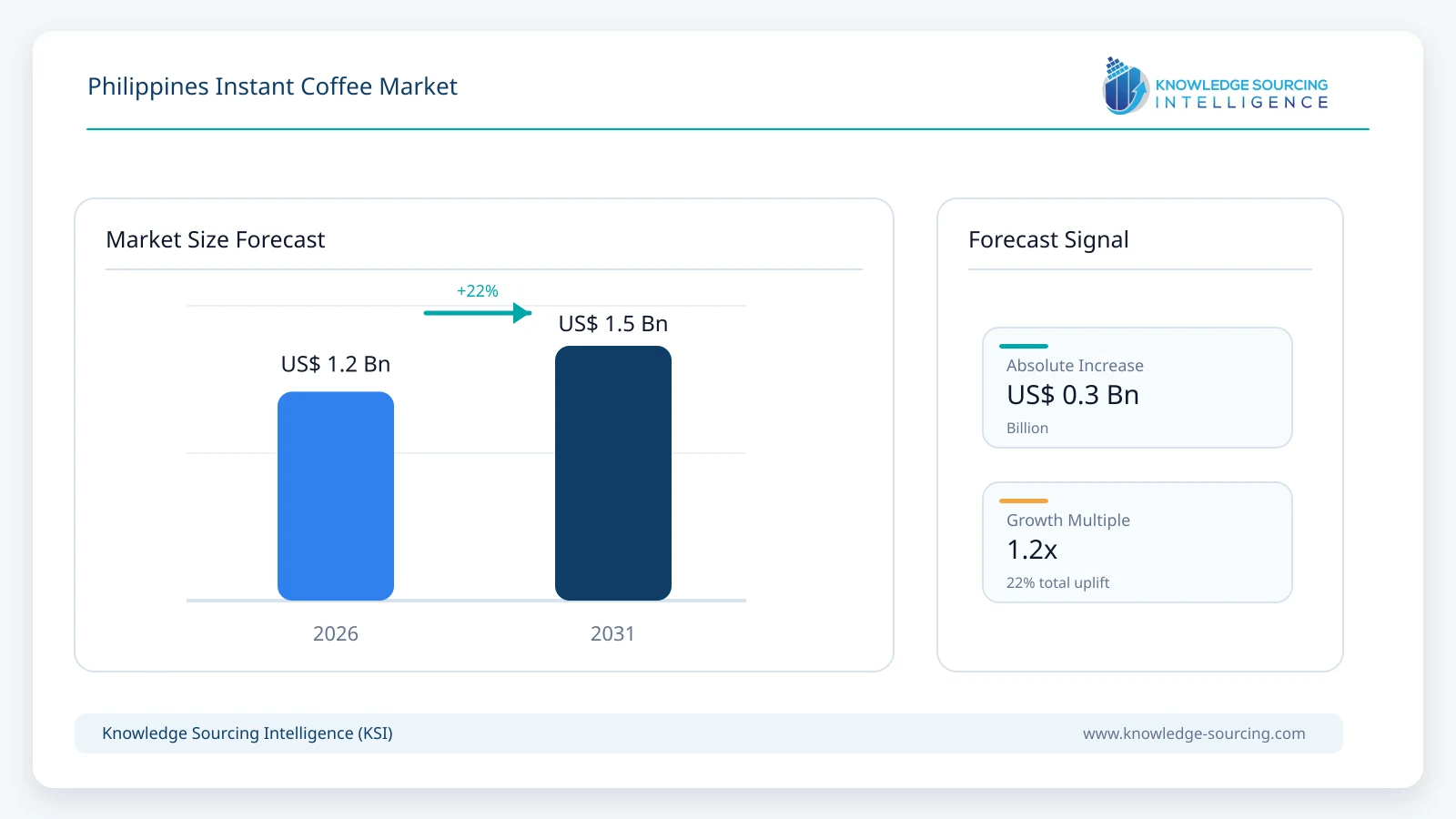
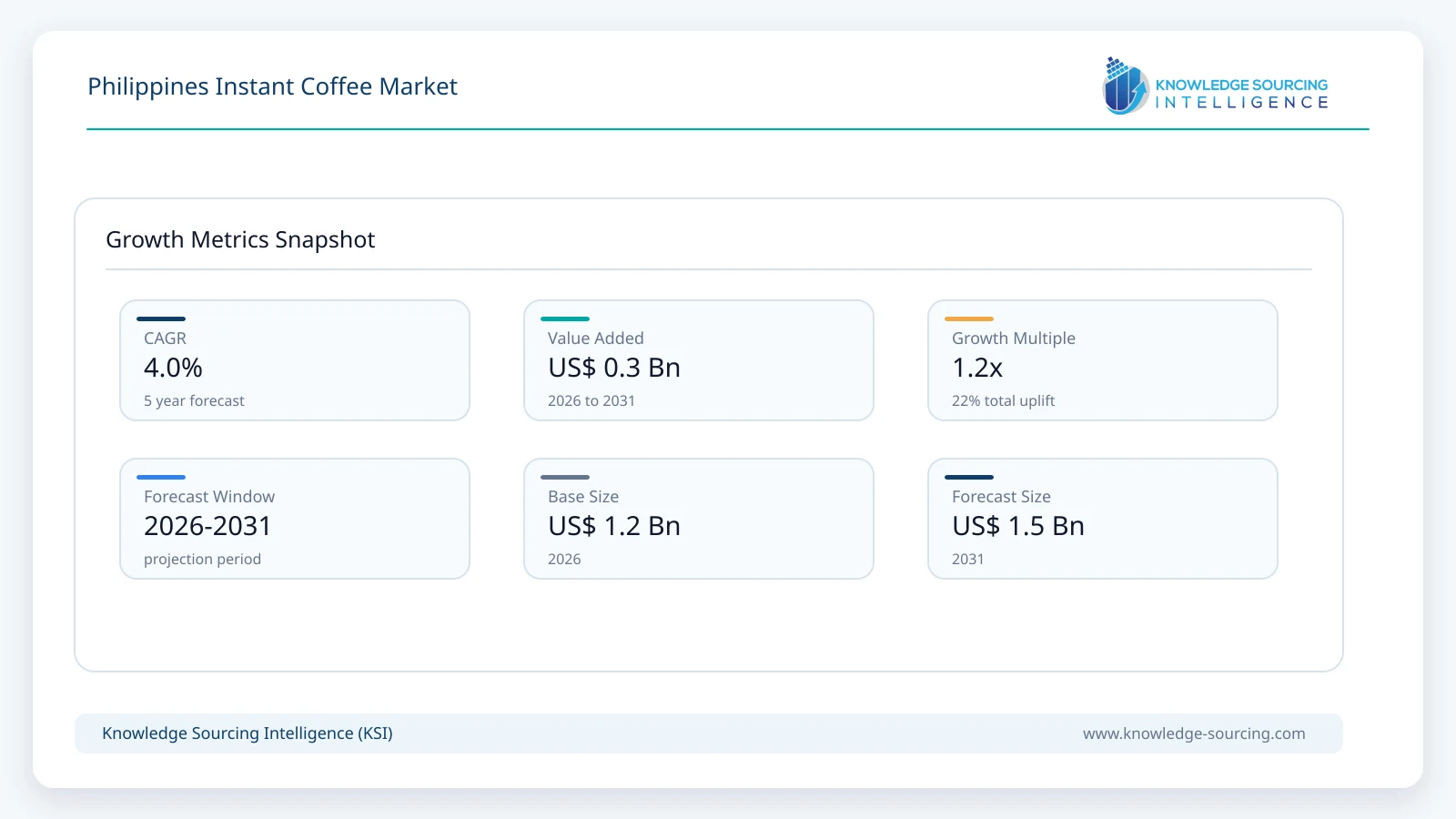
The Philippines Instant Coffee Market is forecast to grow at a CAGR of approximately 4.0%, reaching USD 1.50 billion in 2031 from USD 1.23 billion in 2026.
Highlights:
- 1Instant coffee mixes account for approximately 86% of the market in 2026, led by 3-in-1 formats designed around affordability and convenience.
- 2Sachets and sticks represent approximately 79% of market value in 2026, reflecting the importance of low-unit-price purchasing across Philippine retail.
- 3Small local grocers and sari-sari stores account for approximately 48% of sales in 2026, supported by their reach across urban and provincial communities.
- 4Online instant-coffee sales are projected to grow at approximately 8.2% annually through 2031, supported by multipack purchasing and premium imported products.
- 5Domestic coffee production supplies only around one-quarter of Philippine requirements, leaving instant-coffee manufacturers significantly exposed to imported raw material costs.
Market Overview
Instant coffee occupies an unusually important position in Philippine coffee consumption. The market includes pure soluble coffee and instant coffee mixes sold for at-home and similar retail consumption, with coffee mixes containing sugar, creamer or other ingredients representing the majority of consumer expenditure. The market excludes roasted whole-bean and ground coffee, coffee capsules sold primarily for brewing systems, ready-to-drink coffee and beverages prepared by cafés or restaurants. This definition is narrower than the total Philippine coffee market and prevents café expenditure or packaged RTD beverages from inflating the instant-coffee estimate. It also distinguishes instant coffee from the value of green coffee imports and domestic agricultural production, which form part of the supply chain but are not themselves equivalent to retail market revenue.
The revised estimate is materially below KSI's previous market value because the former figure cannot be reconciled with Philippine consumption volumes and prevailing retail prices. USDA estimates Philippine domestic coffee consumption at around 6.75 million 60-kilogram bags for marketing year 2025/26, while industry analysis based on USDA and UN data indicates that soluble coffee accounts for the overwhelming majority of national coffee consumption. Retail pricing provides an additional constraint. Mainstream 3-in-1 sachets from brands including Nescafé, Kopiko, Great Taste and San Mig Coffee typically remain priced in single-digit pesos per serving, while pure instant-coffee refills command a higher price per kilogram but represent a substantially smaller volume base. Reconciling consumption, product mix and retail pricing produces a 2026 instant-coffee market close to USD 1.23 billion rather than the previously published USD 3.7 billion.
The Philippine market is mature in basic instant coffee but continues to evolve through product mix rather than simple category penetration. Coffee mixes remain central to daily household consumption because they combine low preparation time, low purchase price and broad retail availability. Premiumization is nevertheless becoming more visible through stronger coffee profiles, creamy latte variants, muscovado and flavored products, premium pure-soluble coffee and imported white-coffee formats. Current retail-market analysis indicates that instant coffee mixes remained the largest contributor to Philippine coffee sales in 2025, even as fresh ground coffee recorded stronger percentage growth from a much smaller base. The market outlook therefore assumes continued dominance of instant coffee while allowing a gradual shift in consumer spending toward higher-value products and alternative coffee formats.
Market Trends
Single-Serve Coffee Mixes Remain Central to Philippine Consumption
The Philippine instant-coffee market is shaped by the economics of the sachet. Single-serve coffee mixes allow consumers to buy one or several servings without committing to a jar or larger package and fit naturally into the country's extensive sari-sari store network. This packaging model has enabled companies to maintain broad household penetration across different income groups while offering multiple flavor and strength variants at similar unit-price points. The market includes mainstream 3-in-1 coffee, stronger black-coffee mixes, creamy white coffee, reduced-sugar variants and products using flavors or alternative sweeteners. The continued presence of Nescafé Original, Kopiko Black, Great Taste Original, Blend 45 and San Mig Coffee within government-monitored basic retail pricing illustrates the mass-market nature of the category. Product innovation is consequently focused on adjusting taste, sweetness, creaminess and coffee intensity without moving mainstream products too far beyond familiar household price points.
Premiumization Is Occurring Within Instant Coffee Rather Than Replacing It
The expansion of café culture and fresh coffee is not eliminating instant coffee consumption. Instead, some of the characteristics consumers encounter in cafés are being incorporated into packaged instant products through latte-style formulations, richer milk profiles, premium Arabica positioning and stronger black-coffee variants. Nestlé markets products ranging from Nescafé Classic and Original to Creamy Latte and Nescafé Gold, while Mayora's coffee portfolio includes Kopiko Brown Coffee and multiple latte and cappuccino formats. URC has similarly expanded Great Taste beyond conventional coffee mixes into variants designed around differentiated sweetness and flavor. This allows manufacturers to capture additional consumer spending while retaining the convenience of instant preparation. Premiumization also supports value growth when volume expansion is moderate, which is increasingly important in a category where basic 3-in-1 coffee is already deeply established.
Raw-Material Dependence Remains Structurally Important
Philippine coffee demand substantially exceeds domestic production. Nestlé Philippines states that local production supplies only around 27% of national coffee requirements, while legislative proposals and government industry initiatives continue to emphasize heavy import dependence. This gap matters directly to instant-coffee manufacturers because green coffee prices, international freight, currency movements and sourcing conditions can affect input costs even when companies manufacture or pack products locally. Robusta is particularly important because it provides the stronger flavor and cost structure required for many mainstream soluble-coffee products. Nestlé continues to source locally produced Robusta where available and supports farmers through the NESCAFÉ Plan, but domestic production remains insufficient to remove reliance on imported coffee. Consequently, the market remains exposed to international coffee-price volatility, while companies must balance input-cost increases against the price sensitivity of consumers purchasing low-cost sachets.
Health Positioning Is Gradually Changing Coffee-Mix Formulation
Traditional Philippine coffee mixes are built around coffee, sugar and creamer, but manufacturers face increasing consumer awareness of sugar intake and ingredient composition. The shift remains gradual because taste and affordability continue to drive mass-market purchasing, yet sugar-free, reduced-sugar and black-coffee formats provide alternatives to conventional sweetened mixes. San Mig Coffee sells sugar-free variants, while Nescafé and other brands offer pure instant coffee that allows consumers to control the amount of sugar and milk added. Product development is likely to move toward greater choice rather than an abrupt replacement of conventional 3-in-1 products. Manufacturers therefore have room to segment the market between indulgent creamy variants, stronger black-coffee mixes, lower-sugar products and premium pure-soluble offerings while maintaining mainstream price accessibility.
Market Drivers
Deeply Established Instant-Coffee Consumption
The Philippines is one of Asia's most instant-coffee-oriented markets. Industry analysis based on USDA consumption data indicates that soluble coffee represents the overwhelming majority of national coffee consumption, distinguishing the country from more mature markets where roasted and ground coffee dominate. Instant coffee is embedded in everyday consumption because it requires minimal equipment, has a long shelf life and can be sold at very low unit prices. This creates a large recurring demand base that does not depend on the expansion of café infrastructure. Growth through 2031 therefore comes primarily from changes in product mix, population, household spending and premiumization rather than consumers first entering the instant-coffee category.
Affordability and the Sachet Economy
The widespread use of sachets allows manufacturers to maintain access across income groups even when household budgets are under pressure. Government retail-price monitoring in 2025 showed leading 3-in-1 products generally selling at only several pesos per serving, reinforcing instant coffee's position as an affordable everyday beverage. This low-ticket purchasing model is difficult for many premium fresh-coffee products to replicate and supports continued demand through traditional trade. It also encourages frequent product switching and trial because consumers can purchase a single serving of a new flavor without meaningful financial commitment.
Large Import Requirement Supports a Deep Processing Market
Domestic coffee production remains substantially below national consumption, requiring the Philippines to import large quantities of coffee and coffee-related inputs. For instant-coffee manufacturers, import availability enables the scale required for mass-market production despite limited local agricultural output. The presence of established domestic manufacturing and packaging operations, including Nestlé's Philippine coffee operations and URC's long history in soluble coffee, gives the country a developed processing and distribution base even though raw-material self-sufficiency remains low. The market can therefore support significant consumer demand without being constrained directly by annual domestic harvest volumes.
Product Innovation Extends Mature Category Demand
The maturity of instant coffee means manufacturers cannot rely solely on basic 3-in-1 penetration. New demand is increasingly created by reformulating the familiar format through stronger coffee profiles, premium creamers, specialty sweeteners, white coffee, latte variants and lower-sugar options. URC's product development across Great Taste and Blend 45 and the broad Nescafé portfolio illustrate how companies use flavor and positioning to create additional consumption occasions without abandoning the convenience that defines the category. Continued innovation supports modest value growth even as competition from cafés and fresh coffee increases.
Market Restraints
International Coffee-Price Volatility
The dependence on imported coffee exposes manufacturers to changes in global Robusta and Arabica prices, currency movements and freight costs. This creates a particular challenge in a market where much of the volume is concentrated in low-priced sachets and consumers are sensitive to even small increases in unit price. Manufacturers can adjust pack weight, product formulation or promotional activity, but prolonged input-cost increases eventually place pressure on margins or consumer prices. The supply imbalance also means improvements in domestic production are commercially valuable even if local output remains insufficient to replace imports.
Fresh Coffee and Café Culture are Expanding
Fresh coffee remains a much smaller retail category but is recording stronger percentage growth as urban consumers become more familiar with specialty coffee, home brewing and café-style beverages. This creates competitive pressure at the premium end of instant coffee, particularly among younger and higher-income consumers. The effect is unlikely to eliminate mass-market instant demand because the products serve different price and convenience requirements, but it limits the amount of premium consumer spending that instant-coffee brands can capture.
Mature Household Penetration Limits Volume Acceleration
Instant coffee is already deeply established across Philippine households, reducing the opportunity for growth purely through new-category adoption. Volume gains therefore depend more heavily on population, consumption frequency and competitive switching, while value growth requires improved mix or pricing. This produces a more moderate outlook than the previous KSI forecast and is one reason the revised model does not carry forward the earlier high-single-digit CAGR.
Segment Analysis
By Product Type
Instant Coffee Mixes
Instant coffee mixes remain the core of the Philippine market and include 3-in-1, 2-in-1 and other premixed products combining soluble coffee with sugar, creamer, milk ingredients or flavor components. The category's strength reflects convenience, low unit cost and extensive availability across sari-sari stores, supermarkets, convenience outlets and online channels. Mainstream products from Kopiko, Nescafé, Great Taste, Blend 45 and San Mig Coffee compete through differences in coffee intensity, sweetness, creaminess and flavor rather than through fundamentally different preparation methods. Innovation is expanding the category into white coffee, creamy latte, muscovado, stronger black coffee and reduced-sugar formats, enabling companies to maintain a familiar sachet format while targeting narrower consumer preferences. Mixes are expected to remain dominant through 2031, although competition from fresh coffee and more premium at-home brewing limits the scope for very high volume growth.
Standard Instant Coffee
Standard instant coffee, comprising soluble coffee sold without pre-added sugar or creamer, represents approximately USD 0.17 billion in 2026. The segment includes granules, powder and premium freeze-dried formats sold in sticks, refill packs and jars. Consumers purchasing standard instant coffee generally have greater control over strength, milk and sweetness, giving the format relevance among black-coffee drinkers and households seeking to customize preparation. Nescafé Classic and Great Taste granules are established mass-market products, while premium soluble offerings such as Nescafé Gold, Moccona and imported brands serve higher-value niches. The segment remains much smaller than premixed coffee because the Philippine market has developed around ready-proportioned sachets, but premiumization and increasing concern around sugar intake provide opportunities for stronger value growth in selected pure-coffee formats.
By Processing Type
Spray-Dried
Spray-dried coffee remains the principal processing format for mass-market instant coffee because it combines high production efficiency with the cost structure required for mainstream mixes. The technology is particularly suitable for high-volume products where coffee will subsequently be blended with sugar, creamer or other ingredients. Its established supply chain and manufacturing economics make it important to affordable sachet products, although the consumer rarely purchases coffee explicitly according to drying technology. Competitive positioning therefore occurs primarily through brand, taste and final product format rather than through the processing method itself.
Freeze-Dried
Freeze-dried instant coffee is projected to record stronger growth than the overall market as premium pure-soluble products gain visibility among urban consumers. Freeze drying better preserves aroma and flavor characteristics than conventional high-volume processing but also carries higher production costs, positioning products toward premium jars, sticks and imported coffee ranges. The segment does not threaten the scale of mainstream coffee mixes, but it allows instant coffee to compete more effectively with fresh coffee for consumers who want convenience without choosing low-cost 3-in-1 products.
Agglomerated and Other Instant Coffee
Agglomerated products combine soluble coffee particles into larger granules to improve appearance and dissolution, while other processing formats serve specialized formulations and manufacturer requirements. These products occupy a smaller position than mainstream spray-dried coffee but remain relevant to pure-soluble and premium instant products. Development is expected to follow product reformulation and premiumization rather than substantial independent demand for a particular processing technology.
By Packaging
Sachets and Sticks
Sachets and sticks are fundamental to the Philippine instant-coffee business model. Small packs support low cash outlay per purchase, frequent replenishment and distribution through small neighborhood stores where consumers commonly purchase individual servings rather than larger household packs. The same format also gives manufacturers flexibility to introduce new flavors and variants without requiring consumers to purchase a full jar. Multipacks sold through supermarkets and e-commerce preserve the sachet format while increasing transaction size. The packaging segment is therefore expected to remain dominant even as premium products and larger packs gradually gain share.
Jars
Jars are concentrated primarily in pure soluble coffee and premium instant products and appeal to households consuming coffee frequently enough to justify a larger pack. They provide lower packaging cost per serving and greater preparation flexibility but require a higher upfront purchase than individual sachets. Growth is supported by premium granulated and freeze-dried products as well as households seeking to control milk and sugar rather than using premixed coffee.
Pouches, Bags and Others
Pouches and refill packs allow consumers to purchase larger quantities without the cost of rigid packaging and are used particularly for standard soluble coffee and value-oriented refills. Other formats include boxes containing individually wrapped sticks and specialty packaging used by imported brands. These formats remain secondary to sachets but expand the range of price points available to consumers.
By Distribution Channel
Small Local Grocers and Sari-Sari Stores
Small local grocers and sari-sari stores remain the most important route to market because instant coffee is purchased frequently and often in individual sachets. Their geographic reach and proximity to households make them especially important outside major commercial centers and among consumers making low-value daily purchases. Instant-coffee manufacturers therefore depend heavily on traditional trade distribution, wholesaler networks and consistent product availability at very low unit-price points. The channel's role also explains why sachet innovation can have greater commercial significance than premium jar launches despite the latter receiving more attention in modern retail.
Supermarkets and Hypermarkets
Supermarkets and hypermarkets support larger multipacks, jars, refill packs and broader brand assortments. They are important for household stocking and provide greater shelf space for premium variants than small traditional outlets. Promotional bundling and price competition are influential in this channel, particularly among Nescafé, Kopiko and Great Taste. Modern grocery retail also provides consumers with easier comparison between instant coffee, fresh coffee and capsules, creating both premiumization opportunities and competitive pressure on conventional mixes.
Convenience Stores
Convenience stores provide a useful channel for single-serve and smaller instant-coffee purchases, especially among urban workers and commuters. Their role overlaps partly with ready-to-drink coffee and prepared beverage formats, meaning instant coffee competes for convenience occasions rather than operating in isolation. The channel is expected to remain important for mainstream sachets and selected premium products.
Online
Online retail remains smaller than traditional grocery but provides a faster-growing route for multipacks, imported brands, premium instant coffee and bulk household purchasing. Digital marketplaces reduce the distribution disadvantage faced by niche foreign brands and allow consumers to compare flavors, pack sizes and prices more easily. Online purchasing also favors larger basket sizes than individual sari-sari store transactions, making it commercially attractive even while representing a minority of total category sales.
Regional Outlook
National Capital Region
NCR represents the country's largest concentration of higher-value consumer demand and provides a strong market for both mainstream coffee mixes and premium instant products. Modern grocery, convenience retail and e-commerce provide broader product choice than in many provincial markets, while café exposure encourages consumers to experiment with stronger, creamier and more premium coffee profiles. The region is therefore important for product launches and premiumization even though basic instant coffee is already mature.
CALABARZON and Central Luzon
CALABARZON and Central Luzon combine large populations, extensive urban and peri-urban development and strong access to both traditional and modern grocery channels. Demand remains heavily oriented toward mass-market sachets, although supermarket expansion and e-commerce are widening access to larger packs and premium products. Their proximity to Metro Manila also supports efficient distribution by major manufacturers and wholesalers.
Visayas
The Visayas represent an important consumer market where traditional retail remains central to everyday instant-coffee purchasing. Cebu and other major urban areas provide opportunities for premium products and modern grocery, while smaller communities reinforce the importance of affordable sachets and broad distribution. Product availability and wholesaler reach remain important competitive factors because the market is geographically fragmented across islands.
Mindanao
Mindanao is commercially important both as a consumer region and as the center of Philippine domestic coffee production. Nestlé states that roughly four-fifths of locally grown Philippine coffee originates in Mindanao, particularly areas including Sultan Kudarat and Bukidnon. This does not mean Mindanao accounts for the same share of instant-coffee consumption, but the region has strategic supply-chain importance because manufacturers and government programs are seeking to strengthen local Robusta production. Consumer demand remains strongly oriented toward affordable coffee mixes and traditional trade.
Other Philippines
Other regions maintain substantial instant-coffee consumption through small local retailers and value-oriented products. Geographic dispersion increases the importance of distributor networks and product shelf life, both of which favor instant coffee relative to beverages requiring more complex preparation or cold-chain infrastructure.
Competitive Landscape
The Philippine instant-coffee market is concentrated around several large consumer brands. Mayora Indah, through Kopiko, maintains a major position in coffee mixes, while Nestlé competes across pure soluble and premixed coffee through Nescafé. Universal Robina Corporation participates through Great Taste and Blend 45 and reported a 25.8% share in the Philippine instant-coffee category in its first-quarter 2026 investor presentation, behind a market leader at 70.3% under the relevant Nielsen category definition. URC also holds a meaningful position in coffee mixes, demonstrating that competitive shares differ according to whether the category is measured as pure instant coffee, coffee mixes or the broader coffee market.
San Miguel Super Coffeemix competes through San Mig Coffee and distributes additional JDE products in the Philippines, including Moccona and L'OR formats. Commonwealth Foods continues to participate through Café Puro, while imported products including OldTown, Alicafé, G7, Indocafe and other Asian instant-coffee brands expand consumer choice through modern retail and e-commerce. Competition is expected to remain concentrated in mainstream sachets while becoming more fragmented in premium soluble and imported coffee.
Recent Developments
May 2026: Nestlé Philippines intensified efforts to increase domestic coffee sourcing through farmer training and post-harvest support, aiming to reduce reliance on imported coffee for Nescafé production.
May 2026: The Philippine Department of Agriculture allocated PHP 2.5 billion for farm-to-market roads in Sultan Kudarat, with coffee identified among the priority crops for production expansion.
April 2026: The Department of Trade and Industry maintained a temporary price freeze on basic goods, including coffee, through May 10 amid continued commodity-cost pressure.
February 2026: The Department of Agriculture established the Coffee Industry Development Office (CIDO) to coordinate coffee-sector programmes, funding and policy implementation.
Market Outlook
The Philippines instant coffee market is expected to remain highly resilient through 2031 because convenience, affordability and entrenched consumption habits continue to favor soluble coffee. Growth is nevertheless expected to be substantially more moderate than indicated by KSI's previous forecast. The largest opportunity remains within coffee mixes, where manufacturers can use flavor, sweetness, creaminess and stronger coffee positioning to increase value without requiring consumers to adopt a new preparation method. Premium pure-soluble and freeze-dried products provide a smaller higher-value opportunity, while e-commerce increases access to imported and specialty formats. Traditional retail remains central to the market because the ability to purchase one inexpensive sachet at a time is a defining feature of Philippine consumption. Import dependence and commodity-price volatility remain the principal supply-side risks, making local Robusta development strategically important even though domestic production is unlikely to satisfy national requirements during the forecast period.
Philippines Instant Coffee Market Scope:
| Report Metric | Details |
|---|---|
| Total Market Size in 2026 | USD 1.23 billion |
| Total Market Size in 2031 | USD 1.50 billion |
| Forecast Unit | Billion |
| Growth Rate | 4.0% |
| Study Period | 2021 to 2031 |
| Historical Data | 2021 to 2024 |
| Base Year | 2025 |
| Forecast Period | 2026 – 2031 |
| Segmentation | Product Type, Processing Type, Packaging, Distribution Channel, Region |
| Companies |
|
Market Segmentation
By Product Type
Instant Coffee Mixes
3-in-1 Coffee Mixes
2-in-1 Coffee Mixes
Flavoured and Specialty Coffee Mixes
Standard Instant Coffee
By Processing Type
Spray-Dried
Freeze-Dried
Agglomerated and Others
By Packaging
Sachets and Sticks
Jars
Pouches and Bags
Others
By Distribution Channel
Small Local Grocers and Sari-Sari Stores
Supermarkets and Hypermarkets
Convenience Stores
Online
Others
By Region
National Capital Region
CALABARZON
Central Luzon
Visayas
Mindanao
Other Philippines
Table of Contents
1. INTRODUCTION
1.1. Market Overview
1.2. Market Definition
1.3. Inclusion and Exclusion Criteria
1.4. Scope of the Study
1.5. Market Segmentation
1.6. Currency
1.7. Assumptions
1.8. Base and Forecast Years
1.9. Key Benefits to Stakeholders
2. RESEARCH METHODOLOGY
2.1. Research Design
2.2. Secondary Research
2.3. Primary Research
2.4. Market Estimation
2.5. Retail Volume and Price Reconciliation
2.6. Segment Modelling
2.7. Data Triangulation and Validation
3. EXECUTIVE SUMMARY
3.1. Key Findings
3.2. Philippines Instant Coffee Market Size, 2026-2031
3.3. Product Type Outlook
3.4. Packaging Outlook
3.5. Distribution Channel Outlook
3.6. Regional Opportunity Summary
3.7. Analyst View
4. MARKET DYNAMICS
4.1. Market Drivers
4.1.1. Deeply Established Instant-Coffee Consumption
4.1.2. Affordability and the Sachet Economy
4.1.3. Large Import Requirement and Processing Infrastructure
4.1.4. Product Innovation and Premiumization
4.2. Market Restraints
4.2.1. International Coffee-Price Volatility
4.2.2. Expansion of Fresh Coffee and Café Culture
4.2.3. Mature Household Penetration
4.3. Market Opportunities
4.4. Porter’s Five Forces Analysis
4.5. Industry Value Chain Analysis
4.6. Green Coffee Import and Domestic Supply Outlook
4.7. Retail Pricing and Sachet Economics
5. CONSUMER AND PRODUCT TRENDS
5.1. 3-in-1 and Coffee Mix Consumption
5.2. Strong Black Coffee Formats
5.3. White Coffee and Creamy Latte Variants
5.4. Reduced-Sugar and Sugar-Free Products
5.5. Premium Pure Soluble Coffee
5.6. Imported Instant-Coffee Brands
6. PHILIPPINES INSTANT COFFEE MARKET BY PRODUCT TYPE
6.1. Introduction
6.2. Instant Coffee Mixes
6.2.1. 3-in-1 Coffee Mixes
6.2.2. 2-in-1 Coffee Mixes
6.2.3. Flavoured and Specialty Coffee Mixes
6.3. Standard Instant Coffee
7. PHILIPPINES INSTANT COFFEE MARKET BY PROCESSING TYPE
7.1. Introduction
7.2. Spray-Dried
7.3. Freeze-Dried
7.4. Agglomerated and Others
8. PHILIPPINES INSTANT COFFEE MARKET BY PACKAGING
8.1. Introduction
8.2. Sachets and Sticks
8.3. Jars
8.4. Pouches and Bags
8.5. Others
9. PHILIPPINES INSTANT COFFEE MARKET BY DISTRIBUTION CHANNEL
9.1. Introduction
9.2. Small Local Grocers and Sari-Sari Stores
9.3. Supermarkets and Hypermarkets
9.4. Convenience Stores
9.5. Online
9.6. Others
10. PHILIPPINES INSTANT COFFEE MARKET BY REGION
10.1. National Capital Region
10.2. CALABARZON
10.3. Central Luzon
10.4. Visayas
10.5. Mindanao
10.6. Other Philippines
11. COMPETITIVE ENVIRONMENT AND ANALYSIS
11.1. Major Players and Strategy Analysis
11.2. Instant Coffee Mix Competitive Positioning
11.3. Standard Instant Coffee Positioning
11.4. Mass-Market versus Premium Positioning
11.5. Sachet Pricing and Pack Architecture
11.6. Traditional Retail Distribution Strength
11.7. Local versus Imported Brand Positioning
11.8. Product Launches and Portfolio Expansion
11.9. Competitive Dashboard
12. COMPANY PROFILES
12.1. PT Mayora Indah Tbk
12.2. Nestlé Philippines, Inc.
12.3. Universal Robina Corporation
12.4. San Miguel Super Coffeemix Co., Inc.
12.5. JDE Peet's
12.6. Commonwealth Foods, Inc.
12.7. UCC Ueshima Coffee Philippines, Inc.
12.8. Power Root Berhad
12.9. PT Sari Incofood Corporation
12.10. Trung Nguyen Legend Corporation
12.11. OLDTOWN Berhad
12.12. Food Empire Holdings Limited
13. APPENDIX
13.1. Market Definition and Scope
13.2. Product Inclusion and Exclusion Criteria
13.3. Retail Price Conversion
13.4. Currency and Conversion Assumptions
13.5. Base Year and Forecast Period
13.6. Market Estimation Approach
13.7. Segment Modelling Assumptions
13.8. Primary and Secondary Research Framework
13.9. Data Triangulation and Validation
13.10. Abbreviations
13.11. Key Benefits for Stakeholders
Navigate
Trusted by the world's leading organizations











