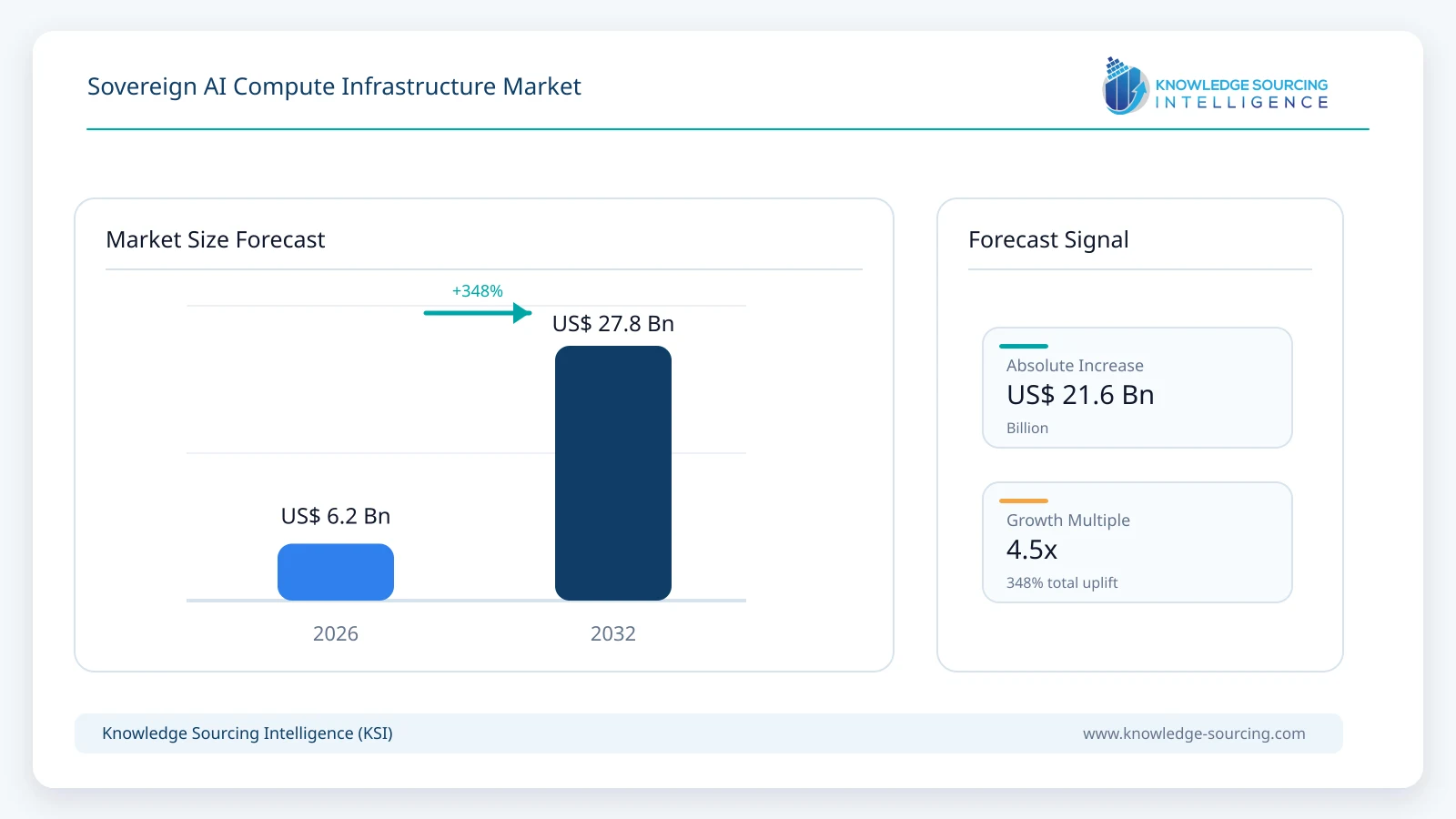
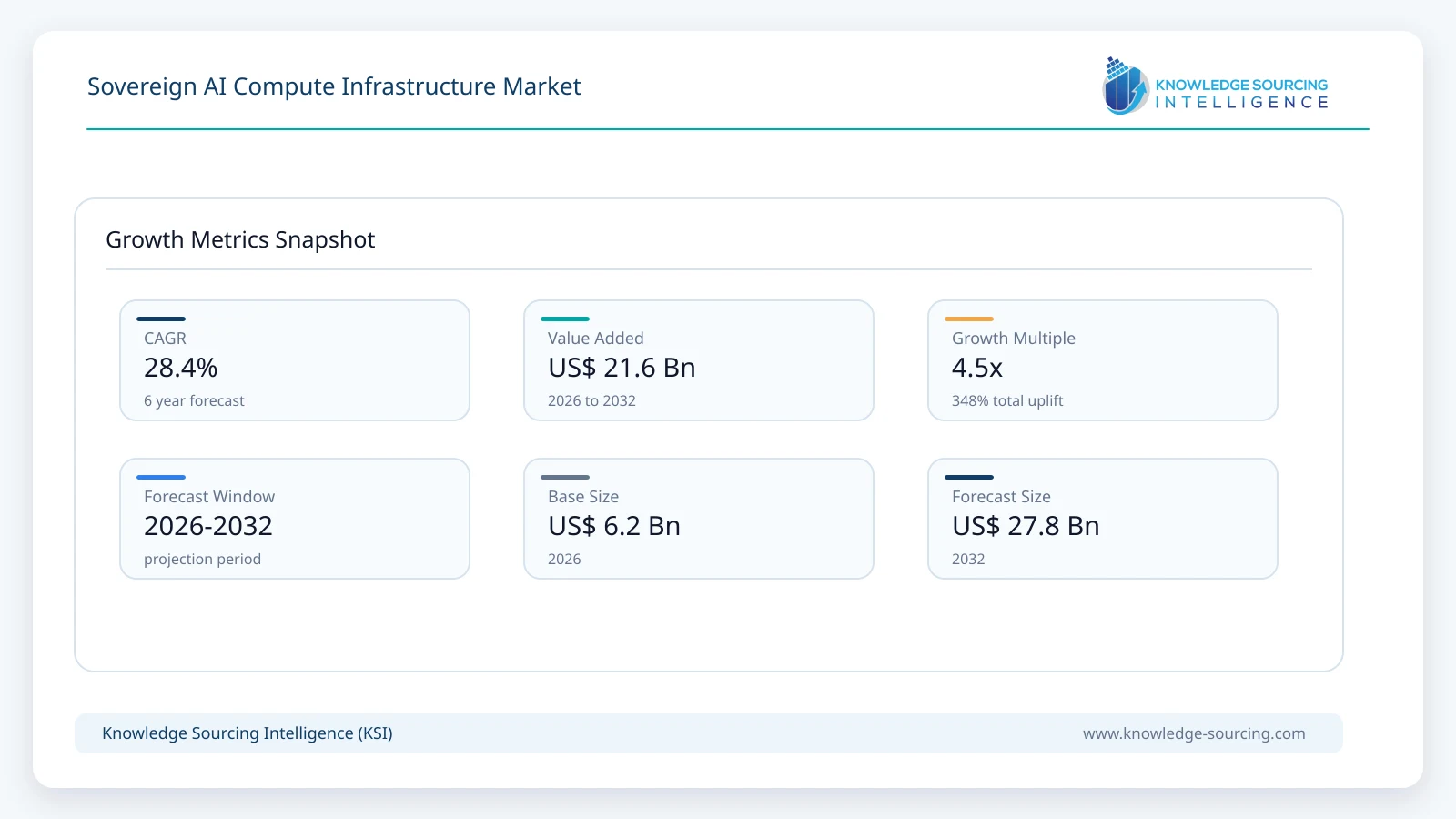
The global sovereign AI compute infrastructure market is forecast to grow at a CAGR of 28.4%, reaching approximately USD 27.75 billion by 2032 from USD 6.20 billion in 2026.
Highlights:
- 1National AI programs are shifting from temporary research clusters toward persistent AI factories serving government, industry, startups and research users.
- 2The European Union is developing 19 AI Factories and has launched a separate AI Gigafactory program for much larger frontier-model compute capacity.
- 3IndiaAI shared compute capacity exceeded 45,000 GPUs by mid-2026, creating one of the largest publicly supported national compute pools.
- 4The United Kingdom is expanding the AI Research Resource with a new £750 million heterogeneous AI supercomputer program.
- 5Germany's Industrial AI Cloud entered operation in 2026 with around 10,000 NVIDIA GPUs for industry, research and public-sector workloads.
- 6Japan announced a 140 MW national AI factory with 27,500 NVIDIA Rubin GPUs for physical-AI applications.
- 7Korea is expanding national AI factory infrastructure from an initial 55 MW toward 200 MW and a longer-term gigawatt-scale target.
- 8Saudi Arabia and the UAE are combining sovereign AI objectives with hyperscale commercial AI campuses measured in hundreds of megawatts to gigawatts.
- 9Public-private operating models are increasing because governments can secure strategic access without owning every layer of the infrastructure stack.
- 10Accelerator procurement remains only one part of sovereign AI economics; networking, storage, orchestration, security and utilization determine effective national compute capacity.
- 11The global sovereign AI compute infrastructure market is estimated at USD 6.20 billion in 2026 and forecast to reach USD 27.75 billion by 2032.
Market Definition
Sovereign AI compute infrastructure comprises accelerated computing capacity deployed under a national, sovereign or strategically anchored framework in which compute access, data residency, security, domestic ecosystem development or strategic availability is an explicit objective. The infrastructure may be government-owned, publicly funded, operated by a national telecom or cloud provider, or delivered through a public-private partnership.
The primary market estimate includes accelerator servers and integrated AI systems, high-speed compute networking, shared high-performance storage, cluster orchestration, AI infrastructure management and directly associated platform software supplied as part of the sovereign compute environment. General-purpose public-cloud capacity is excluded unless it is ring-fenced or contracted for a sovereign AI program. Building shell, land, conventional data-center fit-out, utility infrastructure and dedicated power generation are excluded to avoid overlap with broader AI data-center infrastructure markets.
Annual infrastructure spending and supplier revenue are assessed alongside installed and committed accelerator capacity. AI IT load in megawatts is used as a second physical measure because accelerator counts become less comparable as hardware generations change. Deployment spans public supercomputing, national shared-cloud pools, telecom-led AI factories, sovereign commercial clouds and public-private hyperscale projects.
Market Overview
Sovereign AI compute has developed because access to advanced accelerators has become a strategic input for model development, scientific research and digital services. National programs increasingly treat compute as shared infrastructure that can be allocated to startups, universities, government agencies and domestic companies. This differs from conventional supercomputing procurement because the capacity must support a broader mix of training, fine-tuning, inference and production workloads rather than a limited set of scientific users.
Europe provides one of the clearest multi-country examples. The European Commission reports that 19 AI Factories and 13 AI Factory antennas are being established across the region, supported by EuroHPC infrastructure. A separate AI Gigafactory initiative is targeting facilities with more than 100,000 advanced AI processors, backed by public and private capital. The distinction is important for the market model because national and regional AI infrastructure is moving from tens of thousands of accelerators toward much larger industrial-scale clusters.
India has taken a marketplace-based approach. The IndiaAI Compute framework uses empanelled service providers to make subsidized accelerator capacity available to startups, researchers, academia and government users. Empanelled shared-compute capacity exceeded 45,000 GPUs by June 2026, while official plans also include a secure national GPU cluster for sovereign and strategic applications. This model allows the government to aggregate demand and influence access without owning the complete physical estate.
Telecom and national cloud operators form another commercial path. Deutsche Telekom operates an Industrial AI Cloud in Germany with around 10,000 NVIDIA GPUs and a domestic technology stack for industry and public-sector users. Korea's NAVER and SK Telecom are developing AI factories and cloud capacity on NVIDIA DSX architectures, while Japan's Noetra project combines government support with industrial partners and a 140 MW AI factory. These projects create recurring infrastructure demand because capacity is operated as a service rather than installed for a single research program.
The Middle East adds a hyperscale sovereign model. Saudi Arabia's HUMAIN has announced an AI-factory roadmap measured in hundreds of megawatts, while Stargate UAE is planned as a planned 1 GW compute cluster within a proposed 5 GW AI campus. These projects combine local strategic capacity with regional and global commercial services. Their scale expands the sovereign AI market beyond public-sector procurement and creates competition among countries to attract AI workloads, developers and infrastructure investment.
Market Drivers
National Demand for Strategic Compute Access
Advanced AI development depends on access to accelerators that remain expensive, supply-constrained and increasingly concentrated in a small number of hyperscale providers. National compute programs create reserved or domestically governed capacity for local users that may not be able to secure large clusters independently. This supports procurement of shared accelerator systems, high-speed fabrics and storage at scales beyond conventional research-computing budgets.
Data Residency and Regulated Workloads
Government, defense, financial-services, healthcare and critical-industry workloads can require local processing, controlled operator access and defined security boundaries. Sovereign AI infrastructure allows these workloads to use modern accelerators and foundation models while maintaining domestic hosting and governance. This increases demand for secure cluster management, isolation, observability and localized platform services in addition to raw compute.
Domestic Model and AI Ecosystem Development
Countries are supporting local foundation models, language models, industrial AI and scientific AI programs that require sustained access to compute. Shared national infrastructure lowers the capital barrier for startups and research groups, while large anchor projects can also create demand for domestic systems integration, software, model services and skilled operators. The commercial value therefore extends beyond the first hardware procurement cycle.
Public-Private Financing and AI-as-a-Service Models
Large AI clusters require capital, power and operational expertise that governments do not always want to build internally. Public-private structures allow telecom operators, cloud providers, specialist AI clouds and infrastructure funds to finance and operate capacity while governments support access, utilization or strategic availability. This widens the supplier base and converts one-time public procurement into longer-duration infrastructure and service contracts.
Market Restraints
Rapid Accelerator Obsolescence
Accelerator platforms refresh faster than conventional national supercomputers. A sovereign cluster can lose relative performance within several years if the procurement cycle is too slow or if funding is concentrated in a single hardware generation. Operators therefore need modular expansion and refresh strategies rather than treating national AI infrastructure as a one-time capital project.
Utilization and Allocation Risk
Large national compute pools can be underutilized if allocation processes are slow, application pipelines are immature or user workloads cannot scale efficiently. Conversely, successful programs can face demand far above available capacity. Utilization, scheduling and pricing therefore determine the economic value of the infrastructure as much as installed accelerator count.
Dependence on Global Hardware Supply Chains
Most national AI programs continue to rely on globally sourced accelerators, networking and memory. Export controls, supply concentration and long lead times can affect project timing and configuration. Sovereign operation therefore does not necessarily imply sovereign hardware, creating a distinction between control of deployed capacity and control of the underlying technology supply chain.
Power and Data-Center Availability
AI factories require substantial grid capacity, cooling and data-center infrastructure. National compute programs can announce accelerator targets before suitable powered sites are available, creating deployment delays. Large projects increasingly require coordinated planning across compute procurement, data-center capacity, power generation, transmission and financing.
Segmentation Analysis
By Infrastructure Component
The market is segmented into accelerator and AI compute systems, high-speed networking, AI storage, cluster management and orchestration, and platform/security infrastructure. Accelerator systems form the largest revenue pool because advanced GPUs and XPUs account for a substantial share of initial infrastructure cost. Networking and storage become increasingly important as national clusters grow beyond individual supercomputers into shared multi-tenant AI factories.
Cluster management and orchestration represent a smaller but strategically important segment because shared national infrastructure must allocate accelerators across many users, enforce security boundaries and maintain utilization. Sovereign platforms increasingly require metering, scheduler integration, secure model deployment, observability and policy controls that are not required in the same form within a single-user research cluster.
By Deployment Model
Deployment models include publicly owned supercomputing, national shared-compute marketplaces, telecom or national-cloud AI factories, sovereign commercial clouds, and public-private hyperscale AI campuses. Public supercomputing remains important for science and model research, while shared marketplace and commercial-cloud structures are expanding because they provide broader user access and allow capacity to be refreshed without a complete government-owned operating stack.
Public-private hyperscale campuses represent the highest-capacity model. These projects combine national strategic access with commercial customers and international capital, allowing infrastructure to scale into hundreds of megawatts or gigawatts. Their economics differ from public research systems because utilization must support both national objectives and commercial returns.
By Access Model
The market is analyzed across reserved government and strategic capacity, subsidized shared access, commercial sovereign cloud, research and startup allocation, and mixed public-private access. Subsidized shared access expands the user base and supports ecosystem development, while reserved capacity is more common for sensitive government, defense and critical-infrastructure workloads.
By Workload
Key workloads include foundation-model training, fine-tuning and adaptation, large-scale inference, scientific and engineering AI, public-sector AI and physical/industrial AI. Training drives the largest accelerator clusters, while inference increases the need for geographically distributed and continuously available sovereign capacity. Physical AI is becoming more important in programs linked to manufacturing, robotics, logistics and national industrial policy.
By Customer and User Group
Users include government agencies, national research institutions, startups and model developers, domestic enterprises, regulated industries and universities. Startups and research institutions are particularly dependent on shared access because they cannot independently finance large accelerator clusters, while regulated industries value sovereign hosting and operational control for production workloads.
Regional Opportunity
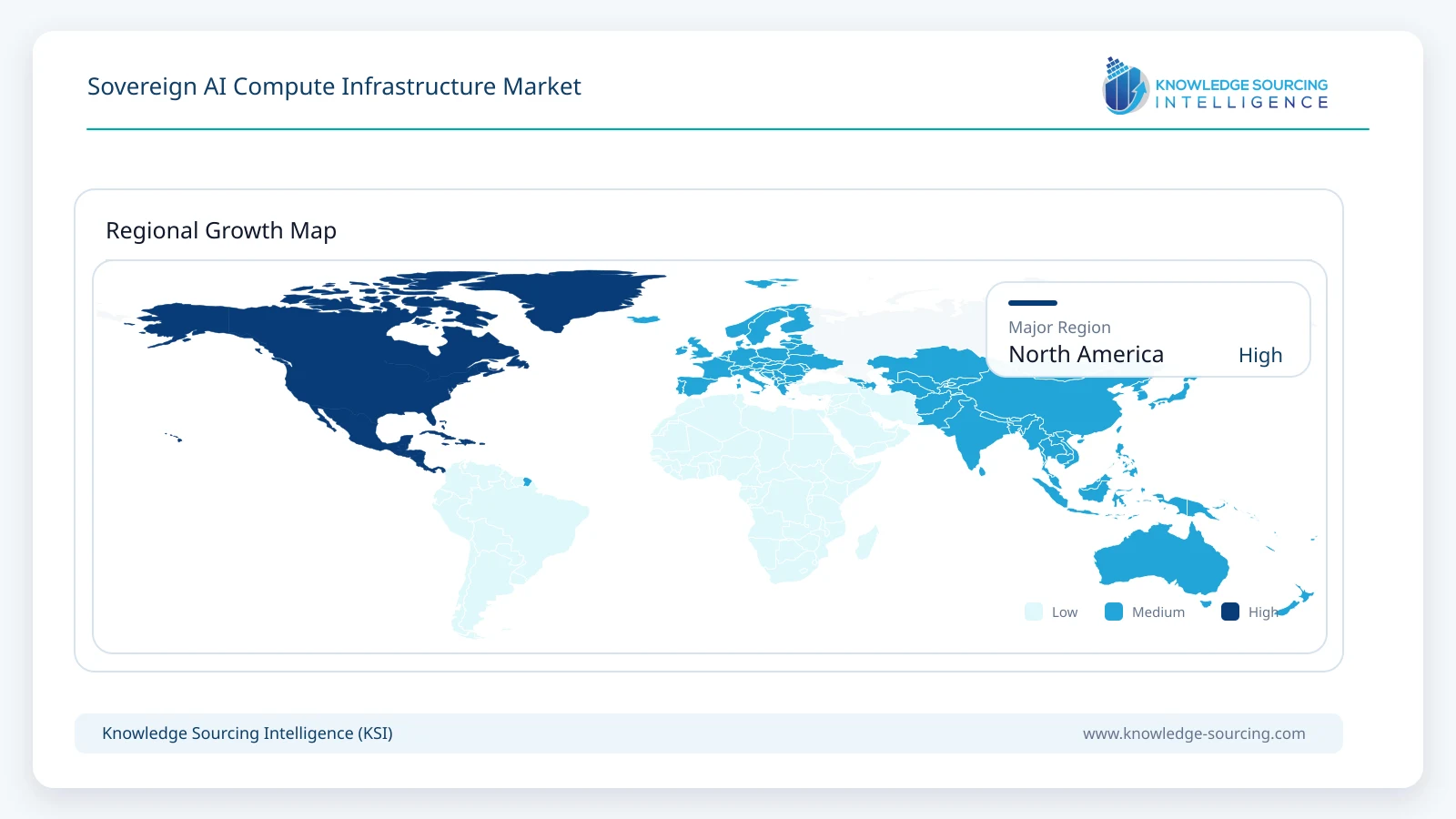
North America
North America combines the world's largest AI infrastructure base with national-security, research and public-sector compute programs. The region is also the principal source of advanced accelerator, networking and AI platform technology used by sovereign programs globally. U.S. market revenue in this study is limited to explicitly sovereign, strategic or public compute rather than the broader commercial hyperscale market.
Europe
Europe represents one of the largest coordinated sovereign AI opportunities. EuroHPC AI Factories, AI Gigafactories, national industrial AI clouds and the UK AI Research Resource create multiple procurement and operating models. Regional demand includes public supercomputing, national-cloud capacity, telecom-led infrastructure and industry-focused AI factories.
Asia Pacific excluding China
India, Japan, South Korea and other Asia Pacific countries are expanding national AI compute through shared GPU pools, sovereign cloud, industrial AI factories and government-supported clusters. The region combines large domestic user bases with strong electronics, telecom and data-center operators, supporting both public and commercial sovereign models.
China
China maintains a large domestic AI and supercomputing ecosystem with substantial state and commercial investment in locally operated compute. China is a distinct regional market because domestic accelerator supply, cloud platforms and procurement conditions differ from those in markets relying heavily on U.S.-origin accelerators.
Middle East and Rest of World
The Middle East represents the fastest-moving greenfield sovereign AI opportunity, led by projects in the UAE and Saudi Arabia. Large AI campuses combine national strategic objectives with regional commercial services and global technology partners, creating unusually high compute capacity per project.
Major Sovereign AI Programs and Capacity Pipeline
European Union AI Factories and Gigafactories
The EU is establishing 19 AI Factories and 13 antennas around EuroHPC infrastructure. The AI Gigafactory initiative targets up to seven large facilities with more than 100,000 advanced AI processors per gigafactory and a combination of public and private funding.
IndiaAI Compute
India's shared national compute pool exceeded 45,000 GPUs by June 2026 and is delivered through empanelled service providers. The program supports startups, researchers, academic institutions and government users while separate secure compute is being developed for sovereign and strategic applications.
United Kingdom AI Research Resource
The UK AIRR combines Isambard-AI, Dawn and additional planned systems. A £750 million heterogeneous AI supercomputer program announced in 2026 is intended to expand national compute for frontier AI research, inference and scientific workloads.
Germany Industrial AI Cloud
Deutsche Telekom's Munich AI factory entered operation in February 2026 with around 10,000 NVIDIA GPUs. The platform supports industrial, research and public-sector users under German and European data and security requirements.
Japan National Physical-AI Infrastructure
Japan's Noetra project, supported by METI, is planned around 27,500 NVIDIA Rubin GPUs and 140 MW of data-center capacity for manufacturing, logistics, healthcare and other physical-AI applications.
Korea National AI Factory Expansion
NAVER, NVIDIA and Brookfield announced plans to expand an initial 55 MW sovereign AI factory to 200 MW by 2028, with a longer-term path toward gigawatt-scale infrastructure. SK Telecom is separately planning gigawatt-scale AI cloud capacity.
Saudi Arabia Sovereign AI Factories
HUMAIN has announced plans for AI factories with capacity up to 500 MW over several years, while a separate national financing framework supports up to 250 MW of hyperscale AI data-center capacity. Sovereign AI capacity includes government and commercial deployment.
UAE Stargate and AI Campus
Stargate UAE is planned as a 1 GW compute cluster within a 5 GW UAE-US AI campus, with an initial 200 MW phase expected to come online first. The project combines sovereign local capacity with regional commercial AI services.
Competitive and Technology Landscape
Competition spans accelerator vendors, server and system manufacturers, hyperscale cloud providers, national cloud operators, telecom companies and specialist AI infrastructure providers. NVIDIA has the broadest visible participation across national AI factory programs through accelerated computing, networking, software and the DSX architecture. AMD and Intel participate in sovereign compute through alternative accelerator and CPU platforms, while Dell Technologies, HPE, Lenovo, Supermicro and Eviden supply systems and integration for public and research infrastructure.
Operators are becoming equally important. Deutsche Telekom, NAVER Cloud, SK Telecom, Nscale, G42 and HUMAIN combine data-center operations with sovereign or nationally anchored AI services. Oracle, Microsoft and other hyperscalers participate where governments require local capacity, dedicated tenancy or regulated cloud environments. The competitive distinction therefore lies not only in hardware performance but in the ability to finance, operate, refresh and securely expose national compute to multiple user groups.
Recent Developments
August 2026: India reported that shared IndiaAI compute capacity had exceeded 45,000 GPUs, while 237 projects had consumed more than 9.3 million subsidized GPU hours by August.
July 2026: The European Union launched a tender process for up to seven AI Gigafactories, supported by up to €10 billion in EU and national funding and intended to unlock at least €20 billion of private investment.
July 2026: NAVER, NVIDIA and Brookfield announced plans to expand Korea's sovereign AI factory at Sejong from 55 MW to 200 MW by 2028, with a longer-term gigawatt-scale roadmap.
July 2026: Japan announced a national physical-AI factory with 27,500 NVIDIA Rubin GPUs and 140 MW of data-center capacity under the Noetra-led project supported by METI.
July 2026: The United Kingdom opened site selection for a new £750 million heterogeneous AI supercomputer within the AI Research Resource.
February 2026: Deutsche Telekom put its Munich Industrial AI Cloud into operation with around 10,000 NVIDIA GPUs for industry, research and public-sector use.
January 2026: Saudi Arabia's HUMAIN and the National Infrastructure Fund announced a financing framework of up to USD 1.2 billion to support up to 250 MW of hyperscale AI data-center capacity.
2026: Stargate UAE continued development as a 1 GW AI compute cluster within a planned 5 GW AI campus, with an initial 200 MW phase intended to establish local and regional sovereign AI capacity.
Sovereign AI Compute Infrastructure Market Scope:
| Report Metric | Details |
|---|---|
| Total Market Size in 2026 | USD 6.20 billion |
| Total Market Size in 2032 | USD 27.75 billion |
| Forecast Unit | USD Billion |
| Growth Rate | 28.4% |
| Study Period | 2021 to 2032 |
| Historical Data | 2021 to 2024 |
| Base Year | 2025 |
| Forecast Period | 2026 – 2032 |
| Segmentation | Infrastructure Component, Deployment Model, Access Model, Workload, User Group, Geography |
| Companies |
|
Market Segmentation
By Infrastructure Component
Accelerator and AI Compute Systems
High-Speed Networking
AI Storage Infrastructure
Cluster Management and Orchestration
Platform, Security and Infrastructure Software
By Deployment Model
Publicly Owned Supercomputing
National Shared-Compute Marketplace
Telecom and National-Cloud AI Factory
Sovereign Commercial Cloud
Public-Private Hyperscale AI Campus
By Access Model
Reserved Strategic and Government Capacity
Subsidized Shared Access
Commercial Sovereign AI Cloud
Research and Startup Allocation
Mixed Public-Private Access
By Workload
Foundation Model Training
Fine-Tuning and Model Adaptation
Large-Scale Inference
Scientific and Engineering AI
Public-Sector and Regulated AI
Physical and Industrial AI
By User Group
Government Agencies
National Research Institutions and Universities
Startups and Foundation-Model Developers
Domestic Enterprises
Regulated and Critical Industries
By Geography
North America
Europe
Asia Pacific Excluding China
China
Middle East and Rest of World
Table of Contents
1. EXECUTIVE SUMMARY
1.1. Market Opportunity and Key Findings
1.2. Sovereign AI Capacity Pipeline
1.3. Major Infrastructure Revenue Pools
1.4. Deployment and Access Models
2. RESEARCH SCOPE AND METHODOLOGY
2.1. Market Definition
2.2. Included and Excluded Revenue
2.3. Sovereign Infrastructure Qualification Criteria
2.4. Accelerator Capacity and AI IT Load Model
2.5. Infrastructure Spend and Supplier Revenue Model
2.6. Forecast Methodology, 2026-2032
3. SOVEREIGN AI INFRASTRUCTURE ARCHITECTURE
3.1. National AI Factories and Shared Compute
3.2. Public Supercomputing and Research Infrastructure
3.3. Sovereign Commercial Cloud
3.4. Telecom-Led AI Factories
3.5. Public-Private Hyperscale AI Campuses
3.6. Multi-Tenant Security and Data Residency
3.7. Cluster Scheduling, Metering and Access Control
4. MARKET SIZE AND FORECAST, 2026-2032
4.1. Global Infrastructure Spend and Supplier Revenue
4.2. Installed and Committed Accelerator Capacity
4.3. Sovereign AI IT Load, MW
4.4. Infrastructure Spend per MW
4.5. Public versus Private Capital Contribution
4.6. Forecast Sensitivities
5. MARKET BY INFRASTRUCTURE COMPONENT
5.1. Accelerator and AI Compute Systems
5.2. High-Speed Networking
5.3. AI Storage Infrastructure
5.4. Cluster Management and Orchestration
5.5. Platform, Security and Infrastructure Software
6. MARKET BY DEPLOYMENT MODEL
6.1. Publicly Owned Supercomputing
6.2. National Shared-Compute Marketplace
6.3. Telecom and National-Cloud AI Factory
6.4. Sovereign Commercial Cloud
6.5. Public-Private Hyperscale AI Campus
7. MARKET BY ACCESS MODEL
7.1. Reserved Strategic and Government Capacity
7.2. Subsidized Shared Access
7.3. Commercial Sovereign AI Cloud
7.4. Research and Startup Allocation
7.5. Mixed Public-Private Access
8. MARKET BY WORKLOAD
8.1. Foundation Model Training
8.2. Fine-Tuning and Model Adaptation
8.3. Large-Scale Inference
8.4. Scientific and Engineering AI
8.5. Public-Sector and Regulated AI
8.6. Physical and Industrial AI
9. MARKET BY USER GROUP
9.1. Government Agencies
9.2. National Research Institutions and Universities
9.3. Startups and Foundation-Model Developers
9.4. Domestic Enterprises
9.5. Regulated and Critical Industries
10. REGIONAL MARKET
10.1. North America
10.2. Europe
10.3. Asia Pacific excluding China
10.4. China
10.5. Middle East and Rest of World
11. MAJOR SOVEREIGN AI PROGRAMS AND CAPACITY PIPELINE
11.1. European AI Factories and AI Gigafactories
11.2. IndiaAI Compute
11.3. United Kingdom AI Research Resource
11.4. Telecom and Industrial AI Factories in Europe
11.5. Japan and Korea National AI Factory Programs
11.6. Gulf Sovereign AI Campuses
12. TECHNOLOGY AND COMMERCIALIZATION OUTLOOK
12.1. GPU and XPU Refresh Cycles
12.2. Multi-Vendor Accelerator Infrastructure
12.3. National AI Cloud and Marketplace Models
12.4. Distributed Sovereign Inference
12.5. AI Factory Standardization
12.6. Utilization and Cost-per-Compute Optimization
13. COMPETITIVE LANDSCAPE
13.1. Value Chain
13.2. Accelerator and AI System Suppliers
13.3. Server and Infrastructure OEMs
13.4. Cloud and Sovereign AI Operators
13.5. Telecom-Led AI Infrastructure Providers
13.6. Systems Integration and Platform Providers
13.7. Partnerships and Financing Models
14. COMPANY PROFILES
14.1. NVIDIA
14.2. AMD
14.3. Intel
14.4. Dell Technologies
14.5. HPE
14.6. Lenovo
14.7. Supermicro
14.8. Eviden
14.9. Oracle
14.10. Microsoft
14.11. Deutsche Telekom
14.12. NAVER Cloud
14.13. SK Telecom
14.14. Nscale
14.15. G42
14.16. HUMAIN
14.17. Yotta Data Services
14.18. Tata Consultancy Services / Tata Group
14.19. CoreWeave
14.20. NEC
15. APPENDIX
15.1. Definitions and Abbreviations
15.2. Sovereign AI Infrastructure Classification
15.3. Forecast Assumptions
15.4. Source and Data Notes
Navigate
Trusted by the world's leading organizations