
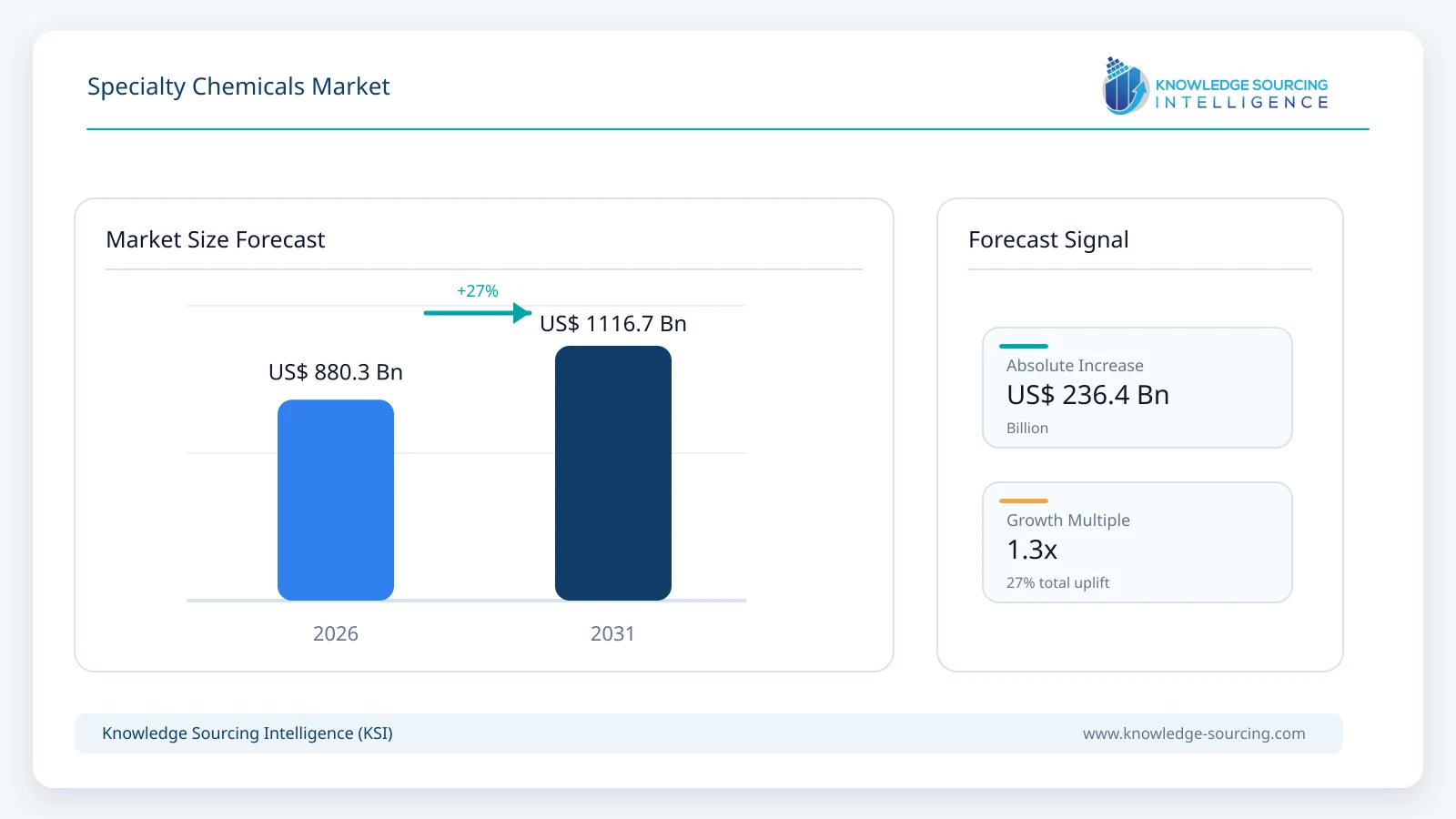
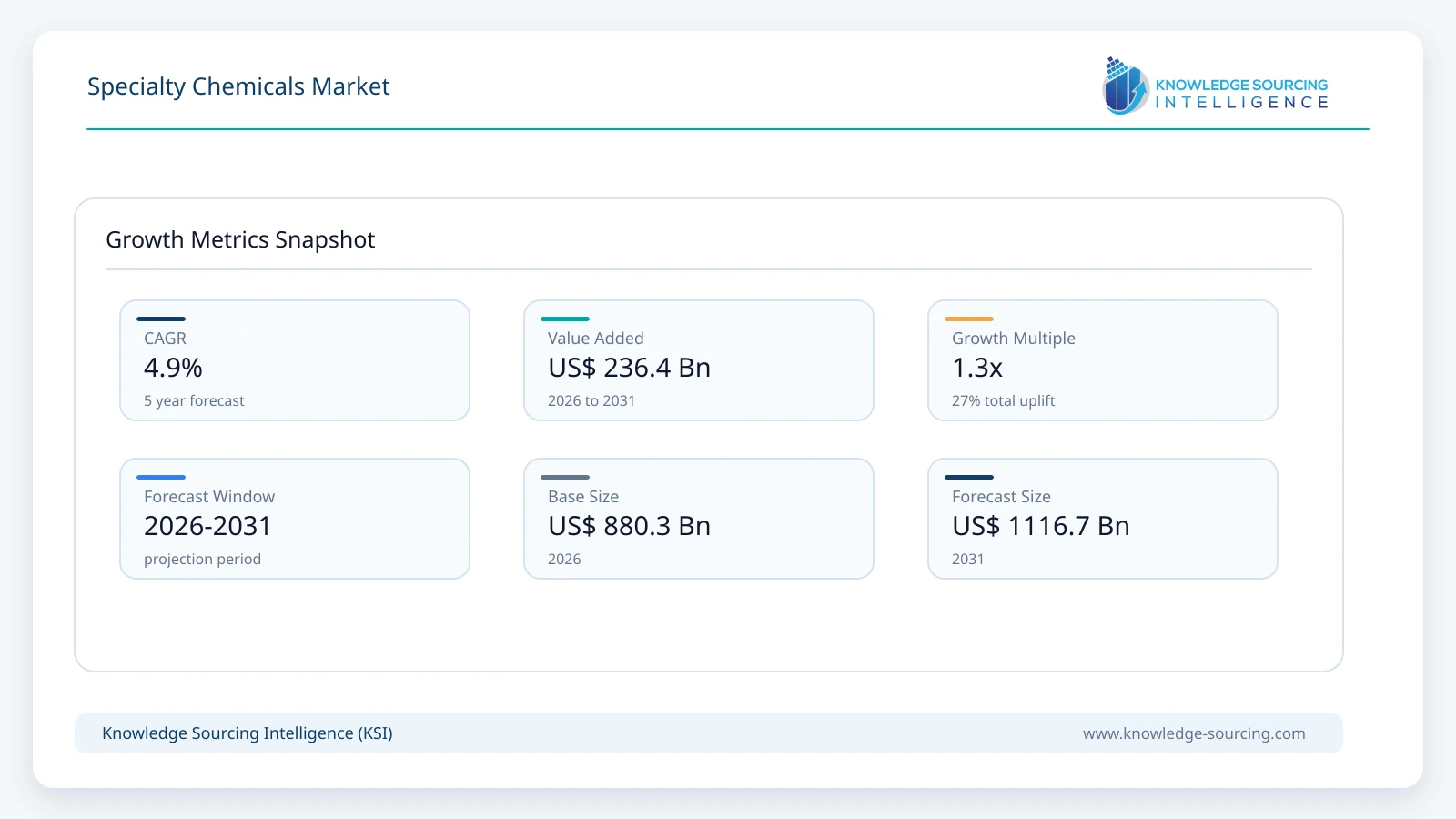
The Specialty Chemicals market is forecast to grow at a CAGR of 4.9%, reaching USD 1,116.7 billion in 2031 from USD 880.3 billion in 2026.
Highlights:
- 1Construction, semiconductor manufacturing, healthcare, and advanced manufacturing remain primary demand generators for specialty chemicals.
- 2Construction chemicals represent one of the most commercially important product categories due to sustained infrastructure investment and building performance requirements.
- 3Asia Pacific continues to attract manufacturing investment supported by expanding industrial production, electronics manufacturing, and urban infrastructure development.
- 4Bio-based formulations, advanced functional additives, and sustainable specialty polymers are receiving increased research and capital investment.
- 5Environmental regulations governing emissions, hazardous substances, and wastewater treatment continue to influence product development and procurement decisions.
- 6Competition increasingly centers on formulation expertise, technical service, regional manufacturing presence, and long-term customer qualification.
The specialty chemicals market comprises high-value chemical formulations engineered to deliver specific performance characteristics rather than bulk chemical volume. These products serve critical functions across pharmaceuticals, electronics, automotive manufacturing, construction, agriculture, personal care, food processing, water treatment, and industrial manufacturing. Unlike commodity chemicals, purchasing decisions are influenced by product performance, regulatory compliance, technical support, consistency, and application-specific requirements rather than price alone. This positions specialty chemicals as an essential input for manufacturers seeking differentiated product quality, production efficiency, and compliance with evolving environmental and safety standards.
Demand is supported by structural shifts in global manufacturing, infrastructure modernization, semiconductor fabrication, healthcare expansion, and stricter environmental regulations governing emissions, water quality, and chemical safety. Construction chemicals improve durability and lifecycle costs of buildings and infrastructure, while electronic chemicals enable advanced semiconductor manufacturing and printed circuit board production. Specialty polymers, additives, and coatings are increasingly specified to reduce weight, improve corrosion resistance, and enhance product longevity across transportation and industrial applications.
Procurement strategies within end-user industries have evolved beyond conventional cost optimization. Buyers increasingly prioritize suppliers capable of guaranteeing uninterrupted supply, regulatory documentation, formulation customization, technical service, and local manufacturing presence. Multinational manufacturers often establish long-term supply agreements with specialty chemical producers to reduce qualification costs and minimize operational disruptions, particularly in regulated sectors such as pharmaceuticals and electronics where formulation changes require extensive validation.
Feedstock diversification has also become a strategic consideration. Petrochemical-based raw materials remain dominant due to established infrastructure and production economics; however, bio-based and renewable feedstock-based specialty chemicals are gaining commercial acceptance as sustainability objectives become embedded within corporate procurement frameworks. Consumer-facing industries including cosmetics, packaging, and food ingredients are placing greater emphasis on renewable raw materials to satisfy environmental commitments and changing customer preferences.
Technological progress is reshaping product development across the industry. Advanced catalysts, process intensification, digital manufacturing controls, molecular engineering, and application-specific formulations enable suppliers to deliver products with improved efficiency, lower emissions, and enhanced performance characteristics. Investment increasingly targets research capabilities that shorten product development cycles while meeting stringent regulatory and customer qualification requirements.
The market structure remains highly diversified, encompassing global integrated chemical producers alongside regional formulation specialists. Competitive differentiation depends on proprietary chemistry, customer collaboration, manufacturing scale, distribution networks, regulatory expertise, and innovation capability. Companies with broad product portfolios and localized production facilities are better positioned to respond to regional demand fluctuations, raw material volatility, and customer-specific formulation requirements.
Market Drivers
Expansion of Advanced Manufacturing Industries
Semiconductor fabrication, electric vehicle production, pharmaceutical manufacturing, and precision engineering require specialty chemicals with highly controlled purity, performance consistency, and regulatory compliance. Electronic manufacturers purchase high-purity process chemicals capable of minimizing contamination during wafer fabrication, while pharmaceutical companies require validated excipients and processing chemicals that satisfy stringent quality standards. Suppliers continue investing in specialized manufacturing facilities and analytical capabilities to meet increasingly demanding product specifications, strengthening long-term commercial relationships.
Infrastructure Modernization Supporting Construction Chemicals
Governments continue allocating substantial funding toward transportation infrastructure, residential construction, industrial facilities, and energy projects. Construction chemicals, including waterproofing agents, concrete admixtures, repair materials, sealants, and protective coatings, improve structural durability while reducing maintenance costs throughout asset lifecycles. Engineering contractors and infrastructure developers increasingly specify premium-performance materials because lifecycle economics outweigh initial material costs, creating stable demand for high-performance formulations.
Sustainability Objectives Influencing Procurement Decisions
Corporate sustainability commitments increasingly influence purchasing behavior across consumer goods, packaging, automotive, and industrial manufacturing. Buyers seek specialty chemicals with lower carbon footprints, renewable feedstocks, improved recyclability, and reduced hazardous substance content. Chemical manufacturers are responding by expanding bio-based product portfolios, optimizing production efficiency, and investing in renewable raw material sourcing. These developments strengthen supplier competitiveness among multinational customers with environmental reporting obligations.
Water Quality and Industrial Treatment Requirements
Industrial expansion and tighter wastewater discharge regulations continue driving investment in advanced water treatment chemicals. Municipal utilities, manufacturing facilities, mining operations, and power generation plants require specialized coagulants, corrosion inhibitors, biocides, and scale control formulations to comply with environmental regulations while maintaining operational efficiency. Suppliers capable of delivering application-specific treatment programs alongside technical support gain stronger customer retention and recurring revenue streams.
Market Restraints and Challenges
Feedstock Price Volatility
Many specialty chemical formulations continue relying on petrochemical derivatives whose prices fluctuate with global energy markets and supply disruptions. Raw material inflation compresses manufacturer margins when contractual pricing limits immediate cost recovery. Companies increasingly mitigate this risk through diversified sourcing strategies, long-term supplier agreements, and formulation optimization that reduces dependence on volatile feedstocks.
Lengthy Customer Qualification Processes
Industries such as pharmaceuticals, electronics, aerospace, and automotive require extensive testing before approving new chemical formulations or suppliers. Qualification timelines may extend over several months or years, delaying commercialization and increasing development costs. Suppliers therefore invest heavily in technical documentation, regulatory compliance, application laboratories, and collaborative product development to accelerate customer approval processes.
Tightening Environmental Compliance Requirements
Chemical producers face expanding regulatory obligations concerning emissions, hazardous substances, waste management, and product registration. Compliance investments increase operating costs while requiring continuous reformulation of certain products. Companies with established regulatory expertise and global compliance infrastructure are generally better positioned to adapt to changing legislative requirements than smaller manufacturers.
Supply Chain Complexity
Global specialty chemical supply chains depend on specialized intermediates, custom manufacturing, and international logistics. Geopolitical tensions, transportation disruptions, and regional production interruptions can affect material availability and delivery schedules. Manufacturers increasingly regionalize production capacity, diversify supplier networks, and increase inventory resilience to improve supply continuity for strategic customers.
Major Segment Analysis
Construction Chemicals
Construction chemicals remain among the most commercially influential segments because they directly improve infrastructure durability, energy efficiency, structural integrity, and maintenance performance. Demand extends across residential housing, commercial buildings, industrial facilities, transportation infrastructure, and renewable energy installations.
Procurement decisions emphasize technical performance rather than acquisition cost alone. Contractors, engineering firms, and project developers evaluate compressive strength enhancement, corrosion resistance, waterproofing effectiveness, curing efficiency, lifecycle maintenance savings, and regulatory compliance when selecting formulations. Performance certification and technical support frequently influence supplier selection alongside product pricing.
Competition centers on innovation, localized manufacturing, project-specific formulation capability, and technical field services. Suppliers collaborate with architects, contractors, and infrastructure developers during project planning to optimize material selection according to climate conditions, structural requirements, and construction methods. This collaborative approach strengthens customer relationships while generating opportunities for premium pricing through differentiated product performance.
Infrastructure renewal programs, sustainable construction practices, and resilient building standards are expected to maintain commercial relevance for construction chemicals throughout the forecast period.
Regional Analysis
North America
Demand remains supported by infrastructure modernization, advanced manufacturing investment, pharmaceutical production, and semiconductor capacity expansion. Buyers emphasize regulatory compliance, domestic supply security, and long-term supplier partnerships. Environmental regulations also encourage adoption of lower-emission formulations and sustainable chemical technologies.
Europe
European demand is shaped by environmental legislation, circular economy initiatives, and industrial decarbonization strategies. Manufacturers prioritize bio-based products, recyclable materials, and energy-efficient production processes. Specialty chemical suppliers increasingly invest in sustainable product development to satisfy regulatory requirements and corporate environmental commitments.
Asia Pacific
Asia Pacific represents the largest manufacturing base for electronics, automotive production, industrial equipment, and consumer goods. Industrialization, urban development, and expanding domestic consumption continue stimulating demand across multiple specialty chemical categories. Regional investment in semiconductor fabrication and advanced manufacturing further strengthens demand for electronic chemicals and specialty materials.
Middle East & Africa and South America
Infrastructure development, mining activity, agriculture, and industrial diversification generate demand across these regions. Although investment levels vary by country, construction chemicals, water treatment products, and agricultural specialty chemicals remain important application areas. Supply chain development and regulatory harmonization continue influencing purchasing decisions and supplier expansion strategies.
Competitive Landscape
Competition combines global integrated chemical manufacturers with specialized formulation companies possessing expertise in targeted application areas. BASF SE, Dow Inc., Evonik Industries AG, PPG Industries, Inc., Mitsubishi Chemical Corporation, Brenntag SE, Toray Industries, Inc., LANXESS AG, 3M Company, Albemarle Corporation, ALTANA AG, Archroma, Arkema S.A., Clariant AG, Huntsman Corporation, Ashland Inc., Croda International Plc, and Eastman Chemical Company compete through formulation innovation, technical collaboration, manufacturing scale, regional production capability, and regulatory expertise.
Competitive positioning increasingly depends on customer-specific product development, application engineering, sustainable chemistry investments, distribution efficiency, and localized manufacturing capacity. Strategic partnerships with industrial manufacturers and expansion of regional production facilities continue supporting customer retention while reducing supply chain risk.
Recent Developments
June 2026: BASF launched Micadelva™, a non-allergenic citrus fragrance ingredient, alongside its new Safe-by-Design concept, expanding its specialty aroma ingredients portfolio with future-ready fragrance solutions supporting evolving regulatory and sustainability requirements.
March 2026: BASF launched reduced product carbon footprint (rPCF) variants of BDO, THF, PolyTHF® and NMP, enabling customers to lower Scope 3 emissions through specialty chemical solutions without changing existing formulations or manufacturing processes.
April 2026: BASF SE announced additional investments to expand specialty materials production supporting electric vehicle and advanced industrial applications. The expansion strengthens regional supply capability and addresses growing demand from advanced manufacturing sectors.
February 2026: Evonik Industries AG introduced new specialty additives designed to improve coating performance while supporting lower volatile organic compound (VOC) formulations. The launch aligns with tightening environmental compliance requirements across multiple end-user industries.
Regulatory and Policy Environment
The specialty chemicals industry operates within comprehensive regulatory frameworks governing chemical registration, environmental protection, occupational safety, transportation, and product stewardship. Regulations such as the European Union's REACH framework, chemical management requirements in North America and Asia, wastewater discharge standards, VOC emission limits, and hazardous substance restrictions significantly influence formulation development and commercialization strategies.
Government infrastructure programs stimulate demand for construction chemicals, while industrial water treatment regulations increase procurement of advanced treatment formulations. Pharmaceutical and food industries require compliance with strict manufacturing and quality standards, increasing demand for validated specialty ingredients and processing chemicals. Sustainability reporting obligations further encourage adoption of renewable feedstocks and lower-emission production technologies throughout global supply chains.
Outlook and Strategic Implications
Between 2026 and 2031, investment priorities are expected to focus on sustainable chemistry, advanced manufacturing applications, supply chain resilience, and regional production expansion. Buyers will continue emphasizing product reliability, technical support, environmental compliance, and lifecycle performance rather than procurement cost alone.
Research investment will increasingly target renewable feedstocks, recyclable materials, specialty polymers, electronic chemicals, and low-emission formulations compatible with evolving regulatory requirements. Digital manufacturing technologies and advanced analytical capabilities are also expected to shorten product development cycles while improving manufacturing consistency.
Competitive advantage will increasingly depend on localized production, customer collaboration, regulatory expertise, and innovation capability. Companies capable of integrating sustainable raw materials, maintaining diversified supply networks, and providing application-specific technical services are likely to strengthen commercial positioning across multiple end-use industries.
Although raw material volatility, environmental compliance costs, and geopolitical supply chain risks will continue influencing operating conditions, long-term demand fundamentals remain supported by industrial modernization, infrastructure investment, healthcare expansion, semiconductor manufacturing, and the continued adoption of higher-performance materials across global manufacturing sectors.
Specialty Chemicals Market Scope
| Report Metric | Details |
|---|---|
| Total Market Size in 2026 | USD 880.3 billion |
| Total Market Size in 2031 | USD 1,116.7 billion |
| Forecast Unit | Billion |
| Growth Rate | 4.9% |
| Study Period | 2021 to 2031 |
| Historical Data | 2021 to 2024 |
| Base Year | 2025 |
| Forecast Period | 2026 – 2031 |
| Segmentation | Type, End-User, Source, Geography |
| Companies |
|
Market Segmentation
By Type
By End-user
By Source
By Geography
Table of Contents
1. EXECUTIVE SUMMARY
2. MARKET SNAPSHOT
2.1. Market Overview
2.2. Market Definition
2.3. Scope of the Study
2.4. Market Segmentation
3. BUSINESS LANDSCAPE
3.1. Market Drivers
3.2. Market Restraints
3.3. Market Opportunities
3.4. Porter’s Five Forces Analysis
3.5. Industry Value Chain Analysis
3.6. Policies and Regulations
3.7. Strategic Recommendations
4. TECHNOLOGICAL OUTLOOK
5. SPECIALTY CHEMICALS MARKET BY TYPE
5.1. Introduction
5.2. Specialty Polymers
5.3. Construction Chemicals
5.4. Specialty Coatings
5.5. Plastic Additives
5.6. Electronic Chemicals
5.7. Water Treatment Chemicals
5.8. Others
6. SPECIALTY CHEMICALS MARKET BY END-USER
6.1. Introduction
6.2. Pharmaceuticals
6.3. Electronics
6.4. Automotive
6.5. Construction
6.6. Agriculture
6.7. Personal Care and Cosmetics
6.8. Food and Beverage
6.9. Others
7. SPECIALTY CHEMICALS MARKET BY SOURCE
7.1. Introduction
7.2. Petrochemical-Based
7.3. Bio-Based
7.4. Renewable Feedstock-Based
8. SPECIALTY CHEMICALS MARKET BY GEOGRAPHY
8.1. Introduction
8.2. North America
8.2.1. USA
8.2.2. Canada
8.2.3. Mexico
8.3. South America
8.3.1. Brazil
8.3.2. Argentina
8.3.3. Others
8.4. Europe
8.4.1. United Kingdom
8.4.2. Germany
8.4.3. France
8.4.4. Italy
8.4.5. Spain
8.4.6. Others
8.5. Middle East and Africa
8.5.1. Saudi Arabia
8.5.2. UAE
8.5.3. Others
8.6. Asia Pacific
8.6.1. China
8.6.2. India
8.6.3. Japan
8.6.4. South Korea
8.6.5. Australia
8.6.6. Indonesia
8.6.7. Thailand
8.6.8. Others
9. COMPETITIVE ENVIRONMENT AND ANALYSIS
9.1. Major Players and Strategy Analysis
9.2. Market Share Analysis
9.3. Competitive Benchmarking
9.4. Mergers, Acquisitions, Agreements, and Collaborations
9.5. Competitive Dashboard
10. COMPANY PROFILES
10.1. BASF SE
10.2. Dow Inc.
10.3. Evonik Industries AG
10.4. PPG Industries, Inc.
10.5. Mitsubishi Chemical Corporation
10.6. Brenntag SE
10.7. Toray Industries, Inc.
10.8. LANXESS AG
10.9. 3M Company
10.10. Albemarle Corporation
10.11. ALTANA AG
10.12. Archroma
10.13. Arkema S.A.
10.14. Clariant AG
10.15. Huntsman Corporation
10.16. Ashland Inc.
10.17. Croda International Plc
10.18. Eastman Chemical Company
11. APPENDIX
11.1. Currency
11.2. Assumptions
11.3. Base and Forecast Years Timeline
11.4. Key Benefits to the Stakeholders
11.5. Research Methodology
11.6. Abbreviations
Navigate
Trusted by the world's leading organizations











