The Internet of Things (IoT) has transformed several sectors, incorporating automated material handling. The IoT system helps in effectively carrying out logistics operations by linking physical devices to the internet such that data can be captured, analyzed, and controlled in real time. IoT’s majo...
 Source: International Trade Administration (ITA)
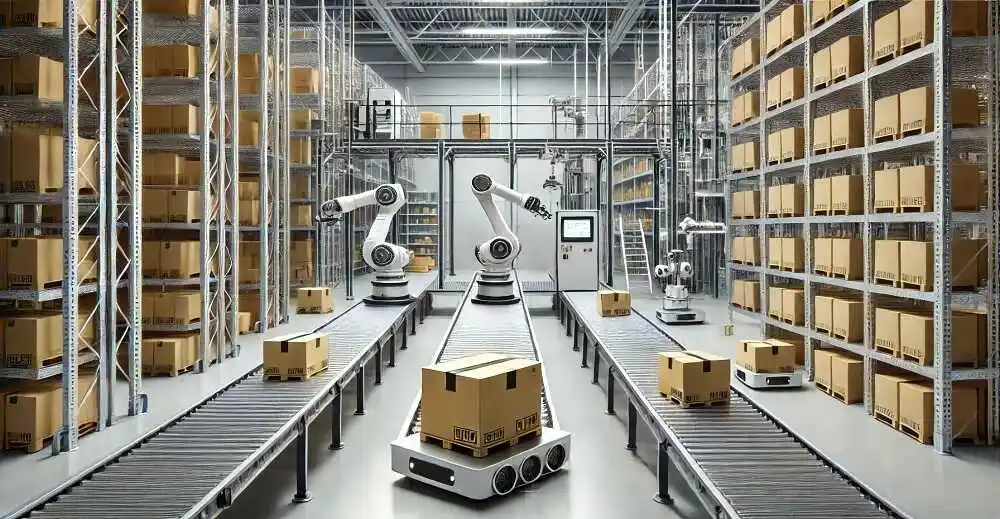
Moreover, e-commerce processes optimized through IoT technologies can ensure quicker delivery with more precision, which will result in higher levels of customer satisfaction. This technology can also help mitigate risks of inaccuracies and guarantee the correct filling of orders consequently raising the esteem of customers. E-commerce includes a wide range of business activities, including e-retailing, digital marketplaces, and e-commerce business-to-business interactions. E-retailing deals with goods sold from businesses to customers directly, while digital marketplaces are intermediaries that bring together sellers and buyers in a variety of sectors. E-commerce B2B consists of buying and selling products between companies through electronic and internet canyons like catalogs and marketplaces. In recent years, e-commerce order handling has been a necessity considering the growing scope of e-commerce activities. It is the increased acceptance of e-commerce retailing and its automation that translates to the application of automated material handling like automated vehicles and conveyors to enhance efficiency and accuracy. The B2B e-commerce sector recorded a significant rate of growth which was a market size of US$28.082 billion in 2022 and will reach US$36,163 billion by 2026, ITA reported.
Key Developments:
Source: International Trade Administration (ITA)
Moreover, e-commerce processes optimized through IoT technologies can ensure quicker delivery with more precision, which will result in higher levels of customer satisfaction. This technology can also help mitigate risks of inaccuracies and guarantee the correct filling of orders consequently raising the esteem of customers. E-commerce includes a wide range of business activities, including e-retailing, digital marketplaces, and e-commerce business-to-business interactions. E-retailing deals with goods sold from businesses to customers directly, while digital marketplaces are intermediaries that bring together sellers and buyers in a variety of sectors. E-commerce B2B consists of buying and selling products between companies through electronic and internet canyons like catalogs and marketplaces. In recent years, e-commerce order handling has been a necessity considering the growing scope of e-commerce activities. It is the increased acceptance of e-commerce retailing and its automation that translates to the application of automated material handling like automated vehicles and conveyors to enhance efficiency and accuracy. The B2B e-commerce sector recorded a significant rate of growth which was a market size of US$28.082 billion in 2022 and will reach US$36,163 billion by 2026, ITA reported.
Key Developments:
| Year | Development |
| July 2024 | In Japan, a cloud-based AI service for assessing the safety of forklifts was developed by Toyota Material Handling and Fujitsu. The AI Forklift Driving Analysis service integrates logistics processes using Fujitsu Data Intelligence PaaS and the Fujitsu Kozuchi AI service to evaluate safety in operating a forklift which is particularly infrastructure for the cloud. The service, which can be found in TMHJ FOLKLORE IoT subscription services, uses an AI that has learned from how forks are maneuvered and how operators conduct safety checks to smartly warn of unsafe operations and also prepare safety driving scorecards for the operators. This reduces the amount of time that would be used in watching video footage and increases the level of awareness in the safety of the operators. |
| May 2024 | KION North America partnered with Fox Robotics, where KION NA would manufacture and assemble autonomous trailer loaders/unloaders referred to as FoxBots in Summerville, South Carolina KION facilities. This is a non-strategic collaboration and the purpose of this collaboration is to increase the supply chain for FoxBots ATLs and create the network for services for autonomous forklifts across the USA. |
| May 2023 | Toyota Material Handling launched three additional electric lift truck models together with the Side Entry End Rider model, Center Rider Stacker model as well as Industrial Tow Tractor model. They incorporate functionality and adaptability of the operators making them competent in inter-warehouse movement as well as order assembly. Side Entry End Rider that comes in 6000 and 8000-pound variants comes with an automatic parking brake and power-assisted steering making it more energy efficient. |
Need specialized data cuts or competitive intelligence?
Our analyst team provides bespoke market sizing, supplier audits, and country-level feasibility reports tailored to your enterprise roadmap.
Speak With an Industry Analyst →Ask an Industry Analyst
Have questions regarding this briefing or market projections? Inquire with our sector lead.
Related Blogs
View All →
How America’s Aging Population is Reshaping Healthcare Demand
Jul 14, 2026
Which OSAT Companies Are Best Positioned for AI and HPC Chip Demand?
Jun 29, 2026
Wearable Health Devices and Their Role in Modern Healthcare
Jun 11, 2026
Beyond the Glass: The Decisive Transition to Computational Tissue Intelligence
May 25, 2026
Companion Diagnostics for Targeted Therapies Market: The U.S. Edge In Personalized Medicine
May 21, 2026More Blogs
Clinical Decision Support Diagnostic Systems Market: Why the U.S. Healthcare System Is Quietly Rebuilding Diagnosis Around Algorithms
The U.S. clinical decision support diagnostic systems market is rapidly evolving as hospitals adopt AI-driven tools to manage rising diagnostic complexity, workforce shortages, and operational pressures. Growth is fueled by demand for faster, accurate diagnoses, workflow efficiency, interoperability, and value-based care, while physician trust, cybersecurity, and regulatory compliance increasingly determine long-term market success.
Top U.S. Healthcare Industry Trends to Watch in 2026 for the Global Healthcare Market
The global healthcare industry in 2026 is shifting toward AI-driven efficiency, stronger cybersecurity, outpatient care expansion, and domestic pharmaceutical manufacturing. U.S. healthcare leaders are prioritizing workforce support, operational resilience, value-based care, and integrated digital systems to improve patient outcomes while controlling costs.
How AI Is Reshaping the American Healthcare Industry
The U.S. healthcare industry is rapidly integrating artificial intelligence across clinical, administrative, and pharmaceutical operations. AI is improving diagnostics, automating workflows, reducing clinician burden, accelerating drug discovery, and enhancing personalized care. With strong adoption by hospitals and tech companies, AI is transforming healthcare delivery while driving the U.S. AI healthcare market toward significant growth by 2031.