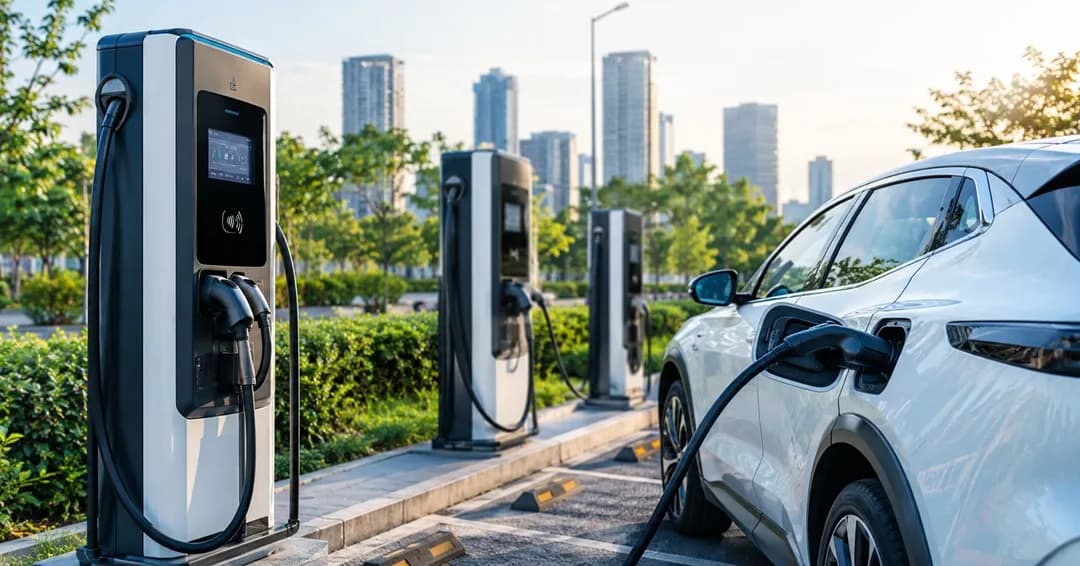
The EV charging industry is advancing through adaptive charging, dynamic load management, and ultra-fast battery technologies. Recent launches from CTEK, Schneider Electric, and CATL highlight growing demand for intelligent, high-speed, application-specific charging solutions across residential, commercial, and fleet electric mobility.
Major electric vehicle (EV) and energy-technology players have recently launched products that reveal a major transition in the industry for EV charging stations.
CTEK is rolling out an innovative adaptive charging technology to fit new modern vehicle environments. CTEK introduced its PRO Series chargers under the MODESHIFT technology banner on 1st September 2026, with the release of PRO 1240, PRO 2420 and PRO 2440. The technology switches automatically between battery support and intelligent charging depending on the power demand of the vehicle.
These chargers are created for workshops and showrooms equipped with vehicles that more often need reliable electrical power, whether during diagnostics, software updates, or other electronic support operations. The PRO 1240 provides 12V/40A output and is battery-powered with both lead-acid and lithium-ion/LiFePO4, with the PRO 2420 and PRO 2440 options developed for application in 24V heavy-duty commercial models.
Schneider Electric is driving intelligent residential charging with dynamic load management integration. On 25th August 2026, the company unveiled Schneider Charge, a Level 2 home EV charger featuring SmartAmp dynamic load management. The system customizes charging output based on the home's available electrical capacity, which reduces or eliminates the costly need for electrical service upgrades or panel changes.
It can output up to 11.5 kW / 48A and supports NACS J3400 & J1772 connectors. Its monitoring and scheduling features enable users to schedule their charging sessions while reducing their electricity costs through time-of-use charging.
In addition, CATL is shifting towards ultra-fast charging in commercial and fleet-oriented electric mobility. It introduced its Tectrans II battery for light-duty commercial vehicles with support for peak 8C charging on 6th July 2026.
The battery takes around 6 minutes and 48 seconds to reach 80 per cent state of charge, while a full charge can take around 8 minutes and 56 seconds. CATL is also pairing ultra-fast charging with battery-swapping infrastructure, revealing plans in 2026 to build 4,000 integrated supercharging and battery-swapping stations located in about 190 cities across China. This infrastructure is being optimized towards urban distribution, intercity transport, cold-chain logistics, and last-mile delivery applications.
Market Impact of These Developments
These three developments signify that the charging-station industry is heading for much faster charging speeds, more intelligent energy management, increased automation, and infrastructure tailored to specific applications.
Such developments have an impact on the market in several essential ways:
EV owners and Fleet operators are moving towards ultra-fast charging infrastructure to decrease vehicle downtime.
Smart and dynamic charging is becoming a central functionality in which charging systems draw power according to the vehicle's needs and available electrical capacity.
Load management is making residential and workplace charging more accessible while minimizing expensive electrical-panel or service upgrades.
The emerging fleet and commercial charging sector is more specialized, with high-power DC charging, faster charging cycles, and integrated or battery-swapping solutions supporting intensive vehicle use.
Electric Vehicle Charging Stations Market Outlook
These developments are closely related to the Electric Vehicle Charging Stations Market report by Knowledge Sourcing Intelligence (KSI). According to a research study published by KSI, the Electric Vehicle Charging Stations Market is expected to grow at a CAGR of 29.2%, reaching USD 472.6 million in 2031 from USD 131.3 million in 2026.
The KSI Electric Vehicle Charging Stations Market provides an in-depth analysis of the market through major technology and application categories, which helps stakeholders understand how different charging requirements are driving overall market growth.
Market segmentation:
Segmentation Category | Segments |
|---|---|
Type of Electric Vehicle | Battery Electric Vehicles (BEVs), Plug-in Hybrid Electric Vehicles (PHEVs) |
Type of Charging Station | AC Charging Stations, DC Charging Stations |
Charging Speed | Slow Charging, Fast Charging, Ultra-Fast Charging |
Application | Residential Charging, Workplace Charging, Public Charging, Fleet and Commercial Charging |
Geography | North America, South America, Europe, Middle East and Africa, Asia Pacific |
AC Charging Stations Segment Is Growing in Necessity
The AC charging stations segment is more relevant to residential and workplace applications that connect vehicles for longer durations. One such example is Schneider Electric's recently announced Level 2 residential charger, which brings together AC charging along with that application's dynamic load management to operate within existing household power capacity.
Ultra-Fast Charging Emerging as Key Future Trend
Based on the latest developments in the industry, ultra-fast charging is expected to remain the top charging speed trend driving the market. CATL's 8C charging technology and plans to build integrated stations for supercharging commercial trucks show the advancement toward significantly shorter charging times.
Explore More Reports:
Have questions?
More Press Releases
Semiconductor Test Socket Market Projected to Reach USD 3.55 Billion by 2032, Driven by AI and HPC Demand
The semiconductor test socket market is expanding as AI processors, high-performance computing, advanced packaging, and high-speed memory increase testing requirements. Growing semiconductor complexity is driving demand for reliable electrical contacts, improved signal integrity, and thermal management. Automotive electronics and power semiconductors are further creating opportunities for specialized test socket technologies.
Hydrogen Energy Storage Market to Reach USD 25.40 Billion by 2032 as Demand for Long-Duration Storage Grows
The hydrogen energy storage market is expanding as renewable energy integration, industrial hydrogen demand, and infrastructure investment drive adoption. Advancements in compressed gas, liquid hydrogen, underground geological, and solid-state storage technologies are creating opportunities across utilities, industrial applications, and grid-scale energy systems, while cost efficiency and infrastructure readiness remain critical challenges.
Thermal Energy Storage Market to Reach USD 10.20 Billion by 2032, Driven by Renewable Energy Integration and Industrial Heat Electrification
The thermal energy storage market is advancing as renewable energy integration, industrial electrification, and energy cost management drive demand. Innovations in sensible heat, latent heat, and thermochemical storage are expanding applications across industrial heating, cooling, concentrated solar power, and commercial buildings, creating opportunities for technology providers across major regional markets worldwide.