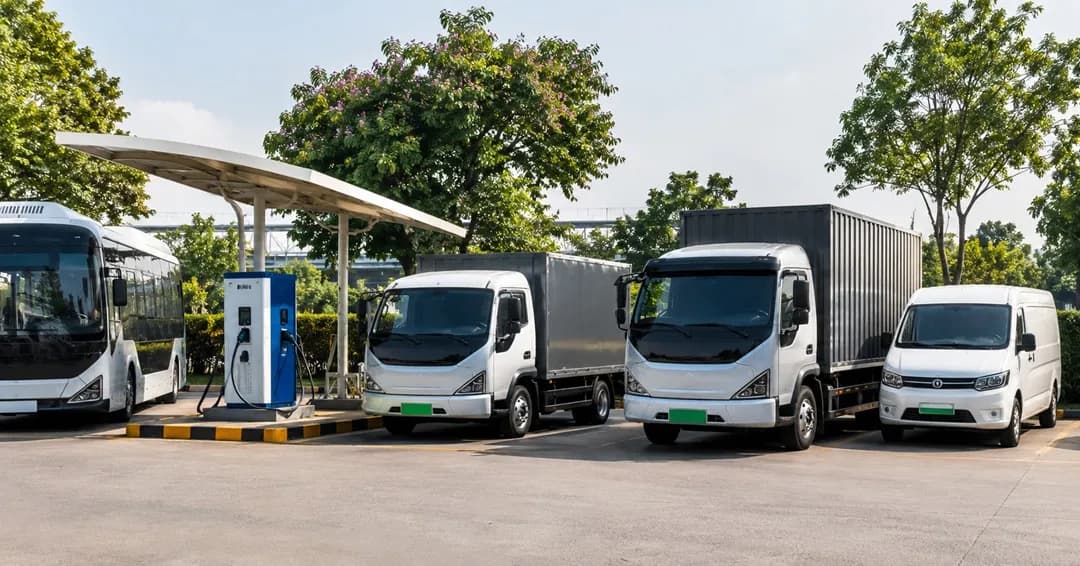
India's government incentives are accelerating electric commercial vehicle adoption by supporting manufacturing, batteries, charging infrastructure, public procurement, and financing. Beyond reducing purchase costs, these policies improve total ownership economics, strengthen domestic EV production, encourage fleet electrification, and create a self-sustaining ecosystem that supports long-term commercial and industrial growth.
Electric commercial vehicles (ECVs) have moved beyond the experimental phase in India. A few years ago, electric buses and cargo three-wheelers were largely confined to pilot projects, municipal demonstrations, or startup-led urban delivery networks. Today, the discussion is increasingly centered on manufacturing capacity, financing models, charging ecosystems, localization, and long-term fleet economics. This shift has not occurred organically. Government intervention has played a decisive role in shaping market adoption.
Unlike passenger electric vehicles, commercial fleets make purchasing decisions based on measurable financial outcomes rather than consumer sentiment. Fleet operators evaluate vehicles through operating costs, asset utilization, maintenance expenditure, uptime, financing terms, and regulatory compliance. Consequently, incentives that reduce acquisition costs or improve operational certainty can significantly influence purchasing decisions.
India's policymakers recognized this distinction early. Instead of relying solely on consumer subsidies, they have gradually developed a broader ecosystem that addresses manufacturing, battery production, charging infrastructure, public procurement, and state-level fiscal benefits. More recently, national initiatives such as the PM E-DRIVE Scheme have reinforced this approach by supporting electric buses, trucks, ambulances, charging infrastructure, and vehicle demand through targeted incentives rather than broad consumer subsidies. The result is an environment where electric commercial mobility is increasingly becoming commercially viable rather than merely environmentally desirable.
Perhaps the most significant change over the last several years is that incentives are no longer viewed simply as purchase discounts. They now function as industrial policy instruments designed to stimulate domestic manufacturing, reduce dependence on imported fossil fuels, improve urban air quality, and strengthen India's position as a producer of electric mobility technologies.
Government Support Has Shifted From Individual Vehicles to Entire Value Chains
The first generation of electric mobility incentives focused primarily on reducing vehicle acquisition costs. While this approach helped stimulate initial demand, policymakers gradually realized that sustainable adoption required support across the entire supply chain.
Today, incentives extend well beyond vehicle purchases.
Production-Linked Incentive (PLI) programmes for the automobile sector and Advanced Chemistry Cell (ACC) battery manufacturing encourage domestic production of electric vehicle components and battery technologies. State governments continue to offer land concessions, electricity tariff benefits, stamp duty exemptions, and manufacturing incentives. Public sector procurement programmes provide stable demand for electric buses, while public-sector financial institutions and private lenders are gradually expanding financing options as operational experience with electric fleets improves.
This layered approach has produced an important market effect. Manufacturers are making investment decisions with greater confidence because policy support exists across multiple stages of production rather than only at the point of sale.
For fleet operators, this translates into improved vehicle availability, expanding service networks, better financing options, and gradually declining ownership costs.
The market is therefore transitioning from a subsidy-driven environment toward one supported by broader industrial competitiveness.
Financial Incentives Are Improving Total Cost of Ownership Rather Than Simply Lowering Purchase Prices
Commercial fleet operators rarely choose vehicles based solely on acquisition costs.
Instead, purchasing decisions revolve around total cost of ownership (TCO), which includes:
Cost Component | Diesel Commercial Vehicle | Electric Commercial Vehicle |
Vehicle Purchase Cost | Lower | Higher (partially offset by government incentives) |
Fuel/Energy Cost | High and volatile | Significantly lower |
Maintenance | Higher due to engine complexity | Lower because of fewer moving parts |
Operating Noise | High | Low |
Urban Emission Compliance | Increasing regulatory risk | Fully compliant with zero tailpipe emissions |
Long-Term Operating Cost | Higher | Lower under high utilization |
Government incentives influence nearly every variable in this equation:
Purchase incentives and demand-support schemes reduce upfront capital expenditure.
The 5% GST applicable to most electric vehicles continues to improve acquisition economics compared with conventional commercial vehicles.
State registration fee exemptions provide additional savings where applicable.
Improving financing programmes and leasing models are gradually increasing affordability for commercial fleet operators.
Charging infrastructure support minimizes operational uncertainty.
When these factors are evaluated collectively, electric commercial vehicles become increasingly competitive in high-utilization applications such as urban logistics, municipal services, airport operations, intra-city freight, and public transportation.
The policy objective therefore extends beyond making electric vehicles cheaper. It aims to shorten the payback period sufficiently to influence investment decisions while encouraging greater domestic manufacturing, localized supply chains, and wider deployment of charging infrastructure.
Urban Freight Is Emerging as the Biggest Beneficiary
The rapid expansion of India's e-commerce sector has strengthened the effectiveness of government incentives for electric commercial vehicles. Growth in e-commerce, quick commerce, and urban logistics has increased demand for predictable, high-frequency delivery operations where electric cargo vehicles can offer lower operating costs over their service life.
Last-mile delivery companies operate predictable routes, return to central depots each day, and maintain high vehicle utilization rates. These characteristics align particularly well with battery-electric commercial vehicles.
Government incentives have accelerated adoption by reducing barriers during the transition period. In addition to purchase incentives, expanding charging infrastructure and improving financing options have made fleet electrification more practical for logistics operators.
Many logistics operators now view electric cargo vehicles as operational assets capable of generating measurable savings rather than experimental technologies.
This shift has encouraged several large fleet operators to commit to gradual electrification targets as part of their cost optimization and sustainability strategies.
Interestingly, rising diesel price volatility has amplified the value of government incentives. Subsidies alone may not justify fleet replacement, but when combined with lower operating expenses and predictable energy costs, they significantly improve investment returns.
Consequently, urban freight has become one of the strongest demand segments for electric commercial mobility.
Public Bus Electrification Demonstrates How Procurement Can Shape Markets
Government procurement has been one of the most influential drivers of India's electric commercial vehicle ecosystem.
Unlike private fleet purchases, public transportation contracts create predictable, large-scale demand that allows manufacturers to plan production capacity with greater certainty.
Electric bus tenders have encouraged manufacturers to expand assembly facilities, develop localized supply chains, and invest in service infrastructure. Recent government programmes supporting electric bus deployment have further reinforced demand by combining central financial assistance with state and city-level implementation.
An equally important development has been the growing adoption of gross cost contract (GCC) models.
Under these arrangements, operators provide buses while government agencies pay based on vehicle availability and service performance.
This structure distributes financial risk more efficiently.
Manufacturers gain long-term contracts.
Operators receive predictable revenue.
Municipal authorities benefit from cleaner transportation without bearing full ownership responsibilities.
The broader market also benefits because suppliers can scale operations more efficiently when production schedules become more predictable.
Battery Manufacturing Incentives Are Addressing a Critical Structural Challenge
Battery costs continue to represent one of the largest components of electric commercial vehicle pricing.
Recognizing this, the government has expanded support beyond vehicles to include domestic battery manufacturing.
Key benefits of encouraging local production include:
Reduced exposure to international supply chain disruptions.
Higher domestic value addition.
Increased manufacturing employment.
Greater long-term price stability.
Support for the development of an integrated battery value chain through Advanced Chemistry Cell (ACC) manufacturing incentives and related industrial policies.
Although India still imports several critical battery materials, localized cell production and battery pack assembly are gradually improving supply chain resilience. Domestic investments in battery manufacturing are also expected to reduce import dependence over the medium term, although critical minerals will continue to rely significantly on global supply chains.
The impact extends beyond manufacturing.
Domestic battery production shortens delivery timelines, supports localized product customization, and enables closer collaboration between battery suppliers and vehicle manufacturers.
Over time, these improvements are expected to reduce both vehicle costs and maintenance expenses while strengthening the domestic electric mobility ecosystem.
State Governments Are Becoming Important Catalysts
National policies establish the overall framework, but implementation increasingly depends on state governments.
States compete to attract electric vehicle manufacturing investments through various fiscal incentives.
Some prioritize manufacturing.
Others encourage fleet adoption.
Several focus on charging infrastructure.
States including Maharashtra, Tamil Nadu, Gujarat, Karnataka, Uttar Pradesh, and Telangana have introduced EV policies that combine manufacturing incentives with measures to encourage vehicle adoption and charging infrastructure development.
This diversity has created regional differences in market development.
States with stronger industrial ecosystems and proactive policy implementation have generally witnessed faster commercial vehicle deployment.
Rather than viewing these variations as inconsistencies, they may represent useful experimentation. Different policy approaches generate practical insights that can later inform broader national strategies.
Healthy competition among states has also accelerated infrastructure investment and encouraged manufacturers to expand production facilities across multiple regions.
Charging Infrastructure Incentives Reduce Operational Uncertainty
Fleet operators generally express less concern about vehicle technology than about operational continuity.
A vehicle that cannot complete scheduled routes undermines commercial viability regardless of acquisition incentives.
Government support for charging infrastructure directly addresses this concern. Recent policy measures have expanded support for public charging networks, depot charging facilities, and high-capacity charging infrastructure to meet the operational requirements of commercial fleets.
Public funding, viability gap support, land allocation, and distribution network upgrades have encouraged charging station deployment across urban logistics corridors. The PM E-DRIVE Scheme also includes financial support for expanding public charging infrastructure, helping reduce range anxiety and improve fleet reliability.
Commercial fleets possess an important advantage over passenger vehicles.
Many return to centralized depots daily.
Depot-based charging significantly reduces infrastructure complexity and improves energy management.
Government incentives have therefore focused increasingly on enabling large-scale fleet charging rather than exclusively expanding public charging stations. This approach supports overnight charging, optimized energy management, and reduced operating costs for fleet operators.
This distinction is important because commercial charging economics differ substantially from private vehicle charging patterns.
Domestic Manufacturing Is Becoming a Strategic Objective Rather Than a Secondary Benefit
The conversation surrounding electric commercial vehicles increasingly overlaps with industrial policy.
Government incentives aim not only to increase electric vehicle adoption but also to strengthen India's manufacturing competitiveness.
Vehicle assembly alone generates limited economic value.
Greater opportunities exist in motors, power electronics, battery systems, thermal management, software integration, telematics, and charging equipment.
By encouraging domestic production across these components, policymakers seek to increase local value addition while reducing import dependence. Production-linked incentives and investments in battery manufacturing are also encouraging suppliers to expand domestic production capabilities across the EV value chain.
This strategy also improves export potential.
Several Indian manufacturers are beginning to explore overseas markets where affordable electric commercial vehicles are gaining attention. Indian manufacturers are also expanding exports of electric buses, three-wheelers, and light commercial vehicles to emerging markets in Asia, Africa, and the Middle East, although export volumes remain modest compared with domestic demand.
If domestic manufacturing continues expanding alongside demand, India could become an important production hub for emerging markets with similar transportation requirements.
Policy Impact Across the Electric Commercial Vehicle Ecosystem
Policy Area | Primary Objective | Market Impact |
Purchase Incentives | Lower acquisition costs | Faster fleet adoption |
GST Reduction | Improve affordability | Better total cost of ownership |
Production-Linked Incentives | Expand domestic manufacturing | Higher localization |
Battery Manufacturing Support | Reduce import dependence | Lower long-term battery costs |
Charging Infrastructure Programmes | Improve operational confidence | Higher fleet utilization |
Public Procurement | Generate predictable demand | Manufacturing scale expansion |
State EV Policies | Encourage investment | Regional ecosystem development |
PM E-DRIVE Scheme | Support demand for electric commercial vehicles, buses and charging infrastructure | Accelerates commercial fleet electrification and ecosystem development |
Financing Still Represents an Underestimated Challenge
Despite substantial policy support, financing remains one of the less discussed obstacles to wider electric commercial vehicle adoption.
Commercial vehicles generate revenue immediately after deployment, yet lenders often remain cautious because electric assets lack the long operating histories of conventional diesel vehicles.
Residual value estimation remains uncertain.
Battery replacement costs introduce additional complexity.
Secondary markets for used electric commercial vehicles are still developing.
Government incentives have partially offset these concerns by reducing acquisition costs, but financing innovation may ultimately become equally important. As fleet operating data becomes more widely available, financial institutions are gradually improving their ability to assess vehicle performance, battery life, and residual values, helping reduce lending risk.
Battery leasing, vehicle-as-a-service models, operating leases, and pay-per-kilometre financing are beginning to emerge as practical alternatives. Several manufacturers and fleet operators are also collaborating with banks and non-banking financial companies (NBFCs) to develop financing products tailored to commercial EV fleets.
These business model innovations complement government incentives by reducing upfront investment requirements.
Their combined effect could significantly accelerate fleet electrification during the coming decade.
Market Momentum Is Becoming Self-Reinforcing
One of the more interesting characteristics of India's electric commercial vehicle market is that government incentives are gradually becoming less influential as adoption increases.
Early subsidies primarily reduced uncertainty.
As deployment expands, operational experience itself becomes a stronger adoption driver.
Fleet operators share performance data.
Maintenance records become more predictable.
Charging practices improve.
Resale markets slowly develop.
Manufacturers continue to refine vehicle reliability, battery management systems, and after-sales support.
Each successful deployment reduces perceived risk for future buyers.
This creates a self-reinforcing cycle where market confidence grows alongside expanding operational experience rather than depending solely on subsidy levels.
Such transitions typically indicate that an emerging industry is progressing toward broader commercial adoption.
Environmental Benefits Are Becoming Financial Benefits
While emissions reduction remains an important policy objective, commercial operators increasingly focus on measurable financial outcomes.
Key commercial benefits include:
Reduced fuel expenditure.
Lower maintenance costs.
Improved urban regulatory compliance.
Reduced vehicle downtime.
Enhanced corporate sustainability reporting and ESG performance.
Greater predictability in operating costs, particularly for high-utilization fleets.
These factors increasingly influence procurement decisions.
Government incentives have accelerated this transition by shortening investment payback periods and improving the business case for fleet electrification.
Environmental performance therefore becomes an additional commercial advantage rather than solely a regulatory obligation.
This gradual shift is likely to remain more sustainable over the long term than reliance on direct purchase subsidies alone.
The Next Phase Will Depend Less on Incentives and More on Execution
Government incentives have undoubtedly accelerated India's electric commercial vehicle market, but their long-term success will depend on effective implementation.
Charging infrastructure deployment must continue keeping pace with fleet expansion.
Battery recycling and second-life battery ecosystems require further development.
Grid modernization will become increasingly important as charging demand increases.
Domestic supply chains must improve competitiveness while continuing to expand local manufacturing capabilities.
The continued implementation of schemes supporting charging infrastructure, battery manufacturing, vehicle localization, and public procurement will also influence the pace of commercial EV adoption over the coming years.
Perhaps most importantly, policy should gradually evolve from stimulating demand toward encouraging innovation, manufacturing efficiency, and productivity.
History suggests that industries achieve lasting competitiveness when government support creates capable markets rather than permanently subsidized ones.
India appears to be moving steadily in that direction.
The country's policy framework has already shifted from isolated vehicle incentives to broader industrial development. If implementation remains consistent and investment momentum continues, electric commercial vehicles could become one of the strongest examples of coordinated industrial policy supporting both environmental and economic objectives.
The transition is unlikely to be perfectly linear. Supply chain constraints, financing gaps, evolving battery technologies, charging infrastructure expansion, and critical mineral availability will continue to influence adoption rates. Nevertheless, the long-term direction of India's commercial EV market remains positive, supported by sustained policy initiatives, increasing private investment, expanding domestic manufacturing, and growing fleet operator confidence.
Government incentives have not merely accelerated electric commercial vehicle adoption. They have helped reshape investment priorities across manufacturers, component suppliers, charging infrastructure providers, financiers, fleet operators, and public transport agencies, laying the foundation for a more mature and competitive electric commercial vehicle ecosystem.
Have questions?
More Thought Articles
How EV Charger Manufacturers Can Capitalize on India’s Home Charging Revolution
India’s residential EV charging opportunity is expanding as policy support, EV adoption, and private parking infrastructure develop. Manufacturers can capture value beyond AC chargers through installation, smart charging, load management, solar integration, software, and after-sales services. Housing societies, automakers, and property developers offer scalable routes to residential charging customers.
Second-Life EV Battery Market in India: What Is Driving Demand from Manufacturers?
India’s second-life EV battery market is gaining relevance as electric vehicle adoption expands and batteries retain useful capacity after automotive service. Growing stationary-storage demand, battery data, refurbishment capabilities, EPR obligations, and critical-mineral policies are encouraging manufacturers to extend battery value through reuse before eventual recycling within India’s emerging circular battery ecosystem.
The Rise of Locally Manufactured Battery Separators in India’s EV Ecosystem
India’s battery industry is progressing from pack assembly toward domestic cell and material manufacturing, creating opportunities for lithium-ion battery separators. Policy support, ACC capacity expansion and R&D initiatives are strengthening the ecosystem. However, technical complexity, manufacturing yields, qualification requirements and economics mean localisation will likely advance gradually through coatings, testing and finishing.