
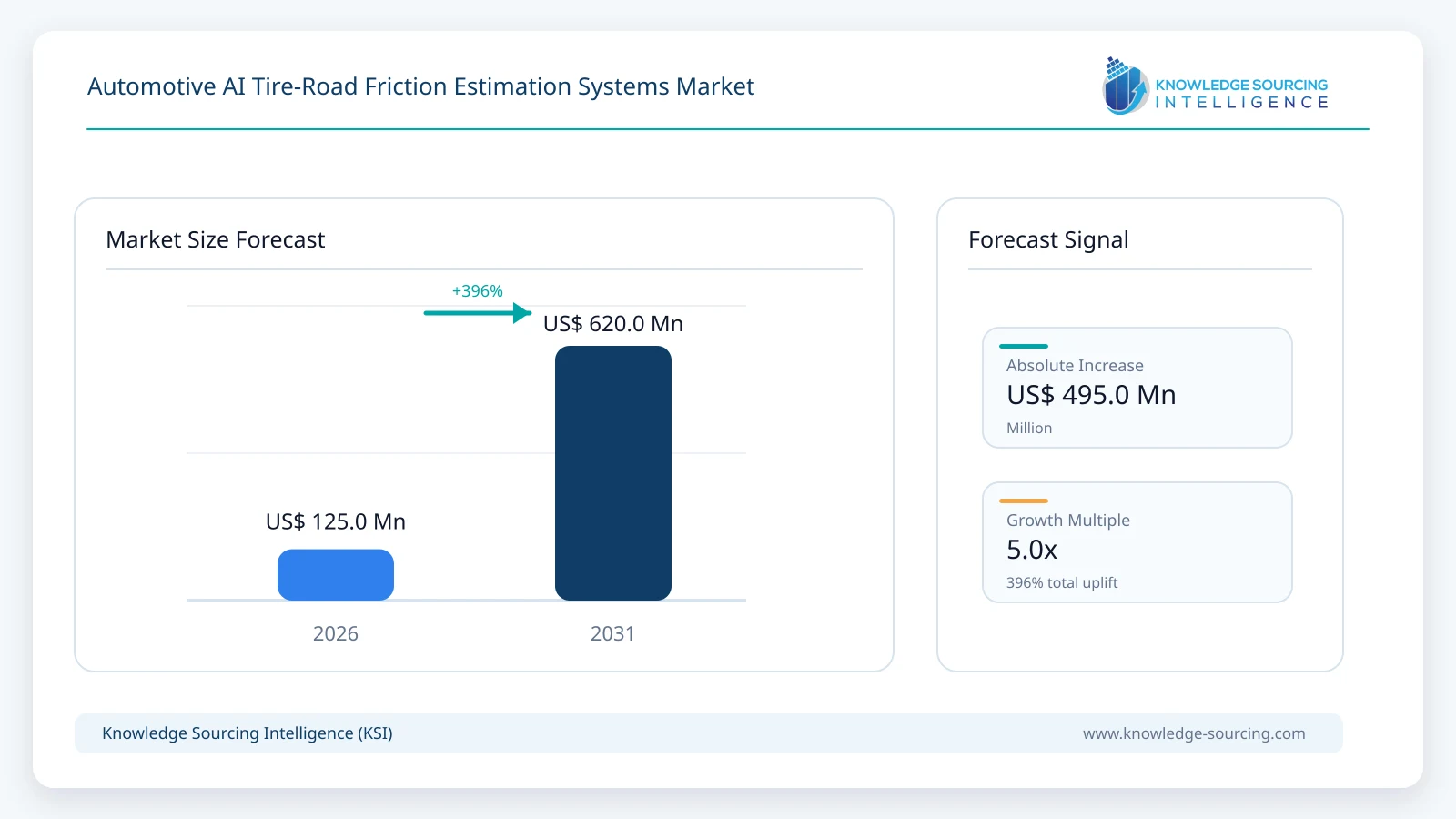
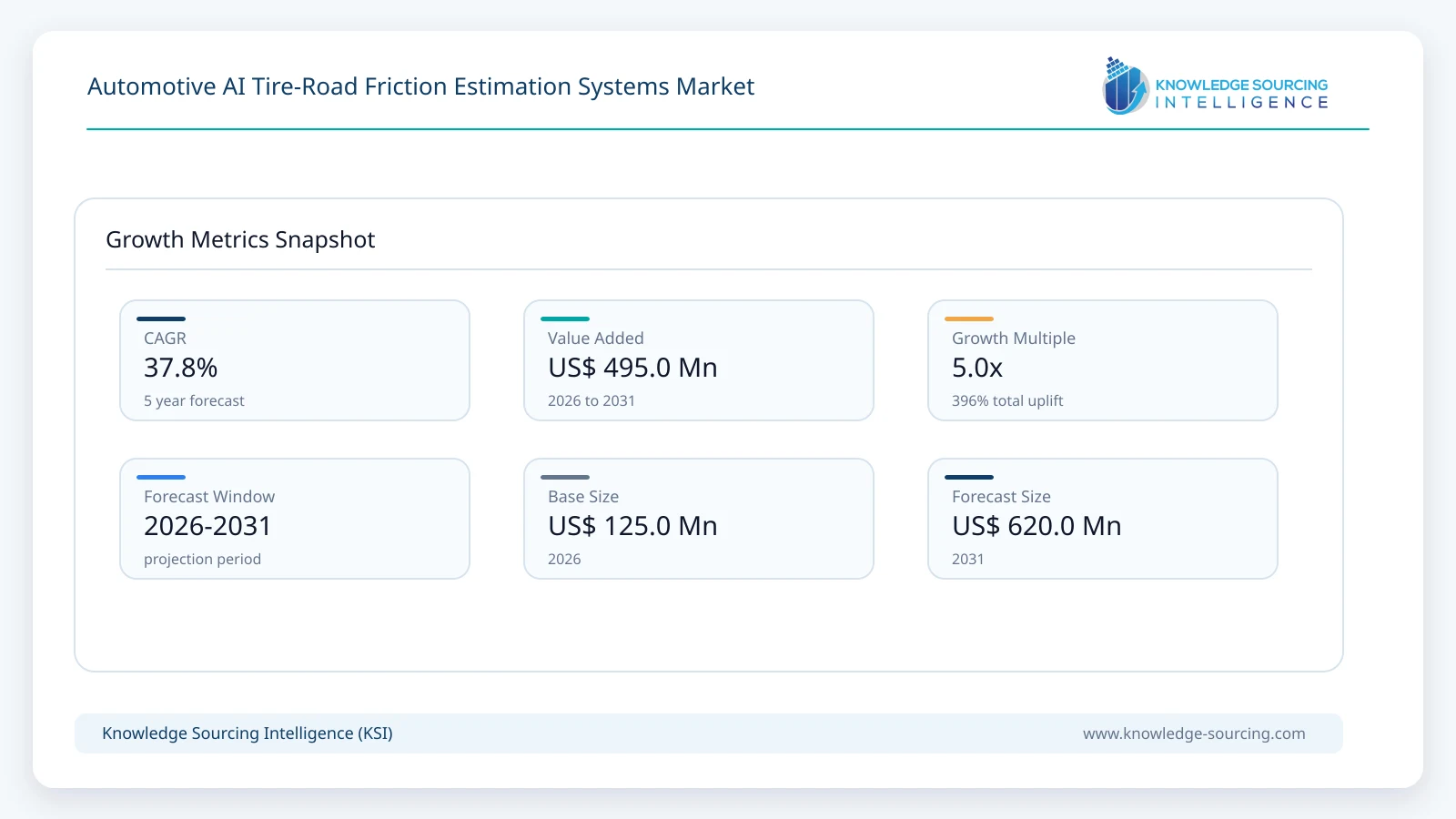
The Automotive AI Tire-Road Friction Estimation Systems Market is forecast to grow at a CAGR of 37.8%, reaching USD 620.0 million in 2031 from USD 125.0 million in 2026.
Highlights:
- 1Global market revenue is estimated at USD 125 million in 2026 and USD 620 million in 2031.
- 2Vehicle-dynamics virtual sensing contributes approximately 43% of 2026 modeled revenue, reflecting the appeal of existing vehicle-sensor inputs.
- 3Embedded friction-estimation software accounts for approximately 54% of 2026 supplier value.
- 4Stability and traction-control functions represent approximately 39% of 2026 market demand.
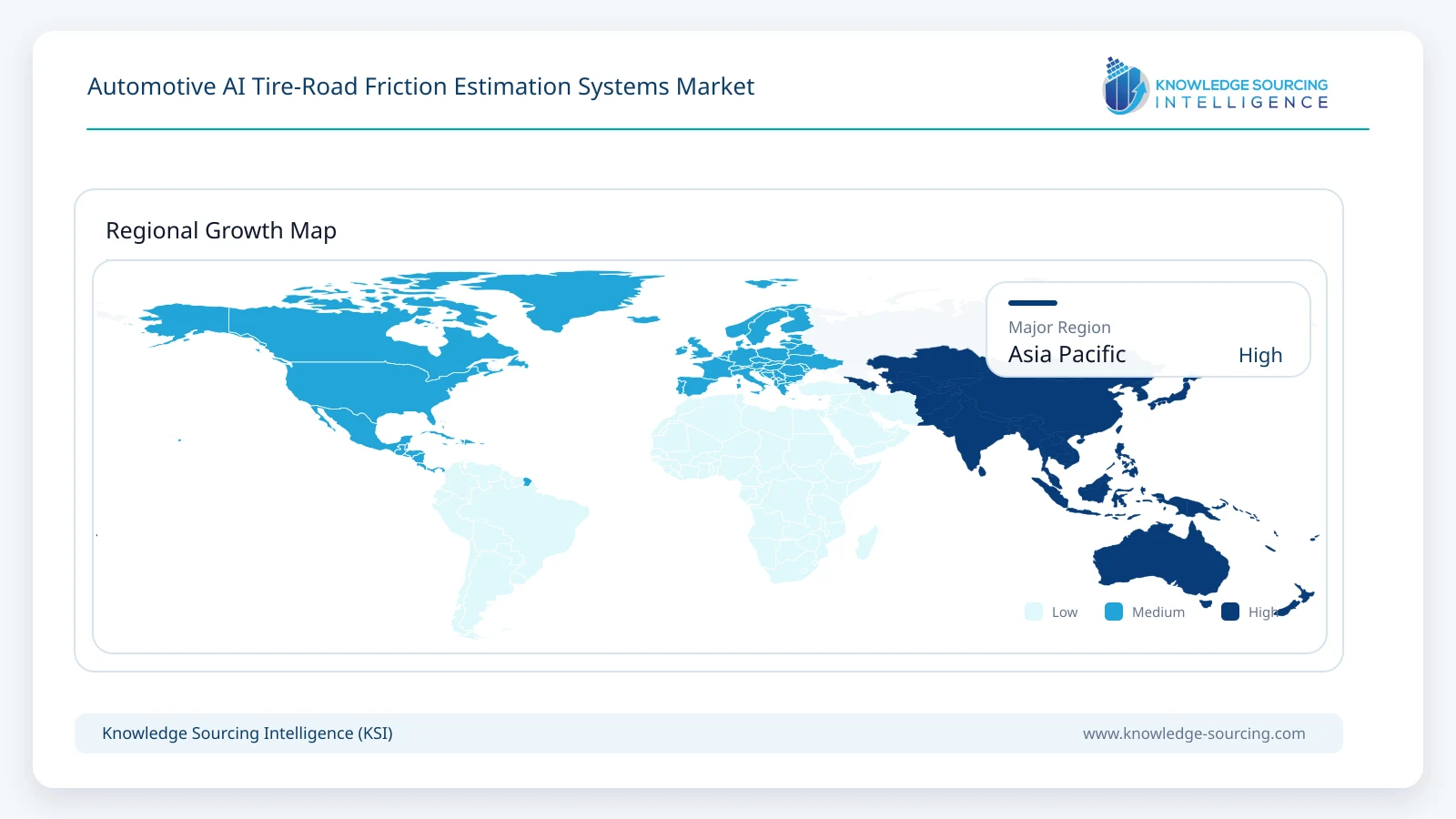
- 5Asia Pacific leads the modeled regional market in 2026, while Europe retains a concentrated supplier and qualification ecosystem.
- 6Connected friction intelligence and multimodal sensing gain importance for ADAS and autonomous-driving decisions.
- 7Automotive-qualified integration, tire variability, and cautious safety validation remain important commercialization constraints.
The automotive AI tire-road friction estimation systems market comprises dedicated embedded estimation software, qualifying intelligent-tire integration content, connected friction-data services, and directly associated program engineering. Friction estimates describe the grip that a tire can use on a given road surface, enabling vehicle functions to respond before significant wheel slip occurs. In-vehicle implementations combine dynamics observers with data about tires, temperature, and driving conditions, while connected variants provide early context for road segments ahead.
NIRA Dynamics offers a software-only Tire Grip Indicator using available vehicle signals, while Michelin’s universal tire digital twin estimates tire behavior through physics models and data science. Pirelli Cyber Tyre provides a complementary sensor-equipped approach, integrating tire measurements with vehicle-control electronics through Bosch cooperation. These offerings create distinct routes for vehicle manufacturers to purchase friction intelligence without buying a complete brake controller or traction system.
Market Overview
Tire-road friction estimation aims to identify the adhesion available at each wheel under changing road, tire, and vehicle conditions, often before conventional stability control needs to intervene. A system may derive the estimate from wheel-speed differences and vehicle dynamics, combine those observations with visual road perception, or measure tire vibrations through intelligent sensors. The usable estimate depends on tire condition and available excitation, so suppliers must account for uncertainty rather than rely on road-surface classification alone.
NIRA’s Tire Grip Indicator continuously evaluates tire-road interaction from standard vehicle signals. Michelin’s May 2026 tire digital-twin announcement illustrates the potential for tire-aware embedded software without additional physical sensors. Pirelli’s production Cyber Tyre integration with Bosch shows that embedded tire electronics can also communicate directly with vehicle stability systems. Commercial models differ in hardware requirements and maturity, but all seek to provide more actionable grip information to chassis controllers.
Connected observations expand this function beyond an individual vehicle. NIRA reports Road Surface Conditions coverage built from millions of participating vehicles, while Bosch’s connected-map services combine fleet signals, weather, and infrastructure context to anticipate hazardous conditions. A connected feed can be valuable before a vehicle enters a low-friction road segment, but its reliability depends on map matching, current conditions and the interpretation of tire-specific road measurements.
Market Trends
Virtual Friction Sensing Becomes a Software-Defined Vehicle Function
Automotive suppliers are increasingly offering tire-road friction estimation as embedded software using standard wheel speed, steering and chassis motion signals rather than a new dedicated physical sensor. NIRA Dynamics’ Tire Grip Indicator is designed to identify low-grip conditions before ABS or ESC activation, while Tactile Mobility uses vehicle-data-derived virtual sensors to infer tire grip and road interaction.
This architecture reduces bill-of-material barriers and supports reuse across multiple vehicle programs. The commercial challenge moves toward tire-aware calibration, uncertainty handling, and system-level validation, creating a license and engineering market that is distinct from the underlying brake or stability control hardware.
Multimodal AI Combines Road Perception with Vehicle Dynamics
Road cameras and environmental signals can indicate water, snow, or surface texture ahead of the vehicle, while tire and chassis data measure the forces available at the contact patch. Volvo Cars’ SAFE-RIDE program combines perception and tire-based estimates, and a September 2026 Information Fusion study tested uncertainty-aware multimodal friction prediction in real vehicles.
The benefit of multimodal fusion is earlier road-ahead awareness without abandoning vehicle-based measurement. Engineers must still test whether a visually wet road is truly slippery for a particular tire and vehicle, so confidence scoring and safe fallback logic are as important as the AI model itself.
Tire Intelligence Connects Directly with Braking Controllers
Pirelli’s Cyber Tyre production programs and its cooperation with Bosch link tire-integrated sensor information to vehicle dynamic control electronics. The May 2026 Pagani Utopia Roadster demonstration emphasized a fully integrated vehicle application, while the September 2025 Aston Martin agreement provides a further platform-development route.
Goodyear’s SightLine collaboration with TNO has also demonstrated the use of intelligent tire information to refine automatic emergency braking. Although these cases differ in hardware and maturity, they show suppliers moving beyond tire-condition dashboards toward control functions that respond to the estimated grip available.
Connected Fleets Turn Friction Measurements into Road Intelligence
NIRA Dynamics’ Road Surface Conditions and Road Surface Alerts services aggregate measurements from connected vehicles into road-specific friction information. Bosch’s connected-map approach similarly combines fleet observations with weather and road context. The resulting data can reach a car before the tire experiences the relevant road segment.
Network coverage and data processing create recurring service opportunities, but the market should not confuse broad weather alerts with measured friction intelligence. OEMs will pay a premium when the information can demonstrably improve braking, speed selection or automated-driving decisions.
Research-Stage In-Tire AI Moves Toward Automotive Evaluation
POLYN Technology reported delivery of VibroSense engineering sensor nodes for customer evaluation in September 2026. Its approach processes high-frequency tire accelerometer information to estimate peak friction, offering a different sensing path from algorithms based only on vehicle chassis signals.
The announcement is an engineering-stage milestone rather than evidence of vehicle-production revenue. Future commercialization will depend on automotive qualification, battery and radio reliability, manufacturing cost, and whether a direct in-tire estimate provides enough added value compared with software-only sensing.
Segment Analysis
By Friction Estimation Technology: Vehicle-Dynamics Virtual Sensing
Software-based vehicle-dynamics estimation is the largest modeled technology group, representing about 43% of 2026 revenue. Wheel-speed variations, steering activity, and chassis motion provide useful signatures of tire-road interaction without requiring tires to incorporate electronics. NIRA Dynamics and Tactile Mobility demonstrate the commercial direction of sensor-free or existing-sensor virtual friction estimation.
The technology remains sensitive to tire differences and low-excitation driving conditions, so suppliers compete through field data, confidence estimation, and robust vehicle-specific calibration. Multimodal fusion is forecast to grow faster as cameras and road-context signals support earlier warnings before grip is directly exercised.
By Primary Application: Stability and Traction Control
Stability and traction-control functions represent approximately 39% of 2026 supplier value because friction information can help coordinate brake intervention, wheel torque, and vehicle motion before substantial tire slip develops. NIRA’s friction-estimation use cases include all-wheel-drive torque decisions and regenerative braking operating limits, while Pirelli’s tire-data integration informs stability-control electronics.
Grip-aware ADAS braking and cruise functions are projected to gain share through 2031 as road-condition inputs become part of control-system validation. The central commercial requirement is a reliable estimate that changes vehicle behavior safely, not the availability of raw road classifications on a display.
By Revenue Component: Embedded Friction Estimation Software
Embedded software accounts for around 54% of modeled 2026 revenue. Its value arises from friction-specific algorithms, tire-aware model parameters and licensed integration within established vehicle-control processors rather than the purchase of a complete chassis ECU. The virtual-sensor approaches of NIRA, Michelin and Tactile Mobility illustrate why software can be the main monetized content.
Additional revenue comes from smart-tire interfaces and connected friction data, while development programs still require calibration and validation engineering. Cloud data services gain share as vehicle fleets contribute repeat observations and OEMs incorporate road-ahead grip layers into assistance and navigation systems.
By Region: Asia Pacific
Asia Pacific leads the model at approximately 37% of 2026 market value, reflecting the scale of vehicle manufacturing in China and advanced electronics programs in Japan and South Korea. OICA recorded 96.4 million motor vehicles produced worldwide in 2025, while China’s automotive manufacturing scale creates a substantial future application base for low-cost friction-aware software.
Europe remains a critical technology and early-adoption center, supported by NIRA in Sweden, Pirelli in Italy, Bosch and AUMOVIO in Germany and established chassis engineering. Asia Pacific’s modeled growth is driven by broader platform adoption, whereas European suppliers remain prominent in validation, software intellectual property and premium vehicle launches.
Market Drivers
Software-Only Grip Estimation from Existing Vehicle Sensors
Wheel-speed sensors, yaw-rate measurements and steering signals already present on many modern vehicles create a practical input set for estimating available tire-road friction without adding a dedicated wheel sensor. NIRA Dynamics markets Tire Grip Indicator as a continuous measurement solution that operates during ordinary driving, before ABS or traction control intervenes. Its commercial appeal lies in licensing a narrowly defined safety function onto an established electronic architecture, rather than purchasing a new sensor network.
Virtual sensing also allows automakers to update friction models when tire characteristics or vehicle control strategies change. Michelin’s universal tire digital twin applies tire physics and data science to existing vehicle signals, illustrating how supplier differentiation can move into software and validation datasets. These capabilities support adoption across vehicle platforms with different propulsion systems.
More Grip-Aware Braking and Driver Assistance
Automatic emergency braking and adaptive cruise control must balance requested deceleration against the traction available on wet, icy or otherwise low-grip roads. Goodyear and TNO demonstrated integration of tire intelligence into AEB in January 2025, showing how road-adhesion inputs can make braking decisions more specific to actual conditions. For vehicle manufacturers, the engineering value comes from refining the point at which warning, braking and stability functions intervene.
The resulting market opportunity spans braking controllers, chassis software and assistance stacks, but only the incremental friction-estimation function belongs within this market. Adoption should favor suppliers able to validate consistent estimates across changing tires, road surfaces and vehicle loads rather than products limited to a narrow demonstration route.
Connected Road Data and Road-Ahead Hazard Intelligence
Connected fleets provide repeated measurements of road grip across the same road segments, allowing a vehicle to receive friction context before its own wheels encounter the surface. NIRA Dynamics describes connected Road Surface Conditions data with 25-meter road segments and frequent updates, supported by observations from more than two million connected vehicles. Bosch also combines fleet signals and weather observations in its connected-map services to identify low-friction hazards.
Road-friction data services introduce a revenue stream in addition to embedded licensing, especially for OEM navigation and automated-driving programs. However, predictive map feeds need reliable coverage, localization, and update timing; a weather-only hazard alert cannot be treated as an accurate tire-specific friction coefficient.
Intelligent Tire Packaging and Vehicle Chassis Integration
Pirelli Cyber Tyre combines tire-mounted sensing with software that exchanges information with stability and braking electronics. Production applications on selected performance models and the supplier’s work with Bosch demonstrate an alternative to purely virtual sensing. Sensor-equipped tires can add tire-specific information that a vehicle-wide model would otherwise infer indirectly, particularly when grip varies with tire construction, temperature or wear.
The opportunity for specialist suppliers extends to qualified sensor nodes, low-power processing and calibration interfaces, although these additions raise replacement and lifecycle costs. POLYN’s September 2026 VibroSense engineering samples illustrate possible AI-based in-tire processing but remain evaluation hardware, not verified serial volumes.
Road Friction as an Input to Automated Vehicle Decisions
Automated-driving functions need an estimate of tire force limits when selecting cornering speed, braking distance, and feasible trajectories. Volvo Cars and its Swedish research partners began the SAFE-RIDE project to combine tire-based and perception-based friction estimates for embedded road-grip prediction, with work scheduled through early 2028. The project demonstrates industry attention to multimodal validation rather than a claim of mass-market deployment.
As software-defined chassis platforms coordinate steering, braking, and torque distribution, a validated grip estimate can be consumed by several applications. This shared technical value increases the incentive to develop a consistent friction signal, even though the same software license must be counted only once in supplier revenue.
Market Restraints
Friction Estimation Under Normal Driving Conditions
The maximum available tire-road friction is difficult to infer when a vehicle is operating far below the traction limit, because observed wheel behavior contains only limited information about the unused grip margin. Suppliers therefore combine physics-based observers, learned relationships and confidence estimates to avoid turning small disturbances into false claims of precise road adhesion.
An inaccurate high-grip estimate can be more problematic than a cautious warning, particularly when it is passed to braking or trajectory-planning systems. Automotive buyers consequently demand robust calibration across tires, temperatures and road materials before allowing friction outputs to influence safety-critical interventions.
Changing Tire Condition and Calibration Requirements
Tire compound, inflation, wear, load and temperature change the relationship between road surface properties and usable friction. A model calibrated with one tire and vehicle platform may not transfer directly to a different vehicle, especially when different tire brands or replacement tires are fitted over the service life.
Michelin and NIRA both position tire-aware interpretation as a core value proposition, but that strength must be demonstrated through vehicle-specific tests. Extensive road validation, data collection and ongoing software updates raise costs for suppliers and slow qualification into high-volume safety systems.
Automotive Safety Validation and Functional Integration
Friction estimates that influence ESC, automated braking or steering decisions must be integrated with validated fallbacks and sensible operating limits. A standalone estimate displayed to the driver has a different safety burden from one capable of automatically reducing torque or initiating braking.
Vehicle platforms typically undergo long development cycles, and changes to diagnostic interfaces, data quality thresholds or control software can trigger additional system-level verification. Suppliers therefore need repeatable test evidence and clear fault handling before gaining broad automotive program awards.
Incremental Hardware and Connected-Service Costs
Smart-tire and direct contact-patch sensing approaches introduce packaging, power, communication and tire-replacement considerations beyond ordinary wheel-speed-based estimation. Pirelli’s Cyber Tyre demonstrates production feasibility at premium vehicle levels, but wider adoption depends on proving the additional data value against software-only alternatives.
Cloud-led estimation also requires secure fleet-data transfer, processing, mapping, and service availability across regions. Automakers may accept the cost in premium assistance packages or commercial fleets while retaining simpler local observers in price-sensitive vehicles.
Data Coverage and Conflicting Road Observations
Crowdsourced friction estimates can vary because participating vehicles use different tires, speeds, and maneuvers, while road conditions can change faster than the network updates. A localized wet patch may therefore create a different hazard from the average road-friction estimate for a mapped segment.
Reliable deployment requires road-segment matching, uncertainty handling, and enough participating vehicles to distinguish one vehicle’s unusual behavior from an actual surface condition. Limited coverage can weaken the value of cloud friction services in rural areas or newly entered countries.
Regional Outlook
Asia Pacific
China’s large passenger-vehicle manufacturing base, dense electric-vehicle ecosystem and rapid platform refresh cycles support the greatest modeled regional demand for friction-estimation functionality. Japan and South Korea add established vehicle-control electronics and tire research capabilities, while India and Southeast Asia provide longer-term potential as driver-assistance content expands into broader segments.
Asia Pacific is estimated at USD 46 million in 2026 and USD 245 million in 2031. The forecast assumes that software-only estimates expand faster than costly tire-integrated sensor packages in volume-market vehicles. Price pressure remains substantial, and OEM programs must still demonstrate friction-algorithm performance across regional roads, weather, and replacement tires.
Europe
European suppliers play a visible role in friction-intelligence research and product commercialization. NIRA Dynamics operates from Sweden, Pirelli and Bosch collaborate on production-level tire signal integration, and Michelin is extending its universal tire digital-twin software toward grip and hydroplaning functions. Volvo Cars’ SAFE-RIDE research adds a structured path for multimodal estimation and automotive validation.
Europe represents a modeled USD 43 million of market value in 2026, increasing to USD 190 million by 2031. Demand is supported by premium safety systems, winter-road applications and cross-border connected-road data services. Qualification costs and variability across tire types are likely to favor established sensor, tire and control-system partners.
Competitive Landscape
NIRA Dynamics competes through software-only grip estimation and connected friction-data services, addressing both vehicle OEMs and users of road-surface intelligence. Tactile Mobility also emphasizes virtual sensors built from existing chassis signals, while Michelin applies tire-physics models and data science to an all-brand tire digital twin. These approaches reduce reliance on tire-mounted hardware and direct commercial value toward algorithms, calibration, and qualified software deployment.
Pirelli and Goodyear pursue tire-intelligence approaches with different levels of vehicle integration. Pirelli Cyber Tyre has production applications and a Bosch cooperation focused on vehicle dynamic controls, whereas Goodyear SightLine has demonstrated friction-aware ABS and automatic emergency braking with research and mobility partners. Specialist POLYN Technology is evaluating in-tire signal processing but has not established commercial serial production since its September 2026 engineering sample announcement.
Bosch, AUMOVIO and ZF participate through connected road context, chassis software or vehicle motion-control architectures rather than necessarily selling stand-alone friction-estimation licenses for every reported function. Purchasing decisions depend on the quality of the friction signal, intellectual-property ownership, safety validation, OEM platform access and the ability to integrate with existing brake and driver-assistance controllers.
Recent Developments
September 2026: POLYN Technology delivered VibroSense engineering nodes for evaluation in tire-mounted AI friction sensing; the announcement represents a prototype-stage milestone, not series production.
June 2026: NIRA Dynamics introduced Road Surface Alerts as a connected vehicle service offering road-matched low-grip and hydroplaning hazard warnings derived from fleet measurements.
May 2026: Michelin introduced its universal software-enabled tire digital twin, combining vehicle signals and tire physics to support grip prediction and ADAS performance.
January 2026: ZF presented AI Road Sense and cubiX-based road-condition adaptation at CES, illustrating chassis control integration rather than a separately verified tire-friction license.
September 2025: Pirelli and Aston Martin announced a future-vehicle Cyber Tyre integration agreement using tire sensor information and Bosch Engineering vehicle-control interfaces.
January 2025: Goodyear and TNO demonstrated the use of SightLine tire intelligence within automatic emergency braking to improve decisions under challenging road conditions.
Market Outlook
Embedded tire-road friction algorithms should become more common in vehicle platforms as OEMs seek earlier low-grip awareness for automated braking, stability management, and torque distribution. Software-only virtual sensing is expected to remain important because it uses signals already available on many vehicles, while multimodal fusion offers a route to better road-ahead prediction when camera and weather context are dependable.
Connected friction intelligence is expected to grow alongside higher-frequency vehicle data and map-based assistance services. NIRA’s fleet-derived road condition feeds, and Bosch’s connected-map architecture illustrate how a vehicle may benefit from grip observations captured by other drivers, provided data quality and road-segment matching meet the intended safety use case.
New tire-mounted processing approaches could capture higher per-vehicle content in performance and automated applications, but cost, qualification and service life will constrain adoption. The suppliers best positioned to expand revenue will combine physics-based tire expertise, robust machine-learning models, repeatable OEM validation and commercially practical interfaces to brake and vehicle-motion systems.
Automotive AI Tire-Road Friction Estimation Systems Market Scope:
| Report Metric | Details |
|---|---|
| Total Market Size in 2026 | USD 125.0 million |
| Total Market Size in 2031 | USD 620.0 million |
| Forecast Unit | USD Million |
| Growth Rate | 37.8% |
| Study Period | 2021 to 2031 |
| Historical Data | 2021 to 2024 |
| Base Year | 2025 |
| Forecast Period | 2026 – 2031 |
| Segmentation | Friction Estimation Technology, Revenue Component, Primary Application, Direct Customer |
| Companies |
|
Market Segmentation
By Friction Estimation Technology
Vehicle-Dynamics Virtual Sensing
Multimodal Vision and Sensor Fusion
Intelligent Tire Sensor Fusion
Cloud-Assisted Road Friction Estimation
By Revenue Component
Embedded Friction Estimation Software
Dedicated Sensor and Processing Integration
Connected Friction Data Services
Calibration and Validation Services
By Primary Application
Stability and Traction Control
ADAS Braking and Adaptive Cruise
Automated Driving and Path Planning
Driver and Road Hazard Alerts
Energy and Driveline Optimization
By Direct Customer
Vehicle OEM Platform Programs
Tier-1 Safety and Chassis Suppliers
ADAS and Automated-Driving Developers
Fleet and Road-Intelligence Operators
By Vehicle Type
Passenger Cars and SUVs
Light Commercial Vehicles
Buses and Medium/Heavy Trucks
Specialized Automated Fleets
By Propulsion Type
Internal Combustion Vehicles
Hybrid and Plug-in Hybrid Vehicles
Battery Electric Vehicles
By Deployment Model
Factory-Integrated Vehicle Platforms
OTA-Activated and Upgraded Vehicles
Connected Fleet and Data Deployments
By Data Processing Architecture
Primarily On-Board Estimation
Hybrid On-Board and Cloud Fusion
Cloud-Led Road-Ahead Intelligence
By Geography
North America
United States
Canada
Mexico
South America
Brazil
Argentina
Others
Europe
Germany
United Kingdom
France
Italy
Spain
Others
Middle East and Africa
Saudi Arabia
UAE
South Africa
Others
Asia Pacific
China
Japan
South Korea
India
Indonesia
Thailand
Taiwan
Others
Table of Contents
1. EXECUTIVE SUMMARY
1.1. Market Opportunity and Key Findings
1.2. Market Size and Growth, 2026–2031
1.3. Technology and Application Outlook
1.4. Regional Opportunity Summary
2. MARKET SNAPSHOT
2.1. Market Overview
2.2. Market Definition
2.3. Scope of the Study
2.4. Market Segmentation
3. BUSINESS LANDSCAPE
3.1. Market Drivers
3.1.1. Software-Only Grip Estimation from Existing Vehicle Sensors
3.1.2. More Grip-Aware Braking and Driver Assistance
3.1.3. Connected Road Data and Road-Ahead Hazard Intelligence
3.1.4. Intelligent Tire Packaging and Vehicle Chassis Integration
3.1.5. Road Friction as an Input to Automated Vehicle Decisions
3.2. Market Restraints
3.2.1. Friction Estimation Under Normal Driving Conditions
3.2.2. Changing Tire Condition and Calibration Requirements
3.2.3. Automotive Safety Validation and Functional Integration
3.2.4. Incremental Hardware and Connected-Service Costs
3.2.5. Data Coverage and Conflicting Road Observations
3.3. Market Opportunities
3.4. Porter’s Five Forces Analysis
3.5. Industry Value Chain Analysis
3.6. Policies and Regulations
3.7. Strategic Recommendations
4. TECHNOLOGICAL OUTLOOK
4.1. Virtual Wheel-Dynamics Friction Estimation
4.2. Multimodal Road-Perception and Chassis Fusion
4.3. Intelligent Tire Sensor Processing
4.4. Connected Road Surface Intelligence
4.5. Uncertainty Assessment and Control-System Validation
5. AUTOMOTIVE AI TIRE-ROAD FRICTION ESTIMATION SYSTEMS MARKET BY FRICTION ESTIMATION TECHNOLOGY
5.1. Introduction
5.2. Vehicle-Dynamics Virtual Sensing
5.3. Multimodal Vision and Sensor Fusion
5.4. Intelligent Tire Sensor Fusion
5.5. Cloud-Assisted Road Friction Estimation
6. AUTOMOTIVE AI TIRE-ROAD FRICTION ESTIMATION SYSTEMS MARKET BY REVENUE COMPONENT
6.1. Introduction
6.2. Embedded Friction Estimation Software
6.3. Dedicated Sensor and Processing Integration
6.4. Connected Friction Data Services
6.5. Calibration and Validation Services
7. AUTOMOTIVE AI TIRE-ROAD FRICTION ESTIMATION SYSTEMS MARKET BY PRIMARY APPLICATION
7.1. Introduction
7.2. Stability and Traction Control
7.3. ADAS Braking and Adaptive Cruise
7.4. Automated Driving and Path Planning
7.5. Driver and Road Hazard Alerts
7.6. Energy and Driveline Optimization
8. AUTOMOTIVE AI TIRE-ROAD FRICTION ESTIMATION SYSTEMS MARKET BY DIRECT CUSTOMER
8.1. Introduction
8.2. Vehicle OEM Platform Programs
8.3. Tier-1 Safety and Chassis Suppliers
8.4. ADAS and Automated-Driving Developers
8.5. Fleet and Road-Intelligence Operators
9. AUTOMOTIVE AI TIRE-ROAD FRICTION ESTIMATION SYSTEMS MARKET BY VEHICLE TYPE
9.1. Introduction
9.2. Passenger Cars and SUVs
9.3. Light Commercial Vehicles
9.4. Buses and Medium/Heavy Trucks
9.5. Specialized Automated Fleets
10. AUTOMOTIVE AI TIRE-ROAD FRICTION ESTIMATION SYSTEMS MARKET BY PROPULSION TYPE
10.1. Introduction
10.2. Internal Combustion Vehicles
10.3. Hybrid and Plug-in Hybrid Vehicles
10.4. Battery Electric Vehicles
11. AUTOMOTIVE AI TIRE-ROAD FRICTION ESTIMATION SYSTEMS MARKET BY DEPLOYMENT MODEL
11.1. Introduction
11.2. Factory-Integrated Vehicle Platforms
11.3. OTA-Activated and Upgraded Vehicles
11.4. Connected Fleet and Data Deployments
12. AUTOMOTIVE AI TIRE-ROAD FRICTION ESTIMATION SYSTEMS MARKET BY DATA PROCESSING ARCHITECTURE
12.1. Introduction
12.2. Primarily On-Board Estimation
12.3. Hybrid On-Board and Cloud Fusion
12.4. Cloud-Led Road-Ahead Intelligence
13. AUTOMOTIVE AI TIRE-ROAD FRICTION ESTIMATION SYSTEMS MARKET BY GEOGRAPHY
13.1. North America
13.1.1. United States
13.1.2. Canada
13.1.3. Mexico
13.2. South America
13.2.1. Brazil
13.2.2. Argentina
13.2.3. Others
13.3. Europe
13.3.1. Germany
13.3.2. United Kingdom
13.3.3. France
13.3.4. Italy
13.3.5. Spain
13.3.6. Others
13.4. Middle East and Africa
13.4.1. Saudi Arabia
13.4.2. UAE
13.4.3. South Africa
13.4.4. Others
13.5. Asia Pacific
13.5.1. China
13.5.2. Japan
13.5.3. South Korea
13.5.4. India
13.5.5. Indonesia
13.5.6. Thailand
13.5.7. Taiwan
13.5.8. Others
14. COMPETITIVE ENVIRONMENT AND ANALYSIS
14.1. Major Players and Strategy Analysis
14.2. Market Share Analysis
14.3. Mergers, Acquisitions, Agreements and Collaborations
14.4. Competitive Dashboard
15. COMPANY PROFILES
15.1. NIRA Dynamics AB
15.2. Michelin
15.3. Pirelli & C. S.p.A.
15.4. The Goodyear Tire & Rubber Company
15.5. Tactile Mobility
15.6. Robert Bosch GmbH
15.7. AUMOVIO SE
15.8. ZF Friedrichshafen AG
15.9. POLYN Technology
16. APPENDIX
16.1. Currency
16.2. Assumptions
16.3. Base and Forecast Years Timeline
16.4. Key Benefits for Stakeholders
16.5. Research Methodology
16.6. Abbreviations
Navigate
Trusted by the world's leading organizations











