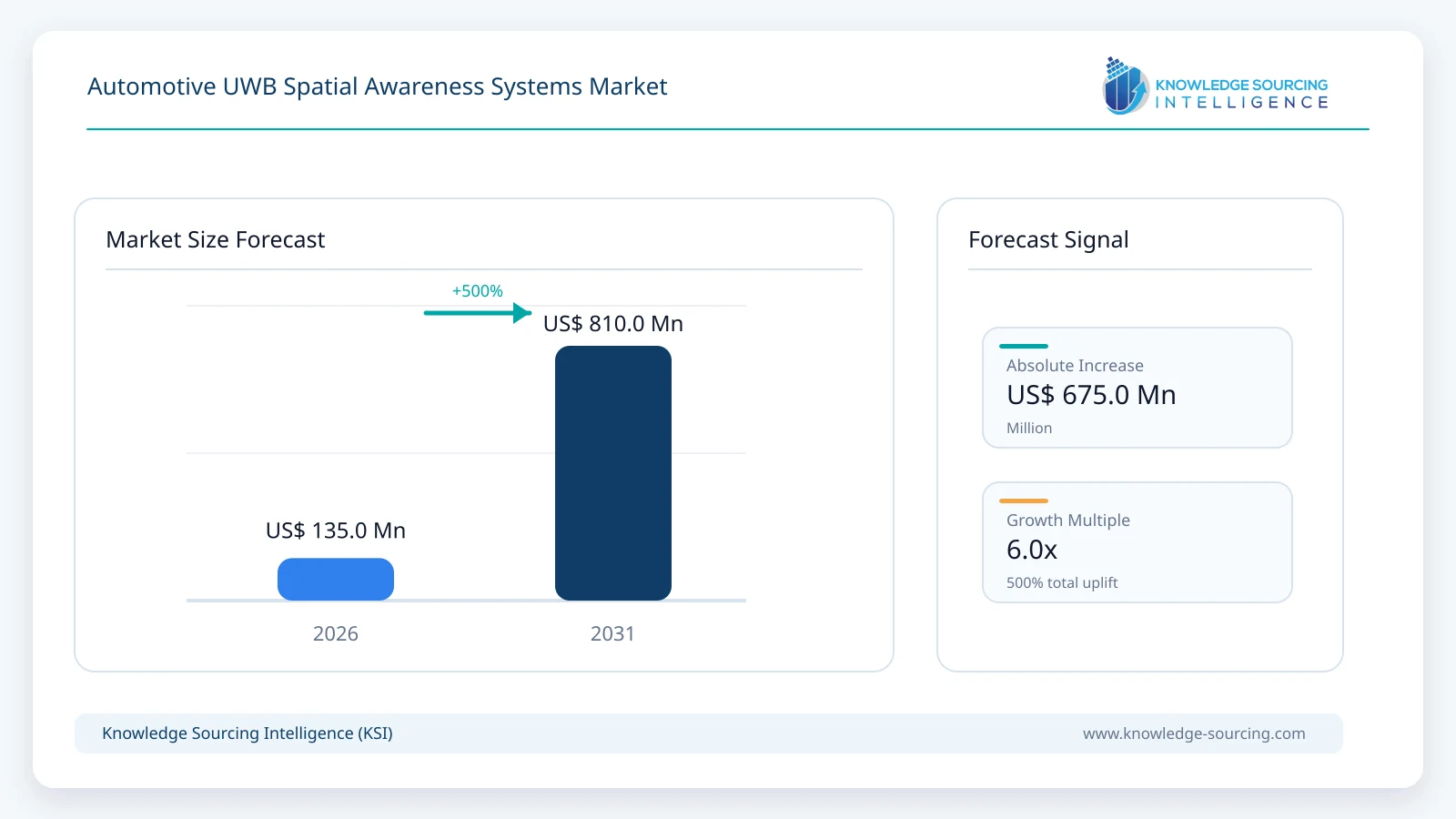
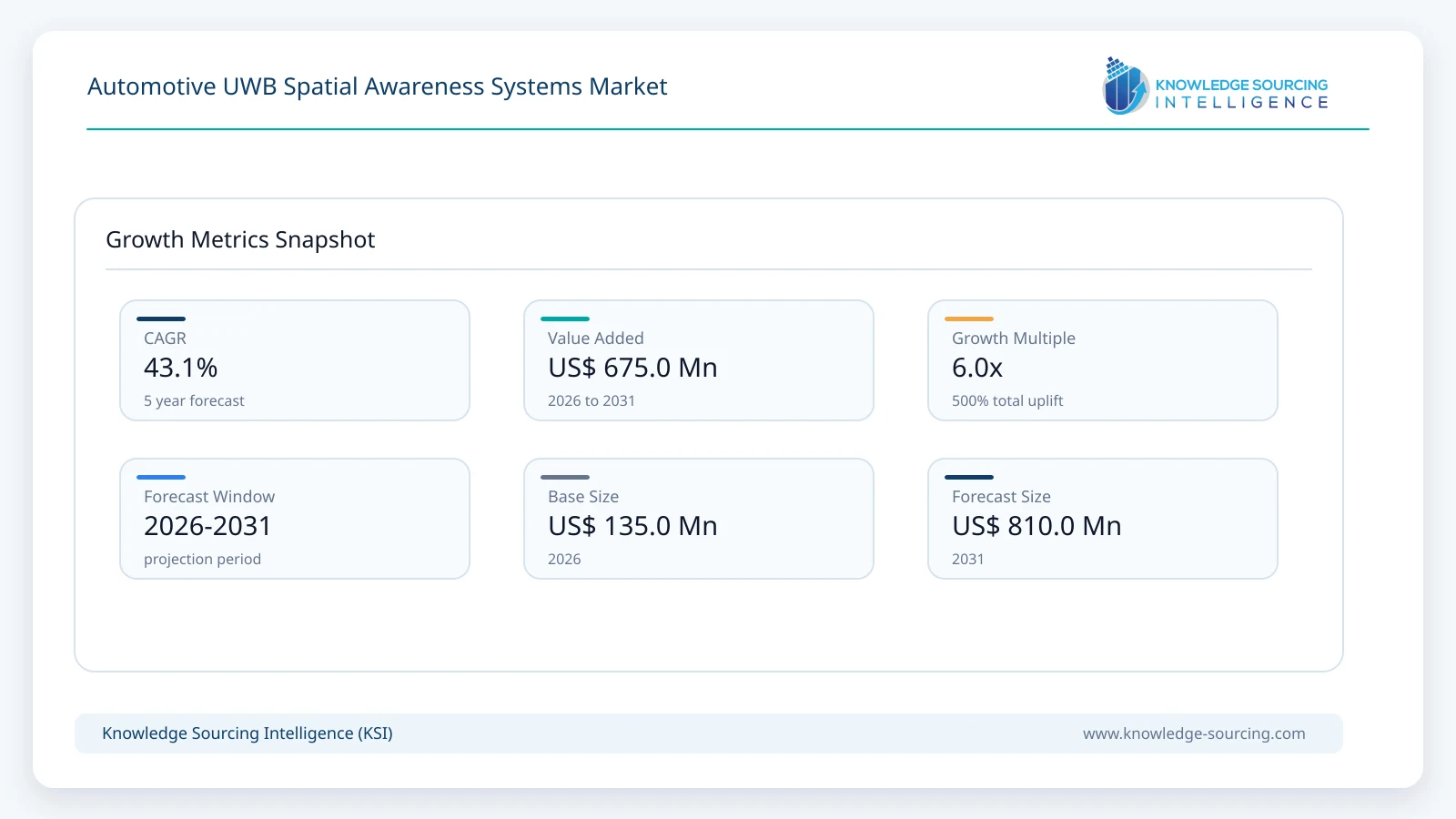
The automotive UWB spatial awareness systems market is forecast to grow at a CAGR of 43.1%, increasing from USD 135 million in 2026 to USD 810 million by 2031.
Highlights:
- 1Secure device and user localization is the largest primary function in 2026, representing an estimated USD 49 million of system value.
- 2Combined UWB ranging-and-radar architectures expand from USD 54 million in 2026 to USD 415 million in 2031 as multifunction use increases.
- 3Passenger cars generate more than 95% of the 2026 supplier-value estimate, with deployment concentrated in premium and technically advanced models.
- 4NXP’s August 2026 BMW announcement provides a named OEM example of access and presence detection sharing one UWB platform.
- 5Direct child-presence assessment, reliable micro-motion sensing and secure spatial localization influence engineering requirements, alongside lower-cost competing radar solutions.
Automotive UWB spatial awareness systems provide vehicle-level spatial context through fine ranging, localization and short-range impulse radar. Their commercial components include automotive-qualified UWB ICs and antennas, embedded spatial algorithms, distributed anchor networks, and vehicle-specific calibration. Applications range from determining whether an authorized device is inside the cabin to identifying breathing-related micro-motion in a parked vehicle and recognizing near-body gestures for an automated tailgate.
Combined ranging and sensing changes how automakers buy vehicle-access electronics. NXP, Valeo and AUMOVIO have shown that access hardware can be extended into occupancy or proximity functions, while Qorvo, STMicroelectronics and Infineon offer semiconductor architectures for secure localization and sensing. A vehicle platform that can reuse antennas, processing and cybersecurity controls across functions can reduce duplicated component content even as the software and qualification value per system rises.
Implementation remains uneven across vehicle classes and regions because ranging accuracy alone does not establish occupant-detection performance. Cabin materials, reflections, antenna position, children’s posture, nearby pedestrian motion and vehicle power states determine whether a sensing configuration can deliver dependable alerts. Tier-1 suppliers therefore retain an important role in vehicle integration, functional testing and translating chip-level capabilities into repeatable production behavior.
Market Overview
Spatial awareness differs from conventional remote key detection because the vehicle must establish where a recognized device or occupant is located and respond to that location. UWB time-of-flight ranging can distinguish a phone outside the car from one inside the cabin, improving access decisions and reducing relay-attack exposure. When equipped with radar-capable hardware and signal processing, the architecture can also detect subtle movement associated with a person left inside a stationary vehicle.
NXP’s NCJ29D6 automotive family integrates UWB secure ranging with short-range radar, while STMicroelectronics’ ST64UWB portfolio describes further capabilities for longer-range ranging and cabin sensing. Supplier maturity varies: NXP cites selected 2026 BMW vehicle programs, whereas ST lists its ST64UWB-A500 as a preview device and Qorvo has described customer sampling for its QPF5100Q. Treating these product milestones differently is important for procurement planning and realistic adoption.
Valeo offers UWB-based occupancy monitoring with life-presence algorithms, and Ceva has demonstrated how UWB radio chains can be reused through software-defined radar processing. AUMOVIO’s CoSmA heritage illustrates the benefit of integrating proximity sensing with digital access electronics. As these architectures mature, OEM purchasing increasingly combines RF components, secure firmware, cabin sensing algorithms and vehicle-specific validation into a coordinated electronics program.
Market Trends
Ranging and Radar Converge on Common Vehicle Hardware
UWB platforms are moving from localization-only functions toward combined device ranging and environmental sensing. NXP’s NCJ29D6 uses a shared chip family for secure access and short-range radar, allowing an automaker to reuse part of the radio system for occupant or gesture functions. Product economics improve when antennas, security controls and power management serve more than one application, but the relative value shifts toward embedded algorithms and program calibration.
STMicroelectronics describes a similar direction with its emerging ST64UWB architecture, including narrowband-assisted ranging and radar processing. New silicon capabilities do not immediately convert to production revenue because qualification, body-in-white antenna performance, EMI testing and OEM program cycles remain necessary. The greatest near-term opportunity sits with suppliers able to deliver repeatable integrated functions rather than only chip specifications.
Direct Child-Presence Sensing Shapes Cabin Architecture
Euro NCAP’s direct-sensing child-presence evaluation places practical emphasis on detecting an occupant rather than merely inferring that a door was opened. UWB micro-motion sensing offers a privacy-preserving route to life detection, especially when a parked vehicle needs cabin coverage without active lighting. Valeo’s UWB monitoring proposition and NXP’s BMW announcement connect this technical approach to identifiable automotive system development.
Cabin interiors make the engineering problem more complex than an open-room demonstration. Rear-facing child seats, heavy blankets, temperature variation and multiple passengers may alter received signals, while activity outside a window can create false detections. OEMs therefore need validated sensing zones, alert logic and low-power parked operation, creating demand for calibration, filtering and diagnostic software as well as RF hardware.
Next-Generation UWB Improves Localization and Sensor Flexibility
IEEE 802.15.4ab-oriented product development is aimed at greater ranging performance and stronger interference resilience in difficult environments. Ceva launched a next-generation UWB IP platform in March 2026, and NXP’s NCJ29D8 product information adds extended-range and enhanced radar capabilities at a preproduction stage. These developments support future vehicle designs that must distinguish approaching users or other spatial events around metal body structures.
Wider functional coverage does not eliminate the need for secure ranging or interoperability. UWB anchors must work with diverse handsets, accessories and automotive control networks, and some operating modes must coexist with digital-key authentication. Manufacturers that can preserve timing accuracy, low standby current and secure protocol behavior while adding radar tasks are positioned to win multifunction platform programs.
Software Reuse Expands Sensing Without Proportional Hardware Growth
Ceva’s February 2026 UWB radar study illustrates how an existing RF chain can be adapted to detect respiration-related motion through software processing. This design route matters because additional dedicated cabin sensors increase packaging, wiring and validation demands. Sharing RF hardware allows the vehicle supplier to monetize new spatial features through firmware, processing algorithms and calibration even when silicon content per vehicle declines.
Hardware reuse has limits: antenna placement optimized for door access may not provide complete in-cabin coverage, and a dedicated cabin module may still be needed for particular seating positions. Tier-1 integrators will therefore evaluate software reuse and dedicated sensing on a model-by-model basis. The purchasing outcome depends on measured zone coverage, processor loading, functional reliability and total vehicle cost.
Supplier Ecosystem Broadens Across Chips, Modules and Automotive Programs
Qorvo’s automotive-qualified UWB device, Murata’s precision timing design support, YFORE’s multifunction sensing showcase and the Ceva-LG integration agreement demonstrate that value is spreading beyond one type of supplier. Semiconductor firms influence performance and security, while Tier-1 manufacturers translate chip capabilities into multi-antenna installations with vehicle-grade diagnostics. That layered supply chain gives OEMs more architecture choices but also more complex integration responsibility.
Several 2026 announcements remain design-stage or demonstration activity rather than mass-production proof. Production commitments and verified vehicle deployments deserve greater weight than laboratory sensitivity results when assessing near-term demand. Competition increasingly rests on low-power operation, accurate zone separation, device interoperability and the ability to maintain sensing performance over a vehicle’s life.
Segment Analysis
By Primary Function: Secure Localization and Child Presence Detection
Secure device and user localization holds the leading 2026 primary-function share because hands-free vehicle access already provides an installed UWB anchor network on selected vehicles. Approximately USD 49 million of 2026 value is allocated to precise access-related spatial context, including localization software and attributable ranging electronics. The function also supports position-aware welcome, authorized approach and inside/outside discrimination, which helps manufacturers justify multi-antenna systems.
Child and occupant presence detection shows stronger modeled growth, reaching USD 304 million by 2031 as direct cabin sensing becomes more prevalent. Valeo’s offering and NXP’s BMW program establish recognizable industry approaches, though neither supplier publishes complete market shipments for the function. Differentiation rests on reliable life detection across cabin zones and avoiding unnecessary hardware additions where access antennas can be reused.
By Sensing Architecture: Combined UWB Ranging and Radar
Combined UWB ranging-and-radar systems represent approximately 40.0% of the market in 2026 and are expected to lead by 2031. A shared RF platform gives OEMs the option to pair secure phone localization with occupant sensing, near-field monitoring and contextual access functions. This capability can increase system utilization while limiting incremental silicon and antenna costs compared with separate single-purpose designs.
Ranging-only solutions remain important where the OEM prioritizes secure access and smartphone compatibility, whereas sensor fusion appears in programs requiring additional contextual inputs. The right architecture depends on cabin coverage, product positioning and safety validation rather than on RF performance alone. More multifunction features also place greater weight on low-power scheduling and software integrity when access and sensing operate on the same hardware.
By Component: Integrated UWB Hardware and Software
UWB ICs, antennas and vehicle anchor modules account for roughly USD 85 million in 2026, making them the largest component-level spending category. Discrete silicon and qualified modules still carry substantial vehicle content because localization requires careful geometric placement around doors, cabin zones and sometimes luggage compartments. Supplier choices are influenced by RF timing, secure processing, automotive temperature qualification and the installed number of anchors.
Spatial processing software grows from an estimated USD 32 million in 2026 to USD 215 million in 2031 as OEMs adopt micro-motion classification, gesture recognition and richer spatial decision rules. Engineering and calibration are a separate supplier revenue stream, particularly during first vehicle programs and architecture migrations. Vehicle manufacturers increasingly separate spatial software capability from physical UWB content, allowing software updates and new application functions to extend the usefulness of qualified sensing hardware.
By Installation Topology: Distributed Multi-Anchor Platforms
Distributed multi-anchor networks lead 2026 spending with about USD 87 million, reflecting the need to triangulate device position at exterior access points and inside the cabin. Placement around doors and interior trim helps improve geometric coverage, while central controllers manage ranging sessions and authentication-related messages. Such networks are attractive on premium platforms where UWB digital access is already specified.
Centralized shared-anchor and dedicated in-cabin module configurations gain relevance as suppliers adapt spatial sensing for different body styles and vehicle price points. A dedicated module can simplify cabin radar qualification but may reduce the cost advantage of shared access hardware. The eventual configuration is determined by cabin layout, blind spots, vehicle power strategy and the performance required across multiple sensing functions.
Market Drivers
Shared UWB Hardware Lowers the Incremental Cost of New Cabin Functions
Automakers increasingly seek to add occupant protection and context-aware convenience without installing a separate sensor network for every feature. NXP’s NCJ29D6 combines fine-ranging and radar modes, while Ceva has demonstrated the reuse of UWB access radios for cabin micro-motion sensing. This reuse can turn an existing keyless-entry architecture into a platform for several separately valuable functions.
Integrated programs still require software validation and occasionally new antenna placements, but their bill-of-material advantages become attractive as more vehicle lines adopt digital access. Tier-1 systems that expose reliable spatial APIs can spread engineering costs across vehicle programs, encouraging OEMs to introduce features beyond the original key system.
Direct Child-Presence Assessment Raises Demand for Reliable Interior Detection
Euro NCAP evaluates direct child-presence sensing and requires evidence of reliable system functionality under specified test conditions. UWB radar can detect micro-motion even when a camera has limited visibility, making it relevant to vehicle designs where children may be concealed behind seats or blankets. The technology provides an alternative or complement to other direct-detection methods.
Automakers must select sensing functions early enough to validate the cabin layout, alert logic and low-power monitoring states. The safety use case supports demand for qualified spatial algorithms and sensing hardware, while suppliers that demonstrate consistent detection across representative vehicle interiors gain an advantage in nomination decisions.
Automotive-Grade Ranging Technology Supports Secure Spatial Context
Precise UWB flight-time measurements distinguish whether an authorized device is near, inside or away from the vehicle, strengthening passive-access decisions. Continental’s Audi Q6 e-tron program and Bosch’s UWB access offering show how centimeter-scale position information contributes to secure and convenient use. Once those signals are available in the car, manufacturers can extend them into approach-aware actions and interior localization.
Interoperability between phones, vehicles and secure digital-key software increases the usefulness of installed UWB networks. OEM programs with stable localization performance are more likely to add spatial-awareness features through new software and sensing modes, supporting higher value per equipped vehicle without relying on broader handset sales as the revenue base.
More Powerful Automotive UWB ICs Expand Multifunction Design Options
STMicroelectronics, NXP, Infineon and Qorvo are advancing automotive UWB products with integrated processing, secure ranging and sensing features. The movement toward IEEE 802.15.4ab and more capable edge processing can extend practical sensing configurations and improve interference performance. Wider choice also reduces dependence on a single chip generation for long-lifecycle vehicle programs.
Automotive customers favor solutions with predictable supply, documented qualification progress and firmware support, rather than maximum advertised range alone. Suppliers that combine software stacks with automotive-grade RF hardware can shorten design cycles and improve integration yields as multifunction spatial sensing becomes more common.
Premium Electric and Connected Vehicle Programs Establish an Adoption Base
Premium electric and connected vehicles commonly integrate centralized electronics, software-updatable functions and smartphone-based access, creating a natural environment for new UWB spatial applications. The IEA reported that global electric-car sales exceeded 20 million in 2025, and NXP’s selected BMW 2026 programs demonstrate an OEM pathway for combined ranging and presence detection.
The growth mechanism is not that all electric vehicles require UWB. Rather, platforms already investing in connected access and cabin electronics can justify a multifunction architecture more easily than low-cost vehicles with conventional key hardware. Adoption should broaden only as unit cost, compatibility and feature demand support the additional integration expense.
Market Restraints
Cabin Geometry and Occupant Conditions Make Direct Sensing Difficult
UWB radar must separate actual occupant micro-motion from reflections created by dashboards, seat frames, cargo and nearby passengers. A child in a rear-facing seat or under a thick blanket presents a different sensing profile from an unobstructed adult. Automotive suppliers therefore need vehicle-specific antenna placement and careful validation to avoid missed detection and false alerts.
Changes in cabin architecture can force new calibration even when the semiconductor platform is unchanged. Test effort rises for multiple seating rows, wide temperature ranges and parked low-power states. These constraints can slow rollout to lower-volume vehicle lines where validation expense is harder to recover.
Shared Access and Sensing Must Meet Competing Power and Timing Requirements
Automotive UWB access systems need secure ranging sessions, while radar functions may need periodic monitoring during a parked state. Running both on shared electronics creates scheduling, power-budget and latency tradeoffs that differ from those of a single-purpose keyless entry system. In battery-sensitive modes, continuous sensing without optimized processing may be unacceptable.
Engineers must manage wake-up policies, processor load, secure access traffic and network behavior before an OEM can count on the architecture for multiple functions. Systems with dedicated sensing paths can simplify some tasks but raise hardware cost, limiting the expected economic advantage of convergence.
Digital-Key Compatibility and Cybersecurity Extend Qualification Cycles
CCC and FiRa interoperability requirements create an important foundation for UWB spatial applications, but they also expand validation across phone models, software versions and radio operating modes. An OEM cannot allow new gesture or radar functions to weaken distance-bounding behavior for secure entry. Wireless interference and relay-attack resistance must remain controlled as feature complexity increases.
Semiconductor updates, smartphone ecosystem changes and multi-year vehicle support commitments create lifecycle work for OEM software teams. Suppliers with integrated security, RF and application support can manage that burden, but smaller providers may face substantial qualification overhead before reaching serial production.
Competing Cabin Radar Technologies Can Win Specific Functions at Lower Cost
Sixty-gigahertz mmWave radar, camera systems and seat sensors provide alternative ways to monitor occupants and classify cabin activity. Texas Instruments has documented a 60 GHz cabin radar solution integrating multiple sensing functions, showing that UWB is not the only candidate for direct child-presence applications. A supplier must demonstrate an actual system-level advantage for the chosen cabin.
Where a vehicle does not already have a suitable UWB anchor network, installing new UWB electronics only for one safety function may be less attractive than buying a dedicated radar module. Conversely, a reused UWB network may be preferable on an access-equipped model. This architecture-dependent comparison restrains uniform adoption across OEM portfolios.
Automotive Production Qualification and Supply-Chain Maturity Remain Uneven
Product announcements span current automotive devices, customer-sampling parts and preproduction components, making the supply base heterogeneous. Qorvo described an automotive-qualified UWB SoC that was sampling in 2025, while STMicroelectronics lists an advanced radar-capable part at the preview stage. These milestones establish technology availability but do not guarantee a committed production vehicle program.
OEM sourcing teams require long-term component availability, EMI evidence, safety documentation where relevant, stable firmware and cost-down plans across the product life. Delays in any one area can shift system adoption by a model year or encourage reuse of a previously qualified, narrower access-only platform.
Regional Outlook
Asia Pacific
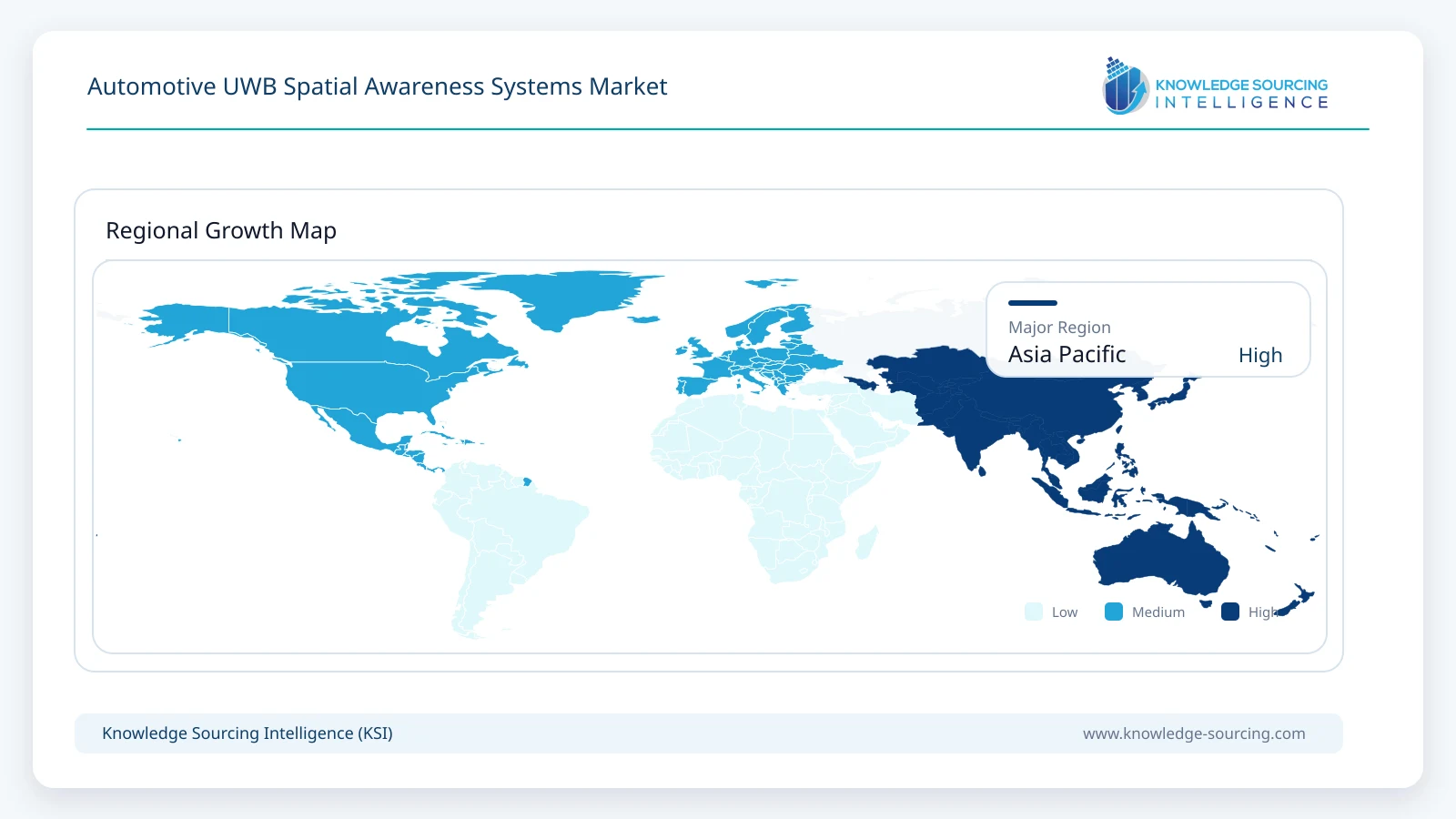
Asia Pacific leads the 2026 regional estimate at USD 57 million, supported by its concentration of vehicle manufacturing and the rapid proliferation of connected access features. China provides the largest country contribution, while Japan and South Korea retain strengths in semiconductor, electronics and OEM engineering. CCC interoperability testing hosted by Geely in September 2026 illustrates the scale of industry coordination across automotive and mobile-device ecosystems.
Regional suppliers compete on cost, smartphone compatibility and the ability to make one UWB network serve several cabin and exterior functions. Higher-end Chinese and Korean vehicles offer a natural path for early multi-function integration, but broader rollouts still depend on proven safety performance and economical anchor configurations. India and Southeast Asia contribute longer-term opportunities as connected features spread to additional price segments.
Europe
Europe accounts for an estimated USD 39 million in 2026 and remains a critical center for premium vehicle UWB development, safety assessment and Tier-1 sourcing. BMW selected NXP secure ranging and presence detection for 2026 vehicle programs, while Continental’s earlier Audi Q6 e-tron access program demonstrates production integration of precise UWB localization. Valeo and other European suppliers provide cabin monitoring and integration expertise.
Euro NCAP’s direct child-presence evaluation gives automakers a clear technical reason to review cabin-sensing architectures, although it does not mandate UWB specifically. Suppliers that can combine accurate user localization with reliable life detection and low-power operation are positioned for future nominations. Validation costs, competing radar technologies and European vehicle-program cycles will shape the pace of adoption.
Competitive Landscape
Competition spans semiconductor makers, RF software licensors and vehicle-level integrators rather than a single homogeneous supplier group. NXP combines automotive UWB silicon with a named BMW deployment, while STMicroelectronics, Infineon and Qorvo target secure ranging and sensing with different levels of commercial maturity. Ceva supplies baseband and signal-processing IP that can be designed into multiple chip programs. Semiconductor differentiation centers on RF sensitivity, precision, power consumption, automotive qualification and secure firmware.
Valeo, AUMOVIO, Bosch and YFORE translate ranging and radar capabilities into integrated access or cabin-sensing systems. Their value lies in antenna layout, vehicle-level calibration, alarm integration and the ability to deliver consistent behavior across many trims and vehicle environments. Murata contributes qualified timing components and modules to the broader UWB ecosystem, while LG Electronics is collaborating with Ceva on RF and baseband integration for semiconductor customers.
Automakers are likely to compare dedicated sensing modules with reusable UWB access networks over each vehicle platform lifecycle. A strong competitive position therefore requires more than a standalone chip or proof-of-concept classifier: engineering teams must demonstrate stable multipath performance, integration with connected access, diagnostics, interoperability and sustainable program costs. Production qualification and integrated system responsibility provide more meaningful competitive differentiation than an isolated radar-sensitivity or chip-price comparison.
Recent Developments
09 September 2026 | Ceva / LG Electronics: Ceva and LG Electronics announced UWB baseband, software and RF integration for next-generation SoCs; the disclosed semiconductor customer supports design interest, not an announced vehicle production start.
04 August 2026 | NXP Semiconductors / BMW Group: NXP confirmed NCJ29D6 ranging-and-radar technology for selected BMW 2026 programs, combining Digital Key Plus with in-cabin presence detection; this gives a named OEM route for multifunction UWB.
31 August 2026 | YFORE Technology: YFORE showcased a multifunction UWB radar portfolio spanning cabin life detection, intruder detection and kick sensing; this expands Tier-1 application offerings but does not establish volume shipments.
30 April 2026 | Murata Manufacturing: Murata introduced timing-component design support for automotive UWB uses including digital key and child presence detection, addressing precision and temperature-stability requirements.
10 March 2026 | Ceva: Ceva launched next-generation UWB IP aligned with IEEE 802.15.4ab and extended ranging, providing an IP pathway for future multi-function sensing hardware.
07 January 2025 | Qorvo: Qorvo announced that its QPF5100Q UWB SoC was automotive-qualified and sampling, with child-presence and motion sensing as supported application targets.
Market Outlook
By 2031, UWB spatial awareness is expected to be purchased increasingly as a multifunction vehicle electronics capability rather than an isolated digital-key option. Combined ranging-and-radar designs grow more quickly than access-only spatial sensing, particularly where automakers can reuse anchor networks for occupancy protection or exterior convenience. The forecast assumes qualification expands from selected premium programs to a wider set of passenger vehicle platforms as chip integration and software reuse improve project economics.
The main source of additional supplier value will be the reliability of spatial algorithms, validation effort and software that interprets secure ranging or radar signals for vehicle control. Multi-anchor topology will remain relevant for exterior positioning, while cabin-focused modules and fusion approaches serve programs that need more reliable direct-sensing coverage. Safety assessment will encourage stronger detection capabilities, but competing sensing technologies will continue to win designs depending on body configuration and cost.
Asia Pacific should retain the largest revenue contribution through 2031, with European Tier-1 and OEM programs remaining influential in integrated sensing. Commercial winners will be suppliers that can document vehicle-grade performance and support long-lifecycle deployments across several model lines. Broader adoption will depend on the balance between shared-hardware savings, interoperability requirements and measured field performance, not only on the availability of faster UWB chips.
Automotive UWB Spatial Awareness Systems Market Scope
| Report Metric | Details |
|---|---|
| Total Market Size in 2026 | USD 135 million |
| Total Market Size in 2031 | USD 810 million |
| Forecast Unit | Million |
| Growth Rate | 43.1% |
| Study Period | 2021 to 2031 |
| Historical Data | 2021 to 2024 |
| Base Year | 2025 |
| Forecast Period | 2026 – 2031 |
| Segmentation | Primary Function, Sensing Architecture, Component, Vehicle Type, Propulsion Type, Installation Topology, Supply Arrangement, Geography |
| Companies |
|
Market Segmentation
By Primary Function
Secure Device and User Localization
Child and Occupant Presence Detection
Exterior Gesture and Kick Sensing
Intrusion and Near-Field Monitoring
Cabin Position and Seat-Zone Awareness
By Sensing Architecture
UWB Precision Ranging
Combined UWB Ranging and Radar
UWB Multisensor Fusion
By Component
UWB ICs, Antennas and Vehicle Anchors
Spatial Processing and Sensing Software
Engineering, Calibration and Integration
By Vehicle Type
Passenger Cars
Light Commercial Vehicles
Medium and Heavy Commercial Vehicles
By Propulsion Type
Battery Electric Vehicles
Plug-in Hybrid Electric Vehicles
Hybrid Electric Vehicles
Internal Combustion Engine Vehicles
By Installation Topology
Distributed Multi-Anchor
Centralized Shared-Anchor
Dedicated In-Cabin UWB Sensing Module
By Supply Arrangement
Tier-1 Integrated Systems
Direct OEM Semiconductor and Software Programs
Specialized Spatial Sensing Programs
By Geography
North America
United States
Canada
Mexico
South America
Brazil
Argentina
Chile
Others
Europe
Germany
United Kingdom
France
Italy
Spain
Sweden
Others
Middle East and Africa
Saudi Arabia
United Arab Emirates
Israel
South Africa
Others
Asia Pacific
China
Japan
South Korea
India
Indonesia
Thailand
Australia
Taiwan
Others
Table of Contents
1. EXECUTIVE SUMMARY
1.1. Market Opportunity and Key Findings
1.2. Outlook for UWB Spatial Awareness
2. MARKET SNAPSHOT
2.1. Market Overview
2.2. Market Definition
2.3. Scope of the Study
2.4. Market Segmentation
3. BUSINESS LANDSCAPE
3.1. Market Drivers
3.1.1. Shared UWB Hardware Lowers the Incremental Cost of New Cabin Functions
3.1.2. Direct Child-Presence Assessment Raises Demand for Reliable Interior Detection
3.1.3. Automotive-Grade Ranging Technology Supports Secure Spatial Context
3.1.4. More Powerful Automotive UWB ICs Expand Multifunction Design Options
3.1.5. Premium Electric and Connected Vehicle Programs Establish an Adoption Base
3.2. Market Restraints
3.2.1. Cabin Geometry and Occupant Conditions Make Direct Sensing Difficult
3.2.2. Shared Access and Sensing Must Meet Competing Power and Timing Requirements
3.2.3. Digital-Key Compatibility and Cybersecurity Extend Qualification Cycles
3.2.4. Competing Cabin Radar Technologies Can Win Specific Functions at Lower Cost
3.2.5. Automotive Production Qualification and Supply-Chain Maturity Remain Uneven
3.3. Market Opportunities
3.4. Porter’s Five Forces Analysis
3.5. Industry Value Chain Analysis
3.6. Policies and Regulations
3.7. Strategic Recommendations
4. TECHNOLOGICAL OUTLOOK
4.1. UWB Secure Ranging and Angle-of-Arrival
4.2. UWB Short-Range Radar and Micro-Motion Processing
4.3. IEEE 802.15.4z and 802.15.4ab Platforms
4.4. Automotive Antenna Networks and Sensing Fusion
5. AUTOMOTIVE UWB SPATIAL AWARENESS SYSTEMS MARKET BY PRIMARY FUNCTION
5.1. Secure Device and User Localization
5.2. Child and Occupant Presence Detection
5.3. Exterior Gesture and Kick Sensing
5.4. Intrusion and Near-Field Monitoring
5.5. Cabin Position and Seat-Zone Awareness
6. AUTOMOTIVE UWB SPATIAL AWARENESS SYSTEMS MARKET BY SENSING ARCHITECTURE
6.1. UWB Precision Ranging
6.2. Combined UWB Ranging and Radar
6.3. UWB Multisensor Fusion
7. AUTOMOTIVE UWB SPATIAL AWARENESS SYSTEMS MARKET BY COMPONENT
7.1. UWB ICs, Antennas and Vehicle Anchors
7.2. Spatial Processing and Sensing Software
7.3. Engineering, Calibration and Integration
8. AUTOMOTIVE UWB SPATIAL AWARENESS SYSTEMS MARKET BY VEHICLE TYPE
8.1. Passenger Cars
8.2. Light Commercial Vehicles
8.3. Medium and Heavy Commercial Vehicles
9. AUTOMOTIVE UWB SPATIAL AWARENESS SYSTEMS MARKET BY PROPULSION TYPE
9.1. Battery Electric Vehicles
9.2. Plug-in Hybrid Electric Vehicles
9.3. Hybrid Electric Vehicles
9.4. Internal Combustion Engine Vehicles
10. AUTOMOTIVE UWB SPATIAL AWARENESS SYSTEMS MARKET BY INSTALLATION TOPOLOGY
10.1. Distributed Multi-Anchor
10.2. Centralized Shared-Anchor
10.3. Dedicated In-Cabin UWB Sensing Module
11. AUTOMOTIVE UWB SPATIAL AWARENESS SYSTEMS MARKET BY SUPPLY ARRANGEMENT
11.1. Tier-1 Integrated Systems
11.2. Direct OEM Semiconductor and Software Programs
11.3. Specialized Spatial Sensing Programs
12. AUTOMOTIVE UWB SPATIAL AWARENESS SYSTEMS MARKET BY GEOGRAPHY
12.1. North America
12.1.1. United States
12.1.2. Canada
12.1.3. Mexico
12.2. South America
12.2.1. Brazil
12.2.2. Argentina
12.2.3. Chile
12.2.4. Others
12.3. Europe
12.3.1. Germany
12.3.2. United Kingdom
12.3.3. France
12.3.4. Italy
12.3.5. Spain
12.3.6. Sweden
12.3.7. Others
12.4. Middle East and Africa
12.4.1. Saudi Arabia
12.4.2. United Arab Emirates
12.4.3. Israel
12.4.4. South Africa
12.4.5. Others
12.5. Asia Pacific
12.5.1. China
12.5.2. Japan
12.5.3. South Korea
12.5.4. India
12.5.5. Indonesia
12.5.6. Thailand
12.5.7. Australia
12.5.8. Taiwan
12.5.9. Others
13. COMPETITIVE ENVIRONMENT AND ANALYSIS
13.1. Major Players and Strategy Analysis
13.2. Market Share Analysis
13.3. Mergers, Acquisitions, Agreements and Collaborations
13.4. Competitive Dashboard
14. COMPANY PROFILES
14.1. NXP Semiconductors
14.2. STMicroelectronics
14.3. Infineon Technologies
14.4. Qorvo
14.5. Valeo
14.6. AUMOVIO
14.7. Bosch Mobility
14.8. Ceva
14.9. YFORE Technology
14.10. Murata Manufacturing
14.11. LG Electronics
15. APPENDIX
15.1. Currency
15.2. Assumptions
15.3. Base and Forecast Years Timeline
15.4. Key Benefits for Stakeholders
15.5. Research Methodology
15.6. Abbreviations
Navigate
Trusted by the world's leading organizations