
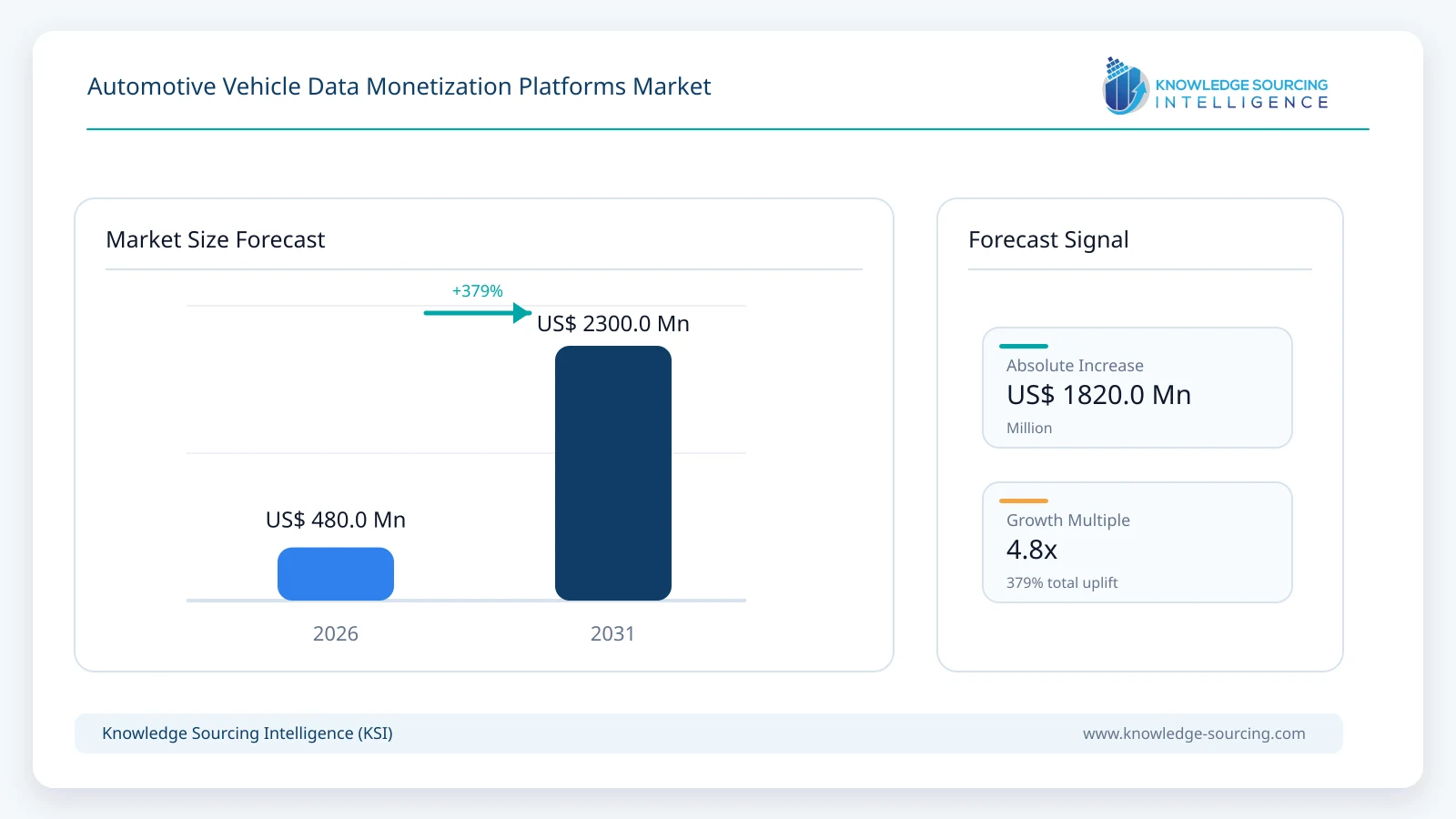
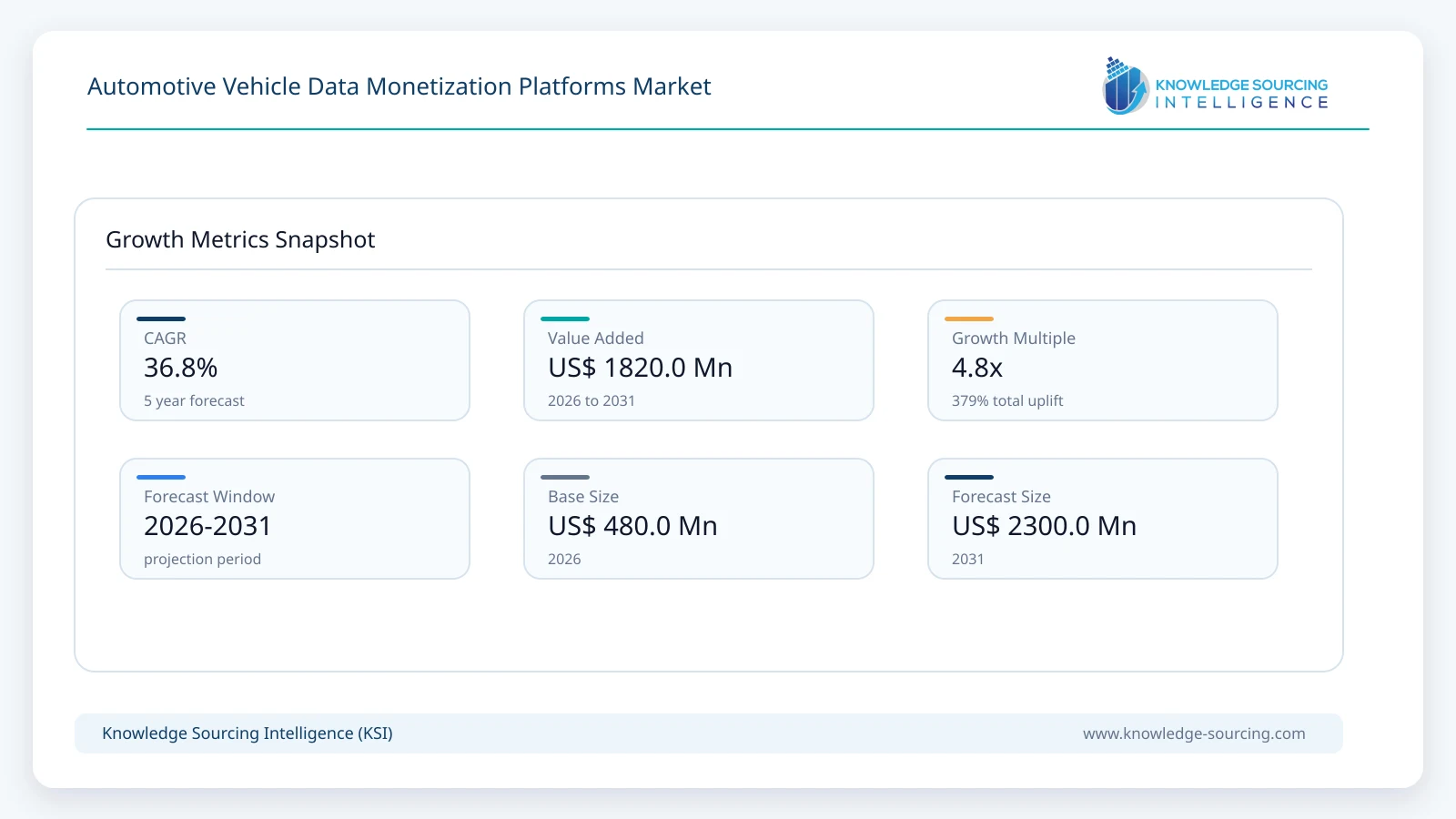
The Automotive Vehicle Data Monetization Platforms Market is forecast to grow at a CAGR of 36.8%, reaching USD 2,300.0 million in 2031 from USD 480.0 million in 2026.
Highlights:
- 1The global market grows from USD 480 million in 2026 to USD 2.30 billion in 2031, supported by additional paid vehicle activations and data-product contracts.
- 2Vehicle-linked data access represents 62.5% of estimated 2026 value, with enterprise agreements and integration contributing the balance.
- 3Commercial fleet platforms remain the largest application in 2026, while vehicle energy and charging data become an increasingly important data product.
- 4Multi-OEM aggregators gain share as software buyers seek a consistent feed rather than separate integrations for each automotive brand.
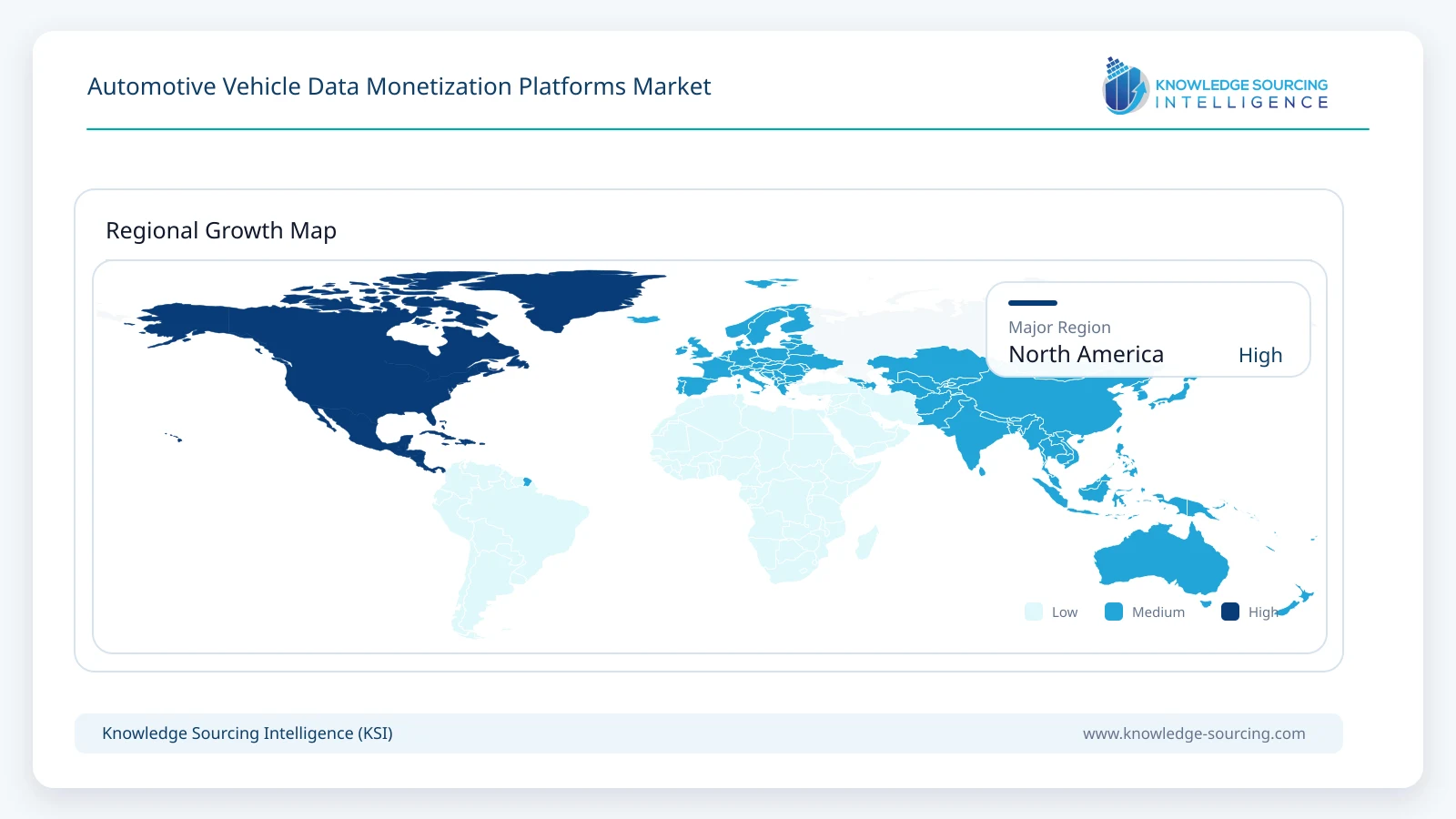
- 5North America holds an estimated 34% of 2026 market revenue; Asia Pacific becomes the largest region by 2031.
- 6Consent management, source-data quality and contractual onward-use rights remain central to commercial value and supplier selection.
Vehicle manufacturers and authorized data intermediaries increasingly supply selected connected vehicle information as a paid digital service rather than a by-product of a telematics contract. Vehicle status, odometer records, diagnostic events, trip information, and battery charge measurements are delivered through interfaces that verify user permission and restrict access to an agreed business purpose. BMW CarData and the Stellantis Mobilisights business represent OEM-controlled distribution approaches; aggregators such as High Mobility provide a common technical and commercial interface across multiple manufacturers.
Automotive data monetization is supported by several purchasing models. Fleet platforms commonly procure active-vehicle data packages; insurers may license mileage and relevant usage information; and energy companies purchase charging and battery signals for approved vehicle accounts. Enterprise agreements cover dedicated data products and structured access, while integration providers connect purchased feeds to existing customer workflows. These contracts increasingly place data quality, rights management and onboarding cost alongside the nominal price of access.
Commercial expansion depends on the number of eligible, activated vehicles and the willingness of customers to pay for approved data fields. High Mobility prices services according to active vehicles, data packages and underlying OEM costs. The resulting supplier economics favor providers that can deliver consistent signals across manufacturers while meeting contractual restrictions on retention, onward sharing and permissible use.
Market Overview
Connected vehicle data becomes commercially useful when the purchaser can identify a qualifying vehicle, obtain current and reliable signals, and apply them under a lawful, documented permission. BMW’s CarData service allows approved providers to receive defined telematics records, while High Mobility delivers standardized OEM feeds to mixed-brand business customers. The product being sold is recurring access to information and the supporting consent, normalization, and delivery functions, rather than the whole connected-car technology stack.
Automotive data distributors are building common schemas and operational service layers around manufacturer-specific signals. COVESA’s Vehicle Signal Specification provides shared definitions for data such as speed and tire pressure, reducing interpretation work between OEMs and software providers. Smartcar’s April 2026 API update introduced a common signal schema and revised event webhooks, illustrating how platform operators are improving the reliability and scalability of external vehicle-data applications.
Buyers assess the economic return from fewer hardware installations, improved service accuracy, and broader vehicle coverage. Factory-connected vehicle data can support fleet monitoring without an aftermarket telematics device, as shown by Geotab’s Hyundai and Polestar integrations in 2026. Contract value nevertheless depends on model-year coverage, refresh frequency, customer consent, and the rights to store or combine information, so a large connected fleet does not automatically translate into an equally large paid dataset.
Market Trends
Commercial Distribution Is Moving Toward OEM-Native Data Feeds
Automakers increasingly distribute telemetry through cloud-to-cloud agreements that make native signals available to approved commercial software. In March 2026, Geotab introduced hardware-free Hyundai fleet access across Europe, and in May it expanded its OEM network to Polestar vehicles across major regions. These integrations establish a practical route for billing eligible vehicle access without fitting additional devices.
Commercial buyers gain access to odometer, location, battery, tire, and maintenance information where supported by each model. Removing hardware reduces installation labor and can shorten activation cycles, but reliable VIN eligibility checks and consent workflows remain essential. Providers that maintain consistent availability and signal quality across brands are positioned to capture recurring access revenue.
Multi-Brand Marketplaces Are Reducing Integration Complexity
CARUSO added Hyundai data to its European marketplace in 2026, while High Mobility introduced Nissan as its 30th supported vehicle brand in April. Both offerings give third-party software companies access to additional OEM vehicle datasets through established interfaces rather than separate contracts and bespoke technical connections for every manufacturer.
Multi-brand delivery raises the value of a platform to fleet managers, insurers and service networks that operate mixed vehicle populations. Revenue growth still depends on the commercial permission attached to each dataset: a vehicle connection does not imply the right to pool data or resell every derived insight. Supplier differentiation therefore rests on technical normalization and enforceable rights.
Consent and Usage Rights Are Becoming Commercial Product Features
European vehicle-data guidance accompanying the Data Act and BMW’s CarData access mechanism place customer permission and defined data-use purposes at the center of data delivery. Smartcar also requires vehicle-owner consent before an application can retrieve data, and provides permission scopes for specific signals. These mechanisms form part of a sellable service rather than optional administrative tools.
Insurers and fleet-software providers must be able to demonstrate that the signals they purchase are appropriate for their intended use and retained for permitted periods. Platforms that offer auditable permission logs and reproducible access controls can reduce buyer implementation risk, although access rights do not automatically allow unrestricted redistribution of OEM data.
Metered Data Access Is Replacing One-Size-Fits-All Bundles
High Mobility prices OEM vehicle data by active vehicle, requested data packages, and the commercial costs imposed by the supplying manufacturer. Its API-only option also separates technical standardization from the underlying OEM data contract. The approach demonstrates why platform providers must manage billable activations and customer data consumption rather than treat all connected cars as identical customers.
Vehicle information has different economic value across applications. Odometer updates needed for maintenance planning may be requested less often than charging events supporting operational energy scheduling. Flexible packages can improve customer retention and limit unnecessary data delivery expense, while forcing suppliers to maintain clear service-level and usage records.
Fleet and Energy Applications Are Broadening the Revenue Mix
Mobilisights’ collaboration with OCTO links Stellantis vehicle data to commercial insurance and rental use cases, while Geotab’s factory-integrated partnerships make electric-vehicle health and charging information available in fleet software. Smartcar also positions battery status and charging events as inputs for energy-management applications.
Fleet operations remain a large purchasing category, but charging infrastructure operators, repair networks and insurance platforms create additional customer groups. Growth in these applications favors data products with defined source coverage and business outcomes rather than generic streams of raw telemetry; revenue is realized through licensed access and specific commercial integrations.
Segment Analysis
By Revenue Component: Vehicle-Linked Data Access
Vehicle-linked data access accounts for approximately 62.5% of market value in 2026, reflecting subscriptions and usage fees tied to approved vehicle records. BMW CarData permits third parties to retrieve requested data after customer authorization; independent providers such as High Mobility standardize data from several automakers under active-vehicle billing. These purchasing models provide a repeatable path from eligible vehicle to invoice.
The vehicle-linked component gains share through 2031 as buyers expand active fleets and add application-specific signal packages. Enterprise contracts remain important for larger insurers and mobility businesses, while implementation services are required for the initial configuration of customer systems. Commercial value is determined by retained, billable activity rather than the number of connected cars in an OEM fleet.
By Monetization Model: Per-Active-Vehicle Subscriptions
Per-active-vehicle subscriptions represent an estimated 42% of revenue in 2026 because they align invoices with the units a fleet, insurer, or service operator is actually using. High Mobility’s pricing structure demonstrates how OEM fees and requested data packages shape the final charge, while monthly activation and deactivation provide practical control over customer expenditure.
As buyers mature, enterprise licenses and API usage models become more important for applications that consume different signal volumes across large fleets. Marketplace arrangements remain relevant where suppliers manage cross-OEM contracting and billing, but buyers increasingly want transparent rates, service-level visibility and a clear distinction between source-data rights and platform access.
By Application: Commercial Fleet Management
Commercial fleets account for approximately 32% of 2026 market revenue as operators use authorized location, odometer, fault and utilization data for maintenance scheduling and asset management. Geotab’s Hyundai and Polestar partnerships and Motorq’s multi-brand data interfaces show how cloud-sourced OEM records can reach established enterprise workflows without a separate device installation in every vehicle.
Insurance and energy-related applications generate additional demand for specialized data. Insurers use mileage and permitted driving records to improve rating and claims processes, while charging providers seek battery state and charging session signals to coordinate energy services. These markets expand revenue opportunities but also impose distinct requirements for consent, accuracy and commercial data use.
By Data Access Channel: OEM-Managed Portals and Multi-OEM Aggregators
Automaker portals account for an estimated 36% of revenue in 2026 because manufacturers control originating signals and contractual access conditions. BMW CarData exemplifies a direct OEM channel, while Stellantis’s Mobilisights business serves buyers through data products and commercial integrations. OEM control offers authoritative data, although customers with mixed-brand fleets may need multiple vendor relationships.
Independent multi-OEM aggregators gain share as access to a wider assortment of manufacturers and normalized fields becomes more important to buyers. CARUSO, High Mobility, Smartcar and Motorq address aspects of this integration problem. Providers compete on manufacturer coverage, latency, data fidelity and contract terms, rather than merely on the breadth of their published signal catalogs.
Market Drivers
Expansion of OEM-Embedded Connectivity in Commercial Fleets
Native vehicle communication systems let authorized data providers offer operational telemetry without installing a third-party device in each vehicle. Geotab’s 2026 Hyundai and Polestar integrations demonstrate commercial use of factory-installed connections for battery, location, diagnostics, and fleet operations. This directly reduces the rollout work required for compatible vehicle populations.
When buyers can enable existing vehicle connections through a contract and consent process, recurring data subscriptions become easier to justify. Supplier growth still depends on eligibility across model years and territories, but lower activation effort can improve conversion from a technically connected vehicle to a paying customer.
Demand for Standardized Data Across Multiple Automotive Brands
Fleet software providers face different APIs, permissions, and signal descriptions across OEM portfolios. CARUSO’s Hyundai addition and High Mobility’s Nissan integration illustrate investment in broader brand coverage. COVESA’s Vehicle Signal Specification addresses the semantic differences that otherwise increase development and maintenance costs for external data buyers.
A stable cross-brand data model allows software developers to reuse rules for mileage, battery state, and vehicle health across vehicle fleets. That reduces the cost of adding another manufacturer and supports higher platform renewal rates, particularly for commercial customers operating large mixed fleets.
Growth of Usage-Based Insurance and Vehicle Risk Analytics
Mobilisights and OCTO’s 2025 agreement connects vehicle-originated data with insurance, accident analysis, and rental-fleet applications. These services require approved, reasonably complete information about vehicle use and events, making dependable data access an identifiable part of the business model.
An insurer’s ability to validate mileage or selected vehicle events can reduce manual reporting and support more accurate claims handling. Buyers pay when the information improves a measurable process, while privacy rules and differences in signal availability determine which data products can be commercialized at scale.
New EV Data Use Cases Across Charging and Maintenance
Electric vehicles make battery state, charge status, and energy-related events commercially relevant to charging companies and fleet operators. Smartcar’s standardized vehicle API supports approved charging signals, while Geotab’s native OEM connections include charging and battery data for supported fleet vehicles.
Energy applications purchase data for scheduling, monitoring, and customer support rather than for general vehicle tracking. As EV fleets grow, use-case-specific subscriptions can add incremental recurring revenue, provided providers can deliver the necessary refresh rates, permission controls and manufacturer coverage.
Broader Availability of Partner APIs and Enterprise Integrations
Smartcar introduced its V3 API in April 2026 with common authentication, signal schemas, and webhooks, and Motorq offers normalized vehicle data through APIs, streaming, and cloud-warehouse integrations. Standard integration methods reduce the time required for software vendors to consume and operationalize eligible vehicle records.
Greater developer accessibility broadens the pool of potential buyers, particularly service networks and smaller fleet software suppliers that cannot maintain a large OEM integration team. The benefit accrues most to providers that combine usable technical documentation with dependable business permissions and support.
Market Restraints
Consent, Data Protection and Contractual Use Restrictions
Vehicle location, driving history and diagnostic information can reveal personal and commercially sensitive patterns. The EU Data Act and accompanying vehicle-data guidance address access and user rights, while supplier contracts impose their own limits on permitted uses. High Mobility’s legal terms specify permission requirements and restrictions on onward data use.
Data monetization providers must maintain consent records and often design different permission journeys for insurance, fleet and aftersales applications. Expanding a product into new countries or buyer groups therefore involves legal and operational work beyond the API connection, limiting immediate conversion of vehicle coverage into revenue.
Uneven Vehicle Eligibility and Signal Coverage
The set of available vehicle data fields varies by automotive brand, model, and software version. Smartcar’s 2026 API provides a compatibility interface because a signal supported on one car cannot automatically be assumed available on another. High Mobility also discloses regional restrictions affecting live OEM feeds.
Fleet buyers require consistent coverage across many vehicles to integrate purchased data into standard processes. When requested signals are missing or refresh intervals differ, customers may retain aftermarket devices or reduce the scale of a license. These coverage gaps slow expansion and create additional support requirements.
Underlying OEM Data Costs and Intermediary Margin Pressure
High Mobility states that a substantial portion of the final data fee can reflect OEM access charges, with pricing determined by brand, package, and vehicle activity. An intermediary that buys OEM records and resells standardized access must recover data costs alongside normalization, infrastructure, and customer-support expenses.
Large enterprise buyers can negotiate price reductions while demanding broader coverage and higher update frequency. Profitability then depends on contract mix, signal efficiency, and whether the distributor earns enough value-added margin after the manufacturer’s commercial charge. Excessive pass-through fees can discourage adoption in lower-value applications.
Fragmented Data Quality and Liability Allocation
Critical vehicle events may be delayed, stale, or interpreted differently by manufacturers and software systems. COVESA’s common vehicle signal models improve consistency, but they do not guarantee that every data source delivers identical precision or timeliness. Insurance and maintenance use cases can be sensitive to missing or erroneous event information.
Data customers may require formal service levels and clear responsibility when a purchased feed does not meet agreed quality standards. Vendors often need data provenance checks, exception handling, and audit logs before an insurer or enterprise buyer will commit to a longer contract. These requirements increase operating costs and extend procurement timelines.
Legacy Business Models and Slow Enterprise Procurement
Established fleets and service businesses often have devices, internal databases and long-term telematics contracts already in use. Moving to OEM-native data requires integration testing, financial approval and agreement on the information that can be retained, shared or combined with existing records.
Platform providers must demonstrate a practical return from reduced hardware costs, fewer manual processes or higher-quality insights. Where an enterprise cannot identify a measurable benefit beyond its existing software, it may purchase only limited data packages or postpone wider rollout, even when the underlying OEM data is technically accessible.
Regional Outlook
North America
North America accounts for an estimated 34% of global market revenue in 2026, reflecting commercial fleet data purchases, insurer and software-provider demand, and established OEM-to-platform integrations. Motorq offers normalized data from a broad range of automotive brands for fleet operations, while Geotab’s 2026 Polestar integration extends its OEM data network across North America and other regions. These services show how purchased vehicle information can be embedded in operational applications.
North American buyers are often sensitive to data quality, coverage by manufacturer and the economic comparison with existing telematics devices. Per-vehicle subscriptions, enterprise contracts and use-case-specific API agreements can coexist in larger fleets. Continued growth is expected where suppliers document savings from hardware-free connectivity and provide consistent signals for mixed-brand operations.
Asia Pacific
Asia Pacific is projected to become the largest regional market by 2031 as vehicle connectivity expands and OEMs commercialize approved data products at greater scale. China, Japan, India and South Korea support different combinations of connected vehicles, domestic software ecosystems and commercial fleet applications. Hyundai Connected Mobility’s data API demonstrates a permissions-based manufacturer route, while the Geotab–Toyota Connected alliance announced in June 2026 illustrates efforts to develop regional fleet services.
Commercial expansion will vary by national regulation, local data infrastructure and customer purchasing practices. Multi-brand aggregators may face more complex OEM contracting than providers closely linked with domestic manufacturers. The strongest regional opportunities are likely to emerge where connected-vehicle availability, active customer permission and a clear business case align.
Competitive Landscape
Automotive OEMs and their data-service subsidiaries control access to many of the originating vehicle signals. BMW operates CarData for approved third-party service providers, while Stellantis offers B2B data and fleet solutions through Mobilisights Connect. These organizations have an advantage in originating data rights and vehicle coverage but still rely on partners to commercialize particular insurer, fleet or aftersales applications.
Independent platforms compete by resolving differences among manufacturer contracts, data structures and consent methods. High Mobility and CARUSO provide multi-brand data distribution, Smartcar emphasizes user-authorized software integration, and Motorq packages OEM telemetry for commercial workflows. Geotab, Vinli, OCTO and Samsara connect vehicle data to enterprise use cases, although not all revenue from their larger software suites is attributable to data-access services. Contract clarity, signal quality and recurring buyer adoption are more meaningful differentiators than unverified claims of market share.
Recent Developments
1 September 2026: ARUSO Dataplace announced live Hyundai data coverage through both B2B and B2C marketplace channels, broadening manufacturer access for approved fleet, insurance and service applications.
23 June 2026: Geotab and Toyota Connected announced a phased global alliance to develop connected fleet solutions; the agreement expands prospective OEM data distribution without implying an immediate worldwide rollout.
5 May 2026: Geotab and Polestar made native Polestar telematics data available within MyGeotab across North America, Europe and Asia Pacific, reducing the need for additional aftermarket hardware.
22 April 2026: Smartcar introduced API V3 with application-level authentication, standardized vehicle signal endpoints, revised webhooks and improved compatibility checks.
20 April 2026: High Mobility added Nissan vehicle data through its unified API as its thirtieth supported brand, increasing cross-OEM availability of selected status and charging information.
6 March 2026: Stellantis' data subsidiary Mobilisights officially rebranded as Mobilisights Connect. The change marks its evolution from a baseline Data-as-a-Service (DaaS) model into an expanded provider of full B2B fleet telematics software and data solutions.
Market Outlook
Connected-vehicle data monetization will become more dependent on active permissioned use than on the installed population of vehicles with cellular hardware. Customers are expected to prioritize source reliability and clear contract terms for data needed in fleet operations, insurance, charging and maintenance. Vehicle-linked APIs should remain a principal source of growth as connected OEM fleets become easier to activate through approved cloud relationships.
Data distributors that support common signal definitions, differentiated package pricing and auditable rights controls can serve multiple customer segments without building an isolated interface for each automotive manufacturer. OEM-owned portals should continue to retain a significant position where a buyer values original-source data, while neutral aggregators gain relevance for multi-brand operations and international software providers.
The transition from 2026 to 2031 is expected to increase revenue associated with electric-vehicle energy signals, fleet applications and enterprise data contracts. Sustained growth will require suppliers to limit data-delivery expense, protect end-user permissions and demonstrate customer value in measurable workflows. Competition is likely to favor commercial access networks that combine credible OEM relationships with repeatable customer onboarding.
Automotive Vehicle Data Monetization Platforms Market Scope:
| Report Metric | Details |
|---|---|
| Total Market Size in 2026 | USD 480.0 million |
| Total Market Size in 2031 | USD 2,300.0 million |
| Forecast Unit | USD Million |
| Growth Rate | 36.8% |
| Study Period | 2021 to 2031 |
| Historical Data | 2021 to 2024 |
| Base Year | 2025 |
| Forecast Period | 2026 – 2031 |
| Segmentation | Revenue Component, Monetization Model, Data Product, Application |
| Companies |
|
Market Segmentation
By Revenue Component
Vehicle-linked data access
Enterprise data licensing
Integration and onboarding
By Monetization Model
Per-active-vehicle subscriptions
Usage-metered API access
Enterprise data licensing
Marketplace transaction participation
Integration contracts
By Data Product
Location, trips and mileage
Vehicle health and maintenance
Battery and charging
Vehicle usage and safety signals
Residual value and other data
By Application
Commercial fleet management
Insurance and risk services
EV charging and energy
Aftersales and repair
Road and mobility services
Vehicle valuation and finance
By Customer Type
Fleet management providers
Insurance and risk platforms
Energy and charging providers
Aftersales and repair providers
Automotive software integrators
Public and mobility operators
By Data Access Channel
OEM-managed data portals
Independent multi-OEM aggregators
Software provider APIs
White-label partner networks
By Vehicle Type
Passenger cars
Light commercial vehicles
Medium and heavy commercial vehicles
By Geography
North America
United States
Canada
Mexico
South America
Brazil
Argentina
Chile
Others
Europe
Germany
United Kingdom
France
Italy
Spain
Others
Middle East and Africa
Saudi Arabia
United Arab Emirates
South Africa
Israel
Turkey
Others
Asia Pacific
China
Japan
India
South Korea
Australia
Indonesia
Thailand
Taiwan
Others
Table of Contents
1. EXECUTIVE SUMMARY
1.1. Market Opportunity and Key Findings
1.2. Global Market Forecast
1.3. Regional Opportunity
2. MARKET SNAPSHOT
2.1. Market Overview
2.2. Market Definition
2.3. Scope of the Study
2.4. Market Segmentation
3. BUSINESS LANDSCAPE
3.1. Market Drivers
3.1.1. Expansion of OEM-Embedded Connectivity in Commercial Fleets
3.1.2. Demand for Standardized Data Across Multiple Automotive Brands
3.1.3. Growth of Usage-Based Insurance and Vehicle Risk Analytics
3.1.4. New EV Data Use Cases Across Charging and Maintenance
3.1.5. Broader Availability of Partner APIs and Enterprise Integrations
3.2. Market Restraints
3.2.1. Consent, Data Protection and Contractual Use Restrictions
3.2.2. Uneven Vehicle Eligibility and Signal Coverage
3.2.3. Underlying OEM Data Costs and Intermediary Margin Pressure
3.2.4. Fragmented Data Quality and Liability Allocation
3.2.5. Legacy Business Models and Slow Enterprise Procurement
3.3. Market Opportunities
3.4. Porter’s Five Forces Analysis
3.5. Industry Value Chain Analysis
3.6. Policies and Regulations
3.7. Strategic Recommendations
4. TECHNOLOGICAL OUTLOOK
4.1. OEM Vehicle Data APIs
4.2. Multi-Brand Signal Normalization
4.3. Consent and Data Governance
4.4. Data Subscription and Metering Platforms
5. AUTOMOTIVE VEHICLE DATA MONETIZATION PLATFORMS MARKET BY REVENUE COMPONENT
5.1. Vehicle-linked data access
5.2. Enterprise data licensing
5.3. Integration and onboarding
6. AUTOMOTIVE VEHICLE DATA MONETIZATION PLATFORMS MARKET BY MONETIZATION MODEL
6.1. Per-active-vehicle subscriptions
6.2. Usage-metered API access
6.3. Enterprise data licensing
6.4. Marketplace transaction participation
6.5. Integration contracts
7. AUTOMOTIVE VEHICLE DATA MONETIZATION PLATFORMS MARKET BY DATA PRODUCT
7.1. Location, trips and mileage
7.2. Vehicle health and maintenance
7.3. Battery and charging
7.4. Vehicle usage and safety signals
7.5. Residual value and other data
8. AUTOMOTIVE VEHICLE DATA MONETIZATION PLATFORMS MARKET BY APPLICATION
8.1. Commercial fleet management
8.2. Insurance and risk services
8.3. EV charging and energy
8.4. Aftersales and repair
8.5. Road and mobility services
8.6. Vehicle valuation and finance
9. AUTOMOTIVE VEHICLE DATA MONETIZATION PLATFORMS MARKET BY CUSTOMER TYPE
9.1. Fleet management providers
9.2. Insurance and risk platforms
9.3. Energy and charging providers
9.4. Aftersales and repair providers
9.5. Automotive software integrators
9.6. Public and mobility operators
10. AUTOMOTIVE VEHICLE DATA MONETIZATION PLATFORMS MARKET BY DATA ACCESS CHANNEL
10.1. OEM-managed data portals
10.2. Independent multi-OEM aggregators
10.3. Software provider APIs
10.4. White-label partner networks
11. AUTOMOTIVE VEHICLE DATA MONETIZATION PLATFORMS MARKET BY VEHICLE TYPE
11.1. Passenger cars
11.2. Light commercial vehicles
11.3. Medium and heavy commercial vehicles
12. AUTOMOTIVE VEHICLE DATA MONETIZATION PLATFORMS MARKET BY GEOGRAPHY
12.1. North America
12.1.1. United States
12.1.2. Canada
12.1.3. Mexico
12.2. South America
12.2.1. Brazil
12.2.2. Argentina
12.2.3. Chile
12.2.4. Others
12.3. Europe
12.3.1. Germany
12.3.2. United Kingdom
12.3.3. France
12.3.4. Italy
12.3.5. Spain
12.3.6. Others
12.4. Middle East and Africa
12.4.1. Saudi Arabia
12.4.2. United Arab Emirates
12.4.3. South Africa
12.4.4. Israel
12.4.5. Turkey
12.4.6. Others
12.5. Asia Pacific
12.5.1. China
12.5.2. Japan
12.5.3. India
12.5.4. South Korea
12.5.5. Australia
12.5.6. Indonesia
12.5.7. Thailand
12.5.8. Taiwan
12.5.9. Others
13. COMPETITIVE ENVIRONMENT AND ANALYSIS
13.1. Major Players and Strategy Analysis
13.2. Market Share Analysis
13.3. Mergers, Acquisitions, Agreements and Collaborations
13.4. Competitive Dashboard
14. COMPANY PROFILES
14.1. BMW Group
14.2. Stellantis
14.3. High Mobility
14.4. CARUSO GmbH
14.5. Smartcar
14.6. Geotab Inc.
14.7. Motorq Inc.
14.8. Vinli Inc.
14.9. OCTO Telematics
14.10. Hyundai Connected Mobility
14.11. Samsara Inc.
15. APPENDIX
15.1. Currency
15.2. Assumptions
15.3. Base and Forecast Years Timeline
15.4. Key Benefits for Stakeholders
15.5. Research Methodology
15.6. Abbreviations
Navigate
Trusted by the world's leading organizations











