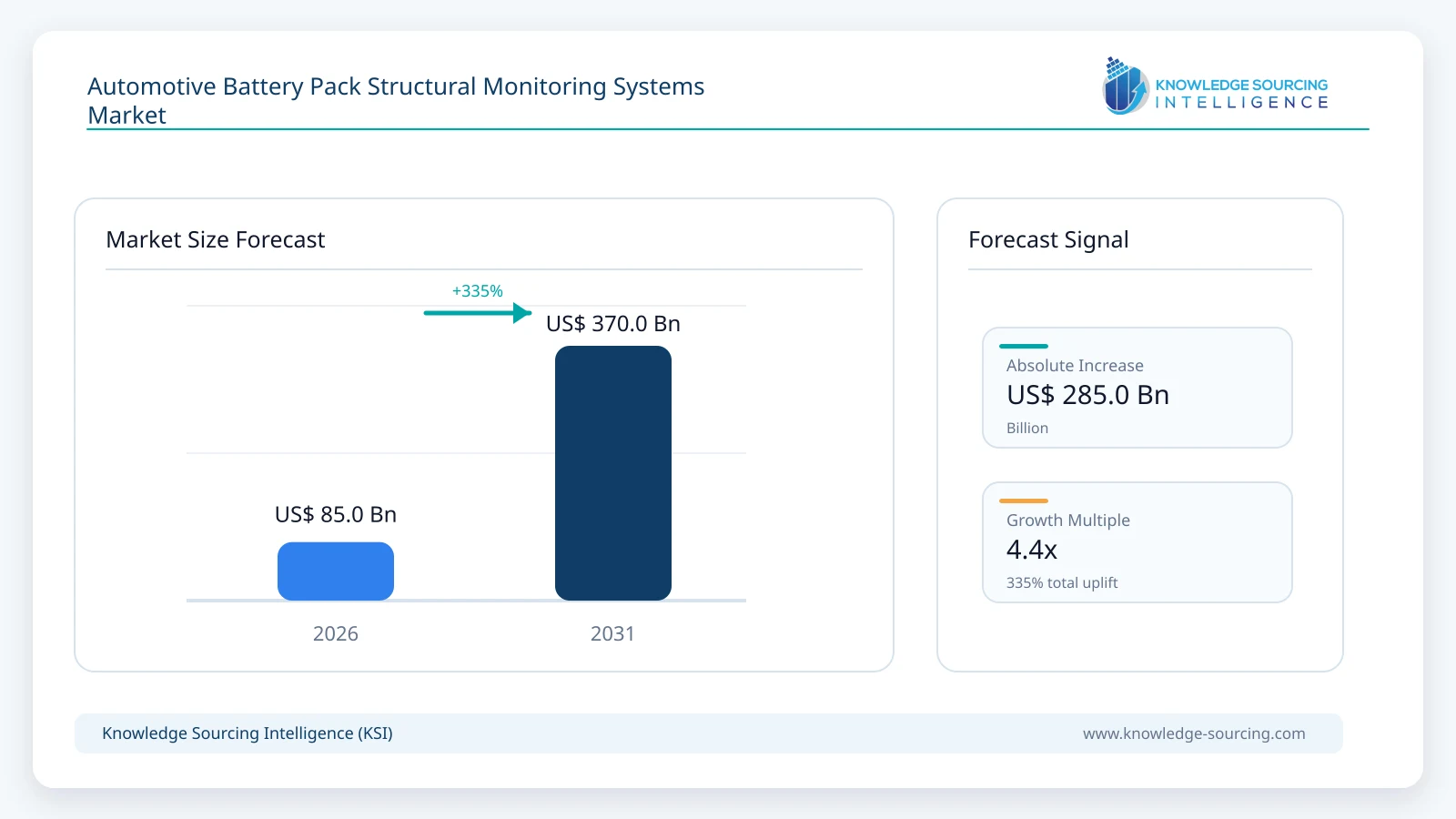
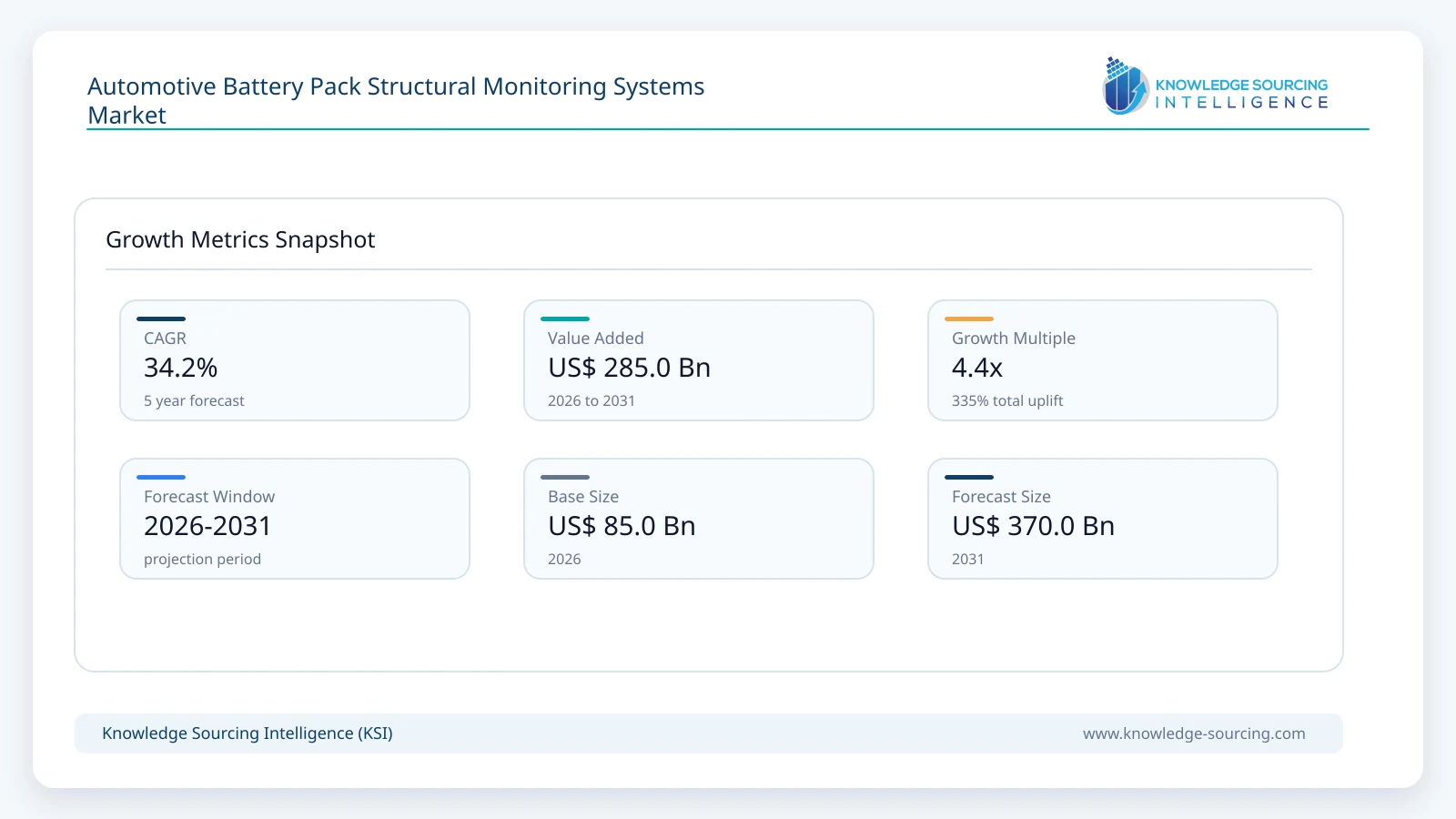
The Automotive Battery Pack Structural Monitoring Systems Market is projected to expand at a CAGR of 34.2%, increasing from USD 85.0 million in 2026 to USD 370.0 million by 2031.
Highlights:
- 1Underfloor impact and intrusion detection accounts for approximately 47% of modeled 2026 market value, reflecting the comparatively mature vehicle-safety use case.
- 2Pressure-tube and satellite sensing leads the 2026 technology mix, while strain and optical approaches gain weight as pack structures become more integrated.
- 3Event-triggered damage detection is the largest monitoring strategy in 2026; continuous condition monitoring expands through 2031 as packaging and sensing improve.
- 4Cell-to-pack and other module-less architectures increase the commercial importance of direct enclosure and cell-stack mechanical data.
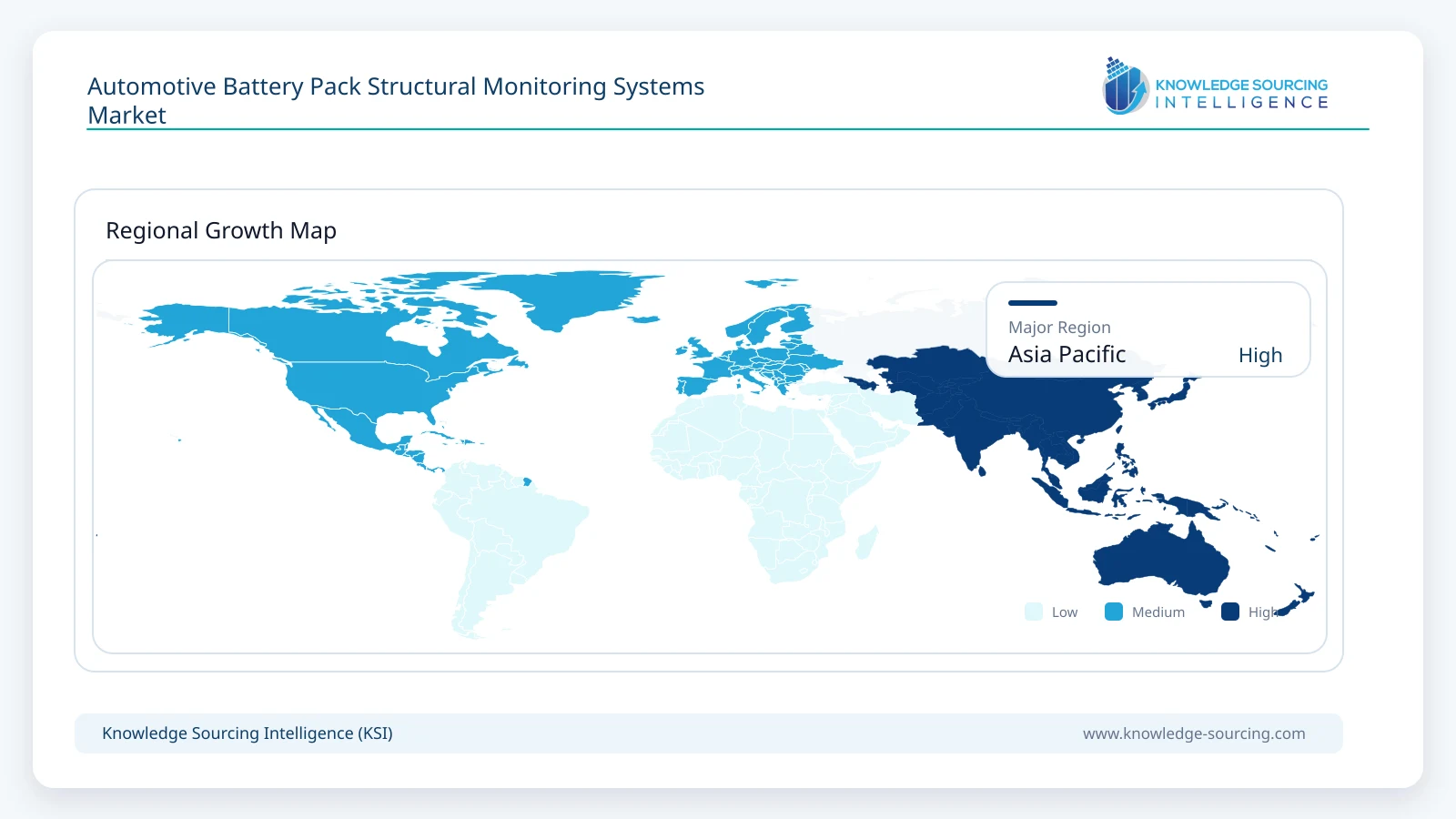
- 5Asia Pacific represents an estimated 43% of 2026 demand, supported by the region’s battery and electric-vehicle manufacturing concentration.
- 6Qualification requirements, false-alarm management, sensor durability, and uncertain production attach rates remain material constraints.
The automotive battery pack structural monitoring systems market covers vehicle-installed sensing and control content dedicated to observing underbody impacts, pack deformation, internal compression, and mechanically induced structural deterioration. It includes pressure-tube detection assemblies, strain and acceleration sensing, pack-local diagnostic interfaces, qualified software, and directly associated program engineering. Battery enclosures, crash structures, ordinary cell-voltage and temperature BMS hardware, thermal-runaway gas detectors and laboratory vibration or pressure-mapping equipment are outside the revenue scope.
Continental developed Battery Impact Detection around an air-filled tube and two pressure-sensor satellites positioned beneath the high-voltage battery. Impact timing and pressure signals help identify the location and severity of underbody contact, with vehicle warning and other protective responses managed through safety electronics. Battery pressure-mapping products from Tekscan and high-voltage strain gauges from HBK establish the feasibility of more detailed mechanical characterization, but their published applications predominantly concern validation rather than sustained production fitment.
Market Overview
Underbody battery placement exposes electric-vehicle packs to mechanical hazards that do not necessarily produce an immediate voltage, current, or temperature fault. A vehicle can strike a road obstacle or scrape a battery enclosure without triggering the conventional crash sensors used to protect occupants. Pack-specific structural sensing addresses this information gap by locating an impact, assessing its severity, and informing the driver or vehicle safety controller when inspection or protective action is warranted. The commercial value is greatest where a mechanical event creates uncertainty about hidden damage to cells, cooling channels or electrical isolation.
Continental’s Battery Impact Detection transfers a proven pressure-satellite measurement principle into underfloor battery protection. Deformation of its sensing tube produces a pressure signal whose arrival times at two endpoints can be used to estimate the location of contact. Tekscan’s flexible Model 7800 provides a different measurement approach, mapping pressure distributions between cells or interfaces during battery development, while HBK’s electrically insulated strain gauges can measure deformation around high-voltage battery frames. These examples define a practical technology spectrum from low-channel-count event detection to distributed, high-resolution structural measurement; the latter is not yet a proven mass-market automotive fitment.
Battery-pack architects must decide which mechanical conditions justify permanent sensors rather than qualification testing or heavier passive shielding. Continuous strain arrays can detect swelling or loading patterns missed by a point sensor, but require wiring, packaging space, calibration and reliable temperature compensation. A vehicle-installed structural monitoring design also has to survive moisture, salt, debris, vibration and extended service life without generating excessive warnings. Suppliers therefore compete on system cost, diagnostic confidence and integration into existing safety or battery-control electronics, not simply on sensor resolution.
Market Trends
Underfloor Impact Detection Is Becoming a Distinct Safety Function
Continental’s pressure-based Battery Impact Detection separates underfloor contact from the vehicle’s conventional occupant-crash measurements and can classify events by severity. Its pressure satellites connect to an algorithm in the safety-control architecture, enabling targeted driver warnings and potential protective responses. The design supports lighter mechanical protection in suitable vehicles, although system deployment depends on each OEM’s structural safety case and the trade-off against reinforced shielding.
CATARC researchers examined traction-battery damage following bottom impacts in an April 2025 SAE study, reinforcing the need to understand hidden mechanical failure modes. The research does not establish sales of onboard sensors, but it supports the engineering rationale for recording and localizing battery strikes. OEM adoption will depend on whether event classification reduces missed damage and unnecessary servicing without introducing unacceptable false alarms.
Pack Compression and Deformation Are Moving into the Diagnostic Discussion
Module-less and cell-to-pack arrangements reduce intermediate packaging and change how cell expansion forces are transmitted through the supporting structure. Tekscan’s battery-specific pressure mapping instruments are used to characterize contact-pressure changes during formation and cycling, while Micro-Epsilon’s laser displacement sensors measure cell expansion on development and production test stands. These measurement methods help suppliers define allowable mechanical windows before considering which signals can be carried into vehicles as permanent diagnostics.
Cell swelling can be influenced by state of charge, temperature, ageing and cell chemistry, making structural measurements difficult to interpret in isolation. Integrating strain observations with existing pack telemetry offers a route to distinguish expected expansion from anomalous pressure buildup. Commercial vehicle-fitment potential remains less mature than event-triggered underfloor sensing, supporting a selective transition toward continuous monitoring rather than universal near-term fitment.
Fiber-Optic Approaches Are Extending Experimental Resolution
Research published in Applied Energy in March 2026 used optical-fiber strain observations to improve battery-pack state estimation, indicating that mechanical response contains information about internal battery behaviour. A September 2026 study demonstrated simultaneous temperature and strain monitoring using fiber Bragg grating arrays in a lithium iron phosphate module. Both developments show technical feasibility under controlled conditions rather than confirmed large-scale automotive deployment.
Fiber-based sensors offer electrical isolation and distributed measurement potential around high-voltage structures, but optical interrogation electronics and durable routing introduce significant costs. The strongest near-term applications are likely to remain development platforms and high-value packs until suppliers demonstrate automotive environmental robustness, stable calibration and sufficiently low per-vehicle costs for production programs.
Structural Monitoring Is Being Evaluated Alongside Tougher Battery Safety Validation
China’s GB 38031-2025 traction-battery safety requirements entered into force in July 2026, increasing the relevance of rigorous pack safety validation. The standard does not mandate dedicated structural-health monitoring devices, but stronger validation expectations encourage OEMs to investigate impact consequences and failure propagation. A January 2026 SAE paper by Volvo Group India researchers modeled coupled thermal and mechanical stresses in battery enclosures, showing how digital validation can complement targeted sensor development.
Vehicle manufacturers are likely to combine structural design improvements, crash simulations, test instrumentation and selective onboard sensing rather than adopt an identical architecture across every model. Sensor vendors able to connect measured strain or impact signatures to validated failure criteria have a stronger commercial proposition than suppliers offering raw measurements alone. Battery-platform qualification cycles and liability considerations will determine how quickly prototype monitoring methods become normal purchased content.
Segment Analysis
By Monitoring Function: Underfloor Impact and Intrusion Detection
Underfloor impact and intrusion detection leads the modeled 2026 market because pressure-satellite architectures can address a direct vehicle-safety problem without requiring dense sensor arrays throughout a battery pack. Continental’s design uses a sensing tube routed near the vulnerable underside to help locate deformation, with diagnostic thresholds capable of producing differentiated warnings. The segment accounts for approximately 47% of 2026 value, while its relative share declines as continuous compression and strain functions begin to commercialize.
Impact classification is particularly useful in vehicles with lightweight battery shielding or underfloor packs exposed to gravel, curbs and road debris. System suppliers must still demonstrate that events requiring inspection can be separated from routine road vibration, and that diagnostics remain reliable after years of wear. OEM safety cases therefore favor proven sensor components and a limited number of well-characterized failure modes.
By Sensing Technology: Strain and Pressure Systems
Pressure-tube and satellite technology retains the leading near-term revenue position owing to established automotive pressure-sensing heritage. Strain-gauge and force methods become increasingly relevant for cell-to-pack assemblies, where compression loads and enclosure bending can alter mechanical margins. HBK’s high-voltage strain products provide a useful measurement reference, but production deployment requires sensors and connections designed for vehicle service rather than laboratory instrumentation.
Fiber-optic sensing is projected to gain share from a small base, supported by the ability to capture distributed deformation with immunity to electromagnetic interference. Optical interrogation cost and packaging complexity will constrain the pace, especially in entry-level passenger cars. Integrated diagnostic electronics that translate mechanical data into a verified safety decision remain a higher-value differentiator than sensor count alone.
By Pack Architecture: Cell-to-Pack and Structural Packs
Cell-to-pack architectures are expected to account for a rising share of structural-monitoring demand as large-format cells and shared mechanical members transmit loading differently from traditional modular packs. CATL- and BYD-style integrated battery designs make structural layout an important influence on sensor placement and calibration, but these pack architectures do not automatically incorporate a separately sold structural monitoring product. Actual demand will depend on platform-specific sensor fitment rather than the overall volume of module-less batteries.
By Vehicle Type: Passenger Cars and Commercial Vehicles
Passenger cars and SUVs account for approximately 85% of 2026 market value because their volumes dominate electric-vehicle production and their packs commonly sit below the occupant floor. Buses, delivery vehicles and heavier commercial trucks represent a smaller but developing opportunity, especially where exposed underfloor structures, high utilization or costly service downtime make diagnostic information valuable. Different frame layouts and duty cycles require separate impact thresholds, environmental qualification and service workflows.
Drivers
Increasing Underfloor Battery Exposure
Large traction packs positioned between the axles place valuable energy-storage systems close to road debris, curb contact and other underbody hazards. Continental’s purpose-built battery impact sensing demonstrates that established vehicle crash measurements do not answer every battery-integrity question. OEMs that seek lighter shielding without giving up diagnostic assurance may fund additional sensing, although actual selection depends on packaging, warranty and vehicle safety targets.
Growth of Integrated Battery-Pack Architectures
Cell-to-pack and structural battery designs reduce intermediate mechanical components and distribute loads through larger shared pack members. This raises the value of understanding compression and deformation at key locations, particularly during fast charging, high-temperature operation and lifetime ageing. The opportunity is concentrated in platforms that can extract a validated mechanical health signal from a limited number of automotive-grade sensors.
Demand for Traceable Damage Diagnosis
After a severe underbody strike, visual inspection may not reveal damage inside the enclosure. Mechanically triggered records can help service technicians decide whether pack inspection, isolation or replacement is necessary and provide clearer evidence for warranty decisions. This benefit depends on reliable event localization and thresholds, making software validation and vehicle-system interfaces as important as the sensor element.
More Rigorous Battery Safety Engineering
Automakers are expanding the use of impact tests, mechanical simulations and combined electro-thermal-mechanical models to define battery protection. China’s revised GB 38031-2025 safety framework increases attention to pack-level verification even though it does not prescribe structural sensors. Better test evidence can translate into clearer onboard thresholds and ultimately support selective adoption of hardware-based mechanical diagnostics.
Advances in Compact Pressure and Strain Sensors
Automotive pressure satellites, printed sensing films, and insulated strain-gauge technologies offer multiple design routes for monitoring different load conditions. Continued miniaturization and improved signal conditioning can reduce wiring and calibration burdens, while suppliers with established automotive component qualification are better positioned to move from prototype sensing to production hardware. Unit economics remain central to commercialization.
Restraints
Uncertain Revenue Attribution Inside Safety Electronics
Structural monitoring may be implemented through an existing airbag ECU, a pack-local diagnostic module or battery-manufacturer-owned software. Purchasing contracts seldom isolate its price, and multiple suppliers may contribute to one function. This makes commercial tracking difficult and can weaken the incentive to procure a separately identified structural-monitoring product rather than bundle the capability with conventional safety electronics.
False Alarms and Difficult Failure Thresholds
Pack deformation varies with temperature, state of charge, road excitation and ageing. A sensor that reacts too frequently may trigger unnecessary service visits, whereas a poorly calibrated threshold can miss genuine damage. OEMs require large validation datasets across battery chemistries, suspension configurations and crash scenarios before authorizing mechanical-condition algorithms for vehicle warning or protective action.
Packaging and Long-Term Durability Constraints
Sensors installed near battery underbodies face water, salt, stones, vibration, thermal cycles and mechanical shock. Adhesive-bonded strain sensors and optical routing may be difficult to maintain or replace after assembly. Additional harnessing and connector penetrations can introduce new reliability concerns, especially when packs are sealed and designed for a long service life.
Competition from Passive Design and Existing Sensors
Reinforced shields, more robust pack structures and established crash sensors can satisfy parts of the same safety requirement without dedicated pack instrumentation. Manufacturers may prefer structural margin and periodic inspection where a sensing system adds too much cost or only marginally improves risk reduction. The cost comparison is particularly demanding in mass-market electric vehicles.
Limited Evidence of High-Volume Continuous Monitoring
Company and technical publications document numerous battery pressure, strain and fiber-optic measurement methods, but many concern laboratory testing, manufacturing inspection or academic prototypes. Their presence does not establish sustained vehicle-installed revenue. Automotive validation, product liability and vehicle-platform development cycles are expected to delay broad deployment of continuous structural-health networks.
Regional Outlook
Asia Pacific
China’s large battery-manufacturing base and high penetration of integrated pack architectures make Asia Pacific the largest modeled regional market, with an estimated 43% share in 2026. China accounts for the largest portion of regional demand as OEMs scale electric-vehicle platforms and evaluate mechanical safety requirements for increasingly compact battery packs. Japan and South Korea contribute sensor, battery and validation engineering, while India and Southeast Asia gradually expand their electric-vehicle manufacturing footprints. Regional spending remains highly dependent on actual adoption of additional vehicle-installed hardware rather than the production volume of batteries alone.
Europe
Continental’s work on Battery Impact Detection provides Europe with a visible automotive supplier base for underbody protection sensing. German and other European manufacturers also operate extensive structural safety validation programs and high-voltage battery engineering ecosystems. Europe is estimated to represent 29% of global 2026 value, with adoption linked to premium and higher-complexity packs before broader cost reduction. HBK and Tekscan-related development tools help generate the test evidence needed for future sensing designs, but their laboratory equipment does not count as installed vehicle systems in this market.
Competitive Landscape
Competition is unusually concentrated at the vehicle-system level. Continental, now represented in the automotive supplier landscape through AUMOVIO, provides the clearest specifically described battery underfloor impact-detection product. Other relevant companies participate mainly through enabling sensors, pressure mapping, high-voltage strain measurement, and mechanical validation tools. Tekscan and its parent Uneo, FLEXOO, HBK, Micro-Epsilon, Kistler and MB Dynamics have useful technology positions, but their documented testing systems should not be mistaken for broad, independently verified onboard battery structural-monitoring sales.
Automotive qualification and access to OEM safety-control architectures will determine which suppliers can move beyond mechanical measurement into recurring production content. A complete proposition requires defined sensing placement, calibrated event interpretation, compatibility with existing control units and a serviceable damage-response workflow. Supplier consolidation in printed and thin-film pressure sensing may broaden technology options, although procurement evidence and actual system integration must be established before assigning market share.
Recent Developments
September 2026: Researchers published a 16-cell lithium iron phosphate module study using fiber Bragg grating arrays for simultaneous strain and temperature sensing, a technical demonstration rather than confirmed vehicle production.
July 2026: China’s GB 38031-2025 electric traction battery safety standard came into effect, strengthening pack-safety design and validation requirements without specifically mandating structural monitoring sensors.
March 2026: A peer-reviewed Applied Energy paper reported pack-scale fiber-optic strain measurement for adaptive battery state estimation, showing the diagnostic potential of mechanical signals at the research stage.
January 2026: Volvo Group India researchers presented a coupled thermo-mechanical simulation framework for evaluating battery-pack enclosures under demanding conditions, supporting calibration of mechanical risk thresholds.
November 2025: Uneo completed its acquisition of Tekscan, combining flexible printed-sensor and pressure-mapping capabilities relevant to future battery-pack measurement architectures. The transaction did not disclose automotive onboard monitoring revenue.
April 2025: CATARC and Tianjin University researchers published SAE bottom-impact damage analysis for traction batteries, strengthening the engineering evidence for location-specific mechanical fault monitoring.
Market Outlook
Automotive battery pack structural monitoring is estimated to grow from USD 85 million in 2026 to USD 370 million in 2031 as selective deployment of underfloor impact detection expands and higher-resolution strain approaches become more technically mature. Event-driven sensing should remain the commercial base in the near term because it responds to an identifiable hazard and can reuse existing safety-control knowledge. Longer-term revenue potential rests on continuous condition monitoring in module-less and structural packs, where mechanical data may add value beyond temperature and voltage monitoring.
Production rollout is unlikely to follow a single industrywide timetable. High-value packs, specialized commercial vehicles and OEMs pursuing lighter shielding may justify a dedicated system earlier, while cost-sensitive platforms will continue to rely on passive protection and established sensing. Suppliers that can link a measurable mechanical signal to an actionable service or safety decision, with credible environmental qualification, are best positioned to convert sensor development into sustainable vehicle-program revenue.
Companies Profiled
AUMOVIO / Continental automotive sensor business
Continental’s Battery Impact Detection uses pressure-satellite technology and pack-underbody tubing to classify impact events. Its direct vehicle-application evidence makes this the most closely aligned participant, although public documentation does not disclose aggregate vehicle installation volumes.
Tekscan (Uneo group)
Tekscan provides thin-film battery pressure-mapping sensors and I-Scan measurement systems used for validation and development. The 2025 acquisition by Uneo expands printed-sensing expertise; disclosed products are predominantly instrumentation rather than confirmed long-life pack installations.
FLEXOO
FLEXOO develops printed sensor technologies and partnered with Tekscan in February 2025. Flexible sensor manufacturing is a potential enabling route for pressure and deformation monitoring, with automotive mass-production fitment not established by the announcement alone.
HBK (Hottinger Brüel & Kjær)
HBK supplies insulated strain gauges suitable for high-voltage battery frame stress analysis and broader vibration and structural test systems. The evidence supports its role in sensing and qualification, rather than an independently verified onboard monitoring platform.
Micro-Epsilon
Micro-Epsilon uses laser displacement sensors to monitor battery cell expansion during charging and production evaluation. The measurement approach informs mechanical monitoring designs, although factory equipment sales fall outside the vehicle-installed market revenue boundary.
Kistler Group
Kistler offers dynamic force sensors and crash-test instrumentation including SmartCrash force measurement elements. These tools support structural validation of battery and vehicle impacts; their use in test facilities is not booked as vehicle-installed structural sensing.
MB Dynamics
MB Dynamics supplies battery-pack vibration testing equipment used in vehicle and production qualification. The company is a relevant validation-ecosystem participant, not a proven direct competitor in continuous in-vehicle pack structural monitoring.
Automotive Battery Pack Structural Monitoring Systems Market Scope:
| Report Metric | Details |
|---|---|
| Total Market Size in 2026 | USD 85.0 million |
| Total Market Size in 2031 | USD 370.0 million |
| Forecast Unit | USD Billion |
| Growth Rate | 34.2% |
| Study Period | 2021 to 2031 |
| Historical Data | 2021 to 2024 |
| Base Year | 2025 |
| Forecast Period | 2026 – 2031 |
| Segmentation | Structural Monitoring Function, Sensing Technology, System Integration Architecture, Monitoring Strategy |
| Companies |
|
Market Segmentation
By Structural Monitoring Function
Underfloor Impact and Intrusion Detection
Cell Stack Compression and Swelling
Enclosure Strain and Deformation
Vibration and Mechanical Fatigue
By Sensing Technology
Pressure-Tube and Satellite
Strain-Gauge and Force
Inertial and Acceleration
Optical and Fiber-Based
Hybrid and Others
By System Integration Architecture
Battery-Safety ECU Integrated
Pack-Local Sensor Module
Vehicle Crash ECU Integrated
By Monitoring Strategy
Event-Triggered Damage Detection
Continuous Structural Surveillance
Hybrid Monitoring
By Battery Pack Architecture
Conventional Module-Based
Cell-to-Pack and Module-Less
Structural and Cell-to-Body
By Battery Chemistry
Lithium Iron Phosphate
NMC and NCA
Other Lithium-Based Chemistries
By Vehicle Type
Passenger Cars and SUVs
Light Commercial Vehicles
Buses and Heavy Commercial Vehicles
By Propulsion
Battery Electric Vehicles
Plug-in Hybrid and Range-Extended
By Geography
North America
United States
Canada
Mexico
South America
Brazil
Argentina
Others
Europe
Germany
France
UK
Spain
Italy
Others
Middle East and Africa
Saudi Arabia
UAE
South Africa
Others
Asia Pacific
China
Japan
South Korea
India
Thailand
Indonesia
Taiwan
Others
Table of Contents
1. EXECUTIVE SUMMARY
1.1. Market Opportunity and Key Findings
1.2. Market Size and Growth, 2026–2031
1.3. Structural Monitoring Technology Outlook
1.4. Regional Opportunity Summary
2. MARKET SNAPSHOT
2.1. Market Overview
2.2. Market Definition
2.3. Scope of the Study
2.4. Market Segmentation
3. BUSINESS LANDSCAPE
3.1. Market Drivers
3.1.1. Increasing Underfloor Battery Exposure
3.1.2. Growth of Integrated Battery-Pack Architectures
3.1.3. Demand for Traceable Damage Diagnosis
3.1.4. More Rigorous Battery Safety Engineering
3.1.5. Advances in Compact Pressure and Strain Sensors
3.2. Market Restraints
3.2.1. System Cost and Procurement Integration
3.2.2. False Alarms and Difficult Failure Thresholds
3.2.3. Packaging and Long-Term Durability Constraints
3.2.4. Competition from Passive Design and Existing Sensors
3.2.5. Continuous Monitoring Qualification and Commercialization
3.3. Market Opportunities
3.4. Porter's Five Forces Analysis
3.5. Industry Value Chain Analysis
3.6. Policies and Regulations
3.7. Strategic Recommendations
4. TECHNOLOGICAL OUTLOOK
4.1. Underfloor Battery Impact Detection
4.2. Strain and Compression Monitoring
4.3. Fiber-Optic Structural Sensing
4.4. Diagnostic Algorithms and Data Fusion
4.5. Automotive Environmental and Safety Qualification
5. AUTOMOTIVE BATTERY PACK STRUCTURAL MONITORING SYSTEMS MARKET BY MONITORING FUNCTION
5.1. Introduction
5.2. Underfloor Impact and Intrusion Detection
5.3. Cell Stack Compression and Swelling
5.4. Pack Enclosure Strain and Deformation
5.5. Vibration and Mechanical Fatigue Monitoring
6. AUTOMOTIVE BATTERY PACK STRUCTURAL MONITORING SYSTEMS MARKET BY SENSING TECHNOLOGY
6.1. Introduction
6.2. Pressure-Tube and Satellite Sensing
6.3. Strain-Gauge and Force Sensing
6.4. Inertial and Acceleration Sensing
6.5. Optical and Fiber-Based Sensing
6.6. Hybrid and Other Sensing
7. AUTOMOTIVE BATTERY PACK STRUCTURAL MONITORING SYSTEMS MARKET BY SYSTEM INTEGRATION ARCHITECTURE
7.1. Introduction
7.2. Integrated Battery-Safety ECU
7.3. Pack-Local Sensor and Diagnostic Module
7.4. Vehicle Crash ECU-Integrated Monitoring
8. AUTOMOTIVE BATTERY PACK STRUCTURAL MONITORING SYSTEMS MARKET BY MONITORING STRATEGY
8.1. Introduction
8.2. Event-Triggered Structural Damage Detection
8.3. Continuous Structural-Condition Surveillance
8.4. Hybrid Event and Continuous Monitoring
9. AUTOMOTIVE BATTERY PACK STRUCTURAL MONITORING SYSTEMS MARKET BY BATTERY PACK ARCHITECTURE
9.1. Introduction
9.2. Conventional Module-Based Packs
9.3. Cell-to-Pack and Module-Less Packs
9.4. Structural and Cell-to-Body Packs
10. AUTOMOTIVE BATTERY PACK STRUCTURAL MONITORING SYSTEMS MARKET BY BATTERY CHEMISTRY
10.1. Introduction
10.2. Lithium Iron Phosphate
10.3. Nickel-Rich Lithium-Ion and NMC/NCA
10.4. Other Lithium-Based Chemistries
11. AUTOMOTIVE BATTERY PACK STRUCTURAL MONITORING SYSTEMS MARKET BY VEHICLE TYPE
11.1. Introduction
11.2. Passenger Cars and SUVs
11.3. Light Commercial Vehicles
11.4. Buses and Medium/Heavy Commercial Vehicles
12. AUTOMOTIVE BATTERY PACK STRUCTURAL MONITORING SYSTEMS MARKET BY PROPULSION TYPE
12.1. Introduction
12.2. Battery Electric Vehicles
12.3. Plug-in Hybrid and Range-Extended Vehicles
13. AUTOMOTIVE BATTERY PACK STRUCTURAL MONITORING SYSTEMS MARKET BY GEOGRAPHY
13.1. North America
13.1.1. United States
13.1.2. Canada
13.1.3. Mexico
13.2. South America
13.2.1. Brazil
13.2.2. Argentina
13.2.3. Others
13.3. Europe
13.3.1. Germany
13.3.2. France
13.3.3. United Kingdom
13.3.4. Spain
13.3.5. Italy
13.3.6. Others
13.4. Middle East and Africa
13.4.1. Saudi Arabia
13.4.2. United Arab Emirates
13.4.3. South Africa
13.4.4. Others
13.5. Asia Pacific
13.5.1. China
13.5.2. Japan
13.5.3. South Korea
13.5.4. India
13.5.5. Thailand
13.5.6. Indonesia
13.5.7. Taiwan
13.5.8. Others
14. COMPETITIVE ENVIRONMENT AND ANALYSIS
14.1. Major Players and Strategy Analysis
14.2. Market Share Analysis
14.3. Mergers, Acquisitions, Agreements and Collaborations
14.4. Competitive Dashboard
15. COMPANY PROFILES
15.1. AUMOVIO
15.2. Tekscan
15.3. FLEXOO
15.4. HBK (Hottinger Brüel & Kjær)
15.5. Micro-Epsilon
15.6. Kistler Group
15.7. MB Dynamics
16. APPENDIX
16.1. Currency
16.2. Assumptions
16.3. Base and Forecast Years Timeline
16.4. Key Benefits for Stakeholders
16.5. Research Methodology
16.6. Abbreviations
Navigate
Trusted by the world's leading organizations