
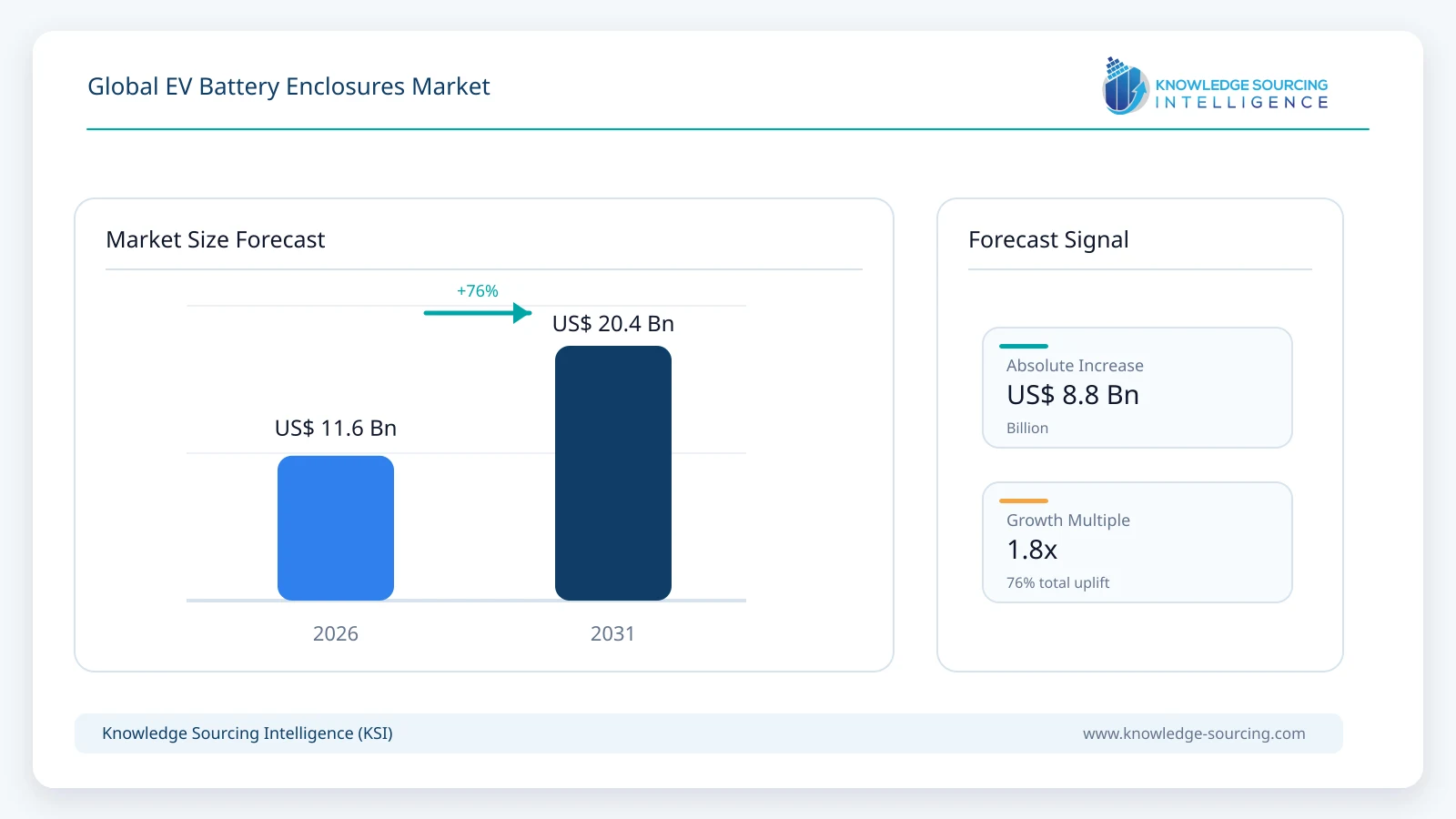
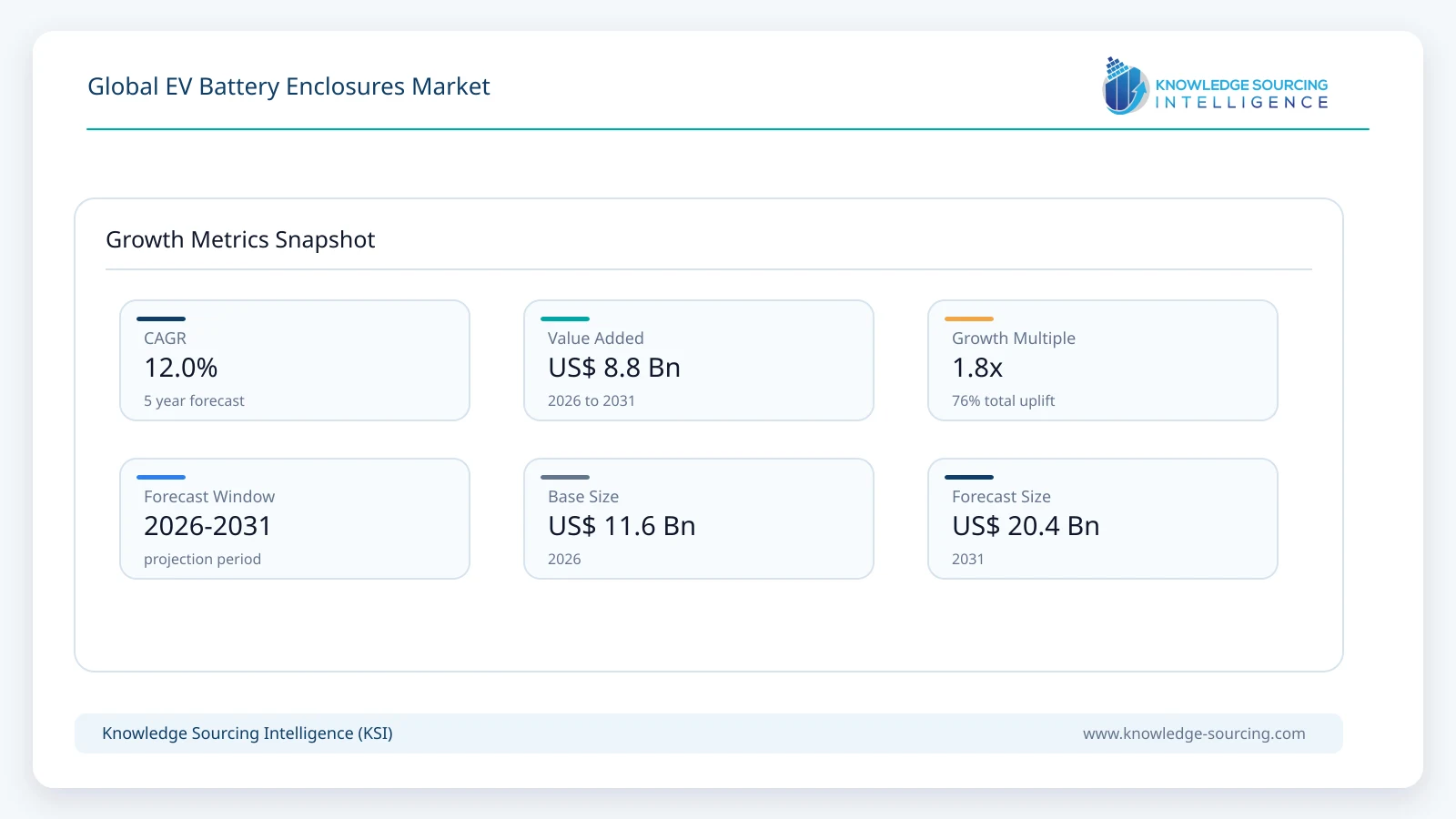
The global EV battery enclosures market will grow from USD 11.6 billion in 2026 to USD 20.4 billion by 2031 at a CAGR of 12.0% during the forecast period.
Highlights:
- 1Global electric-car sales are expected to reach approximately 23 million units in 2026, expanding the addressable enclosure volume.
- 2Steel remains highly competitive where crash performance, manufacturing cost and high-volume stamping are prioritized.
- 3Aluminium enclosures retain a strong lightweighting advantage and can reduce enclosure mass materially versus comparable steel designs.
- 4Thermoplastic composite and hybrid enclosures are moving from demonstration into serial-production awards.
- 5Cell-to-pack architectures increase the structural and integration role of the enclosure within the complete battery system.
- 6One-piece and reduced-weld manufacturing concepts gain importance as OEMs seek better leak tightness and lower assembly complexity.
- 7Asia Pacific remains the principal production base because China accounts for the majority of global electric-vehicle output.
Market Overview
Battery enclosures sit at the intersection of structural engineering, electrical safety and battery-pack packaging. A modern enclosure must protect cells and high-voltage electronics against side, pole and underbody impacts while remaining sealed against water and dust. It also has to support thermal-propagation barriers, grounding, electromagnetic compatibility, mounting interfaces and increasingly the cooling architecture. These requirements make the enclosure one of the most highly engineered large-format components in an electric vehicle.
Material selection is increasingly platform-specific rather than driven by a single lightweighting objective. Magna offers steel, aluminium and cast-hybrid enclosure architectures and states that its aluminium designs can be about 20% lighter than comparable steel designs. At the same time, high-strength steel remains attractive because of lower material cost and familiar stamping and joining processes. Composite systems offer additional electrical isolation and part-integration advantages, while hybrid architectures place different materials where their structural, thermal and manufacturing properties create the greatest value.
The market is distinct from the EV composites market. This report follows the complete battery enclosure as a component irrespective of material choice. A composite-market report instead follows composite material demand across battery structures, body, chassis and other vehicle applications. The enclosure market therefore includes substantial steel and aluminium revenue that sits outside a composites-only scope.
Enclosure Material and Architecture Comparison
Architecture | Principal Advantages | Typical Manufacturing Route | Key Trade-Off |
Stamped / Formed Steel | Crash strength, lower material cost, mature automotive supply chain | Deep drawing, stamping, welding, roll forming | Higher mass than aluminium or composite alternatives |
Aluminium | Lightweighting, corrosion resistance, scalable modular designs | Extrusions, stampings, castings, laser/CMT welding | Higher raw-material cost and joining complexity |
Thermoplastic Composite | Electrical isolation, corrosion resistance, integration, low mass | Injection or compression molding, one-shot integration | Material qualification, cost and recycling pathway |
Composite-Metal Hybrid | Balances crash strength, lightweighting and multifunctional integration | Mixed forming, molding and joining processes | Interface design and multi-material manufacturing complexity |
One-Piece / Reduced-Weld Designs | Improved leak tightness, fewer joints and lower assembly complexity | Advanced deep drawing or large-format molding | High tooling and process-development requirements |
Market Dynamics
EV Production Scale Expands the Addressable Enclosure Base
The enclosure market scales directly with electrified vehicle production because every traction battery requires a mechanically and environmentally protected housing. The International Energy Agency expects global electric-car sales to reach approximately 23 million in 2026, representing close to three in ten new cars sold. Nearly 22 million electric cars were produced globally in 2025, and China accounted for about three-quarters of that output. This scale gives enclosure suppliers a large recurring vehicle-platform opportunity rather than a one-time battery-plant equipment market.
Structural Battery Architectures Increase Enclosure Value per Platform
Cell-to-pack and structural-pack concepts reduce intermediate module structures and place greater responsibility on the enclosure and vehicle underbody. The housing increasingly carries battery loads, reacts crash forces, manages sealing and supports thermal systems. Kautex markets cell-to-pack enclosure concepts that integrate structural and thermal functions, while Magna has developed one-piece designs intended to maximize usable internal volume. These trends increase the engineering content of the enclosure even as OEMs work to reduce part count.
Material Competition Is Shifting from Weight Alone to Total System Cost
Automakers are evaluating enclosure materials on the basis of crashworthiness, manufacturability, sealing, repairability, thermal integration and lifecycle emissions in addition to mass. High-strength steel can deliver cost-effective protection, aluminium can reduce mass and enable modular extrusion-based architectures, and composites can integrate insulation and corrosion resistance. This creates a multi-material market in which no single material is likely to displace the others across all vehicle segments.
Qualification and Platform-Specific Tooling Limit Rapid Supplier Switching
Battery enclosures are safety-critical and require extensive validation for impact, crush, fire, sealing, corrosion and high-voltage protection. Once a housing is designed into a vehicle platform, tooling and body integration make supplier substitution difficult. Competitive intensity is therefore highest during platform development and sourcing, while awarded programs can provide multi-year volume visibility after start of production.
Technological Outlook
High-Strength Steel and Advanced Forming
Steel enclosure development is moving toward higher-strength grades and manufacturing concepts that reduce welds and improve package efficiency. Magna's OptiForm concept uses deep drawing to create near-vertical sidewalls and tighter corner radii, increasing usable internal battery space while reducing assembly complexity. thyssenkrupp is also supplying lower-carbon recycled steel for the BMW iX3 battery housing from 2026, showing that material carbon intensity is becoming part of enclosure procurement.
Aluminium Extrusion, Stamping and Casting
Aluminium enclosures typically combine extrusions, stamped panels and castings to create a rigid lightweight structure. Constellium and Novelis continue to develop enclosure-specific alloys and manufacturing routes, while Magna already has aluminium enclosures in production. Aluminium remains particularly attractive for larger battery packs where mass savings can offset the higher material and joining cost.
Thermoplastic Composite Enclosures
Thermoplastic composites are moving closer to series production. Kautex secured a 2025 full-battery-electric lower-housing order and a further 2026 enclosure award for a multi-vehicle hybrid platform. Its Pentatonic system combines composite or composite-metal structures with integrated thermal-management features. The architecture also provides electrical isolation and corrosion resistance without relying entirely on metallic housings.
Integrated Thermal and Fire-Protection Functions
Enclosures increasingly incorporate thermal-propagation barriers, cooling interfaces and underbody protection rather than acting as passive structural shells. Magna received recognition for production engineering around thermal-propagation fleece in an MEB battery system, while Kautex integrates cooling features into composite enclosure concepts. This integration can reduce secondary assembly operations but increases the enclosure supplier's engineering responsibility.
Segment Analysis
By Material
Steel, aluminium, composites and hybrid structures all remain commercially relevant because enclosure requirements differ by vehicle size, battery capacity, cost target and manufacturing footprint. Steel is strongest where cost-efficient crash protection and established stamping capacity are central. Aluminium provides a favorable weight-to-strength balance for premium and large-battery vehicles, while composites and hybrid architectures are gaining interest where part consolidation, electrical isolation and corrosion resistance justify added material complexity.
By Vehicle Type
Passenger battery-electric vehicles account for the largest enclosure demand because they dominate global electric-car volumes. Plug-in hybrids use smaller battery housings but add substantial unit demand in markets where hybridisation remains strong. Commercial electric vehicles create a smaller but high-value opportunity because trucks and buses often require larger, more robust enclosures and may use modular or multi-pack layouts.
By Enclosure Architecture
Conventional multi-piece trays remain widespread, but one-piece, reduced-weld, cell-to-pack and structural-pack architectures are gaining importance. The direction is toward fewer joints, higher sealing reliability and greater integration of cross-members, cooling and fire-protection functions. The pace of adoption depends on platform redesign cycles because enclosure architecture is closely tied to the vehicle underbody and body-in-white.
By Manufacturing Process
High-volume stamped and welded processes dominate steel enclosures, while aluminium typically uses combinations of extrusion, stamping, casting and welding. Composite housings rely on injection or compression molding and may incorporate structural inserts or metal frames. Advanced deep drawing, roll forming and large-format molding are being developed to reduce component count and improve dimensional consistency.
Market and Demand Indicators
Indicator | Latest Development | Market Impact |
Global EV sales | IEA expects approximately 23 million electric-car sales in 2026. | Directly expands annual enclosure unit demand. |
Global EV manufacturing | Nearly 22 million electric cars were produced globally in 2025. | Supports high-volume enclosure localization around vehicle plants. |
One-piece manufacturing | Magna advanced its OptiForm one-piece deep-drawn enclosure concept in 2026. | Shows focus on fewer welds, better leak tightness and higher usable pack volume. |
New enclosure award | Kautex secured a June 2026 full enclosure award for a multi-vehicle electrified platform. | Confirms continued platform sourcing and localization. |
Lower-carbon steel | thyssenkrupp began supplying recycled-content steel for the BMW iX3 battery housing in 2026. | Adds lifecycle carbon as a material-procurement factor. |
Aluminium lightweighting | Magna states aluminium enclosure designs can be around 20% lighter than comparable steel designs. | Supports aluminium where vehicle mass reduction justifies material cost. |
Asia Pacific Market Analysis
Asia Pacific is the most important production region for EV battery enclosures because China accounts for the majority of global electric-car manufacturing. The region contains large vehicle plants, battery-pack factories, aluminium and steel suppliers, composite processors and automotive stamping capacity. High production density allows enclosure suppliers to localize close to assembly plants, reducing logistics costs for large-format components that are expensive to transport over long distances.
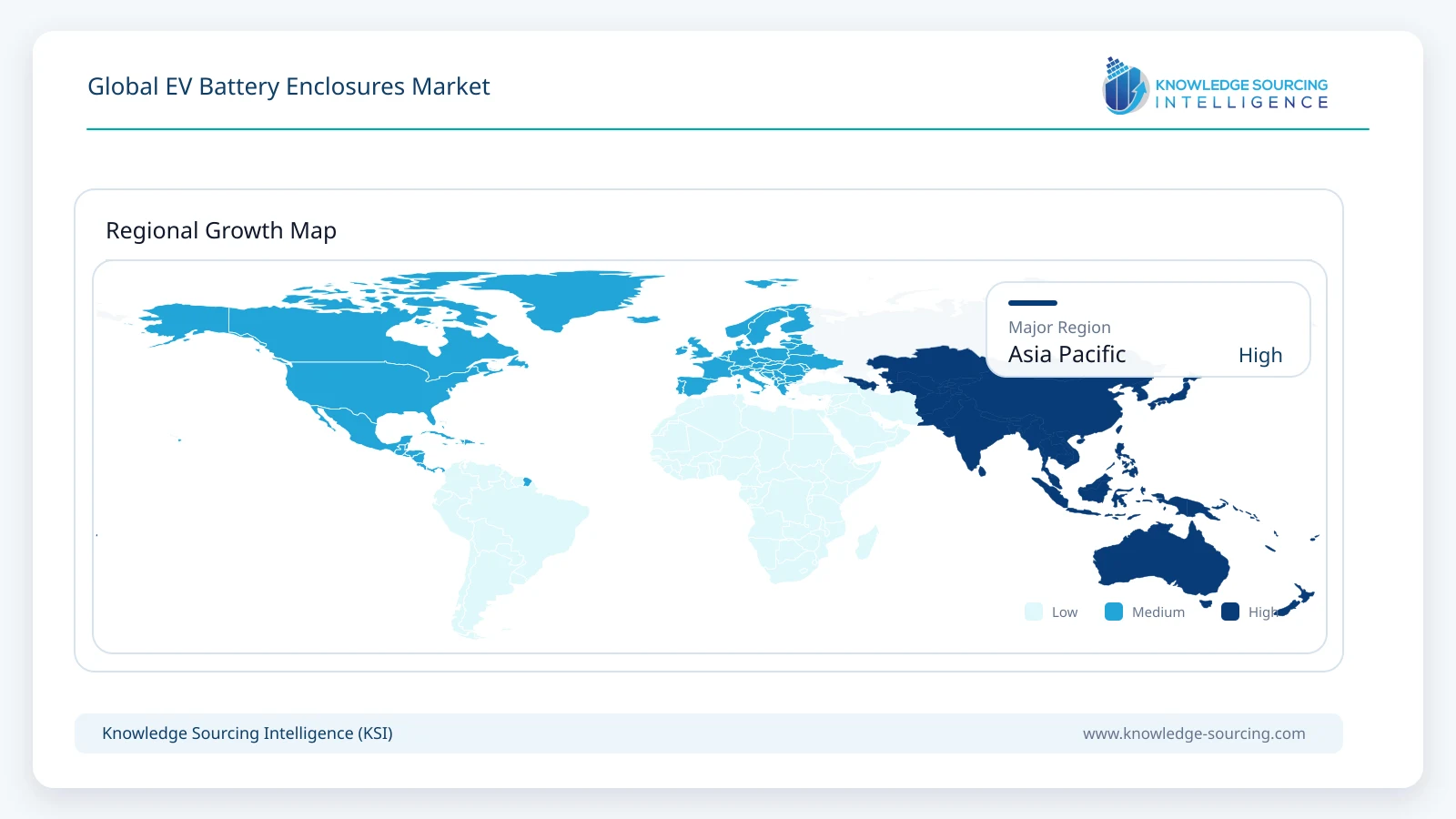
China leads in unit volume and supports a wide range of enclosure architectures from cost-focused steel housings to aluminium and composite systems. Japan and South Korea contribute advanced materials, joining technologies and automotive structural engineering. India is emerging as a localization market as domestic EV platforms expand. Through 2031, the region is expected to remain the largest enclosure manufacturing base even as North America and Europe deepen local battery supply chains.
Competitive Landscape
The market spans global Tier 1 body and chassis suppliers, specialist battery-system companies and material producers that increasingly participate in enclosure engineering. Magna provides steel, aluminium and cast-hybrid battery enclosures. Kautex is expanding thermoplastic composite and composite-metal hybrid systems. Gestamp, Benteler, Minth Group and Nemak participate in structural battery and EV body-component supply, while thyssenkrupp contributes high-strength steel housing concepts. Aluminium companies including Novelis, Constellium and Hydro support material and structural development for lightweight housings.
Competitive advantage is increasingly tied to complete-system capability rather than material supply alone. OEMs require validated crash performance, sealing, fire protection, high-volume tooling, joining expertise and local manufacturing capacity. Suppliers that can integrate thermal interfaces, underbody protection and structural functions while reducing assembly steps can capture more value per platform and deepen their relationship with vehicle manufacturers.
Recent Developments
June 2026: Kautex secured a new Pentatonic battery-enclosure award for a leading automotive OEM, including the top cover, bottom tray and thermal-management solution for a multi-vehicle platform.
March 2026: Magna detailed its OptiForm one-piece battery enclosure, which uses deep-draw forming to reduce joints and improve internal pack-space utilization.
February 2026: thyssenkrupp Steel began supplying recycled-content bluemint steel for series production of the BMW iX3, including the vehicle battery housing.
July 2025: Kautex secured a full-BEV thermoplastic-composite lower battery housing order for a major automotive platform.
March 2025: Novelis, Shape Corp. and Metalsa announced a collaboration to develop roll-form-intensive aluminium EV battery-tray concepts.
EV Battery Enclosures Market Scope:
| Report Metric | Details |
|---|---|
| Total Market Size in 2026 | USD 11.6 billion |
| Total Market Size in 2031 | USD 20.4 billion |
| Forecast Unit | Billion |
| Growth Rate | 12.0% |
| Study Period | 2021 to 2031 |
| Historical Data | 2021 to 2024 |
| Base Year | 2025 |
| Forecast Period | 2026 – 2031 |
| Segmentation | Material, Vehicle Type, Enclosure Architecture, Manufacturing Process, Geography |
| Companies |
|
Market Segmentation
By Material
Steel
Aluminium
Composite
Hybrid and Other Materials
By Vehicle Type
Passenger Battery Electric Vehicles
Plug-in Hybrid Electric Vehicles
Commercial Electric Vehicles
Other Electric Vehicles
By Enclosure Architecture
Conventional Multi-Piece Enclosures
One-Piece / Reduced-Weld Enclosures
Cell-to-Pack and Structural Pack Enclosures
Hybrid Enclosure Architectures
By Manufacturing Process
Stamping and Welding
Extrusion and Fabrication
Casting
Compression / Injection Molding
Other Processes
By Geography
North America
United States
Canada
Mexico
South America
Brazil
Argentina
Rest of South America
Europe
Germany
United Kingdom
France
Italy
Rest of Europe
Middle East and Africa
Saudi Arabia
United Arab Emirates
South Africa
Rest of Middle East and Africa
Asia Pacific
China
Japan
India
South Korea
Rest of Asia Pacific
Table of Contents
1. EXECUTIVE SUMMARY
2. MARKET SNAPSHOT
2.1. Market Overview
2.2. Market Segmentation
3. BUSINESS LANDSCAPE
3.1. Market Drivers
3.1.1. EV Production Scale Expands the Addressable Enclosure Base
3.1.2. Structural Battery Architectures Increase Enclosure Value per Platform
3.1.3. Material Competition Is Shifting from Weight Alone to Total System Cost
3.2. Market Restraints
3.2.1. Qualification and Platform-Specific Tooling Limit Rapid Supplier Switching
3.3. Market Opportunities
3.4. Porter's Five Forces Analysis
3.5. Industry Value Chain Analysis
3.6. Battery Safety and Structural Requirements
4. TECHNOLOGICAL OUTLOOK
4.1. High-Strength Steel and Advanced Forming
4.2. Aluminium Extrusion, Stamping and Casting
4.3. Thermoplastic Composite Enclosures
4.4. Integrated Thermal and Fire-Protection Functions
5. GLOBAL EV BATTERY ENCLOSURES MARKET BY MATERIAL
5.1. Steel
5.2. Aluminium
5.3. Composite
5.4. Hybrid and Other Materials
6. GLOBAL EV BATTERY ENCLOSURES MARKET BY VEHICLE TYPE
6.1. Passenger Battery Electric Vehicles
6.2. Plug-in Hybrid Electric Vehicles
6.3. Commercial Electric Vehicles
6.4. Other Electric Vehicles
7. GLOBAL EV BATTERY ENCLOSURES MARKET BY ENCLOSURE ARCHITECTURE
7.1. Conventional Multi-Piece Enclosures
7.2. One-Piece / Reduced-Weld Enclosures
7.3. Cell-to-Pack and Structural Pack Enclosures
7.4. Hybrid Enclosure Architectures
8. GLOBAL EV BATTERY ENCLOSURES MARKET BY MANUFACTURING PROCESS
8.1. Stamping and Welding
8.2. Extrusion and Fabrication
8.3. Casting
8.4. Compression / Injection Molding
8.5. Other Processes
9. GLOBAL EV BATTERY ENCLOSURES MARKET BY GEOGRAPHY
9.1. North America
9.1.1. United States
9.1.2. Canada
9.1.3. Mexico
9.2. South America
9.2.1. Brazil
9.2.2. Argentina
9.2.3. Rest of South America
9.3. Europe
9.3.1. Germany
9.3.2. United Kingdom
9.3.3. France
9.3.4. Italy
9.3.5. Rest of Europe
9.4. Middle East and Africa
9.4.1. Saudi Arabia
9.4.2. United Arab Emirates
9.4.3. South Africa
9.4.4. Rest of Middle East and Africa
9.5. Asia Pacific
9.5.1. China
9.5.2. Japan
9.5.3. India
9.5.4. South Korea
9.5.5. Rest of Asia Pacific
10. COMPETITIVE ENVIRONMENT AND ANALYSIS
10.1. Major Players and Strategy Analysis
10.2. Market Share Analysis
10.3. Product Development, Contracts and Collaborations
10.4. Competitive Dashboard
11. COMPANY PROFILES
11.1. Magna International Inc.
11.2. Gestamp Automocion, S.A.
11.3. Kautex Textron GmbH & Co. KG
11.4. Benteler International AG
11.5. Minth Group Limited
11.6. Nemak, S.A.B. de C.V.
11.7. thyssenkrupp AG
11.8. Novelis Inc.
11.9. Constellium SE
11.10. Hydro Extrusions / Norsk Hydro ASA
11.11. Shape Corp.
11.12. Metalsa S.A. de C.V.
11.13. SGL Carbon SE
11.14. SABIC
11.15. Rochling Automotive
11.16. Autoneum Holding AG
11.17. Hanwha Advanced Materials
11.18. GF Casting Solutions
12. RECENT DEVELOPMENTS
13. APPENDIX
13.1. Currency
13.2. Assumptions
13.3. Base and Forecast Years Timeline
13.4. Abbreviations
Navigate
Trusted by the world's leading organizations











