
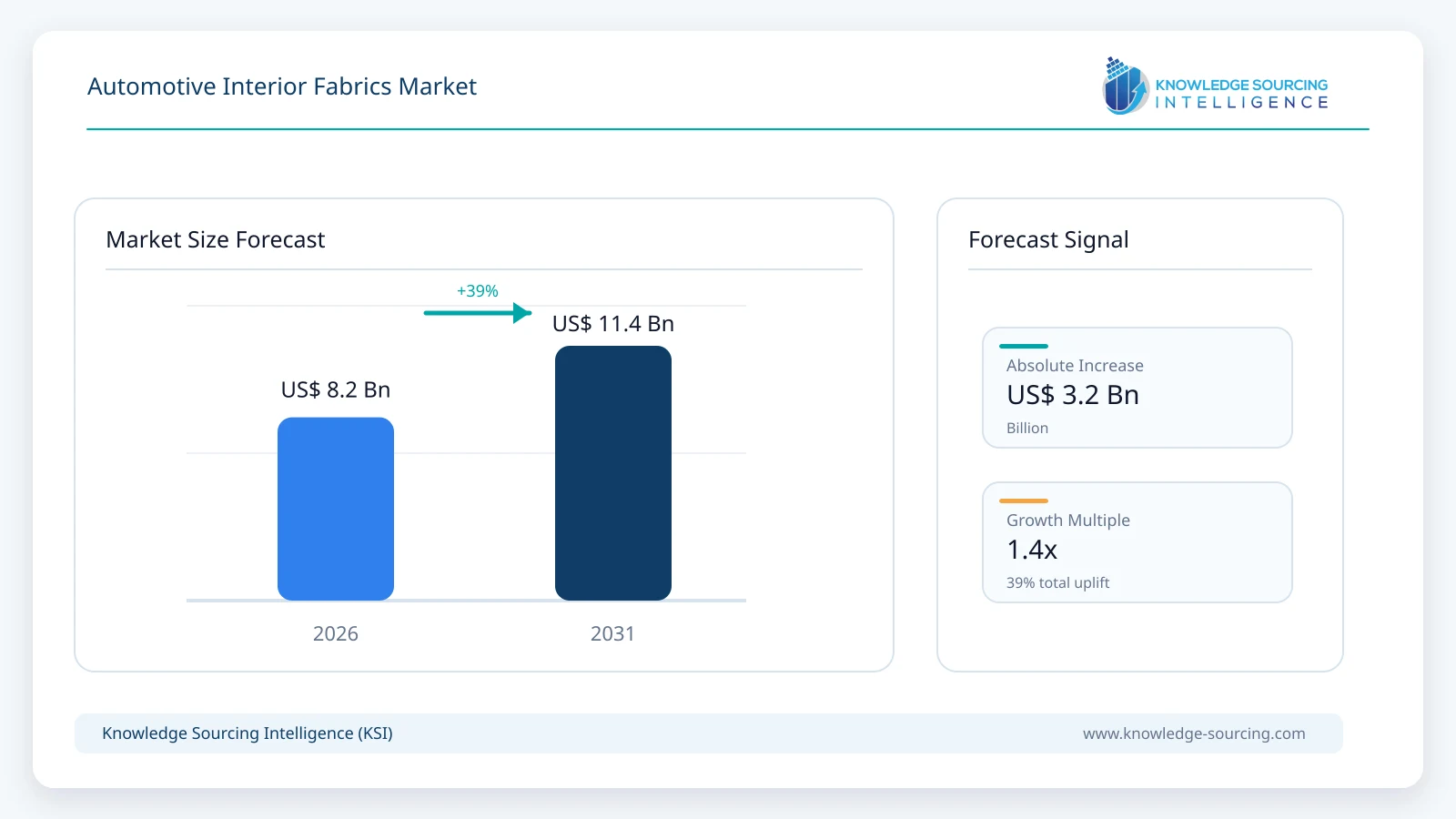
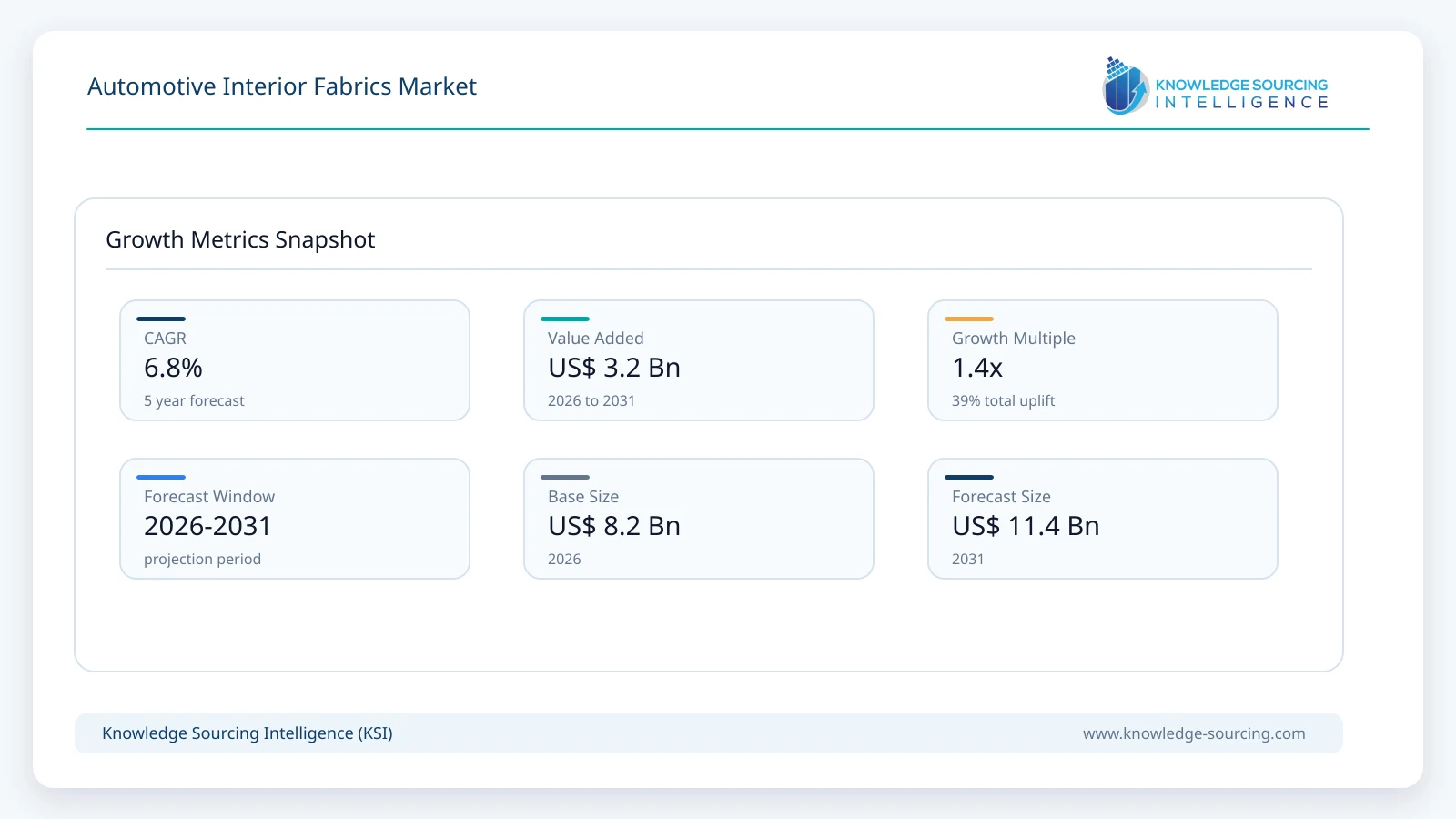
The Automotive Interior Fabrics Market is projected to expand at a CAGR of 6.81%, increasing from USD 8.20 billion in 2026 to USD 11.4 billion by 2031.
Highlights:
- 1Polyester, including recycled polyester, represents approximately 62% of global interior fabric value in 2026 as a primary-fiber classification.
- 2Seating and upholstery fabrics account for approximately 39% of 2026 market value, reflecting high textile specifications and large exposed surface areas.
- 3Woven fabrics account for roughly 36% of market value in 2026; nonwovens represent 35% across carpet, headliner and acoustic applications.
- 4Asia Pacific represents approximately 47% of estimated 2026 revenue as China, Japan, India and Southeast Asia support extensive interior-textile manufacturing.
- 5Nonwoven fabrics are projected to gain share by 2031 as lighter, recyclable carpet structures and acoustic layers gain wider program acceptance.
- 6Textile recyclability increasingly depends on backing chemistry, lamination choices and recoverable fiber streams rather than recycled-yarn content alone.
Woven, knitted and nonwoven technical textiles are supplied as automotive-qualified fabrics, backed textiles and textile-facing materials for seats, headliners, carpets, door coverings and passenger-compartment insulation. The market includes fabric conversion, finishing and qualified textile backing at the material-supply stage, rather than the assembled value of complete seats or interior trim modules.
Automotive textile suppliers combine fiber selection, weaving or knitting, needling, surface finishing and lamination to meet durability and vehicle interior air-quality requirements. AUNDE manufactures automotive upholstery materials and technical textiles, while SUMINOE supplies seat coverings, ceiling materials and floor carpets across an international production network. Lear’s Guilford business offers recycled-content ReNewKnit surface material and ComfortVent spacer textiles, illustrating how textile construction increasingly determines both cabin appearance and functional performance.
Market Overview
Passenger-compartment fabrics cover several technically distinct products despite sharing common polymer fibers. Seating fabrics must resist abrasion, pilling, sunlight and repeated occupant movement while maintaining consistent color and feel. Headliner fabrics place greater emphasis on formability, sag resistance and low mass, whereas carpets require wear resistance, dimensional stability and compatibility with forming or backing processes. Fabric specifications therefore vary by cabin location, vehicle class and the selected assembly process.
AUNDE and SUMINOE combine textile design with large-scale fabric manufacturing, while Lear integrates Guilford textile technologies into seating systems. SUMINOE markets woven, tricot, jersey and knitted seat-covering materials as well as knitted and nonwoven ceiling fabrics, providing an established example of how textile construction changes with end use. Seiren adds differentiated surface printing through Viscotecs, with integrated fiber, weaving or knitting and finishing capabilities suited to coordinated interior designs.
Nonwoven fabrics form a separate commercial base for headliner facings, carpets, cargo trim and selected acoustic layers. Freudenberg Performance Materials supplies molded-carpet backings, decorative headliner facings and sound-absorbing nonwovens, while Autoneum develops recycled-PET carpet constructions and polyester-felt insulation for vehicle interiors. Fabric suppliers increasingly evaluate the balance between low weight, achievable contour shape, abrasion resistance and material recovery when setting product specifications.
Material origin matters most where equivalent vehicle performance can be achieved with recycled yarns or mono-material construction. Lear describes ReNewKnit as a recyclable suede-like textile made using recycled polyester derived from plastic bottles, and AUNDE develops yarn and textile surfaces using recycled material. Coating, foam bonding and adhesive backing still complicate recycling in some assemblies, so the commercial preference for recycled content has not eliminated demanding qualification work or the use of mixed-material constructions.
Market Trends
Recycled Polyester Is Moving Beyond a Sustainability Label
Automotive-grade recycled polyester is increasingly selected for products that must meet existing color, abrasion, and processing specifications. Lear’s ReNewKnit combines recycled polyester yarn with a foam-free recycled fleece backing, while Seiren offers recycled-fiber interior materials through its environmental product portfolio. Material suppliers are concentrating on traceable quality, uniform appearance and consistent mechanical properties rather than assuming that recycled feedstock alone satisfies automotive requirements.
AUNDE and PreZero agreed in October 2025 to develop a recycling facility for polyester-containing textile waste and production of high-quality recycled polyester granules. The agreement reflects a transition toward recovering textile feedstock rather than relying exclusively on recycled beverage-bottle material. Broad commercial deployment remains contingent on sorting quality, investment execution and OEM qualification, but improved feedstock access could strengthen future automotive textile supply chains.
Nonwoven Carpet Systems Are Reducing Materials and Process Steps
Carpet and interior insulation fabric construction is changing as automakers seek lower component mass and improved end-of-life material recovery. Autoneum offers Flexi-Light PET, a moldable polyester-felt acoustic material made with up to 90% recycled content, for carpet and inner-dash uses. Freudenberg’s carpet backing and decorative-facing technologies similarly emphasize moldability and mass efficiency, supporting nonwoven adoption in interior surfaces that do not require traditional woven upholstery construction.
Recyclability increasingly depends on how face fabrics are joined to acoustic backings and other component layers. Adhesive-free or polymer-compatible solutions can simplify separation and reprocessing, although alternative constructions must still pass thermal-aging, fit and acoustic tests. For suppliers, the commercial value of a recyclable fabric arises when manufacturing yield, processing time and validated cabin performance remain competitive with established materials.
Seat Fabrics Are Incorporating Comfort and Thermal Functions
Vehicle seating textiles are being engineered for air circulation, thermal comfort and controlled surface feel as well as decoration. Lear’s ComfortVent 3D spacer textile provides a ventilated alternative to some foam-based constructions, while ComfortMax integrates thermal comfort technology into selected General Motors trim covers. These developments increase the engineering content associated with qualified seat fabrics, even though electronic hardware and finished seat-module revenue remain separate product markets.
Low-Emission Finishing and Surface Design Are Becoming More Important
Textile finishing processes influence cabin odor, fogging, emissions, and long-term appearance, particularly where large surfaces are exposed to sun and elevated temperatures. Seiren’s Viscotecs process provides detailed pattern placement and flexible design changes, while SUMINOE offers functional ceiling materials and treated seating fabrics. Consistent dyeing, controlled finishing chemistry and reliable quality across regional plants are becoming stronger supplier-selection factors for global vehicle programs.
Segment Analysis
By Fabric Construction: Woven Fabrics
Woven fabrics account for an estimated 36% of automotive interior fabric value in 2026, with seat upholstery providing a substantial share of demand. Woven constructions support durable face surfaces, precise patterns and specified tear and abrasion performance for high-contact seating areas. SUMINOE and Seiren offer varied woven upholstery technologies, while specialist textile mills compete on surface development, yarn specification and consistent finish quality.
Woven fabrics are projected to reach approximately USD 3.76 billion by 2031, although the share of total interior fabric value is expected to decline as nonwoven materials expand in floor, headliner and acoustic applications. Premium woven surfaces retain a defensible position where complex design, dimensional control and visible texture justify additional conversion cost.
By Primary Fiber Material: Polyester
Polyester represents approximately 62% of global automotive interior fabric value in 2026, supported by broad use in seats, headliners, carpets and acoustic nonwovens. Virgin and recycled PET fibers can be processed through weaving, knitting, needling and surface finishing, giving polyester a wider application base than most competing fiber types. Freudenberg, Autoneum, AUNDE and Lear already commercialize polyester-based materials with different backing and performance architectures.
Polyester-based fabrics are forecast to account for approximately 65% of market value by 2031 as recycled feedstock and recyclable product design gain attention. Higher polyester penetration should not be interpreted as a simple price benefit: manufacturers must maintain fiber cleanliness, consistent dye response, and emissions compliance across qualification programs.
By Application: Seating and Upholstery Fabrics
Seat-covering fabrics constitute the largest application, representing approximately 39% of global market value in 2026. Upholstery materials combine high surface area per vehicle with demanding tests for abrasion, sunlight, staining, seam behavior and tactile quality. Lear, AUNDE, Sage Automotive Interiors and SUMINOE compete through engineered surfaces, design capabilities and manufacturing relationships with seating or vehicle manufacturers.
The seating fabric segment is estimated to reach approximately USD 4.56 billion by 2031, supported by upgraded surface specifications, recycled polyester, and specialty knitted or spacer constructions. Fabric suppliers capable of integrating comfort functions and maintaining uniform appearance across several assembly regions should be better positioned for high-value seat-covering programs.
By Vehicle Type: Passenger Vehicles
Passenger vehicles contribute approximately 88% of automotive interior fabrics revenue in 2026 because passenger cars and utility vehicles combine large production volumes with substantial seating, floor and roof textile content. Trim differentiation is also greater across passenger vehicle price classes than across many basic commercial-vehicle applications. Premium cloth surfaces, functional seating textiles and recyclable carpet designs raise average fabric value in selected models without requiring a proportional increase in vehicle output.
Commercial vehicles retain meaningful demand for durable upholstery, flooring and cab insulation, particularly in buses and heavy vehicles with larger interior surface areas per unit. The lower commercial-vehicle production base nevertheless keeps passenger cars and utility vehicles dominant over the forecast period.
Market Drivers
Higher Material Specification in Vehicle Cabins
Automakers are specifying seating and trim textiles with improved abrasion resistance, design consistency, stain performance and surface feel. More demanding interior programs can increase textile conversion value through complex knit structures, surface engineering and specialized finishing. Automotive fabric suppliers with testing and design capabilities can benefit when higher specification content offsets limited growth in vehicle production.
Expansion of Recycled-Polyester Programs
Recycled polyester is an established feedstock for automotive carpets, headliners and seating surfaces. Lear’s ReNewKnit, Autoneum’s PET products and AUNDE’s textile recycling initiatives demonstrate distinct approaches to material circularity. Automotive buyers increasingly examine recycled-content traceability and production reliability alongside the durability of finished fabric structures.
Lightweight Cabin and Acoustic Design
Nonwoven felts and optimized textile backings can reduce the weight of headliner and carpet constructions while maintaining acoustic or appearance requirements. Freudenberg’s lightweight decorative facings and Autoneum’s Flexi-Light PET illustrate commercially available materials built around those trade-offs. Higher adoption is likely in applications where existing tooling and assembly processes can accommodate the new fabric construction.
Functional Seating Surfaces
Seat fabrics are evolving from passive coverings into part of the vehicle comfort system. Lear integrates thermal-comfort engineering in seat trim covers, and three-dimensional spacer fabrics provide ventilation pathways in selected constructions. Functional textile content can raise material value per seating program, but qualification requires coordination among fabric mills, seating suppliers, and thermal-system developers.
Localized Automotive Textile Supply Networks
Automotive manufacturers expect uniform fabrics to be available near final assembly operations across several countries. SUMINOE operates an international textile manufacturing network, while AUNDE combines yarn, surface and seat-cover production capabilities across global sites. Regional finishing and lamination capacity can reduce delivery risk, particularly for high-volume programs with tight color and texture tolerances.
Market Restraints
Raw-Fiber Quality and Recycled Feedstock Consistency
Recycled polyester sourced from mixed waste streams can vary in color, polymer quality, and contamination, complicating automotive qualification. Textile suppliers must maintain yarn uniformity and control material properties over long production runs. The requirement for reliable feedstock raises sorting, processing, and inspection costs where closed-loop supply is not yet established.
Flammability, Odor and Emissions Qualification
Cabin textiles must meet the applicable vehicle safety and interior-material requirements, including flammability performance and automaker-specific emission limits. US FMVSS No. 302 addresses burn resistance for covered interior materials, while OEM protocols may add fogging, odor and chemical-exposure testing. New finishes, adhesives, or recycled fibers can trigger additional validation instead of being accepted solely because previous material grades passed.
Adhesive and Backing Complexity
Many seat and headliner fabrics contain foam, coatings or mixed-polymer adhesives selected for comfort and assembly performance. Composite constructions can complicate material recovery and limit the practical recycling value of otherwise recyclable yarns. Transitioning toward mono-material textiles requires performance verification at the complete component level, not only at the fabric mill.
Price Competition and Supplier Switching Costs
Automotive fabric contracts are exposed to detailed costing, vehicle-program schedules and stringent appearance approvals. Commodity polyester or polypropylene cost changes can affect margins, while suppliers may not be able to pass through every increase during the contract term. Once a fabric is qualified for a high-volume model, switching materials also requires revalidation and color coordination across multiple trim components.
Alternative Surface Materials
Polyurethane-coated synthetic leather, vinyl skins and other polymer surface materials compete with conventional textile upholstery for seating and door applications. Design shifts toward easy-clean surfaces or particular premium finishes can reduce fabric coverage on some models. Automotive textile manufacturers therefore compete through durability, breathable structures, specialty surface effects and environmental performance rather than assuming that cabin area automatically translates into textile demand.
Regional Outlook
Asia Pacific
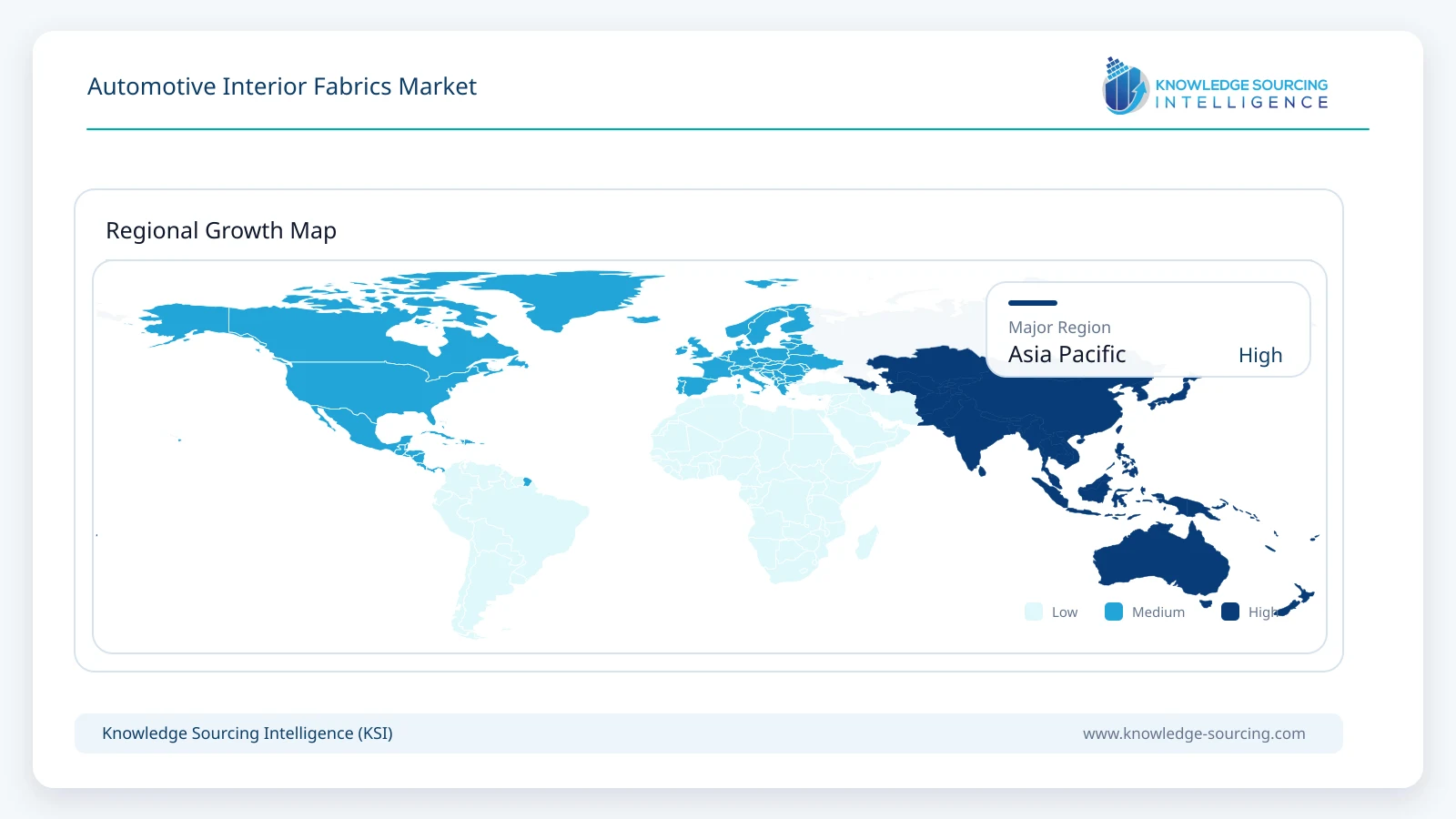
Asia Pacific represents approximately 47% of global automotive interior fabric value in 2026 and is projected to remain the largest regional market through 2031. China accounts for the largest regional production and material demand base, while Japan and South Korea maintain established textile and interior-component technology networks. India and Southeast Asia add capacity and growth as vehicle manufacturing expands and localized textile supply becomes more important for international vehicle programs.
SUMINOE operates fabric and carpet manufacturing sites across several Asian vehicle production markets, while Seiren and Toyota Boshoku support specialist interior material development in Japan. The region’s growth prospects are strongest for qualified recycled polyester, cost-effective nonwovens and seat fabrics designed for fast-changing vehicle platforms.
Europe
European automotive fabric demand reflects established premium vehicle production, technical textile suppliers and increasingly detailed material traceability requirements. AUNDE, Freudenberg Performance Materials and Autoneum are prominent participants in seat fabrics, nonwoven interior facings and acoustic material construction. OEM programs are placing greater emphasis on recycled feedstock and end-of-life design, although European vehicle production performance has been more subdued than in Asia in recent years.
Regulation (EU) 2026/1738 strengthens the direction of vehicle material circularity and recycled-content documentation over staged implementation periods. The regulation should not be described as an immediate textile-specific recycled-content mandate, but European suppliers face growing pressure to offer qualified, traceable and recoverable cabin fabric constructions.
Competitive Landscape
The automotive interior fabrics market combines integrated textile producers, specialist mills, nonwoven material manufacturers and vehicle-interior suppliers with in-house textile technologies. AUNDE, Sage Automotive Interiors, Seiren and SUMINOE emphasize designed upholstery surfaces, while Freudenberg Performance Materials and Autoneum concentrate on nonwoven carpet, headliner and acoustic applications. Lear’s Guilford textile platform links material development with seating integration, creating a different competitive position from independent fabric producers.
Competition centers on OEM approval history, global color consistency, textile process capability, emission performance and manufacturing proximity. Recycled-polyester offerings are becoming more common, making traceable feedstock and scalable production more meaningful differentiators than recycled content claims alone. Specialist suppliers continue to compete in high-value niches such as technical spacer structures, advanced surface patterns and multi-functional upholstery.
Recent Developments
May 2026: Toyota Boshoku presented its PET circular-economy development at Automotive Engineering Exposition 2026, describing mono-material interior construction and reuse of recycled polyester fibers. The work remains a material-development direction rather than proof of industry-wide commercial adoption.
May 2026: Seiren’s FY2025 investor presentation identified next-generation vehicle seat-covering materials among automotive interior growth priorities. The disclosure indicates continued product investment rather than a separately quantified new fabric order.
February 2026: Freudenberg Performance Materials outlined Filc seating nonwovens, Finsol acoustic textiles and recyclable luggage-area lining materials for Techtextil 2026. The portfolio reinforces demand for specialized nonwoven interiors rather than only decorative upholstery.
October 2025: AUNDE and PreZero announced a strategic agreement to develop polyester-textile recycling capacity for high-quality recycled granules. The initiative addresses feedstock circularity but should not be equated with confirmed plant output.
July 2025: Autoneum introduced Flexi-Light PET, a polyester-felt insulation product using up to 90% recycled PET for carpets and inner-dash applications. The product supports lighter acoustic textile constructions and recyclable material systems.
February 2025: Lear announced ComfortMax integration with selected General Motors vehicle seating programs, bringing thermal comfort technologies into seat trim covers. The development expands the functional requirements of upholstery surfaces.
Market Outlook
Automotive interior fabric demand is expected to increase as vehicle manufacturers specify more durable, lightweight and recyclable cabin textiles. Polyester should remain the principal fiber platform, with woven upholstery retaining important design-led positions and nonwoven carpet and acoustic materials recording faster penetration in selected uses. Seat-covering fabrics will continue to provide the largest application revenue pool, supported by higher content in surface finishing, ventilation and premium fabric design.
Asia Pacific is expected to maintain the largest regional market, while European suppliers remain important in textile recycling, acoustic nonwovens and advanced surface technologies. The pace of forecast expansion will depend on the commercial viability of recycled-fiber supply, production consistency, OEM approvals and adoption of more recoverable backing systems. Supplier competitiveness is likely to depend increasingly on verified performance and local manufacturing capability rather than textile price alone.
Automotive Interior Fabrics Market Scope:
| Report Metric | Details |
|---|---|
| Total Market Size in 2026 | USD 8.20 billion |
| Total Market Size in 2031 | USD 11.4 billion |
| Forecast Unit | USD Billion |
| Growth Rate | 6.81% |
| Study Period | 2021 to 2031 |
| Historical Data | 2021 to 2024 |
| Base Year | 2025 |
| Forecast Period | 2026 – 2031 |
| Segmentation | Fabric Construction, Primary Fiber Material, Application, Vehicle Type |
| Companies |
|
Market Segmentation
By Fabric Construction
Woven Fabrics
Knitted Fabrics
Nonwoven Fabrics
By Primary Fiber Material
Polyester (Virgin and Recycled)
Polypropylene
Polyamide (Nylon)
Natural Fibers
Other Fibers and Classified Blends
By Application
Seating and Upholstery Fabrics
Floor Carpets and Mat Fabrics
Headliner and Roof-Facing Fabrics
Door, Pillar and Side-Trim Fabrics
Interior Acoustic and Cargo-Lining Fabrics
By Vehicle Type
Passenger Vehicles
Light Commercial Vehicles
Medium and Heavy Commercial Vehicles and Buses
By Geography
North America
United States
Canada
Mexico
South America
Brazil
Argentina
Others
Europe
Germany
France
United Kingdom
Spain
Others
Middle East and Africa
Saudi Arabia
UAE
Israel
Others
Asia Pacific
China
India
Japan
South Korea
Indonesia
Thailand
Taiwan
Others
Table of Contents
1. EXECUTIVE SUMMARY
2. MARKET SNAPSHOT
2.1. Market Overview
2.2. Market Definition
2.3. Scope of the Study
2.4. Market Segmentation
3. BUSINESS LANDSCAPE
3.1. Market Drivers
3.1.1. Higher Material Specification in Vehicle Cabins
3.1.2. Expansion of Recycled-Polyester Programs
3.1.3. Lightweight Cabin and Acoustic Design
3.1.4. Functional Seating Surfaces
3.1.5. Localized Automotive Textile Supply Networks
3.2. Market Restraints
3.2.1. Raw-Fiber Quality and Recycled Feedstock Consistency
3.2.2. Flammability, Odor and Emissions Qualification
3.2.3. Adhesive and Backing Complexity
3.2.4. Price Competition and Supplier Switching Costs
3.2.5. Alternative Surface Materials
3.3. Market Opportunities
3.4. Porter’s Five Forces Analysis
3.5. Industry Value Chain Analysis
3.6. Policies and Regulations
3.7. Strategic Recommendations
4. TECHNOLOGICAL OUTLOOK
4.1. Woven Fabric Design and Engineered Yarns
4.2. Knitted and 3D Spacer Textile Technologies
4.3. Needlepunched and Spunbond Nonwovens
4.4. Recycled Polyester and Mono-Material Construction
4.5. Low-Emission Finishing and Surface Printing
4.6. Functional Thermal and Acoustic Textile Systems
5. AUTOMOTIVE INTERIOR FABRICS MARKET BY FABRIC CONSTRUCTION
5.1. Introduction
5.2. Woven Fabrics
5.3. Knitted Fabrics
5.4. Nonwoven Fabrics
6. AUTOMOTIVE INTERIOR FABRICS MARKET BY PRIMARY FIBER MATERIAL
6.1. Introduction
6.2. Polyester (Virgin and Recycled)
6.3. Polypropylene
6.4. Polyamide (Nylon)
6.5. Natural Fibers
6.6. Other Fibers and Classified Blends
7. AUTOMOTIVE INTERIOR FABRICS MARKET BY APPLICATION
7.1. Introduction
7.2. Seating and Upholstery Fabrics
7.3. Floor Carpets and Mat Fabrics
7.4. Headliner and Roof-Facing Fabrics
7.5. Door, Pillar and Side-Trim Fabrics
7.6. Interior Acoustic and Cargo-Lining Fabrics
8. AUTOMOTIVE INTERIOR FABRICS MARKET BY VEHICLE TYPE
8.1. Introduction
8.2. Passenger Vehicles
8.3. Light Commercial Vehicles
8.4. Medium and Heavy Commercial Vehicles and Buses
9. AUTOMOTIVE INTERIOR FABRICS MARKET BY GEOGRAPHY
9.1. Introduction
9.2. North America
9.2.1. United States
9.2.2. Canada
9.2.3. Mexico
9.3. South America
9.3.1. Brazil
9.3.2. Argentina
9.3.3. Others
9.4. Europe
9.4.1. Germany
9.4.2. France
9.4.3. United Kingdom
9.4.4. Spain
9.4.5. Others
9.5. Middle East and Africa
9.5.1. Saudi Arabia
9.5.2. UAE
9.5.3. Israel
9.5.4. Others
9.6. Asia Pacific
9.6.1. China
9.6.2. India
9.6.3. Japan
9.6.4. South Korea
9.6.5. Indonesia
9.6.6. Thailand
9.6.7. Taiwan
9.6.8. Others
10. COMPETITIVE ENVIRONMENT AND ANALYSIS
10.1. Major Players and Strategy Analysis
10.2. Market Share Analysis
10.3. Mergers, Acquisitions, Agreements and Collaborations
10.4. Competitive Dashboard
11. COMPANY PROFILES
11.1. AUNDE Group SE
11.2. Lear Corporation
11.3. Asahi Kasei Corporation (Sage Automotive Interiors)
11.4. Seiren Co., Ltd.
11.5. SUMINOE Co., Ltd.
11.6. Freudenberg Performance Materials
11.7. Autoneum Holding AG
11.8. Toyota Boshoku Corporation
11.9. Heathcoat Fabrics Limited
11.10. Hayashi Telempu Corporation
12. APPENDIX
12.1. Currency
12.2. Assumptions
12.3. Base and Forecast Years Timeline
12.4. Key Benefits for Stakeholders
12.5. Research Methodology
12.6. Abbreviations
Navigate
Trusted by the world's leading organizations











