
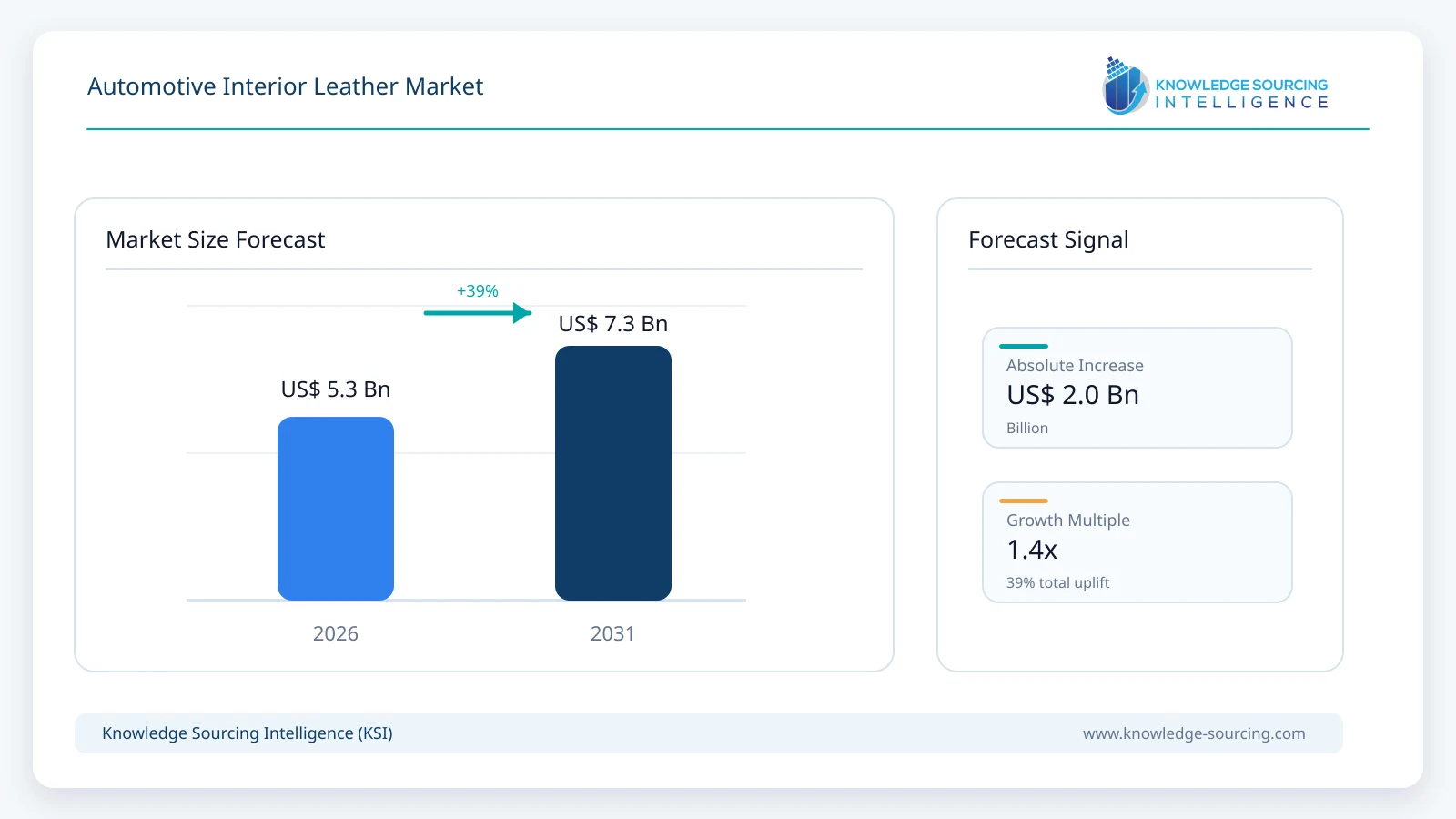
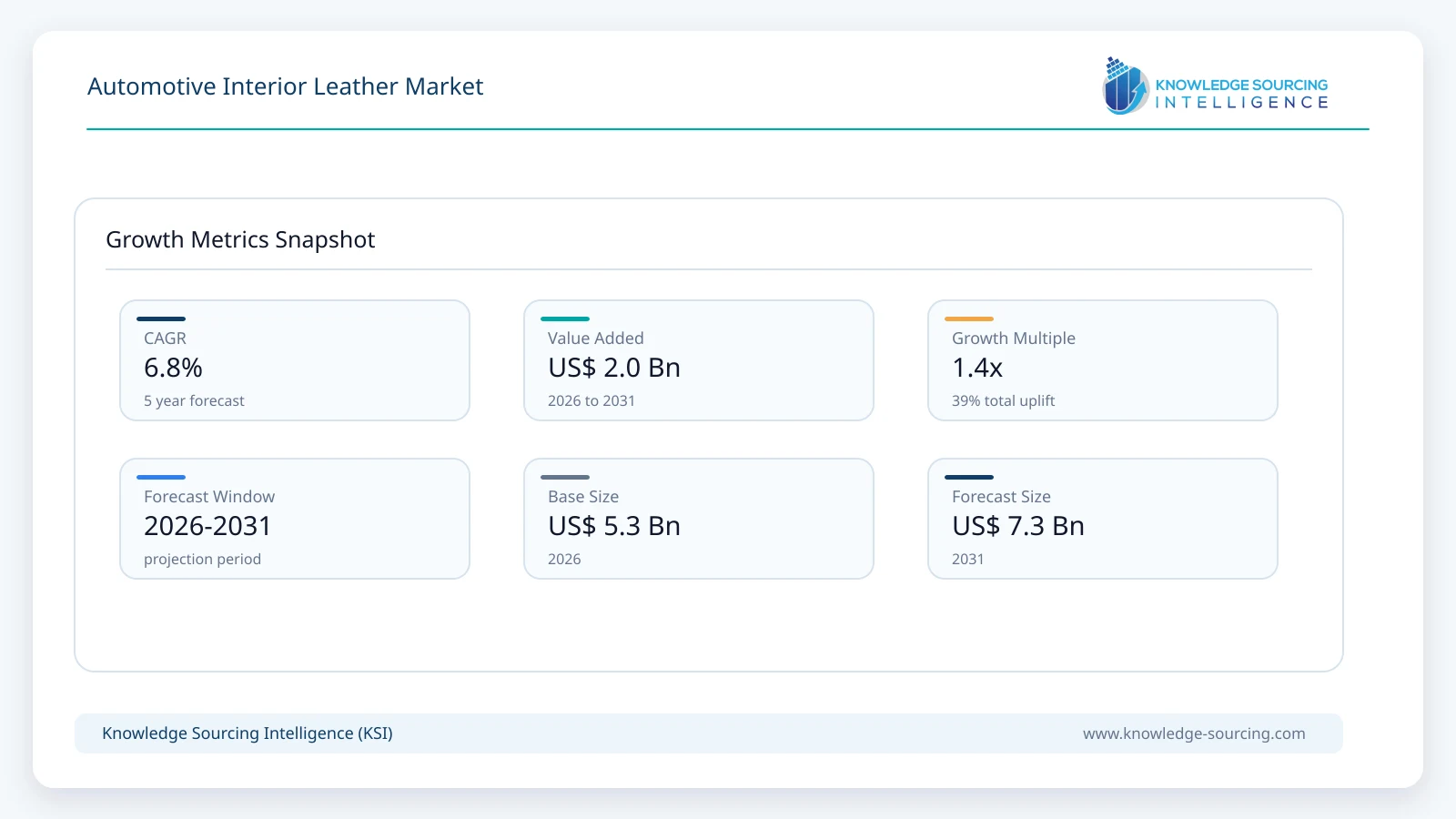
The Automotive Interior Leather Market is expected to grow at a CAGR of 6.76%, rising from USD 5.30 billion in 2026 to USD 7.35 billion in 2031.
Highlights:
- 1Genuine automotive leather represents an estimated 39% of 2026 market value, supported by premium seating and steering-wheel applications.
- 2Polyurethane synthetic leather accounts for approximately 34% in 2026 and is modeled to gain share through 2031 as interior packages combine soft touch with standardized production.
- 3Seat upholstery provides about 68% of 2026 demand because seating has the largest continuous exposed surface area and intensive finishing requirements.
- 4OEM supply accounts for approximately 91% of 2026 market value, reflecting material qualification and integration into production programs.
- 5Asia Pacific contributes roughly 42% of 2026 demand and is expected to gain share through vehicle production, premiumization and synthetic-leather capacity.
- 6Chrome-free tanning, recycled-content coated textiles and low-emission polyurethane systems are developing alongside established genuine leather specifications.
Automotive-grade genuine leather, polyurethane synthetic leather, PVC synthetic leather and selected new coated alternatives are supplied as finished hides, rolls or prepared surface coverings. The market captures leather-material value and relevant surface conversion at the qualified supply stage, rather than the full value of seats, cockpit modules or complete leather-trimmed interior assemblies.
Premium leather remains commercially important because leather grain, surface feel, perforation and finishing can differentiate seating and interior packages without changing the underlying seat structure. BADER manufactures automotive leather and trim covers across an international network, while Lear combines Eagle Ottawa leather capabilities with seat engineering and surface integration. Alternative surface materials compete on consistent appearance, cost, cleanability, and low-emission performance, broadening the range of vehicles that use leather-look upholstery.
Market Overview
Genuine automotive leather is used where tactile quality, natural grain and long-term surface appearance are important to a vehicle’s interior positioning. Finished hides undergo selection, tanning, coloring, grain treatment and coating to deliver repeatable mechanical and aesthetic properties across production batches. Steering-wheel leather requires exceptional grip and surface stability, while perforated seat leather must retain strength around openings and resist repeated occupant abrasion. Dedicated material suppliers therefore work closely with seat manufacturers on thickness, color matching, and cutting yield.
BADER reports global production of 12,900 leather hides and 21,500 trim covers per day in 2024, demonstrating the industrial scale of automotive leather conversion. Wollsdorf supplies material for steering wheels, seats, door trims and instrument panels, with specific finishes for heat exposure, soiling resistance and tactile performance. Lear’s Eagle Ottawa capability adds automotive leather material development within an integrated seating supply business.
Synthetic-leather platforms extend leather-look surfaces into vehicle classes where genuine-hide costs and hide-to-hide variations are more difficult to absorb. Seiren supplies automotive synthetic leather with different grain, grip, and surface characteristics, while Mayur Uniquoters produces PVC and PU-coated materials for original equipment and aftermarket interiors. FORVIA markets Ecorium as a premium leather alternative containing recycled and bio-derived inputs.
Market Trends
Premium Interiors Retain Genuine Leather While Expanding Material Choice
BADER’s collaboration on Lucid Gravity includes chrome-free premium leather for seats, headrests, armrests, and instrument-panel coverings. Such programs show that genuine leather can expand beyond traditional seat inserts when premium models emphasize consistent interior materials. Premium material demand is consequently more sensitive to automaker package choices than to total vehicle production alone.
Coated Leather Alternatives Move Toward Lower-Impact Production
Synthetic-leather production is changing through solvent reduction, improved polyurethane processing and greater recycled or bio-derived content in backing and coatings. BASF presents Haptex polyurethane technology for synthetic automotive leather, including an application demonstrated on a car seat at PU TECH 2025. FORVIA’s Ecorium combines recycled polyethylene terephthalate and hemp-based inputs for a leather alternative available on selected Renault 5 E-Tech variants. These examples indicate additional design options rather than uniform conversion of all vehicle seating to bio-based materials.
Surface Performance Is Becoming a More Important Purchasing Criterion
Automotive leather suppliers increasingly differentiate through cut quality, perforation, anti-soiling finishes, heat response and repeatability across large production runs. Wollsdorf offers lightweight automotive leather and dedicated finishes for seats, steering wheels and instrument panels, demonstrating application-specific development within natural leather. Seat-heating and ventilation functions place further emphasis on leather perforation, surface flexibility and integration with underlying textiles. Surface engineering can therefore improve the functional value of leather coverings without requiring a proportionate increase in material area.
Segment Analysis
By Material Type: Genuine Automotive Leather
Genuine automotive leather accounts for approximately 39% of the estimated 2026 market despite representing a smaller share of vehicles fitted with leather-like upholstery. The value position reflects finished-hide pricing, loss during cutting and premium specifications for color, texture, and visible grain. BADER, BOXMARK, Scottish Leather Group and Wollsdorf manufacture leather for premium cabin applications, while Lear integrates genuine leather into qualified seating programs. Premium vehicle production and expanded leather coverage support revenue, although synthetic surfaces take a growing share of leather-like interior area.
The genuine-leather share is expected to decline toward 34% by 2031 as synthetic platforms grow across mid-market vehicles. Genuine leather remains important in luxury seating, steering wheels, and decorative trim where appearance and craftsmanship command a premium. Improved finishing processes and responsibly sourced, traceable hides help sustain qualification in programs with stricter supply-chain requirements. Growth is therefore concentrated in differentiated surface programs rather than broad market penetration across entry-level vehicles.
By Material Type: Polyurethane Synthetic Leather
Polyurethane synthetic leather is projected to increase its market share from approximately 34% in 2026 to 40% by 2031. PU materials offer a broad combination of soft touch, consistent grain, flexible design, and scalable coating methods, supporting use in seat inserts, bolsters, and other touched surfaces. Mayur Uniquoters and Seiren provide production capabilities for automotive-grade synthetic leather, while BASF supplies enabling polyurethane chemistry through Haptex. Expanded use depends on abrasion performance, hydrolysis resistance, emissions performance, and the cost of qualified production processes.
By Application: Seat Upholstery
Seat upholstery accounts for approximately 68% of market value in 2026 because the seat surface carries both the largest material area and the most demanding daily contact requirements. Genuine and synthetic coverings are selected according to trim level, comfort functions, ventilation design, wear resistance and cabin appearance. The value of finished leather rises when vehicle platforms use additional perforations, customized grains or multiple coordinated surfaces, although those features do not necessarily imply proportionate gains in square meters consumed.
Seat design changes also affect material suppliers because heating, ventilation and comfort features must be compatible with the upholstery surface. Lear’s integration of thermal-comfort functionality into seat trim illustrates the growing coordination between covering suppliers and seating-system engineers. Durable, conformable leather surfaces remain important for high-frequency flexing around cushions and bolsters.
By Sales Channel: OEM
OEM deliveries account for an estimated 91% of market value in 2026, reflecting long vehicle-program lifecycles and strict material approval requirements. Production contracts involve color approval, repeated performance testing, supply localization and continuity over several model years. Automotive leather suppliers consequently invest in nearby conversion and cutting operations rather than relying exclusively on centrally exported finished hides or rolls. The aftermarket remains smaller but provides demand for seat-cover replacement and interior personalization.
By Vehicle Type: Passenger Vehicles
Passenger vehicles generate approximately 90% of market demand in 2026 because personal vehicles combine the largest production base with optional premium seating and decorative interiors. Sedans, sport-utility vehicles and luxury models account for different material quantities, with sport-utility vehicles often accommodating larger seat and trim surfaces. Commercial vehicles continue using easy-clean synthetic surfaces and selected premium coverings in driver-oriented cabins, but the material intensity and trim mix differ materially from passenger cars.
Market Drivers
Greater Penetration of Premium Interior Packages
Automakers continue to use seat coverings, dashboard finishes and coordinated door surfaces to distinguish interior packages within the same model range. Premium leather packages generate more material demand per vehicle when genuine leather extends from seat cushions to door armrests, steering wheels and instrument-panel panels. BADER’s work on the Lucid Gravity demonstrates how one premium program can incorporate several qualified leather surface locations. The market benefits from higher-value cabin configurations even when vehicle production growth remains moderate.
Wider Automotive Adoption of PU Synthetic Leather
Polyurethane synthetic leather allows manufacturers to specify uniform color, grain and touch across high-volume programs without the hide variation and cutting waste associated with natural leather. Seiren’s automotive synthetic materials and Mayur Uniquoters’ PU expansion demonstrate established and developing capacity for these applications. Technical improvements in abrasion, flexibility and surface finishing enable leather-like materials to compete in more exposed cabin locations. PU adoption is expected to account for a disproportionate share of incremental market revenue through 2031.
Vehicle Production and Regional Assembly Localization
OICA reports that global vehicle production rose to 96.4 million units in 2025, with Asia accounting for a large portion of industrial expansion. Automotive leather suppliers must align conversion capacity with assembly regions because interiors require closely controlled colors, on-time delivery and recurring engineering changes. BADER operates a multinational production network, while Mayur maintains material conversion capacity and overseas customer supply infrastructure.
Functional Upholstery and Higher Surface Specifications
Leather coverings increasingly need to accommodate advanced seating features while meeting established durability, safety and cabin-emission specifications. Perforated natural leather, coated synthetic surfaces and temperature-management finishes expand the engineering work required before a material receives OEM approval. Wollsdorf markets application-specific leather for steering wheels and seats, while Lear integrates surface and thermal features at seat-system level. Greater engineering content can support material differentiation and higher realized value without materially changing basic upholstery area.
Demand for Traceable and Lower-Impact Materials
Vehicle manufacturers are requesting clearer information about leather sourcing, finishing chemistry, and lifecycle impact. Polestar identifies traceable chrome-free Bridge of Weir Nappa leather as a selectable premium upholstery option, while FORVIA offers Ecorium as an alternative with recycled and renewable inputs. Natural-leather producers also face increasing expectations for tannery management, animal-welfare assurance and waste handling. These requirements reward suppliers able to document material origin and qualify alternative chemistries at automotive scale.
Market Restraints
Material Premiums and Hide-Yield Variability
Genuine leather has a substantially different conversion cost structure from standardized coated polymers because hide grading, defects, irregular geometry and cutting yield affect usable area. Automakers frequently reserve genuine leather for premium options rather than specifying a full-leather cabin across high-volume trims. Even premium programs can reduce material usage by combining leather contact zones with synthetic side panels.
Competition from High-Performance Textile Upholstery
Woven, knitted and engineered microfiber fabrics provide alternative seat coverings with different thermal comfort, mass and cost characteristics. Recycled-polyester textiles also compete for interior programs with specific sustainability or recyclability objectives. Genuine leather and synthetic leather therefore face substitution from technical fabrics rather than competing only with each other.
Emissions, Flammability and Long Approval Cycles
Automotive interior surfaces require qualification for wear resistance, cabin odor, fogging, sunlight exposure and applicable flammability rules. The U.S. FMVSS 302 framework explicitly covers specified occupant-compartment materials, including seat and trim components. Changes to coating chemistry or recycled backing materials can trigger repeated testing and customer validation.
Chemical-Processing and Traceability Requirements
Leather finishing and synthetic polymer coating processes face separate chemical-control concerns. Genuine leather suppliers must manage tanning chemistry and source information, while synthetic producers face coating, plasticizer and solvent requirements that vary by formulation. European restrictions on chromium VI in qualifying leather articles illustrate the need for robust chemical controls, although not every automotive upholstery application has identical direct-skin-contact exposure. Additional supplier documentation and laboratory testing increase compliance expenditure.
Capacity Investment and Program Concentration
Automotive leather and coated-fabric suppliers often invest in specialized production lines and product validation before receiving full vehicle-program volumes. Changes in an OEM platform, trim take rate or customer specification can therefore leave production assets underutilized. Regional delivery requirements also limit flexibility when converting material across plants with different coating equipment. Suppliers with diversified genuine, PU and PVC capabilities are better positioned to manage these demand shifts.
Regional Outlook
Asia Pacific
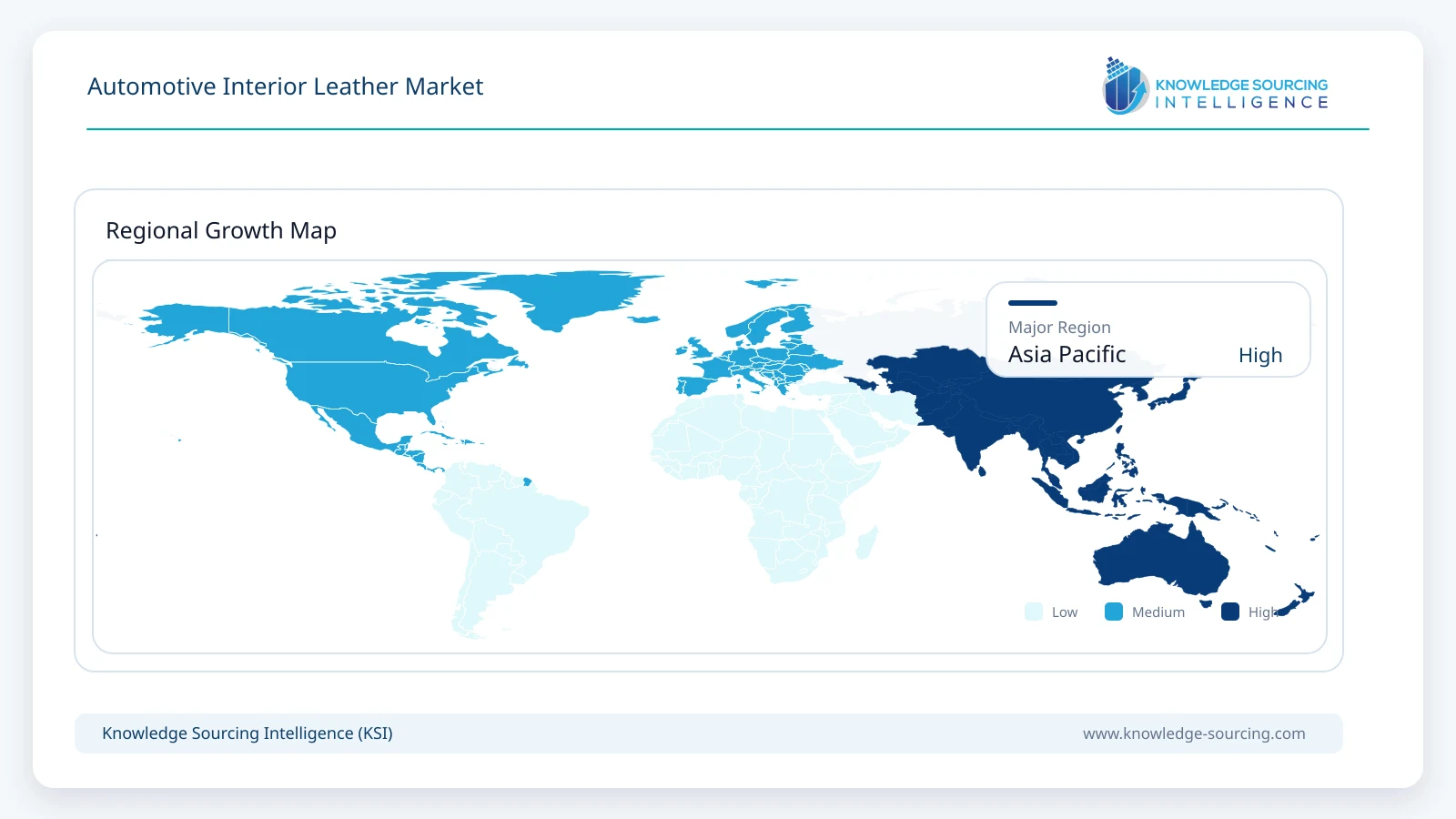
Asia Pacific represents approximately 42% of global market value in 2026, supported by vehicle assembly in China, Japan, India and South Korea and extensive synthetic-leather manufacturing infrastructure. The regional market is projected to approach USD 3.38 billion in 2031 as PU-coated materials gain share in vehicle interior packages. China is the largest national demand center, while India supplies an important base of PVC and developing PU coating capacity. Seiren and Mayur Uniquoters demonstrate different parts of the regional supply system, combining specialized automotive finishes with scaled material manufacturing.
Asian demand growth is not uniform across material types. Premium leather retains a position in upper-end vehicles, but synthetic surface coverage is generally more scalable across a wider price spectrum. Vehicle makers increasingly require low-odor materials, consistent finish and localized conversion to serve high-volume production programs. Strong competition on pricing makes yield improvement and production quality central to supplier performance.
Europe
Europe accounts for an estimated 26% of global market value in 2026, reflecting premium vehicle production, established leather-processing technology and demanding OEM material standards. Germany, Italy, the United Kingdom and neighboring supply hubs support a mix of premium leather and automotive trim conversion. BADER, BOXMARK, Scottish Leather Group and Wollsdorf participate through genuine leather engineering, finishing and customer-specific programs. Europe is projected to remain a leading region for premium material development even as Asia Pacific increases its share of global volume.
European specifications increasingly emphasize traceability, chemical management, durability and recoverability of automotive interior materials. Premium leather maintains established OEM relationships, while coated alternatives provide routes to lower-impact and more standardized surfaces. Regulations affecting vehicle end-of-life treatment can raise attention to material recovery and component information, but should not be interpreted as direct requirements to substitute animal leather with synthetic upholstery. Material performance and vehicle-program economics will continue to determine uptake.
Competitive Landscape
Automotive interior leather supply combines global leather tanneries, specialist coated-fabric producers and vehicle seating integrators. BADER, BOXMARK, Wollsdorf and Scottish Leather Group concentrate on genuine automotive leather and finishing, while Mayur Uniquoters and Seiren develop synthetic leather materials. Lear and FORVIA combine interior materials with component integration, allowing closer alignment between material specification and seat or cabin design. Product capabilities and OEM relationships are more meaningful differentiators than nominal company scale alone.
The competitive position of each supplier depends on automotive approvals, material consistency, traceability, cutting efficiency and the ability to support global platform launches. Natural leather manufacturers compete through texture, finish, premium credentials and process controls, whereas synthetic-leather producers place greater emphasis on consistent coating economics and technical performance.
Recent Developments
May 2026: BADER described leather coverage and international production coordination for the 2027 Volkswagen Atlas interior. The program illustrates how premium leather material specification spans several regions and requires integrated trim development.
May 2026: BADER marked production of 100,000 CUPRA Terramar vehicles with BADER seat-cover craftsmanship. The milestone provides direct evidence of production-scale leather-trim program participation.
January 2026: BADER confirmed chrome-free leather supplied for the Lucid Gravity SUV, including seating, armrests and instrument-panel applications. The program demonstrates wider premium leather content within electric-vehicle interiors.
September 2025: BADER presented CIRCUTEX as an engineered coated textile alternative for automotive cabin coverings. Its recycled-content material system broadens the supplier’s offering beyond animal-hide leather; sales volumes have not been disclosed.
April 2025: BADER disclosed Nappa leather seat-cover supply for the Audi A6 and S6 e-tron, reporting coverage of approximately 90% of the relevant seat covers. The production program illustrates continued premium-leather adoption on battery-electric vehicles.
April 2025: BASF demonstrated an automotive seat application using Haptex synthetic-leather polyurethane technology at PU TECH 2025. The presentation advances lower-impact synthetic finishing but does not establish adoption across all vehicle platforms.
Market Outlook
Asia Pacific is expected to record the largest incremental revenue contribution through 2031 as automotive production and leather-like interior coverage expand. European suppliers are likely to preserve a strong position in premium genuine leather, high-quality finishes and traceability-led products. Continued material development will be shaped by emissions performance, coating economics, supply reliability and the balance between natural and synthetic surfaces in future vehicle programs. Pricing and penetration remain sensitive to OEM trim strategy, making supplier-specific production evidence an important guide to future market performance.
Automotive Interior Leather Market Scope:
| Report Metric | Details |
|---|---|
| Total Market Size in 2026 | USD 5.30 billion |
| Total Market Size in 2031 | USD 7.35 billion |
| Forecast Unit | USD Billion |
| Growth Rate | 6.76%, |
| Study Period | 2021 to 2031 |
| Historical Data | 2021 to 2024 |
| Base Year | 2025 |
| Forecast Period | 2026 – 2031 |
| Segmentation | Material Type, Application, Sales Channel, Vehicle Type |
| Companies |
|
Market Segmentation
By Material Type
Genuine Automotive Leather
Polyurethane (PU) Synthetic Leather
Polyvinyl Chloride (PVC) Synthetic Leather
Other Advanced Leather Alternatives
By Application
Seat Upholstery
Steering-Wheel and Control Coverings
Door and Pillar Trim Surfaces
Instrument Panels and Consoles
Other Cabin Coverings
By Sales Channel
OEM
Aftermarket
By Vehicle Type
Passenger Vehicles
Light Commercial Vehicles
Medium/Heavy Commercial Vehicles and Buses
By Geography
By North America
United States
Canada
Mexico
By South America
Brazil
Argentina
Others
By Europe
Germany
Italy
United Kingdom
France
Spain
Others
By Middle East and Africa
Saudi Arabia
UAE
South Africa
Others
By Asia Pacific
China
India
Japan
South Korea
Thailand
Indonesia
Others
Table of Contents
1. EXECUTIVE SUMMARY
2. MARKET SNAPSHOT
2.1. Market Overview
2.2. Market Definition
2.3. Scope of the Study
2.4. Market Segmentation
3. BUSINESS LANDSCAPE
3.1. Market Drivers
3.1.1. Greater Penetration of Premium Interior Packages
3.1.2. Wider Adoption of PU Synthetic Leather
3.1.3. Vehicle Production and Regional Localization
3.1.4. Functional Upholstery and Higher Surface Specifications
3.1.5. Demand for Traceable and Lower-Impact Materials
3.2. Market Restraints
3.2.1. Material Premiums and Hide-Yield Variability
3.2.2. Competition from High-Performance Textile Upholstery
3.2.3. Emissions, Flammability and Long Approval Cycles
3.2.4. Chemical Processing and Traceability Requirements
3.2.5. Capacity Investment and Program Concentration
3.3. Market Opportunities
3.4. Porter’s Five Forces Analysis
3.5. Industry Value Chain Analysis
3.6. Policies and Regulations
3.7. Strategic Recommendations
4. TECHNOLOGICAL OUTLOOK
4.1. Chrome-Free and Advanced Leather Finishing
4.2. Polyurethane Synthetic Leather Production
4.3. PVC Coated Surface Technology
4.4. Recycled and Bio-Attributed Leather Alternatives
4.5. Perforation, Surface Texturing and Anti-Soiling
4.6. Low-Emission and Lightweight Interior Coverings
5. AUTOMOTIVE INTERIOR LEATHER MARKET BY MATERIAL TYPE
5.1. Introduction
5.2. Genuine Automotive Leather
5.3. Polyurethane (PU) Synthetic Leather
5.4. Polyvinyl Chloride (PVC) Synthetic Leather
5.5. Other Advanced Leather Alternatives
6. AUTOMOTIVE INTERIOR LEATHER MARKET BY APPLICATION
6.1. Introduction
6.2. Seat Upholstery
6.3. Steering-Wheel and Control Coverings
6.4. Door and Pillar Trim Surfaces
6.5. Instrument Panels and Consoles
6.6. Other Cabin Coverings
7. AUTOMOTIVE INTERIOR LEATHER MARKET BY SALES CHANNEL
7.1. Introduction
7.2. OEM
7.3. Aftermarket
8. AUTOMOTIVE INTERIOR LEATHER MARKET BY VEHICLE TYPE
8.1. Introduction
8.2. Passenger Vehicles
8.3. Light Commercial Vehicles
8.4. Medium/Heavy Commercial Vehicles and Buses
9. AUTOMOTIVE INTERIOR LEATHER MARKET BY GEOGRAPHY
9.1. Introduction
9.2. North America
9.2.1. By Material Type
9.2.2. By Application
9.2.3. By Sales Channel
9.2.4. By Vehicle Type
9.2.5. By Country
9.2.5.1. United States
9.2.5.2. Canada
9.2.5.3. Mexico
9.3. South America
9.3.1. By Material Type
9.3.2. By Application
9.3.3. By Sales Channel
9.3.4. By Vehicle Type
9.3.5. By Country
9.3.5.1. Brazil
9.3.5.2. Argentina
9.3.5.3. Others
9.4. Europe
9.4.1. By Material Type
9.4.2. By Application
9.4.3. By Sales Channel
9.4.4. By Vehicle Type
9.4.5. By Country
9.4.5.1. Germany
9.4.5.2. Italy
9.4.5.3. United Kingdom
9.4.5.4. France
9.4.5.5. Spain
9.4.5.6. Others
9.5. Middle East and Africa
9.5.1. By Material Type
9.5.2. By Application
9.5.3. By Sales Channel
9.5.4. By Vehicle Type
9.5.5. By Country
9.5.5.1. Saudi Arabia
9.5.5.2. UAE
9.5.5.3. South Africa
9.5.5.4. Others
9.6. Asia Pacific
9.6.1. By Material Type
9.6.2. By Application
9.6.3. By Sales Channel
9.6.4. By Vehicle Type
9.6.5. By Country
9.6.5.1. China
9.6.5.2. India
9.6.5.3. Japan
9.6.5.4. South Korea
9.6.5.5. Thailand
9.6.5.6. Indonesia
9.6.5.7. Others
10. COMPETITIVE ENVIRONMENT AND ANALYSIS
10.1. Major Players and Strategy Analysis
10.2. Market Share Analysis
10.3. Mergers, Acquisitions, Agreements and Collaborations
10.4. Competitive Dashboard
11. COMPANY PROFILES
11.1. BADER GmbH & Co. KG
11.2. Lear Corporation
11.3. BOXMARK Leather GmbH & Co KG
11.4. Scottish Leather Group Limited
11.5. Wollsdorf International GmbH
11.6. FORVIA SE
11.7. Mayur Uniquoters Limited
11.8. Seiren Co., Ltd.
11.9. Continental AG
11.10. Katzkin Leather, Inc.
11.11. Toyota Boshoku Corporation
12. APPENDIX
12.1. Currency
12.2. Assumptions
12.3. Base and Forecast Years Timeline
12.4. Key Benefits for Stakeholders
12.5. Research Methodology
12.6. Abbreviations
Navigate
Trusted by the world's leading organizations











